Let’s face it, AR-platform rifles run dirty, at least compared to typical bolt-action rifles. The AR15 works by piping gas from the barrel back into the bolt carrier, causing the bolt to unlock and the carrier to move the bolt backward. The “exhaust gas” from the barrel contains soot and carbon. The carbon will form hard deposits on the bolt. In addition, the carbon can combine with lube on the bolt carrier to make a nasty, paste-like sludge. This can be particularly problematic when the black paste pollutes the ejector and extractor recess.
This Editor has inspected dozens of ARs over the years. Other than mag-related malfunctions, the most common cause of AR cycling problems I found was oily gunk in the extractor and ejector areas. Many AR owners overlook these critical areas. Look at an AR that hasn’t been cleaned properly and you’ll probably find black gunk (and small brass shavings) in the ejector and extractor recesses.
If you want to keep your black rifle running smoothly and reliably, you must clean it regularly and follow the correct maintenance procedures. Here are three videos that explain how to properly disassemble and clean AR-platform rifles.
Take-Down and Full Cleaning of AR15 by Jerry Miculek
Here ace shooter Jerry Miculek takes down and cleans an AR-platform rifle belonging to his daughter Lena. This is a good video because Lena’s rifle was “run hard and packed up dirty” so you can see where carbon and grease build up. This 35-minute video is very thorough. Jerry is one of the nation’s top action carbine shooters, so listen carefully to his advice on cleaning and lubrication.
How to Clean Your AR-Platform Rifle
This is a good basic video that shows the take-down and cleaning procedure for a typical AR15. It uses some fast-motion sequences to speed up the story. Check out this video if you don’t have the time to sit through the Miculek video above.
Cleaning and Lubricating AR15 Bolt Carrier Group
This video offers very specific advice on the bolt carrier group, which receives the dirty gas directly from the barrel. Be sure to check the extractor and ejector recesses. That’s where old lube, brass shavings, and carbon accumulate. Follow the directions in this video for lubrication, and don’t over-lubricate the bolt carrier — that will only capture more carbon.
There’s a nice article in the Western Powders Blog that any varminter will enjoy. In this hare-raising tale, gunwriter Jim Waddell explains how he used a self-loading Savage A17 rifle to take care of a serious jack-rabbit problem on a rancho in California. “[My friends] purchased a huge amount of acreage that had some existing alfalfa fields and [surrounding sagebrush]. Sagebrush is home to jack rabbits. Lots of jack rabbits. The previous owner of this property didn’t do any varmint or predator control[.] The ink wasn’t dry on the escrow papers before [my friends] started asking for help shooting rabbits. A problem in taking these critters is it has to be done at night when they come out to feed as they lay low in the bush during the daylight hours.”
Savage A17 Comes to the Rescue
Initially Waddell and some friends took on the jack-rabbit hordes using Ruger 10/22s and a .44 Magnum Marlin lever gun. Neither option was ideal. The .44 Magnum just couldn’t keep up the desired shooting pace (it took too long to reload) ant the .22 LRs were too anemic. So Waddell decided to give the more potent 17 HMR a try. He acquired a Savage A17 and went back for a second bunny-busting session. He came away convinced that the 17 HMR cartridge in the modern semi-auto Savage works great for small varmint control.
Waddell writes: “I wanted more than a .22 after seeing the problems my pals had with their [10/22] bullets not anchoring the rabbits. Armed with my new Savage A17 it was time to head back to the alfalfa fields. This time my hunting partner was Dan, my son-in-law from Seattle. We hunted for four nights. Each night was either raining, windy or both. My question about whether or not rabbits would be out in the weather was answered immediately. They were everywhere. As miserable as the weather was, we got all the shooting we wanted and that Savage rifle was up to the task. We got so many rabbits it was impossible to count.” CLICK HERE for the full account of Waddell’s jack-rabbit adventures on the California rancho. It’s worth a read. Here is a sample:
Wabbits, Wabbits Everywhere — Even Running Right at You
I couldn’t believe my eyes when I saw a sea of rabbits as far as the lights would shine and when the light beams hit the bunnies, they became confused and as often as not, would run right at the lights so a good percentage of our shots were literally in spitting distance. It was also a new experience shooting at targets that are running TOWARD you. Most of us who’ve done much hunting for game or varmints have experienced moving targets but how many of those targets are coming at you?
To err is human… Sooner or later you’ll probably get a case stuck in a die. This “fix-it” article, which originally appeared in the Western Powders Blog, explains the procedure for removing a firmly stuck cartridge case using an RCBS kit. This isn’t rocket science, but you do want to follow the directions carefully, step-by-step. Visit the Western Powders Blog for other helpful Tech Tips.
Curing the Stuck Case Blues
Sticking a case in the sizer die is a rite of passage for the beginning handloader. If you haven’t done it yet, that’s great, but it probably will eventually happen. When it does, fixing the problem requires a bit of ingenuity or a nice little kit like the one we got from RCBS.
The first step is to clear the de-capping pin from the flash hole. Just unscrew the de-capping assembly to move it as far as possible from the primer pocket and flash hole (photo at right). Don’t try to pull it all the way out. It won’t come. Just unscrew it and open as much space as possible inside the case.
Place the die upside down in the padded jaws of a vise and clamp it firmly into place. Using the supplied #7 bit, drill through the primer pocket. Be careful not to go too deeply inside the cartridge once the hole has opened up. It is important to be aware that the de-capping pin and expander ball are still in there and can be damaged by the bit.
Drill and Tap the Stuck Case
Once the cartridge head has been drilled, a ¼ – 20 is tap is used to cut threads into the pocket. Brass is relatively soft compared to a hardened tap, so no lube is needed for the tapping process. RCBS says that a drill can be used for this step, but it seems like a bit of overkill in a project of this nature. A wrench (photo above right) makes short work of the project.
RCBS supplies a part they call the “Stuck Case Remover Body” for the next step. If you are a do-it-yourselfer and have the bit and tap, this piece is easily replicated by a length of electrical conduit of the proper diameter and some washers. In either case, this tool provides a standoff for the screw that will do the actual pulling.
With an Allen Wrench, Finish the Job
Run the screw through the standoff and into the tapped case head. With a wrench, tighten the screw which hopefully pulls the case free. Once the case is free, clamp the case in a vice and pull it free of the de-capping pin. There is tension here because the sizing ball is oversized to the neck dimension as part of the sizing process. It doesn’t take much force, but be aware there is still this last little hurdle to clear before you get back to loading. Don’t feel bad, everyone does this. Just use more lube next time!
Article find by EdLongrange. We welcome reader submissions.
Today, AR-platform rifles are hugely popular. Dozens of manufacturers sell AR-type rifles, in a wide variety of configurations and calibers. But before there were M16s and AR-15s, ArmaLite produced a 7.62×51 caliber rifle, the AR-10. Yes before there were millions of 5.56 black rifles, there was a .30-caliber big brother with reddish-brown furniture. Invented by Eugene (‘Gene’) Stoner for the Armalite company in the late 1950s, this is the father of all of today’s AR-platform rifles. Way ahead of its time, this remarkable, select-fire battle rifle weighed just 7.25 pounds as first developed.
If you’re curious about the AR-10, in this video, Jerry Miculek puts an original 1957-vintage AR-10 through its paces on the range. This extremely rare, early-production rifle was provided by Mr. Reed Knight and the Institute of Military Technology. (The gun in the video was actually produced in the Netherlands under license, see video at 4:40.) This AR-10 is the direct ancestor of the AR-15, M16, and many of the modern sporting rifles that we use today.
The AR-10 was slim and light, weighing in at around 7 pounds. Some folks might argue that the original “old-school” AR10 is actually better that some of today’s heavy, gadget-laden ARs. The AR-10’s charging “lever” was under the carry handle — that made it easier to manipulate with the gun raised in a firing position.
You’ll notice there is no “forward assist”. Inventor Gene Stoner did not believe a separate “bolt-pusher” was necessary. The forward assist was added to solve problems encountered in Viet Nam. Some critics say the forward assist “only takes a small problem and makes it a big problem.” For today’s competition ARs (that are never dragged through the mud) the forward assist probably is superfluous. It is rarely if ever needed.
Note also that the handguards are fairly slim and tapered. Today, six decades after the first AR-10 prototypes, we are now seeing these kind of slim handguards (made from aluminum or lightweight composites) used on “full race” ARs campaigned in 3-gun competition.
History of the AR-10
The AR-10 is a 7.62 mm battle rifle developed by Eugene Stoner in the late 1950s at ArmaLite, then a division of the Fairchild Aircraft Corporation. When first introduced in 1956, the AR-10 used an innovative straight-line barrel/stock design with phenolic composite and forged alloy parts resulting in a small arm significantly easier to control in automatic fire and over one pound lighter than other infantry rifles of the day. Over its production life, the original AR-10 was built in relatively small numbers, with fewer than 9,900 rifles assembled.
In 1957, the basic AR-10 design was substantially modified by ArmaLite to accommodate the .223 Remington cartridge, and given the designation AR-15. ArmaLite licensed the AR-10 and AR-15 designs to Colt Firearms. The AR-15 eventually became the M16 rifle.
AR-10 photos from Arms Izarra, a Spanish company specializing in de-militarized, collectible firearms. Interestingly, this particular AR-10 was produced in the Netherlands under license.
There are three notable articles in the latest January 2018 Digital Edition of Shooting Sports USA Magazine. F-Class competitors will definitely want to read the report on the 2017 World Championships. And hand-loaders will appreciate the insightful article on the AMP induction annealing machine. The third recommended article provides tips and techniques for sighting in hunting, tactical, and benchrest rifles. Access the entire SSUSA 54-page January 2018 eZine by clicking THIS LINK.
F-Class 2017 World Championships in Canada Story by Larry Bartholome
Fifteen years ago, the very first F-Class World Championships were held in Canada. In 2017, the Championships returned to Canada for the fifth edition of the match. This year there were triple the number of entries, representing the growing popularity of F-Class competition. Notably, this year’s event was preceded by the Canadian F-Class National Championships. This issue contains a full report on the event, written by Larry Bartolome, a past National F-Open Champion. Shown at right above is the new F-TR World Champion, our friend Derek Rodgers from New Mexico.
AMP Annealing Machine — Annealing .30-06 Brass for Vintage Military Rifles Story by Art Merrill
Produced in New Zealand, the AMP (Annealing Made Perfect) unit is a sophisticated, microprocessor-controlled annealing machine that achieves ultra-consistent results using an electrical INDUCTION process. By contrast, with butane torch systems you may have to adjust the system when the ambient temperature changes, or even if your butane fuel is slightly different. In this month’s issue of Shooting Sports USA, Field Editor Art Merrill uses the AMP to anneal .30-06 brass for vintage military rifles. The review shows how to use the AMP and explains the advantages of the Induction Annealing vs. flame-based annealing.
Sighting In Your Rifle — Tips for All Shooters Story by Jim Shults
This month’s “Rifle Issue” of Shooting Sports USA focuses on rifle shooting in various forms. Author Jim Shults has written an lengthy article offering tips and techniques for sighting-in your rifle. Shults says “The trick in effective sighting-in (zeroing) is shot-to-shot consistency”. To achieve that consistency, you must first eliminate driver error. You need a stable set-up. Good ammo is also essential and Shults offers an important tip: “Keep your ammo cool and out of direct sun at the range”. Shults also explains there is a big difference between load testing and zeroing. You want to finalize your zero AFTER you have developed your match or hunting load.
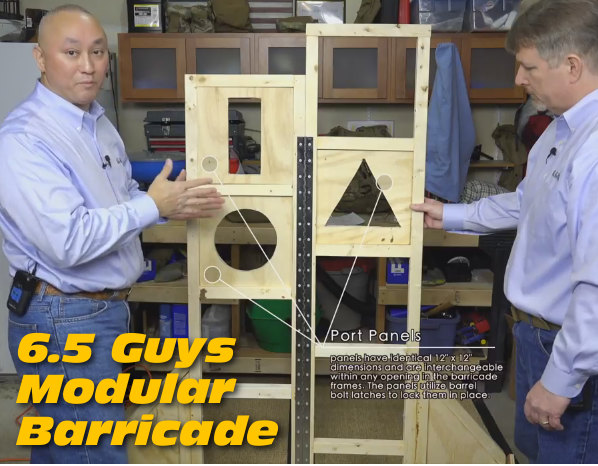
Here’s a great Do-It-Yourself project for tactical shooters. Ed and Steve of the 65Guys.com have created a versatile wooden barricade designed for easy transport. The goal with this design was to create a stable barricade that offers a variety of shooting positions, but can also fit in the bed of a pick-up or the back of an SUV. The 69″ tall barricade is hinged in the middle, so it’s just 27″ wide. To deploy the Barricade you simply fold it open and then nest the lower wings in ground-level stands.
We call this the BYOB Project — Build Your Own Barricade. Anyone with basic wood-working skills should find the Barricade prettyeasy to make. The only tricky part is cutting the side Dado joints for the left and right lower wings. But when you’ve got it completed, you have a low-cost unit that is versatile and sturdy yet easy to pack in a truck and carry out on the range. In the video below the 6.5 Guys showcase their Gen 2 barricade and explain how to build one just like it.
Looking at the 6.5 Guys Modular Barricade
The Modular Barricade was drawn up by Steve in PowerPoint and then dimensions added. Once the entire plan was created, Steve cut components to size and then used ordinary wood screws and wood glue to assemble the barricade frame. This was done to ensure maximum rigidity due to the light weight construction using 2″ x 2″ frame members. A long piano hinge was used to allow the Barricade to fold in half, while still having high torsional rigidity. Each of the Barricade openings are 12″ x 12″ square. This consistent ‘window’ spacing allows interchangeable panels with different cut-out shapes to be placed at varies heights/locations in the Barricade.
Modular Barricade Key Features
— Lightweight construction using low-cost 2×2 wood beams.
— Collapsible frame with center hinges for easy transport and deployment.
— Multiple Support levels at 6″ vertical intervals (6″ variance R to L).
— Modular port design allows ports to be changed and moved as desired.
6.5 Guys’ Modular Barricade — Construction Tips
The Modular Barricade can be constructed over a weekend with the proper materials and basic shop tools such as a power saw and electric screwdriver. Steve used a router for the side panel dado joints but a table saw could also be used for that task. Steve’s only real issue with the build involved the port panels — getting them to fit right. The 2″ x 2″ frame wood wasn’t always straight; even a small variation in the wood could cause a port panel to be too tight or too loose. Steve had to do a lot of extra sanding and planing to get the port panels to fit just right.
Where and How to Use the Barricade for Training
Because the 6.5 Guys’ Modular Barricade is so easy to move, you can simply pack it up and deploy it at your local range for practice. (Do ensure club/range rules allow shooting from barricades.) While the Barricade is designed to sit on the natural ground, the base stands can also be placed on concrete if your range does not allow deployment forward of the normal firing line. While you can use the Barricade for training on your own, Ed and Steve say novice shooters can benefit from a formal clinic.
In the video below, the 6.5 Guys discuss precision rifle training with Scott Satterlee, an instructor with Core Shooting Solutions. This video explains why new shooters should consider enrolling in a formal training clinic. Topics covered are: typical course format and “curriculum”, the gear needed to participate in a precision rifle clinic, and skills shooters should practice before attending the clinic.
This article appears in the Cheaper Than Dirt Shooter’s Log.
The passage of the Concealed Carry Reciprocity Act through the U.S. House of Representatives is a step in the right direction, but not a law yet. The U.S. is a patchwork of confusing and cumbersome laws that change the rules of what you can carry, where you can carry, and whether you can possess the firearm, ammunition of magazine at without running afoul of the local laws. Now, if every state was like Vermont, law abiding gun owners could freely travel with their firearms with no worries. Unfortunately, many states have a history of being hostile to traveling gun owners.
The federal “Firearms Owner Protection Act” allows travel through any state as long as the firearm is unloaded, in a locked case, and not easily accessible to the passengers. However, that is not to say that certain states that are less friendly to firearms have not created their own laws that would snare unsuspecting otherwise law-abiding firearm owners. This led us to name the Top 5 States to Avoid while traveling with a firearm this holiday season.
CONNECTICUT
Connecticut does not have any gun reciprocity agreements with other states. This means nonresidents are not allowed to carry handguns in Connecticut under a permit issued by another state.
HAWAII
Every person arriving into the state who brings a firearm of any description, usable or not, shall register the firearm within three days of the arrival of the person or the firearm, whichever arrives later, with the chief of police of the county where the person will reside, where their business is, or the person’s place of sojourn. GET Hawaii Firearms INFO HERE.
MASSACHUSETTS
Massachusetts imposes harsh penalties on the mere possession and transport of firearms without a license to carry. Prospective travelers are urged to contact the Massachusetts Firearms Records Bureau at (617) 660-4780 or contact the State Police. GET Massachusetts Firearms INFO HERE.
NEW JERSEY
New Jersey has some of the most restrictive firearms laws in the country. Your firearm must be unloaded, in a locked container, and not accessible in the passenger compartment of the vehicle. The New Jersey Supreme Court ruled that anyone traveling within the state is deemed to be aware of these regulations and will be held strictly accountable for violations. If you’re traveling through New Jersey, the N.J. State Police website provides information regarding transporting firearms within state lines. GET New Jersey Firearms INFO HERE.
NEW YORK
Use extreme caution when traveling through New York state with firearms. New York’s general approach is to make the possession of handguns and so-called “assault weapons” illegal. A number of localities, including Albany, Buffalo, New York City, Rochester, Suffolk County, and Yonkers, impose their own requirements on the possession, registration, and transport of firearms. Possession of a handgun within New York City requires a New York City handgun license or a special permit from the city Police Commissioner. This license validates a state license within the city. Even New York state licenses are generally not valid within New York City unless a specific exemption applies. Possession of a shotgun or rifle within New York City requires a permit, which is available to non-residents, and a certificate of registration.
More Scary States for Gun Owners
Here are six other jurisdictions (five states and DC) where you need to be wary when traveling. California, for example, treats all handguns in vehicles as “loaded” if there is ammunition loaded into an attached magazine. It’s wise, when in California, to have handguns unloaded in a LOCKED case, with all ammunition or magazines in a separate section of the vehicle. These states (and DC) all have laws that can trap unsuspecting gun-owners. Be wary.
California
Delaware
Dist. of Columbia
Illinois
Maryland
Rhode Island
Ret. Army Lt. Col. Lones W. Wigger, Olympic shooter and international champion, passed away on the evening of December 14, 2017 at his home in Colorado Springs, Colorado of complications from pancreatic cancer. He was 80 years old. By many measures, Wigger could be called the best iron sights, position shooter in history. During his shooting career, Wigger won 111 medals and set or tied 29 world records in international competition, more than any other shooter in the world. He was on the USA Olympic Shooting Team in 1964, 1968, 1972, and 1980.
Kelly McMillan mourns Wigger: “My heart is broken. Sometimes something happens that though you may have been expecting it, when it happens the effect that it has on you is a complete surprise. I feel honored to have attended his [80th] Birthday Celebration in August and was extremely fortunate to have him on my radio show a little over a month ago. I am honored to have known him and to call him my friend… I miss him already.”
A Lifetime of Shooting Excellence
Originally from Fort Benton, Montana, Wigger won three Olympic medals in his career including Golds in 1964 and 1972. His resume also includes 24 World Championship Gold Medals and 29 World Records. The retired Lt. Col. also served his country in the U.S. Army with tours of duty in Vietnam in 1967 and 1971. Wigger was primed for Olympic success in 1980 but never got the chance due to the U.S. boycott.
Wigger is often regarded as the greatest competitive rifle shooter ever to have taken aim for the United States. He won more medals in international shooting competition (111) than any other shooting athlete in the world and is the only athlete to win medals in all three Olympic rifle shooting disciplines. Wigger is the only USA Shooting Team member ever elected to the U.S. Olympic Committee’s Hall of Fame.
Wigger was a USA Olympic shooting team member in 1964, 1968, 1972, and 1980. The 1964 effort resulted in a Gold Medal. He won the gold for the 3-position small-bore rifle. In 1972, Wigger won the Gold Medal for 3-position Free Rifle. Wigger also competed on five Pan American Games teams, where he won five Silver and 13 Gold medals. A retired Army Lt. Colonel, Wigger was a Vietnam Veteran who spent 25 years on active duty, retiring with the rank of Lt. Colonel. While in the Army, Wiggers also competed with the USAMU.
Wisdom from Wigger — The Psychology of Winning
by Lones Wigger, Olympic Medalist
It’s pretty complicated — this subject of dealing with pressure. I’m a precision shooter and have learned to excel in that discipline. You’ve got to learn to shoot the desired scores at home and in training. And once you’re capable of shooting the scores, you may not shoot the same way in the match because of the match pressure. As a result, it takes 3-4 years to learn how to shoot, and another 3-4 years to learn how to win — to deal with the match pressure. It takes several more years to learn how to do it when it counts.
To win, there are several things you have to learn how to do. You have to do it from within. You have to learn how to train just as if you were in a big competition. You work on every shot. You have got to learn to treat it just like a match — to get the maximum value out of every shot.
You have got to use the same technique in practice and in training. A lot of shooters have a problem because they change their technique from practice to the match. In competition, you work your ass off for every shot. You have to approach the training the same way.
A second way to combat pressure is to shoot in every competition you can get into so that you become accustomed to it.
Do Everything Possible to Prepare
The third technique is preparation. Before you are going to shoot in a big competition, train hard to do everything you can to raise your scores. So when you’re in the match, you know that you have done everything humanly possible to get ready for the competition. If you have self-doubt, you will not shoot well. You have to have the will to prepare to win.
When Gary Anderson was a kid, he couldn’t afford a gun or ammunition. He had read about the great Soviet shooters. With his single shot rifle, he would get into position, point that gun and dry fire for hours at a time in the three different positions. He had tremendous desire. He wanted to win and he did whatever he could to get there. When he finally got into competition, he shot fantastic scores from the beginning.
Visualize Winning to Train the Subconscious Mind
A little bit of psychology: You picture in your mind what you want to do. You have to say, OK, I’m going to the Olympics and perform well. Picture yourself shooting a great score and how good it feels. You are training your subconscious mind. Once you get it trained, it takes over. A coach taught me to visualize the outcome, and it worked. Eventually you train your subconscious and it believes you can win. At first I didn’t know about teaching the subconscious to take over, but now I do it all the time. And it certainly worked for me at the 1972 Olympics. What it really takes is training and doing the same thing in training as at a match. If you are “just shooting,” you are wasting your time.
This above text comes from an interview with Lones Wigger by Jock Elliot, part of a three-part series, The Fine Art of Not Cracking Under Pressure. CLICK HERE to READ FULL ARTICLE featuring other interviews with Brian Zins, Bruce Piatt, Carl Bernosky and Ernie Vande Zande.
Image Courtesy NSSF. This story is based on a recent NSSF Article.
‘Tis the season of gift-giving (and Christmas Day is nearly here). As hunters, shooters, collectors or just plain plinkers, it’s a natural instinct to want to share our enjoyment of firearms with others. What better way to do that than to make a gift of a firearm to a family member, close friend or relative?
The first thing to remember if you’re thinking about giving someone a gun is that … it’s a gun! You already know that ownership of a firearm brings with it some serious legal and ethical obligations that other consumer products don’t. So let’s look at some questions you may have about giving a firearm as a gift.
Image Courtesy NSSF
The first question you have to ask is whether the intended recipient can legally own the firearm where he or she lives. With more than 20,000 different gun laws on the books, even the kinds of firearms that law-abiding citizens can own vary from place to place. For example, juveniles (under age 18) generally speaking are precluded by law from possessing a handgun. Check out the Bureau of Alcohol, Tobacco, Firearms and Explosives (ATF) website for an overview of local laws and, whatever you do, don’t forget that you can never under any circumstances transfer a firearm to someone you know — or have reasonable cause to believe — legally can’t own one. That’s a federal felony, so be careful.
There’s no federal law that prohibits a gift of a firearm to a relative or friend who lives in your home state. Abramski v. United States, a recent Supreme Court decision involving a “straw purchase” of a firearm did not change the law regarding firearms as gifts. The following states (California, Colorado, Connecticut, Delaware, New York, Oregon, Rhode Island, Washington State) and the District of Columbia require you to transfer a firearm through a local firearms retailer so an instant background check will be performed to make sure the recipient is not legally prohibited from owning the gun. Maryland and Pennsylvania require a background check for private party transfer of a handgun. There are exceptions, so it’s important to check the law of your state or ask your local firearms retailer.
Consider a Gift Card Instead of Direct Gift
The ATF recommends that if you want to give someone a new firearm, rather than going to a gun store and buying the gun on your own, consider instead purchasing a gift certificate/card from your favorite gun retailer. Then give that gift card as the present. That way the recipient can choose the exact gun he or she wants, and there’s no question about who is “the actual buyer of the firearm,” which is a question any purchaser must certify on the Federal Form 4473 at the time of purchase. The Gift Card option avoids any “straw purchaser” issues.
Intra-Family Transfers and Antique Arms
What if you want to give “Old Betsy,” your favorite old deer rifle, to your son or daughter as a college graduation gift? Again, in most states, there’s no law that says you can’t, but some states require even intra-family transfers to go through a licensed dealer. Remember, you can never transfer a firearm directly to another person who is a resident of a different state. In that case, you must transfer the firearm through a licensed dealer in the state where the person receiving the gift resides. Using a gift certificate from a firearms retailer near where the recipient lives might be a good solution. Pre-1898 antique firearms are generally exempt from the dealer requirement. [But check with the laws in your jurisdiction]. Be safe and check with your dealer or local law enforcement before you hand over your prized possession.
Regulations on Firearms Shipping to Third Parties
When you intend to transfer a gun, there are important rules on interstate shipping*. Generally speaking, you can only ship a handgun by common carrier (but not U.S. Mail) and a long gun by U.S. Mail or common carrier to a federally licensed dealer, but not to a non-licensed individual. With all carriers, federal law requires you to declare that your package contains an unloaded firearm. To be safe, always consult your carrier in advance about its regulations for shipping firearms. Also check your state laws on transfers.
*Different rules may apply to shipping to parties IN-STATE or shipping firearms to yourself in temporary care of others. Always consult your own state laws, but here are some FAQs copied directly from the ATF.GOV website:
Merry Christmas from Guns & Ammo. This publication is making its entire 106-page December 2017 issue available for FREE online from December 12, 2017 through January 9, 2018. To read the entire issue for FREE, go to: GunsandAmmo.com/freepreview.
The free December issue will include the 2017 Guns & Ammo of the Year Awards (page 52) and a first-look at the new Smith & Wesson M&P9 M2.0 Compact, Shield and M360 lightweight revolver. You’ll want to check out the articles about: Winston Churchill’s Mauser C.96 Pistol (page 104), the Dixie Gunworx DOA Shooting Bench (p. 38), and Concealment Furniture (page 18) that hides your home defense guns. We also recommend the NovX ammo review (page 26). NovX is a new kind of ammunition with a hybrid stainless steel and aluminum case, and polymer-coated copper bullets.
If you haven’t seen a copy of Guns & Ammo recently, here’s a chance to sit down and enjoy a large issue at no cost. We found it interesting to see Guns & Ammo’s Annual Award selections (page 52): CZ P-10 C — Handgun of the Year; Barrett Fieldcraft — Rifle of the Year; Winchester SX4 — Shotgun of the Year. To be honest, we found all those choices puzzling…
Guns & Ammo magazine is one of 15 publications from Outdoor Sportsman Group. The publisher claims Guns & Ammo has more than 11 million readers (29.7 readers per copy) — more readers than any other firearms publication. If that’s really true, we wonder, frankly, why the magazine isn’t a whole lot better. With that circulation, and the high percentage of display ads (over 30% of the pages) Guns & Ammo should be minting money. That should allow the Editors to do some pretty exciting stuff. Unfortunately, many of the articles seem little more than sales brochures. And you won’t find much on precision reloading or competitive rifle shooting.
By all means, check out this FREE Issue of Guns & Ammo. After all the price is right. However, we believe you’ll find more reliable, useful information on websites such as ShootingSportsUSA.com, Rifleshooter.com, PrecisionRifleBlog.com, 65Guys.com, UlimateReloader.com, and, of course, our own site AccurateShooter.com. We provide 80-90 features per month on our Daily Bulletin which is always free. We also offer a very active Shooters’ Forum with over 37,500 members. Many top-flight competitive rifle shooters, barrel-makers, and gunsmiths are Forum members. You can learn from their expertise. If you haven’t joined our Forum yet, you should.


 Sticking a case in the sizer die is a rite of passage for the beginning handloader. If you haven’t done it yet, that’s great, but it probably will eventually happen. When it does, fixing the problem requires a bit of ingenuity or a nice little kit like the one we got from RCBS.




 It’s pretty complicated — this subject of dealing with pressure. I’m a precision shooter and have learned to excel in that discipline. You’ve got to learn to shoot the desired scores at home and in training. And once you’re capable of shooting the scores, you may not shoot the same way in the match because of the match pressure. As a result, it takes 3-4 years to learn how to shoot, and another 3-4 years to learn how to win — to deal with the match pressure. It takes several more years to learn how to do it when it counts.


 The first question you have to ask is whether the intended recipient can legally own the firearm where he or she lives. With more than 20,000 different gun laws on the books, even the kinds of firearms that law-abiding citizens can own vary from place to place. For example, juveniles (under age 18) generally speaking are precluded by law from possessing a handgun. Check out the
 Consider a Gift Card Instead of Direct Gift

 The free December issue will include the 2017 Guns & Ammo of the Year Awards (page 52) and a first-look at the new Smith & Wesson M&P9 M2.0 Compact, Shield and M360 lightweight revolver. You’ll want to check out the articles about: Winston Churchill’s Mauser C.96 Pistol (page 104), the Dixie Gunworx DOA Shooting Bench (p. 38), and Concealment Furniture (page 18) that hides your home defense guns. We also recommend the NovX ammo review (page 26). NovX is a new kind of ammunition with a hybrid stainless steel and aluminum case, and polymer-coated copper bullets.


