Today, AR-platform rifles are hugely popular. Dozens of manufacturers sell AR-type rifles, in a wide variety of configurations and calibers. But before there were M16s and AR-15s, ArmaLite produced a 7.62×51 caliber rifle, the AR-10. Yes before there were millions of 5.56 black rifles, there was a .30-caliber big brother with reddish-brown furniture. Invented by Eugene (‘Gene’) Stoner for the Armalite company in the late 1950s, this is the father of all of today’s AR-platform rifles. Way ahead of its time, this remarkable, select-fire battle rifle weighed just 7.25 pounds as first developed.
If you’re curious about the AR-10, in this video, Jerry Miculek puts an original 1957-vintage AR-10 through its paces on the range. This extremely rare, early-production rifle was provided by Mr. Reed Knight and the Institute of Military Technology. (The gun in the video was actually produced in the Netherlands under license, see video at 4:40.) This AR-10 is the direct ancestor of the AR-15, M16, and many of the modern sporting rifles that we use today.
The AR-10 was slim and light, weighing in at around 7 pounds. Some folks might argue that the original “old-school” AR10 is actually better that some of today’s heavy, gadget-laden ARs. The AR-10’s charging “lever” was under the carry handle — that made it easier to manipulate with the gun raised in a firing position.
You’ll notice there is no “forward assist”. Inventor Gene Stoner did not believe a separate “bolt-pusher” was necessary. The forward assist was added to solve problems encountered in Viet Nam. Some critics say the forward assist “only takes a small problem and makes it a big problem.” For today’s competition ARs (that are never dragged through the mud) the forward assist probably is superfluous. It is rarely if ever needed.
Note also that the handguards are fairly slim and tapered. Today, six decades after the first AR-10 prototypes, we are now seeing these kind of slim handguards (made from aluminum or lightweight composites) used on “full race” ARs campaigned in 3-gun competition.
History of the AR-10
The AR-10 is a 7.62 mm battle rifle developed by Eugene Stoner in the late 1950s at ArmaLite, then a division of the Fairchild Aircraft Corporation. When first introduced in 1956, the AR-10 used an innovative straight-line barrel/stock design with phenolic composite and forged alloy parts resulting in a small arm significantly easier to control in automatic fire and over one pound lighter than other infantry rifles of the day. Over its production life, the original AR-10 was built in relatively small numbers, with fewer than 9,900 rifles assembled.
In 1957, the basic AR-10 design was substantially modified by ArmaLite to accommodate the .223 Remington cartridge, and given the designation AR-15. ArmaLite licensed the AR-10 and AR-15 designs to Colt Firearms. The AR-15 eventually became the M16 rifle.
AR-10 photos from Arms Izarra, a Spanish company specializing in de-militarized, collectible firearms. Interestingly, this particular AR-10 was produced in the Netherlands under license.
Digital editions of the four issues of SHOT Daily, the magazine printed each day of the SHOT Show, are available free in convenient Web eZine formats. Three web issues are available right now, and the fourth issue will be released later today (Friday, 1/20/17). You’ll find many product features plus articles that can benefit shooting club directors and range managers. Definitely check out the Day One Issue’s extensive coverage of new-for-2017 firearms. SHOT Daily is produced for NSSF by Bonnier Corp., publishers of Outdoor Life, Field & Stream, and many other magazines.
Highlights Day 1: New Savage MSR (AR type) rifles, New Firearm Roundup, Exhibitors.
Highlights Day 2: New Products Reports, New Optics, New Ammunition.
Highlights Day 3: New Products Reports, Savage Rimfire, Knives, Accessories
Randy Robinett, founder of BIB Bullets, is a highly respected custom bullet-maker. In recent years, Randy’s 30-caliber projectiles have won countless benchrest-for-score matches, and captured many National titles. If you want to “run with the big dogs” in score competition, campaigning a 30BR with BIB bullets is a very smart way to go. In this article, Randy talks about the process of creating highly uniform cores for benchrest bullets.
This article originally started as an exchange of posts in Stan Ware’s Bench-Talk Forum. Stan, a gifted gunsmith, converted the Forum posts into an article, which first appeared on Stan’s Bench-Talk.com Website.
How to Make Benchrest-Quality Bullet Cores by Randy Robinett, BIB Bullets
OK, Stan “made me do it”! A while back, Stan Ware asked if I’d submit a ditty on bullet-making. Here is the “picture is worth a few words” version. Below is a photo of a spool of lead wire. This is the first step in making benchrest-quality bullets. This spool of .250″ diameter lead wire will be cut into approximately 130 pieces, each about thirty inches long.
The Core Cutter
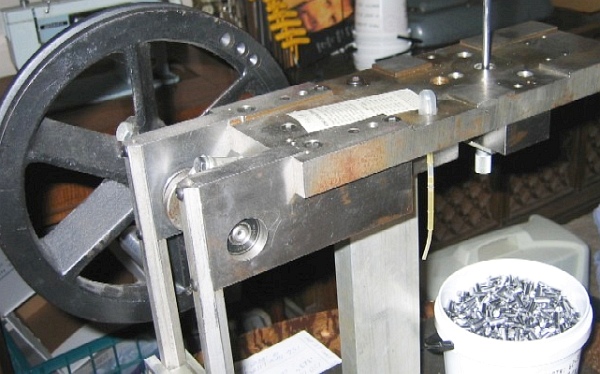
Here’s a really neat machine built by my Uncle and BIG MIKE. This is the core cutter. We made it using scrap steel and borrowed the crank shaft out of a 1966 Yamaha motorcycle to get the desired reciprocating-motion slide. When properly “juiced”, this machine can cut more than 3000 cores per hour.
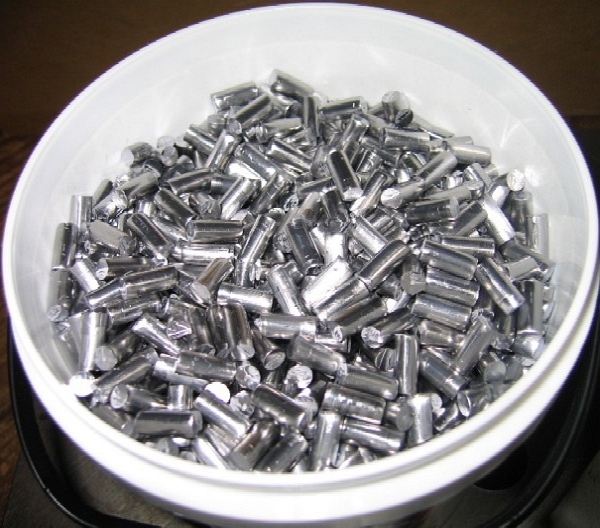
As you doubtless deduced, the “sticks” are inserted, then fed via gravity — straightness is a virtue here! The crank, for now, is powered by the human hand. The bucket contents are the result of loading the cutter and turning the crank wheel. This photo shows cores for 112 grain, .30-caliber bullets. There are about 2500 cores to the bucket.
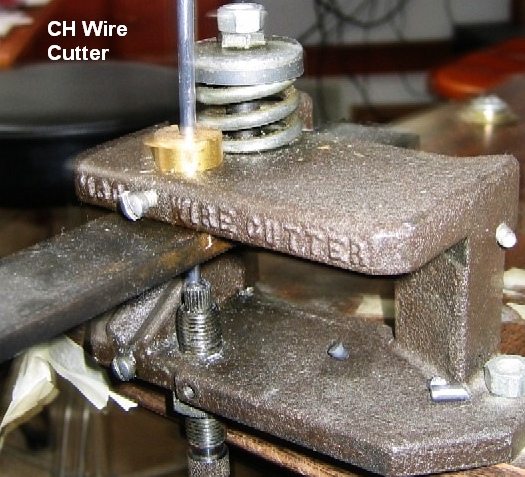
Here’s a close-up of the business end of the core cutter. Using recorded micrometer settings, this clever design allows us to get very repeatable length when changing through the length/weight cycle.
The photo below provides a closer look at the just-cut cores. Note the relatively clean shanks and square, unflared ends. This bucket contains roughly 2500 cores. By contrast, a tour of the Hornady plant will reveal cores being cut and squirted via a single operation, and deposited into 50-100 gallon livestock watering tanks!
Upon my first tour of a commercial plant, I lost all feelings of guilt about the cost of custom, hand-made bullets. When one totals the amount of labor, “feel” and “culling” that goes into them, custom hand-made bullets represent one of the best bargains on the planet!
At Hornady, each press produces 50-55,000 finished bullets per 10-hour shift. By contrast, a maker of hand-crafted bullets, at best, may make 3% of that number during a 10-hour span! Yep, hand-made benchrest-quality bullets are a labor of love and should be purchased with these criteria in mind: 1) QUALITY; 2) availability; 3) price. There is no reason for a maker of hand-made benchrest-quality bullets to negotiate on price. His time is worth what one receives from the bargain!
Core-Making Q & A Randy’s original Bench-Talk Forum posts inspired some questions by Forum members. Here are Randy’s answers to spedific questions about core-making.
Question by Stan Ware: Randy, a post or two back you said the cores were cut into 30″ lengths first and straightened. Why do you cut to 30″ lengths? What is the reason for this?
Answer by Randy: Stan, the wire is cut into 30″ lengths (sticks) and then straightened, following which it is fed into the core cutter and cut into the individual individual “cores”. If you look at the core cutter photo above, you’ll see a stick of lead wire sticking up -it’s toward the right hand end of the contraption. The cut cores are also “ejected” by gravity — the white “tickler” brushes the cores as the slide moves forward and dislodges the core from the cutter bushing.
Q by GregP: Randy, How do you straighten the 30″ sticks? Roll them between metal plates?
Answer by Randy: Greg, BIG MIKE may kill me for letting out the secret. WE “roll” the wire between an aluminum plate, which is equipped with handles, and the “plate” which you can see in the pic of cutting the wire. The straightening is really a drag. Eventually, we will have the new cutter hooked up to a “feeder/straightener” and the wire will be cut into core slugs right off the roll! Well, that’s the Dream….
Question by Jim Saubier: How much of a nub do you use at the end of the 30″ section? I imagine that every section you will lose a little from the feed end. Your cutter looks real slick, we are using the manual deal and it isn’t quick by any means.
Answer by Randy: Jim, Since I cut all of the sticks using diagonal-cutting pliers, the ends are, indeed, waste. However, only about 1/8th inch on the beginning end — the final core may be too short. I have attached a pic of my old reliable CH cutter. I still use this cutter for .22-cal and 6mm cores and, occasionally, an odd lot of thirties. The CH cuts very square ends which are free of bulges and/or flaring.
By Bill Brassard for NSSF
‘Tis the season of gift-giving (and Christmas Day is almost here). As hunters, shooters, collectors or just plain plinkers, it’s a natural instinct to want to share our enjoyment of firearms with others. What better way to do that than to make a gift of a firearm to a family member, close friend or relative?
The first thing to remember if you’re thinking about giving someone a gun is that … it’s a gun! You already know that ownership of a firearm brings with it some serious legal and ethical obligations that other consumer products don’t. So let’s look at some questions you may have about giving a firearm as a gift.
The first question you have to ask is whether the intended recipient can legally own the firearm where he or she lives. With more than 20,000 different gun laws on the books, even the kinds of firearms that law-abiding citizens can own vary from place to place. For example, juveniles (under age 18) generally speaking are precluded by law from possessing a handgun. Check out the Bureau of Alcohol, Tobacco, Firearms and Explosives (ATF) website for an overview of local laws and, whatever you do, don’t forget that you can never under any circumstances transfer a firearm to someone you know — or have reasonable cause to believe — legally can’t own one. That’s a federal felony, so be careful.
Though there’s no federal law that prohibits a gift of a firearm to a relative or friend that lives in your home state, some states (such as California) require you to transfer the gun through a local firearms dealer so an instant background check will be performed to make sure the recipient is not legally prohibited from owning the gun.
The ATF recommends that if you want to give someone a new firearm, rather than going to a gun store, buying it on your own and giving it to, say your father, consider instead purchasing a gift certificate from that retailer and giving it to Dad as his present. That way he’ll get the exact gun he wants, and there’s no question about who is “the actual buyer of the firearm,” which is a question any purchaser must certify on the Federal Form 4473 at the time of purchase.
You can only ship a handgun by common carrier (but not U.S. Mail) and a long gun by U.S. Mail or common carrier to a federally licensed dealer, but not to a non-licensed individual. With all carriers, federal law requires you to declare that your package contains an unloaded firearm. To be safe, always consult your carrier in advance about its regulations for shipping firearms.
What if you want to give “Old Betsy,” your favorite old deer rifle, to your son or daughter as a college graduation gift? Again, in most states, there’s no law that says you can’t, but some states require even inter-family transfers to go through a licensed dealer. Remember, you can never transfer a firearm directly to another person who is a resident of a different state. In that case, you must transfer the firearm through a licensed dealer in the state where the person receiving the gift resides. Using a gift certificate from a firearms retailer near where the recipient lives might be a good solution. Pre-1898 antique firearms are generally exempt from the dealer requirement. [But check with the laws in your jurisdiction]. Be safe and check with your dealer or local law enforcement before you hand over your prized possession.
About the National Shooting Sports Foundation
The National Shooting Sports Foundation is the trade association for the firearms industry. Its mission is to promote, protect and preserve hunting and the shooting sports. Formed in 1961, NSSF has a membership of more than 6,000 manufacturers, distributors, firearms retailers, shooting ranges, sportsmen’s organizations and publishers. For more information, log on to www.nssf.org.
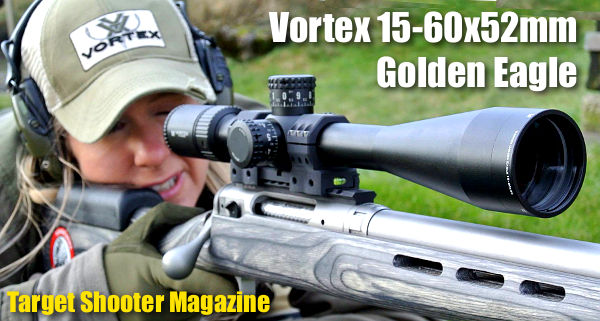
Our British friend Vince Bottomley has had a chance to test the new Vortex 15-60x52mm Golden Eagle scope, priced at $1499.00 in the USA. How does this affordable, high-magnification target scope compete with other comp scopes that cost hundreds (or even thousands) more? Very well indeed according to Vince. He says the Golden Eagle can definitely run with other “big name” high-magnification zoom optics designed for F-Class, Benchrest, and Long Range competition. Vince has written a detailed 15-60x52mm Golden Eagle review for Target Shooter Magazine. Shooters looking for a high-magnification zoom optic should definitely read Vince’s review.
Vince notes that the Vortex Golden Eagle offers impressive performance for the price: “The stunning March 10-60 is the current choice of the serious F-TR shooter – this hand-built scope weighing just 25 oz. from the Deon Optical Corporation of Japan is as near to perfection as any long-range competition shooter could wish. There are several other scopes which have also stood up to scrutiny against the March — the 7-42 Leupold and the Nightforce 15-55 Competition for example. So, why are we getting so excited about the Vortex? One reason – the price!
Sensibly, Vortex manages to offer a product which ticks all the boxes but comes in at around two-thirds of [Leupold 7-42, Nightforce 15-55]. Fantastic value for a top-quality Japanese/American scope, especially considering the dollar/pound exchange rate following Brexit.”
Useful Reticle Design and Innovative Windage Knob
Vince liked the scope’s ECR-1 Reticle which provides true MOA-value hold-off/hold-over stadia (hash marks) at 40X. The Golden Eagle also offers an optional new type of windage knob that provides an increasing value count on both sides of the windage Zero. Vince says this was a smart feature: “The ‘both ways’ windage knob was great. At the end of the shoot, it was easy to know which way to turn it back to zero.”
Should You Buy One?
Here’s how reviewer Vince Bottomley answered that question:
“Well, a high-magnification zoom scope seems to be an F-Class essential, judging from the number of 10-60 March and 15-55 Nightforce scopes in evidence at any GB F-Class League match. If these three scopes were all in the same price-bracket, then the decision in choosing the Vortex 15-60 Golden Eagle would be more difficult but, when the Vortex is only two-thirds the cost of the other two. However, weight-wise, there’s a small penalty – at a tad under 29 oz., the Eagle is 3 oz. heavier than the March but, if you choose your rings carefully, you could pull some of that back.
Finally, Vortex offers probably the best ‘no quibble’ guarantee on the planet and, if you had any wavering doubts about buying a Golden Eagle, that should clinch it.”
UK readers interested in purchasing the Golden Eagle should Contact Osprey Rifles on OspreyRifles.com or e-mail Stuart on stuart@ospreyrifles.com
Top shooters like 11-time National Champion David Tubb have mastered marksmanship by being continually aware of their physical state while shooting. This article by Glen Zediker talks about respiration and how to modulate your breathing to maximize on-target accuracy and consistency. This article originally appeared in the MidSouth Shot Report Blog.
by Glen Zediker
Elsewhere I’ve talked about what I call the “true fundamentals” of shooting. Put the sight on the target and pull the trigger without moving the sight. And we’ve talked about some of the mechanics, like natural point of aim, sight picture, and the trigger itself, that combine to assist this goal.
Holding still sometimes takes more thought, and effort, than we might realize. Shooting well is a truly multi-faceted task that shooters like 11-time National Champion David Tubb have attended to through miniscule details, like being aware of the physical state continually while performing.
Another crucial and largely unknown element is controlling breathing. Right. That thing we do to stay awake and alive. Breathing can be a calculated technique among competitive shooters, and that is because the state of the body in the framework of making a shot is a defining element in the effectiveness of the shooting platform. That platform, by they way, is you!
I’ll break it down, and then offer a few suggestions on how to incorporate a better understanding of the dynamics of maintaining human oxygen supply.
When we are breathing when doing nothing in particular but living, we’re not taking the deepest breaths we can when we inhale, and we’re not expelling all the air we had when we exhale. We’re also not breathing in and out, in and out, in and out in constant successions. We breathe in to a comfortable level. Hold that a bit. We breathe out to a comfortable level. And then we hold that state for a bit. Then we very naturally breathe in again. These cycles are on a balanced rhythm, and a relatively shallow cycle. It’s a lot different than when we’re doing something strenuous, like running.
So, to fire a gun from our most stable state, make the trigger break in what shooting coaches call “the natural respiratory pause”. That’s the state between exhaling and inhaling. From a “human machine” standpoint, that’s when the body is most calm and stable.
Breathing Cycles for Best Shooting
Learn to use the natural pattern of your breathing to experience the most effective (steadiest) hold. When we breathe normally we don’t inhale as much air as we can hold and then blow it all out, and we also don’t breathe continually in and out, in and out. Rather, we simply inhale and exhale to levels that are comfortable to us. Take aim and fire the shot when you have reached what some call the “natural respiratory pause,” or the natural resting point prior to inhalation where we are “using” the oxygen we have retained.
It’s a narrow window. That window of opportunity varies widely depending on a lot of factors, but some experience dry-firing will show you where you stand.
It’s December already. That means winter has definitely arrived — no doubt about it. If you plan to put away all or some of your firearms for the winter, here are TEN Tips for winterizing your firearms.
1. Bore Cleaning and Coating — Clean your barrels and neutralize any solvents you may have used. Then run a couple patches with a corrosion-fighter down the bore. We recommend Eezox or CorrosionX. Eezox leaves a glossy dry film shield with excellent rust resistance. CorrosionX is more like a conventional oil, but with special anti-rust additives. Other products may work well too. Just be wary of the “all in one” products that have a strong solvent, and don’t use any fluid that contains ammonia — this can actually promote corrosion. Here’s a test of various anti-corrosion products: Rust Block Comparison Test.
2. Crown Inspection — After cleaning the barrel, inspect the crown with a magnifying glass. If you see any unusual wear, abrasion, or “shark’s teeth” at the very outer edge of the rifling, make a note — it may be wise to recrown the barrel next spring. Before you place your rifle in the safe, we recommend putting a piece of electrical tape or blue masking tape loosely over the muzzle to protect the crown. This is just to protect the delicate crown during handling — you are NOT trying to seal off the bore.
3. Optics Storage — If your gunsafe is crowded, you may wish to remove the optics and rings from your rifles before winter storage. You can use a white crayon to mark the ring position (on the rail) for next season. We recommend that you store your optics inside a warm part of your house, where temperatures and humidity are relatively stable.
4. Trigger Group — Inspect your trigger assembly. Trigger housings accumulate dirt, grit, and oily gunk over the course of a season. If you have some basic mechanical skills, you may wish to remove the trigger from the hanger and clean it per the manufacturer’s recommendations. Don’t flood it with any kind of thick oil.
5. Bolt and Action – Clean the gunk off your bolt and raceway in your receiver. Put a thin coat of anti-corrosion product on the bolt, and re-grease the lugs and camming surfaces as recommended by the manufacturer. Don’t forget the fasteners and pins on the action and scope rail — these may not be stainless even if you have a stainless steel receiver.
6. Use Thin Gloves — When oiling firearms during the winterization process, we recommend you wear thin latex or nitrile gloves. This will prevent you from leaving skin oils and acids that can actually promote corrosion. This will also protect YOU from any chemicals in the corrosion-blockers you put on your guns.
7. Applying Surface Protectants — For blued firearms, put Eesox or other rust-fighter on a cloth and wipe the barrel and exposed metal. Eezox works best with a couple light coats. Don’t forget iron sights, bottom metal, trigger guards, bolt handles, and sling swivels — they can rust too if not protected. Use Q-Tips or small swabs to reach small, internal parts.
8. Use Gun Sacks — We put rifles and pistols in Bore-Store Gun sleeves. These thick, synthetic-fleece sacks cushion your guns, preventing nicks and scratches. The breathable fabric wicks away moisture, and the fibers are coated with corrosion inhibitors to help fight rust. Bore-Stores are offered in a wide range of sizes, so you can find something to fit everything from a Snub-nosed revolver to a 32″-barrelled 50 BMG. Rifle-size Bore Stores can be purchased for $10.00 – $22.00 from Brownells.com or Amazon.com. While we prefer Bore-Stores for regularly-used guns, if you have heirloom firearms that will be kept in storage for very long periods without seeing any use, you may want to grease them up and place them in the thin, but rugged three-layer storage bags sold by Brownells. Here’s one VITAL bit of advice for using these bags. Be absolutely sure, before you seal up the bags, that your guns are DRY and that all metal surfaces have been coated with an effective rust-blocker, such as BoeShield T9 or Eezox.
9. Take Your Guns OUT of Foam-lined Cases — These common foam-lined cases are Rust Magnets. This may be the most important Tip in this article. Just about the worst thing you can do in the winter (short of leaving your rifle outside in the rain) is to store firearms in tight, foam-padded cases. The foam in these cases actually collects and retains moisture from the air, acting as the perfect breeding ground for rust. Remember, those plastic-shelled cases with foam interiors are for transport, not for long-term storage.
10. Make Your Gun Safe Ready for Winter — If you don’t have a Goldenrod (or equivalent), buy one. Sold as a “dehumidifier”, the Goldenrod is a simple electrical element that can maintain temperature in your gun vault. This helps prevent moisture in the air from condensing on your guns. A small incandescent light-bulb can help as well (just make sure it cannot touch any flammable fabrics or objects). In addition, you may want to purchase Dessicant packs to put inside the safe to absorb moisture. If you have an electronic keypad for your safe, we recommend replacing the batteries at least once a year.
The Legal Brief is a feature of TheGuncollective.com that focuses on firearms rules and regulations. In this Legal Brief video, Attorney Adam Kraut explains key State and Federal regulations governing firearms, and explains how to ensure compliance with all applicable laws.
This five-minute video explains barrel length rules for rifles and shotguns, and also explains the best (and most fool-proof) methods to measure your barrel. In addition, the video explains how to measure firearm overall length. A rifle or shotgun which is less than 26 inches overall can also be classified as a “Short-barreled” rifle/shotgun subject to the NFA. NOTE: Under federal law “If the rifle or shotgun has a collapsible stock, the overall length is measured with the stock EXTENDED”.
Highlights of LEGAL BRIEF Discussion of Barrel Length and Firearm Overall Length
The ATF procedure to measure the length of a barrel is to measure from the closed bolt or breech face to the furthest end of the barrel or permanently attached muzzle device. ATF considers a muzzle device that has been permanently attached to be part of the barrel and therefore counts towards the length.
How to Measure Barrel Length: Drop [a] dowel or rod into the barrel until it touches the bolt or breech face, which has to be closed. Mark the outside of the rod at the end of the muzzle crown (if you don’t have a permanently attached muzzle device) or at the end of the muzzle device if it is permanently attached. Remove the rod and measure from the mark to the end of the rod. That is your barrel length[.]
Remember, if the barrel length is less than 16 inches, it is possible that the firearm could be a short barrel rifle (if you are building a rifle or it is already on a rifle) and if the barrel length is less than 18 inches, it is possible the firearm could be a short barrel shotgun (again if you are building a shotgun or it is already a shotgun). Both of these firearms would be subject to the purview of the National Firearms Act and would require the firearm to be registered accordingly.
How to Measure Overall Length:The overall length of your rifle or shotgun may also classify it as a Short Barrel Rifle or Short Barrel Shotgun. The overall length of a firearm is the distance between the muzzle of the barrel and the rearmost portion of the weapon measured on a line parallel to the axis of the bore. … If the rifle has a permanently attached muzzle device, that is part of the overall length. … If the rifle or shotgun has a collapsible stock, the overall length is measured with the stock extended.
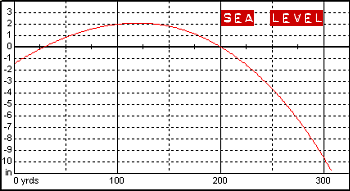
You can do your own experimental calculations using JBM Online Ballistics (free to use). Here is an extreme example, with two printouts (generated with Point Blank software), one showing bullet trajectory at sea level (0′ altitude) and one at 20,000 feet. For demonstration sake, we assigned a low 0.2 BC to the bullet, with a velocity of 3000 fps.
One of our readers asked “What effect does altitude have on the flight of a bullet?” The simplistic answer is that, at higher altitudes, the air is thinner (lower density), so there is less drag on the bullet. This means that the amount of bullet drop is less at any given flight distance from the muzzle. Since the force of gravity is essentially constant on the earth’s surface (for practical purposes), the bullet’s downward acceleration doesn’t change, but a bullet launched at a higher altitude is able to fly slightly farther (in the thinner air) for every increment of downward movement. Effectively, the bullet behaves as if it has a higher ballistic coefficient.
Forum member Milanuk explains that the key factor is not altitude, but rather air pressure. Milanuk writes:
“In basic terms, as your altitude increases, the density of the air the bullet must travel through decreases, thereby reducing the drag on the bullet. Generally, the higher the altitude, the less the bullet will drop. For example, I shoot at a couple ranges here in the Pacific Northwest. Both are at 1000′ ASL or less. I’ll need about 29-30 MOA to get from 100 yard to 1000 yards with a Berger 155gr VLD @ 2960fps. By contrast, in Raton, NM, located at 6600′ ASL, I’ll only need about 24-25 MOA to do the same. That’s a significant difference.
Note that it is the barometric pressure that really matters, not simply the nominal altitude. The barometric pressure will indicate the reduced pressure from a higher altitude, but it will also show you the pressure changes as a front moves in, etc. which can play havoc w/ your calculated come-ups. Most altimeters are simply barometers that read in feet instead of inches of mercury.”
As Milanuk states, it is NOT altitude per se, but the LOCAL barometric pressure (sometimes called “station pressure”) that is key. The two atmospheric conditions that most effect bullet flight are air temperature, and barometric pressure. Normally, humidity has a negligible effect.
It’s important to remember that the barometric pressure reported on the radio (or internet) may be stated as a sea level equivalency. So in Denver (at 6,000 feet amsl), if the local pressure is 24″, the radio will report the barometric pressure to be 30″. If you do high altitude shooting at long range, bring along a Kestrel, or remember to mentally correct the radio station’s pressure, by 1″ per 1,000 feet.”
Recommended Books about Hunting
There’s no shortage of good hunting-related reading material. Here are some of the best books written about hunting. You can find all these titles on Amazon.com. Many are offered in eBook format as well as printed versions. Click on the link(s) below to preview a sample from each book.




 The first question you have to ask is whether the intended recipient can legally own the firearm where he or she lives. With more than 20,000 different gun laws on the books, even the kinds of firearms that law-abiding citizens can own vary from place to place. For example, juveniles (under age 18) generally speaking are precluded by law from possessing a handgun. Check out the


 1. Bore Cleaning and Coating — Clean your barrels and neutralize any solvents you may have used. Then run a couple patches with a corrosion-fighter down the bore. We recommend
 3. Optics Storage — If your gunsafe is crowded, you may wish to remove the optics and rings from your rifles before winter storage. You can use a white crayon to mark the ring position (on the rail) for next season. We recommend that you store your optics inside a warm part of your house, where temperatures and humidity are relatively stable.
 6. Use Thin Gloves — When oiling firearms during the winterization process, we recommend you wear thin latex or nitrile gloves. This will prevent you from leaving skin oils and acids that can actually promote corrosion. This will also protect YOU from any chemicals in the corrosion-blockers you put on your guns.

 9. Take Your Guns OUT of Foam-lined Cases — These common foam-lined cases are Rust Magnets. This may be the most important Tip in this article. Just about the worst thing you can do in the winter (short of leaving your rifle outside in the rain) is to store firearms in tight, foam-padded cases. The foam in these cases actually collects and retains moisture from the air, acting as the perfect breeding ground for rust. Remember, those plastic-shelled cases with foam interiors are for transport, not for long-term storage.


 One of our readers asked “What effect does altitude have on the flight of a bullet?” The simplistic answer is that, at higher altitudes, the air is thinner (lower density), so there is less drag on the bullet. This means that the amount of bullet drop is less at any given flight distance from the muzzle. Since the force of gravity is essentially constant on the earth’s surface (for practical purposes), the bullet’s downward acceleration doesn’t change, but a bullet launched at a higher altitude is able to fly slightly farther (in the thinner air) for every increment of downward movement. Effectively, the bullet behaves as if it has a higher ballistic coefficient.


