The U.S. Army Marksmanship Unit (USAMU) regularly published reloading “how-to” articles on the USAMU Facebook page. One excellent “Handloading Hump Day” post covered preparation of once-fired 5.56x45mm brass. This article, the first in a 3-part series, has many useful tips. If you shoot a rifle chambered in .223 Rem or 5.56x45mm, this article is worth reading. You can obtain once-fired Lake City 5.56x45mm brass for less than half the cost of premium .223 Rem brass.
This week, Handloading Hump-Day will answer a special request from several competitive shooters who asked about procedures for morphing once-fired GI 5.56mm brass into accurate match brass for NRA High Power Rifle use. The USAMU has used virgin Lake City (LC) 5.56 brass to win National Championships and set National Records for many years. In this 3-part series, we’ll share techniques proven to wring match-winning accuracy from combat-grade brass.
GI brass has an excellent attribute, worth noting — it is virtually indestructible. Due to its NATO-spec hardness, the primer pockets last much longer than most commercial brass when using loads at appropriate pressures.
Preparing Once-Fired GI 5.56 Brass for Reloading (Part 1 of 3)
Assuming our readers will be getting brass once-fired as received from surplus dealers, the following steps can help process the low-cost raw material into reliably accurate components.
1. Clean the Brass
First, clean the brass of any dirt/mud/debris, if applicable. Depending on the brass’s condition, washing it in a soap solution followed by a thorough rinsing may help. [This step also extends the life of the tumbling media.] Approaches range from low-tech, using gallon jugs 1/2 full of water/dish soap plus brass and shaking vigorously, to more high-tech, expensive and time-consuming methods.
2. Wet-Tumbling Options (Be Sure to Dry the Brass)
When applying the final cleaning/polish, some use tumblers with liquid cleaning media and stainless steel pins for a brilliant shine inside and out, while others take the traditional vibratory tumbler/ground media approach. Degree of case shine is purely personal preference, but the key issue is simple cleanliness to avoid scratching ones’ dies.
If a liquid cleaner is used, be SURE to dry the cases thoroughly to preclude corrosion inside. One method is to dump the wet brass into an old pillow case, then tilt it left/right so the cases re-orient themselves while shifting from corner to corner. Several repetitions, pausing at each corner until water stops draining, will remove most water. They can then be left to air-dry on a towel, or can be dried in a warm (150° F-200° F max) oven for a few minutes to speed evaporation.
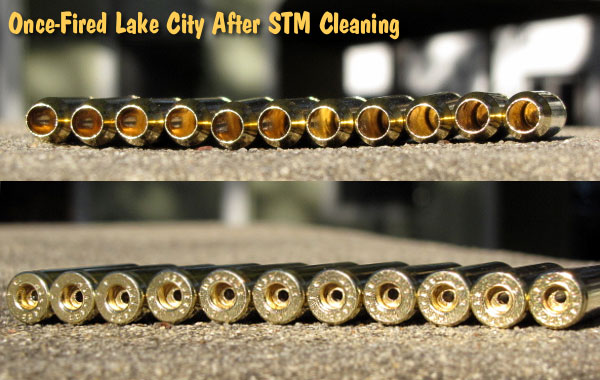
Shown below are Lake City cases after cleaning with Stainless Media (STM). Note: STM Case cleaning was done by a third party, not the USAMU, which does not endorse any particular cleaning method.
NOTE: The USAMU Handloading (HL) Shop does not RE-load fired 5.56 brass. We use virgin LC brass with our chosen primer already staked in place. However, our staff has extensive personal experience reloading GI brass for competition, which will supplement the Shop’s customary steps. In handloading, as in life, there are many ways to accomplish any given task. Our suggestions are note presented as the “only way,” by any means. Time for loading/practicing is always at a premium. Readers who have more efficient, alternative methods that maintain top accuracy are invited to share them here.
3. Inspect Every Case
Once dry, inspect each case for significant deformation (i.e., someone stepped on it), damaged mouths/necks and case head/rim damage. Some rifles’ ejectors actually dig small chunks of brass out of the case head — obviously, not ideal for precision shooting. Similarly, some extractors can bend the case rims so badly that distortion is visible when spinning them in one’s fingers. These can be used for plinking, but our match brass should have straight, undamaged rims.
Dented case mouths are common, and these can easily be rounded using a conical, tapered tool, [such as a .223 expander mandrel. A dummy 7.62 or .30-06 cartridge with a FMJ spitzer can also work.] If most of your brass is of one headstamp, this is a good time to cull out any odd cases.
4. Check the Primers Before Decapping
Your clean, dry and inspected brass is now ready for full-length sizing, decapping and re-priming. Historically, primer crimps on GI brass have caused some head-scratching (and vile language) among handloaders. Our next installment will detail efficient, easy and practical methods to remove primer crimp, plus other useful handloading tips. Until next week, Good Shooting!
Accuracy Potential of Mil-Surp 5.56×45 Brass
So, how accurate can previously-fired GI surplus brass be in a good National Match AR-15? Well, here’s a data point from many years ago that might be of interest. A High Power shooter who wrote for the late Precision Shooting magazine took a Bill Wylde-built AR match rifle to a registered Benchrest match. He had no difficulty obtaining consistent 0.5-0.6 MOA accuracy at 200 yards using LC brass and a generic “practice” load that was not tuned to his rifle.
Happy New Year to all our readers and site visitors, and especially the 81,030+ members of our AccurateShooter Forum. We hope 2026 brings you good times, fulfilment in your lives, and success in your endeavors. We also wish for high match scores, tight groups on target, and successful hunts in the New Year.
Forum Members — Upgrade Your Membership to Get Unlimited Classifieds for 12 Months.
Looking Forward to 2026 Every year we work to improve AccurateShooter.com. We have continued to upgrade the Forum, adding enhanced security measures, with background checks on all sign-ups and enhanced scammer detection. On the content side we have expanded our popular Deals of the Week and Sunday GunDay features. And we’ve added a Video Showcase every Saturday. We also now offer more product reviews in our Daily Bulletin. We hope you’ll continue to enjoy our feature articles, our Deals of the Week, our match reports, and our Forum Classifieds. The formula seems to be working — our audience is bigger than ever, with Forum membership growing substantially year after year.
Forum Membership Increased 6% in 2025
Our Shooters’ Forum grew significantly over the past 12 months. Total registered membership grew by about 6% as Forum ranks swelled to 81,030+ members! More people are successfully buying and selling through our Forum Classifieds services than ever before. Silver and Gold members get unlimited Classifieds for 12 months. Gold members also get custom Avatars and other privileges.
We need your support. For 21+ years the site has relied largely on volunteer efforts. But as the site grows, we need the assistance of Forum moderators, product testers, web gurus, and computer software experts. Those guys don’t work for glory alone.
Consider this — you could pay $30 for a couple medium pizzas. For the same thirty dollars you can become a Silver Forum member for an entire YEAR and help this site provide info, tests, tech tips, bargains, and shooting news.
And consider the benefits — Silver or Gold Members get unlimited classifieds for 12 months. If you were to sell just ONE $600 item through Gunbroker.com, you would pay $32.00 in fees! That’s more than our 12-month Silver Membership fee — just to sell one single $600.00 rifle or pistol.
In 2025 about 2650 site users have donated or upgraded their Forum membership. That’s less than 3.3% of the current membership. We thank all those who have generously contributed. But that still leaves tens of thousands of users who access the site every week without contributing. With more donations and more Forum upgrades, we can deliver more premium content and offer more services to our members.
How to Contribute
If you ARE a Forum member, you can help the site by UPGRADING your membership. CLICK HERE to UPGRADE.
If you are NOT a Forum member, you can still help by making a donation. Donating is simple and easy. Just click on the orange “Donate” button at right. If you have a credit card, you don’t need a PayPal account to contribute. Just choose the “Donate with Debit or Credit Card” Option.
IMPORTANT: After you click on the orange button a PayPal screen will load. You’ll see a field that says “$0″. Fill in the amount you want to give. For example, to give $30, type 30.00 in the amount field. You choose the amount.
Help Support this Site by Making a Secure Donation.
If You Don’t Like PayPal, You Can Send a Check.
Make the check payable to: Jeff Williams. Please list your Shooters’ Forum Log-In Name (if any), and mail the check to:
Jeff Williams
P.O. Box 240
Solon Springs, WI 54873
You’ve probably heard of cut-rifling, but did you know this process was invented in Germany nearly 500 years ago? Read on to learn more about how a cut-rifled barrel is made…
The cut-rifling process, used by leading barrel-makers such as Bartlein, Blake, Brux, and Krieger can yield a very high-quality barrel with a long useful life. Cut-rifled barrels have been at the top in short- and long-range benchrest competition in recent years, and cut-rifled barrels have long been popular with F-Class and High Power shooters.
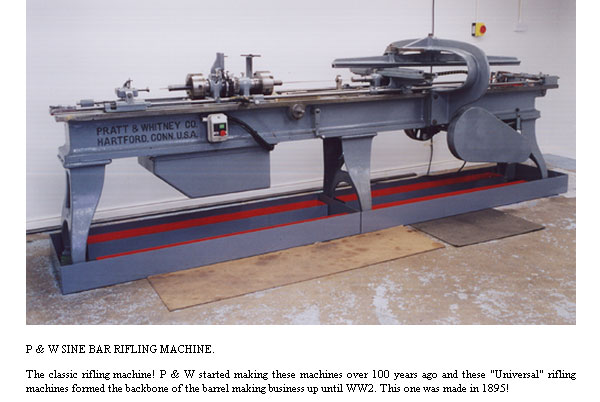
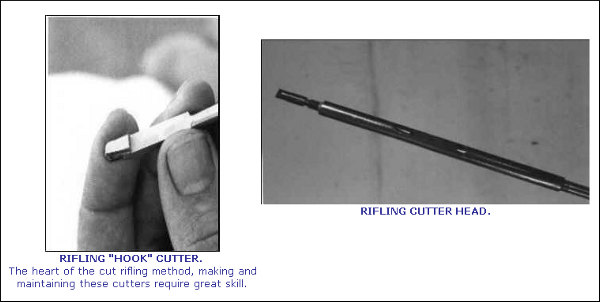
You may be surprised to learn that cut-rifling is probably the oldest method of rifling a barrel. Invented in Nuremberg around 1520, the cut-rifling technique creates spiral grooves in the barrel by removing steel using some form of cutter. In its traditional form, cut rifling may be described as a single-point cutting system using a “hook” cutter. The cutter rests in the cutter box, a hardened steel cylinder made so it will just fit the reamed barrel blank and which also contains the cutter raising mechanism.
Above is a computer animation of an older style, sine-bar cut-rifling machine. Some machine features have been simplified for the purposes of illustration, but the basic operation is correctly shown. No, the cut-rifling machines at Krieger don’t use a hand-crank, but the mechanical process shown in this video is very similar to the way cut-rifling is done with more modern machines.
Read About Cut-Rifling Process at FirearmsID.com
To learn more about the barrel-making process, and cut-rifling in particular, visit FirearmsID.com. There you’ll find a “must-read” article by Dr. Geoffrey Kolbe: The Making of a Rifled Barrel. This article describes in detail how barrels are crafted, using both cut-rifling and button-rifling methods. Kolbe (past owner of Border Barrels) covers all the important processes: steel selection, hole drilling, hole reaming, and rifling (by various means). You’ll find a very extensive discussion of how rifling machines work. Here’s a short sample:
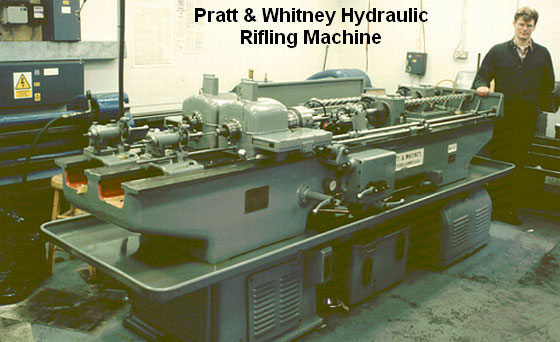
“At the start of World War Two, Pratt & Whitney developed a new, ‘B’ series of hydraulically-powered rifling machines, which were in fact two machines on the same bed. They weighed in at three tons and required the concrete floors now generally seen in workshops by this time. About two thousand were built to satisfy the new demand for rifle barrels, but many were broken up after the war or sold to emerging third world countries building up their own arms industry.
Very few of these hydraulic machines subsequently became available on the surplus market and now it is these machines which are sought after and used by barrel makers like John Krieger and ‘Boots’ Obermeyer. In fact, there are probably less of the ‘B’ series hydraulic riflers around today than of the older ‘Sine Bar’ universal riflers.
The techniques of cut rifling have not stood still since the end of the war though. Largely due to the efforts of Boots Obermeyer the design, manufacture and maintenance of the hook cutter and the cutter box have been refined and developed so that barrels of superb accuracy have come from his shop. Cut rifled barrel makers like John Krieger (Krieger Barrels), Mark Chanlyn (Rocky Mountain Rifle Works) and Cliff Labounty (Labounty Precision Reboring)… learned much of their art from Boots Obermeyer, as did I.” — Geoffrey Kolbe
Video find by Boyd Allen. Archive photos from Border Barrels in the UK.
Our friend Dennis Santiago is a talented Service Rifle shooter, who regularly competes with an AR shooting the .223 Rem cartridge. A few seasons back, he decided to go over to the “dark side”, putting together a Palma (fullbore) rifle chambered for the .308 Winchester. Dennis selected a Competition Machine (Gary Eliseo) R1 Chassis for the project. Here’s Santiago’s account of his “true blue” Palma build.
Palma Rifle Report by Dennis Santiago
“This project was a .308 Win Palma rifle with an Eliseo R1 chassis, Rem 700 action (blue-printed with PT&G upgrades), Jewell trigger, Boots Obermeyer 1:11″-twist barrel, and Phoenix sights holding Gehmann apertures. Next comes chassis and sling set-up, initial mechanical zeroing, and load development. Yup, I have a bunch of Peterson small primer .308 brass, Sierra #2156 155gr MKs, and Varget to get started with. I’m told I can drive 155gr pills to stay supersonic to 1K. Should make for an interesting 2020. My goal was to be cozy with this blue beast by the time the Berger Southwest Nationals kicked off in February 2020.”
CLICK Imagefor full-screen photo with more detail.
Pinning the Picatinny — For a Super-Solid Mount
One of the key parts of the build, Dennis explains, is mounting the top rail with pins: “Once the rail is aligned using a spin-centered optic, it locks down with three 3/16″ roll pins. That way there is no reliance on screws that can come loose. Above is a photo of the top of the Eliseo tube chassis showing the three, 3/16″ roll pins that unitize the Picatinny rail. You can also see the four brass screws that just kiss the action to fully stabilize it in the tube. The recoil ring buttresses completely around the action with metal to metal contact. There are a million details hidden inside a Gary gun.”
Phoenix Sights Front and Rear
Rise of the Phoenix — Here are the sights for the Eliseo R1. There are very few manufacturers left making these kinds of ultra-precise and repeatable iron sights.
These Ray-Vin tools help set mechanical zero on the sights. Dennis notes: “Finally a reason to pull out the Ray-Vin calibration paraphernalia to set up a mechanical zero. This photo is for all of you who still remember that those barrel flats and screws in our sight towers actually had a purpose once upon a time.”
Sling ‘N Irons — Classic Palma Configuration Dennis plans to use an Eric Hollis sling with his new blue Palma rifle.
Peterson Small Primer .308 Win Brass for Santiago’s Rig
Dennis has used Peterson Cartridge Small Rifle primer .308 Win brass. Peterson offers a “Select” version weight-sorted and length-sorted at the factory. All Select casings (in a 50ct box) are guaranteed to be within 1 grain in weight and .001″ in OAL. Peterson Select brass is available for 20 different cartridge types, including .308 Win both small primer/small flash hole and large primer/large flash hole.
Now Adapted with a Scope
Currently (in 2025) Dennis has this rifle fitted with a high-magnification Nightforce zoom scope, and he competes with his blue prone rifle in the “Any-Any” division. He usually runs the scope at about 22X power. For an older guy with aging eyes, being able to run high-magnification optics is a big plus.
With the optics Dennis has found the rifle to be exceptionally accurate. Shooting 168gr bullets it has produced 5-round groups around 1/3-MOA during testing. And it can easily hold the X-Ring at 300 yards.
Getting the Blue Rifle Ready for the Berger SW Nationals
Dennis has campaigned his rifle at recent Berger Southwest Nationals (SWN) events. At the SWN a Palma shooter can shoot iron sights, or also fit a scope and shoot in the “Any Sights” category. The week-long Berger SWN is the biggest rifle match in the Western United States. Hundreds of shooters compete in both individual and team events. The SWN begins with the Mid-Range Nationals at 600 yards. Then the Long-Range matches are held, with targets out to 1000 yards. Watch the video to see the Ben Avery facility, home of the Berger SWN:
Chassis-maker Gary Elesio at the 2017 Berger SW Nationals. Gary shoots what he sells:
One eye or two? That’s the question that confounds some pistol shooters, particularly during slow fire. When shooting one-handed, some bullseye pistol shooters use a piece of tape or paper on one lens of their shooting glasses to obscure their non-dominant eye. That way they can get a more precise sight picture. However, when shooting two-handed, it’s almost always better to shoot with both eyes open. And if you are doing a “move and shoot” session/match, you’ll surely want to have both eyes open.
Champion pistol shooter Doug Koenig says he always shoots handguns with both eyes open: “To me it’s very simple — I wouldn’t drive my car with one eye closed. I wouldn’t walk around the house with one eye closed. To me, it’s all about your vision, your depth perception.” Doug adds that you definitely need both eyes open to transition quickly from target to target.
With both eyes open you’ll have better depth perception and peripheral vision. You will also be able to transition from target to target more quickly. In a timed, multi-target stage, you’ll want to move your head/eyes to the next target right after you break a shot. You’ll find that you will then reflexively move the handgun on to the new target when you swing your vision on to it. Don’t linger on the target you just shot — move to the next.
Here are two other helpful videos from Doug Koenig and the NSSF:
Sight Alignment and Sight Picture
Trigger Press and Trigger Control
Doug Koenig’s List of Championships:
10-time World Champion
18-time Bianchi Cup winner
2016 NRA World Shooting Champion
More than 70 National Championships
6-time World Action Pistol Championship Winner
3-time World Speed Shooting Champion/Steel Challenge
Watch more excellent, informative Doug Koenig videos on KoenigShooting.com. Doug’s video features include pistol set-up, proper stance and grip, Steel Challenges tips, and even rifle setup, and PRS basics.
Bet you’ve never seen anything like this before — a “double-decker” indoor shooting range. Lotus Gunworks of Jensen Beach, Florida, operates a super-sized twin-level indoor shooting range featuring a two-story-high steel funnel bullet trap. Nicknamed the Lotus 8/11 for the number of steel panels used to create it (eight panels on the bottom slope and 11 panels on the top slope), this version of Action Target’s Total Containment Trap is the first of its kind. “No one has ever seen a range like this before” noted Lotus Gunworks’ Robbie Abell.
Abell came up with the two-story concept when it became clear that the new Lotus building in Jensen Beach was not wide enough for two side-by-side ranges AND a gun store. Necessity was the mother of invention… Lotus wanted at least two ranges, so the only option was to make a double-decker range where both levels shot into the same bullet trap.
Indoor ranges require ventilation to remove potentially hazardous dust and lead particles. The sheer size of the double-decker range presented a unique challenge, but Carey’s Small Arms Range Ventilation installed a system that can completely replace all the range air every 80 seconds.
Other Multi-Level Shooting Ranges
While the Lotus Range may have the first two-story bullet trap, it’s not really the first-ever double-decker indoor shooting range. Other multi-level ranges exist, they just don’t have the giant bullet trap. In fact, some of the multi-level ranges in Europe are bigger and even more sophisticated.
Brünig Indoor facility — Multi-Level Range Underground
Switzerland boats a popular shooting facility built completely underground. The large, deluxe Brünig Indoor facility includes a 300m underground range with multi-level shooting stations.
This video shows centerfire rifle practice on the upper level of one of Brünig Indoor’s shooting tunnels:
Dutch Double-Decker Range
Here’s a Dutch Double-Decker Range. Check out Schietsportvereniging (SSV) Katwijk, a great twin-level range in Holland featuring electronic targets with displays at each shooting station (on both levels):
Holiday Greetings to Our Readers
Merry Christmas and Happy Holidays to all our readers and especially our 80,900+ Forum Members. This marks our 21st Christmas “in business”, and the site is stronger than ever thanks to our Gold and Silver Forum members and industry sponsors. AccurateShooter.com is now accessed by over 600,000 visitors every month, who enjoy our Shooters’ Forum, Daily Bulletin, Cartridge Guides, and Feature Articles. Part of the reason for that success is the hard work of our dedicated staff and volunteer helpers.
Unsung Heroes Deserve Recognition
We acknowledge those guys who have really helped out the site. Number one is skilled F-Class shooter Praveen K. who serves as our System Admin. Along with being a talented trigger-puller, Praveen is a super-smart computer wizard who has kept our servers running smoothly and helped with vital software upgrades. We also thank Andy B., our Xenforo ace who has contributed vital Forum software solutions.
A huge “thank-you” goes to F-Class John who finds weekly bargains for the Bulletin and tests new products. John produces gear reviews for his popular YouTube Channel. A past winner of the F-Open Mid-Range National Championship, John is a top-tier shooter as well as video host. We also regularly feature videos from ace shooter Keith Glasscock, and product tests from Gavin Gear of UltimateReloader.com. We thank Boyd Allen and ELR Researcher who supply story leads for the Daily Bulletin. And we wouldn’t be here without Jeff Williams, who handles site donations by mail. We have a great place to test rifles thanks to our valued friend Joe Friedrich. Other important contributors include: Jason Baney of EuroOptic.com, Dennis Santiago, and Hunting Editor Colton Reid. All these men (and many others) have aided the site.
Praise for our Site Sponsors and Advertisers
We also want to thank our major sponsors, without whose support the site could not provide the full AccurateShooter.com experience, with an active Forum, an archive of in-depth articles, and fresh content 365 days a year in our Daily Bulletin. We’re grateful to ALL our sponsors and advertisers. In particular, we want to acknowledge the major companies which have been strong supporters of this site for many years: Capstone Precision Group (Berger, Lapua, SK, Vihtavuori), Bruno Shooters Supply, Bullet Central, EuroOptic, Graf & Sons, Midsouth Shooters, Powder Valley Inc., PMA Tools, Precision Reloading, Pyramyd Air, Whidden Gunworks, and Zeiss Sports Optics. Their continuing support helps us keep up the flow of information and serve our readers and Forum members.
Top to bottom: Remington firing pin assembly with ISS, Tubb SpeedLock alloy-composite system without ISS (current versions have dual, opposite-wound springs), and Remington short action firing pin assembly without ISS.
The U.S. Army Marksmanship Unit regularly publishes technical articles on the USAMU Facebook page. One informative USAMU article covered mechanical issues and related ignition irregularities that can cause vertical fliers even with good ammunition in an otherwise excellent rifle. We highly recommend you read this article, which offers some important tech tips.
Vertical Dispersion: Mechanical/Ignition Issues?
Poor or inconsistent ignition has long been known to be one of the “usual suspects” when one encounters vertical fliers that just shouldn’t be there. By having a sense of some of the basic principles involved, and a few basic areas to check, the shooter may avoid colsiderable frustration, not to mention time, expensive loading components and barrel wear.
Is your well-built rifle of high-quality components plagued with vertical fliers across more than 1-3 handload combinations? Consider the bedding, crown and scope/sight mounts. Are they correct? If so, then you might check for ignition issues before boldly undertaking an extensive, expensive, and quite possibly fruitless quest for the “magic handload”.
SEEING IS BELIEVING: While the author had been aware for many years that poor ignition should be considered and ruled out when dealing with vertical fliers in an otherwise-excellent rifle, actually seeing the problem and its almost instantaneous cure really drove the lesson home.
He was working with a “dot” rifle – a .22 LR match rifle that really stacked bullets into little piles at 50 yards and beyond. With one lot of ELEY Tenex, it produced consistent “bughole” groups at 50, but with another, selected lot of Tenex, similar groups were regularly ruined by single, vertical fliers that did not appear in other rifles. Rather than spending days burning up expensive, select ammunition looking for “magic lots”, he contacted a well-respected rimfire gunsmith and explained the situation.
Without so much as batting an eye, the highly-experienced ‘smith tore into the rifle’s action, and quickly found the cause(s) of the problem. He discovered a demonstrably weak firing pin spring, plus a chip out of the face of the firing pin where it contacted the cartridge rim.
After replacing and tuning the offending parts, the rifle immediately began shooting tiny, bughole groups with the previously “unacceptable” lot of Tenex. Centerfire rifles can also benefit from ensuring positive, consistent ignition. A wise riflesmith is literally worth his weight in gold!
So, what are some issues we as shooters can inspect in our rifles to help determine if ignition woes could be part of our problem? At the club level, ask yourself if that “experienced” Remington, Winchester 70, or even Springfield-based match bolt gun you’re using is still running its’ original 40-80 year-old factory striker spring? If so, a new replacement is cheap insurance against current or future problems. (And BTW, it might be best to stick to the normal, factory-spec spring weight. A super-powerful spring can cause vertical, just as a weak one one can.) Along with that, a routine check for proper firing-pin protrusion is a quick preventive measure that can rule out potential issues.
Other areas to consider are the centering and consistency of the firing pin’s operation in the bolt. Admittedly, with the increasing use of precision-machined custom actions, this is becoming less an issue every day. Below is the firing pin assembly from a custom BAT action:
However, particularly with factory actions, a very quick and easy check is to remove the bolt, let the firing pin go forward, and look at the firing pin tip through the firing pin hole. Is the tip off-center in the hole, and possibly striking it as it moves forward? Is the hole out-of-round or burred from being struck repeatedly? If so, a trip to the riflesmith is likely in order.
Similarly, machining issues in the bolt/firing pin system can lead to rough and erratic firing pin movement, in which the firing pin drags against an internal surface of the bolt. In high-quality rifles these issues are relatively rare, but not unheard-of, and it takes mere minutes to rule them out. It may be worthwhile to remove the cocking piece/firing pin/spring assembly and look for any unusual gouges, dings, peening, burrs or signs of abnormal wear.
This task is especially easy with Winchester 70s, Springfields, and the similar Mauser 98s, involving little more than the push of a button and unscrewing the cocking piece assembly. This is just one of the many reasons these tried-and-true actions have earned such a loyal following in the field, among hunters who must maintain their rifles away from a shop.
Particularly with older rifles, watch for and remove excess grease (or even Cosmoline!) from both the firing pin assembly and inside the bolt. This can help improve firing pin speed and consistency. Other bolt-action designs may need a take-down tool or other measures.
As part of this inspection, AFTER ENSURING THE RIFLE IS UNLOADED, slowly cock the rifle, dry-fire, and repeat several times. Listen carefully near the action for inconsistency in the sounds it generates. Does the striker falling make the same sound each time? Do you hear or feel grinding upon operation? If so, where?
Be sure to check the operation of the cocking piece (bolt shroud), firing pin within the bolt shroud, the cocking piece cam and the rear of the bolt body where the cocking piece cam operates. As with our examination for abnormal wear marks discussed above, look for marks indicating roughness or a possible need for light polishing. Then, clean and lightly grease the bearing surfaces while you’re at it.
Remington 700 bolt shroud and cocking cam
These are relatively easy checks that shooters can undertake to perform a preliminary inspection on their own. Other mechanical issues can also cause ignition issues, chiefly centered around the action of the trigger, sear and sear spring. If these are suspected, a trip to an experienced, qualified riflesmith for diagnosis is recommended. We hope you find this information helpful! Join us again next week, and in the meantime, enjoy the shooting sports safely!
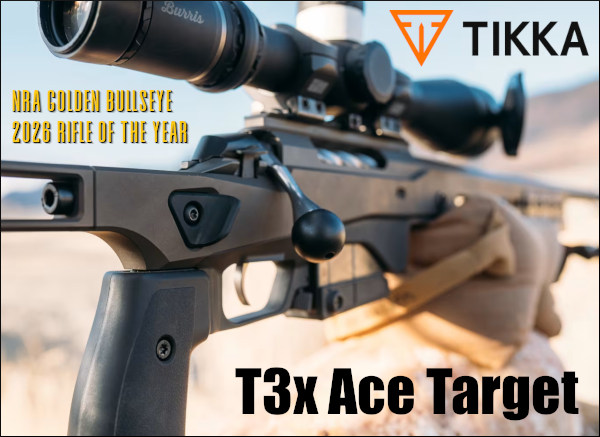
The Tikka T3x Ace Target was named the 2026 American Rifleman Golden Bullseye “Rifle of the Year”.
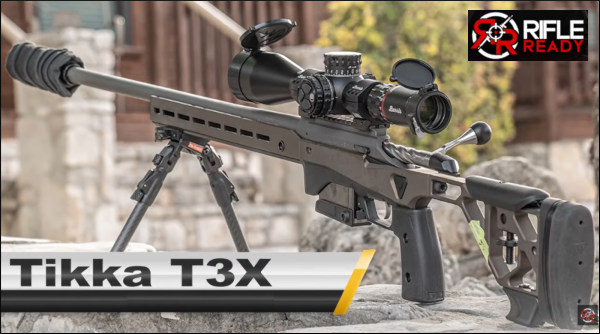
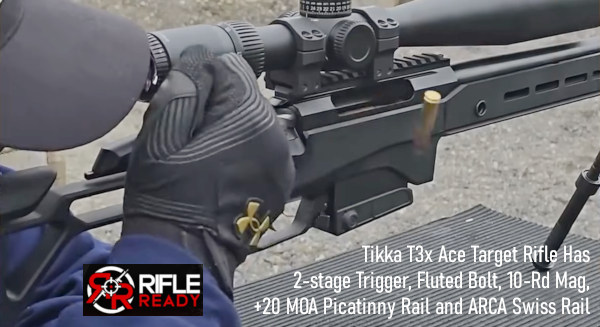
The Tikka T3x ACE Target rifle has been named the 2026 American Rifleman Golden Bullseye Rifle of the Year, a highly coveted award presented annually by NRA Media. This impressive factory rifle is a great choice for PRS/NRL competition. It boast a good chassis with full-length ARCA rail, modular magwell, and adjustable cheekpiece. The action is smooth with a nice fluted bolt and big bolt handle knob. On top of the action is a +20 MOA Picatinny rail which helps with long-range shooting. This rifle has shown very good accuracy with factory ammo, aided by an excellent 2-stage trigger that adjusts from 2 to 4 pounds.
Available chamberings are .223 Rem, 6.5 Creedmoor, and .308 Win with prices starting at $1799.00 at EuroOptic.com. The 6.5 Creedmoor with 26″ barrel would be our choice for PRS/NRL competition.
SPECIAL REPORT: NEW Tikka T3x Ace Target Rifle for PRS/NRL
Tikka is best known for its rugged and accurate hunting rifles. But recently Tikka has introduced an impressive new line of T3x Ace Target chassis rifles. These 10.6-lb rigs have impressive alloy chassis stocks, with modular M-LOK and Arca-Swiss compatible fore-ends, and interchangeable magwells. Optimized for PRS/NRL competition, the Tikka T3x Ace Target has a fine 2-stage adjustable trigger, plus a rear stock section with adjustable cheek-piece and nicely-designed attached lower bag rider. NOTE: Tikka also offers the rimfire .22 LR Tikka T1x Ace Target rifle for practice and competition. This is cool because NRL-22 Matches are now very popular.
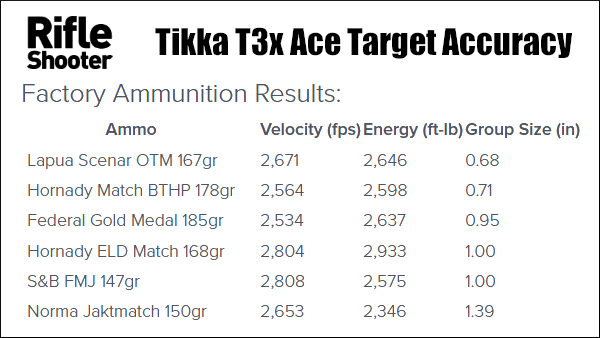
Accuracy Testing Results Rifle Shooter, a leading UK gun publication, did extensive accuracy testing of the Tikka T3X Ace Target. This testing is featured in the above video. Shooting from a bench with rear bag and front tripod, the test rifle delivered MOA (or better) accuracy with five out of six types of factory ammo. The best group, 0.68″ for 5 shots, was shot with Lapua ammunition with 167gr Scenar bullets. Here are the test results:
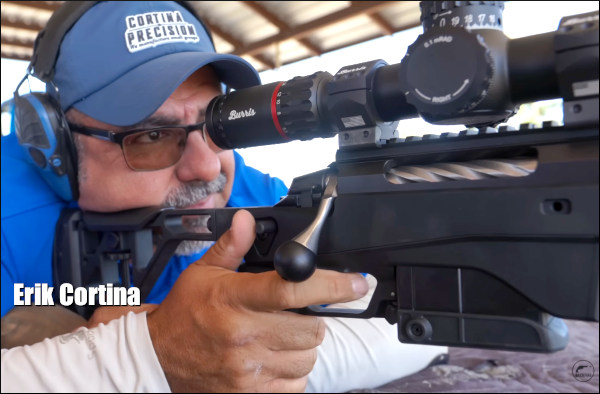
In another test of a Tikka T3X Ace Target, top F-Class shooter Erik Cortina achieved half-MOA or better groups with SAKO 6.5 Creedmoor ammo. Watch Erik shoot the Tikka T3x Ace Target in the video below, starting at 8:22 time-mark.
Tikka T3X ACE Target Rifle Features
2-Stage Adjustable Trigger (2-4 lbs)
Spiral-fluted Bolt with Coned Head
+20 MOA Picatinny Scope Rail
Free-floating Hammer-Forged Barrel
Adjustable Cheekpiece and Buttpad
10-shot steel CTR/Tac-style Magazines
23.6″ or 26″ Heavy Barrels with 5/8″-24 threaded muzzles
Full-length RRS ARCA Swiss Rail with barricade stop, M-Lok & QD Sling Mounts
Optional Factory External and Internal Weights
Two Colors: Black or Cerakote Midnight Bronze
Optional Cerakote coating
According to Rifle Ready: “The new Tikka T3X Ace lineup exploded out of SHOT Show 2025 and instantly became one of the most talked-about precision rifles of the year — and for good reason. With multiple testers recording sub-half MOA groups and even extended 15-shot strings under 1 MOA, the Ace is delivering near-custom accuracy right out of the box. Built on the legendary T3C action and paired with a full competition-ready chassis, the Ace Target and Ace Game rifles blend Finnish craftsmanship with modern modularity in a way Tikka fans have waited years for.”
Want to learn more? A Rifle Ready video released this month showcases Tikka T3X features. It covers real-world accuracy tests, reviewer impressions, and the differences between the Target and Game variants. This video does help explain why some shooters say the Ace “beats rifles triple its price”.
In promoting its rifle, Tikka posted: “The T3x Ace Target, crafted with Tikka’s legendary attention to detail, was developed for precision shooters seeking an out-of-the-box competition-ready platform. With its optimized barrel profile, enhanced ergonomics, and refined trigger system, the Ace Target embodies the advanced engineering and shooter-focused design Tikka is known for.” The video below features a test of the .223 Rem variant.
NRA Media has announced the winners of the 2026 NRA Golden Bullseye Awards. Now in their 24th year, the Golden Bullseye Awards recognize outstanding innovative firearms, optics, shooting products, and ammunition. And there are also Golden Bullseye Awards for top shooters and for individuals who support the gun industry and Second Amendment rights.
Every year the NRA announces Golden Bullseye Award winners for various product categories (rifle, shotgun, handgun, optics, accessories, gear etc.). These awards are like the Oscars for the shooting industry. There are separate Golden Bullseye prizes awarded by different NRA Magazines — including American Rifleman, Shooting Sports USA, and American Hunter. The 2026 Golden Bullseye Awards will be officially awarded during the April NRA Annual Meetings & Exhibits in Houston, Texas.
Golden Bullseye product awards are selected by the staff of the NRA’s American Rifleman and American Hunter magazines, with multiple categories recognized by each magazine. The selections are then reviewed by NRA Media management. To qualify for consideration for a Golden Bullseye Award, the product must have been: 1) Recently introduced; 2) Innovative in design/function; 3) Tested by a NRA Magazine/media staffer; 4) Reliable in the field; 5) Recognized as good value; and 6) Styled in a manner “befitting the shooting and hunting industry”.
American Rifleman 2026 Golden Bullseye Product Awards
The Tikka T3x Ace Target rifle is an affordable tactical rig capable of winning PRS and NRL matches right out of the box. It is offered in three chamberings: .223 Rem, 6.5 Creedmoor, and .308 Win. Two barrel lengths are available: 23.6″ and 26.0″. Standard features include two-stage trigger, adjustable cheekpiece, and forearm rails. The Tikka T3x Ace is available for $1799.00 – $1959.00 at EuroOptic.com.
In this video (above), our friend Erik Cortina tests the Tikka T3x Ace Target rifle, shooting from 100 to 1000 yards. The 6.5 Creedmoor T3x showed superb accuracy with Sako TRG Precision factory ammo. Erik stated he was “very impressed” (2:30 time-mark).
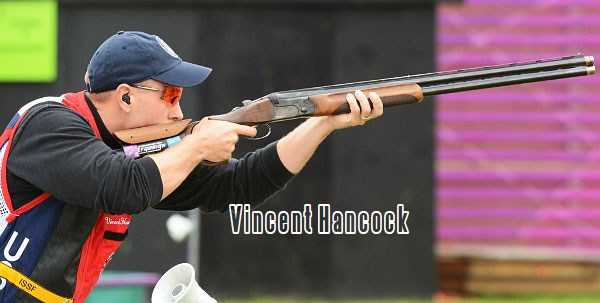
The 2026 Shooting Sports USA Golden Bullseye Competitor Award goes to four-time Olympic Gold Medalist Vincent Hancock. He has been one of the greatest skeet shooter in history. He is also recognized for coaching and mentoring Team USA shooters.
The NRA Media 2026 Golden Bullseye Freedom Award goes to noted attorney, scholar, and author Stephen P. Halbrook. In his legal practice Halbrook has won cases before the U.S. Supreme Court, and his scholarship has contributed to Second Amendment historical knowledge.
The NRA Publications 2026 Golden Bullseye Pioneer Award recipient is Anthony Imperato, the founder and President of Henry Repeating Arms. Imperato has been a strong supporter of the NRA and the Second Amendment rights.
The 2026 Golden Bullseye Woman of the Year winner, nominated by the editors of NRA Women.com, is Tanisha Moner. As a dedicated instruction, Tanisha brought firearms training to thousands of women through the Legally Armed in Detroit (L.A.I.D.) organization.













 Holiday Greetings to Our Readers


 Is your well-built rifle of high-quality components plagued with vertical fliers across more than 1-3 handload combinations? Consider the bedding, crown and scope/sight mounts. Are they correct? If so, then you might check for ignition issues before boldly undertaking an extensive, expensive, and quite possibly fruitless quest for the “magic handload”.