|
|
December 30th, 2009
 There is, understandably, quite a bit of confusion concerning caliber limitations for Palma rifles and Palma competition. Some folks say you can shoot a .308 Winchester (or 7.62 NATO) with a bullet weight up to 156 grains. Others say you can shoot a .308 Win (or 7.62 NATO) with any bullet weight. Still others opine that you can shoot EITHER a .223 Rem (5.56×45) or a .308 Win (or 7.62 NATO).
So who is right? Well, all these viewpoints are correct in part. That’s because different rules apply in different venues. In most, but not all United States Palma competitions, you can shoot either a .223 Rem or .308 Win with no restriction on bullet weights. In some U.S. Matches, most notably the Spirit of America, certain prizes are limited to .308s with 156gr max bullet weights OR .223s with 81gr max bullet weights. What’s the bottom line? In most USA Palma competitions you can shoot either a .308 or a .223 with no limit on bullet weight. In International Palma competitions you can shoot either a .308 or a .223 but the max bullet weight is limited.
Applicable Rules for NRA Palma Competition
To help clarify the Palma rules, German Salazar has collected the applicable NRA and international rules which govern Palma and iron-sights fullbore competition. First, German explains: “The Palma Rifle is defined by NRA High Power Rule 3.3.3″ which states:
3.3.3 U.S. Palma Rifle:
(a) A rifle with metallic sights chambered for the unmodified .308/7.62 or
.223/5.56 NATO cartridge case. Rifles which also meet Rules 3.1 (.308 only)
or 3.1.1 (.308 only) are authorized.
(b) A rifle with metallic sights chambered for the unmodified .308/7.62 NATO
cartridge case. Rifles which also meet Rules 3.1 (.308 only) or 3.1.1 (.308
only or 3.1.2 (.223 only) are authorized.
German tells us: “The references to Rules 3.1, 3.1.1 and 3.1.2 apply to the M1, M14 and M16 rifles or civilian equivalents thereof. Accordingly, Palma Division ‘A’, which is how all matches other than the National Matches are fired, allows any rifle chambered in .308 or .223 with metallic sights. Palma, Division B, which is rarely seen outside the Nationals, is a separate award category for the service rifle in a Palma match.”
German notes that: “In all instances, there is no restriction on bullet weight, rifle weight or trigger weight of pull. All of these are unrestricted. The rules specify that the rifle must be chambered for the unmodified .308 or .223 “cartridge case” but if the chamber has, for instance, a longer than standard throat to accomodate a heavier bullet, that is acceptable.”
CLICK HERE to download NRA High Power Rules Book (PDF File)

NEW NRA Fullbore Rules and International Rules
A few matches are run under the new NRA Fullbore Rules which are meant to align the USA with the rules observed in other nations competing in similar matches. The most notable of these is the annual Spirit of America Match which is also the Fullbore National Championship. The Grand Aggregate prize of the Fullbore National Championship is restricted to those competitors firing the International Target Rifle.
Under the Fullbore Rules, there are two categories of rifle, the Target Rifle, which is the same as the High Power Palma Rifle, and the International Target Rifle, which is compliant with the rules of most other nations. The International Target Rifle has restrictions on trigger weight of pull, but no restrictions on overall rifle weight. Additionally, there is an ammunition restriction which limits the weight of the bullet to 156 grains for the .308 and to 81 grains for the .223; this restriction applies to both Target Rifle and International Target Rifle categories. The applicable rules are listed below.
CLICK HERE to download NRA Fullbore Rule Book (PDF File)
3.3.5 Target Rifle:
(a) A rifle with metallic sights chambered for the unmodified .308/7.62mm
cartridge case. This rifle has no restrictions regarding weight of the rifle
or trigger, However, the trigger must be safe.
(b) A rifle with metallic sights chambered for the unmodified .223/5.56mm x
45 cartridge case. This rifle has no restrictions regarding weight of the
rifle or trigger. However, the trigger must be safe.
3.3.6 International Target Rifle:
(a) A rifle with metallic sights chambered for the unmodified .308/7.62mm
cartridge case with a minimum trigger weight of 0.5 kilograms (approximately
1.1 pounds and the total weight of the rifle is unlimited. OR…
(b) A rifle with metallic sights chambered for the unmodified .223/5.56mm
cartridge case with a minimum trigger weight of 0.5 kilograms (approximately
1.1 pounds) and the total weight of the rifle is unlimited.
3.17 Ammunition:
(a) Target Rifle / International Target Rifle — .308/7.62mm NATO with a
maximum permitted bullet weight of less than 156 grains or .223/5.56mm x 45 NATO with a maximum permitted bullet weight of less than 81 grains.
December 15th, 2009
 On the GunsandHunting.com (Shooting Illustrated) website, you’ll find a well-written, in-depth review of the updated Accuracy International AE MKII rifle in .308 Winchester. (The MKII title means the rifle has a threaded barrel with brake.) The reviewer, Steve Adelmann, is a former Army sniper, so he certainly knows his tactical rifles. Adelmann praised the rifle’s ergonomics and folding stock. He also said the detachable mag system is one of the best available: “AI’s rifles also allow the magazine to be pushed straight into and dropped from the magazine well[.] The feeding and function of the five- and 10-round magazines were flawless during my evaluation, totaling 230 rounds.”
We often hear claims about tactical rifles delivering “benchrest-quality accuracy” when shot from bipod with factory ammo. We always take such reports with a grain of salt. For this article, at 100 yards, Adelmann tested two types of factory ammo, and three sets of handloaded ammo. The average accuracy of ALL the ammunition, based on five, 5-shot groups for each type, was right around one MOA (see chart).

We’re pleased Adelmann published honest results with five groups per load. Some testers will only shoot one or two 3-shot groups, which can give a false impression of the rifle’s true accuracy. Adelman writes: “The rifle still managed sub-MOA performance with the best factory ammo and handloads averaged together for all distances.”
CLICK HERE for full Accuracy Int’l AE MK II Review
Photos and Charts © 2009 National Rifle Association
December 1st, 2009
 |
The latest issue of Target Shooter online magazine has been released and you should definitely check it out. The December issue of Target Shooter is really good — maybe the best yet. READ it here: www.Targetshooter.co.uk.
This month you’ll find an outstanding article by Vince Bottomley, “Building a Rifle for F/TR Class”. Whether you’re shooting F-TR now, or have an F-TR rifle in the works, this story is a “must-read” that will help you choose the right equipment and wring the best performance from it.
The six-page “Hand-loading for the .308 Winchester (Part 2)”, by Laurie Holland, is a fact-filled article that all .308 shooters shoot read and archive. Holland carefully measured various brands of .308 brass, recording weights and neck thickness (see chart below). Even if you are an experienced .308 reloader we guarantee you’ll learn something new from this article. |

The December Target Shooter is chock full of other content covering a wide array of shooting disciplines — from Air Pistols to Black Powder Cartridge Rifles. There’s even something for collectors of historic military arms — Nigel Greenaway’s guide to the Enfield No.4 (T) sniper rifle. This issue also includes a 6-page holiday shopping guide featuring interesting new products as well as low-cost “stocking stuffers”. You can read Target Shooter online via a browser plug-in, and print pages you want to save. In addition, you can now downline the entire month’s content as a handy .pdf file for off-line reading.

November 29th, 2009
 We know that the Daily Bulletin has been heavy with sale notices lately. Rest assured that there has NOT been a fundamental shift in our editorial mix. It’s just that there are some very attractive, but short-lived deals that expire on 11/30/2009, including 10% off at Brownells and Sinclair Int’l. We don’t want you guys to miss out. Also, the Black Friday/Cyber Monday promotions have lowered prices dramatically on some really good stuff. For example, the Samsung netbook I use with my ballistics program, target cam, and PVM-21 chronograph, is $85 cheaper than it was a month ago. The Garmin nüvi 255w GPS, the same unit Jason uses, is now $40 less than in October. So enjoy the deals while they last. You snooze, you lose.
November 25th, 2009
Writer David Fortier recently conducted an extensive torture test of AR15 magazines — both polymer and metal-bodied. Fortier’s test results, some of which may surprise you, are found in David’s article “Feeding Your AR”, published in the latest (November 20, 2009) edition of Shotgun News.
 Fortier tested a variety of popular AR mags including PMAG, Tango Down, CProducts SS, Brownells, Bravo Company, Lancer, MSAR, and Tapco. The “torture tests” included dropping the mags on their feedlips from 8.5 feet, driving a full-size army truck over the mags, jumping on the mags, and deliberately tilting the followers. The mags were also tested for fit and function with live-fire shooting. Results were a little surprising. When dropped from 8.5 feet on their feedlipgs, the Tango Down, PMAG and TAPCO all split down the spine. CLICK HERE for Test Photos.
The Lancer L5 model seemed to be the toughest magazine tested, and Fortier noted how the “old-fashioned” aluminum mags did surprisingly well. Lancer L5 magazines have “see-through” translucent polymer bodies (similar to Sig 55X series magazines). In addition, the Lancers feature teflon-coated, hardened steel feed lips, and a rubber-coated “bumper bottom”. Lancer L5s are offered in 20-round, 30-round, and 48-round capacities. The 48-rounder employs a special coupler to provide super-high capacity for 3-gun comps. Below is a Lancer-produced video showing the L5s being dropped from 5 feet (on both base and feed lips) without injury.
Fortier, posting on AR15.com concluded: “PMAGs are very good, but not as indestructible as some think. Aluminum mags are not as bad as some think. You should consider checking out Lancer’s mag…they surprised me. If MSARs mag dropped free they would be an interesting option. Dropping mags onto cement is A LOT tougher on them then running them over with a SUV…. but all those videos from the various mag companies sure did work wonders for advertising didn’t they?”
 Old Metal 20s — Still Best Match Mag?
Editor’s NOTE: I won’t speculate as to the best 30-round magazine for field and military use. But in all the ARs I’ve owned, and most of the AR target rifles I’ve shot, the best magazine for Bench use and High Power Match use was the old 20-round straight aluminum mag with silver-colored metal follower. These 45-year-old mags seem to work perfectly, even when the gray powder-coat has worn off in spots revealing a dull brass color underneath. The silver metal follower still works better than most of the new “no-tip” polymer followers.
There may be better 20-round polymer mags today, but match shooters won’t go wrong with the original metal-bodied straight 20s with metal followers. I’ve bought, sold, and traded many AR mags over the years — and my old GI metal 20s are the only ones I’ll never sell.
November 25th, 2009
Free Recent Sample Issues to Review
Wolfe Publishing offers FREE, downloadable partial samples of the January 2010 issue of Rifle Magazine and the December 2009 issue of Handloader Magazine. (Note: these are fairly large, 4-5 megabyte .pdf files.) The Rifle magazine sample spotlights Volquartsen’s Evolution varminter. The Handloader sample issue has a nice story on Black Powder Cartridge Rifle (BPCR) Silhouette, plus a full feature on the unusual 22 Jet cartridge.
FREE Hard Copy Samples Also Offered
You can also order FREE sample hard-copy issues of Rifle Magazine, Handloader Magazine, and Successful Hunter magazine. You can request up to one (1) issue each. Just supply your name and address on the Hardcopy Sample Order Page. The full copies of recent issues are both worth a read. The latest issue of Rifle magazine has a good story on the Volquartesen Evolution varmint rifle. The Dec/Jan Handloader includes a fascinating “Cast Bullet Myth Busting” article, plus a guide to powders for the 220 Swift.
November 24th, 2009
 Hornady recently announced its new line of Superformance Hunting Ammo. Loaded with GMX solid bullets and SST jacketed bullets, the new ammo is faster than conventional hunting ammunition. Hornady claims that, “across the board”, Superformance ammo is 100-200 fps faster than other factory hunting ammo with similar bullet weights.
We had a lengthy discussion yesterday with Dave Emary, Hornady’s Senior Ballistician. Dave shared some of the secrets of the new Superperformance ammo, and explained how Hornady is achieving such high velocities. The key, as we suspected, is that Hornady is using new propellants — powders that are not yet available for sale. These new propellants are BALL POWDERS custom-made to Hornady’s specs. Hornady actually commissioned multiple new spherical formulations, in various speed ranges. Then Hornady blends these ball powders to suit particular cartridges and loads. So, each type of Superformance ammo (e.g. 243 Win with 95gr SST and 300 Win Mag with 165gr GMX) represents a custom blend of the new ball propellants of various burn ranges. Hornady tailors the powder blend to achieve maximum velocity, accuracy, and low temp sensitivity for each load.
Hornady is NOT using Alliant’s Reloder 17. However, in some respects, Hornady’s new ball powders behave like Reloder 17 — by “flattening the right side of the pressure curve”. Rather than hitting a high peak pressure and then dropping off dramatically in energy, Reloder 17 sustains high pressure behind the heel of the bullet for a longer in-barrel time. Hornady’s new powders do the same thing — they deliver high energy behind the bullet for more milliseconds as the bullet travels down the bore. This is the main reason Superformance ammo delivers high velocity — the new powders are maintaining higher energy levels for a longer period of time. Additionally, being ball powders that pack tightly, the new propellants can be loaded to a high density in the case — an advantage with medium-sized cartridges such as the 6.5 Creedmoor.
| Here is how Hornady has achieved high velocities with its new Superformance ammunition:
1) Superformance ammo uses advanced new Ball Powders (not yet for sale).
2) The powders are BLENDED, with different “recipes” for different cartridges.
3) The new powders maintain high-energy longer in barrel (like Reloder 17).
4) The new powders burn almost completely, reducing ejecta, for less exit pressure, and less felt recoil.
5) Superformance ball propellants pack very densely, so more grains of powder can fit inside a case, compared to typical extruded stick powders. |
 High Progressivity Powders
In addition to high sustained energy, Emary noted, the new propellants exhibit very high “progressivity”. What this means, in practical terms, is that the new propellants achieve almost 100% burn by the end of the cycle. So, virtually all of the mass of the powder has changed to gas by the time the bullet exits the muzzle. As a result, Emary explained “with Superformance propellants you have less ejecta leaving the muzzle. With some other extruded powders, you’ll get unburned or partly burned sticks leaving the muzzle”. Why does that matter? Dave explains there are a couple major benefits to high progressivity. First, you get “every last ounce of energy” out of each powder kernel. Second, because less unburned ejecta is driven out the barrel, the amount of recoil is reduced, particularly for the large magnum cases.
Dave explains: “In the past, small arms performance has been limited by the powder’s ability to completely burn by the time the bullet exits the muzzle. To attempt to get higher performance, high charge weights of a slow burning powder were used to attempt to maximize muzzle velocity. Powders were not progressive enough to allow these heavy charges of slow powder to be completely burned by the time the bullet left the muzzle, especially with lighter-weight bullets. The end result was very modest increases in velocity with heavy recoil and many times unacceptable accuracy. Superformance powders solve this problem because of their ability to completely burn by bullet muzzle exit…. This results in a much higher percentage of the available powder energy being transferred to the projectile, rather than being blown out the end of the barrel as unburned powder[.]”
In practical terms, Emary stated, the high energy and high progressivity of the new propellants permit many cartridges to deliver “real-world” performance equaling that of larger cartridges loaded with conventional powders. For example, according to Dave, “the 6.5 Creedmoor is performing on a par with a Rem .260.” Dave cited the example of his own 6.5 Creedmoor hunting rifle: “It shoots as flat as a .260 and the accuracy is as good or better.”
Dave has authored a detailed report that shows how 30-06 Superformance ammo can match the velocities of Hornady’s “light magnum” 30-06 ammo loaded with conventional powders. The Superformance 30-06 achieved similar velocities, with equivalent peak pressures, while using 6 grains less powder. This is illlustrated in the graph below.
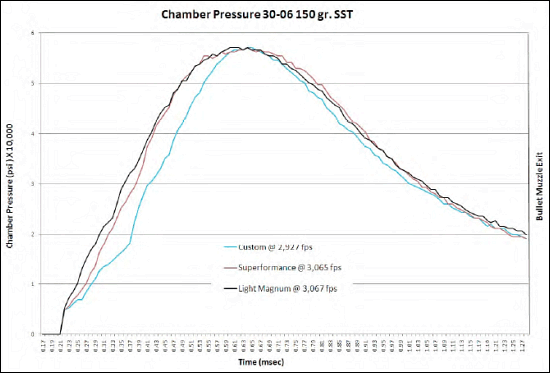
Dave’s report states: “[The chart] shows a comparison of Chamber Pressure vs. Time for Custom, Superformance and Light Magnum ammunition in 30-06 loaded with a 150 gr SST bullet. As can be seen from the graph, all loads produced approximately the same pressure but have widely different charge weights and velocity performance. There is considerably more area under the curve for both Superformance and Light Magnum. This is where the increase in performance comes from. One detail to note is that the Superformance chamber pressure has dropped to at or below that of the Custom ammunition by the time the bullet exits the muzzle. This shows the highly progressive burning characteristics of the powder and its ability to completely burn. As noted above, the charge weights which go along with the different loads and the performance achieved with them are quite different. Custom is loaded with 58.5 grs of powder, Superformance 61.0 grs and Light Magnum 67.0 grs. Superformance ammunition produces significantly higher velocities than Custom with only a small amount more powder and the same velocity as Light Magnum with significantly less powder.”
Superformance Ammo for Match Shooters May Be Next
Right now Hornady is marketing its Superformance line as hunting ammunition only. However, Hornady recognizes that the new propellant technology could benefit match shooters as well. Dave told us that Hornady has begun development of a 6.5 Creedmoor Superformance round using the 140gr A-Max bullet.
November 22nd, 2009
 David “Dirt” King, the owner of Midsouth Shooters Supply, is profiled in American Rifleman’s December 2009 issue. King has a fascinating personal background. Dirt King was raised near Reelfoot Lake and the Mississippi River in the northwest corner of Tennessee, and spent several years as a singer and keyboard player in nationally-known touring and recording bands. In his early teens he started off in rock bands, and later performed with big name country stars like Hank Williams Jr., and Carl Perkins. CLICK HERE to read article.
After his early career as a musician, King became a professional hunting and fishing guide in Tennessee. His guiding experience gave him insight into the outdoor industry and the gear that worked best for real hunters and anglers. Armed with that knowledge, King purchased Midsouth Shooters Supply in 1995 (the company was founded in 1969). King has built Midsouth into one of the nation’s most successful outdoor enterprises (and one that has supported 6mmBR.com from the very beginning). His company now boasts over 30 employees, who sell, pack, and ship millions of dollars of merchandise every month. Somehow, Dirt King also finds time to produce and co-host the popular Hunting University TV show.

You can read more about David “Dirt” King in Jim Wilson’s article profiling Midsouth’s owner. And in case you’re curious about the “Dirt” nickname, King told Wilson that, “That’s just a name that I got when I was a kid, and I’ve never been able to get loose from it.”
November 11th, 2009
On the 11th hour, of the 11th day, of the 11th month of 1918, bugle calls signaled the ‘cease fire’ ending the First World War. (The official Armistice was signed earlier that morning.) To those who endured it, WWI was the “Great War”, “the War to End All Wars.” Tragically, an even greater conflict consumed the world just two decades later.
Today, 91 years after the end of WWI, Americans mark the anniversary of the WWI Armistice as “Veterans Day”. In Canada it is known as Remembrance Day. On this solemn occasion we honor all those who have served in the military in times of war and peace. While more WWII veterans pass away each year, there are still over 23 million veterans in the United States. Take time today to honor those soldiers, sailors, and airmen who have served their nation with pride. Today we remember that… “All gave some, and some gave all.”

Former Secretary of Veterans Affairs Dr. James Peake asked Americans to recognize the nation’s 23.4 million living veterans and the generations before them who fought to protect freedom and democracy: “While our foremost thoughts are with those in distant war zones today, Veterans Day is an opportunity for Americans to pay their respects to all who answered the nation’s call to military service.” Major Veterans Day observances are scheduled at 33 sites in 20 states.
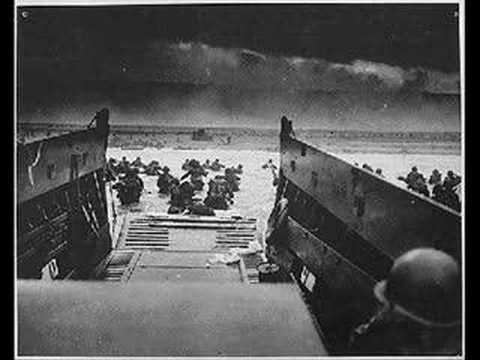
On Veterans Day we especially need to remember the seriously wounded combat veterans. These men and women summon great courage every day to overcome the lasting injuries they suffered in battle. CLICK HERE for inspirational profiles of wounded vets who, through courage and determination, have learned to adapt to their disabilities. Some of these soldiers have lost limbs, yet volunteered to return to combat duty. That is dedication beyond measure.
November 11th, 2009
4,734,991 Americans served in uniform during World War I. They fought on land and sea, in the first true global conflict. By the end of WWI over 15,000,000 soldiers and civilians worldwide had died in that conflict, including 120,000 Americans (as many from disease as from wounds). A thousand U.S. Soldiers died every DAY in the 3-week Meuse-Argonne offensive.
Frank Buckles — The Last Doughboy
This past July, Britain’s Harry Patch died at age 111. Patch had been the oldest soldier-survivor of the “War to End All Wars.” Now American Frank Woodruff Buckles, 108, Britisher Claude Choules, 108, and Canadian John Babcock, 107, stand as the last known veterans of World War I. Buckles lives quietly on a farm in West Virginia. He still remembers his service in the Great War, explaining why he joined the Army at age 16: “When your nation calls,” Buckles said, “you have to go”. (Read recent interview.)
Now, 91 years since the end of WWI, 108-year-old Army veteran Frank Buckles is our last living link with the American “Doughboys” who fought in Europe. His story is a profile in patriotism (and youthful exuberance). When only 16 years old, he tried to enlist in the U.S. Marines. They turned him down, so he joined the Army, lying about his age. He served in Britain and France as an ambulance driver, then helped escort German prisoners home to Germany after the surrender.
 
Following WWI, Buckles wanted to see the world, so he took work with a steamship company. That job placed him in the Philippines when the Japanese invaded. He was captured and interred in a prison camp for three years before being liberated. Below is a CNN feature on Frank Buckles. As all other American WWI vets have passed away, Buckles was honored as the last U.S. Soldier to fight in the “Great War”. To learn more about Frank Buckles and his experiences in WWI, CLICK HERE for a USAToday Feature Story. (Highly recommended–worth reading.)

|


