In discussions of ballistics, you’ll see references to “tangent”, “secant”, and “hybrid” bullet shapes. We know that, for many readers, these terms can be confusing. To add to the confusion, bullet makers don’t always identify their projectiles as secant or tangent designs. This article provides a basic explanation of tangent, secant, and hybrid ogive bullet designs, to help you understand the characteristics of these three basic bullet shapes.
Tangent vs. Secant vs. Hybrid
Most match bullets produced today use a tangent ogive profile, but the modern VLD-style bullets employ a secant profile. To further complicate matters, the latest generation of “Hybrid” projectiles from Berger Bullets feature a blended secant + tangent profile to combine the best qualities of both nose shapes. The secant section provides reduced drag, while the tangent section makes the bullet easier to tune, i.e. less sensitive to bullet seating depth position.
Berger Bullets ballistician Bryan Litz explains tangent and secant bullet ogive designs in a glossary section of his Applied Ballistics website, which we reprint below. Bryan then explains how tangent and secant profiles can be combined in a “hybrid” design.
How Bullet Ogive Curves are Defined
While the term “ogive” is often used to describe the particular point on the bullet where the curve reaches full bullet diameter, in fact the “ogive” properly refers to the entire curve of the bullet from the tip to the full-diameter straight section — the shank.
Understanding then, that the ogive is a curve, how is that curve described?
LITZ: The ogive of a bullet is usually characterized by the length of its radius. This radius is often given in calibers instead of inches. For example, an 8 ogive 6mm bullet has an ogive that is a segment of a circular arc with a radius of 8*.243 = 1.952”. A .30-caliber bullet with an 8 ogive will be proportionally the same as the 8 ogive 6mm bullet, but the actual radius will be 2.464” for the .30 caliber bullet.
For a given nose length, if an ogive is perfectly tangent, it will have a very specific radius. Any radius longer than that will cause the ogive to be secant. Secant ogives can range from very mild (short radius) to very aggressive (long radius). The drag of a secant ogive is minimized when its radius is twice as long as a tangent ogive radius. In other words, if a tangent ogive has an 8 caliber radius, then the longest practical secant ogive radius is 16 calibers long for a given nose length.”
Bryan Litz Explains Hybrid Design and Optimal Hybrid Seating Depths
Ogive Metrics and Rt/R Ratio
LITZ: There is a number that’s used to quantify how secant an ogive is. The metric is known as the Rt/R ratio and it’s the ratio of the tangent ogive radius to the actual ogive radius for a given bullet. In the above example, the 16 caliber ogive would have an Rt/R ratio of 0.5. The number 0.5 is therefore the lowest practical value for the Rt/R ratio, and represents the minimum drag ogive for a given length. An ogive that’s perfectly tangent will have an Rt/R ratio of 1.0. Most ogives are in between an Rt/R of 1.0 and 0.5. The dimensioned drawings at the end of my Applied Ballistics book provide the bullets ogive radius in calibers, as well as the Rt/R ratio. In short, the Rt/R ratio is simply a measure of how secant an ogive is. 1.0 is not secant at all, 0.5 is as secant as it gets.
Hybrid Bullet Design — Best of Both Worlds?
Bryan Litz has developed a number of modern “Hybrid” design bullets for Berger. The objective of Bryan’s design work has been to achieve a very low drag design that is also “not finicky”. Normal (non-hybrid) secant designs, such as the Berger 105gr VLD, deliver very impressive BC values, but the bullets can be sensitive to seating depth. Montana’s Tom Mousel has set world records with the Berger 105gr VLD in his 6mm Dasher, but he tells us “seating depth is critical to the best accuracy”. Tom says a mere .003″ seating depth change “makes a difference”. In an effort to produce more forgiving high-BC bullets, Bryan Litz developed the hybrid tangent/secant bullet shape.
With hunting season coming up soon, we know that many readers will be out in the field — with a set of binoculars. On most game hunts, you’ll speed a lot more time glassing with binocs than looking through your riflescope. With wide field of view and extended low-light capability, a good set of binoculars will be your most important game-finder. And with premium LRF binoculars, such as the ZEISS Victory series, one tool serves both for spotting and laser ranging.
“Without the stabilization of your binoculars [provided by] a tripod … you will be missing a majority of the game you are glassing for.” — Outdoorsmans.com
In this article, Vortex Optics’ Mark Boardman, an experienced hunter, explains the benefits of using a tripod with high-magnification binoculars. Everybody knows that powerful spotting scopes work best when mounted to a stable tripod or otherwise secured to a steady mount. Yet when most folks use binoculars, they never even think of using a tripod, despite the fact that tripod adapters are available for many premium binoculars.
Outdoorsmans Tripod Adapters Outdoorsmans.com sells tripod adapters for various kinds of binoculars. These really work: “Mounting your binoculars to a quality tripod is a must for the serious western hunter. Without the stabilization of your binoculars [by] mounting them to a tripod … you will be missing a majority of the game you are glassing for.”
A serious hunter should learn how to glass with tripod support, using methods outlined here. With binoculars offering more that 8X magnification, you can really benefit from a steady mount. You’ll be amazed at the difference the tripod will make.
Enjoy the Shooting Sports USA Archives
As we head into spring, many Americans will be spending more time at the range. And competitors will be shooting in rimfire and centerfire rifle matches throughout the country. Here’s an opportunity to learn competition skills, gun tuning methods, and reloading techniques from leading experts. A vast resource of great gun-related content available online for FREE. Check out the Shooting Sports USA Articles Archive. SSUSA maintains a vast digital library with hundreds of articles going back to June 2009.
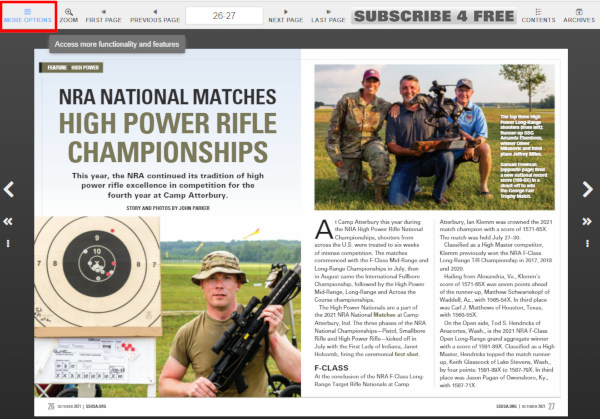
It’s easy to find back issues of Shooting Sports USA magazine. Here’s how: First, navigate to the latest SSUSA Online Issue (September 2025). Then click on the “ARCHIVES” icon in the upper right area (indicated with red arrow). When you click on “ARCHIVES”, a window will open with a selection of Shooting Sports USA magazine covers/dates in a vertical column. The most recent issue (August 2024) will appear at the top left. You can then scroll down — use the vertical scroll bar to go from September 2025 all the way back to June 2009. Click any issue cover to read.
How to Find and Save Articles
To search back issues, select “MORE OPTIONS” from the toolbar (top left). Then click the “SEARCH” button. When that opens, select either “Search Archives” for ALL back issues or “Search Only this Issue”. When you’ve made your choice, enter your search term(s). For example, you can search for “Camp Perry” or “Palma” or “F-Class Championship”. You can also save any archived issue as a PDF for viewing offline. Just click “SAVE” to download the article you’re currently viewing/reading.
Read Sample Articles
Here are a three of our favorite SSUSA feature stories from recent years. There are hundreds of other informative articles worth reading.
F-Class fans will enjoy the coverage of the 2023 F-Class World Championships in the June 2023 issue of Shooting Sports USA. On the cover is our friend and Forum member Erik Cortina. The 2026 F-Class World Championship will be held at the at the world-famous Stickledown range at the Bisley Camp in the UK
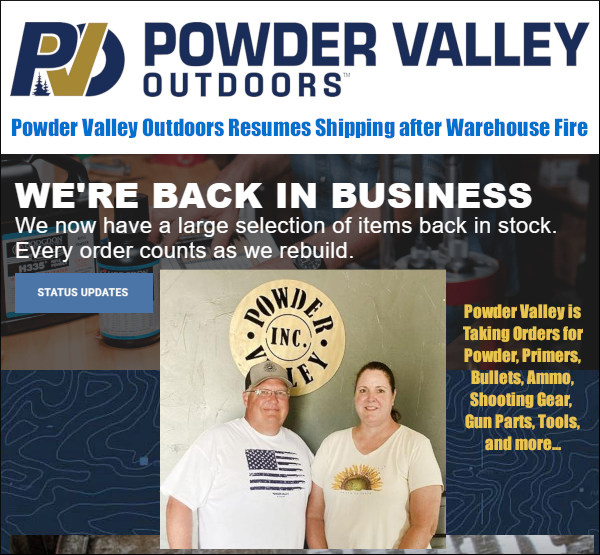
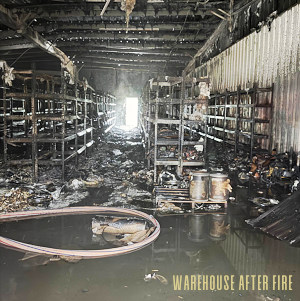
Powder Valley Outdoors (“Powder Valley”) is one of the leading reloading component and shooting supplies vendors in the country. Powder Valley has also been a strong supporter of AccurateShooter.com for over a decade. However, as you may have heard, Powder Valley suffered a warehouse fire recently. Thankfully no one was injured and Powder Valley is now fulfilling orders for customers.
Powder Valley is making great progress after the warehouse fire. The company now has a variety of products back in stock — powder, primers, brass, bullets, and more — and Powder Valley is fulfilling orders through trusted industry partners while Powder Valley gets its own warehouse back up and running. Orders can be placed now through the Powder Valley website. The staff at Powder Valley tells us: “Powder Valley would like to say thank you to the entire community for their incredible support and prayers through this time.” To support Powder Valley and place an order, visit PowderValley.com.
Powder Valley: Rising from the Ashes
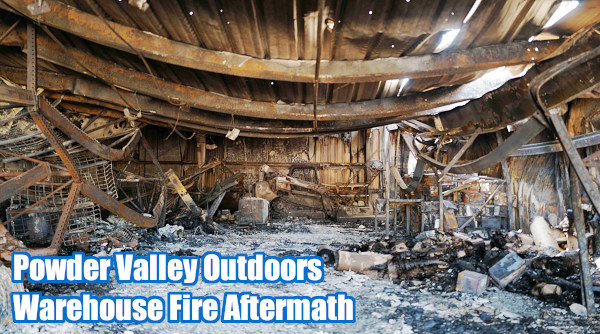
When a devastating fire tore through Powder Valley’s main warehouse and offices, the loss was total. Everything melted, burned, and destroyed. But through it all, the Powder Valley team is standing strong — grateful that everyone is safe and determined to come back better than ever.
In the immediate aftermath, the team rallied to take care of customers. Kim and Kort from Customer Service worked to make sure orders and support didn’t stop. Jacob, laptop in hand, quickly transitioned to remote operations. Beau jumped in to handle inventory assessments in what was left of the office area. Owners Bryan and Noel Richardson also stepped forward, sharing their story with local news outlets about the impact of the fire and what Powder Valley means to their family and community.
The damage to the facility was extreme, and while Powder Valley is insured, dealing with insurance will take time. In the meantime, the company has partnered with trusted industry allies to fulfill orders, ensuring customers can still get what they need while keeping revenue flowing to sustain operations.
“Right now, working with industry partners was the fastest way to get back up and running,” the team explained. “It allows us to continue serving our customers and keep business moving while we navigate insurance and begin planning for our long-term home.”
The road ahead will be long — finding or building a new facility, reorganizing operations, and reestablishing full capacity. But the Richardson family and the entire Powder Valley team are unwavering in their commitment to the shooting sports community. “We’re going to get up and we’re going to keep swinging. We’re going to keep swinging”, Bryan said.
For now, every order placed with Powder Valley helps keep the lights on and supports the rebuild. And the company couldn’t be more grateful for the overwhelming outpouring of support from shooters and reloaders across the country. “This incredible community has given us strength and optimism to keep forging ahead,” the team shared. “From the bottom of our hearts — thank you.”
Proper eye protection is ‘must-have’ gear for shooting sports. In addition to providing reliable impact protection, good shooting glasses should be comfortable, fog-free, and not interfere with your preferred hearing protection. Those who require corrective lenses also need to consider the various options available. In a past episode of their Weekly Gear Review, the 6.5 Guys discuss a variety of shooting glasses they have tried, including examples from DeCot, Oakley, and Wiley-X. Ed and Steve outline the key considerations when choosing eye protection, and then review practical aspects of eyewear design and construction that enhance comfort and functionality in the field.
The 6.5 Guys (Ed and Steve) offer a number of smart tips consider safety eyewear, helping you select the most effective safety glasses at an affordable price. Here are the 6.5 Guys’ KEY Take-aways when choosing shooting glasses, including prescription eyewear:
Key Things To Consider When Choosing Eye Protection
1. Avoid polarized lenses or lenses that reduce light transmission significantly (except for action shooting in very bright conditions with large, close targets).
2. Avoid frame designs that interfere with prone shooting.
3. Avoid designs that easily fog.
4. Avoid frame designs with thicker temples that are uncomfortable to wear underneath hearing protection.
5. Select lenses with an appropriate degree of ballistic protection. CLICK HERE to learn more about eyewear safety standards.
6. When you get your prescription, be sure your ophthalmologist includes the interpupillary distance. This is a critical measurement particularly for heavier prescriptions.
7. If you have a complicated prescription select a vendor who will actually spend time with you to address any concerns.
Horrific .50 BMG Kaboom — Eye Saved by Protective Eyewear
Think you don’t need eye protection? Watch this video starting at 4:10. The screw-on barrel “cap” (chamber closure) of the .50 BMG action flies into the shooter’s face. Without eye protection the shooter would have definitely lost his right eye. (See video at 5:20 for analysis).
Safety First — Your Eyes Are Irreplaceable Accurate shooting begins and ends with the human eye. Your career as a marksman could be cut short if you don’t use good eye protection every time you go to the range and/or handle a firearm.
Every year, over 1,000,000 people suffer serious eye injuries. Shooting is hazardous; it is estimated that there are 30,000 firearms-related eye injuries each year (if you include paintball sports.) After paintball, general hunting accidents comprise most firearms-related eye injuries.
Quality eye protection need not be expensive. You can find comfortable, ANSI Z87.1-certified shooting glasses for under $10.00.
If you select shooting glasses carefully, and ensure that your eyewear is safety-certified, inexpensive shooting glasses can perform very well. But you need to avoid cheap, soft-plastic lenses that claim “impact resistance” without satisfying a testing standard.
“I have molested that rifle on several different occasions over the years. It is more beautiful in person if that is possible. Fine craftsmanship in every aspect.” — Forum Member Matt K.
Today’s Sunday GunDay feature is a “blast from the past”, part of our big Guns of the Week archive. Some years back, Forum member Corbin Shell told us he had a new, full-custom 1000-yard prone rifle. When he sent some photos of the maple-stocked masterpiece, our collective jaws dropped. Check it out — this is truly a “Maple Marvel”.
Corbin’s GunDay rig is an eye-catcher for sure. This is one handsome rifle, built with all-premium components and a stunning Curly Maple thumbhole stock with adjustable cheekpiece. The rifle is chambered in .243 Winchester. It features a custom stainless RBRP action Nesika R action, with keycuts in the bottom instead of recoil lug. A Grünig & Elmiger trigger has been specially modified (milled and pinned) to work with the Nesika action. The primary barrel is a 30″ Broughton 5R Palma-contour tube. Interestingly, Corbin has a second 30″ Broughton barrel chambered in 6mmBR for use at shorter ranges.
The trigger guard, fore-arm rail, cheek adjuster, and 4-way adjustable butt assembly are all custom metal, designed by Dan Gleason. The stock is cut from exhibition-grade fiddleback maple (from Cecil Fredi Gunstocks in Las Vegas) with a Gaboon Ebony tip wood and butt-plate spacer.
Fast and Accurate
Corbin tells us the gun will put five shots into the size of a quarter at 300 yards “when he does his part.” Corbin shoots pointed Berger 105gr VLDs and 45.5 grains of H4831SC. That load runs 3180 fps. He can push it faster, but “that’s where the node was and where it shoots best”, according to Corbin.
Forum member Jim Hardy has seen (and shot against) this beautiful rifle. Jim reports: “A casual observer might think that the trigger guard, cheek plate and butt plate hardware are Anschutz — as the stock takes on the Anschutz prone pattern. However, this is ALL custom metal. The G&E trigger breaks like a glass rod and will makes my BR triggers feel inferior at best. I had the pleasure of holding, shouldering, and lusting over this gun at Camp Perry… and it is even more impressive in person. The killer is that there is yet ANOTHER one in a beautiful, dark figured walnut owned by Corbin’s shooting partner. BTW, both guns will hammer at 1000 yards prone.”
Long Range Prone Shooting with the .243 Winchester
Is the .243 Winchester capable at 1000 yards? Absolutely. John Whidden has used the .243 Win to capture multiple NRA National Long-Range Championships. John selected the .243 Win because it offers excellent ballistics with manageable recoil. John says that, at least for a sling shooter, the .243 Win is hard to beat at long range. John explains that, while you CAN get somewhat better ballistics with a .284 Win or .300 WSM, you’ll pay a heavy price in increased recoil with those bigger cartridges.
Running at an impressive 3275 FPS from his .243 Win, Berger 6mm 105 grain Hybrids are hard to beat, according to Whidden: “My .243 Win shoots inside a 6.5-284 with 142-grainers. Nothing out there is really ahead of [the .243], in 1000-yard ballistics unless you get into the short magnums or .284s and those carry a very significant recoil penalty.” John has tried bigger cases: “In the past I did shoot the 6.5-284. I went to the .243 Win because it had similar ballistics but had much less recoil. It doesn’t beat me up as much and is not as fatiguing.” READ Whidden .243 Winchester Report.
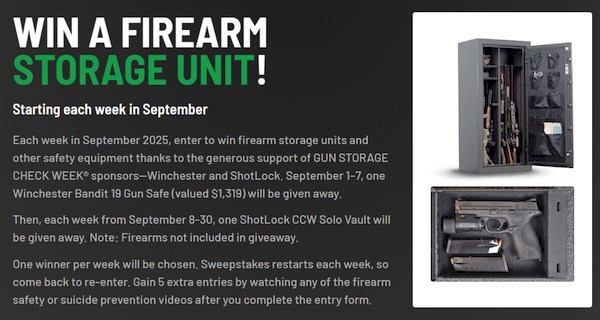
Make sure your firearms are stored securely. The NSSF’s Gun Storage Check Week runs September 1-7, 2025. This national awareness campaign is intended to ensure gun owners store their firearms securely, both to prevent theft and to reduce the risk of misuse and suicide.
Secure firearm storage is the most effective way to help prevent firearm accidents, suicides, and theft. Many secure storage options are available, including lock boxes, cable locks, and full-size safes, to secure firearms when not in use in homes and vehicles. When firearms are not under your direct control, you should place them in locked storage. We recommend large, heavy gun safes for rifle and shotgun storage. It’s best to buy a larger, heavier gun safe than you may think you need initially. We recommend your read our Gun Safe Buyers Guide.
We can do more to help prevent firearm-related accidents, suicides and thefts. During Gun Storage Check Week you should review storage practices and make changes, as needed, to prevent unauthorized access. “No one wants their gun in the hands of an unsupervised child, a person in crisis, an individual who lacks knowledge of safely operating firearms or a thief”, says Joe Bartozzi, President and CEO of NSSF.
Opportunity to WIN a FREE Winchester Gun Safe
Those who visit GunStorageCheck.org will have chances to win firearm storage units and other safety equipment thanks to the generous support of Gun Storage Check Week sponsors — Winchester and ShotLock. For the week of September 1–7, one Winchester Bandit 19 Gun Safe (valued $1,319) will be given away. Then, from September 8 through the 30th, one ShotLock CCW Solo Vault will be given away each week, with one winner per week. The Sweepstakes restarts each week, so come back to re-enter. Note: Firearms are NOT included in giveaway.
Many online vendors are running sales this Labor Day Holiday weekend. You’ll find score of products marked way down, plus discount codes that can save you 15% or more on your purchases. Some sales run through end-of-day (11:59 pm) on Monday, September 1st, while other Labor Day sales extend into next week. Be sure to check the sale schedules.
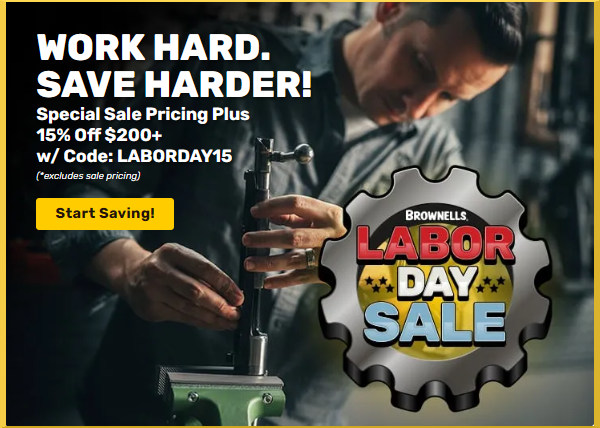
Brownells Labor Day Sale — 15% Off Plus Sale Pricing
Save now with Brownell’s Labor Day Sale which is already underway. You get 15% Off popular $200+ parts and gear orders with promo code: LABORDAY15. Plus there is special SALE Pricing on a vast selection of popular products including actions, barreled actions, triggers, magazines and ammo.
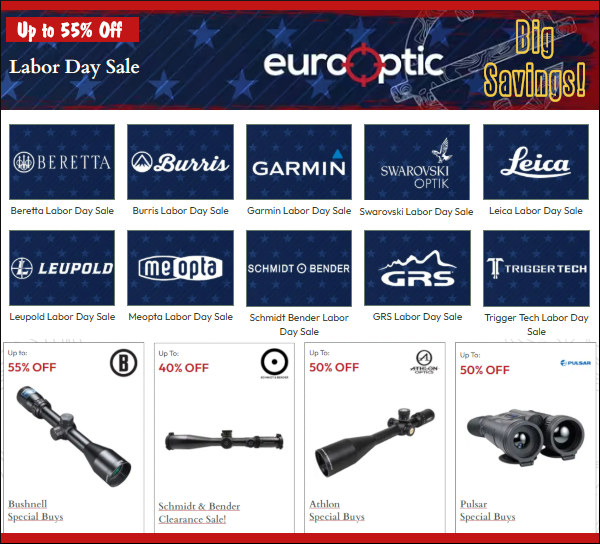
EuroOptic Labor Day Sale — Big Savings on Optics, Stocks & More
EuroOptic has a major Labor Day Sale with big savings on products from a dozen major brands. Discounts range up to 55% on Burris scopes, up to 47% on S&B scopes, up to 40% on Leupold and Leica optics, up to 47% on Meopta binoculars, up to 44% on GRS chassis/stocks, and up to 19% on Beretta shotguns and rifles. This is a great time to shop at EuroOptic with major savings on a huge range of products.
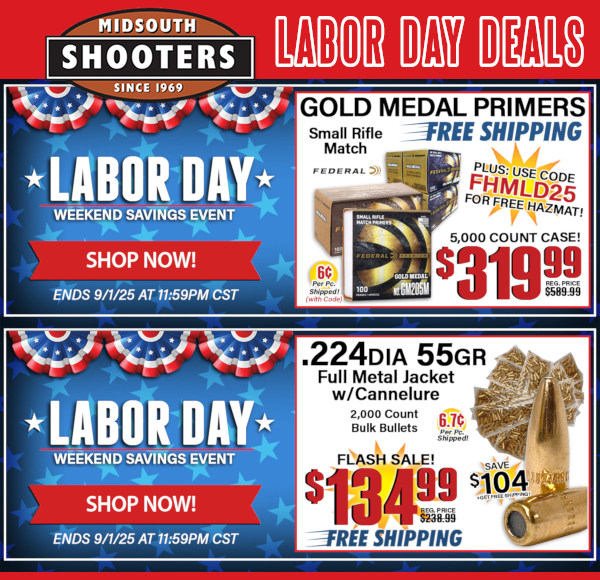
Not too long ago it was hard to find top-grade, American-made small rifle primers for under $110/1000. With this Labor Day Deal, you can get Federal’s superb GM205M Small Rifle Primers for just $64.99/1000 or $319.99/5000. PLus you can get FREE HazMat with code FHMLD25. If you shoot 3-Gun matches or are an active varminter with a .22-Cal rifle, this 55gr Bullet Special is a great deal — save a full $104 (44%) off the regular price. If you want either of these deals (or one of Midsouth’s other Labor Day Specials), don’t hesitate. These deals expire at 11:59 pm CT on September 1st, so act soon.
Primary Arms is running a huge Labor Day Sale, with major brand discounts on AR components (e.g. uppers and lowers), triggers, suppressors, and stocks. In addition there is a big Primary Arm Optics Closeout Sale with huge “Bonus Bucks” store credits. For example, with Primary Arms 3-18x50mm FFP Scope you get $100 in Bonus Bucks. This is a big sale, with new items appearing every few hours.
Sportsman’s Guide — Major Discounts and FREE Shipping $99+
For Labor Day weekend at Sportsman’s Guide there are up to 80% savings on select shooting gear and accessories, but with most savings 10% to 20%. A vast selection of hunting products are on sale including hunting blinds, tree stands, packs, camo clothing, boots and more. And bulk ammo from CCI, Fiocchi, and PMC is also on sale with major discounts for .380 ACP, 9mm, .223 Rem/5.56 NATO, 7.62×39, and .308 Win. For example, 1000 rounds of Blazer 9mm Ammo is $234.99, just $11.75 per 50rd box.
Ammunition Depot — Big Discounts On 16 Ammo Brands
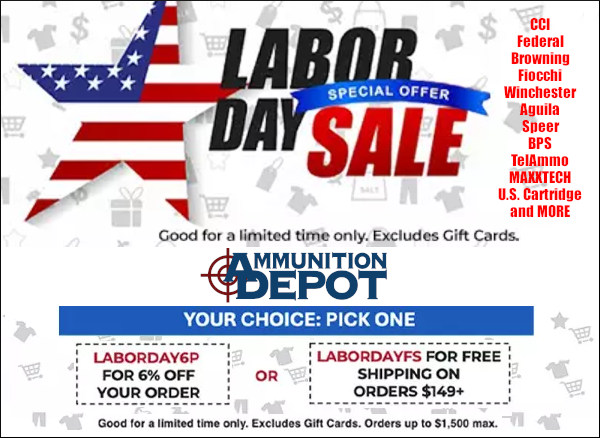
If you need factory ammo for your rifles, pistols, or shotguns, head over to the Ammunition Depot. Right now there are discounts on a huge selection of ammo from 16 different ammo-makers including CCI, Federal, Fiocchi, Speer, Winchester and other big names. You can buy individual boxes, or bulk packs from 120 rounds up to 1000 rounds. On checkout you have two options. Use Code LABORDAY6P to save 6% on your ammunition order. OR, use Code LABORDAYFS to get FREE Shipping on $149+ ammo orders.
Enlightened Equipment — Outdoor Gear 20% Off + FREE Shipping
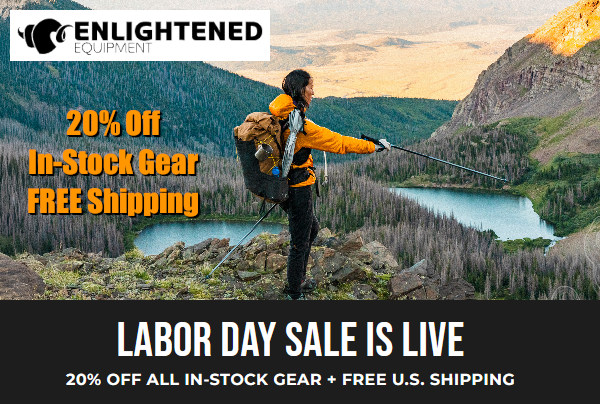
With hunting season right around the corner, now is the time to get your ultralight outdoor gear. Enlightened Equipment offers premium American-made sleeping quilts, apparel, and accessories for the outdoor enthusiast. They are currently running a great Labor Day sale that will save you 20% on all in-stock gear with FREE shipping across the USA.
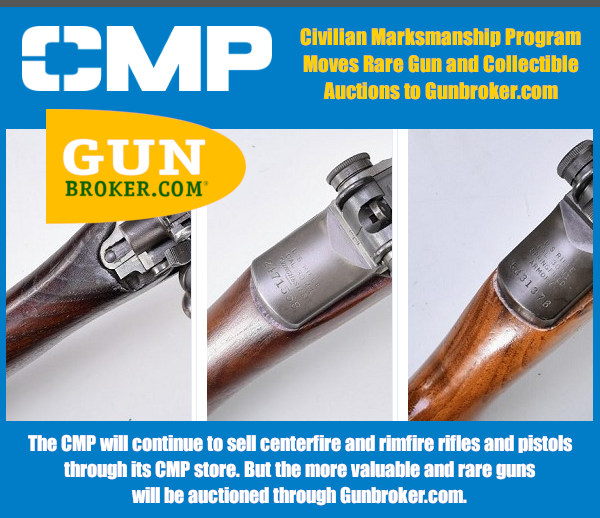
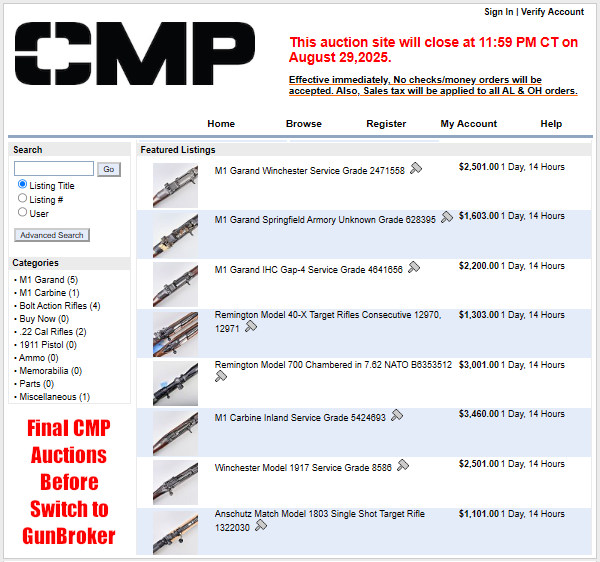
For decades the Civilian Marksmanship Program (CMP) sold firearms, barrels, and other valuable collectible products through its own CMP online auctions. This system worked well, allowing Americans to purchase M1 Garands, M1903 Rifles, 1911 pistols and more via the CMP auction site. But that’s all changing now. The CMP is moving its auction program to GunBroker.com. CLICK HERE for CMP Gunbroker INFO page. The final listings on the current CMP Auction site will end on Friday, August 29, 2025 at 11:59 PM Central Time.
But note, firearms and other products will continue to be sold in the CMP Store. It will be the select or more rare guns that will go up for auction. The CMP states that “Our partnership with GunBroker aims to enhance the quality of our auction services while giving more U.S. citizens the chance to own a treasured piece of our nation’s history.” The CMP store will continue to sell “non-select” M1 Garands, M1917 Enfields, M1911/A1 Pistols, as well as ammunition, gear, and shooting equipment. Visit CMP Online Store.
CMP Auctions on GunBroker
Beginning in September 2025, all CMP Auction and “Buy Now” items will be listed, displayed, and sold through GunBroker.com, one of the most widely-used online marketplaces for firearms and related items. CLICK HERE for more INFO on CMP Gunbroker Auction Programs.
Q. What type of CMP items can we expect to see auctioned on GunBroker?
Memorabilia and Collectibles
Rifles in very low quantities
Other items for which the auction program is used to determine market value.
CMP states this change should make auctions more accessible: “This transition will allow for improved accessibility, a more user-friendly bidding experience, and enhanced customer support, all while maintaining the same level of quality items you’ve come to expect from our auction site.”
CMP Auction Frequently Asked Questions (FAQs)
Here are some common questions about the CMP Auction transition, with answers from the CMP.
Q. How do I register to participate in auctions from the CMP?
Q: Will additional fees be added to auction items?
A: Since CMP is a non-profit, no extra fees will be charged on the GunBroker platform.
Q. Whom should I contact if I have questions about the item being auctioned?
A. Email khayden@thecmp.org or auction@thecmp.org. CMP hours of operation are 7:00 AM – 3:30 PM (CST) Mon-Fri. There is no one available to answer your questions on weekends.
Q: How will GunBroker ensure CMP membership and purchasing requirements are met?
Final CMP-Hosted Auctions Conclude August 29, 2025 at 11:59 PM CT
Learn More About CMP Auctions on Gunbroker
CMP’s current auction website includes a link to the new CMP Page on GunBroker.com. Current and featured listings will also be visible on the CMP site, with direct links to the GunBroker auction.
If you have questions, contact the CMP Auction Team at auction@thecmp.org or 256-835-8455 ext. 418. Inquiries relating to GunBroker account creation are handled through the GunBroker Help Center.
Introduction — What You Need in a Security Gun Safe
If you own firearms, you need a gun safe. In some states, such as California, if you don’t own a safe, you face potential liability if your firearms are stolen. Purchasing a safe is no easy decision however. There are dozens of safe manufacturers and countless design options. Sorting out the facts from the marketing claims can be difficult.
Today’s seven Saturday Showcase videos explain the most important qualities you should look for in a safe, and help you with the tough decisions, such as “Should I get a digital lock or a dial lock?”, “What kind of fire-proofing is most effective?”, “How big a safe do I really need?”, and “What interior works best with long-barreled scoped rifles?” You’ll find reviews of full-size safes, modular safes, and smaller handgun safes. Plus you’ll find expert advice on how to install your safe in your home and how to keep the contents free from rust.
Budget $1200-1500 for a safe from a major maker, with external hinges, and an interior at least 58″ high. That gives you room for 30″-barreled rifles with a top shelf for handguns and other valuables. A rotary rack and slide-out drawers are great additions.
Keypad or Dial? We favor rotary dial locks. With minimal maintenance they will function flawlessly for decades. But the digital locks offer quick-access and convenience. If you go digital, get a commercial-grade unit.
Fire-lining is worth getting, but a thin layer of sheet-rock doesn’t make a safe truly “fire-proof”.
Interior at least 58″ High and 30″ wide Overall Weight 750+ Pounds 8 Gauge or Heavier Wall Thickness Double-Wall, Composite Door with Relockers Minimum UL RSC Rated. TL-15 or TL-30 Rating is Desirable External Hinges
Mechanical UL Group II (or better) Lock with Standard Dial Or UL Type 1 Commercial-Grade Electronic Lock
Custom Interior Suitable for Scoped Guns with Long Barrels On-Door Storage System for Non-scoped Long Guns OR Rotary Gun Rack for Scoped Rifles and ARs
Internal (sandwiched) Insulator, Reinforced if Sheet-rock Palusol? Heat-Activated Expanding Door Seals
Slide-out Drawers for Handguns Fire-lined Inner Safe for Paper and Media
Low Gloss, Rust-resistant External Finish Pre-Drilled holes for Lag Bolts and in Rear for Electric Cord Overhead Fluorescent Lamp and/or LED Mini-lights on Strings
Advice for Gun Safe Buyers — Seven Key Things to Consider
This video covers key gun safe features — Seven Things to Consider Before Buying a Gun Safe. Not all gun safes are created equal. There are many variables — fire ratings, burglar ratings, colors, lock choices, internal capacity, door storage, and more. And with the recent controversy involving Liberty Safes, you should check the safe-maker’s policies regarding digital passcodes — you don’t want your passcode revealed without a warrant and/or without your consent.
DOs and DON’Ts of Safe Buying
DO purchase a safe that is bigger than you think you need.
Your gun collection is bound to grow over time. A good safe is more than just a gun locker–it becomes a secure storage device for your family’s other valuables as well. You’ll find you quickly fill up even a large safe. Spend the money for the size, protection, and features you want. Your gun collection may be worth many tens of thousands of dollars. Some people who visit this site wouldn’t hesitate to spend $1300 for a custom action or $1800+ for a competition scope, yet they don’t want to spend more than a few hundred dollars on a safe. That’s not common sense. If you’re on a tight budget, consider a used safe. Unlike many other products, safes don’t really wear out over time. When businesses change locations, you can get a very high quality commercial safe for little more than the cost of removing it.
DO spend more for a safe that offers fire-resistance.
But you have to do your homework–you can spend a lot of money for “fire-proofing” that actually is not very effective. Make sure if sheet-rock is used that it is properly installed. If you have valuable documents and media files, it’s not a bad idea to purchase a smaller, commercial-grade fire safe to put inside the gun safe. This gives you double protection.
DO look at many different brands of safes before you buy.
There ARE significant differences among brands. For example, Browning offers a unique (patent-pending) door-mounted rifle rack. Zanotti offers slide-out drawers and a modular design that is much easier for an owner to move. Ft. Knox uses an advanced method to secure and stabilize its fire-proofing layers within the safe. Brown offers custom exotic wood interior shelving and safes with commercial-grade burglary protection (much thicker steel with heavy composite doors and walls). Amsec offers a proprietary “DryLight” poured concrete-type fire insulation with greater structural strength than typical sheet-rock panels.
DO investigate the safe’s specifications.
Just because a safe is big and heavy doesn’t mean it’s particularly secure. Heavy-gauge steel is much more resistant to cutting and drilling than light 12- or 14-gauge steel. Some safes on the market have walls so thin they can be penetrated with a fire ax. We recommend 10-gauge steel at a minimum, and 8 gauge is much better. The safe should carry a UL RSC (Underwriters Laboratories “Residential Security Container”) or better rating.
DO ask about the safe’s safeguards against tampering.
A quality safe will feature extra armor or devices to defeat drilling. Low-grade safes can be opened in a few minutes with simple, battery-powered hand tools. All safes should have relockers to help ensure the safe remains locked in the case of a burglary. Relockers are hardened pins that are triggered during an attack, and cannot be retracted without hours of drilling. The number of relockers on a safe ranges from 2-10+ depending on the safe’s size and burglary grade.
DON’T store powder in your safe. A tightly-sealed metal box with a large quantity of powder inside is a bomb. Store powder in a separate, lightly-constructed cabinet or plastic box. The main thing for powder is to keep it dry and away from moisture and light.
Don’t Make the Mistake of Buying an Undersized Safe
The most common mistake people make when buying a gun safe is getting a safe that’s too small. This video explains why you should probably invest in a bigger safe. First, the rated gun capacity is exaggerated — rifles with mounted optics, long barrels, wide forearms and/or pistol grips take up considerably more space than a small rimfire rifle or a lever gun with iron sights. Second, your gun collection will likely grow in years to come. Third, you may want to store other valuables in the safe — such as vital documents, jewelry, watches, and pricey electronics. In this video the host notes: “Get a much larger safe than you think you’ll need at first. This will guarantee that you will have enough room for future purchases and all the guns and equipment you currently have.”
What Happens in a Fire and Deluxe Features
This video shows what can happen INSIDE a gun safe during a fire. This Winchester safe did not fare well during a major hourse. That’s why you want to buy a safe with a good fire rating.
This video shows the features of a large Superior Safe Co. gunsafe with internal organizers and door storage for handguns and accessories.
Modular Safes — Smart Option for Easier Moving
This article features a great video showing how to assemble a modular safe in under 30 minutes. This article also explains the benefits of modular gunsafes — primarily easier transport and installation. “Modular safes have been around for a few years now and are becoming more popular. Here’s why: The safe comes delivered to you in panels, so you can bring them into your home one at a time and put it together anywhere you like. This makes it easy to carry up and down stairs, onto elevators or anywhere! Security — Is it as secure as one that comes pre-assembled? The answer is, absolutely.” READ FULL ARTICLE on NRAWomen.com.
Five Good Gun Safes Under $500
We know some readers have a tight budget. This video looks at some recommended lower-cost safes under $500.00 list price. Note, however, that this video was produced in 2022. Now in 2023, with Bidenflation, the actual gun safe prices may be higher. For a full-size safe, we do recommend you spend quite a bit more — the investment in a higher quality safe, with better fire rating, is worth it.
Locking Device–Mechanical Dial vs. Digital Locks Recommendation: UL Group II mechanical dial lock or commercial-grade electronic.
For gun safes, we prefer rotary-combination dial locks, although commercial-grade electronic locks are now very good. While less convenient, and slower to open than electronic locks, combination locks are still more durable and trouble-free than the digital locks found on many low- to medium-cost gun safes. Among the combination locks, the Sargent & Greenleaf model 6730 (UL Group II) remains an industry standard. The director of Sturdy Safes noted: “An S&G 6730 will be working fine when your grandchildren have grandchildren.” For home use, we also recommend the standard, high-visibility “front-read” white on black dial.
Avoid the cheap, imported electronic locks. These are known for failing relatively quickly–the keypad internals just wear out. With some of these designs, if the lock fails while the door is closed, you’ll have to employ a professional gunsmith to drill your safe and replace the locking assembly and keypad. With any electronic lock, re-program your combination now and then so that keypad wear patterns don’t reveal the numbers you push to open the safe. But when you change the combination, be sure to record the new setting.
With a dial lock, choose a design that meets UL Group II (or better) certification. If you choose a digital lock, we strongly recommend that you select a UL Type I, Commercial Grade lock from LaGard, Sargent & Greenleaf, or Kaba Mas. Commercial-grade locks, such as the S&G Comptronic” 6120 or LaGard “SafeGard” are much more robust and are designed to be used 20 times a day or more in retail and banking environments. A good commercial digital keypad lock should give 10 years or more of continuous use before replacement is required. With any digital lock, however, you should replace the battery at least once a year. Normally this can be done without professional assistance.
A rapid-access bedside safe is a great way to keep your pistol secure, but also readily available, close at hand. Not all rapid-access pistol safes are created equal, however. In this video, John of Pew Pew Tactical explains what to look for in a small pistol safe, and points out the pros and cons of the four safes tested:
Fort Knox PB1 Simplex Pistol Box
Strong case, reliable no-battery locking system. Very good safe, but expensive ($299.00 on Amazon).
Vaultek Electronic Pistol Safes
Multiple styles, thin profile, 5-button electronic ($174.99 on Amazon), or Biometric with sliding door ($359.99 on Amazon), both with rechargeable batteries.
VERPROOF Quick Access Handgun Safe
Designed for vertical mount under desk on vehicle, One gun only, requires batteries, $69.99 on Amazon.


 Hybrid Bullet Design — Best of Both Worlds?

 Outdoorsmans Tripod Adapters





 Accurate shooting begins and ends with the human eye. Your career as a marksman could be cut short if you don’t use good eye protection every time you go to the range and/or handle a firearm.
 Today’s Sunday GunDay feature is a “blast from the past”, part of our big








 For gun safes, we prefer rotary-combination dial locks, although commercial-grade electronic locks are now very good. While less convenient, and slower to open than electronic locks, combination locks are still more durable and trouble-free than the digital locks found on many low- to medium-cost gun safes. Among the combination locks, the Sargent & Greenleaf model 6730 (UL Group II) remains an industry standard. The director of Sturdy Safes noted: “An S&G 6730 will be working fine when your grandchildren have grandchildren.” For home use, we also recommend the standard, high-visibility “front-read” white on black dial.


