Scary stuff — AK-74 after firing corrosive ammo and not being cleaned for a week.
Image courtesy ADCOFirearms.com.
No doubt you’ve heard the term “corrosive” used with respect to ammunition. But what exactly is “corrosive ammunition” (and how does it different from non-corrosive ammo)? What is the chemistry that leads to corrosion, and what cleaning procedures should you follow if you shoot corrosive ammunition? Brownells has come up with answers to these and other questions in a helpful TECH TIP video about corrosive ammo.
In this informative video, Brownells gun tech Steve Ostrem explains the primer-related chemistry that makes some ammo corrosive. The video then reviews suggested cleaning procedures you should follow after you have fired corrosive ammo through any firearms.
What Is “Corrosive” Ammunition?
What makes ammo “corrosive”? Generally speaking, primers are the problem. When corrosive ammunition is fired, the ignited primers leave a residue of corrosive salts. Typically these primers contain potassium chlorate, or sodium petrochlorate which, when burned, change into potassium chloride or sodium chloride. Sodium chloride is also known as common table salt.
Potassium chloride and sodium chloride are both very hygroscopic (i.e. they attract water). Because of that, these alkalis are rust generators. When exposed to the hydrogen and oxygen in the air (and moisture) potassium chloride and sodium chloride can form an acid that quickly causes metal rifle parts to rust and pit.
Given a choice, you may wish to avoid corrosive ammo altogether. However, for some types of fire-arms, particularly older military-style rifles, the most affordable ammunition may be corrosive. If you choose to use corrosive ammo, it is important to clean the gun thoroughly after use. After firing, you want to use an element that will neutralize the primer salts. Brownells suggests a water soak (see video above). Alternatively, Windex with ammonia can help neutralize the salts, but that doesn’t finish the job. After the salts have been neutralized and flushed away, basic anti-corrosion protectant (such as Eezox or other gun oil) should be applied to all metal parts.
This video ahows the effects of Corrosive Ammo after one month without cleaning:
To learn more about the proper procedures for cleaning rifles exposed to corrosive ammo, we suggest an article by Paul Markel on Ammoland.com. Markel, host of the popular Student of the Gun TV series, states that: “Windex (with ammonia) is the Corrosive Ammo shooter’s best friend. After you are done shooting your corrosive ammunition for the day, squirt the window cleaner liberally from the chamber down the barrel. Pull the bolt / bolt carrier / op rod if there is one and douse them as well. A couple of old cotton t-shirts will come in handy. A cotton barrel swab is a nice accessory but you can make do with patches. Some folks will rinse all of the ammonia and loosened corrosive salts off with hot water. Others prefer to wipe it all down and let the ammonia evaporate. Either way, once the corrosive salts have been tackled with the window cleaner, it is time for an all-purpose brush (old toothbrush) and some gun oil.” READ Full Article by Paul Markel.
Video Tip from EdLongrange. We welcome reader submissions.
At the request of our readers, we provide select “Deals of the Week”. Every Sunday afternoon or Monday morning we offer our Best Bargain selections. Here are some of the best deals on firearms, hardware, reloading components, optics, and shooting accessories. Be aware that sale prices are subject to change, and once clearance inventory is sold, it’s gone for good. You snooze you lose.
1. Bruno Shooters Supply — Seb NEO Rests in Stock
The Seb NEO Coaxial front rest is often considered the finest rest available for F-Class and benchrest shooting but there can be a long wait to get one. Head over to Bruno Shooters Supply which has the standard NEO and Ratigan NEO in stock and ready to ship. If you’re looking to upgrade your gear before the match season starts, this is one of the best ways to do it.
2. Stocky’s — Rem 700 Composite Stock with Accublock, $99.99
These stocks were the first run of Stocky’s Long Range Composite Sporters. There is nothing wrong with these “factory seconds” except the barrel channels are narrower than current versions, so you may have to open up the barrel channels a bit (simple task). On Sale for $99.99, these are an Amazing Bargain. Designed for Rem 700 and Rem clone actions, these LRC Sporter Stocks are constructed from a high-fiber composite with precision aluminum Accublock® chassis molded into the stock.
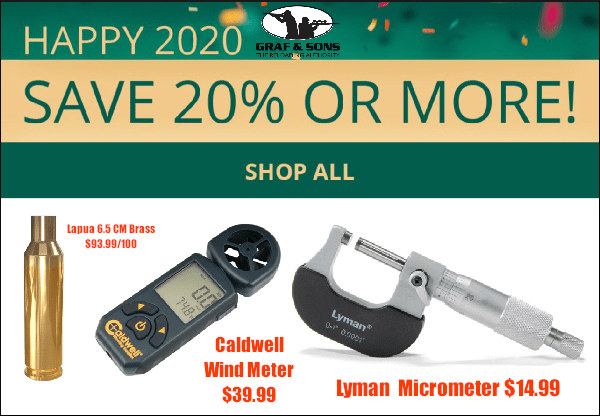
3. Grafs.com – Happy 2020 Sale — Save 20% or more
We saw plenty of large-scale sales before the holidays but here’s the first multi-category sale of 2020. Grafs is running a Happy 2020 Sale featuring products from Lapua, Lyman, Caldwell, Hornady and more. Some of the hot deals we found are: Lapua brass (6mm and 6.5 Creedmoor, .260 Rem, 7.62×39), a Lyman Micrometer for just $14.99, and a Caldwell wind meter for $39.99. In addition, Aguila .22 LR rimfire ammo is on sale for $2.99 per 50rd box. That works out to just 6 cents per round!
4. Amazon — Griffin Portable Range Stool, $34.95
Too many ranges seem to have hard, uncomfortable seating options that never seem to be the right height for the benches. One of the best solutions is to bring your own adjustable drummer stool. This Griffin “Drum Throne” features a comfortable padded seat. The Griffin seat adjusts easily for various heights and the tripod legs fold for transport. Next time you’re shooting from a bench, do it in style and comfort.
5. Cabela’s — Ruger 10/22 Carbine, $179.97
Shooting .22 LR is more popular than ever. With its low cost and wealth of aftermarket accessories, the Ruger 10/22 still dominates the .22 LR entry-level rifle market. Right now, Cabela’s offers the Ruger 10/22 Carbine (blued barrel, gray stock, no sights) for a super-low $179.97 price. A basic 10/22 rifle is $249.99 at MidwayUSA so you can see Cabela’s is offering a great deal.
6. EuroOptic — Nikon BLACK Riflescope Closeout Sale
Nikon’s decision to stop selling riflescopes shocked many in the industry. However, Nikon’s exit from the scope marketplace has created an amazing opportunity. If you’re in the market for a tactical scope, check out EuroOptic’s Nikon BLACK riflescope sale. EuroOptic has a big selection at prices up to 47% off. Choose MOA or MRAD versions with a variety of reticle options. NOTE: These BLACK Nikons are quality scopes that have performed well in the field. You’d have to pay hundreds more to do much better.
7. Natchez — Leupold BX-2 Binoculars, $174.49
For hunting and general outdoor use, a good pair of binoculars is invaluable. While we appreciate binoculars that cost $1000 or more, for many purposes a basic, affordable set of binoculars will get the job done. Natchez now has the Leupold BX-2 8×42 Cascades binoculars for $174.49. That is a great deal — a savings of $80 or more over the original price.
NOTE: These 8×42 Leupold binoculars have been very highly rated for the price, when compared to other budget-priced binoculars. See Video Review above.
8. Midsouth — Lyman Hearing Pro Earmuffs, $34.99
Quality hearing protection is vital for shooters. If you have old or worn-out muffs, upgrading your earmuffs can help protect your hearing for years to come. Right now you can purchase these Lyman Electronic Hearing Pro Earmuffs for only $34.99. That’s a great price for electronic muffs that let you hear range commands and talk to fellow shooters. At this price you can pick up an extra set as a spare. Choose either Flat Dark Earth or Matte Black colors for $34.99.
9. Amazon — Two Pairs Safety Eyewear, Cords, Covers, $13.50
Eye protection is important! All you need is one case separation or blown primer to cause serious eye injury. Don’t take that risk. Plus the CMP has made Eye Protection mandatory for all CMP Pistol and Centerfire Rifle events. Here’s a great kit with TWO Sets of safety eyewear, each with a neck strap and carry bag. These feature ANSI Z87.1-rated lenses that are anti-fog and scratch-resistant. The lenses also block harmful UV rays. Get the full SuperLite and SuperClear Lens Technology Kit for just $13.50.
Just in time for the Berger SW Nationals, Berger has released a class-leading new 7mm bullet — the 190 Grain Long Range Hybrid Target (LRHT). The new 190-grainer boasts a “jump-tolerant” hybrid ogive profile along with formed meplat (bullet tip) for more consistent Ballistic Coefficient (BC). In fact, with its new MRT (Meplat Reduction Technology) nose, Doppler Radar testing confirms less than 1% BC variation from bullet to bullet. While a high BC is of course desirable for competitive shooting, shot-to-shot BC consistency is most critical when engaging targets to 600 yards and beyond. The new 7mm 190gr LRHT’s BC numbers are very impressive: 0.751 G1 and 0.384 G7.
Designed for F-Open competition, the 7mm 190gr LRHTs are optimized for cartridges such as .284 Winchester, 7mm WSM, 7mm SAUM, and 7mm Remington Magnum among others.
No you don’t need a new barrel to shoot the 190s. If you are running Berger 184s in a 1:9″ or faster twist you should be fine. Berger states: “The 190gr LRHT is complementary to the industry-leading Berger 184gr F-Open Target bullet with an identical stability factor and improved ballistics when launched from 1:9″-twist barrels.”
Meplat Reduction Technology for More Consistent BCs
Utilizing advanced and proprietary manufacturing processes, Berger’s innovative Meplat Reduction Technology (MRT) applies controlled pressure along the nose of each LRHT bullet. Berger states this delivers ” a homogeneous and repeatable profile for the industry’s most consistent Ballistic Coefficients”.
“With improved MRT consistency contributing to its superior ballistic coefficient and form factor, the 190 is one of our highest performance projectiles to date. They provide minimal dispersion and more hits on target for F-Open competitors, long range shooters and larger capacity 7mm enthusiasts.” said Garett Stoddard, Berger’s Lead Production Engineer.
The new Berger 7mm 190 Grain Long Range Hybrid Target Bullets are shipping now to Berger authorized retailers.
Blue, Red, Green — There are many Progressive Press options on the market…
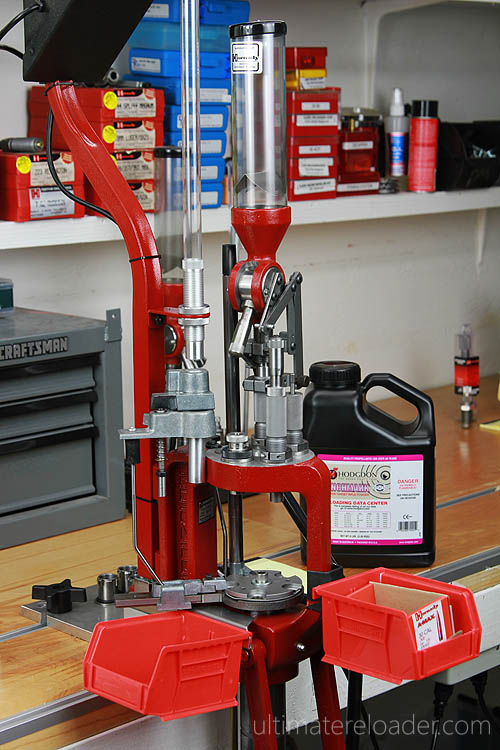
When you need ammo fast — lots of ammo, it’s hard to beat a progressive reloading press for output. We use progressive presses to load handgun ammo and .223 Rem cartridges for varmint safaris. With good dies, and proper press set-up, today’s progressive presses can produce surprisingly uniform and accurate ammo. No, you won’t see Benchrest Hall-of-Famers loading PPC cartridges on progressives. However, if you need 1000 rounds for your next prairie dog adventure, you should consider getting a progressive. Below you can see a Hornady Lock-N-Load AP configured to load .308 Winchester in bulk.
UltimateReloader.com has published helpful Tips to Optimize Progressive Rifle Loading. No matter whether you have a Red (Hornady), Green (RCBS), or Blue (Dillon) progressive, this article can help you load more efficiently and produce better results. Here are some highlights:
Proper Brass Prep
Just like a good paint job requires good prep work, great rifle ammo requires good brass prep. In order to make sure your rifle loading goes smoothly, make sure to perform the following brass prep steps:
Clean the brass (tumble, ultrasonic, etc.)
Inspect brass for cracks, deep dents, etc.
For military brass: de-prime, ream/swage primer pockets, size with small-base sizer die (small base usually optional).
Measure brass length — if too long, size and then trim.
Final inspection before loading.
Cleaning primer pockets may be something you’ll consider (I don’t clean primer pockets except for rare cases or match ammo).
Smooth and Steady Pace
Since you’re loading rifle ammunition on a progressive, you’re already saving a load of time, so there’s no need to rush things! Attention to detail is super-important for safety and for good results. Always keep an eye on powder level (goes down FAST) and what’s happening at each station.
The Right Press and Press Setup
Look for a heavy-duty, well-built press that will stand up to rifle loading. You’ll also want to make sure your powder measure will have the proper capacity (~25 grains for .223, ~50 grains for 308). If you are bulk reloading, ensure you have enough stations for sizing, charging, powder check, bullet feed, bullet seating, and (optional) bullet crimp. Compare the powder measuring systems, and give careful consideration to the priming process. You want case priming to be 100% reliable. This video reviews the differences between the Dillon XL-650 and the new XL-750 Progressive presses.
More Ultimate Reloader Resources for Users of Progressive Presses:
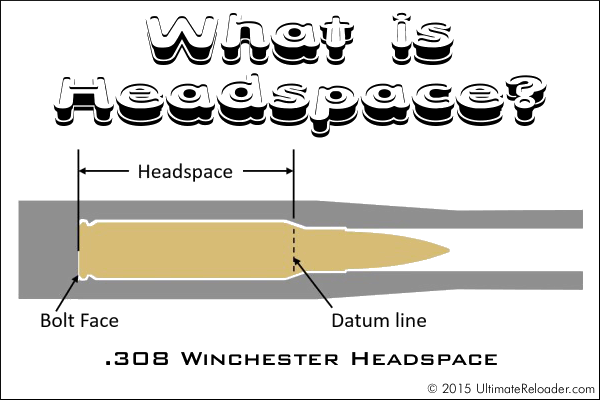
This illustration shows headspace measurement for the popular .308 Winchester cartridge, which headspaces on the shoulder. Image copyright 2015 Ultimate Reloader.
In this Brownells Tech Tip, Brownells gun tech Steve Ostrem explains what headspace is and why it’s one of the most critical measurements for nearly all firearms. Even if you’re an experienced rifle shooter, it’s worth watching this video to refresh your understanding of headspace measurements, and the correct use of “GO” and “NO-GO” gauges.
Headspace Definition
In firearms, headspace is the distance measured from the part of the chamber that stops forward motion of the cartridge (the datum reference) to the face of the bolt. Used as a verb, headspace refers to the interference created between this part of the chamber and the feature of the cartridge that achieves the correct positioning. Different cartridges have their datum lines in different positions in relation to the cartridge. For example, 5.56x45mm NATO ammunition headspaces off the shoulder of the cartridge, whereas .303 British headspaces off the forward rim of the cartridge.
If the headspace is too short, ammunition that is in specification may not chamber correctly. If headspace is too large, the ammunition may not fit as intended or designed and the cartridge case may rupture, possibly damaging the firearm and injuring the shooter. (Source: Wikipedia)
Headspace Gauges
Headspace is measured with a set of two headspace gauges: a “Go” gauge, and a “No-Go” gauge. Headspace gauges resemble the cartridges for the chambers they are designed to headspace, and are typically made of heat-treated tool steel. Both a “Go” and a “No-Go” gauge are required for a gunsmith to headspace a firearm properly. A third gauge, the “Field” gauge, is used (as the name implies) in the field to indicate the absolute maximum safe headspace. This gauge is used because, over time, the bolt and receiver will wear, the bolt and lugs compress, and the receiver may stretch, all causing the headspace to gradually increase from the “factory specs” measured by the “Go” and “No-Go” gauges. A bolt that closes on “No-Go” but not on “Field” is close to being unsafe to fire, and may malfunction on cartridges that are slightly out of spec. (Source: Wikipedia)
To learn more, read Brownell’s longer article Headspace Gauges and How to Use Them. Among other things, this explains the relative lengths of “Go”, “No-Go”, and “Field” gauges. The “Field” is actually the longest: “The GO gauge corresponds to the SAAMI (Sporting Arms & Ammunition Manufacturer’s Institute) minimum chamber length, while the FIELD gauge usually matches the maximum chamber depth, or slightly less. NO-GO gauges are an intermediate length between minimum and maximum, that, technically, is a voluntary dimension. A firearm that closes on a NO-GO gauge and does not close on a FIELD gauge may not give good accuracy and may have very short cartridge case life from the ammunition re-loader’s standpoint.”
A few years back, Our friend Grant Guess had a “close encounter” with a bad primer. An apparently defective primer caused part of the casehead on one of his rounds to blow out. This, in turn, allowed high pressure gas to vent through the damaged primer pocket. Take a good look, boys and girls. This is yet another very good reason to wear safety glasses. The cartridge was a 6.5-06, handloaded in necked-down Winchester-headstamp .270 Win brass. Grant reports:
“I had a blow through between the primer and the primer pocket today. The action was really smoking and I got a face full of gas. This was a reasonably light charge. Thank God for safety glasses.
I should also mention that it appears there is a 3/64 hole that is halfway between the primer and the primer pocket. Like it burned a small jet hole through both of them.”
Could this happen to you? It just might. On seeing this damaged case, one of Grant’s Facebook friends, Chris D., observed: “Search the internet, you will see a lot of these pin hole ‘in the corner’ failures. Obviously Winchester has some issues with the LR primers.”
Careful Examination Reveals Apparent Primer Defect
After this incident, Grant examined the damaged case: “I pinned the flash hole and it is not over-sized or under-sized. The primer clearly has an area where it had a defect. At [50,000 CUP], it doesn’t take much of a defect to cause issues. There was a slight bit of pucker-factor on the next shot….”
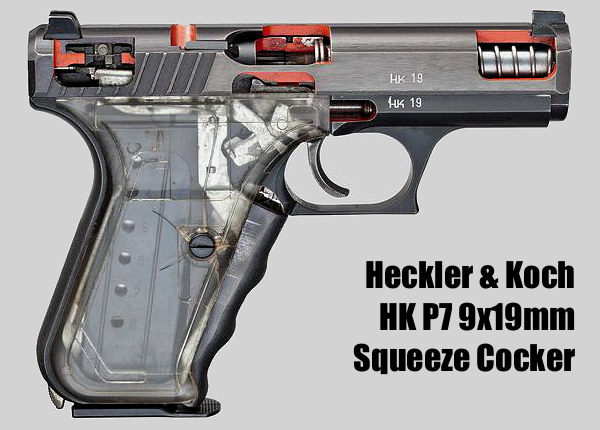
Everyone should have a 9mm Luger (9x19mm) pistol. The 9mm Luger round feeds/cycles great, recoil is moderate, and a vast array of excellent 9mm handguns are available. And, perhaps most importantly, quality factory ammo is affordable. In fact because 9x19mm ammo is produced in such quantity, it is some of the cheapest centerfire pistol ammo you can buy. Today we’ve found some great 9mm Luger ammo deals for you, with big-name factory stuff for under 18 cents per round.
At that price, it may not be worth reloading. Consider this — typical 9mm component costs easily approach fifteen cents per round even with free brass: Bullet ($0.08 – $0.10), Powder ($0.02), and Primer ($0.04). Given the costs of bullets, powder, and primers, it may not be worth reloading 9mm Luger, especially if you value your precious time!
Should You Reload 9mm Ammo? Run the Numbers, Then Decide…
While this Editor reloads almost all his .45 ACP and .44 Magnum ammo, I generally shoot factory ammo in my 9mm Luger pistols. Why? When you give some reasonable value to the time you spend setting-up and operating your reloading press, it is hard to beat factory ammo at around $10 per 50-count box (i.e. $0.20/round). While once-fired 9mm brass is plentiful (and cheap), you can easily spend 15-16 cents per round just on bullet, powder, and primer. So reloading may only save you 4 or 5 cents per round. Hence if you load 200 rounds per hour (including set-up time), you only recoup $8 to $10 per hour (at best) for all your effort. You may decide, as I did, that my time was worth more than that.
Great Deals on 9mm Luger (9x19mm) Factory Ammunition
Thousands of new products will be on display at SHOT Show 2020, the huge gun industry trade show held each January in Las Vegas. Some of the most highly-anticipated products have not yet been revealed, including new rifles, chassis systems, handguns, reloading tools, and state-of-the-art optics.
However, the official SHOT Show Product Planner offers a “sneak peak” at 338 new-for-2020 products. More will come in the weeks ahead. For the time being, however, here are TEN interesting new products. Since most are completely new items, we haven’t been able to test them yet. Accordingly the product descriptions are provided by the manufacturers.
1. Minelli USA — WOOX Furiosa Chassis
The WOOX Furiosa Rifle Chassis is a hybrid stock that combines wood sections over an aluminum sub-chassis, giving the “feel” of a wood stock with the strength and rigidity of a metal stock. The WOOX Furiosa is a full-length rifle chassis replacement for Remington 700s and Sauer 100s. The Furiosa pairs a full-length aluminum skeleton with high-quality wooden front and rear stock elements. The rear stock features an adjustable cheek rest and adjustable LOP and integrated flush cups. The front stock offers M-LOK® rails. The WOOX Furiosa retails for $999.00. Visit Website.
2. March Scopes — High Master 5-42x56mm Wide Angle
The new March 5-42x56mm High Master-Wide Angle is a premium First Focal Plane (FFP) optic developed for serious competition and tactical shooters. This scope features the advanced High Master lens system, with two Super ED lens elements for superb clarity, increased contrast, and minimal chromatic aberration. This advanced optic features a “Temperature Anti-Drift Lens System” which compensates for ambient temp changes by altering the refractive index of the lenses. The 5-42x56mm March High Master offers a full 40 MILs of vertical adjustment, so you can shooter very long ranges without an angled rail. The eyepiece is the new March Wide Angle model with greater field of view throughout the 8.4X zoom range. Center dot and cross are illuminated with .2 and .5 MIL hash marks. Visit Website.
3. GRS Riflestocks — GRS WARG Hybrid Stock
The innovative GRS WARG is a modular, hybrid stock with metal fore-end, full adjustability, and a fiberglass-reinforced main stock shell. The grip is comfortable and ergonomic and cheek height as well as LOP is quickly and easily adjusted using the GRS SpeedLock 2.0 system makes it easy to adjust the length and height of the stock. On the new WARG the AR-style fore-end boast an M-Lok mounting system for Picatinny rails, sling studs, flush cups and other accessories. The GRS WARG is offered in three colors, tan, matte black, and dark green. Stock weight is just under 3 pounds in Tikka T3 inlet. Price is $730.00. Visit Website.
4. Metal Art of Wisconsin — The Freedom Cabinet
The unique Freedom Cabinet is a patriotic, wall-mounted Stars & Stripes Flag-themed concealment unit. Available in Wood, Steel or Carbon Fiber, each secure Freedom Cabinet features inlaid steel and Invisible RFID or Biometric locking systems. The Freedom Cabinet costs $194.95. Along with this flip-up Freedom cabinet, there is a “Slider” version for $254.95. Visit Website.
5. DYX International — Quantum Rangefinder Riflescope
The Quantum Rangefinder Riflescope is a new, affordable option for hunters who want a scope with a built-in Laser Rangefinder that automatically calculates shot hold-over (like the Burris Eliminator). You input the ballistics, click on the target, ant the built-in AMOLED display shows your hold-over point. Notably, the display can also show wind speed/ direction, temp and humidity (from external sensors). DYX Int’l claims the laser works out to 3000 meters, but we suspect the usable range on non-reflective objects is well under 1000 yards. Weight is 570 grams, which is about 6 ounces lighter than the Burris Eliminator III. Visit Website.
6. FightLite Industries — 50-State Legal SCR Hybrid AR
The innovative, patented FightLite SCR® (Sport Configurable Rifle) blends the utility and accuracy of an AR15 with the classic lines of an American sporter. Importantly, this rifle is 50-state legal! The old-fashioned stock design of the SCR permits shipping to FFLs in all 50 states. SCR models for 2020 feature both solid walnut and laminated stocks and furniture as well as a free-floating M-Lok handguard option. The FightLite SCR accepts most Modern Sporting Rifle parts and accessories including magazines, upper receivers, barrels, bolts, handguards, and optics. SCRs start at $1169.99. NOTE: Along with the complete rifle, Fightlite also offers sporter stock lowers for $659.99. Visit Website.
7. Modular Driven Technologies (MDT) — Hybrid Stock System
Modular Driven Technologies (MDT) has a new Hybrid Stock System, designed to “bring the benefits of a chassis to shooters who prefer a more traditional feel.” This has an internal frame of CNC-machined 6061 aluminum. That is then clad in textured composite panels with textured finish. On the metal fore-end is an MLOK pattern attachment system. The MDT offers two (2) interchangeable grip options, angled and vertical (both included). The stock system retails for $549.00. Visit Website.
8. Elftmann Tactical — Savage 110 SE Trigger
The ELF Savage 110 SE Precision Rifle Trigger is a high-quality, drop-in trigger system for the Savage 110, Axis, and other Savage rifles. Pull weight adjusts from under 1.25 pounds to over 4 pounds. Users report this trigger has a good feel and very crisp break. Aerospace grade bearings assure consistency and a smooth pull. Because the bearings press-fit in the trigger, ELF claims “there is absolutely no play in any components”. The adjustable aluminum trigger shoe is offered in both curved and flat styles. Price is $149.00. ELF says this trigger is “100% Drop Safe”. Visit Website.
9. Danger Close — Reaper Multi-Function Target System
The Reaper System is a unique, multi-functional target system. Weighing only 180 pounds, this wheel-equipped mobile target system can be put in place in just a few minutes. Constructed with ⅜” thick AR-500 steel, the Reaper can safely withstand shots from handguns (7 yards and beyond), .223 Rem ARs (20 yards and beyond), all the way up to a .338 Lapua Magnum shot at 240 yards out. The system allows you to shoot a variety of target styles — Cardboard Targets, Anatomical Vitals Plates, or Dueling Tree Plates. Visit Website.
The new Shooter’s Choice Bullseye Box Utility Gun Cleaning Kit includes the necessary equipment for cleaning rifles, pistols and shotguns. Gear is stowed in supplied tackle-box with pull out drawers. This is a very complete kit with cleaning rods, brushes, mops and jags for most popular calibers: .22/.223, .243, .270, .308, 9mm, .40, .45, 20 ga & 12 ga. The kit also ships with 1″ and 2.5″ square patches (100 each). Plus you’ll get all these solvents/cleaners: MC-7 cleaner, FP-10 Lubricant, All Weather Firearm Grease, and Rust Prevent. Additional cleaning supplies are: 3 all-purpose receiver brushes, 50 pipe cleaners, 100 cleaning swabs, lens brush, dust brush, and 3 microfiber gun towels. Bullseye Box MSRP is $149.99. Visit Website.
22Plinkster Tours CCI/Speer Idaho Factory
Trickshot artist and YouTube host 22Plinkster recently got a chance to tour the CCI/Speer production facility in Lewiston, Idaho. This large plant produces both rimfire and centerfire ammunition. While touring the plant, 22Plinkster was allowed to capture video showing the creation of .22 LR rounds from start to finish. This is a fascinating video, well worth watching.
This revealing video shows all phases of .22 LR ammo production including cupping, drawing, annealing, washing, drying, head-stamping, priming, powder charging, bullet seating, crimping, waxing, inspection, and final packaging. If you’ve got ten minutes to spare, we really recommend you watch the video from start to finish. You’ll definitely learn some new things about rimfire ammo.
Field & Stream Tours Federal Ammo Plant in Minnesota
Note to Viewers — After Starting Video, Click Speaker Icon to HEAR audio!
Last year a Field & Stream writer toured the Federal ammunition production facility in Anoka, Minnesota. This large plant produces both rimfire and centerfire ammunition. While touring the plant, the reporter was allowed to capture video showing the creation of .22 LR rounds from start to finish. This is a fascinating video, well worth watching. Click speaker icon for sound.
The Manufacturing Process for .22 LR Rimfire Ammunition Shooting Sports USA explains: “Rimfire cartridge cases are the oldest self-contained cartridge in existence, having been in continuous production since the mid-1850s. Rimfire cases are drawn from a thin piece of brass and formed with a hollow rim. A priming compound is then forced into the case using centrifugal force, where it is charged with powder and a bullet is seated in the mouth of the case. The case is then crimped around the bullet to ensure sufficient push and pull when the round is fired. When the firing pin strikes the thin brass rim of the case, the hollow rim is crushed and the primer is ignited.” Source: SSUSA.org 9/2/2017.
Buried in CCI Rimfire Ammo
22Plinkster was literally up to his neck in ammo while touring the CCI/Speer Idaho ammo plant. He says: “This was truly a dream come true for me. I can’t thank the people at CCI and Speer enough for allowing me to do this. I couldn’t possibly show everything that went on at the factory. However, hopefully I showed you enough for you to grasp the concept of how rimfire [ammo] is made.”
History — Speer Brothers Brought Ammo Production to Lewiston
Here is an interesting historical footnote. Today’s large CCI/Speer operation in Idaho can be traced back to the companies founded by the Speer brothers. After settling in Lewiston in 1944, Vernon Speer started Speer Bullets. A few years later, in 1951, Vernon’s brother Dick (with partner Arvid Nelson) started Cascade Cartridges Inc., a producer of small-arms ammunition and primers. Yes, as you may suspect, Cascade Cartridges Inc. is now CCI, a Vista Outdoor company, and one of the largest manufacturers of primers and loaded ammunition. Today, the CCI/Speer Lewiston plant produces both Speer bullets and CCI-branded ammunition and primers. Vista Outdoor’s predecessor, ATK, acquired the plant in 2001. Vernon Speer died in 1979, and Dick Speer died in 1994.
We like to use the Birchwood Casey 2″ and 3″ orange “Target Spots” stick-on circles (with diamond centers) for shooting at 300 yards and beyond (photo right). These give you a very precise aiming point if you align your cross-hairs with the corners of the diamond. However, we know that some guys, particularly those whose scopes have “target-dot” reticles, prefer to have a small box for an aim point. In addition, the orange Target Spots are not a true “Day-Glo” color, so they may seem a little dull (low-contrast) when the target is in shadow.
For guys who want an ultra-high contrast target with a square box in the center, Birchwood Casey offers a series of neon green targets with box centers and spike-style extended vertical and horizontal lines (like on a compass). The manufacturer explains: “These adhesive Target Spots come in highly-visible Atomic Green. The crosshair design fulfills the needs of open-sight shooters along with scope users. Easily line up your open sights on the center square or lay the crosshairs along the vertical and horizontal diminishing lines.” You can also rotate the Atomic Green Target Spots 45° to create a diamond center with the crosshairs in an “X” pattern.
We’ve sampled these targets. The Atomic Green background is a true “Day-Glo” color (like safety signs) so these circles appear very bright on a target backer. These work well in low light. We won’t throw away our orange Target Spots, but these Atomic Green circles are a nice option. NOTE: Atomic Green spots are NOT “splatter” targets — a contrasting bright color does NOT appear around your bullet holes.
Multiple Sizes Offered
Birchwood Casey sells the new Atomic green circles in various sizes. You can order a Combo Pack with sixty 1″-diameter spots, thirty 2″-diameter spots, and twenty 3″-diameter circles.


 No doubt you’ve heard the term “corrosive” used with respect to ammunition. But what exactly is “corrosive ammunition” (and how does it different from non-corrosive ammo)? What is the chemistry that leads to corrosion, and what cleaning procedures should you follow if you shoot corrosive ammunition? Brownells has come up with answers to these and other questions in a helpful TECH TIP video about corrosive ammo.






 Headspace Gauges




 We like to use the Birchwood Casey 2″ and 3″ orange “Target Spots” stick-on circles (with diamond centers) for shooting at 300 yards and beyond (photo right). These give you a very precise aiming point if you align your cross-hairs with the corners of the diamond. However, we know that some guys, particularly those whose scopes have “target-dot” reticles, prefer to have a small box for an aim point. In addition, the orange Target Spots are not a true “Day-Glo” color, so they may seem a little dull (low-contrast) when the target is in shadow.


