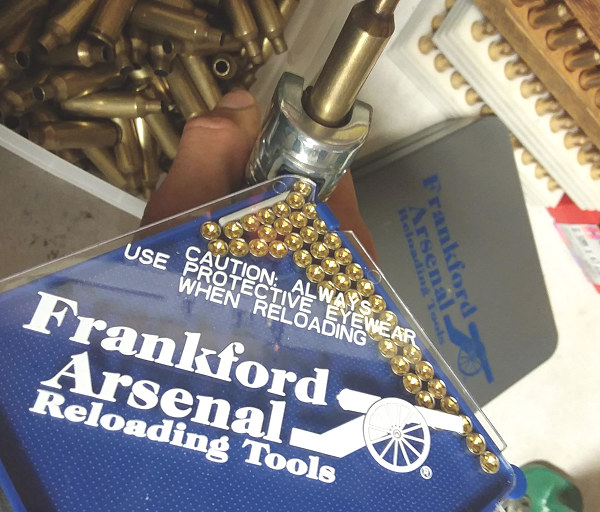
Our friend Jim See of Elite Accuracy LLC recently tested the depth-adjustable hand priming tool from Frankford Arsenal. This product, called the Platinum Series Perfect Seat Hand Primer has some unique features. Primer seating depth can be adjusted with a handy wheel in the tool’s center handgrip. Each “click” of the wheel moves the primer post .001″ (one one-thousandth of an inch). Additionally, the design of the case-holder allows quick and easy removal of a primed case. The unit ships with a full set of shell-holders to match all types of cases. Like many other hand priming units, the primers are loaded into a flip tray that attaches to the head of the tool.
Here is Jim See’s quick review of the Frankford priming tool:
“The Frankford Arsenal perfect hand-priming tool is legit. The tool is built heavy and strong. The only plastic parts in it are the tray and lid. The [primer] seating depth adjustment… is simple and accurate. Easy to operate. I primed 1000 cases, averaging 23 per minute. I adjusted the depth of seating between two different lots of brass in seconds. The system seats primers easily with one hand operation. The cases slide out on their own after seating. Insert, seat, reach for a new case at the same time as you are operating the lever, case slides out and you are inserting the next piece.”
Overall, Jim was “Super impressed with the quality and the results. This thing is super smooth — way less pressure needed than my Lee or RCBS. It’s a lot faster too.” Jim add that one can switch from small to large primer posts in 10-15 seconds.
This Video Shows the Frankford Priming Tool in Operation:
Even with premium brass you may want to adjust your primer seating depth: “Every thing has a tolerance that is acceptable in manufacturing. If primer pocket depth has a .005″ tolerance and the primers themselves have a .002″ tolerance you can see why adjustments would be needed. In this case the two lots were manufactured on year apart. Could you expect them to be identical?”
The Giraud power trimmer indexes off the shoulder of the case. It is costly, but offers high production rates, trimming to length and chamfering in one operation.
The folks at PMA Tool, makers of arbor presses, neck-turning tools, and other case-prep tools, offer some good advice about case trimming on the PMA Tool Blog. Here we reprint a PMA blog post that explains case trimming basics and helps you choose the right case-trimming tool for your needs.
Case Trimming Basics
Trimming the cartridge case to the proper length is a crucial step in case preparation that should not be overlooked or underestimated. The cartridge case or the rifle can be damaged, or even worse you get badly injured. In most instances cases should be trimmed after firing and sizing. Trimming new brass is necessary for a lot of wildcats and can be beneficial in some instances, but by and large, trimming new brass is not necessary for most situations (unless you are neck-turning). Cases should be trimmed after you have sized the case, because the expander ball on the decapping pin can (and will) stretch the neck. Those of us who neck size should get into the habit of trimming after sizing as well. This is a good rule of thumb to go by, and hopefully it will keep you safe during the reloading and shooting process.
There are so many case trimmers out there that work, deciding which one is right for you can be confusing. Even though I have trimmed thousands of cases, using about every method possible, I can’t answer the question of what case trimmer is right for you because of all the variables that may be involved. I can, however shed some light on the subject.
The two most popular designs of trimmers either index (1) off the base or the head of the case, (2) off the shoulder or datum line of the case. There are pros and cons to each and it all depends on what you are willing to live with.
Indexing off the Base (Case Head)
Let’s talk about the first one I have listed, indexing off the base, or the head of the case. The pros to this method are that you can achieve a very accurate over all length and that is after all, what it is all about. The cons to this method are that you can get some variation doing it this way. Let me explain, the base is not always square to the body or can be damaged during firing especially if it is fired through a military style rifle with a very aggressive ejector. These cases should be discarded, but sometimes they can be overlooked. This condition can lead to an over all length that is incorrect. The case head being out of square will be corrected upon firing, however that case will wind up being shorter than the rest of your cases, possibly creating a difference in the neck tension on the bullet. The more you can do to eliminate variables in your reloads the better off you are going to be. This method can also be very slow, and if the user gets careless the result will be a inconsistent over all length.
Indexing off the Shoulder (Datum Line)
The second method I mentioned, trimming off the shoulder or the datum line of the case, has its pros as well. I have found this to be the quickest of the methods and very accurate as well. After the case has been sized through the die the dimensions (particularly the headspace) of the cases are usually very uniform and exact, this allows the case to be trimmed by indexing off the shoulder. This method can be done very quickly, by hand, or by powering either the case, or the trimmer. You also don’t have to worry about the case heads being out of square with the body using this method. Generally the trimming time is cut in half, and this leads to greater focus on the job, without becoming careless.
The PMA Micro-Adjust Case Trimmer indexes case length off of the shoulder of a properly fire-formed and full-length re-sized case. We accomplish this through the use of interchangeable Delrin™ inserts which capture the shoulder and neck of the case. This insert is contained in a spring-loaded tool head that rides on a linear bearing. When the case is captured within the tool head the tool head rotates along with the case, the spring allows for the case to self-align squarely to the cutter and allows you to control the feed rate into the cutter.
— Indexes off shoulder for easy, consistent trim length
— Fully rotating head with bearing for smooth operation keeps cuts square
— Large, ergonomic design fits the hand well
— Sharp carbide cutter for quick, smooth cuts with minimal bur
— Cases captured in Delrin™ (completely non-marring material)
— Spring loaded head allows complete control of rate of feed.
Our trimmer can be used in three ways. The first method utilizes our PMA Tool caseholder drivers and your power screwdriver, drill, case lathe, drill press or lathe. Trimming via this method the case is spun and fed into the trimmer while it is held in your hand. In the second method, the trimmer’s adjustment knob is removed (after adjusting and locking the setting) and the cutting shaft is chucked in a drill, drill press or lathe. Using this method, the case itself is held by hand and fed into the cutter. We’ve found this to be the quickest method to trim.
Summary
The choice is yours to make. I hope that this was some help to you, whether you are looking for your first trimmer or looking to replace the trimmer you have. Just remember to always put safety first and accuracy second, and you will start making little bug holes in no time.
Story Tip by EdLongrange. User submissions are welcome.
Berger Match Solids are now government-endorsed. The U.S. military has selected Berger’s .375 caliber ELR Match Solid Bullet for the Extreme Sniper Strike Operations (ESSO) program (Phase 2). The ESSO program is a U.S. government project to develop a high performance, extreme long-range sniper weapon system built on a bolt-action, magazine-fed platform.
For ESSO, .375-cal Berger solids are loaded into the .375 EnABELR (Engineered by Applied Ballistics for Extreme Long Range) cartridge. This was designed to offer .375 CheyTac performance in a slightly shorter package that mag-feeds well.
Bryan Litz, Berger’s Chief Ballistician said: “The .375 caliber Berger ELR Match Solid Bullets were optimized for use in the ESSO project, which requires high performance and reliability over many rounds in adverse conditions. In addition to meeting the needs of our US military, the Berger Match Solids provide proven, match winning performance for the ELR competition shooter as well.”
ELR Match Solid Bullets drive state-of-the-art ESSO weapon systems. The EnABELR is designed to reliably engage targets at distances out to 2500 meters.
Table 1 below presents basic load data for the .375 EnABELR. Considering the Berger .375 Cal 379gr and 407gr solid bullets were developed in conjunction with the EnABELR case, load data is provided to achieve certain landmark velocities with these bullets, for a range of suitable powders. According to Applied Ballistics, with a 30″ barrel, “the .375 EnABELR can safely push the Berger 379gr Solid to 2900 fps, and the Berger 407gr Solid to 2800 fps.”
Table 1 — .375 EnABLER Load Data
Table 2 — .375 EnABELR Comparative Velocities
Applied Ballistics notes that: “These are conservative, baseline velocities. Higher velocities are possible but the above performance is safely achievable well within pressure limits of the cartridge. Note the performance of the .375 EnABELR is driven by the high BC Berger Solid bullets. If the .375 CheyTac were loaded with the same bullets, the performance would be about the same. ”
About Berger Bullets
Berger manufactures precision projectiles and match-grade ammunition for Target, Hunting and Tactical applications in Mesa, AZ. Berger is part of the Capstone Precision Group, the exclusive U.S. distributor for Berger, Lapua, Vihtavuori and SK-Rimfire products. For more information, visit Bergerbullets.com.
Each Wednesday, the U.S. Army Marksmanship Unit (USAMU) publishes a reloading “how-to” article on the USAMU Facebook page. A while back, the USAMU’s reloading gurus addressed a question frequently asked by handloaders: “How much neck tension is optimal, and how should I select a neck bushing size?” The USAMU offers a straight-forward answer, suggesting that hand-loaders start with a neck bushing that sizes the neck so that it is .003″ less than the loaded outside diameter with bullet in place. From there, you can experiment with more or less tension, but this is a good starting point for many popular cartridge types.
Determining Optimal Case-Neck Tension
This week, we examine determining the correct case neck tension for optimum accuracy. Our method is simple, but relies on the use of case sizing dies which accept interchangeable neck diameter bushings graduated in 0.001″ increments. (Those readers using fixed-diameter dies with expander balls aren’t forgotten, however. Methods of tailoring these dies for proper neck tension will be found below.)
In our experience across many calibers, sizing case necks 0.003″ under the loaded-case neck diameter usually yields excellent accuracy. In other words, the sized case neck expands 0.003″ when the bullet is seated.
Bushing Choice for Optimal Sizing
Over the years, we have periodically experimented with increasing neck tension to possibly improve accuracy. In testing with machine rests at 300/600 yards, accuracy often deteriorated as neck tension increased; thus, 0.003″ expansion (from sized neck to loaded neck) is where we usually start.
Using the .260 Remington as an example, our loaded cartridge case necks measure 0.292”. Simply subtract 0.003” from that, and use a bushing that sizes necks to 0.289” (after springback). There are exceptions — sometimes, brass may be a bit soft or hard. Some case necks might need, say, 0.001” more tension, but in general, this works well.
This .003″ standard of neck tension works very well for single-loaded, long range cartridges. Depending on your caliber and firearm, it MAY also work very well for magazine-fed cartridges. If this neck tension proves inadequate for your purpose, one can increase neck tension as needed while monitoring for possible accuracy changes.
Special Considerations for Coated Bullets: If you are using moly-coated bullets, this significantly reduces the “grip” of the case neck on the bullet, and you can expect to have to tighten your case necks accordingly — particularly for magazine-fed ammunition. In any event, we do not crimp rifle cartridges, and advise against it for accuracy handloads.
Tips for Using Expander Balls
Many savvy handloaders avoid the use of expander balls in high-accuracy reloading, if possible. These can stretch cases and/or disturb the concentricity of the case neck vs. case body. If using a die with an expander ball, tapering both ends of the ball and polishing it to a mirror finish can significantly reduce these effects. (Special carbide expander ball/decapping stem sets are available for this as well.)
The typical dies used with expander balls are intended to take any cases the user may find, and size them down well below the ideal “spec” to ensure any cases will give good neck tension. The necks are then expanded up to provide heavy to medium neck tension as the expander ball exits the neck. The brass is over-worked, leading to premature work-hardening, and seated-bullet concentricity may suffer. However, the cartridges produced are perfectly adequate for most handloaders. Those who seek finest accuracy generally prefer not to over-work their brass if possible.
Another Option — Custom-Honed FL Dies
There are companies which offer to convert one’s standard dies to accept neck bushings, and that gives excellent flexibility. Another, more “old-school” approach, is to have the neck of one’s FL die honed out to the desired diameter for sizing, based on one’s case neck thickness. The expander ball may then be reduced until it barely touches the case necks after sizing, or it may be eliminated entirely. However, once performed, this modification is permanent and leaves fewer options than the bushing route, if one later changes case neck thickness.
Those shooters who turn their case necks for optimum neck wall thickness uniformity, or for a tight-neck chamber, will want to take the reduced neck wall thickness into consideration. For example, when setting up a 7mm match rifle to use a standard hunting die without an expander ball, the slightly thinner necks resulted in a perfect 0.003″ reduction in the fired-neck diameter. The result was a low-cost die that fit with custom precision and yielded excellent, match accuracy!
When you need the ultimate in “knock-down” power, bigger is better. One of the most potent hunting rounds ever created is the mighty .500/.416 Nitro Express. For those who yearn for “More Power”, this is true “Extreme Ammo”.
Kreighoff unveiled the .500/.416 Nitro Express 3 ¼”, based on the proven .500 Nitro Express case, with a nice, long neck for good bullet tension, a good taper for easy feeding… and enough case capacity. The result was a winner — the .500/.416 NE pushes a 410-grain bullet at 2,325 fps, for just under 5,000 ft-lbs of energy at the muzzle.
Text by Norma Staff Writers
The history of double rifle cartridges is a long and colored one. These cartridges were largely designed around the heavy-for-caliber cup-and-core round-nosed and full-patch bullets of yesteryear, and the guns were regulated for relatively close shooting. Almost all of the designs were rimmed cartridges; the rimmed case giving just about the best headspacing available. While the rimmed cartridges didn’t work very well in the repeating rifles, they work just fine in the single-shot and double rifles.
There are some double rifles chambered for the rimless and belted cartridges, but the rimmed cases offer the easiest and most positive extraction. The reputation and performance of the .416 Rigby (and later the .416 Remington) were undeniable, and while there are doubles chambered for these cartridges, Kreighoff saw the wisdom of a rimmed cartridge using a .416″-diameter bullet.
Early in 1996, Kreighoff unveiled the .500/.416 Nitro Express 3 ¼”, based on the proven .500 Nitro Express case, with a nice, long neck for good bullet tension, a good taper for easy feeding under duress, and enough case capacity to mimic the performance of the rimless .416s. The result was a winner — the .500/.416 NE pushes a 410-grain bullet at 2,325 fps, for just under 5,000 foot-pounds of energy at the muzzle. This ballistic formula has been used on the largest game on earth with great results, and in a double rifle, will allow for the reliable, immediate second shot that double rifle shooters have come to appreciate.
The .500/.416 NE bridges a huge gap between the .450/400 and the .450 NE, and offers a shooting experience closer to the .450/400, while giving plenty of power for hunting any and all dangerous game. I think that the .450/.400 and .500/.416 make a great choice for the traveling sportsman. When comparing the two, the .500/.416 offers a bit more frontal diameter (.416” v. .411”) and a considerable increase in velocity (2,325 vs. 2,050 to 2,125, depending on manufacturer), so it boils down to whether you desire a bit more reach-out-and-touch-‘em or the lesser recoil of the lighter cartridge. What I see in the .500/.416 NE is a double rifle cartridge with a performance level on par with the highly familiar .416 Rigby, yet available in the quick-handling double rifles. [Norma’s African PH .500/.416 NE ammo, loaded with excellent Woodleigh projectiles, is an excellent choice.]
If you haven’t checked out NormaUSA’s website, you should. There you’ll find Norma’s Cartridge of the Month Archive. This great resource provides a detailed history of popular cartridges, along with a discussion of these cartridges’ hunting and target-shooting uses. There are currently 29 Cartridge of the Month articles, including the popular 6.5 Creedmoor.
Also on Norma-USA.com you’ll find information on Norma cartridge brass, bullets, powder and factory ammo. The site also offers a video archive plus links to Norma Reloading Data.
At the request of our readers, we provide select “Deals of the Week”. Every Monday morning we offer our Best Bargain selections. Here are some of the best deals on firearms, hardware, reloading components, optics, and shooting accessories. Be aware that sale prices are subject to change, and once clearance inventory is sold, it’s gone for good. You snooze you lose.
1. Midsouth — Rock Chucker Supreme Reloading Kit, $269.99
Everything you see above can be yours for just $269.99. Amazing Deal. Right now, Midsouth is selling the Rock Chucker Supreme Master Reloading Kit for $269.99, a fine price considering all the hardware you get: Press, Primer Tool, Scale, Powder Measure, Loading Tray, Reloading Manual and more. Heck, the Rock Chucker press alone is worth $165.00+. This is good starter kit for any reloader with sturdy items (such as the Rock Chucker press), that will last a lifetime.
2. Amazon — Plano 52″ Two-gun Case, $81.15
This Plano two-gun case is Amazon’s #1 Best Seller in wheeled, heavy-duty firearms cases. This is offered in three sizes: 36″, 42″, and 52″. We like the biggest 52″ version, as it is long enough inside to fit most scoped match rifles. Alternatively, if you have a really long F-Class, ELR, or Palma rig, you can detach the barreled action from the stock, and run the two sections in the shorter 42″ case. The big case lets you easily carry TWO scoped hunting rifles. This case is strong enough for airline travel, meeting FAA requirements for checked baggage. Yes a Pelican 1750 is somewhat better, but that will cost $270.00.
Specifications for 52″ Case:
Exterior Size: 53.5″ x 17″ x 7″
Interior Size: 51.5″ x 14″ x 5.5″
Dri-loc Seal and Pressure Release Valve
Dual Stage Lockable Latches for Travel
Customizable Pluck-to-fit Foam
Easy Glide Enclosed Wheels
3. Savage — 10% Rebate on Savage, Stevens, and Fox Firearms
Get a 10% Factory Rebate for ALL Savage, Stevens, and Fox firearms purchased from now through May 15, 2019. This Tax Season Rebate could easily save you $50, $100, or even $150 on a fine hunting, tactical, or rimfire rifle. During this Tax Season Savings Event, you’ll receive 10% back on your purchase with a maximum $150 Rebate. The Rebate amount is calculated from the retail purchase price excluding taxes and shipping/handling fees. Rebate submission deadline is 6/14/2019. REBATE FORM HERE.
4. Midsouth — Frankford Arsenal Rotary Tumbler LITE, $99.99
Wet-tumbling with stainless media gets large quantities of cartridge brass clean inside and out. If you’ve wanted to try wet-tumbling, here’s your chance. Midsouth has the Frankford Arsenal Platinum LITE Tumbler on sale for just $99.99 — a total steal. If you run large quantities of brass, you can get the larger-capacity Frankford Arsenal Platinum Tumbler for $179.99. Either one of these is a reliable, durable (and watertight) machine that should provide years of worry-free tumbling.
This is a great deal. MSRP on the Weatherby Vanguard Modular Rifle in 6.5 Creedmoor was $1519.00. Now you can buy this rig for just $799.99 on sale. That’s less than you’d pay for most custom actions by themselves. Yes this Weatherby rifle qualifies for PRS Production class — it’s 100% within the rules. Put the hundreds of dollars you save into optics, ammo, and a suppressor — the 20″ barrel comes pre-threaded for brake or suppressor. This rifle has a nice 2-stage trigger, and Luth AR adjustable buttstock fitted to a CNC-machined anodized aluminum chassis. Weatherby guarantees SUB-MOA accuracy with premium ammo.
Looking for a new bipod that can work with a Picatinny rail? You’re in luck because we just found this 6″ – 9″ adjustable Carbon Fiber Bipod and M-Lok adapter combo for the amazingly low price of $25.99 including a handy adapter allowing you to securely attach the bipod to a standard Picatinny Rail. There are also versions with KeyMod or M-Lok Adapters for $27.99. Purchasers have given this unit high praise, with a 4.5-star rating. Here is an actual buyer review:
“Excellent bipod at an excellent price. It seems well-built and is far more rigid and sturdy than others like it. The bipod came with a Picatinny adapter [M-Lok or KeyMod optional]. Mounting was quick and easy. Overall I think this is by far the best bang-for-your-buck bipod.”
7. Midway USA — Magnetospeed V3 Chronograph, $324.86
All serious shooters need a modern, reliable chronograph to determine load velocity (and consistency). You need good velocity data for your ballistics AND to evaluate the consistency of your hand-loads. The Magnetospeed V3 Chronograph is one of the best on the market. Now you can get this fine Chrono for just $324.86, marked down from $380.00, a $55 savings! We like Magnetospeed chronos because you never need to go downrange to set up tripods and screens. Data can be downloaded to your mobile device.
8. Walmart — Keypad Handgun and Valuables Safe, $59.00
This compact Tracker Safe features a digital keypad system that works with 3- to 8-digit passcodes you set. This allows fast access in an emergency — once you enter your code, the spring-loaded door flies open for immediate access to your weapon. You can also lock/unlock the safe with provided manual keys. Walmart offers this safe for just $59.00 with FREE shipping. That’s a bargain. This safe comes with mounting hardware for wall or floor installation. The interior has one shelf plus carpet-type padding.
A clean gun is a happy gun and since patches are the core of any cleaning regimen why not grab some great patches for a great price? Amazon sells 1000-count packs of Boosteady Professional Cleaning Patches starting at just $8.99 for 1″ square patches — a great bargain for 1000. Now you won’t feel so bad running a few extra patches every time you clean just make sure you got the last bit of crud out. Boosteady patches are very highly rated by purchasers and come in 1″ square ($8.99), 2″ square ($11.99), and 2.5″ square ($13.99) sizes, inside a convenient box.
10. Amazon — Universal Cleaning Mat, $19.99
If you’re like most people you spread out a towel before tearing your gun apart. This often leads to missing parts, a messy work area and when you spill anything it just soaks into your pad. Now you can pick up this universal cleaning mat that also includes a MAGNETIC parts keeper on the side. It’s nearly 4 feet long and is made of a oil and solvent resistant material for easy cleanup.
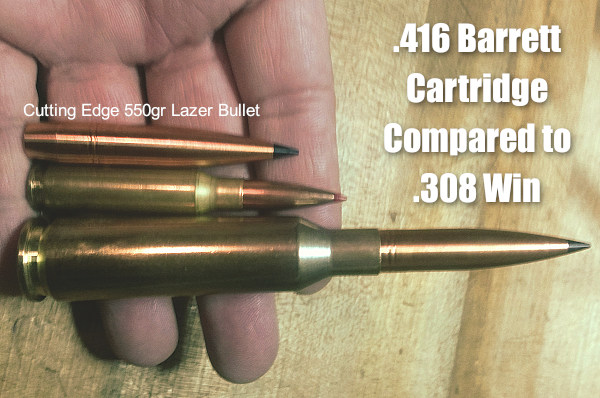
Today’s Sunday GunDay story features Corbin Shell’s remarkable, record-setting .416 Barrett. With a 40″ Krieger barrel secured in a massive barrel block, this is definitely a big boomer!
Last month, Forum member Corbin Shell set a new Extreme Long Range (ELR) record. With no sighters or warm-up shots, Corbin put three (3) shots on a 36″ x 36″ steel plate at 2118 yards, establishing a new Cold Bore ELR World Record. The range was verified with three rangefinders and witnessed by 20+ awestruck shooters. Applied Ballistics reports: “There is a new official ELR World Record. 2118 yards. 3 for 3 cold bore.” This was also recognized as a record by the FCSA (Fifty Caliber Shooting Association).*
This record was set at the ELR Southeast Shootout held at the Arena Training Facility in Blakely, Georgia, on March 2, 2019. The World Record attempt was made in compliance with all ELR Central Rules.
Corbin Shell (on right) stands next to Joe Burdick, match director. That’s three hits on 36″ x 36″ plate.
ELR Ain’t Cheap — $6.55 Cost per Shot
Corbin told us: “Each round fired cost approximately $6.55. The breakdown is as follows: bullet $3.05, powder $0.80, primer $0.50, cartridge case $1.00 (based on five firings), barrel wear $1.20 per shot based on 1000 rounds of barrel life. Hitting steel at distance: PRICELESS!”
ELR Record .416 Barrett Rifle Components
Action: BAT .50 caliber EX, multi-flat, with hard coat finish, extra CheyTac bolt. Barrel: Krieger cut-rifled, .416 caliber, 40″ finish length, 1:9″ twist. Barrel Block: Doyle Anglin Dixie Gunworks, integral Picatinny rail. Muzzle Brake: Ryan Pierce 5-port magnum. Stock: Designed and fabricated by Doyle Anglin, Dixie Gunworks. Obeche laminate, Indian Blanket color scheme. 48″ long excluding butt hardware. Butt and Cheekpiece Hardware: Master Class/Alex Sitman, extended rods. Scope: Sightron SIII 6-24x50mm MOA reticle item #25127. 100 MOA elevation/windage. Bipod: Duplin Rifles by Clint Cooper. Weight: One pound, 2 ounces. Gunsmith: Rifle builder was Doyle Anglin, Dixie Gunworks, Winder, GA.
If you want to learn more about this record-setting rifle, Corbin has prepared a 6-page project history describing all the components and explaining how the rifle was constructed. This Build Document also contains a wealth of information about loading for the .416 Barrett cartridge.
Conditions During Record:
Corbin tells us: “This was shot in Blakely, Georgia at the Arena Training Facility in good Ole dense Southern air. Here are the atmospheric conditions when I shot: 70 degree temperature, 29.70-29.80 inches of mercury, 82% humidity, 1211 Density Altitude (DA).”
Corbin noted that the unique barrel block with rail helps with ELR Optics: “This custom-made barrel block is drilled length wise to reduce weight. It incorporates an integral Picatinny rail which… facilitates mounting of … the Tacom Charlie/Delta TARAC prism system, without the need to bridge mount.” Charlie/Delta TARAC units effectively offset the view that comes into the scope, providing up to 625 MOA elevation.
ELR Cold Bore Shot Record Rules
Congratulations to the new ELR World Record Holder Corbin Shell. The record now stands at 2118 yards. This record was shot under a very specific set of rules established by ELR Central and industry leaders. For more ELR record information, go to ELRCentral.com. All ELR World Record results can be seen on the ELR Central’sEvent Results Page.
* Prior to Corbin Shell’s GA record, David Tubb shot a 2200-yard, 3-shot group that has been recognized as a FCSA record. However, because David had made a same-day attempt, within minutes, with a different rifle, this did not comply with the ELR Central Rules. So, at this time only Corbin Shell is recognized as the ELR Central World Record Holder.
.338 EnABLER (left) with Berger 300 gr Hybrid, and .375 EnABELR (right) with Berger 407 gr Solid.
Applied Ballistics .338 EnABELR and .375 EnABELR Cartridges Applied Ballistics Weapons Division (ABWD) has announced the release of the new EnABELR cartridge. The EnABELR is a medium-capacity, magazine-feedable cartridge available in both .338 and .375 calibers. As you can see from this chart, when using the new Berger solid .375-cal bullets, the .375 EnABELR shows less drop at 2500 meters than the .338 Lapua Magnum and .375 CheyTac (with 400gr CE bullets).
EnABLER Brass, Dies, Reamers, and Complete Rifles Available Applied Ballistics will be offering all components required to shoot (and reload) the EnABELR cartridges including: chamber reamers, Peterson brass, ABWD-made reloading die sets, and complete tactical and competition rifle systems chambered in both .338 and .375 versions of the EnABELR cartridge.
The .375-caliber version of the EnABELR has been selected for Phase 2 of the Extreme Sniper Strike Operations (ESSO) program, a government-funded project to develop a high-performance, Extreme Long Range sniper weapon system.
Bryan Litz, Chief Ballistician for Applied Ballistics and Berger Bullets states that: “The EnABELR Cartridge and the new Berger .375 caliber Solids were optimized for use in the ESSO application which requires high performance, as well as reliability over many rounds in adverse conditions. In addition to meeting the needs of the military, these are also favorable properties for the serious competition shooter as well.”
Put the same load in a variety of barrels (with the same length and chamberings) and you’ll see a wide variance in muzzle velocity. In fact, it’s not unusual to see up to 100 fps difference from one barrel to the next. We demonstrated this with a comparison test of Lapua factory ammo.
Chron Testing Lapua Factory Ammo
At our Southern California test range some years ago, we chronographed Lapua 105gr 6mmBR factory ammo in three different 8-twist barrels of similar length. The results were fascinating. Lapua specs this ammo at 2790 fps, based on Lapua’s testing with its own 26″ test barrel. We observed a speed variance of 67 fps based on tests with three aftermarket barrels.
Barrel Velocity Variance
Brand ‘S’ and Brand ‘PN’ were pre-fit barrels shot on Savage actions. Brand ‘K’ was fitted to a custom action. All test barrels were throated for the 100-108 grain bullets, though there may have been some slight variances in barrel freebore. With a COAL of 2.330″, the rounds were “jumping” to the rifling in all barrels.
Among the four barrels, Brand ‘PN’ was the fastest at 2824 fps average — 67 fps faster than the slowest barrel. Roughly 10 fps can be attributed to the slightly longer length (27″ vs. 26″), but otherwise this particular barrel was simply faster than the rest. (Click Here for results of 6mmBR Barrel Length Velocity Test).
IMPORTANT: Results Are Barrel-Specific, Not Brand-Specific
These tests demonstrate that the exact same load can perform very differently in different barrels. We aren’t publishing the barrel-makers’ names, because it would be wrong to assume that ‘Brand X’ is always going to be faster than ‘Brand Y’ based on test results from a single barrel. In fact, velocities can vary up to 100 fps with two identical-spec barrels from the SAME manufacturer. That’s right, you can have two 8-twist, 26″ barrels, with the same land-groove configuration and contour, from the same manufacturer, and one can be much faster than another.
Don’t Demand More Than Your Barrel Can Deliver
We often hear guys lament, “I don’t get it… how can you guys get 2900 fps with your 6BRs and I can only get 2840?” The answer may simply be that the barrel is slower than average. If you have a slow barrel, you can try using more powder, but there is a good chance it may never run as fast as an inherently fast barrel. You shouldn’t knock yourself out (and over-stress your brass) trying to duplicate the velocities someone else may be getting. You need to work within the limits of your barrel.
Factory Ammo Provides a Benchmark
If you have a .223 Rem, 6mmBR, .243 Win, 6.5×47 Lapua, 6.5 Creedmoor, 6.5×55, .308 Win, 30-06, or .338 LM Rifle, we recommend you buy a box of Lapua factory-loaded ammo. This stuff will shoot great (typically around half-MOA), and it can give you a baseline to determine how your barrel stacks up speedwise. [Editor’s NOTE: The original test was conducted in 2008. The velocity of current-production Lapua factory ammo might be higher or lower, so your results may vary.]
When you complete a new 6mmBR rifle, it’s definitely smart to get a box of the factory ammo and chronograph it. That will immediately give you a good idea whether you have a slow, average, or fast barrel. Then you can set your velocity goals accordingly. For example, if the factory 6BR ammo runs about 2780-2790 fps in your gun, it has an average barrel. If it runs 2820+ in a 26″ barrel (or 2835 fps in a 28″), you’ve got a fast tube.
At the request of our readers, we provide select “Deals of the Week”. Every Monday morning we offer our Best Bargain selections. Here are some of the best deals on firearms, hardware, reloading components, optics, and shooting accessories. Be aware that sale prices are subject to change, and once clearance inventory is sold, it’s gone for good. You snooze you lose.
1. Midsouth — Frankford Arsenal Rotary Tumbler LITE, $99.99
Wet-tumbling with stainless media gets large quantities of cartridge brass clean inside and out. If you’ve wanted to try wet-tumbling, here’s your chance. Midsouth has the Frankford Arsenal Platinum LITE Tumbler on sale for just $99.99 — a total steal. If you run large quantities of brass, you can get the larger-capacity Frankford Arsenal Platinum Tumbler for $179.99. Either one of these is a reliable, durable (and watertight) machine that should provide years of worry-free tumbling.
2. Grizzly Bald Eagle — Great Range Bag and Rifle Case Sale
Grab one of these Bald Eagle rifle cases or range bags at up to 50% off. These are way better than typical too-skinny rifle cases or flimsy fabric bags. The rifle cases have plenty of storage for your match needs and the padding is very good. The box-style range bags have thick closed-cell foam panels in the base, top, and sides. That gives these bags good “wall strength”, so they don’t collapse like typical range bags. These are more like a quality camera-case.
AccurateShooter.com Editor’s Bald Eagle 20″ Range Bag with Spotting Scope:
As you can see, the Bald Eagle 20″ range bag is quite big inside with lots of padding. We use this bag to carry our spotting scope and a small tripod, plus lots of other gear in the pockets. The near-full-width front pocket is very handy. We really like this 20″ range bag, which is a total steal at just $15.97. In fact the Editor likes his 20″ Bald Eagle bag so much he just ordered a second, along with two 15″ bags.
3. Graf’s — Frankford Arsenal M-Press + Extras, $249.99
Frankford Arsenal has been getting a lot of press since SHOT Show with a bounty of new products. Topping the list of must-have items is the M-Press. This press takes all the proven concepts of a Co-Axial press and improves on them. It has reversible cam-over bars plus an LED light, quick-adjusting shell-holders, and many other notable features. Right now Grafs.com is offering the new Frankford M-Press for $249.99. If you need any more incentive, Graf’s is offering a FREE set of three (3) additional die blocks, plus a handy kinetic bullet puller. Nobody else is offering anything like this especially since the M-Press is so new. [Editor: Watch for our M-Press review later this month.]
4. Midsouth — Sierra Loaded Ammunition Sale
Sierra is renowned for making quality bullets but did you know Sierra also produces great loaded ammo for hunters? Available in many of the most popular calibers and featuring GameKing bullets, Sierra’s GameChanger Ammunition could just be the edge you’re looking for on your next hunt. Midsouth has GameChanger ammo on sale right now. Stock up before hunting season arrives and prices go up.
5. Bruno Shooters Supply — Nightforce NXS 5.5-22 Scope, $1699
Nightforce NXS scopes are some of the best optics in their price range. Given their popularity, it’s rare to find NXS models on sale. Right now Bruno’s is discounting these fine scopes, so this is a great buying opportunity. Grab either the Nightforce NXS 5.5-22x50mm or the Nightforce NXS 5.5-22x56mm at a blow out price of $1699. This power range is one of the most popular out there so to buy one of these for over $300 off is a deal you can’t pass up.
6. Bullet Central — Bix’N Andy Trigger with Free Cleaning Kit
Bix’N Andy makes some of the very best trigger systems on the planet. It’s rare that you ever see them associated with any kind of promotion. If you’ve been waiting for a good reason to get a Bix’N Andy trigger, here is your chance. Bullet Central is now offering a free 8 oz. ThorroClean kit with every Bix’N Andy purchase. ThorroClean by Iosso works is a two-part bore flush/bore cleaning package that removes fouling with minimal dwell time. Trust us, you won’t be disappointed with a Bix’N Andy trigger, and the deal provides a little extra incentive.
7. Amazon — 60 Jourdak Quality Earplugs for $12.95
Ever arrived at the range and realized you left your earmuffs at home? It’s happened to us all. That’s why you should keep some extra ear-plugs in your rifle cases and range bags. Right now you can buy a 60-count bottle of Jourdak soft earplugs for $12.95. Buyers say these SNR 35 dB plugs, which “heat-mold” to your ear canal, are very comfortable and effective. Plus there is a 10% Off instant coupon for the Jourdaks. We also recommend the Howard Leight Max-1 ear-plugs. These NRR 33 plugs are comfortable and easy to insert. You can get 20 pairs of Max-1s for just $4.95. Either option comes with free shipping. Remember, always wear effective hearing protection while at the range.
TECH NOTE Concerning NRR (Noise Reduction Rating) and SNR (Single Number Rating)
The highest NRR rating for earplugs is 33, and the highest available NRR rating for earmuffs is 31. These values reflect the level of noise protection available for each device when worn alone. Combining earplugs with earmuffs can offer a NRR protection level of 36. The SNR (single number rating) is a rating system used in the European Union to indicate the amount of protection offered by correctly-fitted hearing protection devices. Source: Protectear.com
8. Palmetto State Armory — S&W M&P 15-22, $299.99
In our view, every gun guy (and gun gal) should own a nice self-loading .22 LR rimfire rifle. And if you own an AR, it makes sense to have a rimfire rig with the same balance and ergonomics. That’s what the M&P 15-22 is all about — AR ergos with rimfire economy. With bulk .22 LR ammo, your cost-per-shot is under nine cents per round! Right now at Palmetto State Armory, the popular Smith & Wesson M&P 15-22 Sport is just $299.99 on sale. That’s not much more than a basic Ruger 10/22 and we like this S&W 15-22 much better — it’s great for plinking and rimfire action disciplines. This rifle can use most AR15-family accessories, and it comes with Magpul MBUS sights, and M-Lok rails.
9. Amazon — TACVASEN Long Sleeve Tactical Shirt, $29.99
Let’s face it, looking good at a match can be almost as important as feeling good. Now you can do both with lightweight TACVASEN Long Sleeve Shirts. The TACVASEN Men’s Slim Fit Long Sleeve Combat Shirt is available in nine different colors, including four with camo sleeves. PRS guys would like these shirts. They fit right so you can run stages without snagging range carts or barriers. These zip-collar shirts feature 65% polyester, 35% cotton fabric for breathability and quick drying. These shirts have earned a 4-star rating with 163 buyer reviews.
Are you considering the Frankford Arsenal tumbler featured above? It’s a great machine. But you’ll also need stainless media for it. Here’s your solution. Amazon sells 2.5 lbs of stainless tumbling media for a mere $19.50. Amazon also offers even larger quantities of stainless steel tumbling pins if you need more than a couple pounds for those really big jobs.






 Bushing Choice for Optimal Sizing


 Looking for a new bipod that can work with a Picatinny rail? You’re in luck because we just found this 6″ – 9″ adjustable




 Barrel Velocity Variance


