Do you have some ammo that got loaded incorrectly, perhaps with the wrong powder? Then you’ll want to disassemble the ammo for safety’s sake. You can use an impact puller to do this task, but if you have more than a dozen rounds or so, you may prefer to use a collet-style bullet puller. These work very quickly and positively, making quick work of big jobs. The efficiency of the collet-style puller is worth the investment if you frequently disassemble ammo. These devices retail for under $35.00 (collets sold separately). Normally, you’ll need a specific collet for each bullet diameter. But collets are not that costly, so this isn’t a big deal, particularly if you only load a few calibers, such as .223, 6mm, and .308.
Hornady and RCBS use different mechanisms to tighten the collet around the bullet. On the red lever Hornady Cam-Lock Bullet Puller, a lever-arm on the top of the bullet puller serves to tighten the collet around the bullet. Simply rotate the lever from the vertical to the horizontal position to grab the bullet. Lower the ram to remove the case. The bullet will drop out when you return the lever arm to the vertical position. This is demonstrated in the video below:
Hornady Cam-Lock Bullet Puller Demonstrated
Collet bullet-pullers resemble a loading die with a lever or handle on the top. They screw into a standard reloading press. Hornady and RCBS both make collet-style bullet pullers. They use the same basic principle — the device tightens a collet around the bullet, and then the bullet is separated from the case by lowering the press ram. NOTE: Collet pullers may leave small marks on your bullets, unlike impact (kinetic) pullers.*
Like the Hornady tool, the RCBS Bullet Puller employs a collet to grab the bullet. However, the RCBS tool tightens the collet in a different way. The head of the RCBS tool is threaded internally. By rotating the lever arm clockwise in a horizontal circle you squeeze the collet around the bullet. To remove the bullet, after lowering the press ram, simply spin the lever arm back in the opposite direction. The use of the RCBS tool is demonstrated in these two videos:
RCBS Collet Bullet Puller Demonstrated:
WARNING: When removing bullets from loaded cartridges, always make sure there are no obstructions or debris in your shell-holder or under the loaded round. NEVER engage a primer seating accessory on your press when working with loaded rounds. You can cause a round to discharge by contacting the primer! Also, we recommend you keep your head and torso away from the bullet puller tool at all times.
*By contrast, impact pullers rarely mark bullets, particularly if you put a little bit of foam or paper wadding in the closed end of your impact puller. When dismantling loaded rounds, powder kernels can get trapped in the wadding, so you should remove and replace the wadding before changing to cartridges loaded with a different powder type (assuming you intend to save the powder).
It’s October, the fall season, and that means rainy, wet weather is on the way in many areas of the country. With rain comes increased moisture in the air, i.e. increased humidity. And that, in turn, can affect how your powders perform by altering their burn rates.
Most shooters realize that significant changes in temperature will alter how powders perform. That’s why you want to keep your loaded ammo out of the hot sun, and keep rounds out of a hot chamber until you’re ready to fire. But there are other factors to be considered — HUMIDITY for one. This article explains why and how humidity can affect powder burn rates and performance.
We’ve all heard the old adage: “Keep your powder dry”. Well, tests by Norma have demonstrated that even normal environmental differences in humidity can affect the way powders burn, at least over the long term. In the Norma Reloading Manual, Sven-Eric Johansson, head of ballistics at Nexplo/Bofors, presents a very important discussion of water vapor absorption by powder. Johansson demonstrates that the same powder will burn at different rates depending on water content.
Powders Leave the Factory with 0.5 to 1.0% Water Content
Johansson explains that, as manufactured, most powders contain 0.5 to 1% of water by weight. (The relative humidity is “equilibrated” at 40-50% during the manufacturing process to maintain this 0.5-1% moisture content). Importantly, Johansson notes that powder exposed to moist air for a long time will absorb water, causing it to burn at a slower rate. On the other hand, long-term storage in a very dry environment reduces powder moisture content, so the powder burns at a faster rate. In addition, Johansson found that single-base powders are MORE sensitive to relative humidity than are double-base powders (which contain nitroglycerine).
Tests Show Burn Rates Vary with Water Content
In his review of the Norma Manual, Fred Barker notes: “Johansson gives twelve (eye-opening) plots of the velocities and pressures obtained on firing several popular cartridges with dehydrated, normal and hydrated Norma powders (from #200 to MRP). He also gives results on loaded .30-06 and .38 Special cartridges stored for 663 to 683 days in relative humidities of 20% and 86%. So Johansson’s advice is to keep powders tightly capped in their factory containers, and to minimize their exposure to dry or humid air.”
Confirming Johansson’s findings that storage conditions can alter burn rates, Barker observes: “I have about 10 pounds of WWII 4831 powder that has been stored in dry (about 20% RH) Colorado air for more than 60 years. It now burns about like IMR 3031.”
What does this teach us? First, all powders start out with a small, but chemically important, amount of water content. Second, a powder’s water content can change over time, depending on where and how the powder is stored. Third, the water content of your powder DOES make a difference in how it burns, particularly for single-base powders. For example, over a period of time, a powder used (and then recapped) in the hot, dry Southwest will probably behave differently than the same powder used in the humid Southeast.
Reloaders are advised to keep these things in mind. If you want to maintain your powders’ “as manufactured” burn rate, it is wise to head Johannson’s recommendation to keep your powders tightly capped when you’re not actually dispensing charges and avoid exposing your powder to very dry or very humid conditions.
Real-World Example — “Dry” H4831sc Runs Hotter
Robert Whitley agrees that the burn rate of the powder varies with the humidity it absorbs. Robert writes: “I had an 8-lb. jug of H4831SC I kept in my detached garage (it can be humid there). 43.5-44.0 gr of this was superbly accurate with the 115 Bergers out of my 6mm Super X. I got tired of bringing it in and out of the garage to my house for reloading so I brought and kept the jug in my reloading room (a dehumidified room in my house) and after a few weeks I loaded up 43.5 gr, went to a match and it shot awful. I could not figure out what was going on until I put that load back over the chronograph and figured out it was going a good bit faster than before and the load was out of the “sweet spot” (42.5 – 43.0 gr was the max I could load and keep it accurate when it was stored in less humid air). I put the jug back in the garage for a few weeks and I now am back to loading 43.5 – 44.0 gr and it shoots great again. I have seen this with other powders too.”
If you have two jugs of the same powder, one kept in a room in your house and one somewhere else where it is drier or more humid, don’t expect the two jugs of the same lot of powder to chrono the same with the same charge weights unless and until they are both stored long enough in the same place to equalize again.
Even with high-quality brass from Lapua, Peterson, Norma, Alpha and RWS, occasionally you may find one or two cases per box which have a small flake or obstruction in the flash-hole. This will appear like a thin crescent on one side of the flash hole (see photo). You should inspect ALL new brass before loading to identify any pieces with a partially-obstructed flash hole. It’s a good idea to remove any flake or thin crescent left as an artifact of the flash-hole forming process. Because the flash-hole itself is normally centered and of the correct diameter, it is not necessary to ream the flash-hole to a larger diameter. All you really need to do is remove the small obstruction(s). This can be done quickly with inexpensive tools.
Use a Small Pin Vise to Remove Flash-Hole Obstructions
Folks have asked if there is a tool that can remove obstructions from a Lapua small, BR-sized flash hole without opening the hole size. The Lapua PPC/BR flash hole is spec’d at 1.5mm, which works out to 0.059055″. Most of the PPC/BR flash-hole uniforming tools on the market use a 1/16″ bit which is nominally 0.0625″, but these often run oversize — up to 0.066″.
If you want to just clear out any obstructions in the flash hole, without increasing the flash hole diameter, you can use an inexpensive “pin vise” with an appropriate drill bit. For $5.39, Amazon sells a 10-piece set of cobalt steel 1.5mm drill bits that match the Lapua flash hole exactly. Other vendors such as Ace Hardware offer a #53 pin vise drill bit that measures .0595″ or .060″ (depending or source). An 0.0595″ (1.51 mm) bit is close enough. You can find pin vises and these small-diameter drill bits at hobby stores.
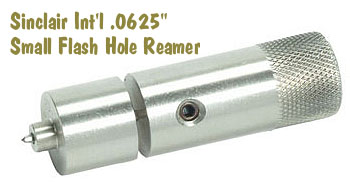
For quite some time, Sinclair Int’l has sold a similar device for small (PPC and BR-size) flash holes. Like the 749008617 unit for large flash holes, the 749005418 Reamer for small flash holes works from the outside, so it can index off the primer pocket. It reams to .0625″, and also costs $29.99. The standard dimension for Lapua 220 Russian and 6mmBR flash holes is 1.5mm or .0590″. This tool will permit standard-size decapping rods with .0625″ tips to work without binding. However, note that both Forster and Redding normally supply .057″ decapping pins with their PPC and BR dies. So, it is NOT necessary to ream your Lapua BR/PPC flashholes, unless you prefer to do so for uniformity. It IS, however, a good idea to check BR/PPC flash holes for burrs before loading the first time.
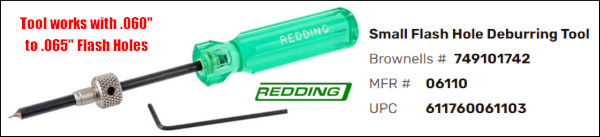
Redding also makes a handy tool that deburs and uniforms small flashholes, but works from the inside of the cases. This Redding tool has a bushing that fits in the case neck for proper alignment.
NOTE: If you purchase the Sinclair Flash Hole Reamer tools, we recommend you mic the cutter tip before you process a bunch of cases. Sometimes a tip comes through that is oversize. This will ream the flash holes larger than you may intend.
With the skyrocketing prices of ammo, more shooters than ever are hand-loading pistol and rifle ammunition. But many novice reloaders tell us that it’s a bit overwhelming in the beginning. Just learning all the technical terms (e.g. ogive, meplat, ballistic coefficient, load density etc.) is difficult, and the task of selecting the right tools and gear can be daunting.
The first thing a new reloader should do is find an experienced reloading mentor. One can learn the basics much more quickly under the guidance of an experienced hand-loader who “knows the ropes”. We also recommend that newbies acquire a good basic reloading handbook — not just a list of load recipes, but a book that explains the processes.
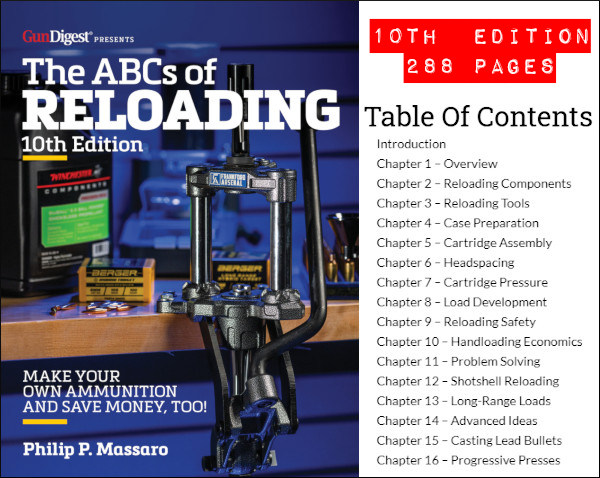
One of the best handbooks available is The ABCs of Reloading (10th Edition, 2021) by Philip Massaro. Released in March 2021, this reference contains 288 pages with hundreds of BW photos. The latest 10th Edition is available from Gun Digest Store for $29.99 (or $29.99 for Printable PDF Digital Book). You can also purchase from Walmart for $19.54 with possible Free Shipping.
Since the first edition was published in the 1970s, the ABCs of Reloading series has taught countless firearms owners safe/reliable methods for creating their own ammunition. ABCs of Reloading provides beginners what they need to know to get started in reloading. From basic topics such as “How does a cartridge work?” and “What components do I need?” to more advanced discussions of cartridge pressure, headspace, and chrono testing, this is a great resource for new handloaders.
In addition, the sections on advanced reloading and new powders make the new edition valuable for experienced handloaders. And long-range shooters will benefit from the sections on making ultra-consistent ammo and fine-tuning for precision accuracy. Massaro’s coverage of new reloading gear and components is another bonus (shown below is the impressive RCBS MatchMaster powder dispenser).
Review from purchaser of “The ABCs of Reloading”, 8th Edition:
“When I first got the itch to load my own ammunition, I was overwhelmed by the amount of information and terminology involved in this fascinating field/hobby. It was very difficult to take all the individual pieces of information that I had and form it into an understandable process. I was snowed in under a blizzard of data that I was piecing together through chat rooms and web sites. Phrases like ‘roll crimp’ and ‘headspace’ came at me in a blizzard. I could look up each phrase, understand each one as a piece, but still the whole picture was fuzzy. In essence, that is what this book will do for you — turn it all into a coherent, linear whole. The writing is very solid and clear, the illustrations are well-done and helpful, and the information is very complete. After reading this book, the entire process made sense to me, and more importantly, I was fully warned about the dos and don’ts of the reloading world. The coverage is very complete. Primers, powders, bullets, and … all necessary tools and accessories are discussed and explained. This is just a great book. It won’t make you an expert … but it will put you on the right road if you wish to become one.” — Mykal Banta
At the request of our readers, we provide select “Deals of the Week”. Every Sunday afternoon or Monday morning we offer our Best Bargain selections. Here are some of the best deals on firearms, hardware, reloading components, optics, and shooting accessories. Be aware that sale prices are subject to change, and once clearance inventory is sold, it’s gone for good. You snooze you lose.
NOTE: All listed products are for sale to persons 18 years of age or older. No products are intended for use by minors.
Brownells — Howa 1500 Barreled Actions with HACT Triggers
⏺️ » Great barreled actions with nice trigger starting under $430.00
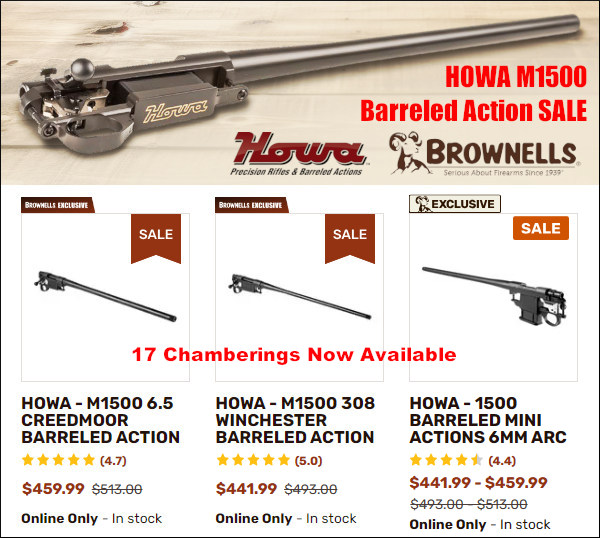
Howa M1500 barreled actions are great for hunting and varmint rifle projects. The actions run smoothly and boast a very good 2-stage trigger. And now you can get a complete barreled action (with trigger!) starting at $429.12. Many chamberings are offered, with a variety of barrel profiles: .223 Rem, 22 ARC, .22-250, 6mm ARC, .243 Win, 6.5 Grendel, 6.5 Creedmoor, 6.5 PRC, 7.62×39, 7mm-08, 7mm PRC, 7mm Rem Mag, .308 Win, 300 AAC, 300 PRC, .300 Win Mag and 350 Legend. These Japanese-made Howa actions are smooth running and the 2-stage HACT trigger is way better than most factory triggers. CLICK HERE to learn more about Howa M1500 barreled actions.
EuroOptic — February Deals on Vortex Scopes, Rifles, Gear
⏺️ » Big savings on Vortex Scopes, Bolt Guns, and Outdoor Gear
EuroOptic.com is running multiple major sales this week. Check out these major specials with savings up to 80% on Outdoor Gear. If you need scopes, spotter, binoculars, and/or rangefinders, check out the Vortex Promo — save 12% with Code VTX12. Next you can save hundreds on bolt-action rifles. There are huge discounts on major brands including SAKO, Tikka, Bergara, Christensen, SAUER, and more. Last but not least, EuroOptic is running a major sale on a wide variety of outdoor gear (clothing, accessories, packs etc.) with discounts up to 80%.
As an Amazon affiliate, this site can earn revenues through sales commissions.
Do you know what the inside of a rifle chamber (and throat zone) really looks like? Do you understand the concept of headspace and why it’s important? If not, you should read the Brownells GunTech article Gauging Success — Minimum Headspace and Maximum COL. This article explains the basics of headspace and shows how to measure headspace (and length to lands) in your barrels with precision. The article also explains how to adjust your full-length sizing dies to “bump the shoulder” as needed.
Why is headspace important? The article explains: “Controlling headspace and setting proper C.O.L. also represent improved safety and reduced cost of handloading. Excessive headspace can cause case head separation and gases in excess of 60,000 PSI escaping from a rifle’s chamber. Too little headspace can result in a chamber forced bullet crimp and a bullet that becomes an obstruction more than a properly secured projectile. Excessive C.O.L. can result in a rifling-bound bullet, a condition that could result in spikes of excessive pressure.” [Editor’s NOTE: It is common for competitive benchrest shooters to seat bullets into the rifling. This can be done safely if you reduce your loads accordingly. With some bullets we often see best accuracy .010″ (or more) into the lands. However, this can generate more pressure than the same bullet seated .010″ away from initial lands contact. As with all reloading, start low and work up gradually.]
How is headspace specified? Most cartridges used within the United States are defined within ANSI/SAAMI Z299.3-4. Brownells explains: “In the case of the .243 Winchester, as an example, there are pressure specifications, cartridge drawings and, as pictured above, chamber drawings. Armed with a chamber drawing, each manufacturer producing a firearm for the .243 Winchester knows the proper standard dimension to cut chambers and set headspace. Notice there are two headspace reference dimensions for the chamber. The upper is a place in the chamber where the shoulder is .400″ in diameter; the “datum” or “basic” line. The lower is the 1.630″~1.640″ minimum – maximum dimension from the breech face (bolt face) to that point in the chamber that measures .400″.”
The actual headspace of any firearm is the distance from the breech face to the point in the chamber that is intended to prevent forward motion of a cartridge.
Finding Cartridge Length to Lands with OAL Gauge
Using a comparator on a set of calipers, you can quickly determine cartridge base-to-ogive length. This is the measurement from the base of the case to the forward-most full diameter section of the bullet, which is for convenience called the ogive. (Technically, the “ogive” is the full curve from bullet tip back to full-diameter ring). Shown here, that ogive is 0.243″ diameter.
The next step is using a modified (threaded) case with a Hornady OAL tool to determine Length-to-Lands (LTL) in your rifle’s chamber. During this measurement process, the modified case, with a bullet in its neck, is inserted in the chamber. Go slow, take your time. Here are 5 tips that will help you get repeatable and reliable LTL measurements:
1. Start with a clean chamber and clean barrel throat.
2. Make sure the modified case is fully screwed down and seated on the OAL Gauge. It can sometimes unscrew a bit during repeated measurements.
3. Insert the modified case slowly and gently, but ensure the shoulder of the modified case is fully seated on the end of the chamber.
4. Push the gray plastic rod GENTLY. It is common for the bullet to be tilted a bit. You want to allow the bullet to self-center in the throat BEFORE you apply much pressure. Then tap a couple times and push until you feel resistance. Do NOT push too hard — that will jam the bullet in the lands.
5. Repeat the measurement at least 3 more times. If you follow our instructions, you should, typically, get a repeatable measurement, within 0.0015″ or so, 3 out of 4 times.
Here’s a smart tip from Bryan Litz, explaining how damage to a bullet jacket can harm the projectile’s Ballistic Coefficient (BC). This tip is posted on Bryan’s new Bryan Litz Ballistics Facebook page. We recommend you subscribe to that page to access Bryan’s latest informative posts.
Bryan notes: “If the case mouth scratches the bullet when you seat it, the damage can cause the BC to be inconsistent, which shows up as vertical dispersion at long range.”
We see this sometimes when running Doppler Radar for competitors at Applied Ballistics Mobile Lab events. If someone is shooting a bullet that typically has a very consistent BC (1% or less) but they’re seeing a higher BC variation, it can be due to the bullets being damaged in the loading process.”
The lead photo above shows the badly-scratched jacket of a bullet seated in a rough-mouthed case. To prevent such jacket damage, one should chamfer, deburr, and smooth case mouths after trimming.
Below is a recorded Doppler radar result showing excessive BC variation. Such variation can increase vertical dispersion at long range. This can result in larger group sizes and lower scores.
⏺️ » Over 70 loadbook varieties — great for pistol and hunting loads
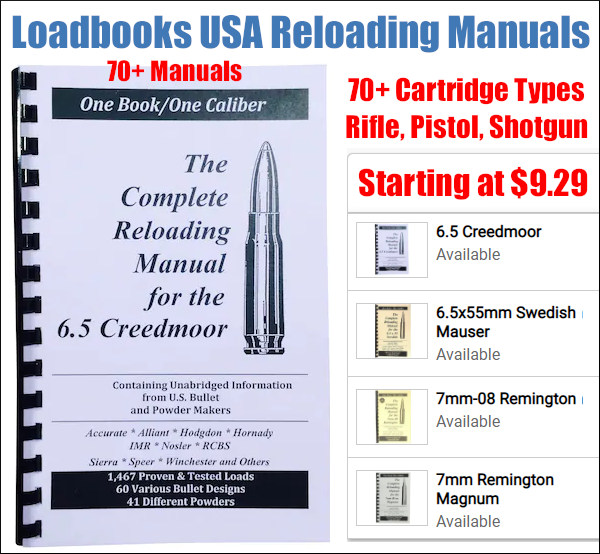
Loadbooks pack a ton of valuable load data in a single handy volume. These booklets efficiently summarize data from multiple bullet and powder manufacturers. We have used these Loadbooks for our pistol loading as well as common rifle hunting loads. Right now a wide selection of these loadbooks are in-stock at MidwayUSA, with affordable prices. The 6.5 Creedmoor manual is $9.29, the .45 ACP book is $10.49, the .223 Rem book is $11.49, and the .308 Win book is $12.49.
Chose from over 70 cartridge types, including .380 ACP, 9mm Luger, .357 Magnum, .40 SW/10mm, .45 ACP, .204 Ruger, .223 Rem, 22-250, 6mm Remington, 6.5 Creedmoor, 6.5×55, 7mm-08, .270 Win, .284 Win, .308 Win, .30-06, 300 WinMag, .338 LM, 12ga shotshell and many more. NOTE: On MidwayUSA’s landing page, click “Select Title” then scroll down to choose your preferred cartridge type. You an order multiple loadbook titles by adding to the shopping cart.
NOTE: Good load information is available online from Hodgdon and other powder companies. But it’s handy to have a print book that you can use without Wifi, and make notes about your loads. Sometimes a traditional reference is actually more convenient than the internet.
At the request of our readers, we provide select “Deals of the Week”. Every Sunday afternoon or Monday morning we offer our Best Bargain selections. Here are some of the best deals on firearms, hardware, reloading components, optics, and shooting accessories. Be aware that sale prices are subject to change, and once clearance inventory is sold, it’s gone for good. You snooze you lose.
NOTE: All listed products are for sale to persons 18 years of age or older. No products are intended for use by minors.
Graf & Sons — Berger Bullet Sale (Save up to 29%)
⏺️ » Save on Berger match, varmint, & hunting bullets, plus Berger ammo
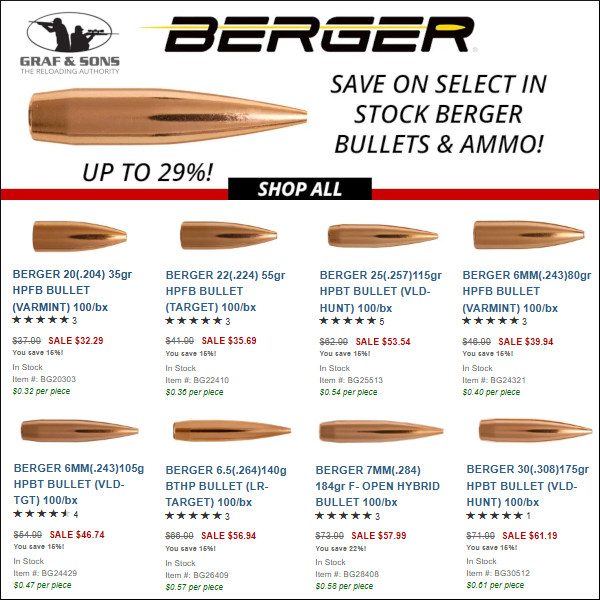
Here’s your chance to stock up on some of the best bullets you can buy. Right now at Graf & Sons, a vast selection of Berger Bullets is on sale for all popular calibers: .204, .224, 6mm, .257, 6.5mm, .270, 7mm, .308, .338 and .375. Save up to 29% on popular match, varmint, and hunting bullets. In addition Graf’s has discounted the excellent Berger Loaded Ammunition which uses top-quality brass. Loaded ammo is offered for a wide variety of cartridge types, from .223 Rem to .338 Norma Mag. If you shoot PRS/NRL we can definitely recommend the Berger 6mm Creedmoor ammo.
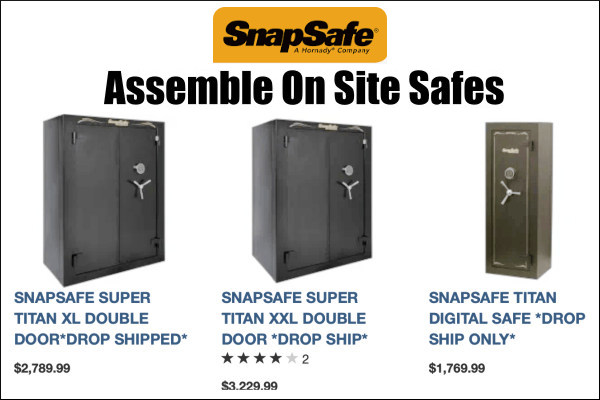
Graf & Sons — SnapSafe Titan Assemble-On-Site GunSafes
⏺️ » Unique Shippable Gun Safes in Liftable Segments
Have you been wanting a good gunsafe but are put off by having to move it or can’t get it into the room you want? Consider one of these SnapSafe Assemble-On-Site Safes that have all the security of a conventional, welded safe in an easy-to-assemble valuables and closet gun vault that moves anywhere piece-by-piece, then locks together in minutes with no specialized tools.
As an Amazon affiliate, this site can earn revenues through sales commissions.
The 6.5 Creedmoor is now one of the most popular cartridges chambered in factory rifles. It found favor among hunters and PRS competitors, but then its little brother the 6mm Creedmoor became widely adopted because the 6mm version delivered less recoil, equivalent or better ballistics, and lower bullet cost.
There’s another Creedmoor cousin, the 22 Creedmoor, basically a 6mm Creedmoor necked down to .224 caliber. While this certainly can be used for PRS and tactical competition, the 22 Creedmoor seems to be ideally suited as a high-velocity varmint round — something to replace the 22-250. You get 22-250 class velocities with a more modern cartridge design, and high-quality brass.
LEARN MORE about the 22 Creedmoor
There is an excellent write-up in the GunsAmerica Digest about the 22 Creedmoor cartridge. Reviewer Jeff Cramblit built a 22 Creedmoor rifle and tested it with a variety of bullet weights. He concluded it worked best as a varminter, but could also do PRS duty, provided it is loaded under the 3200 fps velocity limit common in PRS matches. CLICK HERE to read full GunsAmerica 22 Creedmoor test report.
22 Creedmoor Ammunition, SAAMI Spec
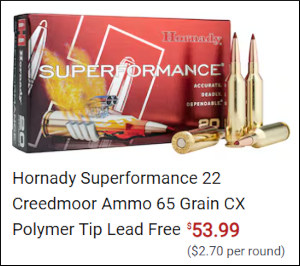
SAAMI (Sporting Arms & Ammunition Mfg’s Institute) officially approved the 22 Creedmoor Cartridge in February, 2024. The cartridge has become more popular over the last two years, so ammo production has increased. Loaded 22 Creedmoor ammo is available from Copper Creek, Gunwerks, Hornady, Nosler, and Spark Munitions. Copper Creek has produced the most 22 Creedmoor loaded ammo varieties, with 18 different bullet options from 68 grains to 95 grains, including two lead-free bullet types. Copper Creek also offers load development packs with either Peterson or Hornady brass. Below are five Cooper Creek loaded ammo options with Sierra and Berger bullets.
In addition, multiple companies now offer 22 Creedmoor cartridge brass: Alpha Munitions, Atlas ADG, Hornady, and Peterson Cartridge. The Peterson 22 Creedmoor brass is excellent.
Of course you can neck down high-quality Lapua 6mm Creedmoor brass. Lapua brass has outstanding consistency and durability. Choose from large primer or small primer types. Necking down is a relatively easy one-step operation with a neck-sizing or full-length sizing die. You’re just stepping down to .224 from .243 — not that big of a jump.
22 Creedmoor Brass from Peterson Cartridge
According to Derek Peterson, President of Peterson Cartridge, “We decided to build the tooling to make our .22 Creedmoor brass in response to the uptick in long-distance predator and varmint hunting. Plus the round is just straight-up fun to shoot. It is a low-recoil, flat shooting, wind-bucking round [that is] deadly accurate up to 800 yards.”
“When we designed the tooling for the .22 Creedmoor we set out to make casings with improved features”, Peterson added. “And we were successful. We increased the head hardness to tolerate higher pressures. And we increased our internal volume slightly to work better with the slow-burning powders [such as Reloder 26 or H1000].”
22 Creedmoor for Varmints — Video from the Varmint Fields of Eastern Oregon
Bullet Choices for 22 Creedmoor
If you have an appropriate twist-rate barrel, you can load the 22 Creedmoor with heavy 85-95 grain bullets. However, we think that, for varminting, the cartridge is better suited for lighter 65-80 grain bullets. This yields high velocities that provide explosive impacts on small varmints.
This GunsAmerica photo shows, L to R, 90gr Sierra MK, Hornady 88gr, 80gr, and 75gr .224 caliber bullets.
What is the Best Role for the 22 Creedmoor?
GunsAmerica tester Jeff Cramblit favors the 22 Creedmoor as a varmint round: “The performance of the 22 Creedmoor with 75-80 grain bullets makes it an outstanding varmint cartridge. I’ve seen claims of 80 grain Bergers at 3500 fps out of 26″ barrels, which would be devastating on any varmint. Loaded ammunition is available with bullets in the 70-75 range leaving 24” barrels at velocities around 3400+ fps, a bit more conservative than personal hand-loading, but still making it a very flat shooting, low recoiling round delivering impressive results.”
Jeff says the 22 Creedmoor will also work for PRS with heavier bullets: “I built the 22 CM to be a dual-purpose gun, or actually a 3-purpose gun. The first was for the coyotes and varmints previously mentioned. The second was for shooting PRS (Precision Rifle Series) style matches on occasion, and the third was for hunting deer-sized game. As with any multi-purpose tool there tends to be compromises.”
More Efficient Alternatives — the 22 BR and 22 BRA
If you already have a 6mmBR rifle, and you want a higher velocity cartridge for varmint shooting, you may want to consider just necking down your brass. We’ve shot the 22 BR in the varmint fields and a steel match. This cartridge offers excellent accuracy, and is very flat shooting. We recommend getting a fairly fast-twist barrel so you can shoot the longer, high-BC bullets if you want to use your 22 BR in local matches. You’ll find that shorter 40gr to 66gr varmint bullets shoot great even in the faster-twist barrels.
For more information on the 22 BR for varminting and target shooting, with recommended loads for 40gr to 90gr bullets, read our Accurate Shooter 22 BR Cartridge Guide.
If you want more velocity than a 22 BR offers, you can have your barrel chambered for the 22 BRA (BR Ackley). With its 40-degree shoulder, the 22 BRA offers a few more grains capacity, so you can get more FPS with all classes of bullets. Fire-forming is easy — just use a normal 22 BR load with good bullets and shoot. We’ve fire-formed a 22 BRA in a varmint match and it showed excellent accuracy — there’s no need to waste bullets fire-forming. Go ahead and fire-form during a fun match.


 Like the Hornady tool, the RCBS Bullet Puller employs a collet to grab the bullet. However, the RCBS tool tightens the collet in a different way. The head of the RCBS tool is threaded internally. By rotating the lever arm clockwise in a horizontal circle you squeeze the collet around the bullet. To remove the bullet, after lowering the press ram, simply spin the lever arm back in the opposite direction. The use of the RCBS tool is demonstrated in these two videos:
 Tests Show Burn Rates Vary with Water Content








 Finding Cartridge Length to Lands with OAL Gauge





 If you already have a 6mmBR rifle, and you want a higher velocity cartridge for varmint shooting, you may want to consider just necking down your brass. We’ve shot the 22 BR in the varmint fields and a steel match. This cartridge offers excellent accuracy, and is very flat shooting. We recommend getting a fairly fast-twist barrel so you can shoot the longer, high-BC bullets if you want to use your 22 BR in local matches. You’ll find that shorter 40gr to 66gr varmint bullets shoot great even in the faster-twist barrels.


