Today is Thanksgiving, aka “Turkey Day”, a time to enjoy an annual get-together with family and friends. To mark this occasion we offer a collection of interesting videos about turkey hunting plus a FREE Turkey target. Enjoy your Thanksgiving holiday!
GetZoneHunting.com has a vast video library for hunters, with hundreds of helpful videos on all types of hunting. In time for spring turkey season, GetZoneHunting offers a big collection of turkey hunting videos: At the Ranch – Turkey. On that page you’ll find 13 turkey hunting “how-to” videos. Here are links to five GetZone Turkey Hunting videos with valuable information from skilled, experienced hunters.
At the Ranch Turkey Hunting Videos
At the Ranch – Turkey offers solid advice for turkey hunters. These five videos will help you better understand turkey behavior and have success on your hunt. Click any photo to watch the particular video on the GetZone website. (Work Warning — When each GetZone video opens, it may immediately launch an annoying commercial with loud AUDIO!). There are eight more turkey hunting videos on GetZone’s Turkey Hunting HQ Page.
At the Ranch: Shot Placement for Turkeys — CLICK PHOTO to Watch Video
At the Ranch: Turkey Hunting Essentials — CLICK PHOTO to Watch Video
At the Ranch: The Difference Between a Jake and a Tom — CLICK PHOTO to Watch Video
At the Ranch: Early vs. Late Spring Turkey Hunt — CLICK PHOTO to Watch Video
At the Ranch: How to Plan a Turkey Hunt — CLICK PHOTO to Watch Video
Free Printable Turkey Target from AccurateShooter.com
As a special bonus for our readers, here is a free, printable Turkey Target, so you can practice for your turkey hunting adventure, This special Turkey Bullseye Target was created by our friend and Forum member Pascal (aka “DesertFrog”). CLICK HERE for FREE Turkey Target.
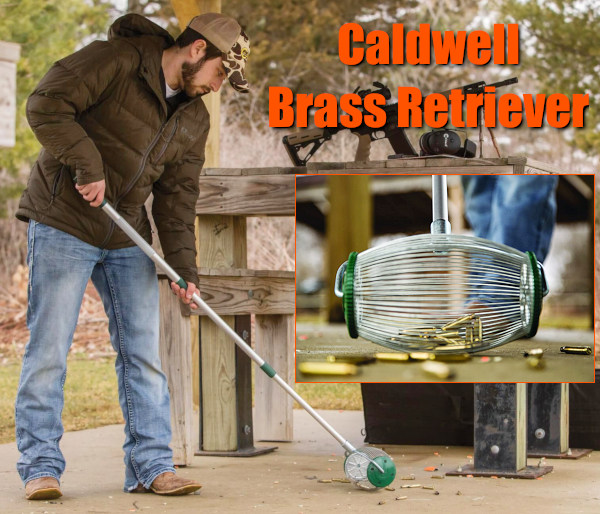
Caldwell Brass Retriever
Tired of bending over or kneeling down to retrieve your fired cartridge brass? For older shooters (including this Editor) getting down on the ground to pick up brass is tough on the lower back and knees. Here’s a product that makes brass retrieval quick, easy, and pain-free. The Caldwell Brass Retriever works quite well with a little practice, once you apply the correct pressure. While it won’t always grab every fired case, it will capture nearly all, and that can really make the job go much faster.
One owner praises this as a “very good tool” that is “a lot easier on my back.” While it can work on grass, gravel, and hard-packed earth, the unit works best on smooth, hard surfaces. Currently priced at $47.46 on Amazon, it is an affordable tool.
Caldwell states: “Spend less time bending over and picking up brass at the range and more time shooting. The Caldwell® Brass Retriever picks up brass, saving your back and time. The Brass Retriever can pick up rifle and pistol brass quickly and efficiently. The retriever comes complete with a roll cage separator that allows you to dump the collected brass into a bucket quickly. It is collapsible as well, making it convenient to transport. The retriever’s handle expands from 28″ up to 57″ tall.”
Brass Retriever Owner Reviews
Here are Amazon reviews from actual purchasers. It’s clear the device is not perfect and can miss a case or two. However, the Brass Retriever does grab the vast majority of brass on the ground, sized .223 Rem or larger diameter. This will save time and reduces stress on your back and joints:
“This thing … does a terrific job of collecting the brass from a standing posture quickly and efficiently. It helps to have the cases on a smooth surface like concrete or dirt without a lot of vegetation. But we used it on open desert yesterday and it collected nearly every case with a single pass. It’s now a permanent piece of gear in the stuff we take when target or ground squirrel shooting.” — Hans H.
“This WILL save your back. The only drawback is you can’t overload it with brass. After couple dozen pieces (or less) it will start dropping brass while you’re attempting to collect others. That’s the limitation (one of them). There is a short learning curve (15 min.) in which you’ll learn how much brass is too much And how you need to orientate the wires to pick up the brass. It doesn’t do as well on gravel or high grass as it does on a smooth, firm surface. Even with its limitations, it’s a keeper. Just empty every dozen or so pieces and it works very well.” — Jeff M.
Specialized Tool for .22 LR Brass
NOTE: The Caldwell Brass Retriever is designed primarily to recover reloadable rifle and pistol brass, with case diameters as fat as .223 Rem or larger. Some people state it can be used for smaller .22 LR cartridges too, but there is a much better product for that.
The UniqueTek Rimfire Brass Wizard is optimized for picking up .22 LR rimfire cases. It has a smaller basket with wires spaced closer together. It can also pick up pistol and rifle cartridge brass but will hold fewer cases than the original Brass Wizard or the Caldwell Brass Retriever. The Brass Wizard “Rimfire” The Brass Wizard “Rimfire” comes standard with the telescoping handle and includes a”Dumper” accessory.
Black Friday is the day after Thanksgiving. Around the country major shooting sports retailers will be offering significant savings on a wide variety of products — from reloading dies to complete, high-end rifles. Some of the major players, such as Brownells, Bud’s Gun Shop, and Palmetto State Armory, have already started their “Black Friday Week” sale, with discounts up to 35% on some products. With Brownells Use Promo Code 15BF to save 15% sitewide — plus you can also get FREE Shipping with $49+ orders.
Gun.Deals has also found some great Black Friday Week bargains from Amazon, as well as major online shops such as KYGUNCO, LockedandLoaded, Sportsman’s Warehouse, and more. We feature a dozen of these hot deals in the table below. Click any box to find the deal on the seller’s website. NOTE: These deals may expire quickly, so you should check often on the Gun.Deals Black Friday Specials Page.
At the request of our readers, we provide select “Deals of the Week”. Every Sunday afternoon or Monday morning we offer our Best Bargain selections. Here are some of the best deals on firearms, hardware, reloading components, optics, and shooting accessories. Be aware that sale prices are subject to change, and once clearance inventory is sold, it’s gone for good. You snooze you lose.
NOTE: All listed products are for sale to persons 18 years of age or older. No products are intended for use by minors.
1. Palmetto SA — Black Friday Guns and Optics Deals
⏺️ Save hundreds on popular AR lowers, pistols, and optics
Black Friday is the day after Thanksgiving. But Palmetto State Armory has kicked off its Black Friday Sale already. There are some absolutely amazing deals, such as a nice SAR9 Pistol complete with holster and belt mag holder for just $249.99. Or get a complete AR lower for just $149.99. If you enjoy rimfire pistol shooting, grab the Taurus TX22 pistol for $219.99 ($75 Off) and get 3 extra magazines via a Taurus rebate.
2. EuroOptic — Bergara Hunting Rifle Clearance
⏺️ Significant savings on Bergara B-14 Wilderness Series rifles
If you want a nice bolt-action hunting rifle at a big discount, check out Closeout Bergara rifles at EuroOptic. Bridging the gap between the B-14 basic and Premier Series, Bergara’s B-14 Wilderness Series is on sale, with featured Hunter ($751.99 on sale) and Terrain ($976.99 on sale) models. These rifles offer good ergonomics and hand-painted camouflage stocks with webbing for increased texture and grip. All Wilderness Series barreled actions feature Sniper Grey Cerakote finishes for advanced protection in extremely harsh weather.
3. Midsouth — LEE Anniversary Press and Dies, $79.99
⏺️ Solid single-stage press AND die set under $80!
The LEE Challenger is the world’s best-selling single station press. The latest Gen III Challenger features an ergonomic lever plus a convenient tube for spent primers. Right now, to mark its 40th Anniversary, LEE is offering a FREE die set with the purchase of the LEE Gen III Challenger Press. Choose one of five cartridge types: .223 Rem, 9mm Luger, .38 SPL/.357 Mag, .44 SPL/.44 Mag, and .45 ACP. A great feature of the LEE Press is the Breech Lock Quick Change Die System — change dies instantly with a twist of the wrist.
4. Ammo Depot — Huge Ammo Sale
⏺️ Major savings on quality 9mm and .223 Rem ammo
Save big bucks right now with the pre-Black Friday Ammo Sale at Ammo Depot. You’ll find top quality ammo from major brands at up to 80% savings. Plus there are range pack discounts for larger quantities — 200 to 5250 rounds. We noted many very great deals on 9mm pistol ammo and .223 Rem (5.56) ammo, with a variety of bullet types.
⏺️ Many positive user reviews — good set-up for varminting and home ranges
Need a good platform for shooting in areas other than organized ranges? Check out the Caldwell Stable Table Deluxe. A bolt in the base allows position adjustment of a single leg, aligning the tabletop so that it is parallel with the horizon. The central shaft, seat, and tabletop are able to pivot (rotate) around a center axis as a single unit while keeping the tabletop parallel to the horizon. This is great for varmint hunting. Owner reviews have been very positive. This item is sold via Walmart.com but ships from Optics Planet.
⏺️ Great value and good choice for PRS/NRL and tactical matches
Need a quality scope at an affordable price for your PRS/NRL rifle? Check out the Vortex 4-24x50mm MRAD Scope at MidwayUSA. Now on sale for just $299.99 (40% off), this quality tactical scope features 0.1 mil click values and EBR4 MRAD-type reticle for easy hold-overs and wind adjustments. Proprietary coatings increase light transmission and the Illuminated reticle provides precise aiming under low-light conditions. Now $200 off the regular $499.99 price, this is a super scope steal.
7. Amazon — Magpul MOE Bipod, $56.93
⏺️ Rugged, reliable bipod that is strong, yet light weight
Whether hunting, competing, or just having fun at the range, having a quality bipod is important. We like the Magpul MOE Bipod which is available in black or FDE. At 8 ounces, it weighs almost 40% less than some other bipods while still providing a dependable, stable platform to shoot from. Staggered soft rubber feet hold fast on a variety of shooting surfaces and are easily removed should users choose to change feet. The bipod legs accept most Atlas-pattern bipod replaceable feet.
8. Amazon — Night Vision Binoculars, $99.97
⏺️ Top-seller with 4k HD image that can be recorded
Here is a great product for hunters that can also serve for home security, allowing you to scan your property at night. These Hexeum 4K Night Vision Binoculars can “watch live” as well as record stills and video. Now available for just $99.97, these view-screen binoculars can take high definition photos and record/playback video in daytime or night time. The recording is 4K HD quality with playback via a 3″ wide view screen. This unit is Amazon’s #1 Best-Seller among Night Vision Binoculars and Goggles. This Hexeum unit comes with a 32GB storage card and offers USB Type-C fast charging.
⏺️ Get TWO good compact lock boxes for home or when traveling
Keeping handguns safe from theft or unauthorized use is vital. One good travel option is the TSA-compliant STOPBOX Gun Safe lock box. The button-activated mechanical lock offers quick access to your firearm. This lock box is also padlock-compatible. This $159.00 deal gives you TWO portable handgun safes, each measuring 9.25″ x 7.15″ x 1.75″ inside — big enough to handle full-size pistols. The patented glass-reinforced polycarbonate ABS and steel-reinforced lock boxes pass tough drop tests and come with a limited lifetime warranty.
With noticeable movement and loud sound at each hit, shot impacts can be heard and seen on the Birchwood Casey Boomslang AR500 Steel Gong even at considerable distance. This portable target is easy to set up and is rated for centerfire handguns and centerfire rifles up to a big .338 Magnum rifles. Note: When using the target, handguns require a minimum distance of 25 yards. With rifles, place the Boomslang target no closer than 100 yards.
As an Amazon affiliate, this site can earn revenues through sales commissions.
In discussions of ballistics, you’ll see references to “tangent”, “secant”, and “hybrid” bullet shapes. We know that, for many readers, these terms can be confusing. To add to the confusion, bullet makers don’t always identify their projectiles as secant or tangent designs. This article provides a basic explanation of tangent, secant, and hybrid ogive bullet designs, to help you understand the characteristics of these three basic bullet shapes.
Tangent vs. Secant vs. Hybrid
Most match bullets produced today use a tangent ogive profile, but the modern VLD-style bullets employ a secant profile. To further complicate matters, the latest generation of “Hybrid” projectiles from Berger Bullets feature a blended secant + tangent profile to combine the best qualities of both nose shapes. The secant section provides reduced drag, while the tangent section makes the bullet easier to tune, i.e. less sensitive to bullet seating depth position.
Berger Bullets ballistician Bryan Litz explains tangent and secant bullet ogive designs in a glossary section of his Applied Ballistics website, which we reprint below. Bryan then explains how tangent and secant profiles can be combined in a “hybrid” design.
How Bullet Ogive Curves are Defined
While the term “ogive” is often used to describe the particular point on the bullet where the curve reaches full bullet diameter, in fact the “ogive” properly refers to the entire curve of the bullet from the tip to the full-diameter straight section — the shank.
Understanding then, that the ogive is a curve, how is that curve described?
LITZ: The ogive of a bullet is usually characterized by the length of its radius. This radius is often given in calibers instead of inches. For example, an 8 ogive 6mm bullet has an ogive that is a segment of a circular arc with a radius of 8*.243 = 1.952”. A .30-caliber bullet with an 8 ogive will be proportionally the same as the 8 ogive 6mm bullet, but the actual radius will be 2.464” for the .30 caliber bullet.
For a given nose length, if an ogive is perfectly tangent, it will have a very specific radius. Any radius longer than that will cause the ogive to be secant. Secant ogives can range from very mild (short radius) to very aggressive (long radius). The drag of a secant ogive is minimized when its radius is twice as long as a tangent ogive radius. In other words, if a tangent ogive has an 8 caliber radius, then the longest practical secant ogive radius is 16 calibers long for a given nose length.”
Bryan Litz Explains Hybrid Design and Optimal Hybrid Seating Depths
Ogive Metrics and Rt/R Ratio
LITZ: There is a number that’s used to quantify how secant an ogive is. The metric is known as the Rt/R ratio and it’s the ratio of the tangent ogive radius to the actual ogive radius for a given bullet. In the above example, the 16 caliber ogive would have an Rt/R ratio of 0.5. The number 0.5 is therefore the lowest practical value for the Rt/R ratio, and represents the minimum drag ogive for a given length. An ogive that’s perfectly tangent will have an Rt/R ratio of 1.0. Most ogives are in between an Rt/R of 1.0 and 0.5. The dimensioned drawings at the end of my Applied Ballistics book provide the bullets ogive radius in calibers, as well as the Rt/R ratio. In short, the Rt/R ratio is simply a measure of how secant an ogive is. 1.0 is not secant at all, 0.5 is as secant as it gets.
Hybrid Bullet Design — Best of Both Worlds?
Bryan Litz has developed a number of modern “Hybrid” design bullets for Berger. The objective of Bryan’s design work has been to achieve a very low drag design that is also “not finicky”. Normal (non-hybrid) secant designs, such as the Berger 105gr VLD, deliver very impressive BC values, but the bullets can be sensitive to seating depth. Montana’s Tom Mousel has set world records with the Berger 105gr VLD in his 6mm Dasher, but he tells us “seating depth is critical to the best accuracy”. Tom says a mere .003″ seating depth change “makes a difference”. In an effort to produce more forgiving high-BC bullets, Bryan Litz developed the hybrid tangent/secant bullet shape.
NOTE: There are ten (10) shots in the group, but for simplicity we are only displaying five (5) shot circles. Adding more circles won’t change the measurement because the two most distant shots, which determine group size, ARE included.
What kind of 200-yard accuracy can you get in an enclosed, underground test range? Would you believe 0.162 MOA at 200 yards with a .338? Have a look at these test targets from Sierra Bullets. Like most bullet manufacturers, Sierra does live-fire bullet testing to ensure that Sierra projectiles perform as promised, with repeatable accuracy. Sierra tests bullets in its own underground test complex. Sierra’s 300-meter test range is the longest, privately-owned underground bullet test facility in the Western Hemisphere.*
Day in and day out, various bullet types are tested using a big collection of barreled actions. These barreled actions are clamped in stout, return-to-battery test fixtures. These big, heavy test fixtures provide near-perfect repeatability (with no human-induced holding or aiming errors).
Sierra Bullets 10-Shot Groups at 200 yards
Check out these 10-shot test groups shot at the Sierra Test Range at 200 yards. Note that the numbers listed on each sample are actual measurements in inches. To convert to MOA, cut those numbers in half (to be more precise, divide by 2.094, which is 1 MOA at 200 yards). For example, the 0.340″ middle group works out to 0.162 MOA at 200 yards.
Scan-Verified 0.162 MOA Accuracy at 200 Yards
To verify the accuracy of Sierra’s measurements, we measured the middle (.338 caliber) 10-shot group with our On-Target Group Measurement software. We registered a group size reading of 0.339″ — within one-thousandth of the Sierra measurement. The calculated group size in MOA (Minute of Angle) is 0.162.
That’s amazingly good for ten rounds of big .338 caliber bullets. A FIVE-shot 0.162 MOA group at 200 would be considered excellent at any benchrest match. But remember this target has TEN shots. The current, one-target IBS world record for ten shots at 200 yards is 0.245″, set by Ed Watson in 1999.
Bevy of Barreled Actions for Bullet Testing
Sierra Bullets uses dozens of barreled actions for testing bullets in its enclosed, 200-yard test range. Each barrel has its own logbook to track the barrel’s usage.
Click Photo to Zoom
*Even Longer Test Tunnels Exist in Europe: At Stadeln in Germany, RWS (now part of RUAG) owns a 500 meter tunnel (above ground level) which has existed for decades. In Thun, Switzerland, RUAG has a fully-instrumented 500 meter underground tunnel. Near Ulm, Germany, there is a 5-lane 300 meter underground shooting range that is open to the public.
Whidden Gunworks makes great sizing and seating dies. The Whidden full-length sizing die with neck bushing is very popular because it allows you to “tune” the neck tension by using different bushings, with larger or smaller inside diameters. In this video, John Whidden explains how to choose a the right bushing size for use with your neck-sizing and full-length sizing bushing dies.
For most applications, John suggest starting with the caliper-measured outside diameter of a loaded cartridge (with your choice of bullet), and then SUBTRACT about three thousandths. For example, if your loaded round mics at .333, then you would want to start with a 0.330 neck bushing. John notes, however, that you may want to experiment with bushings, going down a thousandth and up a thousandth. With thin In addition, as your brass ages and the necks harden, you may want to change your bushing size.
Quick Tip: Try Flipping Your Bushings
You may also want to experiment with “flipping” your neck bushings to alternate the side that first contacts the neck of the case. (One side of the bushing is usually marked with the size, while the other side is unmarked.) So try “number side up” as well as “number side down”.
Some folks believe that one side of the bushing may allow a smoother entry, and that this can enhance concentricity. Other people think they can get very slightly more or less neck tension depending on how the bushing is oriented. This is a subtle effect, but it costs nothing to experiment.
If one bushing orientation proves better you can mark the “up” side with nail polish so that you can always orient the bushing optimally. NOTE: We have confirmed that some bushings are actually made with a slight taper. In addition, bushings may get distorted slightly when the brand name and size is stamped. Therefore there IS a reason to try both orientations.
The 30 BR is an amazing little cartridge. However, 30 BR shooters do have to neck-up 6mmBR or 7mmBR brass and then deal with some issues that can arise from the expansion process. One of our Forum members was concerned about the donut that can form at the new (expanded) neck-shoulder junction. Respected bullet-maker Randy Robinett offers tips on how to deal with the “dreaded donut”.
The Forum member was concerned about thinning the brass if he turned his 30 BR necks after expansion: “Everything I have found on 30 BR case-forming says to simply turn off the bulge at the base of the neck caused by the old 6BR shoulder. I expanded my first case and measured the neck at 0.329″ except on the donut, where it measures 0.335″. Looking inside the case… reveals a groove inside the case under the donut. Now, it is a fact that when I turn that neck and remove the donut, the groove is still going to be there on the inside? That means there is now a thin-spot ring at the base of the neck that is .005 thinner than the rest of the neck. Has anyone experienced a neck cracking on this ring?”
Randy Robinett, who runs BIB Bullet Co., is one of the “founding fathers” of the 30 BR who help prove and popularize the 30 BR for benchrest score shooting. Randy offers this advice on 30 BR case-forming:
While the thinner neck-base was one of our original concerns, unless one cuts too deeply INTO the shoulder, it is not a problem. For my original 30BR chamber, thirty (30) cases were used to fire 6,400 rounds through the barrel. The cases were never annealed, yet there were ZERO case failures, neck separations, or splits. The case-necks were turned for a loaded-round neck diameter of .328″, and, from the beginning, sized with a .324″ neck-bushing.
The best method for avoiding the ‘bulge’ is to fire-form prior to neck-turning (several methods are successfully employed). Cutting too deeply into the shoulder can result in case-neck separations. I have witnessed this, but, with several barrels and thousands to shots fired, have not [personally] experienced it. The last registered BR event fired using that original barrel produced a 500-27x score and a second-place finish. [That’s] not bad for 6K plus shots, at something over 200 firings per case.
Check Out the 30 BR Cartridge Guide on AccurateShooter.com
You’ll find more information on 30 BR Case-forming in our 30 BR Cartridge Guide. Here’s a short excerpt from that page — some tips provided by benchrest for score and HBR shooter Al Nyhus:
30 BR Case-Forming Procedure by Al Nyhus
The 30 BR cartridge is formed by necking-up 6mmBR or 7mmBR brass. You can do this in multiple stages or in one pass. You can use either an expander mandrel (like Joe Entrekin does), or a tapered button in a regular dies. Personally, I use a Redding tapered expander button, part number 16307. This expands the necks from 6mm to .30 cal in one pass. It works well as long as you lube the mandrel and the inside of the necks. I’ve also used the Sinclair expander body with a succession of larger mandrels, but this is a lot more work and the necks stay straighter with the Redding tapered button. This button can be used in any Redding die that has a large enough inside diameter to accept the BR case without any case-to-die contact.
Don’t be concerned about how straight the necks are before firing them the first time. When you whap them with around 50,000 psi, they will straighten out just fine! I recommend not seating the bullets into the lands for the first firing, provided there is an adequate light crush-fit of the case in the chamber. The Lapua cases will shorten from approx. 1.550″ to around 1.520″ after being necked up to 30-caliber I trim to 1.500″ with the (suggested) 1.520 length chambers. I don’t deburr the flash holes or uniform the primer pockets until after the first firing. I use a Ron Hoehn flash hole deburring tool that indexes on the primer pocket, not through the case mouth. — Al Nyhus
For many years, the U.S. Army Marksmanship Unit (USAMU) regularly published reloading “how-to” articles on the USAMU Facebook page. In this article, the USAMU’s reloading gurus address a question frequently asked by prospective handloaders: “Should I buy a single-stage press, or a progressive?” The USAMU says the best answer is Solomon-esque in both its wisdom and simplicity: “Get BOTH!” However, there is definitely more to the issue, as the USAMU explains below.
Progressive Press Safety Considerations
by USAMU Staff
Many are the beginning handloaders who have asked a friend about their “setting up” a progressive press for them. The idea is that the newbie could then just feed in components and crank out buckets of practice ammo without needing to really learn much about handloading. Tempting though this might be, that’s simply not how it works. Such an approach might be ok if there were never a malfunction with either press or operator, but that’s unrealistic. Our hypothetical newbie would then lack the knowledge to problem-solve most situations.
Worse yet, several different handloading operations would be occurring at different stations on the progressive press at the same time. It takes an experienced operator to keep track of, and truly understand the significance of, all those potential mini-problems. Loading without this experience is a recipe for potential disaster – such as a double powder charge (especially with pistol cartridges) dropped while the loader was attending to some other function, etc. Progressives are an animal unto themselves, and while they offer many benefits, they do take some getting used to – even by experienced handloaders!
ILLUSTRATIVE HORROR STORY
Here, enter a 40-year veteran handloader who decided to jump onto the progressive bandwagon late in his career, having used only single-stage presses all his life. A High Master NRA High Power Rifle competitor, he had no background in competitive pistol shooting, where historically most progressive presses are found.
Experienced Action Pistol shooters have typically encountered multiple episodes in which shooters “skipped” a powder charge for some reason, leading to a squib round and a bullet possibly lodged in the bore. Thus, at matches, it’s reflexive for them to yell “STOP!” in unison if they see a shooter get a “click” vs. a “bang”, and rack the slide to keep firing. This writer has personally seen several pistols saved in just such scenarios over the years.
Click No Bang — What NOT to Do
Our High Master set up a popular progressive press and began turning out .223 Rem 100-yard practice ammo with abandon. He was using a moly-coated 52gr match bullet and an economical, fast-burning surplus powder that gave great accuracy. Once on the range, he began practicing strings of rapid-fire. All was well, until he heard “Click!” rather than “Boom”.
Lacking the above experience or onlookers to halt him, he reflexively operated the charging handle on his expensive, custom NM AR15 Service Rifle, and the next trigger squeeze reportedly registered on seismographs over at least a three-state radius. He sat, uninjured but bewildered, until the hail of expensive bits and pieces quit raining down around him.
When the smoke cleared, he immediately cursed the horrid, evil, demonically-possessed progressive press for this, his first-ever reloading mishap. His $1400 NM upper was ruined, but thankfully, his $800 pre-ban lower… and he had escaped injury.
This tale is told not to discourage the use of progressive presses, but to emphasize the need to EASILY and IMMEDIATELY KNOW what is happening with the press at each station, every time the handle is cranked. Not to do so is, as they say, “bad ju-ju.”
It illustrates why we at the USAMU Handloading Shop agree in recommending that new handloaders should begin with a single-stage press. Once one thoroughly learns the steps in each phase of handloading by repeated experience, then one will be qualified to move on to a progressive press.
The single-stage press will REMAIN virtually indispensable for one’s entire handloading career, even after having purchased a progressive press (or two). There are endless small projects that are best handled on a single-stage press, and a poll of USAMU’s Handloading staff reveals that not one would willingly be without his single-stage press, despite owning at least one progressive.
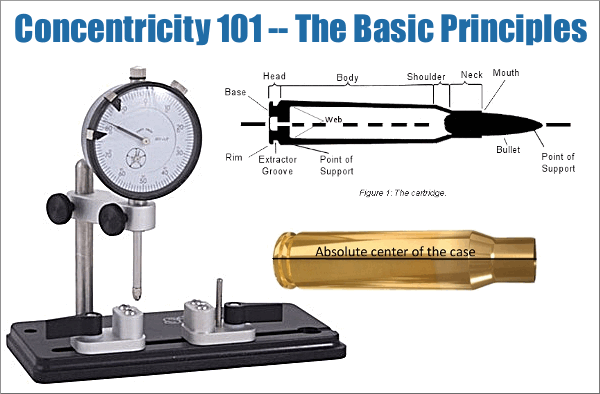
Sinclair Internationalhas released an interesting article about Case Concentricity* and bullet “run-out”. This instructional article by Bob Kohl explains the reasons brass can exhibit poor concentricity, and why high bullet run-out can be detrimental to accuracy.
Concentricity, Bullet Alignment, and Accuracyby Bob Kohl
The purpose of loading your own ammo is to minimize all the variables that can affect accuracy and can be controlled with proper and conscientious handloading. Concentricity and bullet run-out are important when you’re loading for accuracy. Ideally, it’s important to strive to make each round the same as the one before it and the one after it. It’s a simple issue of uniformity.
The reason shooters work with tools and gauges to measure and control concentricity is simple: to make sure the bullet starts down the bore consistently in line with the bore. If the case isn’t properly concentric and the bullet isn’t properly aligned down the center of the bore, the bullet will enter the rifling inconsistently. While the bore might force the bullet to align itself with the bore (but normally it doesn’t), the bullet may be damaged or overstressed in the process – if it even it corrects itself in transit. These are issues we strive to remedy by handloading, to maintain the best standard possible for accurate ammunition.
The term “concentricity” is derived from “concentric circle”. In simple terms it’s the issue of having the outside of the cartridge in a concentric circle around the center. That goes from case head and center of the flash hole, to the tip of the bullet.
Factors Affecting Concentricity
The point of using this term is to identify a series of issues that affect accurate ammunition. Ideally this would work best with a straight-walled case; but since most rifle cartridge cases are tapered, it equates to the smallest cross section that can be measured point by point to verify the concentric circle around the center. For the examples below, I’m working with .308 Winchester ammo.
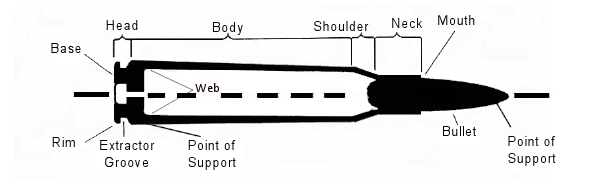
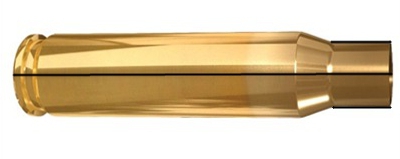
Figure 1: The cartridge.
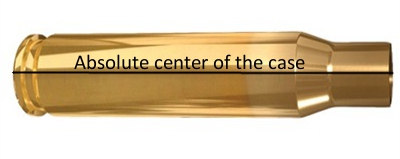
Figure 2: Centerline axis of the case, extending from flash hole to case mouth.
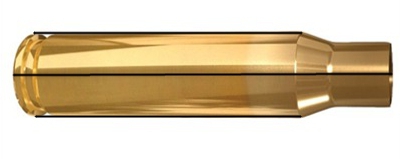
The case walls have to be in perfect alignment with the center, or axis, of that case, even if it’s measured at a thousandth of an inch per segment (in a tapered case).
Figure 3: Case body in alignment with its axis, or centerline, even in a tapered case.
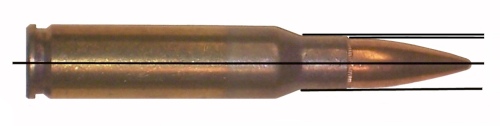
The case neck must also be in alignment with its axis. By not doing so you can have erratic bullet entry into the bore. The case neck wall itself should be as uniform as possible in alignment and in thickness (see the M80 7.62x51mm NATO cartridge in Figure 5) and brass can change its alignment and shape. It’s why we expand the case neck or while some folks ream the inside of the neck and then turn the outside for consistent thickness, which affects the tension on the bullet when seated.
Figure 4: Neck in alignment with center of the case axis.
Figure 5: Variations in case neck wall thickness, especially on some military brass, can cause an offset of the bullet in its alignment. This is an M80 ball round. Note the distinct difference of the neck walls.
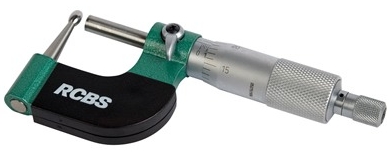
Having a ball micrometer on hand helps, especially with military brass like 7.62x51mm in a semi-auto rifle, where there are limits as to how thin you want the neck walls to be. In the case of 7.62 ball brass you want to keep the wall to .0145″.
Figure 6: A ball micrometer like this RCBS tool (#100-010-268) can measure case neck thickness.
Turning the outside of the neck wall is important with .308 military cases regardless of whether you expand or ream the neck walls. There are several outside neck turning tools from Forster, Hornady, Sinclair, and others. I’ve been using classic Forster case trimming (#100-203-301) and neck turning (#749-012-890) tools for 40 years.
Bullet Run-Out
The cartridge, after being loaded, still needs to be in alignment with the center of the case axis. Figure 7 shows a bad example of this, a round of M80 ball. A tilted bullet is measured for what’s known as bullet “run-out”.
Figure 7: An M80 round with the bullet tilted and not aligned with the axis. This will be a flyer!
Run-out can be affected by several things: (1) improperly indexing your case while sizing, which includes not using the proper shell holder, especially while using a normal expander ball on the sizing die (it also can stretch the brass). (2) The head of a turret press can flex; and (3) improper or sloppy bullet seating. This is also relevant when it comes to using a progressive press when trying to load accuracy ammo.
Mid Tompkins came up with a simple solution for better bullet seating years ago. Seat your bullet half way into the case, back off the seater die and rotate the case 180 degrees before you finish seating the bullet. It cuts down on run-out problems, especially with military brass. You also want to gently ream the inside of the neck mouth to keep from having any brass mar the surface of the bullet jacket and make proper seating easier. A tilted bullet often means a flyer.
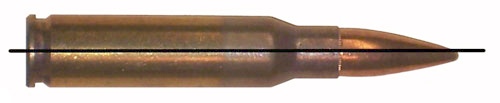
Figure 8: Proper alignment from the center of the case head to the tip of the bullet.
(NOTE: This links to a Web Archive version of the original Sinclair Int’l article.)
*Actually some folks would say that if we are talking about things being off-center or out-of-round, we are actually talking about “eccentricity”. But the tools we use are called “Concentricity Gauges” and Concentricity is the term most commonly used when discussing this subject.




 Hybrid Bullet Design — Best of Both Worlds?


 Scan-Verified 0.162 MOA Accuracy at 200 Yards

 Quick Tip: Try Flipping Your Bushings
 The 30 BR is an amazing little cartridge. However, 30 BR shooters do have to neck-up 6mmBR or 7mmBR brass and then deal with some issues that can arise from the expansion process. One of our Forum members was concerned about the donut that can form at the new (expanded) neck-shoulder junction. Respected bullet-maker Randy Robinett offers tips on how to deal with the “dreaded donut”.