“Golf — the willful misuse of a perfectly good rifle range.”
Here’s a humorous illustration that pokes fun at the game of golf. We posted this on Facebook a few seasons back. To our great surprise this generated 356 shares, and reached 22,000+ readers, making this our most popular Facebook post ever at the time.
So, what do you think — should golf courses be converted to shooting ranges? Is golf truly a “good [shoot] spoiled”? This photo was shared by our shooting buddy Jim de Kort from Holland.
Here are some comments from Facebook users who saw the post:
“Actually golf and shooting are similar sports. Trying to shoot a small object into a small hole from long range.” — Eric A.
“You can hit a golf ball 300 yards, but I can hit a golf ball AT 1000 yards.” — Zach S.
“The game should be changed. You should hit the ball out as far as possible, then get your rifle out and hit the golf ball. The most golf balls hits… with the rifle wins!” — Hui H.
Some rifle ranges certainly are beautiful enough to be country clubs. Here is the scenic General Vokes Range in British Columbia, Canada:
The 2026 Southwest Nationals (SWN) have concluded. Held at the impressive Ben Avery range in Arizona, the 2026 SWN was a very successful event with good conditions (for the most part) and impressive scores by shooters in all three divisions: Sling, F-Open, and F-TR. We congratulate the new SWN Grand Agg Champions: Bobby Gill (Sling), Ryan Mitchell (F-Open), and Brad Sauve (F-TR). This was familiar territory for Sauve who has won the SWN F-TR title before.
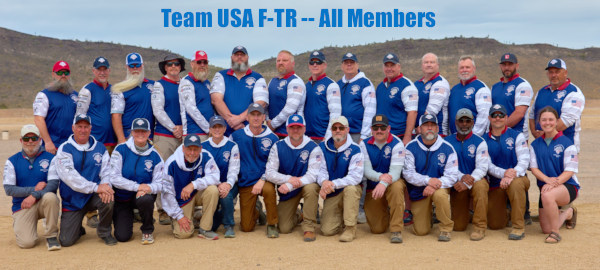
The SWN has both individual and team competition in all three classes. The winning team in the Sling Division was Team USAMU 2564-124X (Capt.: Jarrod McGaffic / Coach: Verne Conant). The top F-Open team was LOS CHINGONES 2590-153X (Capt.: Dennis Ray / Coach: Brian Bowling). The F-TR team competition was dominated by Team USA F-TR VORTEX 2575-123X (Capt.: Ian Klemm / Coach: Keith Trapp).
The 2026 SWN had very high participation in all classes. Observers said that 2026 may have rivaled the highest total turn-out in many years. Weather-wise, we’re told that conditions were “very manageable” for most of the week until the final day of individual competition. Wind angles and velocities became quite hard to diagnose on that last day. As a result many top shooters dropped multiple points in the last individual relay and this created major shake-ups in the leaderboard, with some very skilled shooters dropping out of the Top 20 after an otherwise impressive week.
A special congrats to our friend Gary Eliseo who actually ended up with the highest Sling Division overall score, 1240-64X. But because he used a scope throughout the match he could not win the Sling Grand Aggregate.* Gary Eliseo reported: “I had a great time at SWN 2026. It was a privilege to catch up with so many friends from around the country, managed to shoot a PB too! My UMRS/6.5 El-Mo did everything it could to make me look good.”
SLING TEAM Top 3
Team 44 USAMU HM 2564-124X
Team 49 USNMT VFB MRNAK HM 2564-115X
Team 46 USNRT GILL HM 2562-122X
F-OPEN Grand Aggregate Top 10
1. Ryan Mitchell, 1245-83X, Match Winner
2. Joe Traylor, 1245-74X
3. Tim Vaught, 1245-69X
4. Jason Simes, 1243-73X
5. Gwen Basalla, 1243-66X
6. Brad Johnson, 1242-78X
7. Pat Scully, 1242-74X
8. Erik Cortina, 1242-71X
9. Emil Kovan, 1242-64X
10. Brian Bowling 1241-78X
F-TR TEAM Top 3
Team 23 USA F-TR VORTEX HM 2575-123X
Team 21 USA F-TR BERGER HM 2568-118X
Team 13 CREEDMOOR SPORTS GOLD MA 2556-111X
Report from F-Open Competitor John Masek (F-Class John)
This year’s Southwest Nationals appeared to have the highest attendance I’ve ever seen. The Mid-Range match on Wednesday isn’t usually all that full but this year every firing position was used which is something I’ve never seen before in Mid-Range. Long range was also sold out which I believe is around 365 shooters with the majority being in the F-Open category. I don’t know the exact count, but there were nearly three full pages of F-Open shooters listed — that means there could’ve been close to 200 F-Open shooters. Overall there was beautiful weather with mostly gorgeous conditions during the week, and it was great seeing everyone from across the country and even the world.
Conditions were manageable for a lot of the shooters throughout the week with some of the highest scores I’ve ever seen — 16 F-Open shooters all shot a perfect 450 points on the Palma day Friday. Saturday got just a little trickier, but still many of the top shooters were managing to only have dropped a couple points over the two days. Sunday started with mild conditions again, but the final relay on Sunday afternoon completely shook the leaderboard up. While there were certainly top shooters who were able to hold their positions… but just as many dropped quite a few places down. It was one of the trickiest conditions I’ve ever seen that didn’t involve giant winds.
* Scopes help older sling rifle shooters whose eyes are starting to wear out. But, Gary Eliseo explains: “In this event, the match director dictates that a Palma rifle be used on the first day, and if you want to shoot an ‘any rifle’ on Day Two it also must have iron sights with the third day being ‘any sights’ so ‘F-sling’ is a category where ‘any sights’ are allowed to be used on all three days but that makes us ineligible to win the Grand Aggregate.”
The 2026 Southwest Nationals (SWN) competition concludes this afternoon, February 15, 2026, at the Ben Avery range in Arizona. With skilled shooters in Sling, F-TR, and F-Open classes, the SWN is one of the USA’s most popular multi-class, long-range rifle events held annually. We’ll have a full report on SWN individual and team final results tomorrow.
To show the type of rifle that can win a SWN title, today we feature the .308 Winchester F-TR rifle of talented F-Class shooter Peter Johns. With this impressive rig, Peter won the F-TR Division at the 2020 Berger SW Nationals (SWN), after finishing second in 2019. And Peter also won mid-range AND long-range Texas State championships in 2019. Along the way Peter set a new 600-yard NRA National F-TR Record (200-18X), and tied the 600-yard F-TR Aggregate Record with 600-47X. This Sunday GunDay story features Peter and his trophy-grabbing .308 Win F-TR rifle.
How to Campaign a Winning .308 Winchester F-TR Rifle
Report by Peter Johns
I started contemplating F-Class shooting after talking with Darrell Buell at SHOT Show a decade ago. My first F-Class match was with a Savage VLP with a 26″ Shilen 7mm SAUM barrel and a Harris bipod. After that initial match in Texas I knew I had a lot to learn. I decided that F-TR was the place to start. This story follows my development as an F-TR shooter and showcases the rifle that delivered multiple F-TR match wins in 2019 and 2020.
Watch Peter Johns Shoot his .308 Win F-TR Rig
Equipment Showcase — Key Components of Peter’s F-TR Rifle
Omar Alonzo (Alonzo Custom Rifles, (713) 283-4384, Gunbuilder284@gmail.com) does all my gunsmithing. I believe this is one of the major reasons I have been doing so well in the last couple years. He does a phenomenal job with rifle bedding. He also fixed the timing on my action. The first barrel he chambered has really helped me win matches and set records.
In this Video, Peter talks about his key rifle components and gear:
McMillan Kestros BR Stock — I switched to a Kestros BR stock when they first came out. I painted the stock myself. I am very grateful to Kelly McMillan for letting me be one of the first to try them. The Kestros BR tracks better than any stock I have tried. NOTE — the Kestros was so light that I had to add a steel bar under the forearm to get closer to the F-TR weight limit with a 30″ HV barrel. [Editor: That has the advantage of lowering the center of gravity and the bar can slide fore/aft to adjust center of balance]. I use a SEB Bigfoot rear bag with slick ears and 3/4″ spacing. When I got the Kestros I thought the rear bag spacing was too wide but it worked so well I didn’t change.
Kelbly (Stolle) Panda Action and Krieger Barrel — My rig has a Kelbly Panda F-class action with a Bix’N Andy trigger. At the Berger SWN, I used a Krieger 1:10″-twist 30″ HV 4-groove barrel. It is superbly accurate. I have been bouncing between Krieger and Bartlein for barrels for the last few years. The best barrel I have had is a 30″ Krieger 4-groove HV, however the Bartleins have been very good as well.
Duplin Bipod with Articulating Feet — I really liked the Pohlabel articulating feet that are available for the SEB JoyPod so I asked Dan Pohlabel for permission to copy his feet. I bought some aluminum and made the best copy I could. Since SWN, Duplin has coming out with a new bipod with articulating feet which are considerably better than the feet I made. I use a board and a piece of stall mat with carpet glued on it for the bipod to sit on.
Vortex Golden Eagle Scope — I use the 15-60x52mm Vortex Golden Eagle on all my F-Class rifles. I see the mirage better with the Golden Eagle than any other scope and it tracks perfectly. I also use a Vortex Razor spotting scope with long eye relief lens on the line to help watch mirage and flags. I also use the Razor spotting scope to call wind for Team Texas.
Cleaning Procedure — Less is More — No Cleaning During SWN Long Range Event
Peter has learned that he can go for long round counts without cleaning: “I have found that my .308 Win rigs, for the most part, shoot really well dirty. I can usually get 300 or more rounds before cleaning. I cleaned my barrel at the 2020 SWN after the mid-range event and fouled it before the long-range. I did not clean my barrel again until I got home from the match.”
Peter does clean thoroughly when he gets home: “After a big match I clean my rifles with Boretech Eliminator and a bronze brush followed by Iosso until the majority of carbon is removed from the barrel, as verified with a Lyman borescope. After a thorough cleaning, I find that I need to shoot a bunch of foulers. I will usually go to my practice range and shoot a 20-shot practice match and I will see the accuracy tighten up in the back half.”
600-yard practice target on left. On right is 600-yard record match target shot at 2019 TX State Championships (on ShotMarker targets). This 200-18X was a NRA National Record for F-TR division.
Peter’s Match Load and Reloading Methodology
Loading for .308 Win F-TR — Do What Matters
My loading technique has evolved almost full circle from where I started. I went from the basics to doing every step a person could conceive. Then I decided to start testing all the different steps to see what didn’t matter or made things worse. I am now back to almost no steps in my reloading process. I don’t clean brass anymore. I just wipe the case off, lube, size, prime, and load. I anneal when I feel the necks getting inconsistent when seating the bullets. I pre-load all my ammo for matches. I tried seating them at the match but I didn’t find it to matter on the score card and it takes my focus away from conditions.
Peter’s 2020 SWN-winning .308 Win load consists of Berger 200.20X bullets, Lapua Palma brass, Federal 205M primers, and Varget powder. Peter revealed: “The Berger 200-grainers are running in the mid-2600 fps range. I have tried them much faster but found the best consistency at this speed.”
Peter measures powder to the kernel and also weighs/sorts other components. He runs Berger 200.20X bullets slightly off the lands in a 0.170 freebore chamber. Notably he tests a variety of powders, ascertaining each barrel’s particular preference: “In the last few years I have tried N140, N150, H4895, and Varget. I think they are all good powders for F-TR and the 200.20X bullet. This year I was using Varget. At the 2018 SWN I placed 4th with H4895, in 2019 SWN I got 2nd with N140. I find what powder my particular barrel likes best. I also test CCI BR4 and Fed 205M to see which my rifle likes best. This year I was using Fed 205M. I have been using Lapua Palma brass and it seems to last forever.” Peter full-length sizes with a Redding bushing FL die. He seats his Berger bullets with a Wilson inline seater.
Q & A with Peter Johns, F-TR Ace
Q: What was your biggest challenge at the 2020 Berger SW Nationals?
Peter: I think the biggest challenge was staying focused on conditions. I think the hardest thing for me to do is to stop shooting when the wind conditions are out of my ability to call accurately. I focused hard on this aspect of my game this year and it has paid off. This match is super well run and staff does an excellent job which allows the shooters to maintain their focus.
Q: What gear/hardware items give you an edge over the competition?
Peter: The Kestros BR stock (below) is not used by many F-TR shooters and I think it gives me a huge advantage over the competition. This stock fits me perfectly and tracks in such a manner that I can shoot fast and accurately when conditions are right.
Q: What is your advice for newcomers in F-Class and Long Range competition?
Peter: Go to a top gunsmith building F-Class rifles and do what he says. Competition is the best way to get better. So shoot as many matches as you can. Find top shooter rivals and strive to beat them.
Q: Do you have any specific Gun Handling Tips for F-TR shooters?
Peter: I shoot better with a really light grip and cheek pressure. I can shoot well with a heavier grip and cheek pressure but when the tension of a big match is going my pressure will vary and cause poor accuracy. The most consistent I can shoot is with light gun handling. I also focus on trying to watch the bullet hit through the scope to ensure good follow through and this prevents me from jerking the trigger. There are a bunch of ways to hold a rifle that have proven to be successful. I think a shooter needs to test and find what works best for them.
Q: What do you like most about F-Class and Long Range competition?
A. I really like technical things. F-Class is right in my wheel house for technical stuff. Also, the people in the shooting world are top notch. I enjoy talking with other shooters.
Q: Do you prefer individual events or team matches?
Peter: I prefer the team matches by far because it is a social event with collaboration and there is a lot more pressure. I put a lot of effort into learning the wind for the team matches which in the long run helps me with individual matches.
Peter Johns calls wind for Team Texas at 2018 F-Class Nationals in Raton.
Overcoming Serious Injury in U.S. Navy to Become a Top-Level Marksman
Peter Johns is a U.S. Navy veteran, rank Chief (E7). In 2006, during his duty aboard the U.S.S. Nimitz, Peter sustained very serious and extensive burns in a massive electrical fire. Showing great strength of character, Peter went through a tough, 4-year program of surgeries and rehab. The photo below shows Peter doing therapy during his recovery process.
Peter tells us: “As many of you know I was badly burned on board the U.S.S. Nimitz in 2006. That has limited me in my ability to compete in physical activities that I used to enjoy but F-Class has filled the gap for my competitive nature. I medically retired from the Navy as a Chief (E7) in 2010 after four years of surgeries and physical therapy. I was very surprised to find how accepting and nice people have been in the shooting community. I think the shooting community is comprised of the best people in the world.”
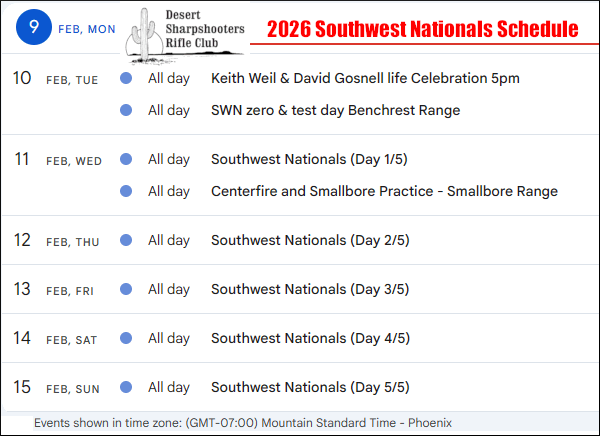
The 2026 Southwest Nationals (SWN), one of the major long-range rifle matches of the year, is underway right now in Arizona for three rifle classes: Sling (“Any Sights” and “Palma”), F-Open, and F-TR. Running from February 11th through 15th, the match started with the Mid-Range 600-yard event on Wednesday, February 11th, and concludes with the 2-day 1000-yard match on Saturday the 14th and Sunday the 15th. On Thursday and Friday there were team and individual Palma-format competitions for all three divisions (Sling, F-TR, F-Open). These are multi-distance matches with targets at 800, 900, and 1000 yards. The match continues today (Saturday) and tomorrow (Sunday) with 1000-yard matches. CLICK HERE for all official 2026 Southwest Nationals results on the Desert Sharpshooters website.
The 2026 Southwest Nationals event continues today and tomorrow (Saturday and Sunday) with individual and team competitions at 1000 yards. CLICK HERE for full 2026 SWN Match Program.
Shown below left are results for the 2026 SWN Nationals 2/13/2026 Individual Palma matches for the three divisions: Sling, F-Open, and F-TR. The Palma match is 15 shots each at 800, 900, and 1000 yards. There were some very impressive performances on Friday the 13th. All the top 10 F-Open shooters did not drop a single point, all finishing with 450 scores (before X-count). Below, to the right of the Palma scores, is a video from ace shooter Brandon Green. This shows the Palma stage at 2026 SWN.
2026 SWN Palma 800/900/1000 Match
Sling Division Top 10
Mark Kelley, 449-31X (Match Winner)
Jerrod McGaffic, 448-28X
Avtar Nanrey, 448-24X
Gary Elesio, 448-23X
Phil Hayes, 448-22X
Vern Conant, 447-32X
Nate Guernsey, 447-26X
Brandon Green, 447-21X
Fazal Mohideen, 447-21X
Ken Foster, 447-20X
Gabriel Rowe, 447-20X
F-Open Division Top 10
Joe Traylor, 450-38X (Match Winner)
Brad Johnson, 450-38X (2d on tie-breaker)
Pat Scully, 450-36X
Henry Ferris, 450-36X
Antun Kovacevic, 450-35X
John Girgis, 450-33X
Roger Mayhall, 450-33X
Barry Holcomb, 450-30X
Peter Johns, 450-30X
Tod Hendricks, 450-29X
F-TR Division Top 10
Tracy Hogg, 450-31X (Match Winner)
Keith Trapp, 450-26X
Brad Sauve, 449-30X
Benoit Vautour, 449-25X
Tom Hubbard, 449-23X
Scott Kyle, 449-23X
Alen Tampke, 449-22X
Oleg Savelyev, 448-30X
Gerry Wiens, 447-25X
James Crofts, 447-24X
Alan Barncroft, 447-24X
Travis Elfgren, 447-24X
2026 SWN Individual Palma Day
Video from Brandon Green
15 shots for record each at 800, 900, 1000 yards.
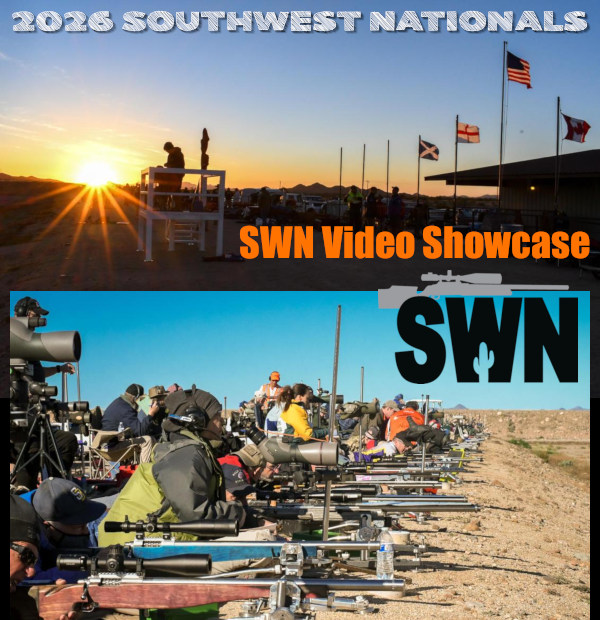
For this Saturday Showcase, we provide videos from past SWN events, plus informative videos that explain how to prepare for the event and pack your gear for air travel and/or lengthy overland trips.
Tips for New Competitors at the Southwest Nationals
Headed to the SW Nationals for the first time? Never shot at the Ben Avery range before? Then definitely watch this F-Class John video. It provides a series of smart tips for SWN first-timers.
Highlights from 2024 SW Nationals with Past Champ Erik Cortina
This video follows long-range competitors at the 2024 Southwest Nationals. The video shows match preparation and competition. There are interviews with participants and highlights of the challenging conditions. The video concludes with the announcement of class winners. 2024 F-Open winner Jay Christopherson is interviewed starting at 12:18 time-mark.
Analyzing Conditions at 2022 SW Nationals
In this video past SWN Champion Erik Cortina and F-Class John analyze relays from the 2022 match, discussing shot holds for specific wind conditions. You can learn quite a bit from this dialog with two top F-Open shooters. Erik won the F-Open LR SWN event in 2023.
Packing Gear for Air Travel — Tips from F-Class John
It can be very challenging to travel via airline to a major shooting event because of all the gear you’ll need to bring, along with your rifle(s). F-Open shooters must bring a heavy, bulky front rest and rear bag, while F-TR shooters will need a large front tripod and rear bag. Then you’ll need to transport a spotting scope with its adjustable mount, plus a LOT of loaded ammunition. Some shooters will also bring a press and dies to do final seating of their ammo. That’s a lot of gear. In this video, F-Class John shows how to pack rifles, gear, and ammo efficiently so air travel can go safely and smoothly.
Southwest Nationals Video SHORTS
Bird’s Eye Ben Avery — A Look at the Range
If you’ve never visited the Ben Avery Facility north of Phoenix, Arizona, here’s a video that shows the 1000-yard range (including drone footage). The desert range at Ben Avery is something special — check out this “birds-eye view”. This 2016 video also includes an interview with Derek Rodgers, F-TR World Champion, King of 2 Miles, and the only man who who has earned both F-Open AND F-TR USA National titles.
Sling Shooters in Palma Division
For the Palma division, the cartridge of choice is the .308 Winchester (7.62.x51). This versatile cartridge is still capable of extreme accuracy. Never underestimate a skilled sling shooter with a good Palma rifle. Below is multi-time NRA National Long-Range Champion John Whidden in action. John’s rifle features a centerfire action in an aluminum Anschutz small-bore stock.
Ballistics wizard Bryan Litz shoots at the 2015 SW Nationals. Notice how steady he holds his rifle.
Today marks the third day of competition at the 2026 Berger Southwest Nationals (SWN). And yes, it’s Friday the 13th — causing some concerns among competitors. The superstitious types among the competitors viewed the day with some trepidation. But most shooters didn’t worry too much about the date — they were more concerned about calling the wind correctly. As Bryan Litz said at the SWN a decade ago: “I don’t believe in superstition. We make our own luck”.
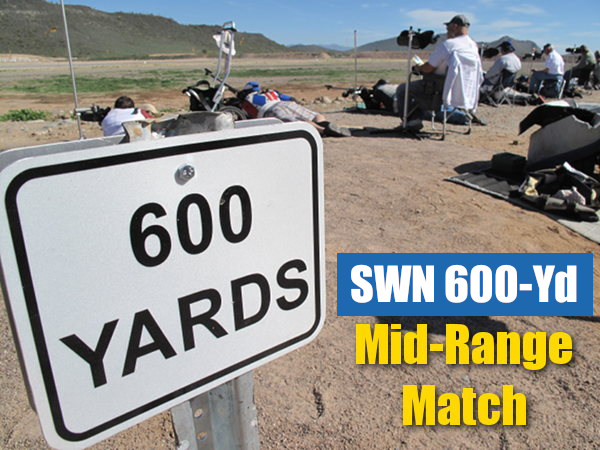
On Wednesday, February 11th, the 600-yard competition was held for all three competition classes: Sling (Palma), F-Open, and F-TR. 600-Yard match results for all three classes are shown below for the Top 10 in each class. For F-Open, F-TR, and Sling Divisions there were three relays, each with 20 rounds for score. Thus, the maximum possible score was 600-60X. There were some very impressive performances with the top 9 F-Open Shooters, top 5 F-TR Shooters, and Sling Winner Fazal Mohideen not dropping a single point. Congrats to the winners — Fazal Mohideen, Sling P 600-34X; Cal Waldner, F-Open 600-49X; and Brad Sauve, F-TR 600-44X. CLICK HERE for full 600-yard results for all competitors.
600-Yard SWN Top 10 Results
Here are the Top TEN 600-Yard Competitors for each Division:
Sling (Two Divisions, “P” and “A”) 600-yard Top 10
The Southwest Nationals is one of the few American events where sling shooters compete on the same firing line as F-Class competitors (though in separate groups). At the SWN this sling division has two sub-classes: “A” for “Any Rifle, Any Sight” and “P” for Palma rifles.
F-Open 600-yard Top 10
1. Cal Waldner 600-49X (Match Winner, MA)
2. Antun Kovacevic — 600-48X (MA)
3. Joe Traylor — 600-44X (HM)
4. Jason Simes — 600-42X (HM)
5. Dan DiLeva — 600-40X (HM)
6. Brian Bowling — 600-39X (HM)
7. Ryan Pierce — 600-37X (HM)
8. Eric Houser — 600-36X (HM)
9. Martin Tardif — 600-31X (HiGS)
10HM. Peter Johns — 599-47X (HM)
10MA. Noah Burleson — 599-47X (MA)
Modern F-Open Rifle with SEB Mini front rest with Blake Machine accessories.
F-TR 600-yard Top 10
1. Brad Sauve — 600-44X (Match Winner, HM)
2. Keith Trapp — 600-43X (HM)
3. Alan Barnhart — 600-39X (HiGS)
4. Alton Johnson — 600-35X (HiSr)
5. Anthony Jordan — 600-34X (HM)
6. Tracy Hogg — 599-42X (HM)
7. Adam Husted — 599-38X (MA)
8. Ryan Crozier — 599-36X (MA)
9. Benoit Vautour — 598-42X (MA)
10. Jeremy Newell — 598-39X (HM)
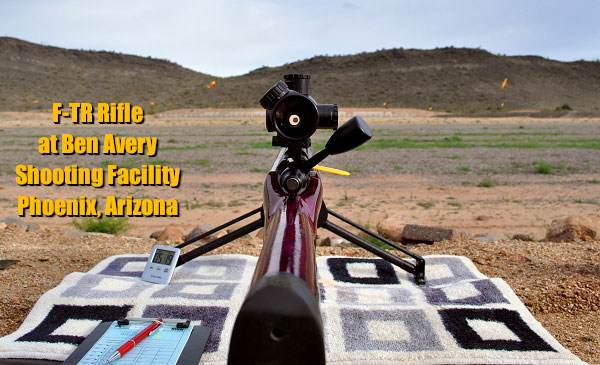
F-TR Rifle looking downrange at the targets.
Palma Format Multi-Distance Matches on Friday the 13th
Today, Friday is the Palma format match. This is not limited to “hard-hold” sling Palma rifles, but the match utilizes a multi-distance target sequence similar to Palma rifle matches. All three rifle classes will be shooting: Sling, F-Open, and F-TR. There will be three target distances with 15 shots for record at 800, 900, and 1000 yards.
In the video below, you’ll see highlights from last year’s SW Nationals from the break of dawn throughout the day. This also features new products on display. This video was created by our friend F-Class John, who is competing right now at the 2026 SWN event.
The 2026 Southwest Nationals (SWN) start today, 2/11/2026, at the Ben Avery Range outside Phoenix, AZ. The big event starts with a 600-yard Mid-Range Match. Many of the nation’s most talented F-Class and sling shooters will be there. But no matter what your skill level, it is still possible to make major mistakes that can spoil the day and/or put you out of the running for the entire match. This article aims to help competitors avoid the big errors/oversights/failures, aka “train wrecks”, that can ruin a match.
Photo by Sherri Jo Gallagher.
In any shooting competition, you must try to avoid major screw-ups that can ruin your day (or your match). In this article, past F-TR National Mid-Range and Long Range Champion Bryan Litz talks about “Train Wrecks”, i.e. those big disasters (such as equipment failures) that can ruin a whole match. Bryan illustrates the types of “train wrecks” that commonly befall competitors, and he explains how to avoid these “unmitigated disasters”.
Urban Dictionary “Train Wreck” Definition: “A total @#$&! disaster … the kind that makes you want to shake your head.”
Success in long range competition depends on many things. Those who aspire to be competitive are usually detail-oriented, and focused on all the small things that might give them an edge. Unfortunately it’s common for shooters lose sight of the big picture — missing the forest for the trees, so to speak.
Consistency is one of the universal principles of successful shooting. The tournament champion is the shooter with the highest average performance over several days, often times not winning a single match. While you can win tournaments without an isolated stellar performance, you cannot win tournaments if you have a single train wreck performance. And this is why it’s important for the detail-oriented shooter to keep an eye out for potential “big picture” problems that can derail the train of success!
Train wrecks can be defined differently by shooters of various skill levels and categories. Anything from problems causing a miss, to problems causing a 3/4-MOA shift in wind zero can manifest as a train wreck, depending on the kind of shooting you’re doing.
Below is a list of common Shooting Match Train Wrecks, and suggestions for avoiding them.
1. Cross-Firing. The fastest and most common way to destroy your score (and any hopes of winning a tournament) is to cross-fire. The cure is obviously basic awareness of your target number on each shot, but you can stack the odds in your favor if you’re smart. For sling shooters, establish your Natural Point of Aim (NPA) and monitor that it doesn’t shift during your course of fire. If you’re doing this right, you’ll always come back on your target naturally, without deliberately checking each time. You should be doing this anyway, but avoiding cross-fires is another incentive for monitoring this important fundamental. In F-Class shooting, pay attention to how the rifle recoils, and where the crosshairs settle. If the crosshairs always settle to the right, either make an adjustment to your bipod, hold, or simply make sure to move back each shot. Also consider your scope. Running super high magnification can leave the number board out of the scope’s field view. That can really increase the risk of cross-firing.
2. Equipment Failure. There are a wide variety of equipment failures you may encounter at a match, from loose sight fasteners, to broken bipods, to high-round-count barrels that that suddenly “go south” (just to mention a few possibilities). Mechanical components can and do fail. The best policy is to put some thought into what the critical failure points are, monitor wear of these parts, and have spares ready. This is where an ounce of prevention can prevent a ton of train wreck. On this note, if you like running hot loads, consider whether that extra 20 fps is worth blowing up a bullet (10 points), sticking a bolt (DNF), or worse yet, causing injury to yourself or someone nearby.
3. Scoring/Pit Malfunction. Although not related to your shooting technique, doing things to insure you get at least fair treatment from your scorer and pit puller is a good idea. Try to meet the others on your target so they can associate a face with the shooter for whom they’re pulling. If you learn your scorer is a Democrat, it’s probably best not to tell Obama jokes before you go for record. If your pit puller is elderly, it may be unwise to shoot very rapidly and risk a shot being missed (by the pit worker), or having to call for a mark. Slowing down a second or two between shots might prevent a 5-minute delay and possibly an undeserved miss.
Photo by Sherri Jo Gallagher.
4. Wind Issues. Tricky winds derail many trains. A lot can be written about wind strategies, but here’s a simple tip about how to take the edge off a worse case scenario. You don’t have to start blazing away on the command of “Commence fire”. If the wind is blowing like a bastard when your time starts, just wait! You’re allotted 30 minutes to fire your string in long range slow fire. With average pit service, it might take you 10 minutes if you hustle, less in F-Class. Point being, you have about three times longer than you need. So let everyone else shoot through the storm and look for a window (or windows) of time which are not so adverse. Of course this is a risk, conditions might get worse if you wait. This is where judgment comes in. Just know you have options for managing time and keep an eye on the clock. Saving rounds in a slow fire match is a costly and embarrassing train wreck.
5. Mind Your Physical Health. While traveling for shooting matches, most shooters break their normal patterns of diet, sleep, alcohol consumption, etc. These disruptions to the norm can have detrimental effects on your body and your ability to shoot and even think clearly. If you’re used to an indoor job and eating salads in air-conditioned break rooms and you travel to a week-long rifle match which keeps you on your feet all day in 90-degree heat and high humidity, while eating greasy restaurant food, drinking beer and getting little sleep, then you might as well plan on daily train wrecks. If the match is four hours away, rather than leaving at 3:00 am and drinking five cups of coffee on the morning drive, arrive the night before and get a good night’s sleep.”
Keep focused on the important stuff. You never want to lose sight of the big picture. Keep the important, common sense things in mind as well as the minutia of meplat trimming, weighing powder to the kernel, and cleaning your barrel ’til it’s squeaky clean. Remember, all the little enhancements can’t make up for one big train wreck!
The 2026 Southwest Nationals match takes place February 11-15, 2026 at the Ben Avery Shooting Facility in Phoenix. So many of our readers will be on the road headed to Arizona this week, with one or more match rifles in their cars or trucks. When crossing into different states with guns in a vehicle, you need to be mindful of all state and local laws and restrictions.
Five Worst States for Traveling with Firearms
This article appears in the Cheaper Than Dirt Shooter’s Log.
The U.S. is a patchwork of confusing and cumbersome laws that change the rules of what you can carry, where you can carry, and whether you can possess the firearm, ammunition of magazine at without running afoul of the local laws. Now, if every state was like Vermont, law abiding gun owners could freely travel with their firearms with no worries. Unfortunately, many states have a history of being hostile to traveling gun owners.
The federal “Firearms Owner Protection Act” allows travel through any state as long as the firearm is unloaded, in a locked case, and not easily accessible to the passengers. However, that is not to say that certain states that are less friendly to firearms have not created their own laws that would snare unsuspecting otherwise law-abiding firearm owners. This led us to name the Top 5 States to Avoid while traveling with a firearm this holiday season.
CONNECTICUT
Connecticut does not have any gun reciprocity agreements with other states. This means nonresidents are not allowed to carry handguns in Connecticut under a permit issued by another state.
HAWAII
Every person arriving into the state who brings a firearm of any description, usable or not, shall register the firearm within three days of the arrival of the person or the firearm, whichever arrives later, with the chief of police of the county where the person will reside, where their business is, or the person’s place of sojourn. GET Hawaii Firearms INFO HERE.
MASSACHUSETTS
Massachusetts imposes harsh penalties on the mere possession and transport of firearms without a license to carry. Prospective travelers are urged to contact the Massachusetts Firearms Records Bureau at (617) 660-4780 or contact the State Police. GET Massachusetts Firearms INFO HERE.
NEW JERSEY
New Jersey has some of the most restrictive firearms laws in the country. Your firearm must be unloaded, in a locked container, and not accessible in the passenger compartment of the vehicle. The New Jersey Supreme Court ruled that anyone traveling within the state is deemed to be aware of these regulations and will be held strictly accountable for violations. If you’re traveling through New Jersey, you need to comply with state laws on firearm transport, which are very strict. GET New Jersey Firearms INFO HERE provided by a New Jersey legal team.
NEW YORK
Use extreme caution when traveling through New York state with firearms. New York’s general approach is to make the possession of handguns and so-called “assault weapons” illegal. A number of localities, including Albany, Buffalo, New York City, Rochester, Suffolk County, and Yonkers, impose their own requirements on the possession, registration, and transport of firearms. Possession of a handgun within New York City requires a New York City handgun license or a special permit from the city Police Commissioner. This license validates a state license within the city. Even New York state licenses are generally not valid within New York City unless a specific exemption applies. Possession of a shotgun or rifle within New York City requires a permit, which is available to non-residents, and a certificate of registration.
More Scary States for Gun Owners
Here are six other jurisdictions (five states and DC) where you need to be wary when traveling. California, for example, treats all handguns in vehicles as “loaded” if there is ammunition loaded into an attached magazine. It’s wise, when in California, to have handguns unloaded in a LOCKED case, with all ammunition or magazines in a separate section of the vehicle. These states (and DC) all have laws that can trap unsuspecting gun-owners. Be wary.
California
Delaware
Dist. of Columbia
Illinois
Maryland
Rhode Island
Hornady will host the Zombies in the Heartland 3-Gun Match, May 29-31, 2026, at the Heartland Public Shooting Park in Grand Island, Nebraska. This is one of the nation’s most popular multi-gun reactive targets match. It attracts 400+ competitors each year. For complete event information, visit the official Zombies in the Heartland website or follow the Zombies in the Heartland Facebook page.
With an unusual and challenging course of fire, Zombies in the Heartland attracts shooters from across the country. Shooters will find exciting new reactive targets developed specifically for this match, with most targets breaking, falling over, or moving. Most participants will compete with a pistol, rifle, and shotgun. Alternatively, shooters can compete with a pistol-caliber carbine and shotgun in the PCC Division.
Reserve lodging at Best Western Plus, 2707 S. Locust Road, Grand Island, NE. Call (308) 675-5656 and mention Zombies match for reduced rates.
2025 Zombies in the Heartland 3-Gun Match Highlights
Ten competitive stages mimicking post-apocalyptic situations were featured. Professional and amateur shooters from across the country enjoyed specially developed reactive zombie targets. The Heartland Zombies match is a veritable theme park for shootists, with many fun stages and innovative targets. Many unique, reactive zombie targets have been developed specifically for this match. The use of paper targets has been minimized — so it’s mostly “bang and clang”. Rifles, pistols, and shotguns are used on most stages. There were also fun side-matches. Watch the video above to see this year’s action.
The 2026 Southwest Nationals will be held at the Ben Avery Shooting Facility in Phoenix, Arizona on February 11-15, 2026. We know many of our readers will be traveling by air with their rifles next week to compete at the SW Nationals in Arizona. Here is a helpful article from Team Savage Shooter Stan Pate. This covers how to ship your rifle safely, and then re-establish zero properly when the gun is reassembled after transport. This is one of a series of Shooting Tips articles in the Savage Blog.
Traveling with Firearms — Important Advice
Traveling with firearms can be stressful. You must comply with multiple regulations and then trust your expensive guns to airline baggage handlers. And after arrival you’ll need to put your rifles back together and confirm the zeros. This article offers helpful travel advice from Team Savage shooter Stan Pate. Pate has traveled the globe competing with match rifles. Here he shares his tips for making trips easier on you and your firearms.
Easier Air Travel With Firearms
TSA isn’t nearly as careful with your rifles as you are. Proper storage before sending your firearm up a conveyer belt and into the belly of a plane is critical. Stan Pate spends lots of time each year traveling the skies and has devised a system for keeping his rifle safe when going to and from.
“Never travel with your firearm completely assembled,” Pate cautions. “A fully assembled firearm is much heavier [as a total unit] than one that has been broken-down and stored [in separate sections]. More weight creates more in-the-case movement, which can result in damage. I learned this the hard way years ago. My rifle was actually broken in half when traveling to an international competition. Record your torque settings, use those settings during reassembly and your return to zero should be no problem.”
“Be sure to check on current TSA rules and regulations before travel to be aware of any changes that may effect how you pack your rifles,” says Pate.
Rifle Reassembly and Resetting Zero
The quicker you can reestablish your zero, the quicker you can relax and stop worrying about if your rounds are going to hit their mark during competition. Pate, over the years, has developed a system for rifle reassembly and getting back to zero as quickly as possible. While his torque settings may not be the same as yours, the process can still be used.
“The barreled-action goes back on the stock, and then I tighten all three receiver screws finger tight,” says Pate. “Next, I tighten the front two receiver screws down to 35-inch pounds. The rear receiver screws on this particular rifle likes 15-inch pounds. [Note: Proper torque settings will vary with your action and stock type. Most actions have TWO screws, not three.] Scope attachment comes next, and I follow manufacturer settings when tightening it down. All that’s left to do now is go zero your rifle.”
This video explains an efficient method to Re-Zero your rifles
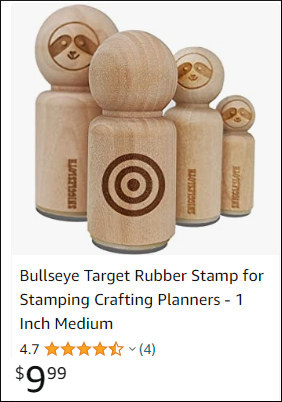
However, if you don’t have a printer, don’t want to pay for commercial targets or adhesive target stickers, then there IS an interesting option. One of our Forum members has created his own Custom TARGET STAMP. Using an INK PAD, this creates a black multi-ring bullseye on paper that matches the exact dimensions of a competition target (SEE Top Photo).
Forum member JimmyMac wanted a target that replicates a competition multi-ring bullseye. He wanted to be able to stamp this bullseye quickly and easily on blank paper. Shown below is the custom stamp he created to accomplish that task. JimmyMac posted: “I took dimensions of a 100-yard group target and had a stamp made to transfer to the paper of my choice. Not revolutionary by any stretch, but works good. I may do a UBR score target stamp next.” JimmyMac purchased the target stamper through an online vendor: “I bought mine online. I provided a template. They did the rest. Here is the stamp and the ink that goes inside.” READ FORUM Thread for more information.
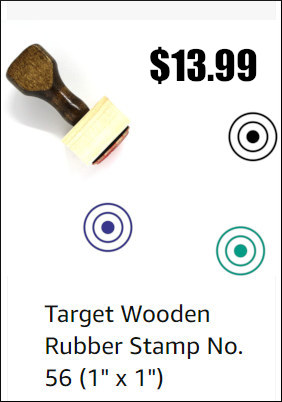
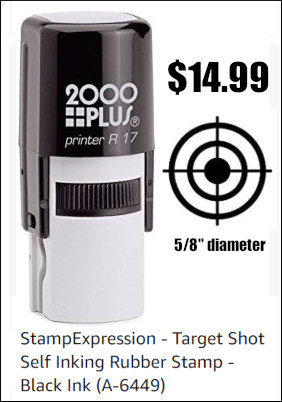
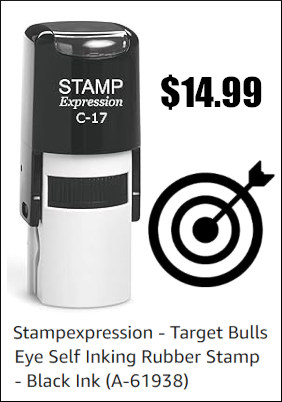
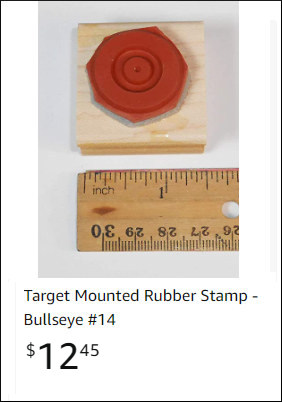
Target Stamp Sets on Amazon
There are a large variety of ink-using target stamps available now on Amazon. Some of these are “self-inking” for convenience, while others require a separate ink pad to function. Here are some of the many target stampers currently offered. There are many target pattern and target size options.
This article is Copyright 2026 AccurateShooter.com. Republication by any other website or media violates Federal copyright law and obliges that third party to pay statutory penalties and damages.


 The 2026 Southwest Nationals (SWN) have concluded. Held at the impressive Ben Avery range in Arizona, the 2026 SWN was a very successful event with good conditions (for the most part) and impressive scores by shooters in all three divisions: Sling, F-Open, and F-TR. We congratulate the new SWN Grand Agg Champions: Bobby Gill (Sling), Ryan Mitchell (F-Open), and Brad Sauve (F-TR). This was familiar territory for Sauve who has won the SWN F-TR title before.




 The
The 








 Train Wrecks (and How to Avoid Them)


 4. Wind Issues. Tricky winds derail many trains. A lot can be written about wind strategies, but here’s a simple tip about how to take the edge off a worse case scenario. You don’t have to start blazing away on the command of “Commence fire”. If the wind is blowing like a bastard when your time starts, just wait! You’re allotted 30 minutes to fire your string in long range slow fire. With average pit service, it might take you 10 minutes if you hustle, less in F-Class. Point being, you have about three times longer than you need. So let everyone else shoot through the storm and look for a window (or windows) of time which are not so adverse. Of course this is a risk, conditions might get worse if you wait. This is where judgment comes in. Just know you have options for managing time and keep an eye on the clock. Saving rounds in a slow fire match is a costly and embarrassing train wreck.






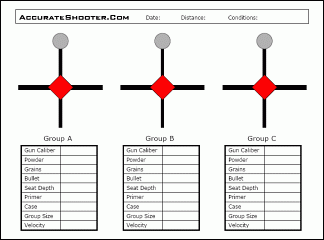 AccurateShooter.com has a page with dozens of