Can’t get enough gun content on your home computer? Now you can stream informative audio broadcasts to your mobile device. In addition to its popular weekly TV shows, Shooting USA now offers podcasts on gun topics. These podcasts feature interviews with ace shooters, notable gunsmiths, and leading firearms industry executives. There are now 123 Shooting USA Podcast episodes available for streaming. Or you can download a podcast to your mobile device for later listening. All Shooting USA Podcast content is free. Use these links to access all Shooting USA Podcasts (123 audio shows):
Now you can listen to timely and entertaining Shooting USA Podcasts, hosted by Jim and John Scoutten. They are available on both Podbean and iTunes.
Here are four (4) of our favorite Shooting USA Podcasts. These include interviews with legendary shooter Jerry Miculek, and ace pistolero Max Michel, perhaps the fastest handgunner on the planet. Click each graphic to launch the PodBean player page for that Podcast.
Watch Max Michel Speed Drill (This Guy is Blazing Fast!)
The NRA has launched a program to encourage new shooters. Guided by NRA President Pete Brownell, the NRA Mentor Initiative is designed to bring new participants, of all ages, into the shooting sports. The aim is to expand interest in firearms, with the goal of fostering hunting, competitive shooting, and support for Second Amendment rights.
NRA President Pete Brownell states: “May has been designated NRA Mentor Initiative month. We are calling on each of our 5-million-and-growing NRA members, and everyone else in the firearm community, to find someone who has never fired a firearm before, take them to the range and help them put their first rounds on target. It’s been my experience that within minutes of the safety briefing, a lesson on marksmanship and the first pull of the trigger, all of the preconceived notions and media-fueled biases melt away…”
There’s no better way to inform Americans [about] the Second Amendment than to provide a positive, first-hand experience.”
AccurateShooter.com supports the goal of introducing newcomers to the shooting sports. Marksmanship is a fun activity that teaches concentration and self-discipline. It is also a great way to make new friends and get outdoors. While our focus is on precision rifle shooting at targets, we support all firearms disciplines — pistol, rifle, and shotgun.
The NRA has a good resource for mentors (and their students). The NRA’s A Guide for New Shooters contains essential safety information and range etiquette instructions. You’ll want to download this PDF to share with your trainee(s).
Click photo to download PDF Guide for New Shooters.
The NRA has produced a series of helpful, short videos for new shooters. Here are two videos covering basics, with a focus on shooting pistols indoors. We actually prefer to start novices at an outdoor range, shooting .22 LR rimfire rifles. Indoor ranges tend to be dark and noisy. The outdoor experience is more like a day at the park.
World Record group shot by Bart Sauter in IBS 600-yard Match on April 21, 2018 in Memphis, TN.
0.282 inches, 0.04 MOA… at 600 Yards. Simply amazing…
What can we say… this 0.282″ 5-shot group 600 yards represents one of the most impressive feats of rifle accuracy in history. Shot in competition, this five-shot group at 600 yards easily fits inside a dime with plenty of room to spare!
Bullet-maker Bart Sauter recently shot this 0.282″ five-shot group at a 600-yard IBS match. Yep, you read that right — 0.282″ at 600. Most shooters would be happy with that group at 100 yards. At 200 it would be remarkable. But at 600 — it is truly amazing. Readers, 0.282″ at 600 works out to 0.04 Minutes of Angle (MOA). Not point four MOA, but point ZERO four MOA, and it was all in the TEN RING for a 50 score. Even measured outside edge to outside edge, that group is just 0.525″, so Bart’s group will easily fit inside a dime (0.705″ diameter).
Sauter’s amazing 0.282″ 50 group smashes the existing IBS Heavy Gun 600-yard record, a 0.404″ shot by John Lewis way back in 2008. It also happens to beat the existing IBS Light Gun group record — the stunning 0.336″ by Rodney Wagner in 2013. (A group many said could never be bettered). Bart’s group will be a new score record too — many 50s have been shot before, but the group size is the tie-breaker, and no one has ever shot smaller at 600 than Bart.
Sauter Smashes IBS World Records with Stunning 600-Yard Group
Report by Boyd Allen, IBS Vice President
On the 21st of April, at the beautiful Memphis Sport Shooting Assn. 600-yard benchrest range, bullet-maker Bart Sauter made history. About 11:00 O’clock with 12-15 MPH switchy winds, Bart Sauter waited for his chosen condition and then ran five shots into an incredible 0.282″ record-breaking group, with a score of 50. Shot in Heavy Gun Class (with his Light Gun), this combination of group and score bettered the previous HG group and score records with sufficient margins that their records in both categories are virtually guaranteed. The previous group record, a 0.404″, belonged to John Lewis and stood for ten years. The previous score record was 50/.513 (group size being the tie breaker) shot by B.J. Francis last year. Bart’s target was 50/.282.
To put it in perspective Bart’s record has the equivalent angular dispersion (MOA) of a .04″ group shot at 100 yards. (Bart’s exact MOA is 0.0448) But consider that crosswinds have roughly 36 times more effect at 600 yards than at 100 yards (by the “Rule of the Square”).
Record-Setting Cartridge and Load with Bart’s Own 105gr Bullets
Bart shot a 6mmBR Ackley Improved (6BRA) wildcat cartridge with an 0.272″ neck. This is basically the 6mmBR Norma with a 40° shoulder. The neck is long like the parent cartridge, not short like a 6mm Dasher. Bart was shooting his own 105 grain, 13 Ogive VLD bullets. He calls this new bullet design “The Hammer” (for good reason). Bart’s Hammer 105s were loaded in Lapua brass with Hodgdon H4895 powder and Wolf primers. Bullet tips were trimmed on a Giraud bullet point trimmer, but not pointed. Bart feels that there is too much potential for damaging bullets during pointing, so he does not point his match bullets. Bart had his LabRadar chrono on the bench during the match. Velocities were 2970-2975 fps with single-digit ES.
Record-Setting Rifle — IBS Light Gun Shot in Heavy Gun Class
Bart’s rifle features a melonited BAT B action, with a 26″, 1:8″-twist, HV contour James Lederer barrel, fitted with a Mike Ezell tuner. The Jewell trigger was set to 1.5 ounces. On top was a March 40X in BAT rings. The initial build was by Mike Moses, with chambering by Dean Stroud, and final (glue and screw) bedding by Billy Stevens. The handsome wood JB 1000 stock (3″-wide fore-end) boasts an aluminum keel added by Alex Wheeler after the initial build. Bart said that it only took him 15 minutes to adjust the keel so that the cross hairs did not wiggle on the target when the gun was pulled back a full 2 ½ inches. Bart is definitely a fan of the adjustable keel.
Bench Equipment and How Rifle Was Shot
Bart used a Farley Coaxial front rest with soft leather Edgewood front back sprinkled with baby powder. In the back was a Protektor Model DR rear bag with Cordura ears and no added lube (not needed with aluminum keel) borrowed from Mike Moses. Bart shot the rifle lightly pinned between his shoulder and the fore-end stop. Interestingly, Bart kept his Labradar chronograph on his bench throughout the day, and recorded velocities during the record group: 2970-2975 fps with single-digit ES.
Reloading Equipment and Methods
After firing, cases are annealed with a Benchsource flame annealer. The inside of the case-necks are brushed with a nylon brush (no lubricant is used). Cases are sized with a custom Whidden Full-length sizing die (with bushings), and a cut-down Wilson micrometer seater that was originally made for the Dasher.
Bullets are seated with a 21st Century Shooting Hydro Bullet Seater, used with the Wilson cut-down Wilson seating die. This state-of-the-art arbor press boasts a hydraulic seating pressure cylinder and gauge. During seating, the force gauge reads about 27.
The powder charge is first thrown from a manual measure and usually trickled onto an A&D 120 FXi magnetic force restoration scale using an Adams automatic trickler, but this time Bart had to settle for his old RCBS trickler because the drive band of the Adams auto-trickler wore out.
Brass Prep — The chamber is a 0.272″ no turn. Bart lightly skims the necks AFTER the first firing just enough to achieve batch to batch uniformity in neck thickness. He uses a .266 bushing which gives him .003 neck tension.
Pre-Loading vs. Loading at the Range
I asked Bart if he pre-loads, or loads at the range. Unexpectedly his answer was “Both…depending”. Bart will identify his “in tune” velocity at his home range and then pre-load that load before the match. However, Bart takes all of his reloading equipment to the match, and if the conditions are such that his pre-loaded ammunition does not give the velocity he wants (as revealed by the LabRadar), he will load at the match.
Another test that he feels is important is to be able to pass a bullet all the way through the neck of his fired cases. Bart thinks that even if the shank of a seated bullet does not directly contact a doughnut, that doughnut can have a negative effect on accuracy.
Bart has brought short range benchrest know-how to 600-yard competition. He uses a full set of short range flags, shown above. At last year’s Nationals, at the same Memphis range, Bart was one of the only shooters with a set of flags. Now other 600-yard competitors are following suit.
Final Throughts — The 6BR Ackley vs. 6mm Dasher
Given its prominence, it is inevitable that comparisons be made between the 6mmBR Ackley Improved and the Dasher. On this subject Bart told me that, based on his experience, he is a “Dasher basher”. He believes the Dasher can be finicky, and has a tendency to flip shots out of the group. For Bart, the 6BR Ackley has been a lot easier to work with and more predictable.
Below is a test target Bart shot at 100 yards. The load yielding the smallest 3-shot group, measuring 0.092″, was the load Bart took to the match. As you can see, the positions of the various load adjustments did not change on the targets. Bart said that that is the kind of positive compensation that he likes to see.
While Bart does most of load testing at short range, he can shoot out to 500 yards near his home. He says his record-setting gun has produced multiple 500-yard, 3-shot groups in the “three-quarter inch range” when testing in calm conditions. That’s 0.14 MOA for three shots. At 500…
Congratulations to Bart on His Great Shooting
Finally, I would like to add my congratulations to Bart Sauter for this spectacular group. I also want to thank Bart for generously taking the time to share the details of his load, reloading methods, and rifle components. Bart has shown that applying some short-range benchrest techniques to the mid-range game can produce remarkable results.
Story based on report by Paul Phillips of Global Precision Group
Extreme Long Range (ELR) shooting continues to evolve, with new forms of competition “pushing the envelope” of marksmanship (and ballistics) at distances out to 4900 yards (2.8 miles) and beyond. The latest big-time ELR shooting match was the World’s Longest Shot Challenge (WLSC) in Texas. This match was held at the Valdina Ranch, 1700+ acres of gorgeous hill country property, located about 1.5 hours west of San Antonio, Texas. The event attracted 28 shooters competing in four classes. Each competitor could be supported by a spotter and a wind coach, shooting as a three-person team.
Key “Take-Aways” from the 2018 WLSC Match:
1. Prototype Berger .375 Caliber Bullet is a Winner
The new .375 caliber monolithic Berger bullet designed by Bryan Litz was used by the first and second place finisher in the above .338 Caliber class. It performed great and the ultra-high BC was confirmed.
2. Team Applied Ballistics Dominated
The combined Applied Ballistics Team made first-round impacts at 1760, 2000, 2200, and 2400 yards. Also, 11 out of the 12 impacts total at 2200 yards belonged to Team AB. And Team AB’s Chris Palka had the top score overall, in his first-ever major ELR competition. That demonstrates how well the AB ballistics solutions work. By yardage, Chris recorded 68280 points total, as follows: 1760×6, 2000×10, 2200×9, 2400×3, 2680×4.
Christopher Palka (Team AB), shooting his first-ever ELR match, finished First Overall. Tactiholics Photo.
3. Got Doppler? Advanced Radar Technology for ELR
To shoot at these extreme ranges, you need rock-solid BC information on your projectiles. Luckily Applied Ballistics brought a Doppler Radar and allowed competitors to shoot their ammo to give them personalized ballistic information.
Top Shots By Class
Above .338 Non-Factory (mostly .375 CheyTac)
.338 and under Factory (mostly .338 Lapua Mag)
.338 and under Non-Factory (mostly .338 Edge)
Chris Palka 68280 HIGH SCORE
Paul Phillips 57360
Chase Stroud 47520
Pete Contacos 44360
Paul Phillips 20080
Chris Wiencke 14160
Tim Seller 25760
Eddie 14560
Calvin 11200
NOTE: There was also a fourth class at the WLSC, the “Above .338 Factory Class” (.50 BMG) with Jay Divorsky scoring 14560.
WLSC Match Procedures and Scoring:
Competitors shot with time limits at each distance: 5 minutes to make 5 shots at each plate. Hits on steel scored points, with a big premium on first-round hits. The point values (for hits) were based upon standard ELR practice: 5 times the distance on the first shot, 4 times the distance on the second shot, and so on. In this ELR match each team may have three members: Shooter, Wind Coach, and Spotter.
Paul Phillips reported: “After drawing names randomly for shooting order, on Day One we shot 36″ metal plates at 1760, 2000, 2200, and 2400 yards. The second day was elimination day — you had to make impact on each target at least once to advance to the next distance. These targets started at 2680 ranging out to 4900 yards. We had winds from 4-8 mph on the first day and 6-15 mph on the second day which made it very challenging.”
Proof in the Shooting — AB Solvers and Berger Bullets
Bryan Litz of Applied Ballistics stated: “This event was a successful test of several new things. Berger’s prototype .375 caliber solid bullets worked well in numerous guns and tracked perfectly to the most distant targets. Radar measurements of these new bullets indicate extraordinary performance as well. The AB Team also had a couple new staff members shooting their first ELR competition (Chris Palka and Chris Wiencke) who both did well with Chris Palka actually winning the event. This match was a successful demonstration of the science of accuracy being used to put rounds on target. The thing about science, is that it works the same for everyone. The ballistic software and Custom Drag Model (CDM) data that we used to put first-round hits on targets out to 2400 yards is the same software that’s available to everyone in the AB devices (Kestrel, Sig Kilo, Garmin Fortrex) and Mobile Apps.”
The AB ELR Team dominated the Podium in the above .338 Non-Factory Class. Chris Palka was high scorer followed by Paul Phillips (Second) and Chase Stroud (Third). The top two finishers were using Applied Ballistic Weapon Division Rifles sending the new Berger .375-Cal solid bullets designed by Bryan Litz. The third place finisher shot a .375 CheyTac with 400 grain Cutting Edge Laser bullets.
In the .338 and under Factory Class there were mostly .338 Lapua Magnums. These .338s did very well and two out of the three shooters made it to the two-mile plate. The final standings in the 338 and under Factory Class: Peter Contacos (first), Paul Phillips (second), Chris Wiencke (Third). Both Paul and Chris were shooting 300 grain Berger bullets.
Title Sponsor ELRHQ, a McMillan company, brought tables full of gear. Everything was on display: scopes, bipods, mats, bags, triggers, actions, brakes, stocks, LabRadars, TargetVision target cams, and more. ELRHQ.com is a great one-stop online vendor with the latest and greatest gear for those interested in the ELR discipline and precision shooting.
The match was organized by Travis Walla who did a great job. The event ran smoothly and shooters say the Texas BBQ was great. Travis posted: “We had an awesome event, thanks to all of our sponsors that helped make this event a huge success. We also had a awesome opportunity for those that shot this match — they were able to shoot across the Oehler Research 88 and Applied Ballistics LLC radar at the same time out to 2400 yards on Saturday afternoon. Thanks again…”
Great News — There will be serious smallbore rifle competition at Camp Perry this year (though the NRA National Smallbore Championships will still be held at Camp Wa-Ke-De in Indiana). The CMP will host a new series of smallbore events in July at Camp Perry, the Mecca of competitive shooting in the USA. This way smallbore competitors can enjoy the experience of shooting on the famed Camp Perry ranges. Smallbore competitions have been slotted into the Camp Perry National Match schedule July 16-22, 2018. These smallbore events include: 3×40 two-day event; 3P Team Match; Two-Day Prone event; Elimination Prone event; Prone Team Match; USAMU Training Clinic.
The smallbore matches will be fired on Rodriguez Range at Camp Perry under a covered firing line. Shooters Technology will provide a scoring App that allows instant scoring for quick results. Finals will be conducted on the CMP’s Electronic Targets installed on the Camp Perry Petrarca Range.
Learn more about the CMP’s smallbore rifle events at the 2018 National Matches on the CMP website. In addition to an event schedule, the 2018 CMP Smallbore Rifle Competition Rules is also available online. To register for the Camp Perry smallbore events, or to review the 2018 Rulebook, visit http://thecmp.org/competitions/cmp-national-matches/smallbore-matches/.
NATIONAL MATCHES at CAMP PERRY
The National Trophy Pistol and Rifle Matches have been a continued tradition of marksmanship excellence every summer since 1903. Moved to Camp Perry, Ohio, in 1907, the event now draws well over 6,000 annual visitors. For any serious marksman, competing at the National Matches at Camp Perry if a definite “bucket list” item, an experience that creates life-long memories. Participants range from novices to the world’s top smallbore and high power shooters.
Here’s a video from 2011 when the NRA Smallbore Championships were held at Camp Perry. It is great to see smallbore events return to Camp Perry in 2018.
Looks like MasterPiece Arms (MPA) stocks are a top choice for the tactical game. MPA chassis systems have been used to WIN 5 of the last 12 matches in the Precision Rifle Series (PRS). The MPA BA Chassis was used by David Preston to win the Carolina PRS Match, Defiance Long Range Shooting Experience (LRSE), and Rocky Mountain Mayhem PRS Match; by Matt Brousseau to win the Bushnell Lonestar Challenge; and by Matt Rooks to win the MPA Spring Shootout. Five of twelve works out to a 42% win percentage — pretty impressive considering all the stock/chassis options on the market today.
The MPA BA Chassis was recently surveyed to be the number one chassis/stock system used by PRS competitors in the PRS 2017 Finale Gear Survey. It experienced a 900% increase in use in 2017 from 2016, which was by far the biggest jump among all chassis systems used by PRS competitors.
MPA’s president, Phil Cashin, is an active PRS shooter. He finished in the top 100 in 2017 and qualified for the finale last year. Cashin, shown in the video below, regularly tests out new ideas and upgrades in actual competition and he regularly seeks out feedback from top tactical competitors. As they say, competition improves the breed.
MPA Production Class Rifle
MPA also offers a PRS Production Class Rifle (PCR) using the MPA Chassis system mated to a Savage Model 12 action. Production Class rifles may cost no more than $2000.00 before optics. Designed specifically for the new PRS Production Class, MPA’s PCR Competition Rifle offers many premium features yet stays under the $2,000 Class limit. The Savage action is upgraded with a Rifle Basix 2-lb trigger, and the adjustable, modular chassis offers a bag rider, barricade stop, and built-in bubble level.
For more information on the MasterPiece Arms product line of rifles, chassis systems and accessories, visit www.Masterpiecearms.com.
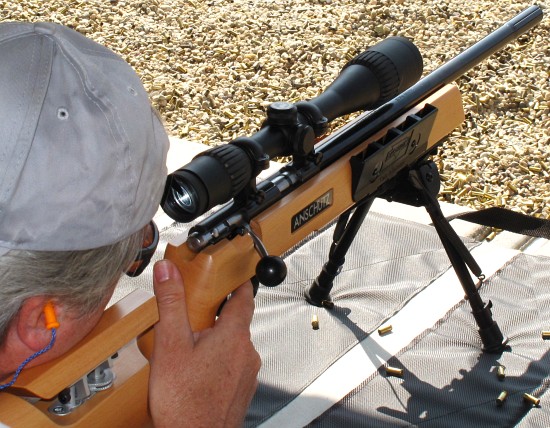
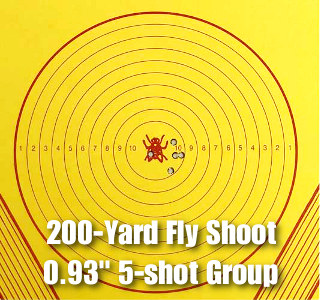
Australian John Lavaring recently shot a group at 200 yards that would make most centerfire shooters proud. The five-shot group, with all shots in the center 10-ring, measured just 0.93 inches. That works out to 0.44 MOA at 200 — mighty impressive for a .22 LR. Recorded at a Rimfire Fly Shoot benchrest event in Canberra, Australia, this 200-yard target set two new Australian SSAA National records! John was using ELEY Tenex ammunition.
Congratulations to John Lavaring for a spectacular demonstration of how well a rimfire rig can shoot — even at 200 yards. We rarely shoot our .22 LR rifles past 50 meters. Maybe it’s time to start a Rimfire ELR series, with targets at 200 or even 300 yards. What do you think of the Rimfire ELR idea? Leave comments below.
Anschutz 54 Benchrest Rig
The rifle was a Anchutz model 54 Match in a custom benchrest stock. John’s record-setting rig features a barrel block, which you can see forward of the action. Scope is a Bausch & Lomb BR model. We don’t have the round count on Lavaring’s barrel, but good rimfire benchrest rifles can often get 10,000 rounds (or more) of accurate life.
Rimfire Ballistics at 200 Yards
Some folks may be wondering about .22 LR ballistics at 200 yards. Well, with a 25-yard zero, the 200-yard drop for John’s 40gr Tenex ammo is 54 inches, assuming 0.145 G1 BC and 1085 fps muzzle velocity per ELEY website. And at 200 yards, a 10 mph crosswind will push that little bullet 15.3 inches! We’re told the winds were pretty tricky when Lavary shot his record group. This makes his achievement all the more impressive — we have to admire John’s wind-reading ability.
This ELEY ammo has proven to be exceptionally accurate. Here is a short video showing TEN rounds of Tenex shot from a machine rest with target at 50 meters.
Did you know you can damage your hearing even if you are wearing the best hearing protection available? Well, have you ever heard of concussion (or concussive) hearing loss? There is no amount of anything you can put in or over your ears to protect you from concussion loss. My audiologist explained to me the concussion comes through the facial bone structure and damages the ear’s tiny bones.
Editor’s NOTE: This may be the most important tech article we’ve run all year. It explains how you can suffer inner ear damage and hearing loss even if you use earplugs or muffs. Read that again — hearing loss even with typical hearing protection. This kind of concussive hearing loss can result from shooting with muzzle brakes in confined spaces. Using a suppressor (aka sound moderator) can reduce the risk of concussive hearing loss. You may not have the ability to use a suppressor, but this article explains how you should be more mindful of your hearing.
Why I Use a Suppressor (Preventing Concussive Hearing Loss)
It must have been the road noise. I thought I was having a hard time hearing my five year old daughter speaking to me on my cell phone because of the road noise. That old SUV was kind of loud inside. Until I switched the phone to my left ear and suddenly I could hear her just fine. Wait, what just happened? I moved the phone back to the right ear and there was that muffled voice again. That’s when I knew I had a problem.
“What?” Lots of us in the shooting community have lost some hearing along the way due to our time on the range or in the field. Those of us who hunt have certainly discharged a firearm or three without ear protection and without concern for our hearing. After all, it’s just one shot, right? How much can it hurt?
Actually, that one shot DOES hurt your hearing. Any sound over 140 dB is immediate hearing loss. It just happens to be killing a small amount of our hearing so most of us continued the practice without a care. Living with hearing loss now makes me wish I could go back 20 years and better protect my hearing. I can’t change what I did in the past, but going forward I can certainly do the most to protect the hearing I still have.
I decided to shoot about a year’s worth of matches with just braked rifles. That year is when I lost significant hearing in my right ear and some in the left. I’ve gone back to shooting only suppressed rifles whenever possible.
I shot my first suppressed firearm, a .22 LR pistol, in 2003. After a few rounds I wondered why everyone (who can do so legally) didn’t shoot suppressed? No one drives without a muffler. Why would you? Point is I immediately appreciated the hearing protection benefits of suppressors. That passion got me into the business of selling suppressors and it wasn’t long before I was one of the biggest retailers for companies like AAC, SWR, SilencerCo, Ops Inc. and others. [Editor: The author’s business, Accurate Ordnance, no longer sells suppressors. So this article is NOT a sales pitch. Mark just wanted to share his experience so others might protect their hearing.]
Did you know you can damage your hearing even if you are wearing the best hearing protection available? You’ve heard guys say, “I’ll wear plugs and muffs, so I’ll be just fine shooting that .50 BMG!” Well, ever heard of concussion (or concussive) hearing loss? Yeah, I hadn’t either. I’ll sum it up the way the last audiologist I spoke with about my hearing loss did – there is no amount of anything you can put in or over your ears to protect you from concussion loss.
A hand grenade went off right next to a buddy of mine. He lost some hearing as a result of the blast. No one is really surprised by that. I mean it is an EXPLOSION. It’s loud. Duh. But I had no idea the blast from a muzzle brake could basically hurt my hearing the same way. The doctor explained to me the concussion comes through the facial bone structure and damages the ear’s tiny bones. Same thing as what can happen through any TBI (traumatic brain injury).
I’ve owned quite a few different suppressors over the years and have shot just about everything out there. I’m still as big a fan as ever. However, I wanted to see if using a suppressor in PRS (Precision Rifle Series) and similar matches was actually a hindrance. Some people feel the added length and weight of a suppressor can make getting into some shooting positions slower or problematic. So I decided to shoot about a year with a muzzle brake instead of a suppressor. I sure regret that decision…
Getting Headaches at PRS Matches Was Warning Sign
It is fairly common in PRS matches to shoot through pipes, vehicles, inside “shoot houses” and around other obstacles that echo a rifle’s blast. I noticed I was starting to get headaches about halfway through a day of PRS match shooting. I knew the issue wasn’t hydration. I mean look, if you are peeing every other stage down at the amazing CORE range facility in mid-summer you are NOT dehydrated. So, what was causing the headaches? It wasn’t until I went back to shooting suppressed in those same environments that it became clear the little mini concussions from that muzzle brake was causing my headaches. And of course the doctors confirmed that.
Let me stop here and say I am NOT anti-brake. Muzzle brakes are useful tools and for some situations are the best tools. An aggressive brake can be more effective at reducing recoil than a good suppressor. A suppressor does add some recoil reduction, just not as much as most quality brakes. Don’t forget to factor other variables, such as caliber and rifle weight, into the equation though. For example, a 15-lb 6mm Creedmoor rifle doesn’t need much recoil reduction in the first place.
So, I started shooting matches long before the PRS even existed and always shot suppressed in those days. The suppressors made communication with a partner or RO easier and it was just a more pleasant shooting experience. On the recommendations of a few people I decided to shoot about a year’s worth of matches with just braked rifles. That year is when I lost significant hearing in my right ear and some in the left. I’ve gone back to shooting only suppressed rifles whenever possible and especially at matches. I’ve only once or twice found the extra length of the suppressor made it a little more inconvenient to run a stage, but not by much. Trust me, the points I missed were not because I took two extra seconds getting the muzzle in a port or window.
My hearing is something I value and will do everything to protect from this point forward. You’ll never again see me on a match field with an un-suppressed rifle. To me the minimal gains of running a braked rifle aren’t worth losing more hearing.
Choosing a Suppressor — What to Consider
Okay, so I have hearing loss that I can’t get back and realize I need to go back to shooting matches with a suppressor. But which one? I’ll still be shooting matches with custom fit plugs so I just need something to add a little recoil reduction and kill that concussion.
At our shop, Accurate Ordnance, we generally recommend direct-thread suppressor solutions to our customers. The main reason for that is all the problems we’ve seen with other fast-attach muzzle devices. It doesn’t take much tolerance stacking to result in accuracy issues. There are a few exceptions for us and the Rugged Suppressors products top the list. Since the Razor 762 uses a muzzle brake adapter on the rifle to attach the suppressor, I can use the same suppressor on my .223 Rem training rifle. My primary match rifles are chambered in 6mm Creedmoor and 6.5 Creedmoor and the muzzle threads on those is a standard 5/8×24. My .223 Rem training rifle has .5×28 threads on the muzzle, which is standard for that caliber. Thus, the muzzle adapter interface lets me share the suppressors between all the rifles. And on that .223 Rem training rifle I have the option of switching the end cap on any of the Rugged products to a .223 aperture size, which makes the suppressors slightly more sound efficient (meaning quieter).
So many options… How do you select the shooting discipline that’s best for you? Of course, “Fun is number one”. But you also need to consider cost — the “bang for the buck”. Or in more scientific parlance, the “Fun to Cost Ratio”. Yes, shooting a .50 BMG is fun, but you could be spending as much as $5.00 per round for factory loads! By contrast, your cost per shot in a rimfire fun match might be well under ten cents, as decent ammo can be easily found for under $5.00 per 50-count box. Five bucks per box (of fifty) sure beats five bucks per round!
We believe in the benefits of rimfire cross-training. With a rimfire rifle that has the same ergonomics and “feel” as your centerfire rig, you can practice more often and more affordably. You can get decent rimfire ammo now for as little as seven cents per round*. Compare that to centerfire factory ammo at $1.40/round or handloads for about $0.70 (bullet, primer, powder, and brass depreciation). So even your handloads could cost TEN times as much as pretty good rimfire ammo. That’s an order of magnitude boys and girls.
For a tactical cross-trainer, you want a rimfire rig that feels like your centerfire rifle. McMillan now offers a stock that fits the bill. McMillan’s new A5-22 stock shares the same look and feel as McMillan’s popular A5 centerfire stock. The A5-22 is able to accommodate 10/22 type actions including KIDD 10-22 models with rear tang attachments. McMillan says: “The A5-22 is dimensionally the same as our standard A5 with some minor changes in the tang and floor plate areas. It is available in a fixed comb configuration or with an adjustable saddle-type cheek piece.”
A used Biathlon trainer works great for rimfire practical matches. This is the Anschutz Model 64-R. Note magazine caddy on forearm. This rifle was a dream to shoot.
Targets for Rimfire Training and Fun Matches
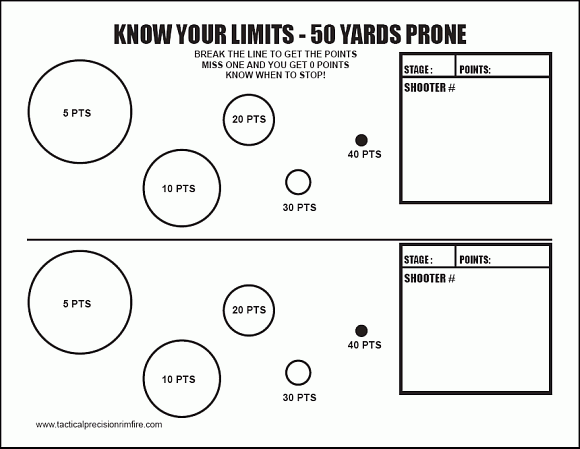
Here’s a rimfire training target with “big to small” target circles. Start with the largest circles, then move to the smaller ones in sequence. This systematic drill provides increasing challenge shot-by-shot. Novices often are quite surprised to see their accuracy improve as they move from bigger to smaller aiming points. That provides positive feedback — always a good thing.
Right Click and “Save as” to download printable PDF versions of target.
Rimfire Practice Targets
SPECIAL BONUS–Rimfire Tactical Precision Targets
These FREE targets by DesertFrog are offered in Adobe Acrobat format for easy printing. CLICK HERE to download all six targets as a .ZIP archive.
Game Theme Commercial Targets — Fun and Colorful
Here are some colorful commercial fun targets, well-suited for rimfire practice. These game-theme targets from Champion should be very popular with kids. You can blast aerial drones, hunt dinosaurs, play a game of “H-O-R-S-E”, or shoot ducks in a Carnival Shooting Gallery. These targets, which cost $5.45-$5.95 per 12-pack, are ideal for younger shooters in your family (and fun for grown-ups too).
* We recently scored 1500 rounds of Norma Match-22 ammo for $99.99 from MidwayUSA. That’s 6.6 cents per round! That deal is gone, but there are other bargains to be found. Use WikiArms.com to find .22LR rimfire ammo bargains.
Shown above is David Tubb, the legendary 11-time National High Power Champion, posing with a very serious rifle used in the Extreme Long Range (ELR) game. David has jumped into the Extreme Long Range discipline in a very big way, producing a .375-caliber, long-barreled ELR version of his famous Tubb rifle, called the Adaptive Target Rifle (ATR). A version of this rifle, piloted by David’s son-in-law Nate Stallter, set the current ELR World Record in January 2018. See video below for a full report.
This video shows Team TUBB setting a new ELR World Record of 2011 Yards using the Tubb Adaptive Target Rifle in .375 CheyTac. Nate Stallter nailed three shots at over one mile — 1768 yards. Then Nate broke his own record, going 3 for 3 at 2011 yards. ELR Central hosted this match, held at the Front Sight gun range, Pahrump, NV on January 21, 2018.
David Tubb will Be Working with Chase Stroud
David has been working with Chase Stroud, a talented young Texan who has competed in tactical rifle competitions and worked with Team Applied Ballistics on ELR projects. Chase has long respected Tubb’s shooting ability as well as his design/engineering talent in developing successful rifle platforms, such as the ground-breaking Tubb 2000.
Recently, Chase had the opportunity to shoot long range with David Tubb. David crafted a left-hand ATR rifle for Chase who will be working with David in the future. Posting on Facebook, Stroud wrote:
“Growing up as a kid I taught myself to shoot long distance from David’s videos. David Tubb was my idol then and still is now. Never in my wildest dreams did I think I would share the line with him much less get to represent his product in the long range community. A literal dream come true for me….
Yesterday we shot some video for the new Tubb ATR system. After pressing him for years he made me a [left-hand ATR] and it shot unreal using his absolute ammo. I thank you … David. It’s time to get some practice under my belt and start shooting again…”


 NRA President Pete Brownell states: “May has been designated NRA Mentor Initiative month. We are calling on each of our 5-million-and-growing NRA members, and everyone else in the firearm community, to find someone who has never fired a firearm before, take them to the range and help them put their first rounds on target. It’s been my experience that within minutes of the safety briefing, a lesson on marksmanship and the first pull of the trigger, all of the preconceived notions and media-fueled biases melt away…”


 Reloading Equipment and Methods




 Anschutz 54 Benchrest Rig