Gary Ocock let the event’s youngest competitor, 12-year-old Gavin Lichtenwalter, shoot Gary’s new Railgun for the last three matches on Sunday afternoon. The day before Gary shot what should be a new IBS 100-yard, five-shot HB group record. Photo credit: Ben Zentner
Heavy Benchrest (Unlimited) rifles, also known as “Railguns”, are the most accurate competition firearms ever invented. And these amazing examples of shooting technology showed their capability recently, with potentially four (4) new records being set at an IBS Heavy Benchrest Invitational match in Visalia, California. If you are curious about the most accurate rifles on the planet, then read on…
2017 Visalia Invitational — IBS Heavy Benchrest Match
Report by Boyd Allen, IBS Exec. Vice President
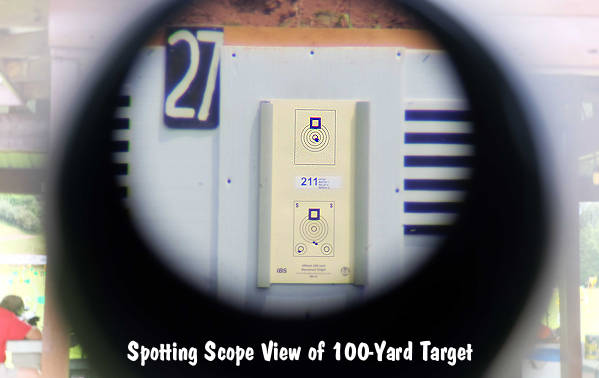
There was some amazing shooting at a recent Invitational Heavy Benchrest match* held in Visalia, California on October 21-22, 2017. No less than FOUR new Heavy Benchrest (HB) records may have been set. Three individual targets were submitted for the 100-yard HB five-shot group record, a .039 by Gary Ocock (photo below), along with two targets by Jim Nicolas, a .040 and .041.
Multiple Aggregate records (at both 100 and 200 yards) may also have been set. Larry Boers shot a 100-yard, five-target 0.1232 Aggregate that will be submitted for the IBS HB 100-yard, five-shot group Agg record. And Gary Ocock may have set two additional HB Agg records. Gary’s five-target 200-yard Agg (0.1310) is a potential new five-shot-per-target record, as is his ten-target Grand Agg (0.1480) (that covers 100 AND 200 yards, five targets per yardage, ten targets total).
Top Guns Come to IBS Match in California
This California match attracted some of the best Railgun pilots in the game today. On the firing line were three current NBRSA Unlimited record holders: Larry Boers (one record), Steve Kostanich (two records), and Gary Ocock (three current NBRSA UNL records, plus one HV). All three shot well enough in this match that their targets are being submitted to the IBS for consideration as Group, Aggregate, or Grand Aggregate records. NOTE: The “Heavy Benchrest” IBS category is equivalent to “Unlimited” under NBRSA rules. CLICK HERE for Complete Match Results.
Top Shooters for the Match included: Larry Boers (Two Gun, HB GrAgg1, HB 100-yd); Gary Ocock (HB 200-yd and HB GrAgg2); Francis Lee (HB 200-yd).
Two-Gun Overall Results Note: The computer software shows the results for one Grand Agg as “Heavy Varmint”. In fact the SAME HB Railguns were used for both Grand Aggs, so the “Two-Gun Agg” is actually a pair of HB Aggs.
Top Equipment List
Saturday Winners: George Lozano, Larry Boers, Lawrence Weisdorn, Gary Ocock, Joe Stanovich, and Jim Nicolas. Photo by: Dan Lutke.
Conditions: It rained on Friday, but Saturday and Sunday were sunny and slightly cool at first and perfect after that. Saturday at 10:00 am it was 62°, 64%, and the wind was light, increasing slightly later in the day. Sunday’s conditions were similar with a slightly higher wind speed, but still light. The wind was from the West at 3-10 mph, generally stronger closer to the firing line than down range. This normally is more of a picker’s range than a runner’s venue. However, there was some “running” of groups this weekend since rail guns are particularly suited for that style of shooting.
Hall of Famer Helps Young Novice
Along with the seasoned veterans, there was a new competitor, a 12-year-old shooting his very first match. As with life, there were highs and lows. Young Gavin started out with an equipment failure — the rifle he brought wasn’t working, so shooter Bob Hatley let Gavin borrow Bob’s bag gun. Then Gavin got some expert assistance from one of the world’s best — Hall of Famer Gary Ocock. Gary let Gavin shoot the last three 200-yard matches with Gary’s new integral block, Jay Young-built Railgun, one of the most accurate firearms on the planet. Gary shot this rig on relay #1 and let Gavin shoot it in relay #2. How many of us will ever get this kind of opportunity, much less a first time 12-year-old competitor? It’s like a school kid getting to drive an Indy-winning race car.
This photo shows Gavin with family and friends: Grandmother Mary Oulrey, father Mark Lichtenwalter (second from left), grandfather Gary Oulrey (far right). Bob Hatley (extreme left) stepped up to share his bag rifle with Gavin, and Gary Ocock (right of Gavin) let Gavin shoot his Railgun. Note Gavin is wearing Gary’s Hall-of-Fame jacket.
The Facility at Visala — Dale Wimp Rifle and Pistol Range
The Visalia Range has a covered firing line with 28 fixed, monolithic steel-reinforced concrete benches. The direction of fire is north. The cover extends well past the front of the benches as does the concrete. There are covered loading areas both at the level of the benches, directly behind them, and one level up farther to the rear. The firing line and range are below the level of the surrounding land, having been excavated in flat ground with the material from the excavation surrounding the range on three sides, higher in the back, forming an impact berm. A major construction project is about to be finished that will extend the range to 300 yards, and provide a new 10-station, 25-yard pistol range.
Surrounded by fields, the Visalia Range is located in California’s Central Valley, a rich agricultural area.
Notables on the Visalia Firing Line
Three of the competitors at the match deserve special mention because of their recent accomplishments in the world of Benchrest shooting and the interesting equipment they had on display.
Jim Nicholas was on fire on Saturday. During Saturday morning’s 100-yard Aggregate he shot a .040 in the fourth match, and a .041 in the fifth. Both targets and the .039 that Gary Ocock shot were sent in to be measured for a record. All are substantially smaller than the current record, Hap Zeiser’s .063. In the photo above, note the tuner. Jim adjusted a little less than 8 degrees just before he shot .040 in the fourth match and .041 in the fifth. That must have been the “sweet spot”. Jim’s blue Railgun, built by Craig Kinsler, features a barrel block that is integral with the rig top. This is like the new Jay Young Railgun Ocock shoots.
Larry Boers owns the NBRSA Unlimited, 100-yard 10-shot group record (.097). This makes the fourth time that he has won the Two-Gun Overall for this match. Larry is not just a trigger-puller — he makes his own bullets and chambers his own barrels. This year he shot a bullet he still lists under his bullet-making mentor’s name (Del Bishop) a 65 grain, double radius 5/9 FB made from J4 .790 jackets, out of a Nemi point die. Del originally made the bullet and the story is that Nemi at first refused to make the die because he was sure that it wouldn’t shoot well. Later, after some cajoling by Del, he made it, tried a few and excitedly called Dell to tell him just how good the bullets shot. Larry set his record shooting a .750 jacket short BT (.040) bullet from the same die.
Steve Kostanich, a long-time competitor and highly-respected gunsmith from Washington State, recently received official confirmation that he will go in the record books with a pair of 10-shot Unlimited NBRSA world records. The first record is a 10-shot 200-yard 0.1839 Aggregate, while the second is Steve’s 100-200 yard 0.1951 Grand Aggregate.
Parting Shot — This is what happens when you set your Wind Flag stand too high.
* Course of Fire: This was a two-day Heavy Benchrest (aka HB or “Unlimited”) weekend match with targets at 100 and 200 yards, five shots per target. Saturday all shooting was at 100 yards. Sunday all shooting was at 200 yards. There were two (2) Grand Aggregates. One Grand Agg combined Saturday morning (100) with Sunday afternoon (200). The Second Grand Agg combined Saturday afternoon (100) and Sunday morning (200). The match had two HB Grand Aggs because only one class of gun (Heavy Benchrest or “Unlimited”) was shot. The computer software shows the results for one Grand Agg as “Heavy Varmint”, but all matches were for Heavy Benchrest (Unlimited) guns. NOTE: Some competitors did shoot bag guns as these are allowed under HB/Unlimited rules.
You’ll want to tune in to Kelly McMillan’s Taking Stock Radio Show tomorrow, Friday, October 27, 2017. This week’s Episode 42 features respected action-maker and gunsmith Jim Borden of Borden Accuracy. The Radio Show, which streams on the internet, runs 8/27/2017 at 11:00 AM Pacific Time on VoiceAmerica Sports Channel.
Jim and Kelly will discuss a variety of topics, including gunsmithing, action design/manufacture, the past/present/future of Benchrest and F-Class competition, and how Benchrest technology have influenced other disciplines. Jim Borden is a “benchrest icon” who has been in the business maybe as long as McMillan. Kelly notes: “I remember the Borden name dating way back to when it was just my mother, father, and I working in the garage. Jim Borden will share the story of his legacy with our listeners”. CLICK HERE to LISTEN.
The Radio Show will also feature Kelly’s friend Kevin Finley, a professional bass fisherman. Access this and other “Taking Stock” episodes by clicking the Radio link on McMillanUSA.com, then select “Listen Live” or select Episode on Demand to hear previous shows. In past weeks, Taking Stock Radio has featured K02M and World F-TR Champ Derek Rodgers, Team USA F-TR Captain Ray Gross, Ballistics Guru Bryan Litz, Long-Range Champ Nancy Tompkins, High Power Champ Carl Bernosky, Legendary Olympic Shooter Lones Wigger, Sniper’s Hide Founder Frank Galli, and many other notables.
Borden and McMillan Collaborate on F-Open Rifle for Juniors
It’s great to see two important businessmen give back to the shooting sports. Kelly McMillan and Jim Borden are working together on a project — creating an F-Class Open rifle that can be loaned out to young shooters to help them get started with the sport. Great idea — we need to get more young folks involved in precision shooting. In F-Class (as well as benchrest) we have an “aging population”. Engaging the next generation of shooters is vitally important.
Borden Accuracy — A Success Story
Borden Accuracy/Borden Rifles has been a source for precision benchrest and hunting rifles for many years. Jim started doing his own gunsmithing while competing in benchrest and High Power silhouette matches. Jim launched his business in 1987, working nights and weekends while still employed at P&G. The business became full-time in 1995 with Jim and his wife Joan doing the work. The business was expanded in 1999 with the construction of the new Springville, PA facility and the addition of sons Jim Jr. and John to the staff. Son-in-law John Mecca came onboard in January 2000.
Jim and company began making Rimrock benchrest and Rimrock hunting actions in 2001. They added Borden Alpine and Timberline actions in 2006. These actions are made in an advanced manufacturing facility which has three CNC vertical Machining centers, three CNC lathes, three manual lathes, a manual knee mill, a surface grinder, a cylindrical grinder and wire EDM machine. To learn more, visit BordenRifles.com, call 570-965-2505, or send email to info [at] bordenrifles.com.
Ten USA Shooting athletes compete this week at the International Shooting Sport Federation (ISSF) World Cup Final in New Delhi, India. Some 160 shooters from 15 countries will compete in this year’s invitation-only World Cup Final which runs October 22-30, 2017. Most of the Team USA squad in India are shotgunners. This year our Skeet/Trap shooters, including six-time Olympic Medalist Kim Rhode (above left), have garnered 26 top-10 finishes plus 12 individual medals and eight team medals.
The new Olympic events of Air Rifle Mixed Team, Air Pistol Mixed Team, and Trap Mixed Team kick off this ISSF World Cup Final in India. The USA has two pairs in the Trap Mixed Team event: Kayle Browning/Jake Wallace and World Championship bronze medalists Ashley Carroll/Derek Haldeman.
Browning and Wallace won a team silver at the World Cup in Acapulco, Mexico. Ashley Carroll (Solvang, California) and Derek Haldeman (USAMU, Sunbury, Ohio) won team bronze at the World Championship in Moscow, Russia. Interestingly, Ashley and Derek have a life together away from the trap range — they have been dating for two years now.
“The way the team event goes, it’s still a pretty individual game,” said Haldeman, who will make his World Cup Final debut in New Delhi. Haldeman, a Double Trap specialist, converted to Trap this season upon Double Trap’s elimination from the Olympic program. “It’s hard to help each other out during the actual competition. Ashley came down to Fort Benning to work on stuff. We worked on how we can work together, what we can say and what we can’t say, and that’s kind of how we were getting ready for World Cup Final. We’ll shoot together, have fun with it and see what happens!”
Ashley will compete again later in the week as the lone U.S. competitor in Women’s Trap. Carroll had a breakout year in 2017, winning her third National Championship win in a row, along with a gold-medal win and world-record finish at World Cup Acapulco.
Thrasher is Sole American Rifle Shooter at ISSF World Cup Final
2016 Olympic gold medalist Ginny Thrasher (Springfield, Virginia) is the sole USA Rifle competitor at the 2017 ISSF World Cup Final. Thrasher, who earned her berth by virtue of winning Olympic Gold in Rio, took Bronze at the 2016 World Cup Final in Bologna, Italy.
ISSF World Cup Final
Competition commenced Sunday and concludes on October 30. The ISSF World Cup Final runs each year at the conclusion of the World Cup season. Athletes earn points through finishes throughout the season, with the eight best athletes in each event earning invitations to this match. Wild card invitations are also granted to title defenders, and in years of the Olympic Games and World Championships, to the three medalists in each event.
ISSF World Cup Finals Schedule (All times USA Eastern Time)
Tuesday, October 24th: Trap Mixed Team at 4:30 am
Wednesday, October 25th: Skeet Women at 5:30 am
Thursday, October 26th: 10m Air Rifle Women at 2:30 am; Skeet Men at 5:30 am
Saturday, October 28th: Trap Women at 5:00 am
Sunday, October 29th: 25m Rapid Fire Pistol Men at 12:45 am
Do you have a hankering to shoot Extreme Long Range (ELR)? Then you’ll want a large-caliber cartridge with plenty of boiler room. Some of the most successful ELR cartridges have been based on the CheyTac family, including the .375 CheyTac (9.5×77) and .408 CheyTac (10.36 x 77). Now brass for both these jumbo cartridges is offered by Peterson Cartridge. This Peterson Cheytac brass has proven to be tough and long-lived. And it is capable of winning — Derek Rodgers won the 2017 King of 2 Miles (K02M) event shooting a .375 Cheytac with Peterson brass. Here’s a report on how Peterson developed and tested its tough CheyTac cartridge brass.
Developing and Testing CheyTac Brass
Report by Peterson Cartridge Co.
Recently, our president, Derek Peterson, was live-testing our most recent iteration of the .375 CheyTac (aka 9.5 X 77). He started with five casings, and did a full-body resizing after each firing. He got 17 firings out of each before he started to notice the early signs of case head separation. [Editor: Theses were with extremely high pressure loads.] He then took another set of casings and after each firing he just bumped the shoulder back, like a typical reloader would. He got 20 firings out of those casings.
Note: CheyTac® is a registered trademark of CheyTac USA, LLC. Peterson Cartridge has no affiliation.
Low MV Extreme Spread
On the first two shots the muzzle velocities were within 12 feet per second of each other. On the 3rd and 4th shots the muzzle velocities were within 6 feet per second of each other. By the 5th shot the muzzle velocities were within 1 foot per second of each other. Now that is how you can put two bullets in the same hole down range.
No SAAMI Spec for CheyTac Cartridges
As many of you probably already know there is no SAAMI spec on these calibers. So, without a SAAMI spec there is no stated maximum pressure for a service load. However, there IS an international spec on the .408 [promulgated by the] CIP (Commission International Permanente). And the CIP max pressure for this round is extremely high. Our partner in Europe tells us it is probably unnecessarily high. Our partner loads these rounds and they have a standard load for the .375s which is also quite high. So that is the pressure we did our testing at. To even achieve that pressure, we had to use a compressed load. We are explaining all this to say that you [should not use] a load that hot, and therefor you will most likely get more reloads than we did[.]
Peterson Brass Goes Through 11 Dimensional Tests
With all the casings we make in any caliber, we perform a battery of in-process, real-time dimensional checks. [We test] 11 different dimensions continuously throughout each shift. Some of these are tube cylindricity, mouth to body concentricity, primer pocket diameter, length to shoulder, overall length, and more. These measurements are automatically fed into Statistical Process Control software. If a dimension begins to drift from nominal we can catch it immediately and correct it.
Peterson is Fully Committed to CheyTac Brass Production
Peterson Cartridge purchased additional manufacturing equipment designed specifically to produce these large casings. Our capacity is 5-million casings a year. We are committed to there not being a shortage of these calibers ever again.
Derek Rodgers is the 2017 King of 2 Miles. He is also the only human to ever hit the maximum distance target target at 3368 yards (1.91 miles). His cartridge choice? The .375 CheyTac. Derek ran Cutting Edge Bullets in Peterson brass with Hodgdon H50BMG powder.
Q: Why did you choose the .375 CheyTac cartridge?
Derek: When I was asked to join the Applied Ballistics Team, I needed to get an ELR rifle built in a short period of time. I was under a very tight time schedule to get the project complete. In an effort to eliminate variables, I decided to keep things standard and as simple as possible. I chose the .375 CheyTac for the ease of getting components. The larger rifles are more difficult to get components quickly and I felt like the .375 CheyTac had enough attributes to be competitive at ELR distances.
Product Tip from EdLongrange. We welcome reader submissions.
Crosman, the world’s largest airgun manufacturer, has again been awarded the contract to supply Sporter Class air rifles for the U.S. Army JROTC program. The Army will purchase more than 13,000 Crosman Challengers, adding to the more than 4,000 rifles the Army purchased in 2016. The Challenger air rifles will be built at Crosman’s headquarters in Bloomfield, New York.
The Challenger PCP (pre-charged pneumatic) Air Rifle is the preferred .177 sporter class air rifle for competitive marksmanship programs throughout the country, including the Marine Corps JROTC, Army JROTC, Air Force JROTC, Navy JROTC, American Legion, and 4-H. The Challenger is a three-position competition rifle that features a fully adjustable stock, a two-stage, adjustable match grade trigger, a hooded front aperture sight, a micro click, adjustable diopter rear sight, a patented ambidextrous pull bolt, and a floating Lothar Walther™ barrel.
“The Crosman Challenger has long been the preferred air rifle for coaches from a variety of marksmanship programs,” said Jennifer Lambert, VP Marketing & Product Development for Crosman. “We’re proud that the Army JROTC chose to continue our partnership and we can’t wait to see what new championships and records their cadets will achieve.”
In addition to airguns, Crosman sells Lasermax optics and laser aiming devices, and Centerpoint archery products. Crosman is a subsidiary of Compass Diversified Holdings Inc. (NYSE: CODI).
Shooter Profile by Des Parr, UK
We have a new European F-Open Champion: Paul Hill from the UK. If he looks familiar, it’s because Paul appeared here 12 months ago when he set a new F-Open record score of 100-17X at 900 yards at last year’s European Championships. There are some factors which make Paul’s victory all the more significant. First, he didn’t employ a top gunsmith to do his work — he’s a real working-class here who did it all himself. To keep costs down he taught himself to do all his own machining and bedding. Paul acquired a lathe, learned how to run it, and then carefully did all his own chambering and fitting. He then taught himself how to bed the rifle too. You have to admire a man who teaches himself how to build Championship-winning rifles.
Another unusual factor is Paul’s choice of components. Paul used the Lapua Scenar 180-grain bullet, the same bullet used to set his 2016 record. The 180gr Scenar is a fairly “old-fashioned” shape, but Paul points them using a “shooting shed” pointing tool. For seating, he uses his own home-made die with a Wilson top. Whatever the Lapuas may lack in BC, they more than compensate for in consistency, and that’s the key to success. As an aside, they compare very favourably in tests on the Juenke ICC machine, indicating that they’re very well made indeed.
Paul Hill Equipment List
Paul shot in the F-Open class firing the 7mm RSAUM cartridge, a short magnum. He ran a 30″ Krieger 1:9″-twist barrel mated to a Barnard Model P action bedded in a Joe West laminated stock. His pushed those Lapu8a Scenar with the relatively new Reload Swiss RS70 powder. Paul rates this RS70 propellant very highly. It may be unfamiliar to shooters in the USA, but RS70 is REACH compliant and is likely to become more popular when many other powders are forbidden from the EU next year. Paul is also a big fan of the Russian KVB-7 primer, a very mild and consistent primer — marketed under “Wolf” in the USA.
It is not just about having the right equipment though, it is also all about the application of skills and techniques and Paul was very keen to acknowledge his debt of thanks to Erik Cortina for his reloading techniques and Brian Litz for his writings on range mind set and diet. There is another, until now, secret factor that may have helped Paul. He is an Apiarist (bee-keeper) and he swears by the beneficial effects of his daily honey on toast. Who knows? Perhaps he’s on to something — nothing sells like success, so Paul’s honey sales may take off now just like his shooting career.
Here’s a good video showing F-Class Shooters at Bisley (FieldSports Channel 2015)
2016 Wasn’t So Bad Either
Paul Hill’s 2017 Championship win followed an impressive performance last year. At the 2016 European F-Class Championships at the Bisley Ranges, Paul set a record score at 900 yards: 100-17V! That’s 17 shots placed in a five-inch circle the size of a CD (compact disc) at over half a mile. [NOTE: At Bisley, the maximum score is FIVE points, not ten points. So the maximum score for 20 shots is 100. Also what Americans call an “X” is called a “V” at Bisley.]
Record Set with Slower Pair Firing Method
The style of shooting in Great Britain is pair-firing. Under this procedure, each of two competitors shoots alternately, taking turns from shot to shot. Each shooter has 45 seconds to take his shot. Allowing for the target pullers to do their jobs, this means that each shot can take up to one minute. As Paul was pair firing, he had to concentrate for up to 40 minutes to get all 20 shots off! You can imagine how many times the wind changed course in those 40 minutes –pick-ups, let-offs, changes of angle and direction. Paul had to counter each change and still managed to put 17 shots in that 5-inch circle!
The International Benchrest Shooters (IBS) is pleased to announce the hiring of Boyd Allen as its new Executive Vice President/IBS Editor. Boyd will be responsible for guiding the IBS’s marketing and Public Relations efforts. He will handle all articles on IBS’s web partner, Accurateshooter.com, the leading rifle accuracy site on the Internet. He will also coordinate and contribute to preparation of match reports on Accurateshooter.com for IBS National Championships and other featured matches. Boyd will also work with the IBS Executive Board and discipline committees on rulebook and other administrative activities. Boyd Allen can be reached at: boydallen [at] live.com.
A long-time competitive shooter, Boyd has competed in registered benchrest matches near his home in Fresno, CA. He has written for both Precision Shooting magazine and Shooter’s News. Most recently, Boyd has been a regular contributor to Accurateshooter.com and an active Forum member. Boyd will help the IBS reach a broader audience through AccurateShooter.com and social media. He expects to enhance match reports and also do regular articles on benchrest equipment and trends. He will spearhead a proposed 300-yard exhibition match in 2018 that can bring together shooters from multiple precision rifle disciplines. (Editor: We like this idea — this 300-yard showdown could be the ultimate “bragging rights” match with “point-blank” PPC shooters dueling with Dasher pilots and F-Class aces.)
The IBS is a leading organization for group and score benchrest competition, including the 100/200/300 benchrest games, along with 600-yard and 1000-yard benchrest disciplines.
News Tip from Edlongrange. We welcome reader submissions.
Thinking of trying out the Precision Rifle Series, starting off with a gas gun? Well Gavin Gear of UltimateReloader.com did just that, competing in his first-ever PRS match up in Washington State. With its timed stages (some just 90 seconds long), Gavin learned that PRS is about speed as well as accuracy. As a PRS newbie, Gavin found the competition fun but challenging. Gavin’s account of his experiences, set forth in two articles with accompanying videos, will help other novice PRS competitors prepare for PRS-type matches and assemble the right equipment.
What PRS is All About
PRS is all about pushing your rifle skills to edge. You may have to hit targets at four different distances in 90 seconds- and dial in your dope between each shot. These kinds of challenges are super-difficult, but with enough experience and practice, it’s amazing what you can do. I saw guys that were so smooth, steady, fast, and accurate, it was mind blowing! It doesn’t come easy, and the guys at the top of the heap are super-dedicated. — Gavin Gear
This video has cool Aerial Drone footage, and in-depth explanation of stages:
Gavin’s First PRS Match: The Experience
By: Ultimate Reloader
Gavin told us that he’s wanted to try out the PRS game: “For a long time I’ve talked with friends about trying out a PRS-style match. Life has been busy, but when the right opportunity came, I decided to give it a try. My friend and shooting partner Jim Findlay offered to help me prepare, and told me it would be ‘fun to shoot gas guns together’. I decided I would shoot an AR-15, and thought that would be an ideal opportunity to try something new — the 22 Nosler. I wasn’t sure exactly what I was getting myself into, but that’s typically the way things happen when you’re really trying something new. It was a great experience, and it taught me a lot about shooting. I also made some great connections and friends during the match. If you are at all interested in PRS (Precision Rifle Series, or just Precision Rifle in general) I would suggest you enter and compete in a match. You most likely won’t regret it.”
Gavin enjoyed his first match: “Overall, the match was more fun and more laid back than I thought it would be. The guys in our squad were all really helpful, and even loaned me gear to try out when they noticed my gear wasn’t right for a particular shooting activity. One such case was when Ken Gustafson (of KYL Gear) offered to loan me one of the bags he had made. Below you can see me shooting off the infamous unstable tippy tank trap with a KYL Gear bag, and I’ll have to say [the bag] was amazing. It helped me lock down my rifle and get on target. What a great feeling!”
Gavin did experience issues with his “stout” 22 Nosler loads: “I did run into some trouble — I had loaded my 22 Nosler rounds to max charge weight with Varget powder and experienced some failure-to-feed issues during the match. Initially I thought my bolt needed more lubrication, but [it was] between 96 – 100°F during the hottest part of the Match day.” With the ultra-high ambient temperatures, Gavin experienced over-pressure. Word to the wise — “Test everything you plan to use on match day, and take into account things like weather conditions as well”.
Gear Choices and Selection
Gavin tells us: “In order to be successful in a PRS match, you need a rifle that is accurate enough, extremely reliable, has great ergonomics, handles well, and fits your budget.”
22 Nosler AR-15 rifle used by Gavin in the PRS match
18″ 1:8-twist 22 Nosler Upper
Two Stage Match Trigger – .154″ Hi-Speed DMR (GEISSELE AUTOMATICS)
Hogue AR-15 rubber grip
Magpul PRS stock
Harris S-BRM 6-9″ bipod
Vortex Viper HS-T 6-24x50mm scope
Action Type — Bolt vs. Semi: While most PRS competitors use bolt-action rifles, there are classes of competition that specifically call for semi-automatic actions to be used. Even so, in Open Class where you can pick which action type you’d like to use, there’s a split between the two for various reasons. I used an AR-15 in my first match, and for comparison, I think I’ll use a bolt-action rifle in my next match!
Support — Bipods and Bags: I think the first thing I said when trying to shoot from a barricade was: ‘You have to be kidding’. For someone used to prone shots from a bipod (when shooting long-range) this new challenge seemed impossible. My reticle was literally all over the place trying to shoot a target at 400 yards. But over time things improved drastically! Part of this improvement came from practice and technique, and part came from using the right support systems, such as the Game Changer Bag from Armaggedon Gear:
Photo Courtesy Accurate Ordnance.
All the Gear Items You Need — Bags, Bipods, Optics and More
UltimateReloader.com’s PRS Gear Summary covers Rifle Choice (gas gun vs. bolt-action), chambering options, optics, support systems (bipods and bags), dope cards, accessories and much more. Both novice and experienced PRS competitors will find this article well worth reading.
Christensen Arms just unveiled a new rifle for PRS competitions and tactical applications. Christensen’s innovative Modern Precision Rifle features an all-new, proprietary chassis system and weighs less than seven pounds (for the 16″-bbl .308 Win version). The Modern Precision Rifle sports high-tech features, such as carbon fiber handguards/fore-end and cheek-piece, and black nitride-coated bolt, receiver, and muzzle brake. The rifle comes complete with a +20 MOA scope rail and a true folding stock with magnetic closure. The Christensen MPR carries a $2295.00 MSRP. That’s a grand more than a Ruger Precision Rifle, but the Christensen MPR’s action runs smoother and the gun is much, much lighter. The fore-end also feel better in the hand and the Christensen Arms rifle balances better than the Ruger.
The Christensen MPR is made from top-quality materials throughout. The chassis is machined from 7075 billet aluminum and features V-block bedding to promote superior accuracy. Other features include an adjustable folding stock with a locking hinge mechanism, and oversized, fluted bolt knob. The Modern Precision Rifle is built with a carbon fiber-wrapped barrel, free-floating handguard, and adjustable comb. The rifle is guaranteed to shoot sub-MOA.
Initial chamberings include 6.5 Creedmoor and .308 Winchester in a variety of barrel lengths. Additional calibers, including long-action offerings, are expected in 2018. The Modern Precision Rifle will hit dealers’ shelves within the next 6-8 weeks with an MSRP of $2295.00.
Carbon Components Keep Weight Down
Visit the Christensen Arms website for full specifications, technical drawings, and more photos.
We were pleased to see our friend John Whidden featured in the October 2017 issue of Shooting Sports USA. John captured the 2017 NRA Long Range Championship this summer, his second LR title in a row, and fifth overall. This year was a bit different, as the competition was held in Indiana at Camp Atterbury. All John’s previous Long Range HP titles were earned at Camp Perry.
Whidden’s Perfect Palma Match
Whidden secured the 2017 LR Title by shooting “clean” (not dropping a point) in the tough Palma competition. In the NRA Palma match, rifles must be .223 Rem or .308 Winchester, with metallic sights (no scopes). The match is conducted at three yardages, 15 shots at each distance of 800/900/1000 yards, with unlimited sighters at 800 and two sighters at 900 and 1000.
SSUSA’s Editor John Parker writes: “On another note, this month’s cover feature highlights the very first NRA High Power Rifle Championships conducted at the match’s new home—Indiana’s Camp Atterbury. Located about 50 miles south of Indianapolis, this active Indiana National Guard base boasts over 60 ranges, making it the ideal new venue to continue the legacy of NRA High Power. Hundreds of competitors made the trek to continue the historic tradition of rifle competition at the National Matches.”
Another friend, Anette Wachter, is featured in this issue as well. That’s the 30CalGal herself in the upper right after winning the Andrus Trophy Match.
Sling Rifle Evolved: The Ultra-Accurate Hybrid Palma Rifle
Since John captured his fifth Long Range crown with a superb performance in the Palma match, we thought we’d give readers a look at John’s very special Palma rifle. This unique .308 Win prone rifle features a Barnard “P” action in a converted aluminum Anschutz “Precise” smallbore (rimfire) stock. The combo of Barnard action and Anschutz ergonomics is hard to beat, says John, who told us: “this is easily the best Palma rifle I’ve ever had.” John told us this gun handles like no other: “After recoil, with this Anschutz stock, the sights fall right back on target — better than any other prone rifle I’ve shot”.
As a bonus, the Barnard “drop-in” required no modification of the Anschutz Precise stock. This means John can actually swap in his rimfire barreled action and shoot smallbore with the same stock.
Whidden Palma Rifle
Action: Barnard “P” (three lugs, 60° bolt lift)
Barrel: Bartlein 32″, Light Palma contour, cryo-treated by 300 Below.
Stock: Anschutz Precise aluminum smallbore stock, set up for centerfire barreled action.
Trigger: Barnard Two-Stage adjustable
Whidden’s Wonder-Gun: German Stock, New Zealand Action, American Barrel
John built this Palma rifle in early 2016. With it, John won back-to-back long-range Championships in 2016 (Camp Perry) and 2017 (Camp Atterbury). The major components are: Barnard ‘P’ action, Anschutz Precise smallbore stock, and Bartlein barrel. The caliber is .308 Win, as dictated by the Palma rules. Palma matches are fired from 800, 900, and 1000 yards utilizing iron sights only. No optical sights are allowed.




 Borden Accuracy — A Success Story


 Paul Hill Equipment List