The NRA High Power Championship cycle commences August 1, 2016. Want to follow the action at the National Matches at Camp Perry? The NRA maintains a webpage with the latest results for all the National rifle and pistol matches at Camp Perry. Click any of the links below to launch a page with match-by-match results. Once you navigate to the appropriate results page, click the particular match title (or 3-digit match number) to open a table with ranked lists of competitors and their scores. For example, the National High Power Rifle Championship is Match number 400.
Tubb 2000 rifle, left-hand version. Note how the butt-plate is adjusted for cant, angle, and drop.
Over $25,000 Worth of Prizes at 2014 NRA Springfield M1A Match
The Springfield M1A Match will be held Sunday, July 31, 2016 (the day after the CMP Garand Match). Sponsored by Springfield Armory, this popular event features big-money payouts and valuable hardware prizes. More than $25,000 in cash and prizes were awarded, with categories for shooters of all skill levels. There was a big turn-out for the event. Competitors were treated to bright, sunny skies yesterday. Here are photos from the match, courtesy NRA General Operations.
When the NRA and CMP issued new rules allowing the use of 4.5X optics for Service Rifles, some asked: “will scopes really make a difference?”. The answer is a resounding “Yes”, based on match results just in from Camp Perry. In the prestigious National President’s 100 Match fired July 25th, the first-, second-, and third-place finishers all had scopes. Keith Stephens won the match, SFC Evan Hess took second, and Hugh Reich finished third — an all-optics Podium. Both winner Keith Stephens and third-place Hugh Reich were running March 1-4.5x24mm scopes on their rifles. And there were many other optics users among the Top 20 competitors in the President’s 100 Finals. (The President’s 100 Match concludes with a single 10-round shoot-off at 600 yards, fired by the best 20 shooters from the prelims.)
The March 1-4.5x24mm scope was designed expressly for Service Rifle competition and tactical applications (it will focus down to 10 yards). This first-focal-plane optic features 1/4″ MOA clicks and optimal eye relief for AR-type rifles. March’s optics experts tell us: “This scope was specifically designed for the Service Rifle match shooter. Oversized tactical turrets allow for easy windage and elevation adjustments. High-quality ED (low distortion) lenses provide superior image resolution”. Current retail price for this scope is $2338.00 from Bullets.com.
That is a significant investment to be sure. But if you asked President’s 100 Match Winner Keith Stephens, he’d probably tell you his March 1-4.5x24mm scope was worth every penny…
Keith Stephens won the prestigious 2016 President’s 100 Match at Camp Perry, as well as the Alice Bull Trophy for the highest-scoring civilian.
Our friend Dennis Santiago is at Camp Perry, where today (25 July) he is shooting the National President’s 100 Rifle Match — a competition steeped in history. First fired in 1878, this match was incorporated into the National Match program in 1903. The President’s Match was modeled after the famous British Queen’s Prize Match. Originally, the Match winner received a letter of congratulations from the President of the United States.
In the President’s Rifle Match, all competitors fire 10 shots standing, 10 shots rapid prone, and 10 shots prone slow fire to determine who makes the President’s 100 list. The top 20 shooters then advance to a final where they fire a 10-shot stage at 600 yards. This 20-marksman Finals Shoot-off now concludes the President’s Rifle Match.
Origins of the President’s Match
The President’s Match originated in 1878 as the American Military Rifle Championship Match. In 1884, the name was changed to the President’s Match for the Military Rifle Championship of the United States. It was fired at Creedmoor, New York until 1891. In 1895, it was reintroduced at Sea Girt, New Jersey. Today, the match is held at Camp Perry, Ohio.
The President’s Match was patterned after an event for British Volunteers called the Queen’s Match. That British competition was started in 1860 by Queen Victoria and the NRA of Great Britain to increase the ability of Britain’s marksmen following the Crimean War.
The tradition of making a letter from the President of the United States the first prize began in 1904 when President Theodore Roosevelt personally wrote a letter of congratulations to the winner, Private Howard Gensch of the New Jersey National Guard.
After a hiatus in the 1930s and 1940s, The President’s Match was reinstated in 1957 at the National Matches as “The President’s Hundred”. The 100 top-scoring competitors in the President’s Match are singled out for special recognition.
Extreme Long Range — 2477 Yards
Notably, two Applied Ballistics team shooters made hits at 2477 yards. Just how far is that? Take a look at the photo above — that shows the location of the 2477-yard target with the firing line in the far distance. Now THAT is truly long range!
By Paul Phillips
I wanted to share a video that I made. This was from the King of 2 Miles event held recently in Raton, New Mexico. I was fortunate enough to be apart of an amazing team with Bryan Litz and Mitchell Fitzpatrick. We had some awesome sponsors: Berger Bullets, Nightforce Optics, McMillan Group International, Lethal Precision Arms LLC and Applied Ballistics LLC. Team Applied Ballistics took First, Second, and Fourth places out of 38 teams in this competition. Our Team highlight was working together to make first-round hits on a 24×36 inch plate at 1.4 miles. With me as coach, both Mitchell and Bryan made their first-round hits at 1.4 miles (2477 yards to be exact).
Video Shows Team Accomplishing Hits at 2477 Yards in Raton, NM
This event has been a personal goal of mine for a long time and I wanted to thank Bryan Litz and Mitchell Fitzpatrick for having me on the team. I call them quiet professionals. I also wanted to thank Kelly McMillan for sponsoring our team and being involved. Kelly has been an amazing sponsor and advocate for shooting sports and providing stocks and rifles for our military snipers for the past 40 years. I can’t forget to thank Ian Klemm for loaning me his Vortex Spotting scope with the MOA milling reticle. It worked great and was very fast to make corrections along with good glass.
Mitchell Fitzpatrick won the KO2M finals to earn the title “King of Two Miles”. He had a dominant performance shooting a .375 Lethal Precision Arms LLC rifle loaded with prototype solid 400gr Berger bullets. Mitchell built this rifle himself using a McMillan A5 Super Mag stock. Note: Berger has no current plans to market this .375-caliber bullet — it is still in the prototype stage.
Editor: Paul Phillips asked to make a special dedication, remembering a family member: “My brother Daniel Phillips passed away with brain cancer last year and this event was one that he wanted to video for me. I know he is smiling in heaven.”
Here’s good news for Precision Rifle Series (PRS) competitors. Tikka will offer a new, modular T3-based Precision Rifle for the PRS Production Rifle Class. This new, sub-$2000 Precision Rifle is a joint project between Beretta U.S.A. and McRees Precision. Tikka’s new, limited edition TSR-1 Precision Rifle combines the barrel and action of the Tikka T3 Compact Tactical Rifle with a modular aluminum chassis from McRees Precision. Tikka TSR-1 production will be limited to 400 pieces and will have a $1995.00 MSRP. Initially, chamberings will be .260 Remington or .308 Winchester.
According to RecoilWeb.com: “The TSR-1 features a McRee’s Precision G10 folding rifle stock with an M-LOK compatible fore end, adjustable LOP and cheek riser, McRee’s M-LEV integrated cant indicator, upper and lower Picatinny rails, QD sling swivel sockets, and a sniper grey Cerakote finish.” The T3 action is fitted with a +20 MOA Mountain Tactical Scope rail, and the barrel comes with a 5/8×24 threaded muzzle. Beretta even includes one of McRee’s Rear Stock Packs.
Phillip Jones, Beretta’s Product Manager for Rifles, says: “Combining the … Tikka T3 Compact Tactical Rifle with McRee’s combat-tested chassis offers the long distance and precision shooting enthusiast an accurate and reliable rifle that is priced aggressively to be eligible for the Production Division of the PRS Series.” Under PRS rules, Production Class rifles may cost no more than $2000.00 (without optic):
PRS Production Class Cost Limits
Production Division combined rifle and scope MSRP as listed on the company’s website shall not exceed $3,000 USD, the rifle shall not exceed $2,000 USD and the optic not exceed $2,000 USD. [Editor: For example, you could have a $2,000 rifle with a $1000.00 scope or vice-versa. The total system cannot exceed $3000. Rifle alone cannot exceed $2000.00 retail sale price.]
Production Division rifles are not permitted to be altered or improved in any way from the original factory configuration”
In developing the Tikka TSR-1, Beretta was no doubt inspired by the huge success of the Ruger Precision Rifle, which sold out its initial production run. Scott McRee, owner of McRees Precision, is enthusiastic about how the market will respond to new Tikka TSR-1: “I am confident that the sport shooting, tactical run and gun competitor, as well as the law enforcement community will enjoy this offering. It’s an honor to be working with Beretta U.S.A. and to be helping them provide another superb product to the American market.”
Quadruple Distinguished Marksman
You are looking at a very special human being — the world’s only holder of FOUR Distinguished Marksmanship Badges. While competing in the 2016 National Trophy Pistol Matches at Camp Perry, Team Lapua’s Steve Reiter (Tucson, AZ) became the first Quadruple Distinguished Badge Marksman in history. This past week, 74-year-old Reiter received his most recent Distinguished Badge, the new .22 Rimfire Pistol Badge, which has only been in existence since 2015. Before that, Reiter had earned his Pistol Distinguished Badge in 1972, his International Badge in 1973, and his Rifle Distinguished Badge in 1998. Over his four-decade competitive career, Reiter has competed in free pistol, standard pistol, air pistol, and centerfire events as well as rifle.
Earning FOUR Distinguished Badges is a great achievement — something that has never been done before, much less by a Senior shooter. We offer our congratulations to Steve for achieving this first-ever, shooting milestone.
Practice and Hard Work Were Key Says Reiter
Reiter told us: “It’s a big honor, really. When you’re the first at anything, it’s a big honor. It feels great to be the first.” Steve added: “Most people don’t understand how much work it is. And it being a CMP badge … it means something.”
To be a successful marksman, Steve explained, it takes dedication and lots of practice: “You have to work pretty hard. More or less, you have to do a lot of practicing and a lot of dry-firing, and actually work at it. You can’t come out here and just shoot. You’ve got to really work at it, like anything else, to get to the top of your field.”
A former U.S. Army Reserve Team member, Reiter’s list of shooting honors over his 40-year competition career is truly remarkable:
Member of the 1980 Olympic team in Free Pistol
Five-time National Champion at Camp Perry
34 Overall National Championship Titles
44 National Records
40+ Regional Championships
Two-time President’s 100 Champion in Pistol
Two-time National Trophy Individual Match Champion in Pistol
10-time Winner of the National Match High Senior Pistol Trophy
Five-time Winner of Citizens’ Military Pistol Trophy
Canada International Service Pistol Champion
Two-time Free Pistol National Champion
Standard Pistol National Champion
Seven-time Interservice Championship Team Member
In addition to these titles, Reiter also set other numerical scoring records, including the best .22 Aggregate (899), and the best Three-Gun Aggregate Score (2671).
Team Lapua — Supporting Excellence
Lapua, or more officially Nammo Lapua Oy, is part of the large Nordic Nammo Group. Our main products are small caliber cartridges and components. The Lapua cartridge factory was established in 1923. From a modest and practical beginning, Lapua has grown into one of the most respected brands in the industry. The best shooters in the world choose Lapua cartridges and components. In 2014, Nammo acquired the Vihtavuori smokeless powder factory.
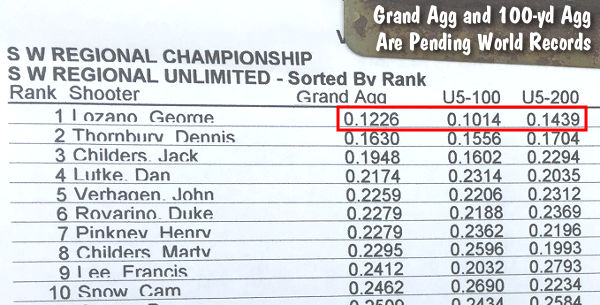
You are looking at one of the most impressive examples of precision shooting in history. On each of those five targets is a five-shot group made at 100 yards. This is the best set of five targets ever shot consecutively at 100 yards in the history of firearms competition on this planet. That’s right, nobody has ever drilled a better set of five, five-shot targets. The combined Aggregate for these five targets is a stunning 0.1014″, with the individual groups measuring: 0.102″, 0.168″, 0.123″, 0.053″, and 0.061″. So, two of the five groups were in the Zeros. And the 0.1014″ Agg handily beats existing world records.
This is an amazing accomplishment that beats both the existing NBRSA and IBS records. The NBRSA Record 100-yard Unlimited 5×5 Aggregate is 0.1242 set by Jerry Lahr in 2012. The IBS Record Heavy Benchrest 100-yard Aggregate (for five, 5-shot groups) is 0.134″, set by R. Howell in 2004.
But there’s more…
Lozano Grand Agg of 0.1226 also Breaks IBS and NBRSA World Records
George Lozano also shot a superb five-target Aggregate at 200 yards: 0.1439. This gave him a combined 100 + 200 Grand Aggregate of .1226 which is also a new world record. NOTE: for the 200-yard Agg, the actual group measurements (in inches) are summed, averaged and then divided by two to provide equivalency with the 100-yard results. Lozano’s actual group measurements at 200 yards were: 0.205″, 0.307″, 0.220″, 0.409″, and 0.298″. As averaged and divided by two, that is 0.1439. When combined with George’s 0.1014 100-yard Agg, Lozano’s 100+200 Grand Agg is a stunning 0.1226.
Lozano’s 0.1226 Grand Agg breaks both NBRSA and IBS World Records. The current NBRSA Unlimited Grand Agg Record for five, 5-shot groups at both 100 and 200 yards is a 0.133 by Dave Dowd in 2012. The equivalent 100 + 200 IBS Heavy Benchrest Grand Agg Record is a 0.1575 by Lester Bruno in 2004.
The talented shooter, George Lozano (shown above), was modest about his achievement: “Thanks, guys. I appreciate your very kind compliments. It was a good Father’s Day weekend and a fun match.”
NOTE: These records are pending verification by the NBRSA official records committee. But based on the numbers we’ve seen, it looks like Lozano will soon find his name in the record books.
Technical Details
We don’t know much about George Lozano’s load — either the powder or bullet. We’re told he was shooting a 6PPC cartridge in an Unlimited Benchrest rig, also known as a “railgun”. Here is a photo of a modern benchrest railgun. This is NOT Lozano’s record-breaking rig, but it shows the type of hardware used in the modern Unlimited Class.
IBS Match Report by Kenneth Frehm
The International Benchrest Shooters (IBS) held its New York State Championships and Annual Pro-Am Group Shoot at the Camillus Sportsmen’s Club on July 9-10, 2016. Forty-nine benchrest competitors vied for glory and trophies. Among these forty-nine, we were fortunate to have two of the fairer sex (such as Donna Sutton, below), as well as youngsters and seniors taking part. The event provided ample opportunities for old friends to reacquaint with each other, as well as time for making new ones. The great camaraderie exhibited by these competitors helps define our sport of Benchrest shooting.
Donna Sutton was “Pretty in Pink” — even down to her pink rifle stock.
As early as the Thursday before, new arrivals tried to learn and master the prevailing conditions at the range. Of course, once the shooting events started, Mother Nature had a few surprises in store for the folks on the line. The surrounding topography at our Camillus Range assures that wind is ever-present, fickle and as changeable as can be! Both days presented the shooters with difficult wind and weather challenges. Saturday was sunny, warm and the winds ranged from two to approximately ten miles per hour. However, twitchy tails on the wind flags made for unpredictable holes appearing in the targets.
Saturday, the wind direction changed constantly making each relay different from the ones before or the ones upcoming. Flags spun along the 100-yard span showing different colors and their streamers indicated the constant changing velocities. Of course, the top shooters managed to correctly analyze these variables and produce Aggs in the “point one+” range — impressive shooting given the conditions.
On Sunday everything changed. We were greeted with what we natives call “Syracuse Sunshine”. This is cold weather, gray skies, with rain showers that came and went all day long. On rare occasions, the sun peeked out along with its partner mirage. However, for most of the day, the 200-yard contestants had to deal with extremely high winds.
Although a left-to-right direction prevailed, wind probes were pegged, their streamers stood straight out, vibrating to gusts that may have topped 25 mph! Those intrepid shooters who didn’t put “dope” on their scopes braved shots that almost went completely off their targets!
Those few opportunities to shoot in a constant condition were rare and only lasted for a few seconds in duration. As in the day prior, the top guns conquered these difficulties. The men were separated from the “boys” as those with the most well-honed skills prevailed.
As for equipment — almost everyone shot 6 PPCs in all classes. This is still very much the cartridge of choice in 100/200 group benchrest competition. There was one .22-caliber rig and Bruce LaChapelle experimented with a new “Wildcat .20 Caliber” rig that he designed and machined himself.
There were many interesting T-Shirts on display at the match:
Pro-Am Competition with Two-Person Teams
One interesting element of this match was the “Pro-Am” competition. The “Pro-Am” features two-person teams with one experienced top-level BR shooter and one amateur shooter. For each two-man team, both shooters’ Two-Gun Aggregates are combined. The Pro-Am winning team is the twosome with the best winning combined, Two-Gun Aggregate. Both shooters receive First Place Pro-Am plaques. The winning amateur, Chris Jeffers (below), also won a barrel blank from Hart Rifle Barrels.
Under Pro-Am rules, an “amateur” is a shooter who has participated in registered BR events for five years or less. The “Pro” level includes shooters who have competed in registered events for six years or more. The Pro-Am was started 18 years ago to encourage new shooters and recognize amateurs in hopes they will continue with the sport. This is a good concept that could be tried at other events.
L to R: Todd Jeffers, Bob Brushingham, Bill Goad, Paul Mitchell, Wyatt Peinhardt, Cody Kurtz, Kevin Donalds Sr.
Our hats are off to the many folks who worked so hard to make this two-day event successful. I didn’t hear any grumbling or nary one complaint. Hal DeBoer, our new club President, ran the line and kept everything running smoothly and safely. Event chairman Bob Hamister had crews of club members working weeks in advance, preparing targets and organizing the many tasks that needed to be accomplished. Colin Hillman and his crew from the Syracuse Police Dept. and Jim Palumbo with the Youth Clay Targets Program were in charge of the target crews. They managed four different target crews, one for each morning and afternoon.
The ladies in the scoring booth (see above) had to analyze each relay, carefully scoring and posting the scores. They did this so efficiently that score sheets were posted immediately after each match. We also were fortunate to have Christopher’s Catering crew who provided breakfast, lunch and dinner during the two days. The food was delicious, plentiful, and affordably-priced.
Top Shooters by Category/Class:
Pro-Am Event Winners: Chris Jeffers (Amateur) and Dale Boop (Pro). Two-Gun: Harley Baker, Bob Hamister, Paul Mitchell, Wyatt Peinhardt, Bill Goad, Dale Boop. Heavy Varmint: Harley Baker, Paul Mitchell, Bob Hamister, Dave Bruno, Mike Mastrogiovanni. Light Varmint: Wyatt Peinhardt, Todd Jeffers, Bill Goad, Bob Brushingham, Barney Small.
I really enjoyed my job as photographer and roving reporter. I don’t have to worry about reloading, getting to the line on time, or trying to shoot small groups. I had ample opportunities to chat with competitors. I learned a little about them, where they lived, and had a chance to pick their brains about their ongoing quest for accuracy. I saw many different styles of loading at the benches and the many variances in equipment, shooting styles and techniques.
Once again, my most important take-away was that this group of sportsmen and sportswomen are friendly, helpful and genuine. Shooting tips, local knowledge, and advice are shared openly by all and help is there, charitably given to anyone who seeks it. — Kenneth Frehm
Camp Perry has entered the electronic age — Perry’s first electronic targets “go live” this week. On Thursday, July 21, the CMP hosts a Ribbon Cutting Ceremony to celebrate the installation of its new Kongsberg electronic rifle and pistol targets on Camp Perry’s Petrarca Range. During the afternoon, guests can test out the new targets with their own suitable firearms, or use “loaner” AR-15 rifles and M9 pistols provided by the CMP.
The first ten electronic rifle targets, placed at 200 yards, are now ready for action on the Petrarca Range. Reduced target centers will allow shooters to practice for longer distances as well. the smaller pistol/smallbore targets are mounted in portable carriers so they can be stationed at 25 or 50 yards. Three pistol targets are now in place (see photo at right).
This is the beginning of a process to supply many ranges at Camp Perry with state-of-the-art Kongsberg (KTS) electronic targets similar to those installed at the CMP’s Talladega Marksmanship Park. However, the CMP is NOT planning a whole-scale replacement of all of Camp Perry’s old-fashioned targets.
CMP Offers Free “Test Drives” of Kongsberg Electronic Targets
Petrarca Range will be open throughout the National Matches to allow competitors and visitors to try the KTS targets for FREE. During this time, guests are encouraged to bring their own firearms and ammo to use at the range as no rentals will be available other than the day of the Ribbon Cutting. After the National Matches are over in August, the range will be open several Mondays for Open Public Shooting, with a small fee charged to shoot on the electronic targets.
Video Demonstrates Kongsberg Target System
KTS Electronic Targets use multiple acoustic sensors to “hear” the shot and accurately triangulate its location. Shot placements (and score values) are calculated instantly and transmitted in real time to display screens at the shooting stations. These kind of targets allow matches to run faster, with no pit duties required. All scoring is handled by the KTS central “brain” which can outputs scores to linked electronic scoreboards.
Monitors Display Score and Shot Location Instantly Each Kongsberg target connects to a monitor that displays the hit locations to the shooter. Easy push-button controls allow the shooter to cycle through hits and options without having to change positions. The monitors employ non-glare glass protected by an aluminum frame that acts as a shade. This ensures good visibility for the shooter.
These state-of-the-art electronic targets are also used in the CMP’s new Talladega Marksmanship Park, where they have proven to be very popular with shooters. NOTE — the CMP is not planning a whole-scale replacement of all of Camp Perry’s old-fashioned targets. However the CMP hopes to modernize the Camp Perry facility, by installing some electronic targets on all Camp Perry ranges by summer 2018.
Derek Rodgers, the only shooter to win both the F-Open and F-TR National Championships, has done it again. While shooting the Santa Fe Trail LR Regional match in Raton, New Mexico, it looks like Derek set a new 1000-yard record. Derek nailed his 1000-yard target, recording a 200-14X score — that’s twenty (20) shots for record, all tens with 14 in the X-Ring. Derek told us: “Yesterday at Raton New Mexico’s Whittington Center, I shot a 200-14X, which should be a new pending F-TR National Record at 1000 yards.” Derek took special pride in this accomplishment, as he held the F-TR record before: “I’m happy to have the record back. I have had three of the last four records”. Well done Derek!
Derek Rodgers .308 Win F-TR Rifle Equipment List:
McMillan Xit stock, Kelbly Panda LBLP action, Bartlein .308 Win barrel (32″, 1:11.25″ twist), Nightforce NXS 8-32x56mm scope. Note that Derek shoots right-handed, but with a LEFT BOLT. This allows him to stay in position better while cycling the bolt with his LEFT hand.
This impressive performance by Derek shows that the best F-TR rifles can rival the big F-Open rigs for pure accuracy, even though the favored F-Open chamberings, such as .284 Win and .300 WSM, are still ballistically superior to the venerable .308 Winchester used by nearly all F-TR competitors. For his record-breaking load, Derek used Berger 200gr Hybrid Target bullets in Lapua .308 Win (small primer pocket) brass, pushed by Hodgdon Varget powder.


 The President’s Match was patterned after an event for British Volunteers called the Queen’s Match. That British competition was started in 1860 by Queen Victoria and the NRA of Great Britain to increase the ability of Britain’s marksmen following the Crimean War.


 Quadruple Distinguished Marksman
 Team Lapua — Supporting Excellence




 The first ten electronic rifle targets, placed at 200 yards, are now ready for action on the Petrarca Range. Reduced target centers will allow shooters to practice for longer distances as well. the smaller pistol/smallbore targets are mounted in portable carriers so they can be stationed at 25 or 50 yards. Three pistol targets are now in place (see photo at right).
 Each Kongsberg target connects to a monitor that displays the hit locations to the shooter. Easy push-button controls allow the shooter to cycle through hits and options without having to change positions. The monitors employ non-glare glass protected by an aluminum frame that acts as a shade. This ensures good visibility for the shooter.


