Today’s the final day of the Berger Southwest Nationals, with individual Sling, F-TR, and F-Open matches on tap. The competition remains tight, with many shooters within striking distance for podium positions. Predictions are for light and variable winds for the day. We’re sad to see the fun come to a close. This is a special event, drawing top shooters from around the nation. As James Crofts told is: “It’s always great to see good friends and fellow shooters from far and near….”
One shot left… will that last bullet end up in the X-ring? We hope so…
If you’ve never shot this match, you should. You’ll squad alongside the nation’s best long-range shooters, and you’ll enjoy a superb facility. The desert range at Ben Avery is something special — check out a “birds-eye view” with our latest video from the match. This video also includes an interview with Derek Rodgers, the only man who who has earned both F-Open AND F-TR National titles. We strongly recommend you watch this video.
“Must-Watch” SWN Video has aerial view of Ben Avery plus highlights from Saturday
Yesterday, Saturday, marked the conclusion of the Team events. In the F-TR division, Michigan extended its lead to win Gold while the U.S. Rifle Team (USRT) held on for silver for the overall team title. Notably, ten of the twelve shooters making up the top three squads are members of the USRT, as are the top two coaches. Congrats to all.
Phil Kelley reports that Saturday’s F-TR team match went down to the wire: “It was a fun 1000-yard team day at SW Nationals. Good to use a teammate’s backup gun to finally be competitive at something. Congrats to Team Michigan for the big win, both for the day and overall. There was great competition today with Michigan winning by 1 point (and some Xs) over X-men and X-men getting Team Virginia/USA by 1 point and some Xs. Great shooting by all.”
Phil added that: “Dan Lentz continues to perform well with another great day and maintains the overall lead going into the final day. Derek Rodgers, Bryan Litz, and Jim Crofts are on his heels but Dan looks confident.” Tomorrow, here on the Daily Bulletin, we will provide final individual results from the match, along with all the final team results.
Snapshots from the Berger Southwest Nationals
Here’s one of the new Borden wide-body actions in a Shurley Brothers stock. The timing on this action is insanely good, making it very smoooooth to operate.
This Scottish shooter showed some style on the range, with his traditional Scottish tweed cap. That’s classy. No floppy boonie hat for this dapper lad.
Take a look at the very useful information card. Note that it shows mirage patterns and provides suggested windage and elevation corrections for all yardages.
Check out the handsome, 3D-effect Stars and Stripes finish applied to this F-TR Rifle. Note that the right-handed shooter is running a Left-Bolt, Left Port action, with a SEB Joy-Pod up front.
Here’s the brand-new F-Class front rest from Competition Machine. This 38-lb beast features a belt-drive elevation adjustment, joy-stick windage, and rotary pivoting head to align with your target.
Rewards for Berger SWN Participants
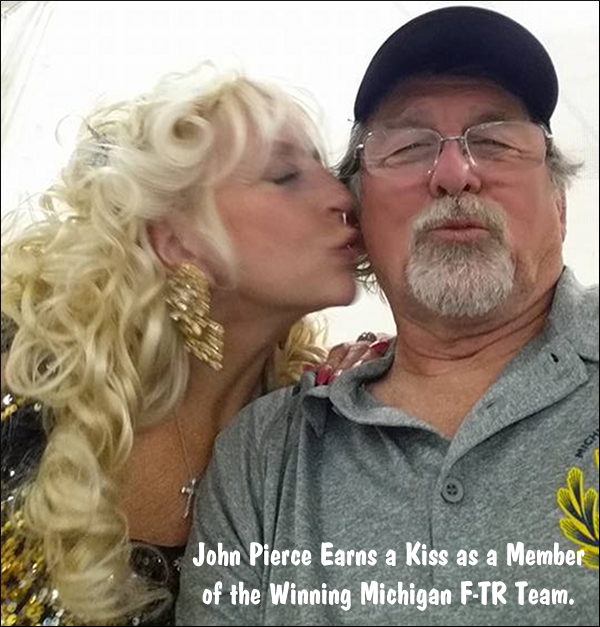
The Berger SW Nationals has one of the richest prize tables in the shooting sports. This Saturday night, nearly 400 participants received a variety of participation prizes and raffle awards. In addition, winners were announced for some of the events which concluded earlier in the week. Gunsmith John Pierce came up a big winner with a kiss from his lady and a Team Trophy for the Michigan F-TR Squad.
The Individual Palma Match kicked off Friday at the Berger Southwest Nationals. While still mostly calm, conditions were more variable and tricky. James Crofts told us that you had to watch both the mirage AND the flags, because sometimes a change appeared on the flags before you could see anything in the mirage. The top shooters were scanning the range constantly for any velocity or angle change. If you don’t pay attention to the flags, James said, “you’ll be out in the nine ring”.
Watch Video with Highlights from Day 3 of Berger SWN, including James Crofts Interview:
Our good friend John Whidden, a past National Long-Range Champion, brought his “A Game” Friday, topping the Sling Division with 449-33X. Competition was fierce with five sling shooters finishing with the same 449 points, separated only by X-Count: Whidden (33X), Oliver Milanovic (31X), Rick Hunt (25X), Michael Barlow (25X), and Steven Powell (22X).
John Whidden file photo from 2015
In F-Open, the top three shooters for the day were: Ken Padilla (448-25X), John Myers (447-32X), and Kenny Adams (447-24X). In F-TR Dan Lentz topped the Field with 447-24X, followed by Derek Rodgers and Justin Bertino (both at 445-23X). Ryan Pierce noted that Dan Lentz’s performance for the day beat all but three of the F-Open shooters: “Extremely impressive is Dan Lentz 447-24X F-TR score [which] tied Kenny Adams’s third-place F-Open Aggregate. Shooting .308 Win off a bipod and keeping up with the 7mms and 30 Cal magnums is outstanding. Good shooting Dan.”
Interesting Hardware
New Speedy F-Open Stock (Jeff Reed, owner)
F-Open competitor Jeff Reed has a new F-Open rig with the brand new Speedy Gonzales laminated stock. Jeff says he loves the stock, saying it “tracks like a dream”. Jeff also likes the recoil-reduction system fitted at the rear of the stock. This really makes a difference for the big calibers says Jeff. If you’re curious, that’s an IOR Valdada 12-52x56mm scope with a 40mm main tube on top of Jeff’s rifle. It features 25 MOA of elevation in one rotation of the turret.
Spotting Scope Mounted to Front Rest
Gunsmith Richard King of Texas has mounted his spotting scope directly to his Farley front rest. Very clever. This puts the spotter eyepiece just a few inches from his riflescope eyepiece so he can move easily from one optic to the other. This set-up also reduces the amount of gear Richard carries to the line. No separate spotting scope base, stand or horizontal mounting arm is required. This is a simple, elegant solution. We bet, with a little tinkering and design work, a similar system could be mounted to a SEB or Bald Eagle front rest. Note, it may appear that the lens is obscured by the front clamp, but that’s just the camera angle. We looked through the spotting scope and everything is clear.
Thursday was a Team Competition day at the Berger Southwest Nationals. Conditions were surprisingly calm for most of the day, with flags hanging straight down through most of the morning. But there were still some “ghost winds” that might affect one flag (and cause some unexplained). Mirage was also tricky for some shooters as the day wore on.
Watch Day 2 Match Highlights including Interview With Team Michigan’s Bill Litz and Bryan Litz
Team Michigan won the F-TR competition, followed by The U.S. F-TR Team in second, and Team X-Men in third. Based on the interim results posted, the Sling Division was one by the UK/Scottish Ethnic Fringe Team led by Captain Angus McLeod. It appears that the top F-Open Squad was Team Berger — those senior guys still know their stuff.
USRT Gold Medal Sponsors Kelly McMillan of McMillan Group International and Sean Murphy of Nightforce Optics came out to observe and shoot with the U.S. Rifle Team. Here’s Kelly with his bionic arm.
It was hot, dry, and sunny in Phoenix. You needed lots of water and plenty of sunscreen…
There was plenty of good food on hand for the competitors…
Here’s an interesting rig that combines a spotting scope (on left) with 15×56 binoculars (on right) This allowed the spotter to watch targets as well as mirage elsewhere on the range. Smart…
Our friend Vince Bottomley in the UK has written an excellent article for Target Shooter Magazine. Vince offers “solid-gold” advice for new F-TR and F-Open shooters. Vince reviews the cartridge options, and offers suggestions for a shooter’s first (and hopefully affordable) F-Class rifle. Vince also reviews various bipod choices for F-TR and discusses optics options (from $300 to $3000).
DEAR DADDY. We all draw positive motivation from different sources. This competitor at the Berger SW Nationals gets a lift from his child’s hand-written note: “Dear Daddy, I love you very much. I hope you win the competition. You are the best….”
The Berger SWN competition began in earnest yesterday, with hundreds of shooters taking to the line. Today, it’s more of the same, with the nation’s top F-TR, F-Open, and Sling Shooters competing at the Ben Avery Shooting Facility north of Phoenix.
Checking conditions at break of day. This week Phoenix will offer cool nights and warm days, with daytime temps in the mid- to high 80s (F).
The Berger Southwest Nationals (SWN), is the biggest, most prestigious long-range shooting match west of the Mississipi. The SW Nationals, which run February 9-14, 2016, kicked off on Tuesday the 9th with a shooting clinic at the Ben Avery 1000-yard Range. This gave competitors a chance to confirm their zeros, study the conditions at Ben Avery, and prep their “mental game” for the upcoming competition. This will be a huge event, with over 370 shooters from all over the USA and many foreign countries. The SW Nationals attracts top F-Class and Sling shooters, lured by the quality of the competition and a huge prize table. This is truly a “world-class” event.
Tuesday’s shooting clinic started with a class on Exterior Ballistics hosted by Bryan Litz. Following the ballistics class, shooters made their way to the firing line for one-on-one instruction with experienced shooters in each discipline (sling, F-TR and F-Open). During this segment of the clinic, champion shooters worked directly with novice and intermediate shooters. Bryan said: “It was great to see the ‘top guns’ sharing their knowledge.”
File photo from 2015.
Nat’l Mid-Range and Long-Range F-TR Champion Bryan Litz instructs during Tuesday’s Clinic at the Ben Avery Shooting Facility.
Eliseo Tubegun with Nightforce Competition scope. These versatile rifle chassis systems are produced by Competition Machine in Cottonwood, Arizona.
Old is new again. After receiving many suggestions on how best to fill the recently-added week at the end of the National Matches in August, the Civilian Marksmanship Program (CMP) has created the “CMP Legacy Series”. To be conducted during the final week of competition at Camp Perry, the Legacy Series will include the following matches:
CMP Heritage Match (Aug. 10) – 800 Aggregate event, 20 shots standing and 20 shots sitting at the 200-yard line, 20 shots rapid fire at the 300-yard line and 20 shots prone slow fire at the 600-yard line.
CMP Viale Memorial Match (Aug. 11) – 50-shot National Match Course of Fire
CMP Critchfield 2-Man Team Match (Aug. 12) – 50-shot National Match Course of Fire.
CMP Modern Military Rifle Match (Aug. 13) – 55-shot match fired at the 200-yard line.
CMP Roosevelt Commemorative Match (Aug. 14) – 30-shot Krag/m1903 match fired at the 200-yard line.
The theme “Legacy Series” was chosen to honor Camp Perry and those individuals who have helped shape the nation’s longest-running series of championship and recreational rifle events in America. The schedule above was chosen by the overwhelming majority of CMP competitors surveyed. Of the 1,595 responses, 1,051 selected the CMP Legacy Series to conclude the 2016 National Matches.
The CMP Heritage Match is typical of the National Match Course service rifle events fired at Camp Perry for more than 100 years. The CMP Viale Memorial Match celebrates the memory of 2nd Lt. Robert M. Viale, KIA, namesake of Camp Perry’s 1,000-yard range. The CMP Critchfield 2-Man Team match is named in honor of Ammon B. Critchfield, Adjutant General of Ohio and founder of Camp Perry, the largest rifle range in the nation.
Critchfield would also be pleased to see those 1903 Springfields in action more than a century later on his range at the CMP Roosevelt Commemorative Match, open only to the Springfield and its predecessor, the Krag-Jorgensen rifle.
The CMP Modern Military Rifle Match showcases modern, semi-automatic military style rifles like the non-accurized M14/M1A, the original lightweight AR15 and many foreign military semi-autos and commercial equivalents.
If you have questions regarding the CMP Legacy Series, contact Christina Roguski at croguski @ thecmp.org, Shannon Hand at shand @ thecmp.org or Kim Filipiak at kfilipiak @ thecmp.org.
Dry-firing practice can benefit all competitors, particularly sling-shooters. However, for AR15 Service Rifle shooters and High Power competitors using AR-based “spaceguns”, dry-firing is complicated by the charging handle location — pulling back on the handle requires that you move your head placement on the rifle. In addition, extensive AR dry-firing can cause pre-mature wear of an AR’s firing pin. AR shooters take heart — now there are products that allow you to dry-fire your AR more easily, without breaking position, and with no adverse effects on the firing pin.
Creedmoor AR15/M16 Dry-Firing Device Creedmoor Sports offers a Delrin dry-firing device that allows you to reset your AR trigger with a very short pull of the charging handle — plus you don’t have to break position. Machined from solid Delrin, the dry-fire device is inserted into the bolt carrier and limits the swing of the hammer, allowing unlimited dry-firing without the risk of firing pin damage. The trigger pull is unchanged and the shooter can reset the trigger mechanism by cycling the charging handle a mere one-quarter inch or so. The shooter can reset his trigger without breaking position and the lessened impact of the hammer allows the shooter to better evaluate his sight picture and follow-through. Creedmoor’s AR-15/M16 Service Rifle Dry-Fire Device, item #C1051, retails for $18.95
Other AR Dry-Firing Devices MidwayUSA offers a similar Delrin dry-firing device for ARs. Like the Creedmoor unit, this TMA-made device fits in the bolt carrier group and protects the firing pin from damage. The orange unit slips between the buffer and bolt, and permits the trigger reset with only a quarter-inch movement of the charging handle. During storage the device can also provide a safety function by preventing the hammer from hitting the firing pin. But, we caution, don’t leave your gun loaded presuming this device, by itself, will make the gun safe. MidwayUSA’s orange Delrin AR dry-firing device, item #872223, costs $17.29.
Story tip by Boyd Allen. We welcome submissions from our readers.
Here’s an AR configuration suited to the new AR Mid-Range Prone Discipline: Moderate-length barrel, Harris Bipod, Leupold Mark AR MOD 1 4-12x40mm scope. Photobucket image by Ingo1978.
The NRA has created a new mid-range, target-shooting discipline for AR owners. The provisional rules for the new AR Mid-Range Prone Competition will allow calibers from .22 up to .308. Rifle weight will be limited to 14 pounds. Competitors may use Harris (or similar) compact, “tactical” bipods, and optics up to 12-power will be allowed (but iron sights can also be used). The goal of this new competition is to get the many AR owners to the range to compete.
The NRA’s Information Sheet for the new mid-range discipline explains: “These rifles are of the ‘AR-Platform’ variety, semi-automatic, chambered in any caliber from .223 cal./5.56mm. up to and including .308 cal./7.62mm. The courses of fire will be the same courses of fire currently used for other NRA Mid-Range (Prone) High Power Competition (300, 500, and 600 yards) and are designed to be fired concurrently with other forms of Mid-Range competition. The targets will be the same targets that are used for Service Rifle, Match Rifle, and Palma Rifle Mid-Range Prone competition. Mid-range telescopic sights will be allowed, but not required. Because this is prone competition, shooters may use tactical front rests such as Harris-type bipods and limited rear rests of the type one might find used in military or police tactical situations.”
A very prominent NRA member who works with the Competition Committee recently posted this explanation of the new AR discipline on our Forum:
NRA Mid-Range (Prone) Tactical Rifle (AR)
For those clubs and match directors who have members with ARs who want to shoot Mid-Range Prone but who don’t want (or can’t afford) to shoot traditional “sling” or F-Class, we have a new opportunity to get those ARs out of the closet and onto the range with very little in the way of additional costs:
It’s called Mid-Range Tactical Rifle (AR). A copy of the description and the Rules (Provisional) are attached as a PDF file and should be published by the NRA very soon. CAUTION — these are NOT official — but I think they are accurate:
In brief, here’s how it works:
1. The event will be fired concurrently with any other Mid-Range event, alongside of F-Class and “sling” divisions.
2. The Event will be fired on the “sling targets”.
3. AR Rifle General Standards:
Calibers: 223/5.56 up to and including .308/7.62mm
Weight: Overall weight not more than 14 pounds
Support: Harris-type “tactical bipod” (no large F-Class bipods).
Optics: Scope not more than 12X
Barrel: Not more than 20″
Trigger: Trigger pull not less than 4.5 pounds
4. This is NOT F-Class — this is designed to be closer to “tactical”. F-Class competition gear is generally illegal; competition stocks are generally illegal. [The event] is designed to attract more law enforcement and/or military (maybe local National Guard?) and other “tactical shooters” out to the range shooting for precision. For more info, check out the attached PDF file.
You’ll find a discussion of this new AR Mid-Range discipline in our Shooters’ Forum, HERE: AR Mid-Range Match Forum Thread. Here are some interesting comments from that thread:
“Opening up mid-range matches for ARs is a great idea. I’m not an AR guy myself, but I have lots of shooting friends who are. They tend to have a lot of ideas what their guns are capable of out to 600 yards, but most don’t take many opportunities to shoot them at those ranges, and none of the existing High Power disciplines are very appealing. Until now. I hope it doesn’t become an equipment race. A 185/200 is a respectable score even with a 12″ 10 ring. I hope everyone is supportive — helping get these guys on the paper and providing positive feedback even for scores that seem modest by F-Class standards.” — Comment by Berger.Fan222
“It looks like the recommended targets will be the same as conventional shooters use (i.e. ~1 MOA X-ring). Given the specifications for rifles/bipods/scopes/etc., I think this would be an appropriate level of difficulty to start. It will be challenging, particularly at 600 yards, but by no means impossible. Of course, at 600 yards, anyone shooting an AR15 (.223/5.56) will be at a disadvantage to ballistically-superior calibers unless they come up with a good way to load 80+ grain bullets that will mag-feed. Personally, I’d like to see this limited strictly to .223 ARs. Almost everyone has one and the mag feed requirement would really keep things even across the board. The inclusion of other calibers will allow this to become a ‘caliber race’ in that .223 will have a very hard time keeping up with other, better calibers at 600 yards.” — Comment by gstaylorg
“Looks like a great new addition. The PDF document says rule 7.20 for course of fire which is mid-range slow fire. I believe all slow fire is currently ‘one round loads’. The PDF explicitly states 10-, 20- or 30-round magazines and no sleds. Does anyone know if this new discipline would be fired from magazine or one-round loads? Shooting from magazine would be keeping with the ‘tactical’ aspect and enforcing mag-length loads. But it does not seem to jive with the ‘one round load’ currently stipulated for slow fire?” — Comment by Highpower-FClass
The 2016 Berger Southwest Nationals event is less than a week away. If you need some last-minute practice before this match and you don’t have the time (or money) to load a couple hundred rounds of centerfire ammo, consider rimfire practice. Past F-TR National Champion James Crofts attributes much of his success to plenty of trigger time with his rimfire training rifle.
Rimfire Training for F-Classers
2014 and 2012 U.S. National F-TR Champion James Crofts is one of America’s top F-Class shooters. A member of the 2013 World Championship-winning F-TR Team USA squad, James knows a thing or two about long-range shooting, that’s for sure. But you may be surprised to learn how James sharpens his shooting skills at relatively short distances. You see, James often practices with a .22 LR rimfire rifle at distances from 50 to 200 yards. James tells us: “Shooting my F-Class rimfire trainer saves me money and improves my shot process and wind-reading abilities.”
Remington rimfire 40X barreled action in PR&T LowBoy stock with PT&G bolt.
Rimfire Training Teaches Wind-Reading Skillsby James Crofts
Training with the rimfire is extremely useful and can be done from 25 yards out to 200 yards. I am lucky and can shoot 50 yards right off my back deck. That is far enough that any miscue on rifle handling will show up on the target. I use a two dry-fire to one actual shot routine for my practices. This gives me much more positive reinforcement without any negative reinforcement.
Wind reading is extremely important with a .22 LR rifle. I use a set of smallbore flags to aid my wind calls. The smallbore flags are a must and force you to look at the flags and mirage on each and every shot. If you think the flags at Camp Butner move a lot, try smallbore flags around tall pine trees.
James Crofts — Photo by Kent Reeve.
Rimfire Training Is Cost-Effective
Rimfire ammunition is much less costly than centerfire ammo. Though .22 LR prices have risen in recent years (and rimfire ammo is harder to find), even now I can get a 500-round brick of .22 LR ammo for less than $75.00. That works out to fifteen cents a round. That’s a fraction of the cost of handloading .308 Win match ammo. Heck, you can pay 40 cents a piece for match-grade .308-cal centerfire bullets. Then you have to figure in brass, primers, and powder.
My CMP 40X Rimfire F-TR LowBoy Clone
My quest into the .22 LLR rimfire field started with an email from the Civilian Marksmanship Program (CMP) announcing Rem 40X stripped barreled actions for sale. I thought, “Hmmm… Could one of those little 40X barreled actions be turned into a F-Class training rifle?” My gunsmith Ray Bowman of Precision Rifle & Tool was brought in at this point.
After conferring with Ray, it was decided that he could indeed turn this into a F-Class training rifle. Ray contacted Dave Kiff of PT&G and ordered a new bolt for the Remington 40X rimfire action. Next was the stock decision. I decided to go with a PR&T Low Boy F-Class stock — this is an exact clone of the stock for my .308 Win F-TR competition rifle. Then a Jewell trigger was acquired to complete the components. Ray built this just like he would any custom rifle, other than using the stock barrel. The project turned out awesome. The rifle was a hammer from the beginning even with the stock barrel.




 The
The 


