Shooting USA TV has a good show today. Shooting USA’s Wednesday Night episode features military rifle competition at Talladega Marksmanship in Alabama. Historic military battle rifles from the past century are competing — Garands, Springfields and a list of other period military battle rifles are on the firing line.
Shooting USA SHOW TIMES: This Shooting USA Episode airs Wednesday, April 16, 2025 at 9:00 PM Eastern and Pacific; 8:00 PM Central. If you miss the regular broadcast, you can stream the show online at any time on Vimeo for $0.99 per episode.
Each spring, the CMP hosts a Spring Classic Event at the Talladega Marksmanship Park. The 2025 CMP Talladega Spring Classic ran Tuesday, March 18 through Sunday, March 23, 2025. The event schedule included both rifle and pistol competition. Events included Garand/Springfield/Vintage/Modern Military, Rifle Marksmanship 101/M16 Match, Pistol Marksmanship 101/M9 Match, CMP Match Pistol 2700, CMP 80 Shot Matches, CMP EIC Service Rifle Match and more.
Competitors used electronic targets for pistol and rifle matches. Each firing point of the 500-acre facility is now equipped with a state-of-the-art, KTS electronic target and scoring monitor. Located beside the shooter, on the firing line, each monitor allows the competitor to see his/her shot value in a matter of seconds. Spectators can view the results in real time on large monitors.
Have you ever wondered how Olympic-class position shooters hold their aim so steady? Those bulky shooting coats help, but there is a lot of bio-mechanics involved also. Top shooters employ their body structure to help support the weight of their rifles, and to steady their aim. This interesting video, produced by GOnra Media, demonstrates rifle hold and body alignment for prone, standing, sitting, and kneeling positions. Olympic Gold Medalist Jamie Corkish (formerly Jamie Gray) demonstrates the proper stance and position of arms and legs for each of the positions.
Ideally, in all of the shooting positions, the shooter takes advantage of skeletal support. The shooter should align the bones of his/her arms and legs to provide a solid foundation. A shooter’s legs and arms form vertical planes helping the body remain stable in the shooting position.
Jamie Corkish, London 2012 Gold Medalist in Women’s 3 X 20, has retired from top-level competitive shooting. However, Jamie remains involved in the shooting sports as a Public Relations/Marketing representative for ELEY, a leading maker of rimfire ammunition. Jamie also works with shooting clubs and educational institutions to promote smallbore target shooting.
Images are stills from GOnraMedia video linked above.
This month USA Shooting celebrates 30 years as the American Governing Body for shooting sports within the U.S. Olympic and Paralympic Committee. USA Shooting will commemorate its anniversary throughout 2025 with special events, social media giveaways, and initiatives designed to further expand participation in competitive shooting sports. To learn more about USA Shooting’s 30th Anniversary programs, visit USAShooting.org and follow @USAShooting on Facebook, X, and Instagram.
“These three decades represent not just organizational longevity, but a remarkable journey of athletic excellence… and competitive innovation,” said Kelly Reisdorf, CEO of USA Shooting. Since its founding in 1995, USA Shooting has guided American marksmen and markswomen to 36 Olympic and Paralympic medals, developing world-class talent across all shooting disciplines.
“The trajectory of American competitive shooting has been defined by both winning at the highest levels and developing tomorrow’s champions,” said Tim Rupli, Chairman of USA Shooting. “We’ve cultivated American talent while championing the values of precision, discipline, and patriotic excellence[.]”
A Legacy of Champions
For three decades USA Shooting has produced shooting sports legends, including Kimberly Rhode, a 6-time Olympic medalist, and Vincent Hancock, the first shooter to win four gold medals in the same event. Most recently, USA Shooting athletes excelled at the Paris 2024 Olympic and Paralympic Games, securing six medals — including gold for Hancock in Men’s Skeet, silver medals for Sagen Maddalena in Women’s 50m Rifle 3 Positions, Conner Prince in Men’s Skeet, Austen Smith and Hancock in Mixed Skeet Team.
The legacy extends to stellar coaches like Lloyd Woodhouse, whose 23-year leadership of the U.S. shotgun team produced 10 Olympic medals across four Games and earned him recognition as the 2003 U.S. Olympic and Paralympic Committee Coach of the Year.
From Amateur Act to Global Force
USA Shooting traces back to the Amateur Sports Act of 1978, which established the National Rifle Association of America as the governing body for shooting sports. The mid-1980s saw the establishment of the U.S. Olympic Shooting Center and Olympic Shooting Park in Colorado Springs, creating a permanent home for the U.S. Shooting Team.
Looking Ahead: The 2028 Olympics in Los Angeles
As the organization celebrates its past, USA Shooting remains focused on the future — particularly the Los Angeles 2028 Olympic and Paralympic Games, which will mark the first Summer Olympics on American soil in over three decades. “Having the summer Games return to the United States presents an unprecedented opportunity to showcase our sport and athletes to a home audience,” Reisdorf added. “We’re positioning USA Shooting for its most successful Olympic cycle in our history.”
At the request of our readers, we provide select “Deals of the Week”. Every Sunday afternoon or Monday morning we offer our Best Bargain selections. Here are some of the best deals on firearms, hardware, reloading components, optics, and shooting accessories. Be aware that sale prices are subject to change, and once clearance inventory is sold, it’s gone for good. You snooze you lose.
NOTE: All listed products are for sale to persons 18 years of age or older. No products are intended for use by minors.
1. EuroOptic — Tikka T3x Rifle Blow-Out Sale — Save 35%
⏺️ » Tikka makes great hunting rifles now offered at major savings
With this Blow-Out Sale at EuroOptic.com, you can save $120-$500 on quality Tikka T3x hunting rifles, starting at just $499.99. Multiple models are on sale including T3x Lite, T3x Lite Compact, T3x Lite Stainless, T3x Hunter, T3x Laminated, and T3x RoughTech. Both right-hand and left-hand versions are offered. The Hunter models feature a handsome wood stock. These rifles can deliver sub-MOA accuracy with good hand-loads.
2. Creedmoor Sports — Berger Bullet Sale, Save up to 20%
⏺️ Good discounts on very large selection of Berger bullets
Now’s the time to get components, with the competition season getting underway. And right now Creedmoor Sports is running a major Berger Bullet Sale with quality Berger bullets from .17 to .30 calibers in a wide variety of hunting and match types. Choose target hybrids, varmint bullets, Elite Hunters or other bullet types for your next match or hunt. Many of the most popular .22-Cal, 6mm, 6.5mm, 7mm, and .30-Cal match bullets are on sale.
3. Sportsman’s WH — Springfield Armory XD-M Elite, $379.99
⏺️ Great deal on excellent 9mm pistol complete with Crimson Trace optic
Here’s a great deal on a high-quality Springfield Armory XD-M Elite 9x19mm pistol complete with a Crimson Trace 1500 Red Dot sight. With this current $379.99 sale price you save $220 (37%). That’s a terrific deal on a pistol with excellent owner reviews: “Great value and a great pistol. 100% reliable and accurate”; “Very happy with this purchase”.
4. Sportsman’s WH: SIGnature Event Optics Sale, Save 20-40%
⏺️ Discounts on scopes, rangefinders, red dots, plus FREE Gift Cards
Head over to Sportsman’s Warehouse for major savings on SIG Sauer scopes, rangefinders, and Red Dot optics. And now through 4/20/2025, you’ll receive a $10 Sportsman’s Warehouse Gift Card for every $100 spent on SIG Sauer items. The eGift Card will be sent once SIG Sauer items are shipped. This eGift Card offer applies to SIG Sauer firearm sales as well as SIG Sauer optics. And with many products Sportsman’s Warehouse is currently offering Free Shipping with orders over $49.00.
5. Midway USA — Walker’s Electronic EarMuffs on Sale
⏺️ Major savings on popular electronic hearing protection
6. Midsouth — Lyman Gen 6 Powder Scale/Dispenser, $219.99
⏺️ Good advanced powder dispenser now $40 Off plus FREE Shipping
Here’s a good, modern powder scale/dispenser offered with a HUGE discount. At Midsouth, the Lyman Gen 6 Compact Powder Dispenser System is now $40 Off with FREE Shipping. So your total price, delivered, is $219.99 — a great deal. This unit is accurate to +/- 0.1 grains and can use any type of smokeless powder. It has a fast warm-up, anti-static/anti-drift technology, with sophisticated electronic shielding to resist interference from other electronic devices. This unit comes with calibration weight, powder tray, and cleaning brush.
⏺️ » Incredibly low price on a good home defense shotgun
If you’re looking for a rugged 12ga shotgun for home defense — here is the deal of the decade. CDNN Sports is now selling a Dickinson XX2T 12ga Pump Shotgun for just $139.99, an amazingly low price. This pistol-grip shotgun works with 2 3/4″ or 3″ shells and has an 18.5″ barrel with factory muzzle brake. This XX2T, with shielded tactical iron sights, is $110 off the regular $249.99 price.
8. Midsouth — Aguila .22 LR ammo, 2000-rd case, $114.99
⏺️ Great 2000-round .22 LR bulk pack, super-low price
Modern .22 LR rimfire ammo is way cheaper than centerfire ammo, which can cost $1.30 or more per round for your own handloads, given the high costs of bullets, powder, and primers. Here’s a great deal — Midsouth offers 2000 rounds of Aguila .22 LR for only $114.99. This 38gr High Velocity Copper Plated Hollow Point is sold in a 2000-rd case. The $114.99 price works out to just $.06 (six cents) per round.
9. Amazon — Tactical Shooting Mat & Rest Bags, $29.99
⏺️ Handy shooting mat with two bags — all for under $30
Shooting prone requires a good shooting mat. And it helps to have front and rear bags when not sling-shooting. One budget-priced option is this DGVR Tactical Shooting Mat (#ad) set that comes with both front and rear bags. Get the mat and both bags for just $29.99 on Amazon (#ad). The bags are made of 600D oxford but do NOT come filled. The 1000D Nylon shooting mat is waterproof, and boasts a non-slip, wear-resistant coating plus a handy carry strap.
10. MidwayUSA — Tipton Jag Kit Brass or Nickel 15-20% Off
⏺️ Very useful kit with 13 different size jags
If you shoot a variety of calibers, you need one of these Jag Kits, now 25% Off. You get 13 different diameter jags in a fitted case for under $17.00. We like the Nickel-Plated Ultra Brass Jags (20% off price $19.99) because you don’t get “false positive” blue from your solvent interacting with the jag itself. But the regular Solid Brass Jags (15% Off price $16.99) also work great and some folks think they are more durable. We own these Jag kits and use them for everything from a .17 HMR up to a 45/70. Both kits contain 13 jags covering these calibers: .17, .20, .22, .243/6mm, .25/6.5mm, .270/7mm, .30, .338/8mm, .35/9mm, .375, .40, .44 and .45.
As an Amazon affiliate, this site can earn revenues through sales commissions.
The digital archives of Shooting Sports USA magazine (SSUSA) features an Expert Forum on Wind Reading. This outstanding article on wind reading starts off with a section by ballistics guru Bryan Litz, author of Applied Ballistics for Long-Range Shooting. Then four of the greatest American shooters in history share their personal wind wisdom. Lanny Basham (Olympic Gold Medalist, author, Winning in the Wind), Nancy Tompkins (Past National HP Champion, author, Prone and Long-Range Rifle Shooting), David Tubb (11-Time Camp Perry National Champion), and Lones Wigger (Olympic Hall of Fame) all offer practical wind-reading lessons learned during their shooting careers.
Whether you shoot paper at Perry or prairie dogs in the Dakotas, this is a certified “must-read” resource on reading the wind. Here is a sample selection from the article:
Shooting Sports USA magazine (SSUSA) has a modern, mobile-friendly website with tons of great content. Log on to www.ssusa.org. There you’ll find current news stories as well as popular articles from the SSUSA archives. The SSUSA website also includes match reports, gear reviews, reloading advice, plus expert marksmanship tips from the USAMU.
Mark your calendars for the return of the Civilian Marksmanship Program’s Bianchi Cup International Pistol Tournament. The second longest-running pistol championship in the world, the 2025 CMP Bianchi Cup is set to run May 20-23, 2025 at the Green Valley Rifle & Pistol Club in Hallsville, Missouri.
About the CMP Bianchi Cup
The Bianchi Cup International Pistol Tournament was first held in 1979, making it the second longest running pistol championship in the world. This year, it will be hosted by the CMP May 20-23, 2025, at the Green Valley Rifle & Pistol Club in Missouri. The Bianchi Cup has been called the most prestigious pistol tournament in the world. Due to the high accuracy required in each stage of the Bianchi Cup, the tournament is considered one of the most difficult handgun championships on the planet.
The Bianchi Cup is Comprised of Four Events:
Practical Event: Competitors fire at distances from 10 yards to 50 yards under varying time limits from the shooting line.
Barricade Event: Competitors fire at targets on either side of the barricade at different distances and under varying time limits from within shooting boxes and behind barricades.
Falling Plate Event: Competitors fire at eight-inch round steel plates arranged in banks of six at distances from 10 to 25 yards under varying time limits.
Moving Target Event: Competitors fire from within shooting boxes at distances ranging from 10 to 25 yards at a target moving from left to right, with the target exposed for six seconds.
Bianchi Cup Open Class Pistol — Features in Review
Above an Australian lady competitor shoots Open Class pistol. Note the large flared grip extension, ported muzzle compensator, and elevated optic. Open pistols may also have special custom fittings: wings for barricades, mover base for leads, and prone pad for stability. Open Class pistols rule at the Bianchi Cup: “Unlike USPSA, all divisions compete heads up at Bianchi. While Bianchi recognizes wins in other divisions, only the absolute top score can win the Cup. Since Bianchi is typically won only with a perfect score, and often by X count, guns other than open are not really competitive.” See Pistol-Training.com.
Position Shooting with Pistols at Bianchi Cup
Competitors shoot from both standing and prone positions and are also required to shoot with both strong and weak hands at various stages. There are no make-up shots in the Bianchi Cup, adding to the difficulty.
Bianchi Cup 1911 Pistol Giveaway
Looking for a 1911 pistol? The Civilian Marksmanship Program (CMP) is giving away a vintage 1911 pistol (plus mags, holster, and ammo) for competitors who register for the upcoming 2025 CMP Bianchi Cup.
The 2025 Bianchi Cup match runs May 20-23 in Hallsville, Missouri. Those who sign up for the CMP Bianchi Cup BEFORE April 27, 2025 will be automatically entered to win.*
To have a chance to win, you must officially register for the 2025 Bianchi Cup. ALL paid registrants will be automatically entered for the raffle. To learn more and REGISTER for the 2023 Bianchi Cup, go to the CMP 2025 Bianchi Cup Web Page.
* The raffle is open to U.S. citizens only. If a non-U.S. citizen is drawn, he or she will receive $500 in place of the 1911 pistol. Those who have already purchased a pistol are still permitted to win.
Team Berger’s Larry Bartholome showcased his shooting prowess by winning the 2025 Western Wildcat Smallbore F-Class Championship. The event, held in March at the Ben Avery Shooting Complex and hosted by the Desert Sharpshooters Rifle Club, brought together the nation’s top smallbore F-Class shooters in a challenging 4-day competition.
Bartholome finished with a 6363 Grand Aggregate score and an impressive 434 Xs, showing remarkable consistency throughout the match. His Western Wildcat win comes on the heels of a strong third-place finish at the NRA Metric Prone National Championship. “The Western Wildcat is one of the most challenging smallbore matches in the country, and I knew I had to bring my absolute best”, said Bartholome. “Thank you to the Lapua group for producing such great .22 ammo. I couldn’t have won without it. The Lapua X-ACT [ammunition] I shot was outstanding.”
Bartholome’s victory at the Western Wildcat highlights not only his personal dedication and skill but also the critical role of precision equipment and top-tier ammunition in elite-level competition. His latest achievement adds to his distinguished career and reinforces his status as one of America’s best F-Class shooters in both centerfire and rimfire disciplines.
Bartholome prepared for the competition by testing ammo lots with his rifle at the Mesa, Arizona, Lapua Rimfire Performance Center. This facility allows testing of of multiple lots at both 50 and 100 meters to identify the best match for a shooter’s rifle. Lapua’s Rimfire Performance Centers, located in Mesa, AZ, and Marengo, OH, provide this ammo-testing service to competitive shooters. Appointments can be scheduled for those looking to refine their ammunition selection.
Want to go to some fun rifle matches in the months ahead? You can access coming events near your location with the interactive NRA SSUSA.org Shooting Sports Coming Events Calendar webpage. You can filter results by shooting discipline (pistol, smallbore rifle, high power rifle etc.) as well as location. You can also view the match locations on a map by clicking on the “View on Map” link on the right side of the page. This alternates with “View as List”.
To see ALL upcoming matches in your area, click on the “Edit Search” button then click the box for the lead category, “All Competition Types”. Or click one or more of these categories:
Action Pistol
Air Rifle
BB Gun
Black Powder Target Rifle
Collegiate Rifle/Pistol
High Power Rifle
International Pistol
Precision Pistol
For example, here are the results of a search for matches within 200 miles of Seattle Washington. First is the list view, then below that is the map view. For any search, you can alternate views by clicking “View on Map” or “View as List” in the right column.
For Summer Travelers, Find Matches Outside Your Home State
If you are planning an out-of-state vacation this summer and you want to combine your travels with a shooting match, simply click the blue “Edit Search” button. Then you can select a different location. Just type in the city and state, or the Zip Code. For example, here are the search results for shooting matches within 75 miles of Las Vegas, Nevada:
Enjoy the Shooting Sports USA Archives
As we head into spring, many Americans will be spending more time at the range. And competitors will be shooting in rimfire and centerfire rifle matches throughout the country. Here’s an opportunity to learn competition skills, gun tuning methods, and reloading techniques from leading experts. A vast resource of great gun-related content available online for FREE. Check out the Shooting Sports USA Articles Archive. SSUSA maintains a vast digital library with hundreds of articles going back to June 2009.
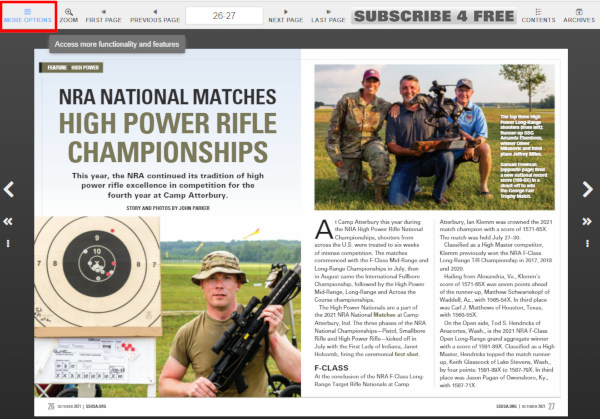
It’s easy to find back issues of Shooting Sports USA magazine. Here’s how: First, navigate to the latest SSUSA Online Issue (April 2025). Then click on the “ARCHIVES” icon in the upper right area (indicated with red arrow). When you click on “ARCHIVES”, a window will open with a selection of Shooting Sports USA magazine covers/dates in a vertical column. The most recent issue (April 2025) will appear at the top left. You can then scroll down — use the vertical scroll bar to go from April 2025 all the way back to June 2009. Click any issue cover to read.
How to Find and Save Articles
To search back issues, select “MORE OPTIONS” from the toolbar (top left). Then click the “SEARCH” button. When that opens, select either “Search Archives” for ALL back issues or “Search Only this Issue”. When you’ve made your choice, enter your search term(s). For example, you can search for “Camp Perry” or “Palma” or “F-Class Championship”. You can also save any archived issue as a PDF for viewing offline. Just click “SAVE” to download the article you’re currently viewing/reading.
Read Sample Articles
Here are a three of our favorite SSUSA feature stories from recent years. There are hundreds of other informative articles worth reading.
F-Class fans will enjoy the coverage of the 2023 F-Class World Championships in the June 2023 issue of Shooting Sports USA. On the cover is our friend and Forum member Erik Cortina.
First there was F-Class, and now there will be E-Class, the “E” standing for “Economy”. The NRA Competitive Shooting Division has just approved a new form of rifle competition starting in 2025: E-Class. Unlike F-Class, E-Class will have tight rifle and gear cost controls. This is a clear response to rising F-Class costs, which have spiraled out of control. The first major E-Class National event will be a preview match held this summer at Camp Atterbury in Indiana.
The NRA’s sanctioning of E-Class competition makes sense. Let’s face it, top-level F-Class competition, both F-TR and F-Open, has become just too expensive. A modern F-Open rifle capable of winning a championship can now cost $9000.00 or more, including rest, premium trigger, and optics. Under the NRA’s new E-Class Rules, rifles can cost no more than $2000.00 total, including optics and rest (E-Open) or bipod (E-TR). In addition, new E-Class rules will recognize a special division, called E-Factory, that is limited to factory rifles, such as the Savage Axis II and Howa rifles. The E-Factory Class will also be restricted to .223 Remington to keep ammo costs down.
COST COMPARISON — F-Open, E-Open, and E-TR Factory
E-TR Factory Division
Complete Rifle
Savage Axis II: $1079 MSRP
Barrel: Included
Stock: Included
Optics: $500
Trigger: Included
Bipod: $150
Rear Bag: $50 Total: $1779.00
Under the new E-Class rules, TOTAL Cost for an E-Open or E-TR Rifle is limited to $2000.00, including optics, front rest or bipod, and rear bag. There are specific gear limits. Scope maximum is $500.00. Front rest or bipod is limited to $300.00. In the chart above you see how an E-Open rifle could be built for $1900 with a $400 action and a $400 optic. In the third column we’ve priced out an E-Factory rifle, based on a Savage Axis II Rifle, at $1779.00.
A top-of-the-line F-Open set-up like this can cost more than $8000.00 with custom stock, high-end optic, and coax front rest. All new E-Class rifles must cost less than $2000 including rests and scope.
These E-Class rigs cost less than a quarter of the price of a Top-of-the-line $8750.00 F-Open Rig. That’s a huge savings, that will allow more shooters to enjoy competitive shooting. E-Class combines the fun challenge of the F-Class course of fire, with a vastly lower investment. With the rising costs of taxes, food, fuel, and everything else, it’s high time we get serious about the money we throw away on competition rifles. We know the wives will approve!
Keeping on Lid on Expenses
In the Wings — Controls on Ammo Costs as Well
Shooters know that the price of the rifle, optics, and rests is only part of the cost equation. The price of ammunition is also significant. Currently, in F-Open, competitors can easily pay $1.40 per round just for the expendables — bullets, powder, and primers. Add in the cost of premium cartridge brass and the cost per shot goes up significantly. One competitor lamented “Shooting a match these days really empties your wallet. I cringe every time I pull the trigger, knowing what it costs.”
Therefore, the NRA is considering E-Class ammo restrictions. Starting in 2026, E-Factory class competitors would be required to shoot recycled bulk brass and blem bullets. Bulk Lake City 5.56 brass will be offered by ARMorAlly.com, and blem bullets will be offered by Midsouth Shooters Supply. Purists may complain about using surplus brass, but it only costs $199.99 for 500 cases! That’s a huge savings.
The Final Step — Claiming Rules for E-Class
As in every competitive endeavor, there may be temptation to bend or even break the rules. Predictably, some E-Class competitors may try to substitute more expensive components, such as high-cost triggers, or modified actions. To prevent this, the NRA plans to impose claiming rules for E-Class matches. This means that any rifle that captures first or second place in a major match can be claimed by another competitor for the fee of $2000.00. This procedure may seem radical but it is used in other sports to ensure parity among the competitors. If a shooter wins with a “cheater” $5000.00 rifle, he can be forced to sell it to a competitor for $2000.00.