Here is a Black Friday video bonus for our Daily Bulletin readers. Today we showcase three of the most amazing 3D “cutaway” gun animations ever created. Watch the operations of a pump shotgun, bolt-action rifle, and semi-automatic pistol. The superb cutaway views show details of the firearms’ internal parts, and show how ammunition cycles start to finish. Each of these videos took hundreds of man-hours to create, and each has been watched many millions of times.
Remington 870 Pump-Action Shotgun
This 3D animation shows how a Remington 870 pump-action shotgun works. The animation is superbly done, showing every aspect of the internal operation. Folks, if you have any interest in shotguns you should definitely watch this video start to finish. This shotgun video has received 3.9 million views in just 10 days!
The video’s talented creator, Matt Rittman states: “Cinema 4D was used to create each individual part, as well as animating everything. Substance Painter was used to create the wood stock and fore-end textures. Corona renderer was used for final output of lighting and textures.” See more of Matt’s 3D videos on his popular YouTube Channel.
This 3D animation showing how a Mauser Karabiner 98K (KAR 98K) bolt-action rifle works. The Karabiner 98K is a controlled-feed bolt-action rifle based on the famous Mauser M98 system. Video creator Matt Rittman notes: “Cinema 4D was used to create each individual part, as well as animating everything. Substance Painter was used to create the wood stock texture. Corona renderer was used to render everything. This animation took me over 500 hours to create.” This video has been watched over 21 million times!
Every bolt-action rifle owner should watch this remarkable video. It shows key processes which are common to many actions — Cocking the Bolt, Feeding from magazine, Engagement of Bolt Lugs, Activation of Trigger and Movement of Firing Pin, and Extraction with Ejection. The modeling of the inside of the bolt and fire-control group is excellent. This really is a superb video that will help rifle owners understand what happening inside their guns as the bolt is cycled. See more of Matt’s 3D videos on his popular YouTube Channel.
This 3D animation demonstrates how a modern semi-automatic, double-action-only Glock 19 handgun works. Cinema 4D was used to create each individual part, as well as animating everything. Substance Painter was used to create the main textures. Corona renderer was used to render everything. This animation took me over 500 hours to create. one of the most-watched gun videos ever created, this Glock 19 animation has been viewed over 78.6 MILLION times!
Video Highlights for Glock 19 Pistol
0:00 Intro
0:11 Basic Function
0:39 Case Extraction
0:47 Cartridge Loading
1:02 Trigger Reset
About Matt Rittman, the 3D Animator/Artist These three amazing videos were all created by the gifted computer graphics artist Matt Rittman. On his Matt Rittman YouTube Channel, Matt states: “I’m a 3D Generalist/Motion Designer from Des Moines, Iowa. I have always enjoyed animation and illustrating how things work. I’m especially interested in cars and anything mechanical.
My aim for this channel is to provide easy to understand how-it-works 3D animations. I will occasionally be releasing tutorials centered around Cinema 4D and the different capabilities of the software.”
Readers know Jim Borden as a Hall of Fame shooter and the owner of Borden Accuracy/Borden Rifles. Jim won 10 IBS National Championships, set 10 IBS world records, and was inducted into the Benchrest Hall of Fame in 1996. But Jim is not just a great shooter. This highly-trained engineer is very much a Renaissance man. He is as skilled with cameras as he is with benchrest rifles.
Jim is a talented outdoor photographer who has compiled an impressive portfolio of wildlife and landscape photographs. For our Thanksgiving-day edition of the Daily Bulletin we are featuring some of Jim’s favorite nature images. We hope readers enjoy them as much as shooters prize Borden’s Rimrock benchrest and Rimrock hunting actions.
Growing up in rural Pennsylvania, in a hunting household and hunting community, Jim learned about shooting at a very early age. He started hunting at the age of nine with his father and grandfather. His grandfather had an avid interest in photography while they were on hunts and Jim became interested as well. Jim began using SLR cameras in the 1970s, often carrying cameras on his hunts. As the years passed, Jim became more interested in “shooting” the animals with a camera versus a gun. Jim converted from film to digital in 2006 and in 2007 Jim’s wife Joan started accompanying Jim on the photo safaris. Jim has a particular passion for elk, moose, and eagles and Jim also enjoys scenic photography. Jim and Joan both shoot Nikon professional equipment. Their photographs can be viewed at www.Borden-Photo.com. You’ll also find Jim’s images (along with photography tips) on his JandJB Wildlife Photography Blog.
All in the Family
Jim’s grandfather was a gunsmith who taught Jim the trade when Jim was very young. Jim’s father and grandfather ran a country business that included an auto repair shop, welding, a small lathe, and a forge. Jim earned a degree in Mechanical engineering at Penn State University. For 23 years he worked for Procter and Gamble (P&G) as an engineer and as an engineering manager/project manager.
Borden Rifles — A Success Story
Borden Accuracy/Borden Rifles has been a source for precision benchrest and hunting rifles for many years. Jim started doing his own gunsmithing while competing in benchrest and high power silhouette matches. Jim launched his business in 1987, working nights and weekends while still employed at P&G. The business became full-time in 1995 with Jim and his wife Joan doing the work. The business was expanded in 1999 with the construction of the new Springville, PA facility and the addition of sons Jim Jr. and John to the staff. Son-in-law John Mecca came onboard in January 2000. Now the Borden shop continues to make some of the finest rifles and actions in the world. Joan tells us that the company has seen a significant growth in ultra-high-quality precision hunting rifles in recent years.
Jim and company began making Rimrock benchrest and Rimrock hunting actions in 2001. They added Borden Alpine and Timberline actions in 2006. These actions are made in an advanced manufacturing facility which has three CNC vertical Machining centers, three CNC lathes, three manual lathes, a manual knee mill, a surface grinder, a cylindrical grinder and wire EDM machine. To learn more, visit BordenRifles.com, call 570-965-2505, or send email to info [at] bordenrifles.com.
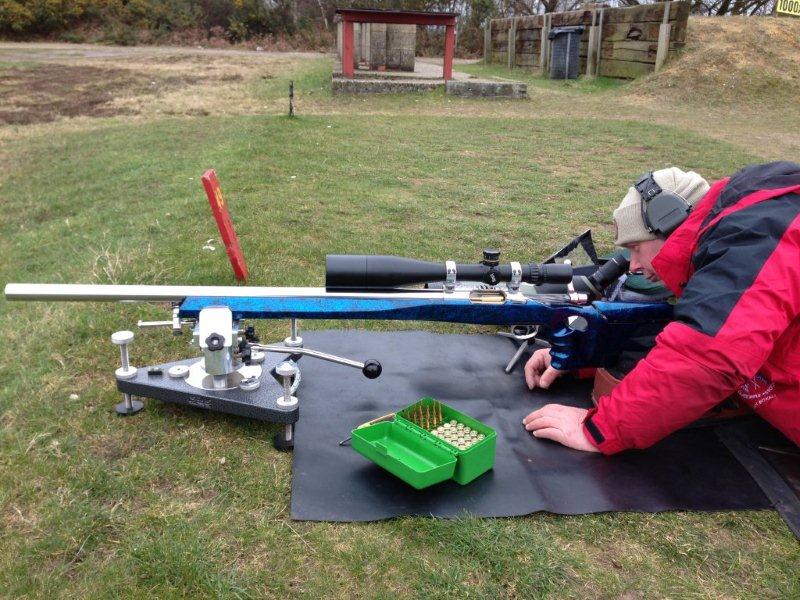
For today’s Sunday Gunday feature, we present a splash of color — the beautiful blue 7mm-270 WSM of Forum member Ian B. (aka “Elwood”) from Great Britain. A very knowledgeable guy, Ian has been one of the UK’s top F-Class shooters. And he’s the proud owner of a very “Flash” F-Class rig.
About the Shooter — Ian’s Background
Ian tells us: “I started shooting F-Class Open [many] years ago when a good friend invited me to Bisley to shoot with the Dorset Riflemen. I found it very enjoyable and a real challenge. The next year I attended the GB F-Class league’s Introduction to F-Class course, and soon afterwards started to compete in the GB F-Class league, while still shooting once a month with the Dorset Riflemen. In this short time frame, I’ve managed to finish 8th in the league last year, 12th in the Europeans, and I was a part of the GB squad that won the team event at the European Championship. I was then selected for the GB F-Open World Championship Team. Unfortunately, due to work commitments, I have had to withdraw.”
Ian’s Beautiful Blue 7mm-270 WSM F-Class Rifle
Report by Ian B. (aka “Elwood”)
Having spent my first year competing with a magazine-fed 7mm WSM tactical/sporting rifle (Surgeon action and AICS mag) and doing reasonably well with it, I then moved on to a .284 Shehane (.284 Winchester Improved). I love the Shehane and still use it but … I wanted something for those windy long-range days and so there was only one logical choice, the 7 WSM. This time I chose a 7mm-270 WSM as I quite enjoy case prep (just kidding). Actually, there’s not much to do really. The quality of Norma brass is well known and the Norma 270 WSM brass is quite easy to obtain in the UK.
The action is a Right Bolt, Left Port (RBLP) Stolle Panda F-Class action, with Jewell trigger. There wasn’t any particular reason behind the RBLP configuration — it was more of a case of that’s what I could get at the time. I had a 1.250″-diameter, straight-profile Bartlein barrel finished at 32 inches and chambered for the Berger 180gr VLD with a .313″ neck diameter. All my metal work and quite a bit of the wood work is done by the excellent Neil McKillop of McKillop Engineering. As with all top gunsmiths, Neil is meticulous to a point of obsessiveness and he’s the name behind quite a few winning rifles including several used by the GB Open and F-TR teams. Neil also inletted the stock from a blank and did the bedding for the action and the front bag runners.
Loading for the 7mm-270 WSM
I have one “tried and tested” load: 7mm Berger 180gr VLDs, seated .020″ into the lands, Vihtavuori N165 powder and CCI BR2 primers. This load is supremely accurate, but at 2990 FPS it’s a bit slow. To get more speed, I’m currently testing H1000 with good results, but it looks like I may have a slow barrel. I have another Bartlein barrel chambered and ready to screw on when the weather gets warmer. If that new barrel shoots well, the current barrel will probably be used as a practice barrel.
Loading Procedure
I do full case prep, neck-turning, uniforming primer pockets after the first firing, chamfering necks inside and out, and removing burrs around flash holes. Even the best brass sometimes suffers from imperfect quality control. I try to use Redding dies if possible, and will use bump dies, neck bushing dies, and competition seating dies.
I use an RCBS ChargeMaster 1500 to throw a charge just slightly under my desired weight and then trickle-up to final weight using the superb Dandy trickler and a Gem Pro 250 scale.
I anneal every other firing using a Bench-Source machine. Before this I used a Ken Light and also did them by spinning them in a drill. Never again will I do that after using the Bench-Source. After I have annealed, I always run a nylon brush wrapped in 0000 wire wool into the neck to remove any debris.
I keep to the same lot numbers of primers, powders, and bullets. Even the Bergers can vary from lot to lot — I have two different lots of 7mm 180gr VLDs that vary .020″ from bullet base to the ogive. I trim and point my bullets. Pointing may be a mental thing — I had a fantastic shoot while using trimmed and pointed bullets so I do it all the time now. ( A fellow GB team shot refers to them as “Pointless Dies” — I have witnessed him shoot a 99-14V at 1000 yards with bullets that weren’t trimmed or pointed). My next move will be to start measuring bearing surface…where does it all end?
Custom Wood Stock Was Modified by Ian and Treated to a Fancy Paint Job
The stock is a custom-made design crafted by Joe and Simon West of Joe West Rifle Stocks. I had several modifications done to one of their existing stock designs. Having done a lot of my shooting with the AICS, I was quite used to a thumbhole stock, so thought I would try one in F-Class. I told Simon what I wanted and he sent me down a prototype made from very inexpensive Tulip wood. We had a few discussions and then made some more mods..
I made two main changes to the stock. First, I removed the lip at the bottom of the pistol grip because I felt I might rest my hand on this and possibly disturb the rifle. Second, I had the protruding pistol grip base removed so that the bottom of the stock was completely flat like the Precision Rifle & Tool F-Class stock. Simon also made the finger grips to fit my hand and flattened them off to allow for a bit more movement. The stock was then sent to Hydro Graphics in the UK to have a custom exterior finish. The paint color is a Marbleized Candy Oriental Blue. As always, Hydro Graphics did a great job.
Optics and Rings
The scope is the excellent 5-50x56mm March with the MTR-2 reticle — far and away the best reticle I have used for F-Class. March makes great optics. During the 2012 European individual F-Class event, using another March (my 8-80x56mm), I could see my shooting partner’s impacts in the white V-Bull at 800 yards! And just recently at a club match I called two V-Bulls at 900 yards using the 8-80X (not at full power). Granted the light has to be perfect to be able to do this, but my highest praise for the Deon Optics glass is that it rivals that of Schmidt & Bender. Having owned both March and S&B scopes and compared them side-by-side, I feel that I can make this statement fairly.
UK-based Third Eye Tactical made the nice, 34mm rings. The UK is now producing some excellent products. We now have UK-made custom actions, rings, rails, stocks and more. It would be nice to think we could have a 100% British-made rifle, and not rely completely on USA-made products. I think all we need is the trigger? But I can’t see there ever being a UK-made scope!
“Science tells us that exposure to continuous noise of 85 dB for eight hours is enough to cause permanent hearing loss, and worse, spikes of 130 dB and more can result in permanent hearing damage instantly.” Source: NRA Blog.
The Risk of Hearing Loss
Hearing loss can be progressive and irreversible. If you are a shooter, this is serious business. As the NRA Blog cautions: “You may not even realize you’re harming your hearing. Hearing loss occurs gradually, and can go effectively unnoticed until symptoms become severe. By then, the damage is done.”
Nobody wants to go deaf. But we often see shooters without effective hearing protection when they are walking around a few yards behind the firing line. That’s bad — even if you are away from the firing line, gunshot noises can damage your hearing. You MUST use effective hearing protection every time you go to the range. Good foam earplugs costs mere pennies but they can prevent deafness in your later years. Many folks also wear muffs over plugs.
Sound Levels for Common Noises:
9mm Luger pistol: 160 dB
Jet aircraft engine (near): 140 dB
.22 LR pistol: 134 dB
Normal human pain threshold: 120 dB
Noisy Nightclub: 110 db
Riding Motorcycle at 65 mph: 103 db
Power Lawnmower: 95 dB
Hearing damage possible: 85 dB (sustained for 8+ hours)
Ringing Telephone: 80 dB
Normal conversation: 60 dB
The Myth of the “Quiet” .22 LR
The NRA Blog notes that “many rimfire shooters, particularly those using the beloved .22 Long Rifle cartridge, argue that the small .22 LR caliber doesn’t produce enough sound to damage your hearing”. So, is that really true … or is it a myth?
In fact, a .22 LR can be much louder than you think — a .22 LR pistol can produce sound levels of 134 dB. That’s well above the normal human pain threshhold.
Compact, Low-Profile NRR 27 dB-Rated Ear Muffs
Many hunters and competitive shooters prefer low-profile ear muffs. As these typically have a lower Noise Reduction Rating, perhaps NRR 22-27, we recommend running earplugs under muffs. If you use low-profile electronic muffs, such as Howard Leight Impact Sport Muffs, you should still be able to hear range commands even with plugs underneath.
Another good option for hunters and range visitors are hearing bands, basically earplugs connected with a semi-rigid plastic band. These banded products provide “quick access” hearing protection for hunters. You can keep them handy around the neck while spotting game, and then insert the plugs before shooting.
Howard Leight MAX NRR33 Earplugs, Just $11.50 for 50 Pairs.
20 Pairs
50 Pairs
These Howard Leight NRR33 Max-1 Plugs are your Editor’s favorite foam earplugs. Between shooting, motorcycling and mowing lawns, I probably have Howard Leight foam plugs in my ears 3-4 days a week. They are comfortable and the flared outer edge helps the NRR. There is also a Max-30 corded version, with the same excellent 33 dB Noise Reduction Rating. Get five pairs of Max-30 Corded Plugs for $6.65 on Amazon, or 100 pairs of Max-30s for $27.86.
Splatterburst 1″ circles, 62 per sheet, 10-pk $8.99. These can be pasted on other paper backers.
We’ve all seen conventional splatter targets with a single large black bullseye. When a shot hits the target, a halo (usually neon yellow) appears around the bullet hole. This makes it easier to see your shot placements indoors, or at long range outdoors. Today we feature a variety of other targets that also offer the cool halo/splatter effect. We’ve found grids, multiple bull targets, sheets with 62 one-inch circle pasters, handgun training targets, and even white background splatter targets (that produce black halos). Try out some of these targets for fun (kids love plinking with splatter targets).
In our Shooters’ Forum, there’s an interesting thread about a very light hunting rifle. Featuring a Defiance ultra-light all-steel action, this 6.5×57 Lapua lightweight tips the scales at just 4.93 pounds including scope and rings! For reference, a half-gallon of milk weighs 4.3 pounds, so this rifle is LIGHT! Here’s a report from the proud owner who built the rifle for a future Kodiak Island Alaska mountain goat hunt.
Ultralight Rifle Report by Forum Member Dave
I decided I wanted the challenge of a Mountain Goat hunt after I turn 60. It was the perfect excuse to put together an ultralight, something I had wanted to do for years. I wanted to see how light a bolt action rifle could actually be. My goal was to stay under 5 pounds, without going to a Titanium action, including rings and scope. I knew this would be difficult but I did manage to achieve the goal.
I started with a Defiance anTi model Rem Model 7 short action. This is an extremely smooth action that weighs just 19.2 ounces in this size. I had Carson Lilja of Lilja Barrels program a barrel taper to my dimensions for a 6.5mm 1:8″-twist stainless, 3-groove 22″ barrel. As fitted in the rifle, the barrel is free-floated except for the first inch or so forward of the action.
Other rifle components are: Bix n Andy Dakota trigger, aluminum trigger guard, blind magazine with an aluminum follower, titanium action screws, and a Leupold 3-9X lightweight optic in Talley rings. I also had an aluminum adapter installed in the for-end to accept a magnetic mount Javelin carbon fiber bipod.
The rifle was chambered up in 6.5×47 Lapua by my friends at Sportsman’s Outfitters in Knox, Pennsylvania. Then I sent the barreled action to Wayne at Oregunsmithing (Pendleton, OR) to have a Kevlar stock built. The stock weighs a whopping 14 ounces! When it came back I had everything Cerakoted (see bottom photo before coating). This stock was a full custom, built around my barreled action. Wayne’s work was reasonably priced with a 3-month turn around.
Excellent Accuracy — 5/8″ Three-Shot Groups at 100 Yards
Now it was time to shoot the rifle and I was not disappointed. It shoots both Barnes TTSX 100s or Swift Scirocco II 130s into 5/8″ at 100 yards. Off a bipod at 400 yards, three go into 3″ or so. This thing is crazy light even though it wears a 22″ barrel.
Without scope and rings, before Cerakoting the action and barrel, this 6.5×47 rifle tipped the scales at a mere 4.20 pounds (67.2 ounces). Check it out:
Do you ever use military-style brass with swaged primer pockets? Then you can really benefit from the new LEE Ram Swage tool. This innovative swaging tool provides a fast, simple, and efficient method of removing the primer pocket crimp on milsurp brass.
Primer pocket swaging is necessary when reloading brass with crimped primer pockets. Many brands of brass for military (and some law enforcement) applications have this crimp. You may find such primer pocket crimps on a variety of milsurp brass types including: 9mm Luger, LEO .40 S&W, .45 ACP, .223 Rem (5.56×45), .308 Win (7.62×51), and .30-06 Springfield, as well as older European cartridge types such as 6.5×55. If you use a progressive press, this new LEE Ram Swage is a boon. Nothing reduces priming problems on a progressive press more than properly swaged primer pockets.
Why use milsurp brass? Surplus military and police department brass is a great low cost source of cases. It is typically very strong, long-lasting, and can often be acquired for a fraction of the cost of new commercial brass. For example, Lake City 7.62×51 (.308 Win) brass is excellent.
Note: This tool is designed for Boxer-primed cases only, not cases with Berdan Primers.
The Lee Ram Swage works on all single stage presses with 7/8″-14 frame threads, and rams which take common “universal” shell-holders. This new tool features spring-assisted case extraction, and an all-steel case guide. This ensures that your cases will be positively centered on the push rod. The swage holder, large or small, installs in seconds into your press ram with no adjustments required.
LEE’s engineers devised a clever “Shell-holderless design” for the LEE Ram Swage. This allows you to swage any small or large primer pocket, without swapping to a different size shell-holder. The hardened steel swage punch is automatically extracted from the primer pocket by five disc springs. The complete LEE Ram Swage set includes one guided 7/8″-14 threaded swage push die, with both large and small ram swage holder assemblies.
Our friend and colleague F-Class John tests some of the finest reloading and shooting equipment you can buy. Recently he added the impressive Henderson Gen 3 Powered Trimmer to his inventory of tools. John is now a Henderson fan. He likes the speed, precision, and repeatability of the $779.00 Henderson machine, which trims-to-length and chamfers the case mouth all in one pass. Unlike some other trimming tools, the Henderson indexes off the overall case length NOT the shoulder. John found this worked just fine for his .284 Winchester brass, which has all been full-length sized prior to trimming.
John liked the precision of the Henderson trimmer and the overall design of the machine, which offers good ergonomics and very precise alignment of the cases. Cycling is smooth and positive, as you can see from the videos. Fit over the pilot was fine for John’s .284 Win brass, but he notes that other users may need to expand their case necks appropriately to fit their pilot.
Watch the video to see the Henderson trimmer in action. The dual, parallel horizontal support shafts provide precise alignment of the case as it moves inward toward the cutter blade. The Taper-Lock cutter provides a 14-degree inside chamfer and 30-degree outside chamfer. The trimming process is very consistent case after case, and the Henderson’s design captures brass shavings effectively.
Testing Trim Length Consistency — Henderson Shows Superb Repeatability
John did a separate quick test to demonstrate the trim length consistency of the Henderson unit. Measuring with digital calipers, John found that he could easily hold case overall trim lengths within .001″ (one-thousandth). The consistency was excellent even when trimming cases very quickly. When trimming .003″ off his cases, John said the Henderson showed superb repeatability. Henderson promises the trimmer “will repeat to within 0.002″ with same brand brass”, and John was able to hold 0.001″ length consistency.
Another Henderson owner posted: “I love mine. I like [the] consistent trim length with the positive stop. [Doing] the trim, chamfer, and debur all in one step sure makes the process nice and easy! I also immediately noticed the problem with the pilot on the cutting head with my sized cases. I just polished the pilots on my cutting heads with some fine grit sand paper a little at a time till I got it perfect for my preferred neck tension setting! I’m very pleased with my purchase of the Henderson precision trimmer.”
Henderson Power Trimmer vs. Giraud Power Trimmer
After he tested his new Henderson trimmer, F-Class John compared the pros and cons of the Henderson vs. his other high-volume power trimmer, a Giraud. He likes both machines, but now favors the Henderson for trimming his .284 Winchester match brass. He found that his ES/SD dropped a bit for brass trimmed with the Henderson vs. brass trimmed with the Giraud. With the Henderson-trimmed brass, John achieved an ES of 15 fps for 49 shots. That’s mighty impressive (see photo at right).
But the Giraud does have it’s advantages. It can work with calibers above .338, and it is very fast. One viewer of this video commented: “The Giraud is insanely fast if you aren’t only loading insane precision ammo. I borrowed one when I first started reloading and immediately ordered one. I’ve trimmed somewhere between 40-50k .223 cases. You can just rip through them while watching TV or listening to a podcast. It trims to length consistently less than +/-.001 all day.” The Giraud also indexes off the shoulder while the Henderson trims based on Cartridge Overall Length (OAL).
Henderson Gen 3 Trimmer Details
The Henderson Trimmer is available from HendersonPrecision.com for $779.00. When ordering, you must select a caliber and a collet size. Expect to wait a bit for delivery, depending on the cartridge type(s) you load. Available calibers are: .223, .243 (6mm), .25, .264 (6.5mm), .277, .284 (7mm), .308, and .338.
Product Description: The Gen 3 powered case trimmer uses a powerful, single-speed DC motor. The DC motor is extremely smooth and quiet and powers the spindle at around 1700 rpm. The enclosed aluminum motor mount shroud bolts directly to the bearing housing. The 90-volt DC motor offers maximum torque at 1700 rpm where you need it most. The motor has an in-line on/off switch for easy control. The Tri-Trim case trimmer includes one Henderson Precision Taper-Lock cutting head with Forster pilots as well as one Forster collet. The Taper-Lock cutter provides a 14 degree inside chamfer and 30 degree outside chamfer. The following cutter heads are available: 224, 243, 25, 264, 277, 284, 308, 338.
Nosler now offers the Nosler Reloading Guide #9, the latest in a respected series of hardback Nosler load manuals. This 800-page guide covers 101 cartridge types. New in this edition you’ll find the popular 6mm Creedmoor, 6mm XC, 6.5 PRC, and 7.62×39, along with 20 Nosler, 22 Nosler, 24 Nosler, 27 Nosler and 33 Nosler. This new guide draws from thousands of hours in the Nosler Ballistic Lab, along with the experience of many respected experts.
The book is available now for $27.99 at Grafs.com. In addition, much of the book’s latest load data is available for free on the Nosler.com online LOAD DATA Center. But to get ALL the data, PLUS the technical articles, you’ll need to buy the book.
The Nosler Reloading Guide 9 Reloading Manual provides load data for 101 rifle and handgun cartridges with hundreds of new powder additions. A comprehensive data set for today’s reloader, this manual is current with every bullet that Nosler offers through 2020 from 17 caliber up to 458 caliber in the rifle section and 9mm up to 45 caliber in the handgun section. Nine new cartridges were added to this manual. These include: 20 Nosler, 22 Nosler, 24 Nosler, 6mm Creedmoor, 6mm XC, 6.5 PRC, 27 Nosler, 7.62×39 and 33 Nosler. Also new for the Nosler Reloading Guide #9 are cartridge introductions written by veteran outdoor writers and industry tech experts. The 800-page book also has helpful “how-to” sections such as “Getting Ready to Reload”.
Q. Why Buy a Book when Load Data is Available Online from Powder Makers?
There are good, solid reasons to buy print-format loading guides produced by bullet-makers. If you go to the Hodgdon online Reloading Data Center you’ll only find loads with Hodgdon, IMR, and Winchester powders — the key brands they sell. In a book such as this Nosler #9 or the Sierra Reloading Manual, you will find loads with a much wider selection of powders including Vihtavuori, Alliant, Accurate, Norma, Ramshot, and other brands. You won’t find a Reloder 16 or VV N140 load on Hodgdon’s website.
In addition, it is handy to have loads in a print edition which is easy to access on your load bench. You don’t need a computer or an internet connection. And using a book is often faster than a web interface when quickly scanning through a variety of bullet choices for a cartridge.
Along with the Nosler #9 Manual, here are four other recommended Reloading Manuals:
CZ has just introduced the new CZ 600 line of centerfire rifles. The series includes four unique models, with a variety of stock types, barrel profiles, action lengths, and chamberings. User-friendly CZ 600 features include 60-degree bolt throw, adjustable triggers, and the ability to swap barrels/chamberings using optional conversion kits. The CZ 600 Series includes four brand new models: Alpha, Lux, Trail, and Range.* These are designed for accuracy, modularity, and smooth cycling. Expect CZ 600s at dealers in early 2022.
Controlled-Feed Action with 60° Throw: CZ 600 Rifles have a 60-degree bolt throw. This cycles faster than a 90-degree bolt, with more clearance between bolt and optic, allowing for larger scopes. All CZ 600 models boast an oversized bolt knob for improved control with gloved hands. And the actions have controlled-round-feed. The 2-position safety allows bolt cycling with the safety engaged.
CZ USA offers Alpha, Range, Trail, and Lux CZ 600 versions. In Europe CZ offers a fifth model, the “Ergo” model, which is mentioned in this video.
Barrel Conversion Kits: Optional barrel conversion kits offer the ability to change cartridges (within the same-sized action) by swapping barrels, bolt face, and magazines, without the need of a gunsmith. This lets shooters use one rifle for a multiple shooting disciplines. A detachable magazine allows quick mag changes and secure magazine retention, with an optional locking feature. On most CZ 600 models, magazines can be topped off through the ejection port for convenience.
User-Adjustable Trigger: The Alpha, Range, and Lux have a user-adjustable, single-stage trigger, while the Trail model utilizes a two-stage trigger. Trigger pull can be adjusted without removing the chassis from the stock. A 4-position dial sets trigger weights from 1.3 to 3 lbs., moving over just 1/2 lb. per click.
CZ 600 Series Rifles Features:
Steel and Alloy Actions, 3 sizes
60-Degree Bolt throw
Vertical two-position safety
Controlled round feed with short extractor
Three barrel profiles: Light, Semi-Heavy, and Heavy
Adjustable trigger – no disassembly needed, 4 weights
Picatinny Rail or Remington 700 scope bases
Detachable magazine with optional lock
Caliber conversion kits (sold separately)
Accuracy guarantees: 3/4 MOA (Range), 1 MOA (Alpha, Lux), and 2 MOA (Trail)
CZ 600 Models — Alpha, Lux, Range, and Trail
CZ 600 Alpha — CZ designed the Alpha as a “do it all” rifle with guaranteed sub-MOA accuracy for a modest $749.00 MSRP. A light-weight aluminum receiver balances the semi-heavy barrel for a 7.3-lb overall weight (before optic). The CZ 600 Alpha is designed to be versatile, durable, and reliable. Available chamberings include .223 Rem, .224 Valkyrie, 6mm Creedmoor, 6.5 Creedmoor, 6.5 PRC, 7.62×39, .308 Win, .300 Win Mag, and .30-06 SPRG.
This Petersen’s video features the CZ Alpha model on a hunt in Central California
CZ 600 Lux — The refined lines and traditional style of the CZ 600 Lux reflect a long, proud legacy. The Lux features a steel action and oil-finished select-grade walnut stock. The steel receiver is drilled and tapped for Rem 700-pattern bases. The Lux model comes with a sub-MOA guarantee. Weight is 8.2 lbs. in 308 Win without scope.
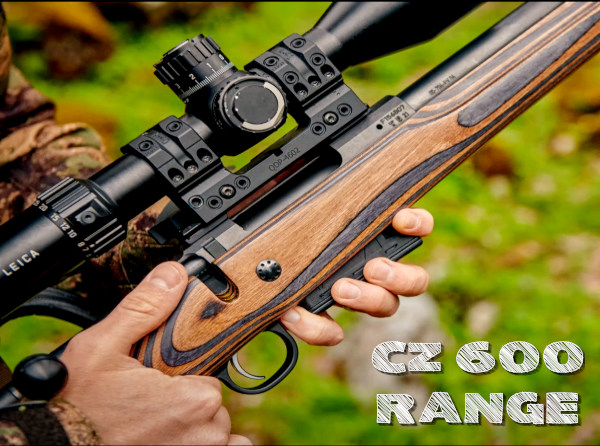
CZ 600 Range — The Range model, with its cold hammer-forged heavy barrel, was designed to give precision shooters outstanding accuracy. The CZ 600 Range features the best accuracy guarantee ever offered by CZ: Sub-3/4 MOA guaranteed at 100 meters, for 5-shot groups with match-grade factory ammo. This accuracy is verified by CZ.
CZ 600 Trail — The CZ 600 Trail is a very light-weight, compact rifle, weighing just 6.1 lbs. before optics. The Trail uses AR-15 compatible mags for .223 Rem with CZ Bren 2 magazines for the other chambering, 7.62×39. The lightweight Trail model offers AR ergonomics along with ambidextrous mag release and safety lever similar to AR-platform rifles.
CZ 600 Trail Model — Initial Field Test
*In Europe CZ offers a fifth CZ 600 model, the “Ergo” model. See the first video linked above.


These three amazing videos were all created by the gifted computer graphics artist Matt Rittman. On his Matt Rittman YouTube Channel, Matt states: “I’m a 3D Generalist/Motion Designer from Des Moines, Iowa. I have always enjoyed animation and illustrating how things work. I’m especially interested in cars and anything mechanical.

 Jim is a talented outdoor photographer who has compiled an impressive portfolio of wildlife and landscape photographs. For our Thanksgiving-day edition of the Daily Bulletin we are featuring some of Jim’s favorite nature images. We hope readers enjoy them as much as shooters prize Borden’s Rimrock benchrest and Rimrock hunting actions.


 Borden Rifles — A Success Story





 Optics and Rings

 The Risk of Hearing Loss


 The


 After he tested his new Henderson trimmer, F-Class John compared the pros and cons of the Henderson vs. his other high-volume power trimmer, a Giraud. He likes both machines, but now favors the Henderson for trimming his .284 Winchester match brass. He found that his ES/SD dropped a bit for brass trimmed with the Henderson vs. brass trimmed with the Giraud. With the Henderson-trimmed brass, John achieved an ES of 15 fps for 49 shots. That’s mighty impressive (see photo at right).