Good news folks — most states have lifted restrictions on shooting ranges. Subject to “social distancing” and safety requirements (masks etc.) many public ranges and private shooting facilities are now open for business. If the weather permits, we encourage readers to head to local ranges which are permitted to operate. Use the opportunity to get out of the house, enjoy some fresh air, and dust off those skills. To help you have fun on your range trips, here are 12 FREE printable targets.
FREE FUN Targets from NSSF
The Billiards Table Target above offers 15 brightly-colored numbered balls with the cue ball at the bottom. Aim for the numbers, shooting 1-15 in sequence, or alternate between stripes and solids. You can also draw an “X” on the white cue ball (or attach a paster), and use that to set your zero. This target is fun for shooting outdoors with rifles at 50 or 100 yards or indoors with pistols. This billiards target is part of a set of 12 Fun Targets from the NSSF. These were issued a couple seasons back for National Shooting Sports Month, held in August of each year.
FREE NSSF Fun Targets — Dartboard, Golf, Billiards, Bowling, Baseball and More…
HERE are a dozen FREE Targets. Along with Bullseye targets, there are some very cool specialty targets here, including a Golf Course Target, Baseball Diamond Target, Billiards Target, Light Bulb Target, Bowling Pin Target, and even a Windmill Target. Enjoy the myriad possibilities with these 12 fun targets.
Here is Tom Mousel with Whitetail taken with his ultra-light hunting rifle fitted with 6mm Creedmoor Lilja barrel. Friend Cody (right) actually took the shot. This gun has a second barrel in 6.5 Creedmoor.
“Light is Right” when it comes to carrying deer rifles long distances in the backcountry. A lighter rifle DOES make a difference when you’re hiking many miles and carrying other gear including binoculars, laser rangefinders, food/water, and packs. And then, if you are successful, you’ll be carrying out game meat, so a lighter rifle translates to a lighter overall load.
When Forum member Tom Mousel (a top 1000-yard competitor) considered a new hunting rifle, he wanted a very light-weight rig. What he got was a low mass masterpiece — an ultra-accurate, five-pound hunting rifle. Not only does this twin-barrel rifle, as built by Alex Wheeler, come in under five pounds (before optics), but it has produced some quarter-MOA 3-shot groups at 1000 yards. The 6mm Creedmoor version of this rifle has demonstrated truly stellar accuracy at long range. The 6.5 Creedmoor barrel also shoots well and packs more punch for hunting use.
CLICK HERE to view full-screen large version of photo.
Here is Tom’s rifle weighing in at 4 pounds, 14 ounces with 21″ Lilja #1 contour 6mm barrel. Tom says: “Here’s the rifle with full Titanium action, bolt, and lug, in a Tom Manners 17 oz. carbon fiber stock. It’s exactly one pound heavier fitted with my Leupold Mark AR 4-12x40mm scope in Talley rings.”
Tom has two barrels for the rifle, one chambered for 6.5 Creedmoor and the other for 6mm Creedmoor. Tom reports: “The 6.5mm is a bit lighter being fluted. But I won’t be switching back now that I’ve shot the 6mm version. Neither has too much recoil, but the 6mm CM just kills the 6.5mm at distance for groups.”
Tom tells us: “What I like about this rifle is there were no corners cut to make it light. On some other ultra-lights, the fore-end has no strength or they are cut down really short. This is a full-sized stock, pillar-bedded with aluminum-filled epoxy and free-floated barrel. The ignition is set up with a TON of firing pin fall to function in the coldest temps.”
Gunsmith Alex Wheeler of Wheeler Accuracy is pleased with how this project turned out: “Tom has shot a bunch of sub-5″ groups and a couple one-inchers back-to-back at 1K. He has the Berger 115gr VLD going about 3050 fps.” Tom noted the 6mm barrel picked up about 50-60 FPS after the first 50 rounds. He shoots 115gr Berger VLDs with CCI 450s and Reloder 16, with the Bergers about .005″-.008″ in the lands.
Groups at 1000 Yards with 6mm Creedmoor Barrel, 115gr Bergers
Here are two of Tom’s 1000-yard targets. This is with the 6mm Creedmoor barrel shooting 115gr Berger VLDs pushed by Alliant Reloder 16 at about 3050 FPS. The average of the two groups is 0.246 MOA. Pretty amazing for an ultra-light rifle shot off a bipod. Tom acknowledges that he can’t do this every day. He says that “shooting 871 yards at my home range, the rifle typically shoots 4″ to 5″ 3-shot groups”.
Q & A with Tom Mousel About his Ultra-Light Hunting Rifle
Q: Why did you choose to build this rig?
Tom: I just wanted to do it to see how light we could build an accurate, good-shooting rifle.
Q: What are your favorite things about the rifle, and is there anything you would change?
Tom: Definitely the light weight, and the overall size — it has a pretty short barrel (21″), so it’s just handy. I wouldn’t change anything about the rifle, now that I have the Titanium bolt. When I bought the action originally it had the steel bolt.
Q: How does this rifle handle?
Tom: It points well considering it is a light rifle. The 6mm Creedmoor version has very little recoil. On a good bipod I can sight in at 1000 without a spotter.
Q: What are your favorite accessories?
I use a Solo Hntr Mtn Lite stretchy cover. You can see it in the photo at right showing me on a hunt. I like this because you can roll it up like a sock and and use it for a rear support.
Q: Why did you choose Alliant Reloder 16 powder?
Tom: Lonnie Anderson, a fellow Deep Creek shooter, did a 6mm Creedmoor and he said RL16 was absolutely the most accurate. We have also found that Reloder 16 is really consistent on velocities through the seasons — from 90 above to teens below zero.
Q: Could this ultra-light set-up work for a bigger caliber also?
Tom: I’ve tried bigger calibers, but I’ve never been satisfied with the consistency of the groups. There’s a cut-off — there’s too much torque and recoil. We see a limit — you don’t want “too much gun” for the platform. Even here, the 6.5 barrel just doesn’t shoot as well as the 6mm.
Q: What advice do you have for hunters considering ultra-light rifles?
Tom: Be careful about falling in love with ballistics and trying to build too much bang for too small a platform. If I built a 7mm WSM for example, I’d want to rifle to weigh at least two pounds more.
Full Titanium Action from Pierce Engineering
This photo shows the Pierce Engineering Titanium Featherweight short action featuring Titanium (Ti) receiver, Ti bolt, and Ti lug. This unit is a mere 15.90 ounces complete. (NOTE: with Titanium body and STEEL bolt the weight is 18.5 ounces). The long action version is 17.4 ounces for the complete Titanium action with Ti bolt and Ti lug.
Jud at Pierce Engineering tells us: “Both the Ti action body and Ti bolt are DLC-coated. This action also has an anti-bind rail for added smoothness and ease of functioning. This really is one of the lightest actions on the market. If you’re looking into building an ultra-light rifle I would seriously check one out! We make these with the highest level of detail, pride, and machining tolerances. They’re just sweet actions… and our Ti Featherweight short action is roughly half the weight of a Remington Model 7. So there’s a significant weight savings with the Pierce Ti Featherweight over a Model 7.”
Owner Profile — Tom Mousel, Hunter AND Long-Range Benchrest Ace
Tom Mousel knows a few things about accurate rifles. He is a top 1000-yard competitor at IBS matches and at the Deep Creek range near Missoula, Montana. In 2016 Tom set a remarkable 6-match Light Gun Group World Record, with a 2.9540″ group size Aggregate for SIX matches. And a year later, in 2017, Mousel set a 10-Match Heavy Gun World Record with a 5.3376″ Aggregate. NOTE: that is for TEN-shot groups in Heavy Gun. That’s an average ten-shot group under 6 inches for 10 matches! Over the past decade, Tom has remained at the top of the 1000-yard game, with many match wins at Deep Creek and other ranges.
AR-platform rifles are fun and versatile, but the standard, mil-spec triggers leave much to be desired. They tend to be gritty, with creep and heavy pull weight. One of the easiest, most effective AR upgrades is a trigger group swap. An improved fire control group makes a huge difference. There are many aftermarket trigger options for the AR platform rifles. Choose single-stage or two-stage, either standard trigger assembly or unitized “drop-in” trigger, such as those made by Timney or Triggertech.
When upgraded with a precision trigger and match barrel, AR-platform rigs work great in NRA High Power competitions (Photo from NRA Blog, at Camp Perry).
Two-Stage vs. Single-Stage Triggers
Two-stage triggers have two separate movements. The first stage offers a light, spring-loaded pressure that works against the shooter’s pull until stopping at the second stage – this is called “take-up”. If there is no spring pressure, it is known as “slack”. Should the shooter continue to pull the trigger once he’s arrived at the second stage, the mechanism will operate like a single-stage trigger from there until engaging the sear and firing the gun. Some shooters prefer a two-stage trigger because it allows a mental preparation (first stage) before the final decision to “break the shot”.
Single-stage triggers feature no take-up or slack, as they begin engaging the sear as soon as the shooter begins pulling the trigger. Some competitive shooters prefer the two-stage trigger because of the feedback it provides during its first stage, while other shooters, including those using their rifle in tactical scenarios, may want the surety of a single-stage trigger, ready to engage and fire once their finger is inside the trigger guard. Regardless of preference, a good trigger will feature minimal creep and should be free of grittiness, providing a smooth, even break.
Drop-In Trigger Assembly vs. Standard Trigger Group
Once you decide between a single-stage or two-stage trigger, you can choose between standard and drop-in trigger groups. Standard trigger groups feature all the fire control group parts separated, and need to be pieced together and installed much like a mil-spec trigger, while drop-in trigger are pre-assembled and contained within a casing that simply drops in to the receiver and accepts the pins, hence the name.
After-Market Trigger Comparison
Some shooters prefer drop-in triggers due to the ease of installation, while others opt for standard groups so they can access the components individually for cleaning adjustment or replacement. If one piece of a drop-in trigger fails, you’ll need to either replace the entire unit or send it to the manufacturer for repair, whereas you may be able to simply replace the broken component of a standard trigger without needing a whole new trigger set.
Trigger Terminology — “Creep”, “Stacking”, “Overtravel”
“Creep” or “travel” is the distance the trigger moves between the end of take-up and when the trigger breaks to fire the fun. Too much creep can affect accuracy, but no creep can be unsafe, as the shooter may not be prepared to fire. “Stacking” occurs when the trigger weight actually increases during travel — this shouldn’t happen. Lastly, “overtravel” is the distance the trigger continues moving back after the gun fires.
This article is based on a longer story in the NRA Blog.
With the high cost and reduced availability of factory ammo, more shooters are loading their own ammo. When good 9mm pistol ammo was $10/box, it might be hard to justify handloading. Now that 50 rounds of 9mm can run $40 or more it certainly makes sense to reload. The same is true with rifle ammo if you shoot large quantities, or if you simply can’t find your preferred ammo for sale these days.
To increase productivity when reloading large quantities of ammunition, many shooters are thinking of getting a progressive press. Because multiple operations take place with a single pull of a lever, a progressive press can produce way more ammo in a given period of time than any single stage press. With a progressive, on the ram up-stroke, the multiple stations can simultaneously remove spent primer, full-length size case, drop powder, seat bullet, and crimp (if desired). Most progressives are also set up to prime cases with the ram in the lower position — though some guys prefer to prime manually.
Progressive presses aren’t just for high-output pistol ammo or bulk rifle ammunition. Good progressives can be adapted to do certain reloading tasks for top-on-the line match ammo. You might use a progressive for decapping, priming, and sizing, then throw powder and/or seat bullets separately. Some Champion shooters do use progressives to load their match ammo! For example 5-Time National Long Range Champion John Whidden and 2020 Berger SWN F-Open Champion Jay Christopherson both use progessive presses for some (but not all) operations.
To help you get started with progressive presses, here are five videos from UltimateReloader.com that cover six popular machines, from the elite Mark 7 Evolution to the affordable Lee Loadmaster. With many of these machines you can add separate vertical bullet feeder systems that further increase loading efficiency.
Gun guys are always shipping stuff around the country — whether it’s a barrel to be chambered, or a scope that needs to go back for warranty repair. Or maybe you’ve sold some bullets or reloading dies you no longer need. To ensure your precious packages get to their destination in one piece, it’s important to take precautions when boxing up your items. And by all means insure packages for full value — even if your packaging is perfect, there is always the possibility that your shipment might be lost altogether. Sadly, that can happen, no matter which carrier you choose: Fedex, UPS, or the U.S. Postal Service (USPS). Here are some tips for shipping gun stuff — we explain how to pack items properly and how to minimize the risk of loss.
Tips for Shippers
Dennis Haffner from McGowen Precision Barrels offers some advice on how to avoid damage when shipping gun parts or other valuable or heavy items. Dennis explains:
“First, I started double-packing the contents and in many cases double-boxing. I spend a fortune on heavy-reinforced shipping tape. If the contents are loosely packed, the package is going to get crushed. On real important items or delicate items, wrap the content in plastic and spray the inside void areas with non-expanding foam. They make shipping foam just for this. This method really works. Since I started paying more attention to packaging, I have just about wiped out my issues with all three companies (Fedex, UPS, USPS). Yes, I hate doing it, but in the long run for us, it’s cheaper.
Bullet shipments are the worst — a shipment of 500+ bullets can destroy a cardboard box. I have ordered bullets from individuals who put them in baggies and filled the remainder of the box with foam peanuts. That is not going to work. Any piece of metal, including a die, will puncture a cardboard box, or destroy a padded envelope. Just look at the tracking information and imagine your package bouncing around in the back of the shipping truck, probably under many other packages. My advice is to NEVER use padded envelopes. Barrel nuts or recoil lugs will most likely never make it.
ORM-D items are required to be shipped in heavily-reinforced, double-walled containers. The packages still get a little damage, but the contents usually survive.
How do shipments get damaged? Consider this — one of the shipping companies this year flipped (overturned) one of our new CNC machines (which rendered it useless). Maybe your small packages were in the same delivery truck as my CNC machine. I wonder how many little boxes were crushed underneath it.
As for USPS flat rate boxes — you would not believe what people try to stuff in these boxes. USPS finally put a weight limit on the boxes — they had to. I sometimes take my delicate items packed in an envelope or small box. I spray foam in a larger flat rate box and insert the smaller package, then fill the remainder of the void with foam. It works, and part usually arrives undamaged.”
Shipping Rifle Barrels (PVC Tube and Tennis Ball Method)
A new match-grade barrel can cost $350 or more, and it might take six months (or more) to replace it, given the current wait time with top barrel-makers. So, you don’t want your nice new tube to get damaged in transit. Forum Member Chuck L. (aka “M-61″) offers these tips for shipping rifle barrels:
“Packing a barrel can be a problem. Here’s a shipping method that won’t stop lost shipments but so far has stopped damage. Get a PVC pipe (of size appropriate to your barrel) with fitted caps for each end. Attach a cap to one end. Tape the barrel threads and tape over the muzzle. Then drop one standard tennis ball into the pipe. Place barrel in pipe. Next add whatever peanuts or foam you can jam in to support the barrel on the sides. Then place a second tennis ball into the opposite end of the PVC pipe. (So now you have a tennis ball on either end of your barrel.) With everything secure inside, attach the upper cap and tape it down securely. With this packing procedure, when the carrier launches the pipe like a javelin, at least the barrel will not come through like a spear and be gone. Label the pipe with very large address labels so no one suspects it’s just garbage laying around. This procedure may seem ridiculous but it has worked for me. Oh and definitely get insurance. If your item is insured, the shippers will look harder to find it.”
Editor’s Note: Fedex also makes a triangular-profile cardboard shipping box. This 38″ x 6″ x 6″ x 6″ Fedex Tube (designed for blueprints and posters) is free for the asking. For most barrels, there should be enough clearance to hold your PVC tube (with barrel packed inside tube). However, don’t ship the barrel inside the cardboard box by itself. Cap and pad the ends and bubble wrap it heavily, or better yet, use the PVC tube method described above, with the PVC tube inside the box.
For a benchrest, F-Class, or ELR competitor, the optic may easily be the most expensive component of the rifle. Even a hunter may spend as much on glass as he/she does on the rifle itself. Because scopes represent such a big investment, it is important to do some research before deciding what to buy.
Unfortunately, it is pretty much impossible to “test drive” a half-dozen or more optics. Thankfully, there are some video reviews on the internet that are, for the most part, helpful. Here we provide five scope comparison tests, with different price points, high to low.
1. Nine Long Range Scopes Compared by Pew Pew Tactical
Pew Pew Tactical (PPT) published lengthy comparison of nine long range scopes. For each model PPT examined clarity, eye relief, reticle design, parallax, and windage/elevation travel. PPT also provides short videos for all the scopes showing the operation of the controls. FULL PPT REVIEW HERE.
NINE Long Range Scopes Compared
1. Vortex Strike Eagle 4-24×50mm
2. Vortex Viper PST II 5-25×50mm
3. Leupold VX3i LRP 8.5-25×50mm
4. Leupold Mark 5HD 5-25×56mm
5. Burris XTR II 5-25×50mm
This 5-scope comparison test by Armslist Media yielded some surprises. All the scopes in the review retailed for $1500 or less. Most offer 5X at the low end and 20X or 25X at the high end. Three provide a four times zoom ratio, while the SIG Whiskey5 has a five times ratio and the Leupold VX6 has a full six times zoom ratio, with its 3-18X lens. That’s good for varmint hunters who often scan a wide field of view and then zoom in on a critter to make the shot. We think all these scopes offer good value for the money. We add that anyone considering these optics should also look at the Zeiss V4 line which offers outstanding glass at very competitive prices. The Zeiss Conquest V4 6-24x50mm is just $1199.00 at EuroOptic. The Zeiss V4 would be one of our first choices for a SFP varmint scope, no doubt about it.
4. Trijicon TR23 5-20×50mm
5. SIG Sauer Whiskey5 5-25x50mm
3. Five Sub-$1000 Scopes Reviewed by Precision Rifle Network
If you are looking for a moderate-priced optic for a PRS or hunting rifle, consider one of the scopes featured in this comparison review. These all offer 24-25 powder at the high end, plenty of magnification for PRS/NRL matches. This video compares the controls of all five optics, and there are through-the-lens views showing the reticles on each optic. The tester criticized the SIG Tango for “scope shadow” in view, and overly complex labeling on the knobs. He liked the Burris XTR2 saying it “is a well-respected optic in the precision rifle community … it is basically ‘bomb-proof'”, but he felt that Burris glass color fidelity was not on a par with the Vortex or Nightforce. (7:58). NOTE: the Nikon Black FX1000 series has been discontinued so these optics are available now at very attractive prices. Even before the price cut, the reviewer said “Guys, for the money, I’m not sure there’s another scope on the market that can compete with this thing.” (7:12). The 4-16x50mm FX1000 is just $649.99 at EuroOptic.com — a steal. We’ve used the 5-25x50mm FX1000 scope reviewed in this video — it has truly excellent glass, albeit stiff knobs.
FIVE $1000 Scopes Compared
1. Burris XTR2 5-25×50mm
2. Nightforce SHV 4.514x50mm
e. Nikon Black FX1000 6-24×50mm
.22 Plinkster is an honest tester who shoots thousands of rimfire rounds every year. So he’s in a good position to review budget-priced scopes designed for rimfire rifles. Because rimfire rifles have a different kind of recoil pulse than centerfire rigs, and because rimfire rifles are often shot rapid fire at plates, with hundreds of rounds fired in an afternoon, you want to find a scope that has been thoroughly tested to ensure long-term durability. Among the dozen scopes he tested, .22 Plinkster favored the Bushnell Rimfire Series: “I’ve used these [Rimfire Series] scopes a lot. These scopes, for the price point… you can’t go wrong.” He also recommended the Vortex Crossfire scope, noting that it had very clear glass and a rock-solid, transferrable lifetime warranty: “Vortex is one of my favorite scope to use, and as a company they really stand behind their products.”
5. Budget Optics for AR-Platform and Defensive Rifles
AR-platform rifles used for 3-Gun matches and home defense purposes don’t need high-magnification optics. Instead you want something that allows rapid target acquisition and has illumination for low-light situations. This video covers three budget-priced AR optics, two one-power Red Dots, and a Primary Arms 1-6x24mm SLx ACSS scope, which is offered in both SFP and FFP versions starting at $389.99 (not $289.99 as stated in video). A similar illuminated scope (with a better warranty), is the Vortex 1-6x24mm Strike Eagle, currently $299.99 on Amazon with BDC3 reticle.
The U.S. Military has a new machine gun and a new rifle in a new caliber. SIG Sauer has confirmed the final delivery of the Next Generation Squad Weapons (NGSW) systems to the U.S. Army, consisting of new 6.8x51mm Hybrid ammunition, the NGSW-AR lightweight belt-fed machine gun, the SIG NGSW-R rifle, and SIG suppressors. Ron Cohen, SIG Sauer President/CEO stated that work with U.S. soldiers has “led to rapid advancements over the current weapons systems and resulted in our delivery of the most innovative Next Generation Squad Weapons system to the U.S. Army.”
The new systems will shoot 6.8×51 Hybrid ammunition — a lightweight cartridge designed to handle higher pressures resulting in increased velocity and terminal performance. In civilian form, SIG Sauer calls this cartridge the 277 SIG FURY. The 277 SIG Fury and the military 6.8x51mm cartridges feature a conventional brass upper case body with a steel alloy bottom, case-head section. The hybrid design allows the ammo to run at significantly higher pressures than conventional ammunition. SIG Sauer states that “despite its revolutionary design, [this] hybrid ammunition can be manufactured on a widespread basis immediately.”
The SIG Sauer 6.8mm hybrid ammunition is designed for increased penetration at greater distances. Cohen continued, “using patent-pending technology the SIG Sauer Ammunition Division has engineered a completely new cartridge resulting in a more compact round, with increased velocity and accuracy, while delivering a substantial reduction in the weight of the ammunition.”
This video shows gun features and includes firing sequences with thermal cameras (1:50 time).
The new 6.8x51mm Hybrid ammo gives the new guns significant advantages: “The SIG Sauer Lightweight Belt-Fed Machine Gun (NGSW-AR) doubles the effective range and is 40% lighter than the current M249 while maintaining the preferred belt-fed operation, with reduced felt recoil to increase accuracy. The SIG SAUER Rifle (NGSW-R) is built on the foundation of the battle tested MCX platform with the added firepower of the 6.8×51 round; both the NGSW-AR and NGSW-R feature familiar AR-style ambidextrous ergonomics designed for a seamless transition from the legacy weapons to the SIG NGSW system.”
SIG SAUER Lightweight Machine Gun (NGSW-AR)
The SIG Sauer NGSW-AR is a light-weight (under 15-lb.), medium-caliber machine gun chambered for 6.8x51mm Hybrid ammunition. SIG Sauer designed the NGSW-AR to be 40% lighter than current systems, and dramatically reduce felt recoil while maintaining traditional belt-fed operation to increase downrange capability. This 6.8mm machine gun features ambidextrous AR-style ergonomics, quick detach magazines, increased M1913 rail space for optics, folding buttstock, and quick-detach suppressor. SIG Sauer claim this NGSW-AR “vastly improves upon the operation and function of the legacy M249.”
SIG SAUER Rifle (NGSW-R):
The NGSW-R lightweight rifle (aka MCX-Spear) is derived from existing SIG military rifles with the added firepower of the 6.8mm round. Features include a fully collapsible and folding stock, rear and side charging handle, free-floating reinforced M-LOK™ handguard, fully ambidextrous controls, and quick-detach suppressor.
277 SIG FURY (6.8x51mm) from SIG Sauer
The 6.8x51mm cartridge will be offered by SIG Sauer in a civilian version called the 277 SIG FURY. This boasts a SAAMI maximum average pressure of 80,000 psi, driving a 135-grain bullet to 3,000+ fps. That 80K PSI pressure is WAY higher than almost all other cartridge types. To achieve these high pressures, the 277 FURY uses a hybrid case with a brass body and harder alloy metal case head. This design allows the cartridge to run very high pressures. Dan Horner of SIG Sauer told us: “When the handloaders get hold of this brass, it will be a game-changer for sure”. We envision this cartridge could be necked down to 6.5 mm and it would dramatically out-perform the 6.5 Creedmoor. And yes the official name of the cartridge is all caps “277 SIG FURY”.
This story is about the purchase of a super-sized spotting scope with a notable history. Forum member David Buffington explains how he located a rare Unertl 100mm-objective spotter that had served Team USA in international competitions.
It is a rare pleasure to acquire a gun with a history. It is simply extraordinary to acquire a scope – in this case, a spotting scope – that has quite literally seen some of the best shots ever taken. The scope is an Unertl Team Spotting Scope, a beast of a 100mm scope especially made for long-range shooting matches. (For technical details, see: http://unertl.alexweb.net/100team.htm.)
And recently, I was pleased and proud to become its custodian …
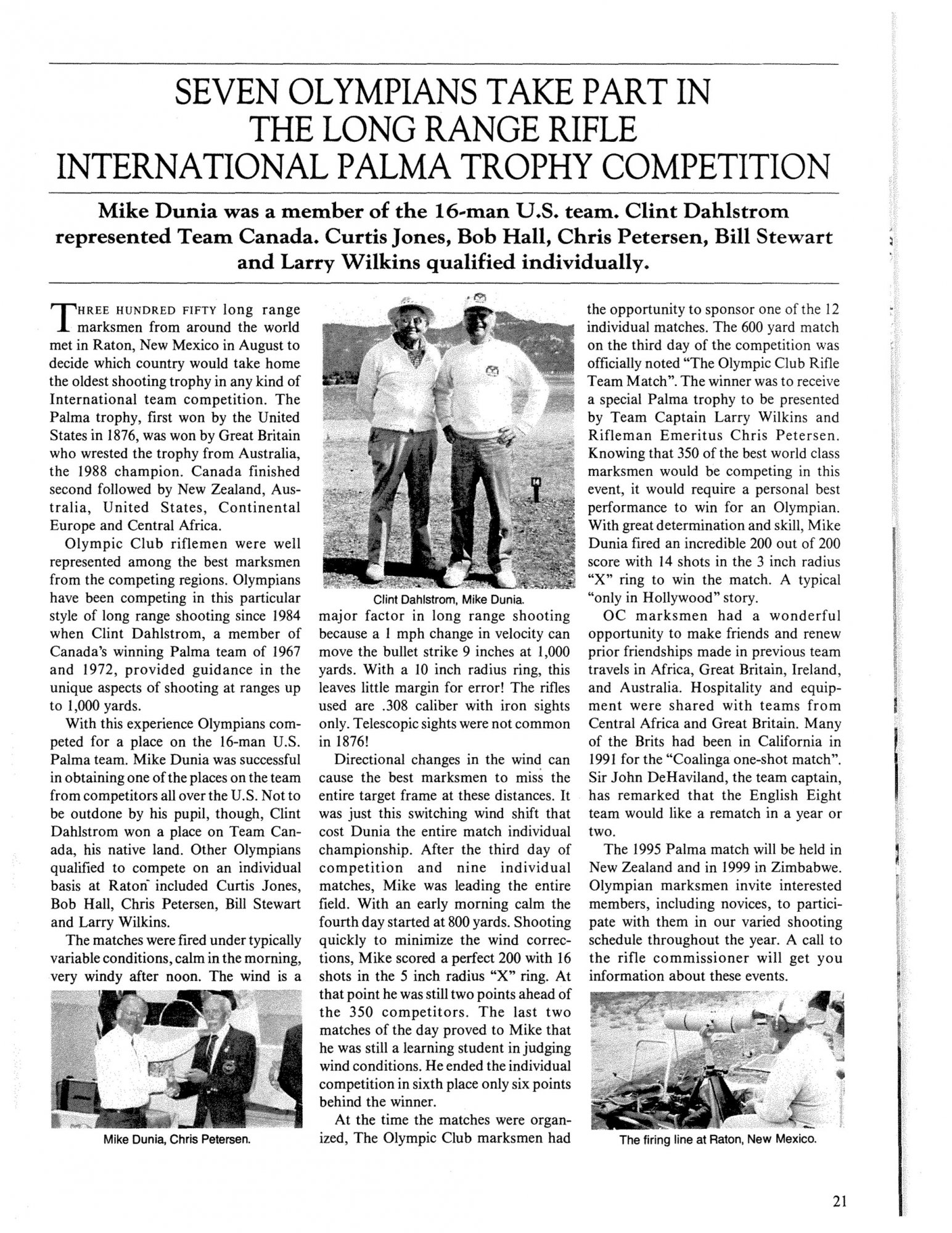
In the AccurateShooter Forum Classifieds my friend, dgeesaman, found an ad for an Unertl “Team” spotting scope, a 100mm beast built by the famed Unertl company specifically for long range shooting spotting. I had tried to find one years earlier, but I had no luck. This time I struck gold. The Unertl Team was being sold by an accomplished shooter, Mike Dunia, and was in excellent condition complete with all the goodies, including the monster travel case you see above.
Now, because of its sheer size – about 60 pounds with the case – this scope is definitely NOT practical for casual spotting, but the image, well, it’s like being there. The image is extremely bright and sharp edge-to-edge with no hint of chromatic aberration. And once you get the beast to where you want to be, setup is remarkably simple, with a tripod, mount and scope all beautifully machined to move smoothly and easily.
Vintage Unertl optics can be purchased from Dewayne (Dewy) Greiner in MN, Classic Unertl Scopes.
The scope was sold to me by Mike Dunia, an accomplished marksman who served with the U.S. Army Marksmanship Unit and represented San Francisco’s famed Olympic Club in competitions around the world, for example, winning the British Columbia Target Rifle Championship in 2002 and the California Palma Championship in 2003. Dunia has had a notable 50+ year shooting career, starting in college when Dunia was Captain of the Stanford University Rifle Team. The scope was owned by Dunia’s friend, Larry Wilkins, who also served in the U.S. Army, was also an accomplished marksman, and also represented San Francisco’s famed Olympic Club.
Below is a photo of the USA Palma Team in 1995 with multiple Unertl 100mm spotting scopes:
The names of the individuals in this 1995 photo were provided by tool-maker Alan Warner, who was there that day many years ago. In the same Shooters’ Forum thread, Alan posted: “Far left, white shirt and hat, squatting is Burt Rallins. Prone — close left with small scope is me, Alan Warner. Standing in team jacket is Ken Erdman. Next in background is Mike Dunia. The Coach, sitting, is Bob Jensen. The Next coach is Eric St. John. Can’t make out the other coach or shooters. Last coach is Bill Meek.”
Here is just a bit of the vaunted history of the San Francisco Olympic Club (click photo to read full screen):
Although I do plan to use the scope, I feel an obligation to preserve as much of its history as I can, including, most importantly, the stories of the shooters who used it before it came to me. I should also mention that Wilkins served with the famous “Task Force Smith” at the start of the Korean War. If you’re not familiar with that horrific story of courage, do look it up.
Unertl Spotting Scope Original Cost … And in Current Dollars
What might this line of 100mm monsters have cost back in the day? Well, I’ve tracked down an Unertl price list from sometime after 1963 — we know that because it has a ZIP code in the address — and the price then was listed as $450, but another price list, dated 1994, puts the price at $2,200.
Of course, that’s $2,200 in 1994 dollars. That would be $3,842 in today’s 2021 money, according to USinflationcalculator.com. So the seven Unertl Team scopes seen here would cost $26,894 at present! — David Buffington
100mm Spotting Scope Operation
Were these scopes used to see bullet holes? Actually that was not their primary purpose. Shot locations on target were shown by shot markers placed by pit workers. But the scopes did serve important purposes, as explained by Forum member Dave Marshall: “You won’t be able to see any bullet holes past 300-400 yards with those scopes. They usually used a fixed 24X eyepiece. I don’t think there is a scope in existence today that can see bullet holes at 1000 yards. [It is possible — but only under very rare, perfect conditions. That said, spotting scopes ARE used all the time to see 1000-yard shot markers and thereby record scores. — Editor]
The main reason those scopes were used [in addition to seeing shot markers] was for better ability to read mirage and the larger objective made it possible to see bullet trace at longer ranges. Once the trace leaves the field of view due to steep trajectory, you can’t see it when it comes back down into the field of view.”
Description of Unertl 100mm Team Spotting Scope by Classic Unertl Scopes
The Unertl 100mm Spotting Scope is a large instrument which was designed to meet the requirements of team coaches to enable critical spotting of long range big bore matches. The coated prismatic optical systems, with a 100mm aperture objective and four element orthoscopic oculars is critically tested and hand-corrected so that the final system will yield matchless resolution. The objective cell has a sunshade which can be extended about 5″ when required and the eyepiece is screw focusing with a fast over-running push-pull travel. Dust covers are provided for each end. Workmanship is of the highest quality and the majority of the instrument is made from aluminum alloy and finished in a light gray wrinkle. The yoke mounting enables easy insertions and removal of the telescope from the yoke and tripod. By tensioning the binding screws the scope can be fixed by locked in position or so set to per-mit scanning of a series of targets. The lower portion of the yoke fits the cylindrical column of a floating action metal tripod. Within the tripod ram is a helical spring which counter-balances the scope and it can be raised or lowered with ease. A wooden carrying case of substantial construction houses the telescope, yoke, tripod and extra interchangeable eyepieces. Standard oculars are 6X, 24X. and 32X.
Above: FN’s new 509 LS Edge is a 9mm Long Slide “factory custom” with Low-Profile Optics-Mounting System, slotted slide, and 5″ hammer-forged target-crown barrel.
In the latest February 2021 edition of Shooting Industry Magazine you’ll find Part III of the publication’s 2021 New Product Showcase. This latest installment of SI’s features over 40 new products, all presented with photos and product details.
If you missed the previous showcases, visit ShootingIndustry.com to see the December 2020 and January 2021 issues or click the links above. Across all three editions, hundreds of products from more than 120 companies were featured in Shooting Industry’s 2021 New Product Showcase.
From the Shooting Industry Part III Showcase, we present four notable handguns:
1. Colt Mfg. and Davidson’s — Engraved 6″ Stainless Python
Davidson’s has collaborated with Colt’s Manufacturing on a special edition Colt Python revolver. Automated Finishing has created a deluxe engraved version of Colt’s new 6″ barreled stainless Python. The engraving is armory-grade cut and encompasses the barrel, full underlug, frame and backstrap. The top of the rib is left matte stainless to cut glare while sighting. The special Python is chambered in .357 Magnum, and has a walnut grip, red-ramp front sight and adjustable rear sight.
2. Volquartsen Black Mamba-X .22 LR Pistol
The Black Mamba-X .22 LR Pistol from Volquartsen features a LLV-4X upper with multiple mounting locations allowing for red dot sights. The pistol has a 1/2×28 threaded stainless steel 4.5″ barrel with stainless steel laser-hardened breech in a type III hard-anodized aluminum shroud. Additional features include the Volquartsen Accurizing Kit for a 2.25-lb trigger pull, DLC coated Volquartsen Competition Bolt and Volquartsen Single-Port Compensator. The LLV-4X Upper will be available as a stand-alone product and is compatible with both the Volquartsen Competition Bolt as well as the Ruger MK IV factory bolt.
3. Heckler & Koch VP9L 9mm Pistol
Combining optics-ready features for competition use, the Heckler & Koch (HK) 9mm VP9L OR (Optics Ready) is based on the popular VP9 platform. HK supplies an O-Ring bushing on the longer 5″ barrel to tighten the lockup, aiding accuracy. This ships with 20-round magazines provide additional rounds for longer stages. A machined slot in the slide accommodates most popular red dot pistol sights with one of 5 available mounting plates (sold separately).
MasterPiece Arms now offers the Freedom Gunworks double-stack 1911 pistol line. The handsome 9mm DS9 Hybrid Pistol shown above is machined from barstock and billet. It boasts an FGW slide serrations with slide lightening cut, Koenig hammer/sear, with a 2-lb. trigger pull. Notably, Each FGW pistol is hand-built, including lapping the slide/frame interface, and comes in a custom MPA single pistol case with one MPA 140mm magazine. A variety of configurations are available, including iron sights or optics-ready models.
Retro is back — at least in the CMP’s Standard Modern Military Rifle AR class. Though Service Rifle competition has evolved to allow optics and heavy barrel profiles, the Standard Modern Military Rifle (AR category) is truly a “blast from the past”. Overall weight is limited to 7.5 pounds, and the rifle must be equipped with iron sights (Rule 5.2.3). In addition, the rifle “be based on the M-16 rifle or be based on an AR design” with “exterior configuration similar [to] the original military or military-type rifle”. See Rules.
With this in mind our friend Dennis Santiago recently put together his own AR-platform Standard Modern Military Rifle for matches run under CMP Competition Rules. This is not quite a classic AR, as it has a metal free-float handguard (vs. plastic handguards), but it IS light (7.3 pounds), and it does have iron sights — a key requirement for Standard Modern Military class rifles.
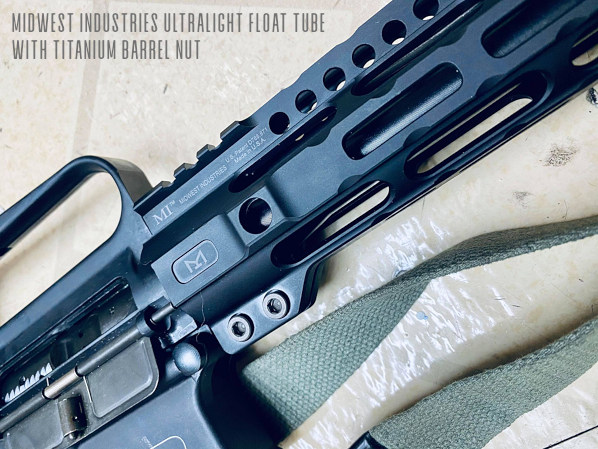
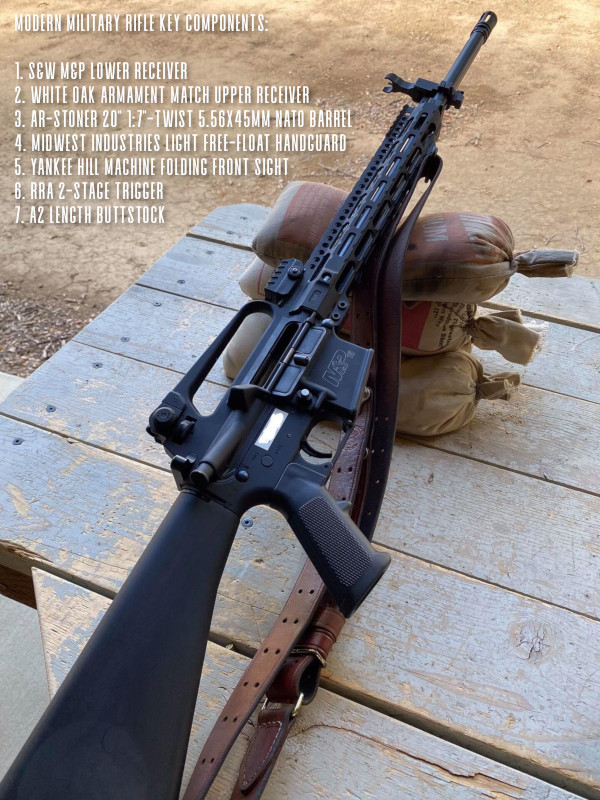
Here is Santiago’s CMP Modern Military Rifle (Standard Class) with an ultralight free float tube that has a titanium barrel nut, and mechanical, center-able front sight. The barrel is an AR-Stoner brand 20″-long 1:7″ Government contour chambered in 5.56×45 NATO. Dennis says: “This makes the 7.5-lb weight limit with a few ounces to spare. We’ll see how well it drives soon enough.”
Dennis explains: “The Standard Modern Military (AR) is a category of military-style rifle that shoots the 200-yard, 30- or 50-shot courses alongside the M1 Garands, Springfields, Vintage, and M1 Carbines. This one boasts a Midwest Industries (MI) ultralight Free-float Handguard and a Yankee Hill folding front sight. Any Government contour or thinner profile rifle-length gas tube barrel with a 0.750″ gas block will work.” Colt makes a suitable Government Contour 20″-long, 1:7″-twist barrel, sold by MidwayUSA.
To test the accuracy of his rifle, Dennis fitted a Mantis-X unit on the top of the float tube. The Mantis-X records the movement of the rifle to interpolate shot placements. Dennis reports: “I spent some extra time at the range grabbing a decent zero for my Modern Military rifle. I stuck a Mantis-X on it to record a few shots shooting offhand at the plates at 200 yards. It drives very easily even with no shooting coat or glove.” The Mantis-X is attached just forward of the carry handle, on top of the MI free-float handguard. The Mantis-X works with live fire as well as dry fire. It communicates via BlueTooth to a smartphone App.
Rifle Shoots Well with 77gr Sierra MatchKings
The gun is presently zeroed with 77gr Sierra MatchKing ammunition. Dennis reports his rifle “can easily hold the X-Ring on an SR target for both 100-yard and 200-yard CMP Modern Military Games matches. And it’s fun to shoot!”
CMP Standard Modern Military Rifle (AR Class)
This rifle is built from carefully selected and fitted parts to conform to the CMP’s 7.5-pound weight limit iron-sighted rifle rule. Officially, this is a CMP Standard Modern Military Rifle, Class “A” (AR type).
1. S&W M&P lower receiver
2. White Oak Armament match upper receiver with 1/4×1/4-MOA pinned rear sights
3. AR-Stoner 20″ 1:7″-twist 5.56x45mm NATO Government contour barrel from MidwayUSA*
4. MidWest Industries ultralight free-float handguard with a Titanium barrel nut
5. Yankee Hill Machine folding front sight with a 0.072″ square front pin
6. RRA 2-stage trigger
7. A2 length buttstock
Easy Rifle Build Using Mostly Existing AR Parts, Plus New Barrel and Free-Float Handguard
Dennis was able to put his Modern Military AR together using components he had collected over the years: “Most of these parts were already in my bin of old AR parts available to be recycled. The barrel and free-float handguard were the only new acquisitions.” And with the AR’s modular format, this was an easy build: “Assembly time was about 30 minutes. I’ve done these parts swaps so many times now.”
Key Rules for Standard Modern Military Rifle (AR Type)
Dennis Santiago’s new AR rifle was built as a “Standard U.S. Modern Military Rifle”, Class A (AR Type), as specified in the CMP Competition Rules.
5.2.3 Standard U.S. Modern Military Rifles, Class A
Category A Standard Modern Military Rifles must comply with these requirements:
a) Rifles must be based on the M-16 rifle or be based on an AR design;
b) Rifles must be manufactured by a USA manufacturer;
c) Rifles must be equipped with issue-type metallic front and rear sights; rear sights with adjustments finer than one minute of angle are permitted;
d) Total rifle weight, with sights and without sling, may not exceed 7.5 pounds;
e) Rifles may be fitted with a float tube or free-floating handguard. A nonadjustable sling swivel may be attached to the forward end of the handguard; and…
f) The rifle must be chambered for the 5.56x45mm or .223 Remington cartridge.
Also, from Rule 5.2.2:
a) The exterior configuration of the rifle must be the similar to that of the
original military or military-type rifle;
b) The trigger pull may not be less than 4.5 lbs.;
Comments from other Modern Military Rifle Shooters:
“I built a Modern Military [Standard]. It was tough getting below the 7.5-lb [limit]. I had to carve off a bunch of the 20″ barrel diameter but wanted to stay with it for sight radius (over a 16″). I would just as soon shoot that little iron-sighted rifle at 200 yards as my 15-lb Nightforce-scoped Service Rifle. I love that little rifle.” — Kenneth S.
“I’m building one of these that will make 7.5-lb [Standard Modern Military] weight limit, with the long barrel and long sight radius. This has been on my list this winter.” — Tom K.
“We found that turning down a National Match barrel and taking a few inches off of it made a very accurate rifle.” — Jack A.
“My old (complete) A2 upper has been sitting forlorn on a shelf for a couple of years now. Perhaps I need to do a [Standard Modern Military] build of my own.” — Derek D.
Dennis Santiago replied: “Derek — that’s the reason I was attracted to this. I had bought a brand new WOA A2 pin upper receiver to make a new upper then the scope rule was adopted and it was all flat tops. This gives new purpose to the old parts.”
CMP Rules Defining Modern Military Rifles
Standard vs. Unlimited, Class A vs. Class B
There are actually two different classes of Standard Modern Military Rifles, Class A for AR-type rifles and Class B for other military-style rifles, such as the M1A and FN-FAL. Ok, got that? Now, in addition, there is also a second division for UNLIMITED Modern Military Rifles, again with two classes (Class A — AR-type and Class B — other military rifles). These unlimited rifles can have optics, heavier weights, modern-design adjustable-length stocks, and other upgrades. Here is Rule 5.2.2 from the current CMP Games Rifle and Pistol Competition Rules:


 FREE FUN Targets from NSSF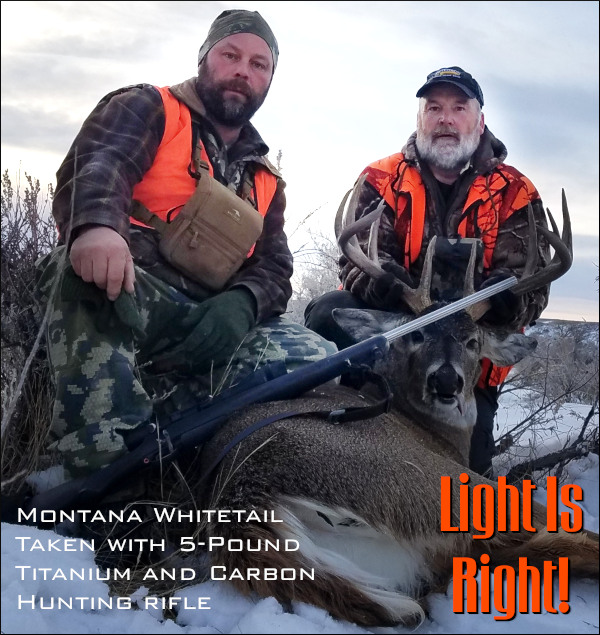


 Q: Why did you choose to build this rig?


 Gun guys are always shipping stuff around the country — whether it’s a barrel to be chambered, or a scope that needs to go back for warranty repair. Or maybe you’ve sold some bullets or reloading dies you no longer need. To ensure your precious packages get to their destination in one piece, it’s important to take precautions when boxing up your items. And by all means insure packages for full value — even if your packaging is perfect, there is always the possibility that your shipment might be lost altogether. Sadly, that can happen, no matter which carrier you choose: Fedex, UPS, or the U.S. Postal Service (USPS). Here are some tips for shipping gun stuff — we explain how to pack items properly and how to minimize the risk of loss.
 “First, I started double-packing the contents and in many cases double-boxing. I spend a fortune on heavy-reinforced shipping tape. If the contents are loosely packed, the package is going to get crushed. On real important items or delicate items, wrap the content in plastic and spray the inside void areas with non-expanding foam. They make shipping foam just for this. This method really works. Since I started paying more attention to packaging, I have just about wiped out my issues with all three companies (Fedex, UPS, USPS). Yes, I hate doing it, but in the long run for us, it’s cheaper.
 How do shipments get damaged? Consider this — one of the shipping companies this year flipped (overturned) one of our new CNC machines (which rendered it useless). Maybe your small packages were in the same delivery truck as my CNC machine. I wonder how many little boxes were crushed underneath it.
 “Packing a barrel can be a problem. Here’s a shipping method that won’t stop lost shipments but so far has stopped damage. Get a PVC pipe (of size appropriate to your barrel) with fitted caps for each end. Attach a cap to one end. Tape the barrel threads and tape over the muzzle. Then drop one standard tennis ball into the pipe. Place barrel in pipe. Next add whatever peanuts or foam you can jam in to support the barrel on the sides. Then place a second tennis ball into the opposite end of the PVC pipe. (So now you have a tennis ball on either end of your barrel.) With everything secure inside, attach the upper cap and tape it down securely. With this packing procedure, when the carrier launches the pipe like a javelin, at least the barrel will not come through like a spear and be gone. Label the pipe with very large address labels so no one suspects it’s just garbage laying around. This procedure may seem ridiculous but it has worked for me. Oh and definitely get insurance. If your item is insured, the shippers will look harder to find it.”