The folks at Sierra Bullets asked a few staff bulletsmiths a classic question about guns: “If you could own only one firearm which one would you choose?” There were many interesting answers including a “cheater” response — the drilling — which is really two guns in one. The most-often mentioned chambering was the venerable .30-06. Respondents cited its versatility, hunting prowess, and ready availability of ammo. The popular .308 Winchester, as expected, got mentions as did its cousins the .243 Win and 7mm-08. There were quite a few votes for classic lever guns, as well as 12-gauge shotguns. Two bulletsmiths cited the .22 LR, and we can certainly see the logic in that answer. The little rimfire cartridge is versatile, quiet, and inexpensive.
We ask our readers the same question — if you could only have one long gun, what type of firearm would it be? List the gun type and chambering in the comments section.
If You Could Have Just One Long-Gun — ANSWERS:
Media Relations Manager Carroll Pilant answered: “I would NEVER own only one gun. If I HAD to pick one, it would be a drilling in 12 gauge over .30-06.”
Ballistic Technician Rich Machholz answered: “The early tang safety Ruger M77s pretty much have all you could want in a bolt gun, but I do like the Winchester lever guns and the combination guns, particularly the drillings. Since I have the first two, I’m going for a Doug Turnbull 1886 or a side by side 20 gauge over .223 drilling.”
Ballistic Technician Philip Mahin answered: “More than likely it would have to be a bolt action .30-06. The reliability is legendary on a wide range of game animals and factory ammunition has still been available at my local stores even in these tough times.”
Ballistic Technician Duane Siercks answered: “If I had to boil it all down to one gun, it would probably be a .30-06. I have a Remington 700C (custom shop gun) that has worked very well for anything and everything I have ever wanted to do with it.”
Ballistic Technician Paul Box answered: “A .22 Rimfire.”
Chief Ballistician Tommy Todd answered: “Remington 700 in .308 Winchester.”
VP – Sales & Marketing Matt Reams answered: “A light weight Kimber in 25-06.”
Production Toolsetter Brad Vansell answered: “Savage weather warrior 7mm-08 is my rifle of choice.”
Production Toolsetter Dan Mahnken answered: “The .308 Winchester rifle — [based on the] wide range of bullets made and the wide range of things that one can hunt with it.”
Process Engineer David Palm answered: “Savage action 243 Winchester.”
Ballistic Technician Gary Prisendorf answered: “Probably a .22 LR. It may not be the best choice, but you could use it for about anything if you really had to.”
Production Manager Chris Hatfield answered: “Beretta A300 Outlander 12 gauge.”
If you’ve ever used a Harris Swivel Bipod, you know that, without tools, it is difficult to put enough tension on the swivel locking knob to really lock the unit solid. And, if you do manage to get the knob really tight (perhaps by using pliers), it is difficult to loosen with fingers alone.
That was why Terry Cross and the folks at KMW Long Range Solutions invented the Pod-Loc™. This system replaces the knurled swivel tension knob with a push-button adjustable handle. Using the handle you can easily set the swivel tension at any level from loose to “rock solid”. And you can release tension to adjust the bipod to different terrain just as easily. The genuine KMW Pod-Loc™ retails for $33.99 at Brownells.com.
How to Build Your Own Bipod Swivel Locking System
While we use genuine KMW Pod-Locs on our rifles, readers on a tight budget, or who have a large collection of bipod-equipped rifles, can economize by putting together their own swivel locking systems from off-the-shelf components. You can buy suitable levers from www.T-Nuts.com. This vendor offers a variety of appropriate handles, ranging in price from $7.70 to $10.00. So, by sourcing the parts, you can outfit four bipods with swivel adjusters for the cost of one Pod-Loc.
We recommend the Nylon/Stainless BPL/NS model ($7.70), but you may prefer the all-metal BPL-ZS ($8.50), or the shorter BPL-Micro model ($8.25). The compact Micro lock does not protrude past the body of the bipod, yet is still easily grasped. T-Nuts supplies one 3/16″ spacer with most of its bipod handles. T-Nuts handles are also available with a metric M6x1.0 thread for use with imported bipods such as Outers and Rockport.
Installation is Easy — With the Right Socket
To install a swivel locking system, first you’ll need a 1/4″ socket to remove the keeper nut from the threaded pivot rod. (During this process, you’ll need to keep pressure on the pivot rod retaining pin on the opposite side of the bipod.) Don’t try to remove the keeper nut with pliers or an open-end wrench. You really need the correct socket. Once that keeper nut is removed, then unscrew the knurled tension knob/ring. This is attached to the same threaded shaft as the keeper nut but you should be able to remove it without tools.
After the knurled tension ring is off, it is easy to put your handle on the bipod. First slip the 3/16″ spacer over the threaded pivot rod. Keeping finger pressure on the pivot rod retaining pin (on reverse side), then spin on the T-Nuts handle. Rotate the handle inwards until it firmly locks the bipod swivel mechanism. By pushing the button in the head of the handle, you can swing the handle left or right to set its position without altering the swivel tension.
We like AR-style .22LR rigs for Rimfire Tactical Matches and 3-Gun cross-training. With an AR-style rimfire rifle you can train with low-cost ammunition while enjoying the same ergonomics, controls, and sighting systems found on your centerfire ARs.
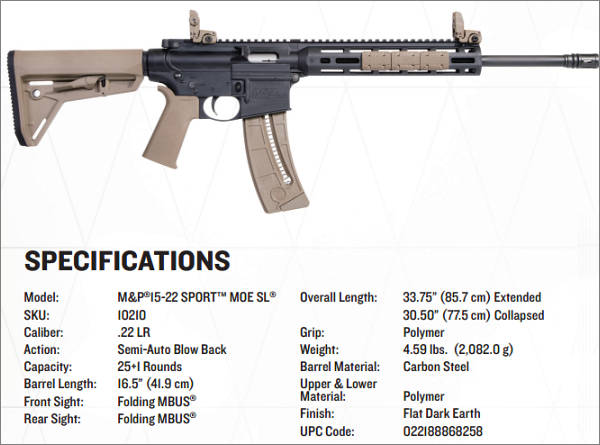
Smith & Wesson offers an upgraded version of its M&P 15-22, a fun rifle that we’ve praised in the past. The enhanced M&P 15-22 Sport MOE SL model (Magpul Original Equipment Slim Line) features a more comfortable handguard, an improved grip, and an adjustable Magpul buttstock. The dedicated .22 LR M&P rifle retains the look and features of the company’s popular M&P rifle line, with the enhanced ergonomics of Magpul furniture. The M&P 15-22 Sport MOE SL model is offered with either Flat Dark Earth (Tan) stock and grips, or with Matte Black components. MSRP is $505.00, with street price around $450.00.
Click Image for full Spec Sheet.
Here is an interesting Long-Term Test of the M&P 15-22 Sport MOE SL:
IMPORTANT: If you are considering buying an M&P 15-22, then definitely watch this video. It explains which types of ammo (CCI, Browning) work well, and which caused issues (Federal bulk). In addition the video explains how best to clean and maintain the rifle.
The M&P 15-22 Sport MOE SL features a high-strength polymer upper and lower receiver. In addition to the standard features of the M&P 15-22 Sport rifle, which include front and rear MBUS folding sights and the M&P Slim M-LOK handguard, the new MOE SL version comes with a Magpul mil-spec carbine stock, SL Grip, and Magpul Type2 M-LOK rail covers. The M&P 15-22 SPORT MOE SL is available in matte black or flat dark earth finishes and comes with a 25-round .22 LR magazine.
S&W 15-22 MOE SL Notable New Features:
— Adjustable stock with improved sloped comb profile.
— Shielded ambidextrous release lever prevents snagging and accidental adjustment.
— Push button QD socket and sling loops.
— Grip is slimmer with more vertical grip angle and Beavertail backstrap.
— Heavily textured grip contact surface.
Got four-and-half grand to burn? Looking for a new rifle that will impress your buddies at the range? Then check out Remington’s updated .50 BMG rifle, the R2Mi. In appearance, it sort of looks like an AR10 on steroids. But this thing is massive. It weighs about 30 pounds and has a 30″ Walther barrel. Though it may look like a semi-auto in the photo, this is a LEFT Bolt, Right port bolt-action gun.
GunsAmerica Digest says the R2Mi is based on the Bushmaster BA50: “The R2Mi has upper and lower receivers that follow the basic design of AR-pattern rifles, but it is a manually operated bolt-action rifle with a left-side charging handle that works the bolt carrier directly. The upper receiver is railed like most modern AR rifles as a scope mount. The R2Mi comes standard with a Lothar Walther 30″ barrel with a 1:15″-twist and a free-floating railed handguard that serves as an accessory mount for low light optics and other accessories along with the included folding steel bipod.”
For the hefty investment ($4599.00 MSRP, $3999.00 Street Price), at least Remington tosses in some good gear. The R2Mi ships in a big Pelican Storm transport case, and comes complete with a bipod, two 10-round magazines, eye protection, ear protection, and cable lock. Those accessories are worth $450.00 or so.
The Remington R2Mi is closely related to the Bushmaster BA50*, shown in this video:
The R2Mi is fitted with a Magpul PRS Gen 3 stock and ErgoGrip Deluxe Tactical pistol grip. If you want to change out those components, the R2Mi is compatible with various AR components including grips and stocks. The controls are similar to AR controls including the selector lever and magazine release.
Here is Remington’s product description: “The free-floated barrel, with 1:15″ twist and 8-groove rifling is perfectly suited for harnessing sub-MOA accuracy from the .50 BMG. And its left-hand operated, right-hand eject bolt-action and 10-round box magazine, ensure comfortable cycling with no need for the shooter to adjust position. The R2Mi is also one of the simplest .50-caliber rifles to assemble and maintain. Its upper receiver locks to the lower receiver with two integral pins, and its full-length Picatinny rail accommodates a wide range of optics.”
Remington R2Mi Features:
• Left Bolt, Right Port Action
• Billet Aluminum Lower Receiver
• Compatible with AR Accessories
• AAC Cyclops Muzzle brake
• Ships with Steel Folding Bipod
• AR-type Take-down for maintenance
Price is Hefty — MSRP is $4599.00
Is this a good value? It depends — this is a mag-fed rifle, with some interesting features. But $4599.00 is still a steep price for a rifle that is not an everyday shooter. On the other hand GunsAmerica states: “It can be very expensive to shoot .50 BMG and many repeating rifles chambered for the round can cost thousands more. The MSRP for the R2MI is only a little more than what some single-shot .50s cost, which means this rifle has a good value.”
* The BA50 was the original design of Cobb Manufacturing. Bushmaster purchased the design, upgraded some features, and released the rifle as the Bushmaster BA50. This bolt-action, magazine-fed .50 BMG rifle featured a 22″ or 30″ Lothar Walther free-floating barrel with a 1:15″-twist rate. Bushmaster claimed the BA50 was capable of shooting 1 Minute of Angle (MOA) groups with M33 ball ammunition.
COVID-19 stay-at-home orders have created abundant free time at home for millions of Americans. To fill otherwise empty hours, we know many readers have been reloading ammo — LOTS of ammo. And quite a few of you folks are thinking of getting a progressive press to increase output. Because multiple operations take place with a single pull of a lever, a progressive press can produce way more ammo in a given period of time than any single stage press. With a progressive, on the ram up-stroke, the multiple stations can simultaneously remove spent primer, full-length size case, drop powder, seat bullet, and crimp (if desired). Most progressives are also set up to prime cases with the ram in the lower position — though some guys prefer to prime manually.
Progressive presses aren’t just for high-output pistol ammo or bulk rifle ammunition. Good progressives can be adapted to do certain reloading tasks for top-on-the line match ammo. You might use a progressive for decapping, priming, and sizing, then throw powder and/or seat bullets separately. Some Champion shooters do use progressives to load their match ammo! For example 5-Time National Long Range Champion John Whidden and 2020 Berger SWN F-Open Champion Jay Christopherson both use progessive presses for some (but not all) operations.
To help you get started with progressive presses, here are five videos from UltimateReloader.com that cover six popular machines, from the elite Mark 7 Evolution to the inexpensive Lee Pro 1000. With many of these machines you can add separate vertical bullet feeder systems that further increase loading efficiency.
Mark 7 Evolution Press — Distributed by Lyman
Dillon XL-650 vs. Dillon XL-750
RCBS Pro Chucker 7 with Bullet Feeder
Dillon 550C with 6mm Creedmoor and 9x19mm
Lee Pro 1000 Features and Operation
Better Safe Than Sorry — the RCBS Lock-Out Die
RCBS Makes a “Lock-Out Die” that senses the powder charge. This will halt the Progressive press if you have a double charge, or an undercharge. Your Editor has the Lock-Out Die on his RCBS Pro 2000. It has “saved his bacon” a half-dozen times over the years. It can be used on Dillon and Hornady progressives as well as RCBS machines.
What if you could have a normal-height rear sight that could dispense with the need to align front sight and rear sight? In fact, what if that rear sight could eliminate the need for a front sight altogether?
That’s exactly what the Meprolight FT Bullseye system does. Employing fiber optics and tritium, the FT Bullseye provides a bright aiming dot inside a circle — no front sight is needed. When the dot is centered in the circle, you’re on target. It’s as simple as that! The front blade is rendered superfluous. This really is innovative technology, albeit expensive — the FT Bullseye’s street price runs $135 to $150, depending on pistol make and model — not cheap.
Traditionally, a shooter aims by aligning the front and rear sights. Meprolight combined the dot and the circle on the rear sight, eliminating the need to use the front sight altogether. This sight is fast on target and works in all light conditions. Meprolight claims the patented FT Bullseye is the “smallest optical sight in the world.”
Red dot and reflex systems also work without iron sights, but red dots are tall and bulky, and they don’t work well at all for shooters with astigmatism.
Meprolight’s engineers created a sleek, low profile rear sight by combining fiber optics with tritium. For concealed carry, this is better than a bulky red-dot. The low-profile design allows the shooter to draw from holster without worrying about snagging a bulky red dot or reflex sight assembly. To see how the FT Bullseye sight works, watch this video.
The fiber optic technology used in the FT Bullseye was pioneered by Tactical Aiming Systems (T.A.S.) an Israeli company. Meprolight dramatically improved the TAS system, adding tritium and an enhanced dot/circle reticle. The FT Bullseye is also smaller and sleeker than the original T.A.S. rear sight. The FT Bullseye is currently available in red or green dot/circle for all Glock models. Meprolight guarantees the tritium to last 12 years. MSRP is $199.00.
When used with rifle or shotgun, these Impact Sports muffs should be reversed, so that the higher part of the relief cut-out is in front. That provides more comb clearance.
Mother’s Day, Sunday May 10th, is just a few days away. Of course don’t forget the flowers and cooking dinner for the Special Lady. And if she enjoys shooting, why not get her a nice set of electronic muffs? Amazon has Howard Leight electronic muffs in pink — perfect for Mother’s Day. These popular Impact Sport muffs are reliable, reasonably comfortable, and easy to store. Built-in directional microphones amplify range commands and other ambient sounds to 82 dB, providing more natural listening and enhanced communication. These muffs carry a 22 NRR Noise Reduction Rating (NRR). The bottom of the muffs is thinner for clearance on a rifle stock, and the headband is adjustable. These Impact Sport Earmuffs include AUX input and 3.5 mm connection cord for MP3 players and smartphones.
More Color Options (If Pink Isn’t Her Favorite)
These same Impact Sport earmuffs are offered in four other color choices: Black, Green, Camo, and Blue. The pink version — ideal for Mother’s Day, is currently $44.80 at Amazon. Other colors run from $43.95 (blue) to $64.93 (camo) on Amazon.
Double Up with Plugs for Maximum Protection
This Editor owns and uses these muffs, but I normally “double up” with plugs underneath muffs when shooting rifles. If I am backed away from the firing line spotting or observing, I can use these NRR 22 muffs alone. For regular shooting, we recommend using foam earplugs underneath Electronic Muffs.
Leveling your scope can be a time-consuming and tedious process. The Fix It Sticks folks have changed that with the introduction of the Scope Jack. This simple unit levels a scope through contact with the flat on the bottom of the scope (opposite the elevation knob). You can do this quickly, with one hand, leaving the other free to tighten your rings once the scope is aligned. This really is a clever, effective, easy-to-use tool, as you can see in this video:
You attach the Scope Jack to the Picatinny rail on your rifle, then lossen the rings so the scope can rotate. Then simply elevate the Scope Jack with a quick twist, using a 1/4″ driver. The Scope Jack’s horizontal roller will contact the scope’s bottom flat, rotating the scope it into proper alignment, square to the rail.
Operating Instructions from Manufacturer Fix It Sticks
The Scope Jack works with any 1/4 inch driver to quickly and easily level your scope to your rail. Just mount the scope jack to the pic rail under your scope and turn the drive handle until the lifting arm engages with the flat section under your turrets. Once the scope is level, maintain pressure while tightening your ring screws to keep optic level throughout the process.
Requirements:
1. Scope much have a central flat section under turrets
2. Needs a minimum of 1/4″ clearance between rail and scope
3. Picatinny Rail must be accessible under optic
TECH TIP: You Still Must Check the Reticle Orientation INSIDE Your Scope
The Scope Jack works fast, but it is NOT the “final solution”. Why? Some scopes have a reticle that is not perfectly aligned with the turrets and/or bottom flat. We have seen scopes with vertical reticle line off as much as three degrees (3 °) from true plumb. With such a scope, you CAN set the reticle square, but then your turrets will be canted relative to the receiver. That creates issues when shooting at long range. Accordingly, if your scope has a badly canted reticle, you should send it back to the manufacture for warranty repair. Three degrees may not sound like much, but it is actually quite noticeable:
For all scopes, AFTER using the Scope Jack, we recommend you test your reticle with a plumb line. You can hang this line from a door or ceiling fixture with a weight on the bottom. Important — when using a plumb line make sure your rifle is 100% level or your results may be off. We recommend using a bubble level to help align your rifle properly.
SHOT Show 2020 Hour-Long Special Episode
This week, Shooting USA features a full hour of SHOT Show coverage. If you watch just one episode of Shooting USA this year, it should be the SHOT Show 2020 Special which runs Wednesday, March 6th at 9:00 pm Eastern/8:00 pm Central on the Outdoor Channel. This episode provides a “first look” at the new guns, optics, and gear introduced for 2020. Shooting USA’s team looks at over 65 new products. Click HERE to learn more about this week’s 2020 SHOT Show episode.
2020 SHOT Show Highlights: Colt Python, Hornady A-Tip bullets, Manners PRS Stock, Volquartsen Summit .17 WSM, Ruger-57 Pistol, Pinnacle Precision Rifle, HK SP5, Impact Sport Muffs, Laugo Arms Alien Pistol, Vortex 1-10X Scope, Glock 44 Pistol, Hornady Rapid Safe and more.
Shooting USA’s SHOT Show 2020 episode airs on the Outdoor Channel Wednesday, March 6 at 9:00 pm ET and Thursday, March 7 at 3:00 pm ET. Look for Shooting USA on the Outdoor Channel. In addition, you can watch all episodes of Shooting USA on the VIMEO channel by subscription. The SHOT Show 2020 edition is just $0.99.
Here are some of the 50+ new products featured on the SHOT Show Special. Click Images for detailed product information.
Report by Jay Christopherson
2020 Berger SW Nationals F-Open Champion Team Member, Team Lapua-Brux-Borden
I’ve been shooting F-Class for about 9 years now. In fact, I shot my very first match, a 600-yard mid-range match, using a 6mm Dasher, on March 19, 2011. My first relay was a 188-4X and my overall score was 582-19X. I remember shooting a really nice group in the 9-ring, because I dialed the scope the wrong way and I shot lots of “verification” shots before making adjustments. I also remember wondering if that was a good score for that range in those mostly calm conditions (it wasn’t). I’ve tracked every match I’ve ever shot and I’ve come a long way since then. I’ve always been a competitive person and F-Class gave me an outlet to indulge both my competitiveness and my fondness for details. In what other individual sport does a thousandth of an inch (or less!) become important? Or a tenth of a grain?
Some of my greatest pleasures in this sport come not necessarily from winning a match (though I won’t turn that down), but in identifying something small in what I am doing that has a material effect on paper. Maybe it’s a tiny change in seating depth. Maybe it’s a slightly modified strategy for making wind calls. Maybe it’s a tiny position or hold change. Whatever it is, when it works, there’s no better feeling.
I have a full-time job to go with this hobby, so finding the time for productive training is difficult. You have to really plan ahead to maximize the time you spend reloading, developing loads, and training at the range. To that end, I invest a lot of time in reducing the things that I do at the loading bench. I load ammo on a progressive press, though modified to produce ammo to my standards. I don’t clean brass. I don’t do a lot of things that most shooters would call traditional in the loading room. Because frankly, I don’t have the time between family, work, and other interests.
If it doesn’t make a difference on paper, I mostly don’t do it. Still, there are one or two loading habits I’m trying to get rid of. I also pre-seat all my ammo for matches — whatever I show up at the match with, is what I have. I don’t clean my rifle between days at the match. I had well over 200 rounds without cleaning by the time the last shot was fired at the 2020 SWN. It took a lot of time for me to get comfortable with that. That works for what I do, but I wouldn’t dare try it with any other loads or rifles, at least, not without a lot of testing to be comfortable. My original 6MM Dasher shooting Reloder 15 couldn’t go that many rounds without cleaning and building up a carbon ring. Unfortunately, I learned a tough lesson on that one my first year.
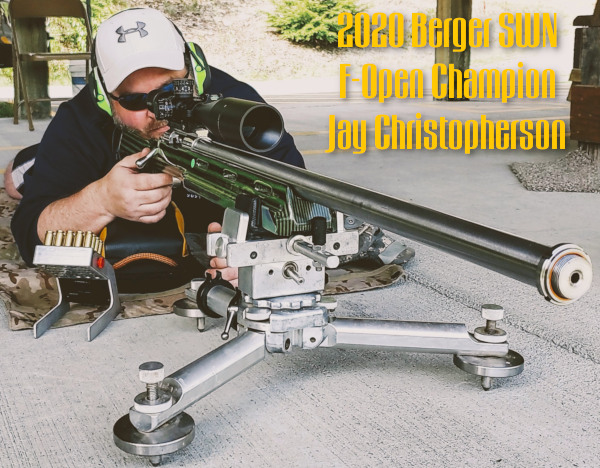
I do all my own gunsmithing, including chambering, bedding, and stock work. I’m no Keith Weil, Alex Wheeler, or some of those other guys, but I feel pretty good about the work I do. I know that when there’s a mistake or imperfection, it’s MY mistake and I can live with that. I like to keep things as minimal as possible, so I shoot off a SEB Mini (no mods) and SEB rear bag.
I also shoot with a spotting scope at Long Range, using a Kowa TSN-663 with 25X LER eyepiece and a relatively new spotting scope stand by Rod Brakhage who is a fine F-Class shooter himself. I really like how smooth and adjustable it is on the ground compared to some other rigs I’ve used.
The 284 Wheeler — Slightly Modified .284 Win
This year at the SWN, I shot a 284 Wheeler, which is a straight .284 Win that has some small modifications designed by Alex Wheeler. I think that the work and experimentation that Alex does with reamer design really shows up on paper. In 2019 I was testing the reamer in a couple barrels, looking for the right load. I shot some great relays and team practices with it that year, but this was the first time I brought enough ammo to shoot the entire week with it. Coupled with Berger’s 7MM 180 grain Hybrid Target bullets which I point to increase BC consistency, and Lapua brass, it’s an effective combination. In particular, the brass has lasted me for 13 firings with no signs of fatigue, so I expect I’ll be able to use it at Worlds in 2021 and beyond.
I also shot the entire 2020 SWN with a Vortex Golden Eagle 15-60x52mm scope, my preferred scope for individual matches. It’s a rock-solid reliable scope in my experience, with a great eye box, reliable and repeatable mechanical controls. The Vortex ECR-1 reticle has quickly become my favorite reticle. All four of my Open rifles are built on Borden BRMXD actions, Brux barrels, and sitting in X-Ring F-Open stocks, which are Robertson clones (more on that below). I’ve tried to make each of my rifles as much of an identical clone as possible.
I am not sponsored by anyone as an individual shooter, only through team sponsorship with Lapua-Brux-Borden. Which means that for individual matches, I am free to use what I think gives me the best opportunity to win for individual matches. In practice, the only difference tends to be the scope that I use, as mentioned above.
Jay Christopherson F-Open Rifle Specifications:
Cartridge: 284 Wheeler (variant of .284 Winchester)
Optics: Vortex Golden Eagle 15-60x52mm
Stock: X-Ring F-Open Stock with R.A.D.
Barrel: Brux 1:9″-twist, 32″-long barrel
Action: Borden BRMXD action
Trigger: Flavio Fare
Q: What was your biggest challenge at the 2020 Berger SWN?
Jay: The biggest challenge for me at this year’s SWN was purely mental. At past SWN matches where I had done well, I was trying to focus on not thinking about the different things going on around me. Where I was ranked on the score sheet. How well other shooters were doing. How many points or Xs I was ahead (or behind). Being worried about conditions or whether my ammo would hold up. And so on. And sooner or later, I think those things break your focus.
Going into a relay calculating the points or Xs that you can’t afford to drop is a recipe for losing. It’s like trying NOT to picture a pink elephant with purple dots when somebody challenges you try to not think of a pink elephant with purple dots. In previous SWN events, I came up just short three times in a row, for one reason or another. So, in 2020 I went in with a mental game plan.
Mental Game Plan — Envisioning Success
I pictured what it would take to be successful and what winning would feel like. First relays, then days, and then the match. I started that process months before the match actually happened. I thought about who I was shooting against and how much pressure there was to make every shot count. I thought about how I had performed or reacted in similar situations in the past. And I planned out what I would do and how I would handle those things. I strived to be neither negative nor positive — I wanted to be neutral. I wanted to be ready to win, instead of being surprised by it.
Q: What gear/hardware items give you an edge over the competition?
Jay: There’s no single piece of gear that I can think of that gives someone an edge over somebody else. It all sort of works — it’s more about being consistent with whatever hardware you have. But one piece of new gear that I tried out at the SWN was a single-piece scope mount called the Alphamount (photo below), by Richard Near of NEAR Manufacturing.
I think scope mounts are the most overlooked piece of equipment in F-Class right now — whether they be improperly aligned, improperly torqued, or just plain junk. I think people put a lot of blame on their scopes that can be traced back to mounts. The Alphamount (and single-piece mounts in general) are something that I believe in now, having done a lot of testing. It worked out OK for me at the SWN.
Action for Back-Up Rifle Is Glued and Screwed into Stock
One of the new things I am trying this year is a “glue and screw” action set-up. At the 2019 US F-Class Nationals in Raton, we got rained on a little and when I pulled my rifle apart, I found water between the bedding and action (the bedding is about 2 years old). At the SWN, I found that something had moved enough that I could torque the front action screw and bind the bolt. Not good, but luckily this was my backup rifle that I shot for Mid-Range (badly) and not my lead rifle. There could have been stock movement or other factors as well, but there was no question the bedding had shrunk when I stuck a dial indicator on it and found that my pillars were now standing proud.
Some people had been goading me to try a “glue-and-screw” procedure. Since I had nothing better to do during the COVID-19 lockdown, I pulled out the Dremel, scuffed up the action and bedding, removed the recoil lug, and glued the action into the stock. I’ve had it out a couple times since and it seems to be shooting well, but we’ll see how it holds up and what sort of difference it might make as time goes on.
Q: What is your advice to newcomers in F-Class and Long Range competition?
Jay: Find a nemesis. Someone local who puts in the same effort that you do and is as competitive as you are. Be friends, share info, but work your behind off to make sure you win on match day. I guarantee you someone reading this knows what I’m talking about. The best thing you can do is have someone who pushes you to perform better each time out. You love to win against them, but not as much as you hate to lose to them.
Q: What do you like most about Long Range and F-Class competition?
Jay: I like the challenge of F-Class — it’s a nice blend of working to get the most out of your equipment and the most out of yourself as a shooter. You can have the greatest shooting rifle in the world and it won’t matter a bit if you can’t be consistent pulling the trigger or making good wind calls. By the same token, you can be the greatest wind caller and most consistent trigger puller in the world — but it won’t matter a bit if you can’t wring the best possible performance out of your rifle for that tiny little target at 1000 yards. I like Long Range because everything is magnified — there are rarely easy shots.
Q: What do you prefer, individual events or team matches?
Jay: Team matches. No contest. Most of the reason I travel to matches is for the team events. But just throwing together a team of great individual shooters is not enough to consistently win. You have to operate as a team, which at times means subsuming your own individual goals for the good of the team. I’ve gone into big matches knowing that my team rifle is my best rifle by a mile — but knowing that the best thing for the team’s current and future success is for me to not burn that barrel out (or burning up known good components) in the individual events. And that’s fine with me. Being part of a team of shooters with the same goal, with the same drive, the same focus on team rather than individual — and able to deliver the goods — that’s the reason why I do this.
Q: What kind of stock do you use and how does it behave?
Jay: I use an X-Ring Open stock, which is basically a Robertson clone. I’ve been using X-Ring for about 4 years now. I’ve been through a lot of different stocks to find the one that fits me and the way I like to shoot, and X-Ring has done that for me. There’s a lot of focus recently on lowering the center of gravity and extending the stock length through various methods to solve problems like torque, jump, etc. — those are just problems that I don’t experience or, at least, that don’t bother me while I’m shooting. So, I don’t tend to worry about them. The X-Ring fits nicely and runs very well in the bags that I use. I do think that you have to spend some time finding the right bag setup for the stock you are using. I have at least 9 different rear bags that I have tested at one time or another until I settled on my current bag.
Q: Do you have any specific Gun Handling Tips for F-Open shooters?
Jay: As for gun handling, I prefer a light hold — my cheek indexes off the stock with a very light touch and my trigger hand indexes off the stock also with a light touch so that I have a consistent trigger finger position. What I do is in the style of “free recoil”, but is NOT fully “free recoil”, since I DO lightly touch the stock. For the butt, I run the R.A.D. recoil reducer at its lowest setting, which means that I can barely touch off for indexing purposes and still not interrupt the recoil pulse because the R.A.D. absorbs it. This was a suggestion that Will McCloskey made to me a couple years ago in place of leaving space.
This video, from a past Berger SWN, illustrates Jay Christopherson’s shooting style. He employs a very light touch on the gun. The front rest is a SEB Mini. If this Facebook video doesn’t load,CLICK HERE.
My hold for F-Class has evolved over time into what it is now. There are lots of successful shooters that are using varying degrees of holds, from light to hard. Again, It all sort of works — the most important part is that whatever you do is consistent and repeatable, hence my touch points that ensure my head, shoulder, and trigger finger are in the same position every time. There are shooters out there that will rant about “the fundamentals of shooting” and insist that your legs have to be a certain way, your cheek has to be a certain way, your breathing has to be done a certain way. I’m sure that’s valid for what they do and I’m fine with them looking down on me for it, but I do what produces results for me. For certain, my position and hold when shooting sling is completely different. All it means is that you have to be prepared to adapt.
PARTING SHOT — Have Guns, Will Travel
Here is one of Jay’s other F-Open Rifles. When traveling he separates the stock from the barreled action. He uses a custom-cut foam piece that holds the components very securely. Note the separate slots for barreled action, stock, scope (in rings), bolt assembly, and spotting scope.


 If you’ve ever used a Harris Swivel Bipod, you know that, without tools, it is difficult to put enough tension on the swivel locking knob to really lock the unit solid. And, if you do manage to get the knob really tight (perhaps by using pliers), it is difficult to loosen with fingers alone.




 That’s exactly what the



 I do all my own gunsmithing, including chambering, bedding, and stock work. I’m no Keith Weil, Alex Wheeler, or some of those other guys, but I feel pretty good about the work I do. I know that when there’s a mistake or imperfection, it’s MY mistake and I can live with that. I like to keep things as minimal as possible, so I shoot off a SEB Mini (no mods) and SEB rear bag.


