Beretta USA officially kicked off its 500-year anniversary with a celebration at the 2026 SHOT Show in Las Vegas, marking the start of a yearlong global tribute to the world’s oldest gun-producing company. The celebration began ahead of the show with Beretta’s exclusive, invite-only Beretta Range Day on Sunday, January 18. The event welcomed more than 200 media members and industry partners for a hands-on preview of Beretta’s newest product releases. Throughout the week, attendees had the opportunity to meet and engage with members of Team Beretta. Beretta’s 500th anniversary celebration will continue throughout 2026 with special product releases, storytelling initiatives, and global events honoring the company’s heritage and forward-looking vision.
Beretta is a huge gun industry company — the Beretta Holding Group now owns Sako, Tikka, Burris, Steiner, and Norma. Sako and Tikka were acquired in 2000, Burris Optics in 2002, and Beretta added Steiner-Optik and Norma via RUAG Ammotec. Beretta Holding provides a complete range of firearms, optics, and ammunition through these and a dozen other brands.
“SHOT Show 2026 marked the beginning of a once-in-a-lifetime celebration for Beretta”, said Cristian Capelli, Beretta USA General Manager. “From the range to the show floor, we were proud to bring together our partners, media, and friends of the brand to honor five centuries of innovation while showcasing the future of Beretta.”
Beretta’s 500th anniversary celebration will continue throughout 2026 with special product releases, storytelling initiatives, and global events honoring the company’s heritage and future plans. To learn more about Beretta Anniversary news and special releases, visit Beretta500.com.
Beretta Range Day Recap Product Review Videos
Beretta showcased numerous new firearms at the exclusive Range Day hosted just before SHOT Show 2026. A wide variety of guns were available for test firing including Beretta shotguns, SAKO and Tikka rifles, and multiple Beretta pistols, including the new Jaguar B22.
New Beretta Jaguar .22 LR Pistol
The new Beretta Jaguar B22 pistol is an advanced .22 LR rimfire pistol that comes in two variants, both tested in the above TFBTV video. The higher-priced competition model features a bronze-colored frame and substantial ported muzzle brake.
Tikka T3X Ace — Great New Chassis Rifle
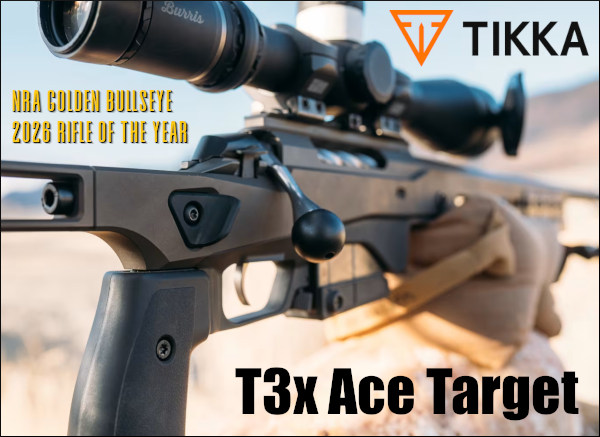
The Tikka T3x ACE Target rifle has been named the 2026 American Rifleman Golden Bullseye Rifle of the Year, a highly coveted award presented annually by NRA Media. This impressive factory rifle is a great choice for PRS/NRL competition. It boasts a good chassis with full-length ARCA rail, modular magwell, and adjustable cheekpiece. The action is smooth with a nice fluted bolt and big bolt handle knob. On top of the action is a +20 MOA Picatinny rail which helps with long-range shooting. This rifle has shown very good accuracy with factory ammo, aided by an excellent 2-stage trigger that adjusts from 2 to 4 pounds. T3x Ace Target available chamberings are .223 Rem, 6.5 Creedmoor, and .308 Win, all priced at $1799.00 at EuroOptic.com. The 6.5 Creedmoor with 26″ barrel would be our choice for PRS/NRL competition.
SAKO S20 — Great Hunting Rifle
About Beretta: Established in 1526, Beretta is the world’s longest-standing gun-making enterprise, with a legacy spanning 16 generations of continuous family ownership. For 500 years, firearms bearing the Beretta name have been trusted and used around the world. Beretta USA Corp. was established in 1977 and became the provider of the most widely deployed sidearm in the U.S. Armed Forces. Today, Beretta USA is part of Beretta Holding Group, which includes over 50 global subsidiaries and 20 noted brands. Beretta manufactures and distributes a complete range of firearms, accessories, and apparel.
Ever wish you could look inside your rifle, to see how the trigger and fire-control system work? Well now that is possible with the magic of 3D computer graphics. Modern software allows detailed “cutaway” side-views (see below), as well as 3D views with 360° rotation. The software can also provide X-Ray-type views into the gun’s internals — as you can see above. And computer animation can show the complete firing process from trigger pull to chambering of the next round.
Rem 700 Cutaway View from Right Side
This article provides some very cool 3-D “Cutaway View” animations of the popular Remington 700 action, probably the most successful American bolt-action ever created.
READERS — Take the time to watch the video! The Rem 700 animation is really outstanding! EVERY bolt-action shooter should watch this video all the way through.
Cutaway 3D Animation of Rem 700 Action — Watch Video
The Model 700 series of bolt-action rifles have been manufactured by Remington Arms since 1962. All are based on basically the same centerfire bolt action. They are typically sold with an internal magazine depending on caliber, some of which have a floor-plate for quick-unloading, and some of which are “blind” (no floor-plate). The rifle can also be ordered with a detachable box magazine. The Model 700 is a development of the Remington 721 and 722 series of rifles, which were introduced in 1948.
The Remington 700 is a manually-operated bolt action with forward, dual opposed lugs. It features “Cock On Opening”, meaning the upward rotation of the bolt when the rifle is opened cocks the firing pin. A cam mechanism pushes the firing pin’s cocking piece backward. The bolt face is recessed, fully enclosing the base of the cartridge. The extractor is a C-clip sitting within the bolt face. The ejector is a plunger on the bolt face actuated by a coil spring. The bolt is of 3-piece construction, brazed together (head, body. and bolt handle). The receiver is milled from round cross-section steel.
This video was made with the help of the World of Guns: Gun Disassembly interactive encyclopedia with 3D rendering. This remarkable web-based software allows users to view the inner workings of hundreds of different rifles and pistols — everything from a .22 LR Ruger to a .55-caliber Boys Anti-Tank rifle. There are also 25,000+ parts diagrams. This is a remarkable technical resource. SEE MORE HERE.
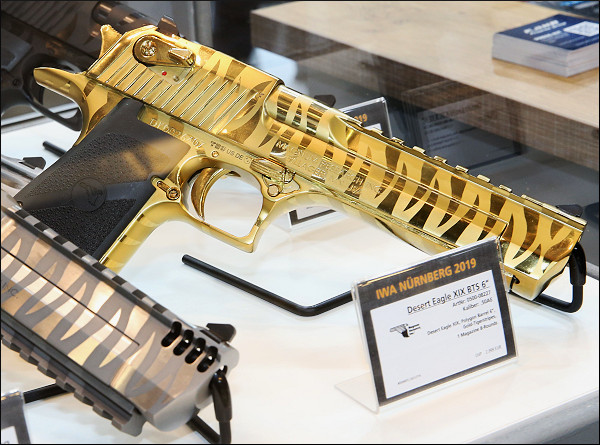
SHOT Show 2026, America’s big firearms trade show, just concluded last Friday, 1/23/2026. But another massive gun/hunting trade show kicks off in four weeks. The IWA Outdoor Classics 2026 show will be held from February 26 to March 1, 2026, in Nuremberg, Germany. This premier international trade fair for hunting, shooting sports, and outdoor equipment features four days of exhibitions. Every year the show features thousands of impressive firearms. Here are some images of handsome handguns on display at past IWA Outdoor Classics trade shows. Enjoy this Pistol Preview.
Custom Walther Pistols with Deluxe Engraving and More…
Stunning, custom Walther pistol with engraved, fancy blued metal and deluxe grip.
At the request of our readers, we provide select “Deals of the Week”. Every Sunday afternoon or Monday morning we offer our Best Bargain selections. Here are some of the best deals on firearms, hardware, reloading components, optics, and shooting accessories. Be aware that sale prices are subject to change, and once clearance inventory is sold, it’s gone for good. You snooze you lose.
NOTE: All listed products are for sale to persons 18 years of age or older. No products are intended for use by minors.
Midsouth — Hornady V-Max Bullet Sale
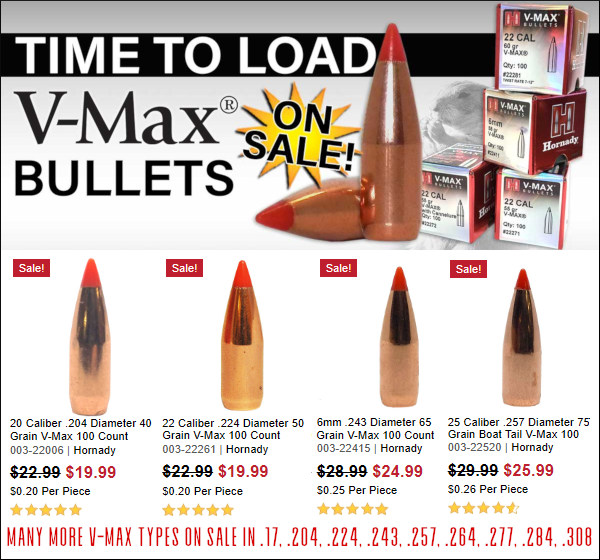
⏺️ » Superb varmint bullets at major discounts — save 13-14%
Ok varminters, here’s your chance to stock up on some of the best varmint bullets you can buy. Right now at Midsouth, along with the four (4) V-Max types shown above, there are 20+ other Hornady V-Max types on Sale in .17, .204, .224, .243, .257, .264, .277, .284, and .308 calibers. Bullet weights range from a mere 25 grains in .17 caliber, up to 120 grains in 7mm (.284).
Palmetto State Armory — SHOT Show Deals ARs, Pistol, Optics
⏺️ » Save hundreds on quality rifles, handguns, and optics
Currently, Palmetto State Armory is running a major SHOT Show sale. There are dozens of good deals on guns, components, optics, ammo and more. Three notable choices featured above are: Complete PSA M4 PA-15 Carbine for $479.99; SAR9 9mm Pistol for $179.99; Crimson Trace RAD 3 MOA Red Dot for $69.99. That SAR9 pistol is truly a steal at under $180.
As an Amazon affiliate, this site can earn revenues through sales commissions.
Progressive reloading presses offer shooters speed and efficiency in producing custom-tailored rifle and pistol ammunition. However, there is a wide choice of Progressive Presses and a bewildering array of options to consider. In this video, the 6.5 Guys and UltimateReloader.com’s Gavin Gear provide an overview of the leading Progressive Presses on the market along with key considerations for precision rifle shooters. If you are considering getting a Progressive for rifle ammo reloading, you should watch this informative, 25-minute video.
10 Tips for Reloading Rifle Ammo on a Progressive Press:
1. Make sure the brass is very clean. Don’t mix old range pick-up brass with newer brass.
2. Apply a thin, spray lube to all cases before the sizing/loading cycle.
3. Consider priming your brass separately (with a hand or bench tool) before the operation. Then inspect the primers before loading powder and bullets.
4. Always wear eye protection when loading with the Progressive, particularly if you are priming cases.
5. With masking tape, mark the powder measure/dropper with the powder type and cartridge charge weight. Check the charge mass multiple times (see below).
6. Cycle a few cases, sizing and adding powder but NOT seating bullets. Weigh the powder charges to ensure the powder measure is dispensing the correct charge. Sometimes this will change a couple tenths as it “settles down” after the first few charges.
7. Check the brass for shoulder bump and bullet seating depth carefully for the first few rounds, then check again periodically.
8. Try to maintain a steady pace and operate the handle the same way every time.
9. Visually inspect the powder charge in each case (before bullet seating), and use a lock-out die if your Progressive Press has enough stations.
10. Never, ever mix pistol and rifle powders! If you have previously loaded pistol ammo with your Progressive, make sure ALL the powder (every flake and kernel) is removed from all parts of the powder-dropping system before you add rifle powder.
Visit these sites for more Reloading and Precision Shooting Videos:
For today’s Sunday GunDay story, we look at the legendary Remington 700, perhaps the most popular American bolt-action rifle of all time. After covering the history of the Rem 700 rifle, we provide an inside look at the Rem 700 through a series of cutaway animations. Then we explain how gunsmiths can enhance a Remington 700 action through “blueprinting” procedures.
Remington 700 Origins and History
After World War II, Remington Arms engineer Mike Walker began designing lower-cost alternatives to the Model 30, which resulted in the Model 721. These used a cylindrical receiver produced from cylindrical bar stock that could be turned on a lathe, rather than machined in a series of milling operations, which significantly reduced the cost of production. Further developments of the basic 721 action under the direction of Walker produced the Model 722 and Model 725, and ultimately in 1962, the Model 700.
Walker sought to increase the accuracy of the rifles, by utilizing tight tolerances in the chamber and bore, a short leade, and a very fast lock time. Like the earlier 721, the Remington 700 action was designed for mass production. Remington initially produced two variants of the Model 700, the ADL and BDL, in both long- and short-action versions. In 1969, Remington introduced upgrades for the rifle, including a longer rear bolt shroud, a jeweled bolt, and improved stock finishing. Four years later, production of left-handed Rem 700s began, to compete with the Savage Model 110, at that time the only major American-made left-bolt rifle.
Other Rem 700 versions include the titanium receiver 700ti, the 700 SPS (which replaced the ADL in 2005), and the CDL model. In addition to its development as a hunting rifle, the Model 700 also provided the basis for military and police sniper rifles, starting with the M40 rifle in 1966, which was initially ordered by the U.S. Marine Corps. The U.S. Army adopted the M24 Sniper Weapon System in 1986.
The Remington 700 is sold in both short action and long action variants. This photo is from the Big ED YouTube video comparing the two action lengths.
The Remington 700 is a manually-operated bolt action with two forward dual-opposed lugs. The bolt face is recessed, fully enclosing the base of the cartridge, The extractor is a C-clip sitting within the bolt face. The ejector is a plunger on the bolt face actuated by a coil spring. The bolt is of 3-piece construction, brazed together (head, body and bolt handle). The receiver is milled from round cross-section steel.
Rem 700 Cutaway Video Shows Components + Operation
Ever wish you could look inside your rifle, to see how the trigger and fire-control system work? Well now that is possible with the magic of 3D computer graphics. Modern software allows detailed “cutaway” side-views (see below), as well as 3D views with 360° rotation. The software can also provide X-Ray-type views into the gun’s internals — as you can see above. And computer animation can show the complete firing process from trigger pull to chambering of the next round.
READERS — Do take the time to watch the video! This Rem 700 animation is really outstanding! EVERY bolt-action shooter should watch this video all the way through.
The Model 700 series of bolt-action rifles have been manufactured by Remington Arms since 1962. All are based on basically the same centerfire bolt action. They are typically sold with an internal magazine depending on caliber, some of which have a floor-plate for quick-unloading, and some of which are “blind” (no floor-plate). The Model 700 is a development of the Remington 721 and 722 series of rifles, which were introduced in 1948.
The Remington 700 is a manually-operated bolt action with forward, dual opposed lugs. It features “Cock On Opening”, meaning the upward rotation of the bolt when the rifle is opened cocks the firing pin. A cam mechanism pushes the firing pin’s cocking piece backward. The bolt face is recessed, fully enclosing the base of the cartridge. The extractor is a C-clip sitting within the bolt face. The ejector is a plunger on the bolt face actuated by a coil spring. The bolt is of 3-piece construction, brazed together (head, body. and bolt handle). The receiver is milled from round cross-section steel.
Chassis Systems for Remington 700s
With the popularity of the Remington 700 series rifles, and the availability of Rem 700 barreled actions by themselves, many companies have created after-market chassis systems. This Brownells video reviews modern Accuracy Int’l chassis systems configured for Remington 700 barreled actions. Modular chassis systems have become particularly popular with PRS/NRL competitors.
The above video shows how a Rem 700 action can be upgraded with a carbon-wrapped barrel and new trigger, and then be easily installed in a modern MDT ESS Chassis.
Blueprinting Rem 700 Action — Making a Good Action Better
You may have heard the phrase “blueprinting an action”, but do you know what that really means? Do you know what operations are done to an action during the blueprinting process? To help you understand, gunsmith Bill Marr of RifleShooter.com has created a helpful article showing a Rem 700 blueprinting job start to finish. This article spotlights how the procedures can be done with manual tools. Bill, who runs 782 Custom Gunworks Ltd., can also perform many of these operations with modern automated machinery. In fact, Bill has written a follow-up article on Truing a Rem 700 receiver with a Lathe.
Bill explains: “Blue-printing, or truing a rifle action, ensures the receiver face, threads, lugs, bolt lugs, and bolt face are square to the center line of the receiver.” In Bill’s informative article, Bill shows how he blueprints a Remington 700 short action receiver with .308 Win bolt face. He covers the following procedures step by step:
Action Disassembly
Ream Minor Diameter of Receiver Threads
Square the Receiver Lugs
Square the Face of the Receiver
Lap the Bolt Lugs
Square the Bolt Face
Bill employed a variety of tools from Brownells to complete the blueprinting job, including: Remington 700 Armorer’s Kit; Manson Receiver Accurizing Kit; Bolt Lapping Kit; Bolt Face Truing Tool; Manson Receiver Ring Facing Cutter; Multi-Vise with Jaw Pads; Silicone Carbide Abrasive; and Do-Drill Cutting Oil>.
1. Truing the Receiver Face
Using the receiver facing tool, the front of the receiver is trued. The tool is placed over the tap and turned by hand. We used Do Drill to lubricate it.
2. Lapping the Lugs
The bolt lapping tool screws into the front of the action and applies rearward pressure on the bolt face. A little bit of lapping compound is placed on the front of the receiver lugs. The bolt handle is then raised and lowered repeatedly. Note — it is critical that we do not get any lapping compound on any other surfaces.
3. Truing the Bolt Face
On this bolt, the central part of the bolt face was low. After the truing operation, this Rem 700 bolt face is now completely square to the action.
IMPORTANT: Rifleshooter.com states: “This article highlights our project and is presented for information purposes only. This provides an overview of the process and should not be attempted without the guidance and supervision of an experienced gunsmith“.
If you like the idea of a Remington action custom rifle, you can order a wide variety of Remington 700 standard and custom shop actions from Pacific Tool & Gauge starting at $399.00 (see above).
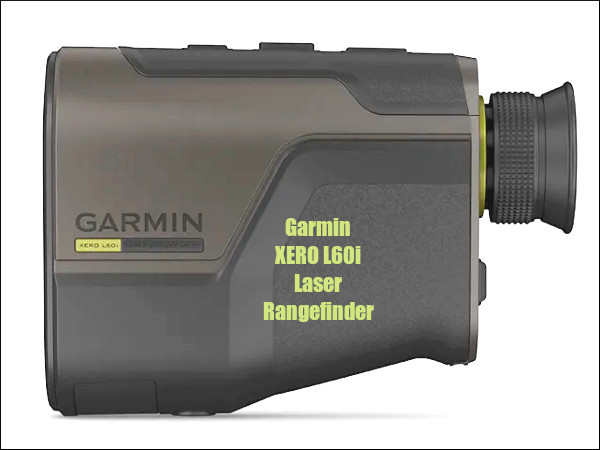
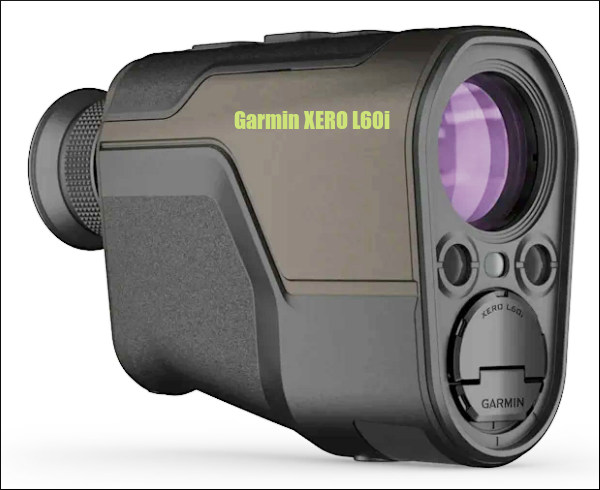
Garmin has introduced a new, very advanced laser rangefinder that raises the bar in terms of hand-held ranging technology. The new Garmin XERO L60i Laser Rangefinder represents a major breakthrough with key functions not found on other rangefinders. This XERO L60i unit has onboard ballistics to help calculate your hold. And there are onboard temperature, barometer, and humidity sensors. And the unit even has geo-memory that can tag a sighted location with GPS. But all that sensor tech and sophisticated ranging comes with a price. This Garmin XERO L60i unit has an MSRP of $2499.99. That’s $1000.99 more than the highly-regarded Leica Rangemaster CRF MAX rangefinder ($1499.00), and it is $1650.99 more than the excellent Leica RangeMaster CRF Pro ($849.00).
Notable features of the new Garmin XERO L60i:
High-resolution, full-color Overlay Display
Very sharp visual optics with 32mm objective and 7X magnification
Ranging out to 2000 yards for trees and out to 1500 yards for animals
Laser Locate feature to set GPS waypoint on previously ranged objects/animals
XERO L60i can access Applied Ballistics solver with AB Quantum Garmin App
Can range up to 1400 times with just two AAA Batteries*
This official Garmin video covers the notable features listed above.
This Garmin video shows how to employ XERO L60i advanced features in the field.
Want this Amazing Rangefinder? It’s in Stock Now at MidwayUSA
* The Garmin Xero L60i chronograph is powered by two user-replaceable 1.5V AAA lithium batteries, providing an operating life of approximately 1400 shots or ranges (based on a one-second range followed by a 10-second display). The unit is designed with an IPX7 water rating and operates between -20° to 60°C (-4° to 140°F).
UltimateReloader.com offers some of the most thorough firearms and reloading tool tests on the internet. And the Ultimate Reloader YouTube Channel now has over 1300 videos that showcase reloading tools, accurate firearms, precision optics, gunsmithing methods, and top-tier reloading components. For today’s Saturday at the Movies feature, we showcase ten videos created by Gavin Gear and his UltimateReloader team. These videos feature ELR Rifles, Peterson and Lapua brass, a brand new RCBS trimmer system, BAT actions, a handsome 6x47L Custom Rifle, the Athlon Rangecraft Chronograph, and Ultimate Reloader’s impressive new RifleBuilderPro Software System. Enjoy this Saturday Video Showcase.
Extreme Long Range — One Mile Shooting
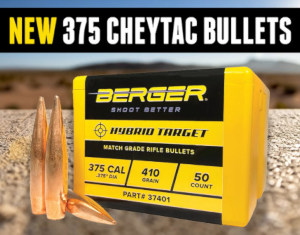
In this video, Gavin meets with Paul Phillips, an ELR “King of Two Miles” past Champion. Paul explains the features in his .375-caliber rifle designed to shoot to one mile and beyond. Along with a big action to hold the very long cartridge, an ELR rifle needs a special high-angle optics rail to allow the needed elevation. In addition, a long-wheelbase chassis is optimal for greater stability and balance. Recoil is very significant so Paul’s rifle boasts a massive 6-port muzzle brake on the very long barrel (ELR barrels can run 34-36″). For his projectiles, Paul is running Berger’s impressive new 410gr .375 caliber Hybrid Target Bullet (6:25 time-mark).
Peterson Cartridge — How High-Quality Brass is Crafted
Ever wondered how modern, top-quality rifle brass is made? Then watch this informative video from start to finish. It shows how the brass cases are drawn (lengthened) in stages, how the primer pockets and rims are formed, how the shoulders and case necks are crafted, and then how the brass cases are machine-annealed for consistent strength and neck tension.
6x47L Rifle Build with BAT Action & Woox Furiosa Ultra Chassis
Gavin Gear has completed many impressive custom rifles. This handsome rifle is one of Gavin’s best efforts. Chambered for the 6-6.5×47 Lapua wildcat cartridge (aka 6x47L), this rifle has show great accuracy. It boast a handsome black BAT Hammerhead action and a wood/metal composite WOOX Furiosa Ultra chassis. This high-tech hybrid stock/chassis combines wood sections over a full-length, aerospace-grade aluminum skeleton chassis, giving it the “feel” of a wood stock with the strength and stability of a metal stock. Gavin likes the way the stock feels on the trigger hand in particular and the smooth wood cheekpiece is also very nice. Made in Italy, the Furiosa is offered in three versions all with wood sections on the forearm, grip area, and cheekpiece. Choose natural Walnut Brown, Micarta Black, or Midnight Grey.
NEW RCBS MatchMaster Precision Case Trimmer System
At SHOT Show 2026, RCBS introduced the new MatchMaster Precision Case Trimmer system. Developed with Henderson Precision, this is a high-speed, motorized system that trims, deburrs, and chamfers .22 to .30 caliber brass in one step. With a $699.99 MSRP, the MatchMaster trimmer features a 3-way carbide cutter, micrometer adjustment for 0.001″ accuracy, and a brass shavings catcher. It is designed for high-volume reloaders, offering fast, consistent, and automatic case prep. In this video, Gavin shows the features of this new RCBS power tool.
BAT Actions — Insider Look at Manufacturing
Full Story:https://bit.ly/3hD2d11 BAT Machine Co. makes some of the finest custom actions you can buy. Numerous national and world records have been set with BAT actions. To create this 31-minute video, Gavin traveled to Idaho to visit the BAT Machine production center in Post Falls, ID. Gavin talked with BAT’s founder Bruce Thom. The video features extensive footage of advanced CNC machines used to produce the superb BAT actions.
New 6GT Cartridge Brass from Lapua
It’s great that Lapua is now offering 6GT brass. Developed by George Gardner of G.A. Precision and Tom Jacobs of Vapor Trail Bullets, the 6GT was designed to have the efficiency of a 6mm Dasher without the need for case forming. It was also designed with a longer case body so it feeds better from magazines.
Even with the added capacity, the 6GT is still very efficient, and can achieve good velocities with less powder than a 6mm Creedmoor. With outstanding brass now being offered by Lapua, the 6GT becomes a very good choice for PRS/NRL competition, and even mid-range F-class competition. It’s longer than a Dasher case so it runs better in magazines, but it’s still more efficient than a 6mm Creedmoor or .243 Win.
RifleBuilderPro Gunsmithing Program Unveiled
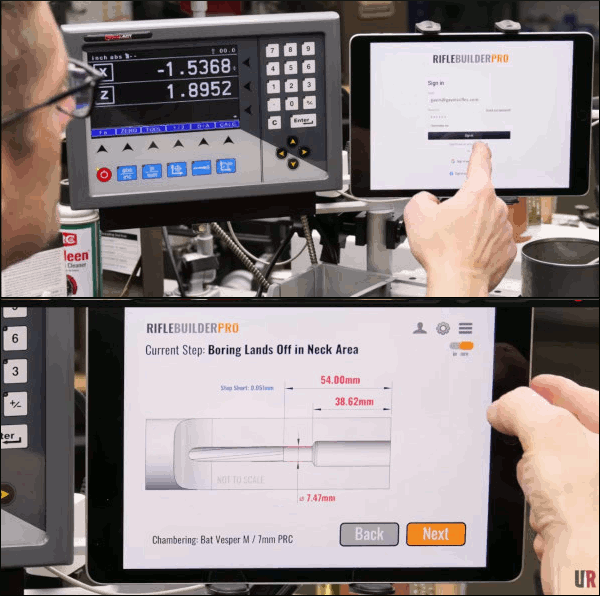
At SHOT Show 2026 Gavin Gear introduced an impressive new software/info system for gunsmiths and gun-building operations. Rifle Builder Pro provides key specifications and data for smithing operations. But it is more than just about machine controls — Rifle Builder PRO will be a subscription-based companion and digital reference library for Precision Rifle Gunsmiths, designed to help them achieve great results in less time. Subscribers will also automatically join an online community full of exclusive resources and support to improve their craft.
Rifle Builder PRO is currently targeted towards precision rifle gunsmiths working on bolt-action rifles but there are expansion plans to include additional types of rifle gunsmithing. At this time Rifle Builder Pro is still in development with a public Beta coming later this year. Sign up for email updates at RifleBuilderPro.com.
Athlon RangeCraft Chronograph (Two Videos)
Athlon’s Rangecraft Velocity PRO Doppler Radar Chronograph is a genuine rival to the popular Garmin. These two UltimateReloader vidoes cover the AThlon’s features, specs, and hardware. Then the video covers the testing process. The new Athlon Rangecraft Velocity Pro Radar Chronograph is an impressive and very affordable compact chrono, selling for $399.99 at most vendors. This employs Doppler radar allowing ultra-accurate velocity readings. Since the unit isn’t triggered by a muzzle blast, it can work with suppressors, muzzle brakes, and other muzzle devices.
The Rangecraft Vel Pro reads velocities between 65 FPS and 5000 FPS. So far field tests have shown that the Athlon Rangecraft chrono is reliable and picks up all shots fired with all types of rifles and pistols (even airguns). However the listed velocities may be a few FPS different than a Magnetospeed or Labradar. The unit includes a compact tripod.
BONUS: .223 Rem vs. 5.56x45mm — Ultimate Reloader’s Most Popular Video EVER with 7.8 Million Views
This video explains essential facts and corrects common misconceptions related to both .223/5.56 ammunition, as well as .223/5.56 rifles. Gavin provides insight on chamber specs, pressure levels, barrel twist rates, military 5.56 crimped brass, and other important topics. If you are new to the AR world, this video is definitely worth watching. And that’s why it now has garnered over 7.7 MILLION YouTube views, making it one of the most popular gun-related videos ever. Full Story:CLICK HERE for full written analysis of .223 Rem vs. 5.56x45mm with graphs and data.
Forum member Rich DeSimone uses a handy “Stub Gauge” for setting shoulder “bump” and seating depth. The gauge is made from a section of barrel lopped off when the muzzle is crowned. The chambering reamer is run in about 1/4 of the way, enough to capture the neck and shoulder area of the case. Rich then uses his full-length die to “bump” a master case with the ideal amount of headspace for easy feeding and extraction. He takes that case and sets it in this Stub Gauge, and measures from the front of the gauge to the rim. He can then quickly compare any fired case to a his “master” case with optimal headspace. Since the gauge measures off the shoulder datum, this tells him how much to bump his fired brass.
In addition, the Stub Gauge can be used to set bullet seating-depth. Rich has a channel cut transversely on one side of the gauge, exposing the throat area. Since the interior of the gauge is identical to the chamber in his gun, this lets him see where a seated bullet engages the rifling. He can tinker with bullet seating length until he gets just the right amount of land contact on the bullet, confirmed visually. Then he measures the case OAL and sets his seating dies accordingly. This is much handier than using a Hornady Tool to measure distance to the lands.
But what happens when the throat wears and moves out on your live barrel — making the actual length to lands different (slightly longer) than before. Well, the stub gauge is still valuable as a known starting point. As your barrel’s throat wears, you may seat your bullets out further to “chase the lands”, but the gauge provides a constant land engagement point, in the barrel’s “as new” condition. By measuring the difference between the land contact point on the gauge and the actual contact point on your barrel, you can determine throat “migration”.
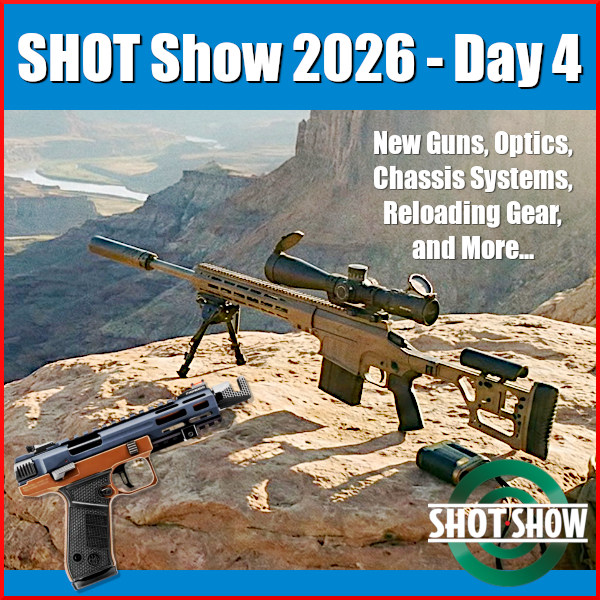
SHOT Show 2026 in Las Vegas concludes today, January 23, 2026 at 4:00 pm. This was an impressive show with thousands of vendors displaying products on 19 acres of floor space at Caesars Forum and The Venetian EXPO. There were many innovative new products, including new optics, chassis systems, barrels, “smart” guns, advanced suppressors and much more. For this Friday Day 4 of SHOT Show we offer a showcase of interesting product report videos.
Good Hunting Gear — Rifles, Optics, LRFs, Packs
26 Interesting Recent Release Rifles (2025-2026)
Beretta B22 Jaguar .22 LR Pistol
With SHOT Show 2026 Concluding — PLAN for SHOT Show 2027!
SHOT Daily Day 4 Digital Magazine
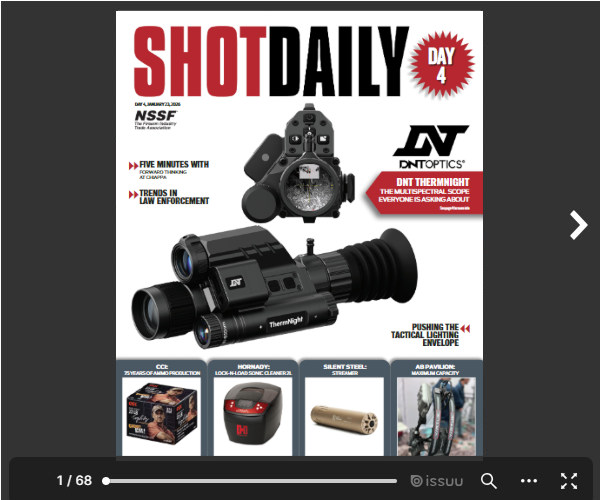
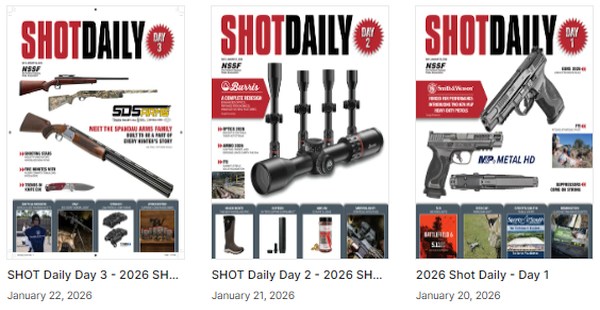
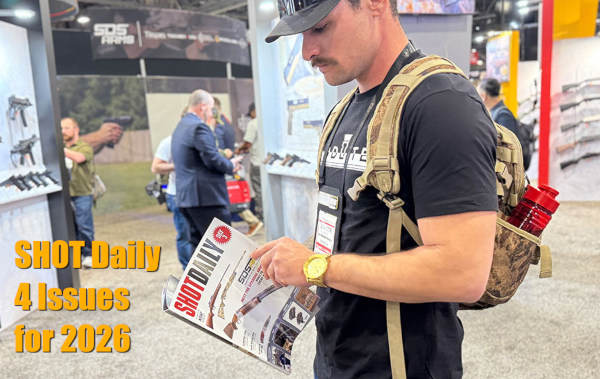
Today is the final day of SHOT Show 2026. So we offer another FREE digital magazine covering many new products at the Show. The SHOT Daily Day 4 edition (shown above) is a digital version of the print magazine distributed today at SHOT Show. It offers a number of interesting articles including NEW Products and Law Enforcement Trends. To access SHOT Daily Day 4 CLICK HERE or visit the SHOT Daily Archive which hosts all 2026 SHOT Daily issues.
To quickly scan through the entire digital magazines, use the slide bar. When you find content you want to read, use the zoom control or click the FULL SCREEN brackets icon at lower right.





 This video was made with the help of the













 In this video, Gavin meets with Paul Phillips, an ELR “King of Two Miles” past Champion. Paul explains the features in his .375-caliber rifle designed to shoot to one mile and beyond. Along with a big action to hold the very long cartridge, an ELR rifle needs a special high-angle optics rail to allow the needed elevation. In addition, a long-wheelbase chassis is optimal for greater stability and balance. Recoil is very significant so Paul’s rifle boasts a massive 6-port muzzle brake on the very long barrel (ELR barrels can run 34-36″). For his projectiles, Paul is running Berger’s impressive new 410gr .375 caliber Hybrid Target Bullet (6:25 time-mark).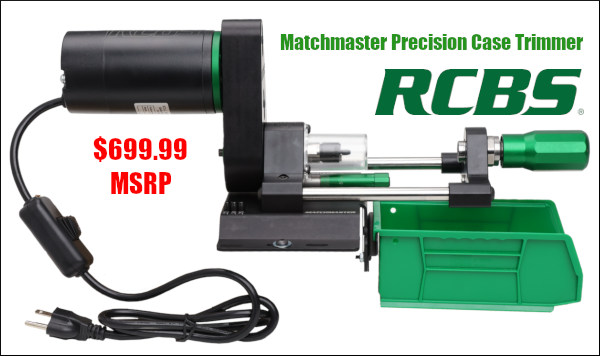



 Forum member Rich DeSimone uses a handy “Stub Gauge” for setting shoulder “bump” and seating depth. The gauge is made from a section of barrel lopped off when the muzzle is crowned. The chambering reamer is run in about 1/4 of the way, enough to capture the neck and shoulder area of the case. Rich then uses his full-length die to “bump” a master case with the ideal amount of headspace for easy feeding and extraction. He takes that case and sets it in this Stub Gauge, and measures from the front of the gauge to the rim. He can then quickly compare any fired case to a his “master” case with optimal headspace. Since the gauge measures off the shoulder datum, this tells him how much to bump his fired brass.