You may recall that Forum member Rodney Wagner (aka “Eggman”) shot a 0.349″ (50-2x) group at 600 yards to set two IBS records. This is the smallest 600-yard group in history. With his BAT-actioned Dasher, Rodney put five shots inside a dime at six hundred yards. This is one of the most amazing feats of shooting ever. And now the gun is gone. It was stolen, along with a second benchrest rifle. The combined value of the two guns is over $11,000, but the record gun is priceless.
Rodney’s Record-Setting Rifle Stolen — We Need Your Help
Over the weekend, Rodney Wagner had two valuable benchrest rifles stolen from his truck. Yes, the BAT-actioned Dasher that shot the historic 0.349″ 5-shot group was stolen, along with a second long-range Benchrest Rifle. The theft took place at a motel in Hendersonville, NC.
We request the help of our readers in recovering these two rifles for Rodney. Help us get the word out — talk to your shooting friends, post this story on other forums, link to it on Facebook. Insurance, if any is available at all, will only cover a small part of the loss. But we all know that this isn’t all about the money. You can’t just write a check and buy a rifle that shoots an 0.349″ group at 600 yards. Ironically, the thieves probably have no idea of the special nature of the guns they stole.
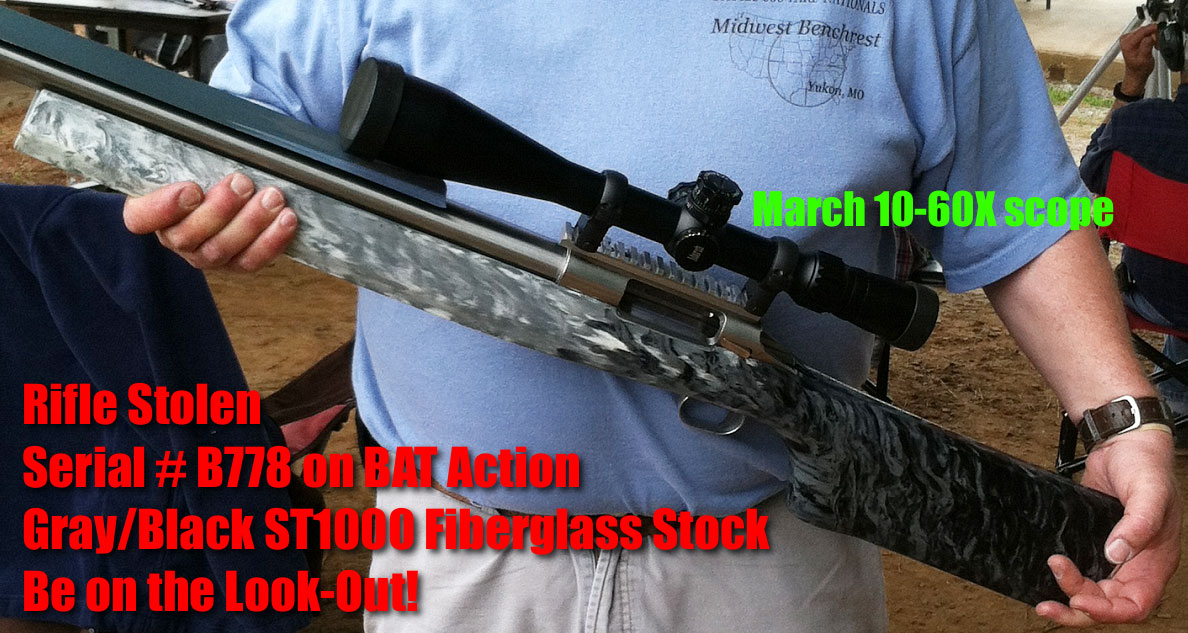
Stolen Rifle One: IBS Record-Setting 17-lb benchrest rifle. The BAT B action has serial number B778. It has a white, gray, and black Shehane ST-1000 fiberglass stock, and a Brux 6mm barrel chambered for the 6mm Dasher. A March 10-60x52mm scope (with tactical knobs) is fitted in Burris Signature rings on top. The action is a Right bolt, Left Port, Right Eject.
Stolen Rifle Two: IBS 17-lb Benchrest Rifle. Borden Rimrock action has serial number BR0253. It has a red and black Shehane ST-1000 fiberglass stock, and Brux 6mm barrel fitted with a VAIS muzzle brake. A March 10-60x52mm scope with tactical knobs was on top. We are still looking for photos of this rifle. It appears very similar to the first rifle, but with a red and black stock and a Rimrock action.
It does NOT appear that thieves were specifically targeting the record-setting rifle. The Hendersonville Police told us that another theft was reported at about the same time in the same neighborhood. They called this “an ordinary crime of opportunity”.
Folks, please keep your eyes out for these two rifles. These are distinctive guns — not what you’d see everyday at a pawn shop (or even at most gun ranges). Please tell other folks in the firearms community to be on the look-out. Also, the thieves might try to unload the two March 10-60X Scopes separately. Look for March Serial Numbers X341 and X291. You can use this link to point people to this story: http://bit.ly/14PtT5o.
If you have any information, please contact officer Peter Laite of the Hendersonville (NC) Police Department. Call 828-697-3025 or email: plaite [at] cityofhendersonville.org
$1000.00 Reward Offered
AccurateShooter.com will provide a Five Hundred Dollar ($500.00) reward to any individual who returns the two guns in undamaged condition or provides information that leads directly to the recovery of the two guns in undamaged condition.
In addition, Rodney Wagner will pay a $500.00 reward if the two rifles are recovered intact and undamaged. This makes the total reward $1000.00. That’s $500 from AccurateShooter.com, and $500 from Rodney Wagner.
Need a premium cut-rifled barrel? Be prepared to wait six months or more. However, if you were a member of the NorCal Practical Precision Rifle Club (NCPPRC) you’d be sitting pretty right now. After receiving a boatload of new Bartleins (31 by our count), NPPRC’s Vu Pham announced on Facebook: “Our first batch of Bartlein Barrels has arrived!! This is less than 1/3 of our 2013 Club order!”
That’s an impressive supply of precious metal to be sure. Are those Bartleins worth their weight in gold? Not quite, but Vu and crew definitely have reason to celebrate. We hope all the folks at NCPPRC shoot lots of good scores with all those pretty new tubes. Yes, you could say we have “barrel envy” now.
From now on, California will require all new-model semi-automatic handguns to be manufactured with microstamping technology (aka “ballistic imprinting”). This requirement went into effect on May 17th, when the California Attorney General’s office declared that technical and patent barriers to the implementation of microstamping had been removed.
To make a firearm compliant, firearms manufacturers must now engrave a gun’s make, model, and serial number on two distinct parts of each gun, including the firing pin, so that, in theory, this data is imprinted on the cartridge casing when the pistol is fired. If the microstamp on the end of the firing pin wears out, then the gun is considered “unsafe” under California law, and the owner may not sell or transfer the gun.
California’s microstamping law was enacted way back in 2007. However, by its terms, the law did not go into effect until the technology was mature and patent rights were resolved. With the State government claiming that microstamping is now practical, new gun models must have microstamping capability in order to be approved for civilian sale in California. This will, eventually serve as a de facto ban on new-model semi auto handguns in California. Brandon Combs, Executive Director of the Calguns Foundation, explains: “Manufacturers are not going to create a special run of firearms with all of these very burdensome manufacturing technologies just so they can comply and produce firearms for one market.” At present, as far as we can determine, no major gun-maker currently offers a microstamping-capable, semi-auto handgun for sale in the United States — not a single one.
Current “California-Approved” Semi-Auto Pistols Can Still Be Sold — For a Time
The “activation” of California’s microstamping requirement does NOT mean that semi-auto handguns currently on the California “approved” list can no longer be sold. The current inventory of “approved” handguns are “grandfathered”, so they may be sold so long as the manufacturers continue to pay annual handgun roster registration fees to the State of California. However, any new-model semi-auto pistol — even one with a minor design change from a previous version — will be blocked from sale in California unless it has the microstamping feature. If a manufacturer stops producing a particular handgun, replacing it with a newer, upgraded version, that newer model cannot be sold in California unless it is microstamp-capable. (We should add that the microstamp requirement does not apply to handguns sold to law enforcement agencies.)
What we can expect is that, in time, as handgun manufacturers replace old models with new models (or make modifications to existing models), fewer and fewer new semi-auto pistols will be offered for sale in California. If, for example, Glock updates its Glock 17, the new model could not be sold in California unless Glock outfits it with microstamping capability.
NRA Plans Legal Challenge
NRA Attorney C.D. Michel says that microstamping is a flawed and impractical technology: “This is not going to help solve crimes. [Microstamping] is easily defeated… and can be used to lead police down false alleys.” Michel notes that criminals can easily defeat the microstamp by filing the tips of firing pins. Overall, Michel believes, microstamping will not reduce crime, but it will cut off the supply of handguns available to Californians. He stated the the NRA plans a legal challenge to the implementation of microstamping in California.
While there is virtually no “real world” evidence that microstamping has ever solved actual crimes, there are many important criticisms of the “ballistic imprinting” technology:
Stamped casing can only be traced to the last registered owner, not to the person who used the gun when the casings were stamped. In the case of a stolen gun, as is the case for most firearms used in crime, the stamped case would not lead to the criminal.
Criminals could collect discarded brass from a firing range and salt crime scenes with microstamped cases, thereby providing false evidence against innocent people and increasing the workload for investigators.
Microstamping is easily defeated. Inexpensive files will remove microstamping. Firing pins are normally replaceable and can be changed with simple tools or without tools. Firing a large number of rounds will wear down the microstamp.
Microstamping is an immature technology, and has not been subjected to sufficient independent testing. Transfer of microstamped marks to the cases is less reliable than proponents claim.
Judge Glen E. Conrad, Chief Judge of the United States District Court for the Western District of Virginia, entered a final judgment upholding the validity of Ashbury International Group, Inc.’s patent on its modular rifle technology. The court also held that Cadex Defence, Inc. of Canada infringed that patent, and enjoined Cadex from future infringement. Ashbury was represented by the Troutman Sanders law firm, and D. Alan Nunley of Reston, Virginia. The official case title is: Ashbury International Group, Inc. v. Cadex Defence, Inc., Case No. 3:11cv79, filed on December 16, 2011, in the U.S. District Court for the Western District of Virginia.
“The court held that Ashbury’s patent is valid, and potential infringers now know that Ashbury will protect its valuable intellectual property,” said Robert Angle, the head of Troutman Sanders’ Litigation Department in Virginia and a leading intellectual property litigator. “This case validates the significant investment Ashbury has made in its technological innovations.”
After entry of judgment, Ashbury CEO/President Morris Peterson declared: “We are very pleased with the final judgment, and feel confident that our intellectual property and [our] many innovative ideas … can in fact be protected, even in the hyper-competitive firearms industry. Our customers in the government, military, and sport shooting communities rely on Ashbury’s innovations. They deserve to have our best-engineered designs, particularly in life-critical applications.”
Virginia-based Ashbury Int’l Group is a DOD contractor, systems integrator, engineering, manufacturing and logistics company serving the government, military, and Spec-Ops communities in the USA and allied foreign nations. Among its products, Ashbury has designed fully integrated precision rifle platforms using the advanced SABER®-FORSST® modular stock chassis system for sporting, target competition and tactical shooting activities. Ashbury currently holds 16 US Patents relating to its advanced modular chassis system for precision bolt action rifle platforms, including the patent infringed by Cadex, U.S. Patent No. 7,802,392, and other patents pending.
About Troutman Sanders Law Firm Troutman Sanders LLP is an international law firm with more than 600 lawyers and offices located throughout the United States and China. Founded in 1897, the law firm represents clients ranging from multinational corporations to individual entrepreneurs, federal and state agencies to foreign governments, and non-profit organizations to businesses representing virtually every sector and industry.
Want a great deal on a pre-owned precision rifle? Then visit Bob White’s Shooter’s Corner website and check out “The List”. Bob maintains a wide selection of used benchrest, varmint, and precision rifles. In fact, Bob offers the largest inventory of used benchrest rifles and equipment in the USA. Along with complete rifles, you’ll find accessories, rests, scopes, and reloading tools.
NOTE: “The List” was last updated in January 2013, but there are still plenty of great deals on hand.
Contact Bob White directly for the latest offerings or ask for his personal “hand picks” from his vast inventory: (973) 663-5159; email: shootcnr [@] optonline.net.
You can find exceptional deals on “The List”, with complete, custom-action Benchrest rifles for as little as $1300.00, and Varmint rifles starting at $500.00. Here are eight examples (listings subject to change without notice):
Benchrest Rifle: 6PPC Light Varmint
BAT “S” multi-flat action R/L R eject. Bartlein 23½” bbl, 1-14T, .262 neck. Bruno/McMillan f-glass glue-in stock with unique Burl figured wood-grain finish. Jewell 2 oz. trigger. Includes: Kelbly type scope bases. Gunsmith: L. Bruno. This rig is Brand New, UNFIRED. Get a new rig without the 6 month to 1 year wait. $3150.(cost to build new $3800.) 4036 ser #S306.
Benchrest Rifle: 6PPC and 25 BR LV or HV (five barrels)
6PPC + 25BR LV/HV. Stolle Teddy polished R/L action with Jewell 2 oz. trigger. 3 Hart and 2 Shilen barrels with .262 PPC neck. One barrel 808 rounds, two barrels less than 100 rounds each. McMillan f-glass glue-in stock. Gunsmiths: D. Scott and S. Goodling. Excellent condition. Hard to find R/L Teddy with FIVE low mileage barrels, .308 bolt-face. Detailed records on all barrels. $2599. Definite $4200+ value (may sell lower w/fewer bbls). 3509 ser #94313
Benchrest Rifle: 6PPC Light Varmint (Left bolt)
6PPC Light Varmint, Stolle Panda LB/RP action with Jewell 2 oz. trigger. Krieger 22” bbl, 1:14″ twist, .262 neck, less than 750 rounds. McMillan f-glass glue-in stock, yellow color. Very good condition. Bargain in an accurate Left Hand bench gun. An extra .223-size bolt available at additional charge. $1449. 4019 ser #0423.
Benchrest Rifle: Unlimited 6PPC + .308
6PPC/308 Unlimited/Heavy Bag Gun, Hart #4 R/R action with two bolts. Two Hart straight-contour 1:14″ twist barrels: (1) .308 1.350×27¼” (unfired) with .340 no-turn neck, plus (1) PPC 1.350×25½” with .264 neck (less than 300 rounds). Lee Six Benchrest Unlimited f-glass stock, glue-in and bolt-in with pillar glass-bedding. Hart 2 oz. trigger. Includes Unertl-posa scope bases and $200 all-aluminum fitted gun case. Gunsmith: B. White and R.W. Hart. Near excellent condition — a super buy in a multipurpose/caliber rig with super accuracy. $1899. Cost to build new $4000+. 3614 ser #W-917.
Long-Range Benchrest Rifle: 300 WSM Light Gun
30-Caliber WSM Light Gun Class. Polished Stolle Kodiak action R/R, with Jewell 2 oz. trigger. Shilen 28.5″, 1:10″-twist barrel, .343 neck. McMillan Tooley MBR f-glass stock, blue color. Includes: decelerator pad. Gunsmith: B. White. Like new. Less than 100 rounds on entire rig/competition ready. $2250. Cost to build new $3900. 4047 ser #98311.
Varmint Rifle: 6mm AR (6.5 Grendel necked to 6mm)
Custom Rem 700 BDL R/R action w/Sako extractor, Timney 2-lb trigger, machined steel trigger guard/floorplate. Douglas 24” sporter barrel, 1:12” twist less than 50 rounds. No-turn neck. H&S Precision f-glass stock (black) with aluminum bedding block. Includes Burris 1″ scope mounts, oversize recoil lug, lapped locking lugs, speed lock fire control, 50 cases and Redding dies. Excellent condition. One accurate shooter. $899. 3996 ser #G6337962.
Rimfire Rifle: .22 LR Cooper Showpiece
Mod 57M Cooper, factory SS 24” fluted LV barrel, 1:16″-twist, less than 500 rounds. Factory Montana varminter AAA+ walnut stock with full fiddleback. Factory 14 oz. trigger. Includes: Talley scope bases. Has Cooper extra charge options: Grade II engraving, Skeleton grip cap, Inlayed sling swivels, extra high-grade wood, fluted barrel. A one-of-a-kind piece in as new (99%) condition at great savings. $2850. Cooper’s new price is $4600. 4051 ser #7113.
Rimfire Rifle: Anschutz .22 Magnum
Anschutz Model 1720 D Meister Grade. Factory 23¼” bbl — bore-scoped excellent. Factory figured/checkered, walnut stock, factory trigger. Includes Leupold 1″ scope mounts, custom bore cleaning action tube, original shipping container w/instr manual and factory test group. One very handsome near-new (98% condition) piece. $899. 4033 ser #1450433.
The 35th Annual Bianchi Cup is happening soon. The 2013 MidwayUSA/NRA Bianchi Cup Championship will take place in Columbia, MO, May 22-25. This major event draws shooters from all over the world. Along with the USA, competitors have come from Australia, Canada, Germany, Italy, Japan, New Zealand, Netherlands, and Switzerland. Firearm categories include: Open Division, Metallic Sights, Service Pistol, and Revolver. In addition there be awards for the top shooters in specific classes: Law enforcement, Women, Junior, International, Newcomer, Senior, Grand Senior.
One of the favorites this year is Jessie Duff, shown below competing with one of her Bianchi Cup custom rigs. Jessie’s pistol sports special brackets to help align and steady the gun during the barricade shots.
Slick Modified 9mm Model 1911 for Jessie
If you’re curious about the hardware used by top shooters in other action pistol events, here is Jessie Duff’s new Taurus PT1911 9mm single-stack, set up for Open Division. Note the extended, tri-port compensator attached up-front, and the large cut-out on top of the forward part of the slide. That cut-out is for weight reduction and improved balance. Interestingly, the rear of the slide is milled flat where the rear sight would be on a conventional model 1911. Jessie relies on her Leupold DeltaPoint red dot sight to get on target, so the pistol doesn’t need front or rear iron sights.
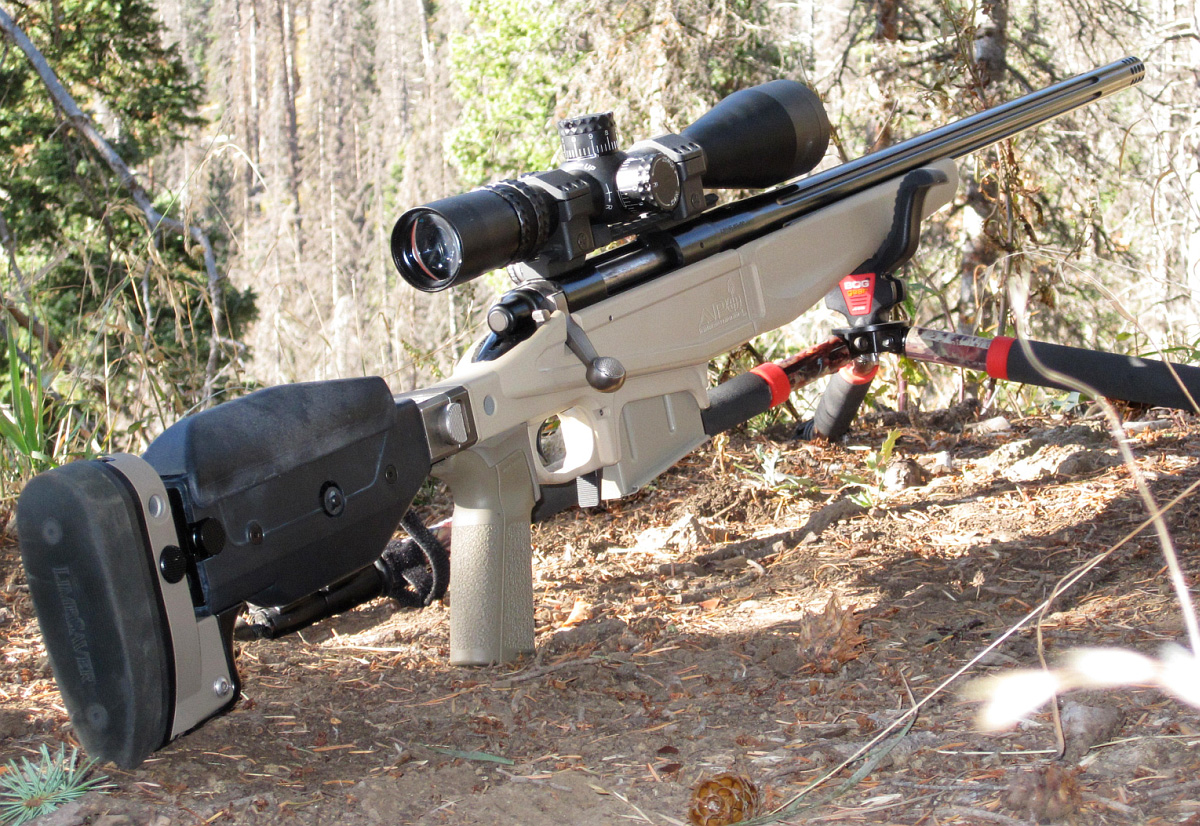
At the NRA Show in Houston, Ashbury Precision Ordnance (“APO”) will spotlight the new long-action SABER-FORSST Sporter Chassis. For hunters and recreational shooters, the SABER Composite Series Sporter is a “drop in, torque down and shoot upgrade” for long-action rifles with 1.200″ to 1.300″ barrel shank diameters. The SABER Sporter chassis features adjustable shoulder stock and carbon-reinforced fore-end (with traditional sporter shaping and twin swivel studs). You can install your barreled action in the SABER Sporter chassis in minutes using simple tools. No gunsmithing or bedding is required. All metal surfaces are coated for durability.
Rugged and Fully Adjustable
The SABER Sporter long-action chassis weighs just 5.25 lbs including the box mag, adjustable buttstock, Limbsaver® recoil pad, and ERGO® Sure Grip. This chassis offers full adjustability — length of pull (LOP), cheek-rest height, buttpad position, and even grip-to-trigger distance. APO says this is a very versatile stock, suitable for both hunting and field applications: “The Sporter is a comfortable, low-recoil rifle chassis impervious to all weather conditions and shoots comfortably off-hand, supported, or from a bipod”. APO’s SABER Sporter is offered in four colors for these action types: Rem700 SA and LA; McMillan G30 SA and LA; Surgeon RSR, 591, 1086, 1581.
Forum member Keith T. (aka “KT”) is in the U.S. Navy, so he has a fondness for seafaring, nautical color-schemes. Here is KT’s new F-Open rifle, smithed by Accurate Ordnance out of Winder, Georgia. The gun is chambered in .284 Winchester for Lapua brass (necked up) and 180gr Berger Hybrids.
KT admits, “It’s a little bit different than most in appearance!” But KT likes it that way: “When I had Accurate Ordnance build it, the only thing I specified was the stock, action, caliber and barrel length. I left the rest up to them. I think they did a pretty awesome job.”
The gun features a Pierce cone-bolt long action (with Jewell trigger) in a McMillan F-Class stock. The barrel is a Brux 31″, 1:9″ twist in the Brux “F-Class contour”. Sitting on top is the new Nightforce 15-55x52mm Competition scope with turrets and sun-shade coated blue to match the blue-coated action, bolt handle, rings, trigger guard and barrel.
The build came out great, but there were a few “bumps on the road”. KT explains: “This rifle took a long time to finish. When it comes to building guns I always joke and say if it weren’t for bad luck I wouldn’t have any luck at all. We started ordering parts in September 2012. Somehow I managed to order the stock from McMillan for the wrong Pierce action. After a bunch of scrambling and hard work on Accurate Ordnance’s part we were able to get my screw-up fixed. Then we ran into a few more snags. AO wanted to have the scope on hand before doing the coating. The first trigger was not up to standard with AO so they ordered another one and the list goes on. The rifle is finally done though and I couldn’t be happier.”
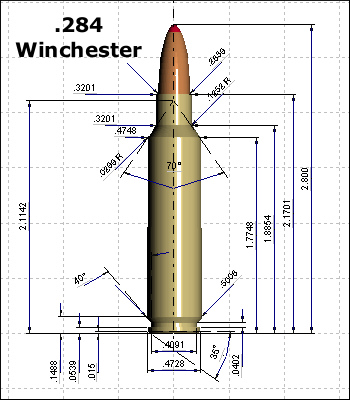
Editor: With Jerry Tierney steering a straight .284 Win to victory at the recent NBRSA 1000-Yard Nationals, we thought readers would appreciate a “second look” at this story. Our friend Bruce Duncan talks about the .284 Win and explains why it has proven so successful in long-range competition.
Building a Straight .284 Winchester
Sometime back–at least two years ago–Jerry Tierney confided in me that he was givng up on the 6.5s, and moving to the 7mms. “If you could only shoot one 7mm, Jerry,” I asked, “which would it be?” … “Straight 284 Win,” he answered.
So when I was thinking to rebarrel my 6.5×47 Lapua, in the fall of 2010, the .284 Win came immediately to mind. I am not about to argue the primacy of any chambering. I look at the dominance of the 6mm Dasher, at Missoula, say, or the recent NBRSA 600- and 1000-Yard Nationals and wonder.
And I’m reasonably convinced that none of us ever makes an entirely rational decision — one based purely on fact, and void of prejudice and emotion. But I knew a bunch of the U.S. F-Class guys were moving to 7mm, and decided to build one myself. This would be a NBRSA Heavy Gun, using my existing Barnard PC twin-port action, and my existing Shehane MBR Tracker stock. Going to the 7mm made sense to me — an accurate heavy bullet with a high BC, such as the Berger 7mm 180gr Hybrid, has a good chance of getting where one wants it to go. That’s particularly important when you’re shooting in tough wind conditions.
I ordered a 1:9″-twist barrel from Bartlein with 5R rifling and 1.250″ straight contour. (By the way, MT Guns has racks of Bartlein barrels if you need one right away.) I spoke at length with Ray Bowman of Precision Rifle & Tool (PR&T), who has immense experience with the .284 Win, and his fingerprints on a lot of winning rifles. Ray was supportive.
“The .284 Shehane isn’t enough bang for the buck”, Ray suggested. I sense he was telling me that I could achieve what I wanted with a standard .284 Win, without the cost of custom-run dies or the hassle of case-forming. I had David Kiff of Pacific Tool & Gauge cut me a reamer with a .313″ neck. I hadn’t decided on a bullet — I shoot Bergers exclusively — but watched the results from Phoenix in 2011, and noticed Bryan Litz did well with his .284 Win, shooting the Berger 180 Hybrid, as did Danny Biggs, shooting a 7mm RSAUM. I did some preliminary 100-yard load testing, and settled on a few loads I wanted to try (at longer range) with the Berger 180.
Shooting in good conditions on an Ojai, California morning, I tried three, five-shot groups with three different loads at 600 yards. One load in particular gave me two groups out of three at 1.8xx”. That’s pretty darn good at 600. The only surprise was that the bullets were seated to have the ogive just kiss the lands, rather than the slight jump that most were using.
It turned out that my load development wasn’t a fluke. The gun shot well, taking Third Place, 6-Target Aggregate Heavy Gun Group at the 2011 NBRSA 1000-Yard Nationals in Sacramento. Together with my 6×47 Lapua Light Gun, I took Third Place Overall. (The LG also featured a Barnard Action, Bartlein barrel, and Shehane stock.)
Great Accuracy Is Possible
So I was not surprised when Ed Docalavich, one of MT Guns clients, wrote to say how happy he was with the .284 Winchester we built for him. He attached one of the proverbial “Wallet Targets” from load testing. You can see it at right. There are five (5) shots at 100 yards, in a ragged hole you could practically cover with the Excedrin tablet in the photo. Not bad for a stout-recoiling rifle. Ed’s gun features a Barnard P action, Bartlein 5R 1:9″-twist, 1.250″-straight barrel, chambered for a no-turn neck.
Like I said, I’m not about to argue the primacy of any particular chambering, and my hat is off to the 6mms that do so well at 1000 yards. But I like the idea of a heavier bullet; the Berger 180gr Hybrid seems like magic. And as you might imagine, I don’t think it’s any coincidence at all that Ryan Pierce recently set a new 1000-Yard F-Open Record shooting the straight .284 Winchester. (READ Pierce Record Story).
Readers said they enjoyed our write-up of an innovative, offset-stocked Heavy Gun that set three multi-match Aggregate IBS records last year. If you’re a fan of “Heavy Artillery” here’s an impressive rifle from Forum member ‘Straightpipes’ that we spotlighted last year. If you missed it the first time — check out this engineering Tour De Force, complete with a custom-built, joy-stick REAR rest. We’re mightily impressed by the cutting-edge design and superb metal-work displayed by this “home-built special”. ‘Straightpipes’ certainly proved that American “know-how” and creativity is still alive….
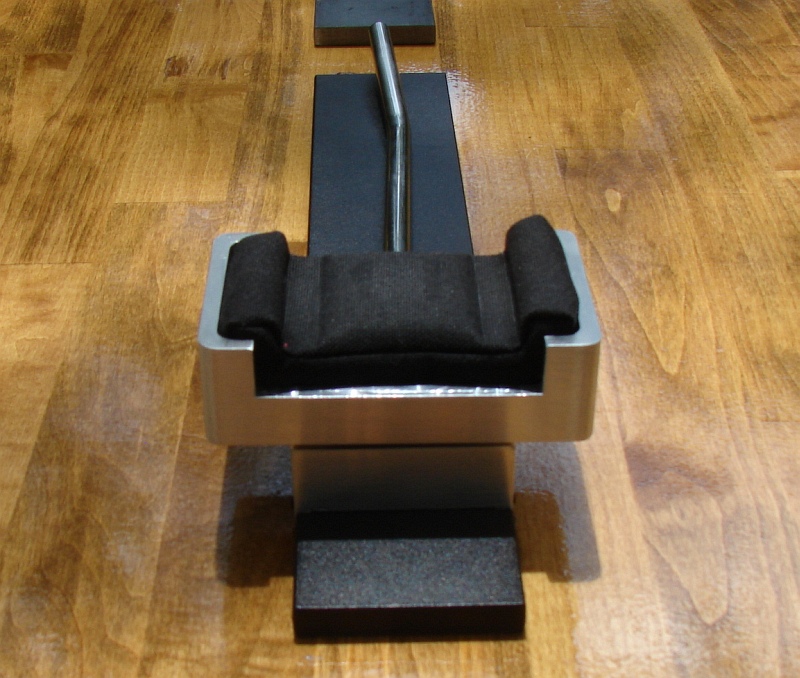
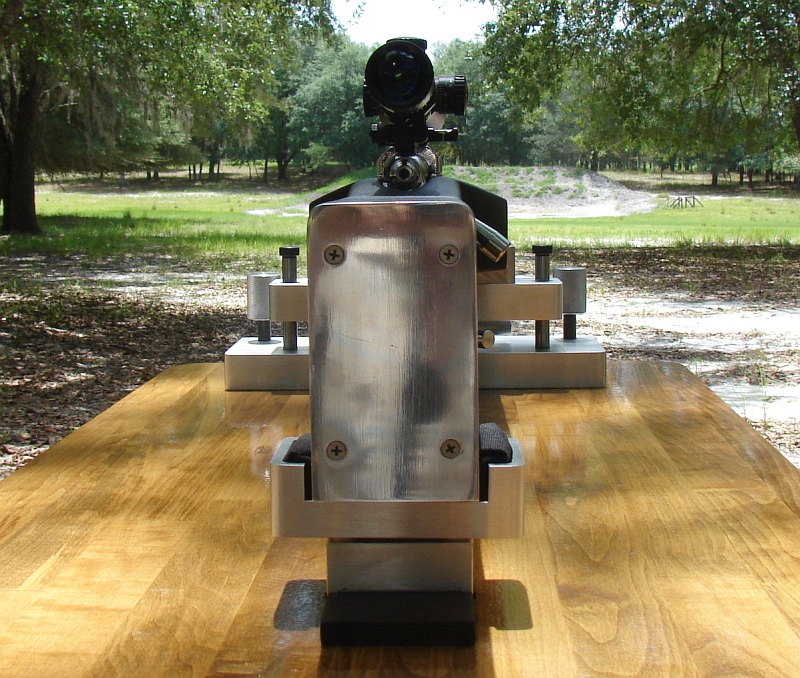
Coaxial (joy-stick) rests allow both vertical and horizontal movement with a single control. If you want to make a diagonal shift in point of aim, you can do this with one, smooth, continuous movement. Until now, this advantage has been limited to front rests. Well there’s some new technology in the benchrest world. Forum member ‘Straightpipes’ has created a coaxial rear joystick rest. He built this simple, compact rear rest in his home workshop for use with his 40-lb Heavy Gun. In combination with a vertically adjustable front rest, this new rear joystick rest allows aiming to be controlled from the rear, with your left hand in a comfortable position.
Straightpipes Rear Coaxial Rest — Design and Features
The rear rest is crafted from aluminum with a stainless steel forward-pointing joystick. Total weight, including the long, stabilizing base foot, is about 10 pounds. Though the rear rest doesn’t seem to have a large movement range, the system offers plenty of “on-target” travel. At 100 yards, the rest offers 10 MOA left, 10 MOA right, 5 MOA up, and 5 MOA down adjustment. That’s plenty of range for most targets, once you center the Point of Aim vertically using the captain’s wheel on the front rest, which Straightpipes also crafted himself. Click Square Photos Below to see Large Images.
Inside the rear cradle sits a Protektor rear sandbag, with Cordura fabric filled with ordinary sand. This fits the 3″-wide bottom of Straightpipes’ 40-lb heavy gun. There are some sophisticated components you can’t see in the photos. The rear rest can pivot (right or left slightly) to stay aligned with the front rest (as adjusted to level the cant of the rifle). Straightpipes says: “With the pivot, whatever I do to the front, the rear follows.” The basket (cradle) also employs a 20-lb bias spring system to handle the weight of the Heavy Gun. This prevents the co-axial system from binding, so it is fluid and easy to operate. Even with 20 pounds of gun weight on the rear, the joystick can be easily manipulated with a light touch of thumb and fore-finger.
Video Shows Rear Coaxial Rest in Action
Watch the video below to see how the joystick controls the rear rest. Total joystick movement is about a 2.5″ sweep. This gives 20 MOA total windage adjustment at 100 yards, and about 10 MOA vertical.
About the Straightpipes Front Rest
The coaxial rear rest is designed to work with the massive front rest as a system, though they are NOT connected, so as to comply with IBS Heavy Gun rules. The 30-lb front rest supports exactly half the weight of the rifle and is used to set gross elevation. Windage and fine elevation is controlled in the rear. Straightpipes also designed and built his beefy front rest himself. As with his rear coaxial unit, the front rest pieces were all shaped by hand on a belt sander after being milled out. Straitpipes even “finish-sculpted some pieces with hand files the old craftsmen way.” The main center support column was milled with extremely fine threads. This allows the captain’s wheel to turn with little effort and no locking mechanism is required. Straightpipes does not need to fuss with locking knobs when he sets gross elevation. To help keep the unit from binding, there are stainless guide shafts on the left and right. These shafts slide in oil-impregnated bronze bushings.
40-lb Barrel Block Heavy Gun with Savage Action
Straightpipes built this beautiful set of rests to work with his 40-lb Heavy Gun. Chambered in 7mm WSM, the gun features a Savage Target Action, and a Brux 32″, 1.300″ straight-diameter barrel fitted with a custom barrel nut. The barrel is clamped forward of the action in a 9″-long barrel block. This allows the Savage action to free-float. The block, also built by Straightpipes, looks fairly standard, but it has some clever design features. Between the barrel and the block there is sleeve that is slightly compressed when the block’s bolts are tensioned. This sleeve, made of a proprietary material, eliminates metal to metal contact between barrel and block. Straightpipes believes this enhances accuracy and provides some damping. Other shooters with barrel-block guns have used epoxy between block and barrel, but that makes disassembly difficult. The sleeve system on Straightpipes’ gun allows the barreled action to be easily removed from the stock. In addition, the compressed sleeve system is very stable — Straightpipes doesn’t have to fiddle with the bolt torques on his block.
‘Black Beauty’ Stock Made from Resin-Soaked Laminated Wood, with Rust-Oleum Finish
Straightpipes built the beefy stock himself. It is made from “red oak” wood soaked in resin and then laminated together with JB Weld. The rear section features a polished aluminum buttplate and twin metal “runners” on the underside, where the stock rides the Protektor Cordura bag. Straightpipes says the stock is very stable: “it absolutely does not flex or warp with changes in temp or humidity”. We asked Straightpipes about the stock finish. To our surprise, “Pipes” revealed he used inexpensive Rust-Oleum fine texture outdoor furniture paint. “Pipes” told us: “I’ve been using this stuff for years. It’s abrasion proof and tough as nails — the bags won’t wear it off. It’s solvent-proof, won’t get soft or bubble up. It cleans up with a damp cloth, just rub it down and it looks like new.”
As designed and crafted by Straightpipes, this Heavy Gun rest system is impressive. The rear rest is brilliantly simple, and beautifully finished. But the important question is: “how does it shoot?”. Straightpipes reports that the whole system exceeds his expectations: “The rear rest actuation is smooth and positive. It works smoothly in conjunction with the front rest. Everything is working together — there’s nothing that’s fighting another element of the system. The gun tracks straight. When it returns to battery, the thing is pretty much waiting for you shot after shot.” The rear rest’s small footprint allows the “driver” to sit comfortably behind the rig. Straightpipes reports: “Shooters can ‘address the rifle’ just like a Light Gun — you’re not straining to wrap your arm around something overly massive. Anybody can shoot this, it’s a very easy gun to shoot.”
Is it accurate? In a word, “Yes”. Straightpipes doesn’t want to make claims before the rig has been tested in competition, but he says it has “shot groups at 600 and 1000 yards that would be very competitive.” We promised not to publish group sizes yet, but we can tell you that at 600 yards in good conditions it drilled some “scary small” 5-shot groups, well, well under 1/4 MOA.



 Need a premium cut-rifled barrel? Be prepared to wait six months or more. However, if you were a member of the
 From now on, California will require all new-model semi-automatic handguns to be manufactured with microstamping technology (aka “ballistic imprinting”). This requirement went into effect on May 17th, when the California
  Judge Glen E. Conrad, Chief Judge of the United States District Court for the Western District of Virginia, entered a final judgment upholding the validity of
 Want a great deal on a pre-owned precision rifle? Then visit Bob White’s


 Rugged and Fully Adjustable


 Building a Straight .284 Winchester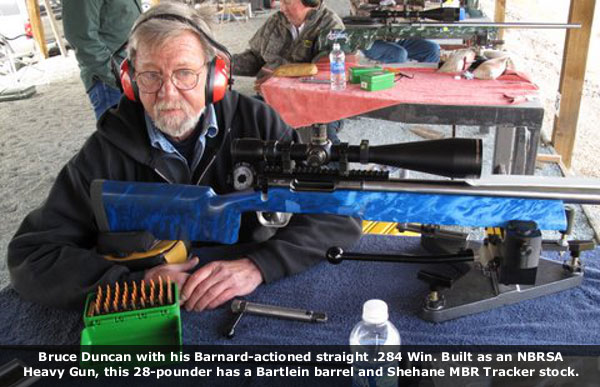
 It turned out that my load development wasn’t a fluke. The gun shot well, taking Third Place, 6-Target Aggregate Heavy Gun Group at the 2011 NBRSA 1000-Yard Nationals in Sacramento. Together with my 6×47 Lapua Light Gun, I took Third Place Overall. (The LG also featured a Barnard Action, Bartlein barrel, and Shehane stock.)