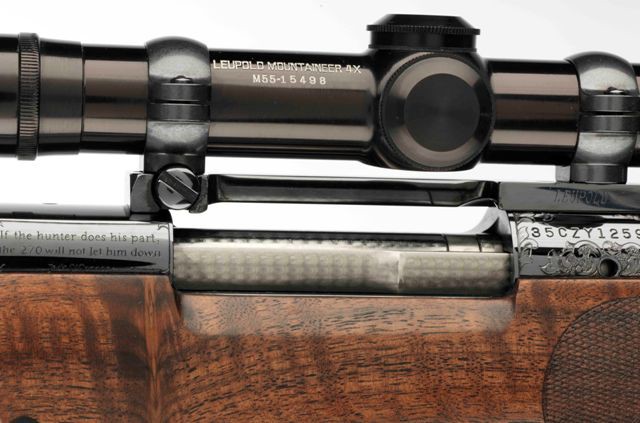
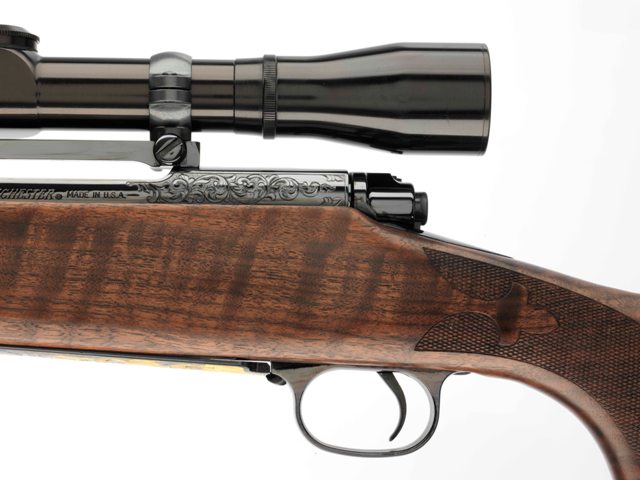
Classic hunting rifles never go out of style. We thought our readers would enjoy some photos of a special Jack O’Connor Tribute rifle in .270 Winchester. This unique Model 70 is a featured SHOT Show 2013 rifle. It is being auctioned on Gunbroker.com, with proceeds to benefit hunting and shooting sports. Bids are currently approaching $7,000.00 with bidding open through January 18, 2013.
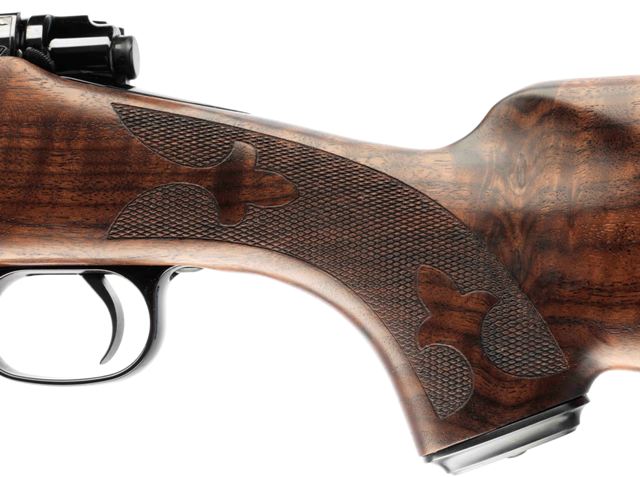
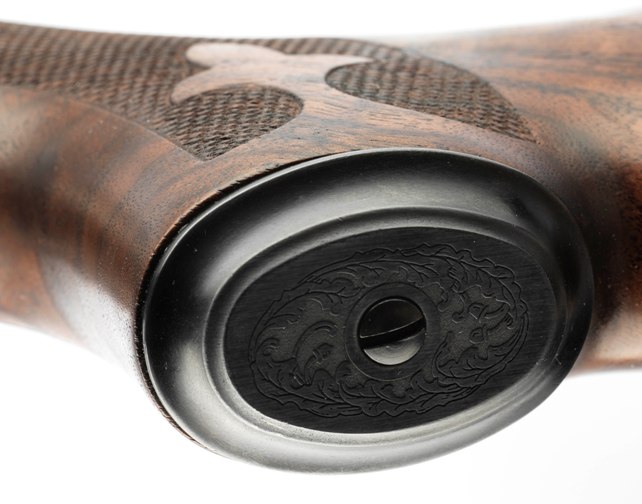
Winchester Repeating Arms states that this 2013 SHOT Show Winchester Model 70 will be the last-ever Jack O’Connor Tribute rifle. The stock for this rifle is AAA grade Claro Walnut with Ebony forearm tip and shadowline cheekpiece. The rifle’s metalwork has been hand-engraved by the artisans at Baron Engraving. The rifle features a featherweight contour, free-floating barrel with target crown.
Interestingly, the Leupold 4X Mountaineer riflescope mounted on this rifle is an original 1950s-era Mountaineer from the vaults of Leupold & Stevens.
Sporting Classics offers a collection of great Jack O’Connor stories from the pages of Outdoor Life, Field & Stream, Petersen’s Hunting and other popular magazines of his day. This 440-page book, entitled Classic O’Connor: 45 Worldwide Hunting Stories, is a sequel of sorts to Sporting Classics’ popular compendium, The Lost Classics of Jack O’Connor.
In this collection, Jack O’Connor recounts his worldwide hunting adventures, during which he pursued everything from ducks to grizzlies, pheasants to kudu. Classic O’Connor presents several of the author’s greatest gun stories and a large selection of never-before-published photographs of the celebrated sportsman and his family on hunting adventures around the world. The book is illustrated with 40+ drawings by acclaimed artist Ron Van Gilder. Hardcover with dust jacket, the book lists for $35, but it can be purchased on Amazon.com for just $23.07.
The Hunting Rifle by Jack O’Connor
Another O’Connor title worth reading is The Hunting Rifle, still considered one of the definitive works on selecting a hunting rifle and cartridge. One owner of The Hunting Rifle explains:
“It would benefit every hunter to take the time and read this book. It offers a corrective to the spirit of things that have gripped the hunting scene lately. Today, if one reads a hunting magazine, [one is] offered the view that you need the fastest and loudest cartridges, rifles with special finishes and the most expensive of anything. Ole Jack reminds us that many have killed game with ‘lesser’ guns for a very long time, and that these new gimmicks will not make you a more lethal hunter.”
Barrel tuners have been used successfully in rimfire benchrest for many years (see photo below). While there are competing theories as to how and why barrel tuners work on rimfire rifles, there is no question that the accuracy of some rimfire barrels can be improved with the addition of a tuner. By changing the position of weights at the end of the barrel, we’ve seen shooters shrink their average group size as well as adjust the “sweet spot” for different lots of rimfire ammo. On the other hand, tuners can be the source of great frustration; some installations may yield little or no benefit. A shooter may have to experiment with a variety of different tuner designs (and weights) to find the optimal configuration.
Centerfire Tuners–Still a Work in Progress
In centerfire benchrest competition, the vast majority of competitors do not use tuners, though a few short-range shooters such as Gene Bukys and Jackie Schmidt have enjoyed considerable success. Gene has won major championships with tuned rifles. In 2011 Gene won both the Super Shoot and World Benchrest Championship (WBC), and Gene recently set a new NBRSA Sporter Class Grand Agg Record.
Centerfire benchrest guns typically employ shorter barrels with a much fatter contour (larger diameter) than rimfire rifles. Because centerfire rounds produce much higher pressures and velocities that a 22LR, a centerfire barrel also exhibits much different vibration characteristics than a typical rimfire barrel. Nonetheless, there are pioneers working with centerfire tuners who believe that tuning may be the “next leap forward” in centerfire accuracy.
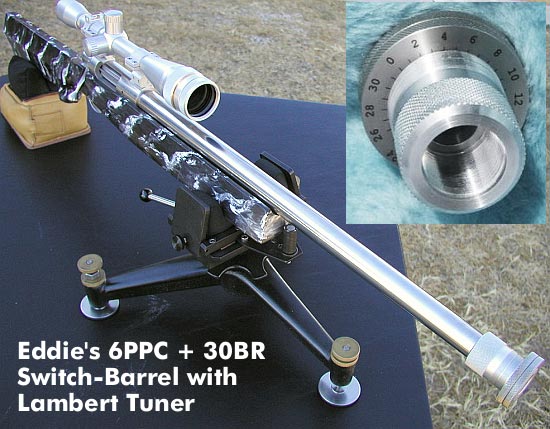
Shown below is a switch-barrel benchrest rifle built by Forum member Eddie W. of Texas. It features a dual-port Hall “M” action with a ShadeTree Engineering Tuner crafted by Butch Lambert. The gun is designed to take both a 6PPC barrel for group shooting and a 30BR barrel for score shooting. The gun was barreled by Wayne Shaw, and Eddie did the stock work himself. Eddie reports: “It is a very accurate rifle.”
Will we see more tuners on centerfire rifles? Only time will tell. Some folks believe that, since one can easily adjust the loads shot by centerfire guns (by tinkering with the powder charge and seating depth), tuners have limited utility. On the other hand, tuner advocates such as Gene Beggs believe tuners can help keep your group sizes small even as conditions (temperature, humidity) change. Gene believes that, with an appropriate tuner, you can spend less time fiddling with the load specs (changing your powder charge) and instead “dial in” your sweet spot using the tuner.
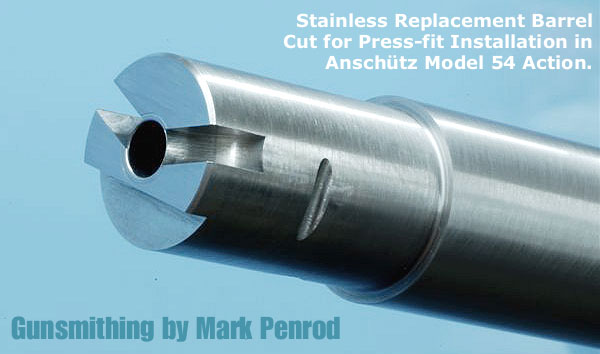
Do you have an older Anschütz model 54-actioned match rifle with a press-in barrel? Perhaps you want to re-barrel your Anschütz to get a few more years of precision shooting out of the old warhorse? Or maybe you want to adapt the Anschütz to a modern stock design for Silhouette, Rimfire Benchrest, or Prone shooting. If you’ve got an older Anschütz m54 that needs re-barreling, you need to send it to a gunsmith who has a proven track record with the model 54s, a smith who can remove the original barrel properly and then install either a new press-in barrel, or a screw-in barrel (after threading the action).
Mark Penrod — Recommended Anschütz Smith
Forum member Edward (aka EAL22) suggests sending Anschütz rimfire projects to Mark Penrod in North Manchester, Indiana. Writing in our Shooters’ Forum, Edward states:
“Penrod can fix you up. He can either press fit [a new barrel] or thread your action [for a screw-in barrel]. He has built guns both ways. Here are some photos of his work. It’s not a bench gun but a nice Anschütz in a System Gemini stock.”
Forum member Bill B. concurs: “I second the suggestion that you send it to Mark Penrod. I’ve just got done working with him on a Hall rimfire action to which he fitted two barrels, a Benchmark and a Lilja. I am building a prone position rifle. He was easy to work with providing good communication, and he’ll do whatever is needed to make your rifle shoot its best.”
Other Recommended Smiths — Bruce Hongista and MT Guns
Another recommended rimfire smith is Bruce Hongisto. Forum member Steve W., a benchrest shooter, says: “My suggestion is to email Butch Hongisto at Hongisto [at] fidnet.com. Butch does amazing work and has made two rimfires for Lapua to use in their factory accuracy evaluations in Finland. Write Butch and ask him which way you should go. He knows his stuff.”
In California, Chesebro Rifles (the successor to Mac Tilton’s MT Guns) has a vast selection of older Anschütz match rifles. Gunsmith Mark Chesebro can rebarrel an older model 54 as well as adapt older Anschütz rifles to modern stocks. Mark even is working on converting single-shot model 54s to repeaters fitted with sturdy, inexpensive CZ detachable magazines. I’ve held the prototype repeater conversion with a 24″ barrel, and it is very cool. I predict the rimfire tactical guys will be lining up to buy these single-shot-to-repeater conversions. Availability is still a few months away. For more info, visit ChesebroRifles.com.
Here’s a cool Torx driver from Brownells that belongs in every shooter’s tool box. The Magna-Tip Tactical/LE Field Torx Kit features a driver with five (5) Torx bits to fit popular scope rings and bases. A storage compartment in the handle holds the bits when not in use. A built-in magnetic socket in the handle holds each bit securely in the shank. We think this is a great new product. When Eyeballing a Torx screw, it’s hard to tell which size bit is required, and the short, L-shaped Torx wrenches that come with ring sets get lost all too easily. The $17.99 Torx Driver Kit, (Brownells Item 080-000-757), will help shooters keep all their often-used Torx bits safely in one place.
In the 1980s, Glen Eberle was an Olympic Biathlete with Team USA. Recognizing the benefits of a lighter, more durable rifle stock, Glen invented a radical new biathlon stock that literally “changed the game”. Glen’s lighter stock allowed biathletes to ski faster. His stock was also more rugged than conventional designs, so it could better survive the inevitable tumbles that occur in competition.
Since retiring from Biathlon competition, Eberle has built a successful Idaho-based company that supplies tough field packs and accessories for hunters and the military. But Glen never lost interest in stock design, and over the past few years he has developed an innovative new tactical chassis that is quite different than anything on the market today.
Eberlestock Model 11 Stealth Rifle Chassis system Fits Rem 700s
The Eberlestock Model 11 Stealth Rifle Chassis system is compact, light-weight and strong. Designed to fit Remington 700 actions, the Eberlestock model 11 chassis offers a drop-in, no-gunsmithing solution for tactical shooters. For the Rem 700 and Rem-clone actions, the Model 11 Chassis employs Accuracy Int’l Classic detachable box magazines (DBMs). The folding-stock version of the new Eberle chassis is very compact. Eberle claims it is “the shortest [folding-stock] sniper system in the world”.
The Model 11 Stealth Chassis is in Production Now
The basic Model 11 Stealth Rifle Chassis weighs 4 pounds and costs $1895.00. First availability will be for the Remington Model 700 short action. Next offerings will be for Rem Model 700 long actions, followed by stocks to fit models from other manufacturers. A variety of configuration options are offered, including folding butt-stock and a fore-stock with mounting rails. For more info, visit www.Eberlestock.com, or call Eberlestock USA in Idaho at 877-866-3047 or 208-424-5081.
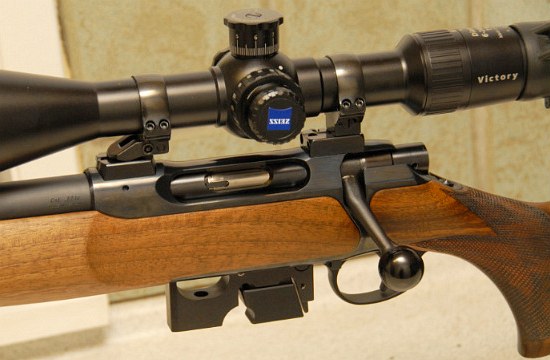
Forum member “Tooms” sent us a report on his very special Sauer 202 with a 22LR conversion kit. Sauer 202 rifles feature a “Quick-change barrel system”. The barrel is clamped into the receiver with crossbolts providing tension. This allows barrels to be swapped in a few minutes with simple tools. Tooms, from Denmark, explains: “The rifle began as a Sauer 202 Avantgarde Gold in .308 Win. I have added a 6.5×55 match barrel, plus a wide flat-bottom match fore-arm with rail for handstop and bipod. The 22LR system [originally] cost $1000.00 [including] barrel, bolt, magazine well assembly, and magazine. The barrel is attached by three cross-bolts and the magazine well assembly is attached by one screw that fits into the barrel.”
Using this “Quick-change system”, Tooms can easily remove his centerfire barrel and swap in a .22 LR barrel. Then he places the factory conversion kit into the magazine well. This kit provides a rimfire bolt, a fitted sleeve for the rimfire bolt, and a track for the magazine. This is a full Sauer factory-designed system so it works flawlessly. With the bolt closed, you can see the “new” 22LR chamber in the front section of the loading port. On the silver section of the bolt you can see the rimfire extractor on the side.
The 22LR Conversion Really Works
The Sauer 202 Varmint rifle shoots very well with the 22LR conversion, as the 50m target at right shows. Though quite expensive, the conversion kit essentially transforms your centerfire rifle into fully functional, mag-fed precision rimfire. That makes the Sauer 202 much more versatile as a hunting platform. It also allows you to cross-train with inexpensive ammo. You don’t have to purchase another scope, trigger, or stock. And you enjoy the exact same stock fit and ergonomics whether you’re shooting centerfire or rimfire. In some countries where gun ownership is severely restricted, it may be easier, from a legal standpoint, to purchase a 22LR conversion kit than to obtain a permit for a second rifle.
To learn more about the complete line of Sauer 202 rifles visit the J.P. Sauer USA website. You’ll also find more information on the primary J.P. Sauer & Sohn German website, www.Sauer.de.
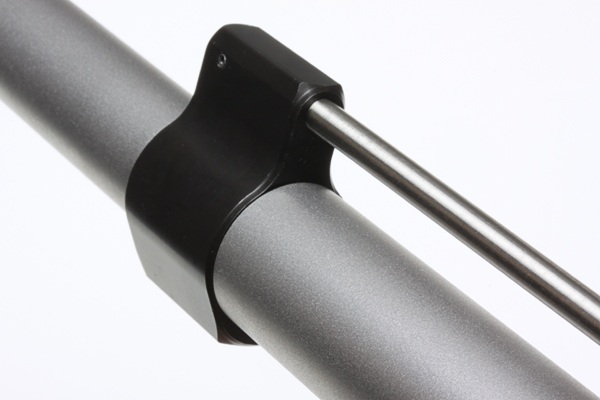
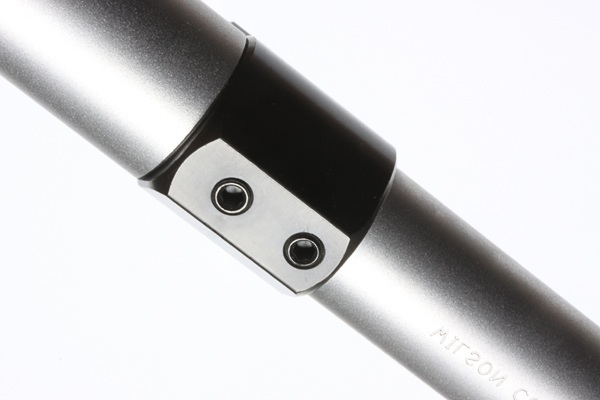
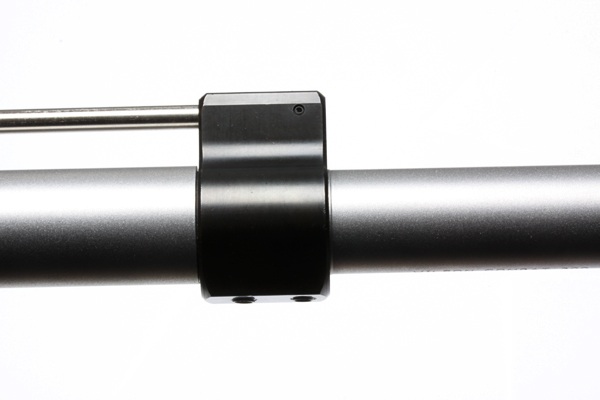
Wilson Combat now offers an Adjustable Lo-Profile AR Gas Block for direct gas impingement AR-type rifles. Wilson Combat’s new adjustable gas block replaces a standard AR gas block and allows you to tune your AR’s gas system for smoother cycling and enhanced reliability. Wilson Combat explains: “Adjusting your rifle’s gas port will lower or increase your bolt’s cyclic rate. This tailors your rifle’s performance to your unique needs.”
A simple adjustment of the hex screw at the front of the block modulates the gas volume allowing you to tune your rifle’s function to your favorite loads. This is very handy when shooting non-standard AR calibers, unusual hand-loads, or suppressed rifles. Adjustable Gas Block systems are sold as complete kits starting at $74.95. Wilson Combat offers two diameters (.750″, .937″) and three lengths (Carbine Length, Mid-Length, & Rifle Length), so you can select the right dimensions for your rifle configuration and barrel diameter. The blocks are Chromoly steel with a Melonited finish.
Package Includes:
Adjustable Gas Block (Melonite Finish)
Adjustment Set Screw (Installed)
Straight Gas Tube (Installed, Gas Tube Pin Installed)
McMillan regularly offers a selection of inletted “Specials” stocks. You should check McMillan’s Specials Page regularly to set if there’s a stock that suits your next build. Not only can you save months of wait time, but you save on the cost of the stock. Many of the Specials stocks are priced $100.00 or more below normal retail. From the list on the Stock Specials Page, choose your action and find a great deal on a McMillan stock. (Once you are on the Stock Specials Page, move your mouse to the left and select action type from the list under the McMillan logo.)
Currently, there are a number of A-Series McMillan stocks on sale. There are currently a large supply of A3s and A5s, inletted for various actions including: Defiance, McMillan, Remington, Ruger, Sako, Savage, Stiller, and Surgeon.
McMillan A5
Hunting Stocks and Benchrest Stocks on Sale Also
In addition to the A-Series specials, McMillan has discounted hunting stocks for Browning, Mauser, Remington, Ruger, Sako, and Winchester actions. There is also currently a good selection of Benchrest Stocks on sale, including the popular McMillan Tooley MBR Stocks. CHECK HERE for availability of your action choice.
McMillan Tooley MBR
Tooley MBR Stocks Available Now: #2924 MBR 70% WHITE 30% BLACK MARBLE, LBRP STILLER PYTHON, SINGLE SHOT, REM ADL T/G, NO FRONT SCREW HOLE, 1.375" STRAIGHT B/C, 1" DEC PAD, 13.5" LOP. $275.00
#3001 MBR 70% TURQUOISE 30% BLACK MARBLE, RBLP, LAWTON 7500 LA, 1.36" DIA, SINGLE SHOT, REM ADL T/G, KRIEG HV B/C WITH 4" CYL, 1" DEC PAD, 13.5" LOP, ALUM. PILLARS INSTALLED. $350.00
#3034 MBR 70% ORANGE 30% YELLOW MARBLE, RH XP100, SINGLE SHOT, BAT T/G, #7 LILJA B/C W/ 4.5" CYL, 1" DEC PAD, 13.5" LOP, ALUMINUM PILLAR INSTALLED. $425.00
#3035 MBR 70% GRAY 20% BLUE 10% LT GRAY MARBLE, RBLP, BAT M 1.53X8.5", SINGLE SHOT, BAT T/G, HV B/C W/ 5" CYL, 1" DEC PAD, 13.5" LOP, 3 ALUM. PILLARS INSTALLED. $475.00
#3078 MBR YELLOW, ORANGE, BLUE FLAME PATTERN, LEAD ADDED, STOCK WEIGHS 15.75 LBS, RH SAVAGE 210, SINGLE SHOT, FAC SAV T/G, 1.5" STRAIGHT B/C, 1" DEC PAD, 13.5" LOP. $473.00
We recently reported on the new Jennings F-TR stock with integrated bipod. When we first saw this rig we thought, “OK, it looks cool, but how does it shoot?” Well, we had a chance to test a .308 Win F-TR rifle built by Chesebro Rifles using the Jennings stock, Barnard action, and 32″ Bartlein barrel. With the gun on the bench, we first shot a few rounds to confirm zero and test for function.
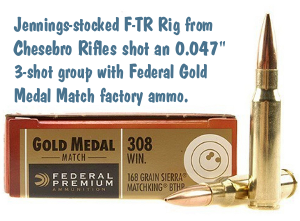
Then gun-builder Mark Chesebro set the rifle on the shooting mat, opened up a box of Federal 168gr Gold Medal Match (GMM) .308 Win ammo, and got down to business — from the ground. What happened next can only be described as “shock and awe”. Mark nailed three successive groups that left us shaking our heads in amazement. The Jennings stock works. Does it ever. This gun hammers.
All groups were shot from the ground, bipod-supported, with Federal factory GMM ammo.
Mark’s first three-shot group had two shots in one hole, then the third leaked a bit high for a 0.184″ group. Then Mark dialed down 2 MOA elevation, and drilled an astonishing 3-shot .047″ group. (For reference, the black diamond in the orange paster is 1/4″ from point to point.)
I was watching through a Swarovski spotting scope and I saw all three shots track into one hole that just got a little whiter in the middle with each successive round. I yelled out “Stop shooting!” because I wanted to measure the group. It was an easy mid-zero — and honestly it looked like just one bullet hole from a pistol. That is amazing with factory .308 Win ammo, particularly in a barrel throated for 185s, not the 168gr SMKs Federal uses in its Gold Medal Match .308 ammunition.
After measuring Mark’s 3-shot bughole, we walked back to the firing line and Mark shot a full 5-shot group. This would have been a two-flat, but he flinched a bit and his third shot went a little high to open the group to a 0.233″. Still darn impressive with factory ammo…
Editor’s Comment: This Gun is Ultra-Stable and Tracks Straight Back
I had a chance to shoot the gun from the ground. I can tell you this — the stock design really works. With the wide-track bipod, the gun is incredibly stable. As you’re aiming there is virtually zero horizontal movement in the crosshairs. All you need to do is squeeze the ears to set your vertical Point of Aim and pull the trigger. This thing is one of the easiest guns to shoot accurately (from the ground) that I’ve ever tried. You don’t have to struggle for stability at all — the gun wants to stay dead calm.
With the large, cylindrical Delrin feet placed on a mat, the gun tracks straight back. And there is no hop, no bounce, no roll. In fact, the gun tracked so well that I could see my bullets impact on the paper target. That’s surprising for a .308 Win with no muzzle brake. After a shot I could slide the gun forward and the crosshairs were right where they should be — the only thing I had to do is squeeze the ears to re-set my vertical. All I can tell you is the thing is very easy to shoot well.
I don’t know whether it is because of the forward-angle geometry of the legs, or the Delrin feet, or the properties of the carbon fiber tube that supports the front end, but the gun seems to have more damping than other metal-chassis stocks I’ve tried. Some metal-stocked guns seem to “ring” and transmit a sharp pulse to the shooter. This Jennings stock doesn’t do that — it seems to soak up vibration somehow. And the recoil is very mild, I think because the Delrin feet slow the gun down as they slide back smoothly.
Bottom Line:We came away very, very impressed with this rifle and the Jennings stock. I have never experienced a bipod-equipped rifle (in any caliber) that is easier to aim and hold steady, or which is easier to return to precise point of aim after each shot. And, without question, this is one of the most accurate .308 Win rifles we have ever shot from the ground. And that was with factory ammo, not tuned handloads!
Making a Great Design Even Better
Could the rifle be improved? Yes. While there is some rear elevation adjustment (via an eccentric bag-rider that rotates) we would like to see more rear-end elevation adjustment, so the gun could better adapt to uphill and downhill target placements. Also we’d like to see a higher mounting point for the bag-rider so you could use a taller, beefier rear bag. We discussed these points with Mark Chesebro, and he’s agreed to start prototyping some upgrades. This may include a thumbwheel-adjustable bag-rider (sort of like an upside-down adjustable cheekpiece). At our suggestion, the vertically adjustable bag-rider may be offered in two versions — straight and angled. With an angled bag-rider (i.e. with a slight amount of drop front to rear), you could adjust your vertical point of aim by sliding the gun forward or aft in the rear bag.
We will supplement this test report with more photos and video in a few days. We know you want to see how well it tracks. The video tells the story better than words can…
Stan Pate is the Captain of Savage’s National Championship F-TR Team. In this article, Stan explains how to adjust the action-screw tension on a three-screw Savage target action to achieve the best accuracy. The procedure described here can be used for any Savage action, including the two-action-screw models. However, the optimal settings for each particular rifle may vary slightly.
Match shooters need to get that extra accuracy edge from our ammunition and firearm. It is easy to get one of the Savage rifles to shoot accurately — even to match standards. If you are looking for that little bit more from your rifle, then please read a method that I have found that works for me. For those of you that are familiar with tuning a receiver (such as a match rimfire action), this article will be nothing new. For the rest of you, this might be new material. The goal here is to find the “sweet spot” for the rifle in relation to the torque settings used on the receiver screws. The proper torque settings [can vary] from rifle to rifle, but they will usually have a noticeable effect on consistent group sizes. A properly-torqued rifle will optimize the “harmonics” of the barreled action using the receiver screws so that the gun delivers peak consistency.
Here is the process I have found that works for me in tuning a Savage rifle receiver to peak accuracy. To use my process you first must already have a load that shoots accurately and consistently in your rifle, and I always use a fouled barrel like I’d be shooting in a match. This process works for me in both the model 10 (two receiver screws), and the model 12 (three receiver screws).
Seat Recoil Lug and Start with Front Action Screw(s)
On the model 12, I will first ensure that the recoil lug is seated securely against the stock by just lightly tightening up the front receiver screw then gently but firmly bumping the butt pad against the floor. Next I will tighten up the front two receiver screws to 30 inch-pounds starting at 20 inch-pounds and working up to the 30 inch-pounds in 5 inch-pound increments, and always tightening the front screw first and then the second screw. Once the front two receiver screws are torqued to the final torque setting, I will set the rear receiver screw to 5 inch-pounds and shoot a 5-shot group [to evaluate accuracy].
Increase Torque Incrementally on Rear Action Screw
After the group is shot and I am satisfied that I called all of the shots as good shots I will allow the rifle to cool off to about the temperature that the fist group was shot at. I will then add 5 inch-pounds to the rear receiver screw and shoot another five-shot group and allow the rifle to cool again. I repeat this process until I have tightened the rear receiver screw to 40 inch-pounds or have seen the groups get smaller and then start getting larger again. Once you have seen the groups decrease and then start to increase in size then you will have found the area of torque to work in. You can then can fine tune this to the exact inch-pound torque settings.
Tuning a Model 10 with Two Receiver Screws
The Savage model 10 action, which has two receiver screws, uses the same process as the three-screw model 12. Measure your group sizes and place the measurements in front of you so that you can see the bell curve showing where your best groups were achieved. NOTE — there may be a better way of doing this and if you should have one, I’d be very interested in hearing it. Good shooting and I hope to see you all on the range. – Stan Pate
This is on the Palma rifle using the torque settings of 30 inch pounds on the front two reciever screws, and 15 inch pounds on the tang screw, it is approximately 1/2″ center to center.
This is my second torque setting which for this rifle and this load is the optimal setting of 30 inch pounds on the front two reciever screws and 25 inch pounds on the tang screw, this group is approximately .180″ center to center.
This is the third torque setting which for this rifle is moving away from the optimal torque setting towards the heavy side of the scale. This torque setting results shows that you will usually see a “bell curve” of accuracy as you move into the optimal torque setting. This group is almost .7″ and the torque setting was 40 inch pounds.
This article was edited for length to appear in the Daily Bulletin.


Sporting Classics offers a collection of great Jack O’Connor stories from the pages of Outdoor Life, Field & Stream, Petersen’s Hunting and other popular magazines of his day. This 440-page book, entitled Classic O’Connor: 45 Worldwide Hunting Stories, is a sequel of sorts to Sporting Classics’ popular compendium, The Lost Classics of Jack O’Connor.

 Centerfire Tuners–Still a Work in Progress

 Mark Penrod — Recommended Anschütz Smith

 In the 1980s,



 The 22LR Conversion Really Works


 Mark’s first three-shot group had two shots in one hole, then the third leaked a bit high for a 0.184″ group. Then Mark dialed down 2 MOA elevation, and drilled an astonishing 3-shot .047″ group. (For reference, the black diamond in the orange paster is 1/4″ from point to point.)

 I don’t know whether it is because of the forward-angle geometry of the legs, or the Delrin feet, or the properties of the carbon fiber tube that supports the front end, but the gun seems to have more damping than other metal-chassis stocks I’ve tried. Some metal-stocked guns seem to “ring” and transmit a sharp pulse to the shooter. This Jennings stock doesn’t do that — it seems to soak up vibration somehow. And the recoil is very mild, I think because the Delrin feet slow the gun down as they slide back smoothly.
 Match shooters need to get that extra accuracy edge from our ammunition and firearm. It is easy to get one of the Savage rifles to shoot accurately — even to match standards. If you are looking for that little bit more from your rifle, then please read a method that I have found that works for me. For those of you that are familiar with tuning a receiver (such as a match rimfire action), this article will be nothing new. For the rest of you, this might be new material. The goal here is to find the “sweet spot” for the rifle in relation to the torque settings used on the receiver screws. The proper torque settings [can vary] from rifle to rifle, but they will usually have a noticeable effect on consistent group sizes. A properly-torqued rifle will optimize the “harmonics” of the barreled action using the receiver screws so that the gun delivers peak consistency.


