Manners Composite Stocks has released a new series of folding tactical stocks, the MCS-TF (Tactical Folder) series. There are four TF versions: TF1 through TF4. These offer different fore-end and buttstock options, but share the same folding mechanism and hardware.
Tom Manners explains the new folding design: “The goal of this project was to create a lightweight, super strong folder stock, with a rock-solid hinge lock-up. We feel that we have got pretty close to that. The weights of the completed stocks are running from 4.5 to 4.8 pounds. If you run a mini chassis this will bring them up to about 4.9 to 5.3 pounds.”
Much work went in to the hinge design, which has been in development for more than a year: “We have created a simpler, lighter weight hinge, with … rock solid lock-up. The hinge is a combination of high strength chrome-moly steel and aluminum, which has been parkerized or hardcoated. It is manufactured by Badger Ordnance exclusively for us. The hinge itself is molded and cast into the stock shell. This means the shell wraps around the hinge, with no screws or attachment systems to become loose. The hinge design itself is very simple and basic; once closed, the back portion of the hinge wraps around and locks-up the front portion of the hinge to create a very solid system. To open [the hinge] all that is needed is a push on the checkered button on the left side of the stock.”
The Manners TF Series also locks back in the folded position, using a positive-locking steel pin. Tom explains: “In the butt, there is a push button on the right side behind the cheek, when it is depressed; it extends the locking mechanism out the left side of the stock. It is just a simple push of the button to close the system. Once closed, the button sits about .250” below the surface of the stock so that it can not be accidentally depressed. To open all you need to do is give it another push.”
Stock Specs and Options
All Manners TF-Series stocks will come standard with an adjustable cheek, full inlet, 1” Pachmayer Decelerator pad, and action pillars. These stocks will be offered with molded-in camo finishes or molded-in solid colors, with a textured surface in key areas. Available inlets include: All Rem-based actions, Winchester Model 70, Savage (and a few others — check website for details). These new TF series stocks will be on display at SHOT Show 2012 in Las Vegas. For more info, visit MannersStocks.com or call Tom Manners at (816) 283-3334.
Product Tip from EdLongrange. We welcome reader submissions.
New from Howa, is the Howa Actuator Controlled Trigger (HACT). This two-stage-style trigger system lightens the trigger pull weight, and reduces the amount of trigger creep. HACT trigger units will fit all Howa M-1500 rifles that were previously equipped with a three-position safety. The HACT trigger assembly is a completely redesigned trigger and sear unit with a lighter, two-stage-style trigger pull. HACT pull-weight range is 2.5 to 3.8 pounds; the factory default setting is 3 pounds.
Writing for the Western Outdoor News, WONews.com, Steve Comus has field-tested the new HACT Trigger. Steve writes: “I always liked two-stage triggers, because of the way I could take-up the slack and then actually know when the rifle was going to go off. The take-up on the [HACT] trigger was fast and easy. The crisp, positive release when pressure was put on during the second stage [reminded me] of some of the target rifles I shot through the years.”
HACT Retrofit Kit Coming in Mid-2012
The HACT trigger will eventually be available as a retrofit for existing Howa 1500 and Weatherby Vanguard Rifles. According to Legacy Sports Int’l Marketing VP Andy McCormick, the retrofit kits “should cost under $100.00 MSRP and should fit all Howa and Weatherby Vanguard short-action rifle with the current three-position safety… and that includes most of these rifles sold in the last 5 or 6 years”. Trigger Kits will be packaged with instructions. McCormick expects much interest in the HACT retrofit kit: “It’s a great two-stage trigger. I would say the HACT trigger kit will be available as a single accessory item by mid-summer 2012. Stay tuned to LegacySports.com for updates.”
Howa Detachable Magazine Kit, Just $98.00 Complete
The recently-introduced Detachable Box Magazine (DBM) Conversion Kit for Howa and Weatherby Vanguard rifles has proven extremely popular. This $98.00 kit includes new plastic floorplate and trigger housing plus either a 5-round or 10-round polymer magazine (as the customer prefers). The DBM Kit saves 1/4 lb. of weight as compared to hinged bottom metal. Made for target shooters and varmint hunters, these POLYMER BODY magazines allow you to turn your 4-round box magazine into a high-capacity DBM system. Conversion kits are currently available for .204, .223, 22-250, .243, 7mm-08, and .308 Win short action Howa rifles. These kits will also fit most late-model, short action Weatherby Vanguard Rifles.
You may not know it, but Whidden Composites, run by two-time National Long-Range Champion John Whidden, produces a nice series of hunting, F-TR, match, tactical, and general purpose gunstocks. These high-grade stocks all feature advanced composite construction, Whidden Gunwork’s signature V-blocks, three installed sling swivels, and a Pachmayr® Decelerator pad. Epoxy construction ensures that these stocks are stiff AND light. John explains: “All of our stocks are crafted with epoxy from core to finish. The core is an expanded epoxy blended to a density that perfectly balances weight, strength, and rigidity. The outer shell is an epoxy coating that is incredibly durable — but light enough to carry all day. The textured epoxy external coating forms a handsome, tactile finish that is great to hold.”
Built-in V-Block Standard, with Many Options Available
The latest stock design from Whidden Composite Works is the model 175 Tactical/F-TR stock. This unit offers a long, rigid fore-end, with a straight comb and straight buttstock toe. This makes it very well-suited for prone shooting with a rear sand-bag and front bipod. The design is ambidextrous so it can be used by either right- or left-handed shooters (with appropriate inlet). Five color choices are offered: black, silver, reddish brown, tan, and green. Base price, inletted for Rem 700 long- or short-action, is a reasonable $549.00 — remember that includes deluxe buttpad and the versatile V-block which allows one stock to be used with multiple barreled actions.
For the model 175, Whidden offers a number of options: $100 Fore-end Rail, $125 Adjustable Cheek piece, $135 Rear Monopod, and $75 Picatinny Bipod Rail. The sling attachments can also be flush-mounted for $10.00 per slot. For just $30.00 over the base price, Southpaws can order a left-hand version of the model 175 stock. Whidden Composites can also inlet for detachable bottom metal and for non-Rem actions (Tikka, Winchester, Sako, etc.), but it does cost more for these non-standard inlets.
Product Tip by EdLongrange. We welcome reader submissions.
In late 2010, the NRA’s National Firearms Museum opened its Robert E. Petersen Gallery, which now showcases 400 of the finest and most valuable firearms from the publishing magnate’s world-renowned collection. We know most of you haven’t yet visited the Petersen Gallery, so we’re presenting some “eye candy” from the Gallery to give you an idea of the quality of the collection.
If you can’t make it to Fairfax, VA to view the collection first-hand, you can view a “virtual gallery” on NRAMuseum.com. The flash-based web gallery features hundreds of pro-quality “glamour shots” of the most notable arms in Petersen’s collection, including spectacular double guns and historic Gatlings. Controls allow you to rotate and zoom the images. Below are some representative samples from the Petersen Collection online gallery. CLICK HERE to view dozens more.
For 2012, Pierce Engineering Ltd. plans to offer Titanium (Ti) versions of its popular Remington-footprint custom actions. Just 42% the weight of steel, Titanium is light yet very strong, with a strength to weight ratio of 1.5+. By producing action bodies from Titanium, Pierce Engineering is able to shave eight ounces (8 oz.) off the weight of a long action (compared to 4140 steel). What’s more, Pierce is now working on Titanium internals and Titanium bolt handles. This could bring the total weight savings to nearly one pound (16 ounces).
John Pierce tells us: “To add to weight reduction we will offer a Titanium recoil lug and install a Titanium handle to the bolt, and possibly a lightened firing pin assembly. I really want to get close to a one-pound reduction overall.”
The new Pierce Titanium actions were inspired by customer requests. One domestic customer wanted an ultra-light action for a sheep rifle, while an Aussie buyer requested a Ti XP action for a silhouette pistol build. John Pierce reports: “After many requests and having a bar of Titanium lying on the shelf for more than three years, [I decided] well ‘Why not have a go?'”
Price and Ordering Info
What will the new Titanium actions cost? Expect to pay an extra $350.00 or so above the cost of Pierce’s stainless and chrome-moly actions. John Pierce explains: “Titanium does cost a lot more and Titanium offers challenges in machining and special tooling. We are estimating that a Ti action will sell in the range of $350.00 more than the steel counterpart.” For more info, visit PierceEngineeringLtd.com, email jpierceltd [at] tds.net or call (517) 321-5051. You can also write to the address below:
Ace UK shooter Vince Bottomley decided he wanted to build a new F-TR rifle for the 2011 season. Vince selected all the best components: Stolle Action, Bartlein Barrel, Precision Rifle & Tool Stock. The build came together superbly, producing a .308 Win rifle that shoots bugholes at 100 yards, and holds sub-half-MOA (or better) to 1000. After building the rifle, Vince decided to shoot Open Class at the 2011 European Championship. So, he graciously loaned his purple F-TR rig to his friend, Stuart Anselm. The rest, as they say, “is history”. Despite having just one day’s practice with the gun, Stuart drove Vince’s rifle to victory, winning the 2011 European F-Class Championship (F-TR division) by a sizable margin.
Superb Accuracy with VV N150 and Berger 185gr Bullets
This 2011 Euro Championship-winning F-TR rifle is the star of our latest Gun of the Week Feature Story. In that article, Vince explains how he modified the long PR&T stock to make weight, and how he developed an accurate load with Vihtavuori N150 and Berger 185gr Target Long-Range Bullets. Vince notes that many UK F-Class shooters are moving back to single-base powders, after trying out double-base powders such as VV N550 and Reloder 17. What’s the reason? Barrel life. Vince feels that the single-base powders can give somewhat better barrel life, even if you lose a little velocity.
New F-TR Champion Reviews Bottomley’s Stolle-Action Rifle
Stuart Anselm tells us: “I only shot the rifle a couple of days before the Europeans — two sighters and then five rounds at 800 yards which went into a 3.75-inch group. That gave me a lot of confidence in the rifle. The bi-pod is very light and looked a bit flimsy but it’s well-engineered, so it worked well. That long Precision Rifle & Tool stock is definitely the way to go and helps the rifle to track nicely under recoil. Of course, the Stolle action was perfect with the right-bolt, left-port set-up and the 10-60X March is just about the ultimate F-Class scope.”
Winning Performance: Scoring 452 points out of a possible 475, Stuart won the F-TR Euro Championship convincingly, finishing 10 points ahead of F-TR runner-up Adam Bagnall (also from Great Britain). Stuart also had the highest V-Bull count with 33.
If you plan to use a Krieger barrel for your next rifle build, better get that order in quickly. Due to a rise in the cost of steel, Krieger Barrels will add $15.00 to the price of a most stainless barrels, starting December 31st. In addition, the price of chrome moly barrels will also increase (typically $25) to become the same price as Krieger’s stainless barrels. (Previously the chrome moly barrels were cheaper than stainless.) The biggest price hike comes with large diameter barrels. There will be a large price hike on over-size diameter barrels ($100 increase on oversize blanks up to 1.450″ diameter.) Krieger says the price changes will “take effect January 1, 2012″, but it also states that price increases would be “implemented” on orders received “after midnight December 30th”. So, to be safe, get your order in before 11:59 pm on December 30th.
Krieger has also announced that it is halting manufacture of 17-caliber barrels as “the tooling on this caliber is too fragile”, and Krieger will no longer offer Custom Engraving. Here is the text of Krieger’s 2012 Price Changes Announcement:
Krieger Barrels — 2012 Price Changes
We [want] to give our customers a “heads up” on price increases to be implemented beginning with all orders received after midnight December 30th. Krieger Barrels has not increased the cost of barrels in two years, and now regretfully we find it necessary to do so. Below you will find a brief description of the changes. Detailed information will be posted as a catalog/website update shortly after Christmas. All price and service changes will take effect January 1, 2012.
Barrel Pricing:
The base cost of most stainless steel barrels will increase by $15.00. Chrome moly barrels will then be the same price as stainless making stainless and chrome moly barrels the same price. [This means the cost of chrome moly barrels will increase $25.00 on average.]
Oversize Diameter Pricing:
Oversize blank diameters up to 1.450″ will increase to $100.00 above the base cost in both stainless steel and chrome moly
Oversize blank diameters greater than 1.450″ up to 2.000″ will increase to $150.00 above the base cost in both stainless steel and chrome moly.
.50 BMG blanks (2.00″ x 36″) will remain the same price in stainless, but chrome moly will increase to the current stainless price.
Muzzle Threads:
We are eliminating the price difference between threading for a timed brake and an un-timed brake. The new cost to thread a muzzle to your machinist drawing or to match the device you send will be $125.00 either timed or un-timed. Fox River Brakes will remain $200.00 installed, and DCM/Service rifle barrels will continue to have no price difference between pre-ban and post-ban models.
Story tip by EdLongrange. We welcome reader submissions.
Alexander Arms is now shipping production 17 HMR AR15 rifles and 17 HMR upper receiver kits. The complete rifles are the only semi-auto rifles specifically designed to reliably shoot the 17 HMR cartridge. Alexander Arm’s 17 HMR rifle does not employ a reworked .22LR rimfire action. Instead the gun features a new bolt assembly design purpose-built built to work with the 17 HMR cartridge. This is good news for varmint hunters who want semi-auto capability for fast follow-up shots in the varmint fields.
The complete rifle comes standard with a straight fluted 18″ stainless barrel, A1 flash-hider, free-floating composite hand guard and two molded-plastic 10-round magazines. Options include a spiral-fluted barrel and MK3 railed upper receiver. Alexander Arms’ 17 HMR ARs will be offered in both fixed stock and collapsible-stock versions. The upper receiver kit includes all the ancillary items needed to convert existing AR15 lowers to work with the 17 HMR cartridge.
17 HMR Basics
If you are not familiar with the 17 HMR, it is a popular varmint cartridge effective out to 200 yards or so. With typical muzzle velocities of 2550-2650 fps, the little 17 HMR packs much more punch than a .22LR, while bucking the wind much better. CLICK HERE for Varmint Al’s 17 HMR webpage, which provides a comprehensive analysis of 17 HMR ballistics, kinetic enegy, and effectiveness on small varmints.
Video Showing Alexander Arms 17HMR Bolt Cycling in Slo-Mo
On its website, Alexander Arms reports: “Our initial production run will be 500 units. We are extremely pleased with this [17 HMR] caliber. With help from Hornady, this unit has been extensively tested and has proven itself to be very capable in the field. At the recent Big 3 Event, we ran two rifles out to ranges of 400 yards and despite windy conditions… the guns performed well. While running guns at the Big 3 we had an opportunity to run one of the rifles with the excellent magnum rimfire silencer from Thunderbeast Arms Corp. The rifle exhibited a slight shift in zero and ran without a hitch for the two days of the event. This unscheduled test provided a quick insight into the flexibility of the rifle and everyone agreed that this combination would serve well for any varminting purposes.”
SAAMI, the Sporting Arms and Ammunition Manufacturers’ Institute, is an association of the nation’s leading manufacturers of firearms, ammunition and components. Founded in 1926, SAAMI promulgates industry standards for firearms ammunition safety, interchangeability, reliability and quality.
New SAAMI Website Offers Free, Printable Cartridge Diagrams
SAAMI recently rolled out a new website loaded with invaluable info for shooters. From the new SAAMI site you can access hundreds of FREE official cartridge diagrams and chamber drawings for all ammo types: Rimfire, Pistol Cartridges, Rifle Cartridges, and Shotshells. Are you looking for the official 17 HMR diagram, or 6.5 Creedmoor, or 7mm Winchester Short Magnum? You’ll find them all, along with hundreds more, on the SAAMI site. Said Rick Patterson, SAAMI’s managing director. “This redesigned website will help provide greater visibility and understanding of SAAMI’s important work.”
Please Read These Instructions Carefully
To access the cartridge diagrams, go to SAAMI’s Technical Information webpage, and CLICK ON Cartridge and Chamber Drawings to reveal categories. You will find links to 20 new and/or updated cartridges there.
To find the full set of cartridge diagrams, you need to click on the link to Current Cartridge & Chamber Drawing documents — American National Standards Published by SAAMI. There you will find links to four categories of diagrams: Rimfire, Shotshell, Centerfire Pistol/Revolver, and Centerfire Rifle. These links will launch large PDF files that have diagrams of the cartridge types. NOTE: These are very large PDF documents. For example, the Centerfire Pistol/Revolver PDF is 189 pages long. You must scroll down to see the cartridge type you want.
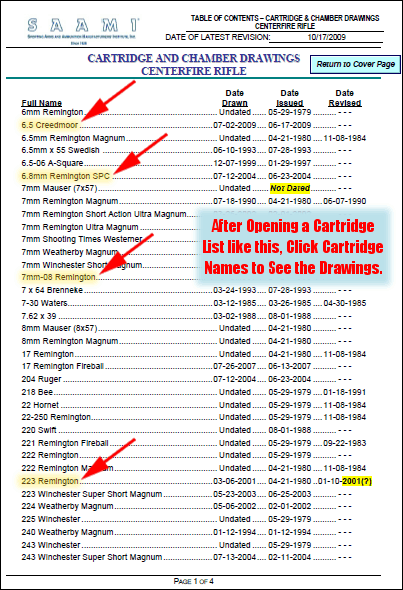
Unfortunately, the organization of the SAAMI site is much less convenient than before. Previously you could access a page and then simply click on a link for the cartridge you wanted to view. Below is a sample of the first page of the previous Rifle Cartridge Diagram List.
Red arrows show you where to click, after you launched the page under the old website.
SAAMI Standards Documents With Additional Info
You can also click the subcategory links under SAAMI/ANSI Standards to see multiple diagrams in a larger PDF file. You may have to click the SAAMI/ANSI standards line first to display the four sub-categories: Pistol/Revolver, Centerfire Rifle, Rimfire, and Shotshell.
Credit Boyd Allen for finding SAAMI’s Cartridge Diagram PDF Archive.
You interested in a really wild, innovative bench gun that can shoot both short-range and long-range matches? Check out Seb Lambang’s latest “do-it-all” rifle. It’s a switch-barrel rifle combining two very different chamberings: 6 PPC and .284 Winchester. With that caliber combo, Seb’s covered from 100 yards (LV/HV mode) all the way out to 1000 (LR Light Gun mode). But the dual chambering is not the rifle’s only trick feature. Exploiting the new long-range benchrest rules, Seb has fitted a 3″-wide, flat rear metal keel to the buttstock. That counter-balances his 30″-long 7mm barrel, improves tracking, and adds stability. Seb built the stock and smithing was done by Australian gunsmith David Kerr.
Detachable Hammerhead Wing Section Plus Fat-Bottom Keel
To further reduce torque and improve tracking, the stock features an 8″-wide, detachable fore-end fixture. This “hammerhead” fore-end section has extended “wings” on both sides, making the rifle super-stable. The hammerhead unit can be removed, leaving the stock 3″ wide for use in registered benchrest matches where 3″ is the maximum width. The photos below show Seb’s gun in .284 Win Long-Range (LR) Light Gun mode.
Yes This Rig Shoots … In Both Configurations, Long-Range and Short
Seb has already used his switch-caliber, switch-barrel rig successfully in competition. Seb tells us: “The gun shot and tracked real well either in 6 PPC LV/HV mode or in .284 Win LG mode. I love it! With this gun I placed Top 10 for the Two-Gun at the Harry Madden Championship in Brisbane, Australia just a few days ago and took the silver medal for the 500m Flyshoot with the .284 Win on the next day. So who says a switch-barrel rifle can’t (or doesn’t) work?” And get this, Seb finished the stock just four days before the Brisbane match. He glued-in the action the evening before the match and shot it the next day in competition. Pretty impressive we’d say….
6 PPC and .284 Win Convertible Rifle Specifications
Action: Stolle Panda Short Action (glue-in plus front/rear alum. pillars), Right Bolt, Right Port, Right Eject, .473 bolt face.
LV/HV Weight: Rifle weighs 10.4 lbs in 6 PPC mode (no keel, no front wings).
LV/HV Barrel: Krieger 21.5″ OAL, 6mm (6 PPC, .270″ neck), 1:14″ twist.
Light Gun Weight: 15.5 lbs in .284 Mode with 3″ rear aluminum keel and 8″ fore-end attachment.
Light Gun Barrel: Maddco 30″ OAL, 7mm (.284 Win, .316″ neck), 1:9″ twist.
Metal: Home-made, one-piece scope base with +15 MOA scope rings.
Seb Lambang — Indonesian Innovator If you don’t know already, Seb Lambang is the designer/builder of the innovative SEB Coaxial rests. These are some of the best joystick rests on the market. The latest version, the SEB Neo Rest, is a brilliant design that folds flat for transport, yet offers extended vertical and horizontal travel and a rest top that can adjust from roughly 2″ wide to over 6″ in width. This Editor uses a SEB Neo for both bench and F-Class shooting and it is my favorite joystick rest. Rest in photos is a SEB Neo MAX.


 New from Howa, is the Howa Actuator Controlled Trigger (HACT). This two-stage-style trigger system lightens the trigger pull weight, and reduces the amount of trigger creep. HACT trigger units will fit all Howa M-1500 rifles that were previously equipped with a three-position safety. The HACT trigger assembly is a completely redesigned trigger and sear unit with a lighter, two-stage-style trigger pull. HACT pull-weight range is 2.5 to 3.8 pounds; the factory default setting is 3 pounds.

 You may not know it, but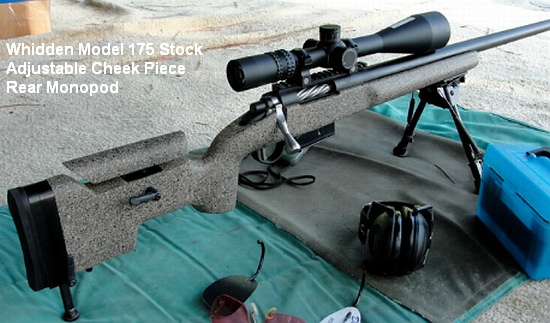


 17 HMR Basics