Ever wondered how the parts inside an AR-15 work together? Just exactly how does the reciprocating bolt carrier feed rounds from the magazine? How do the elements in the trigger group work and reset after each shot? How does the gas system bleed gas from the barrel and operate the bolt carrier? These and other questions are answered in this eye-opening video from 45Snipers. Using “cutaway” 3D computer animation, this 5-minute video shows all features of an AR15 inside and out. This fascinating firearms animation allows the viewer to look inside the upper and lower receivers, into the bolt carrier, chamber, barrel, and magazine. There’s a second AR-15 Video that shows all the internal and external parts of the AR-15 Rifle. CLICK HERE for AR Parts Animation.
2. How an AK-47 Works — With Parts Assembly
This animation shows how the AK-47 (officially Avtomat Kalasnikova model 1947) rifle functions. This very realistic video shows the component parts of the AK47 coming together. They you can see how the fire control system works to ignite the primer, sending the bullet down the barrel. Next you see how the gas piston pushes the bolt carrier rearward to chamber a new 7.62x39mm cartridge.
Tech Note: This high-quality 3D animation was created by Matt Rittman using Cinema 4D and After Effects software. Corona renderer was used in order to create realistic materials and reflections. Credit Forum member Captain Dave F. for finding this video.
3. How a Pistol Cartridge Fires
This cool 3D video from German ammo-maker GECO (part of the Swiss RUAG group of companies) unveils the inside of a pistol cartridge, showing jacket, lead core, case, powder and primer. Uusing advanced CGI rendering, the video shows an X-ray view of ammo being loaded in a handgun, feeding from a magazine. Then it really gets interesting. At 1:32 – 1:50 you’ll see the firing pin strike the primer cup, the primer’s hot jet streaming through the flash-hole, and the powder igniting. Finally you can see the bullet as it moves down the barrel and spins its way to a target. If you’ve ever wondered what happens inside a cartridge when you pull the trigger, this video shows all.
For Best Viewing, Click Gear Symbol and Select HD Playback Mode
4. How a Rifle Cartridge Fires
This CGI video shows what happens inside a rifle chamber and barrel when a cartridge fires. The 3D computer animation reveals every stage in the process of a rifle round being fired. X-Ray-style animation illustrates the primer igniting, the propellant burning, and the bullet moving through the barrel. The video then shows how the bullet spins as it flies along its trajectory. Finally, this animation shows the bullet impacting ballistic gelatin. Watch the bullet mushroom and deform as it creates a “wound channel” in the gelatin.
Watch Video – Cartridge Ignition Sequence Starts at 1:45 Time-Mark
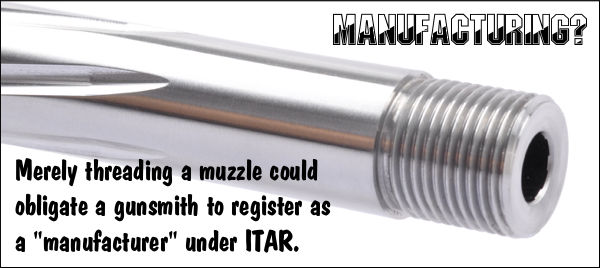
If you are a gunsmith, or do any machine works on firearms, you need to know about ITAR, the International Traffic in Arms Regulations which are enforced through the U.S. Department of State (DOS). ITAR applies to companies that create sophisticated weapons systems. However, under DOS interpretations in recent years, ITAR may also apply to persons and businesses that do simple, basic gunsmithing tasks. That could require filling out lots of paperwork, and paying the Fed’s hefty fees, starting at $2250 per year. A Guidance Statement issued by the DOS Directorate of Defense Trade Counsels (DDTC) in July, 2016 (under the Obama Administration) gave rise to serious concerns that DOS was going to require every gunsmith to register under ITAR, under threat of massive fines and penalties. READ About DDTC ITAR Guidance.
Thankfully, it appears that the Trump Administration is working to narrow the scope of ITAR so that it would NOT apply to basic gunsmithing activities, and not apply to common gun accessories that are not exported. IMPORTANT: Changes have NOT been made yet, but it appears the Feds are heading in the right direction, with the DOS willing to modify its definition of “manufacturing” so ITAR would not embrace basic gunsmithing tasks such as threading a muzzle.
The Gun Collective reports that: “The Directorate of Defense Trade Counsels (DDTC) is working on revising the ITAR regulations which will help the gun industry[.] Gunsmiths having to pay hefty fees, register and comply with ITAR may no longer be a problem if this goes through as planned. Fortunately, we don’t have to wait for Congress to take action, but rather an agency, which appears to be taking initiative to get it done. As always, time will tell, so be sure to keep your eye on the Federal Register….”
While nothing has happened yet, it appears that this administration is working to revise ITAR. For members of the firearms industry, this is a big deal and will be beneficial to all. There is no reason that a gunsmith should be required to register and comply with ITAR to simply thread a muzzle. It will also allow companies to more easily export their products around the world. (Source: The Gun Collective)
The Gun Collective further noted that: “The topic that will be of the most interest to us would be the definition of manufacturing[.] You may remember DDTC’s July 2016 letter, which issued “Guidance” as to who would have to register under ITAR [and suggested] that now gunsmiths would have to register as well. The definition of manufacturing is an important one to define and one that had broad ranging implications as the industries covered under ITAR are wide ranging, everything from the firearms industry to airplanes and missiles. The Guidance stated that ITAR registration was required for gunsmiths who machined or cut firearms, such as the threading of muzzles or muzzle brake installation which required machining. At a hefty $2,250 a year to register, ignoring all of the other things that go along with ITAR, it is easy to see why this would be problematic for most small businesses.”
Here is the key language in the DDTC’s “ITAR Registration Requirements – Consolidated Guidance” Ruling of 7/22/2016:
2. Registration Required – Manufacturing: In response to questions from persons engaged in the business of gunsmithing, DDTC has found in specific cases that ITAR registration is required because the following activities meet the ordinary, contemporary, common meaning of “manufacturing” and, therefore, constitute “manufacturing” for ITAR purposes:
a) Use of any special tooling or equipment upgrading in order to improve the capability of assembled or repaired firearms;
b) Modifications to a firearm that change round capacity;
c) The production of firearm parts (including, but not limited to, barrels, stocks, cylinders, breech mechanisms, triggers, silencers, or suppressors);
d) The systemized production of ammunition, including the automated loading or reloading of ammunition;
e) The machining or cutting of firearms, e.g., threading of muzzles or muzzle brake installation requiring machining, that results in an enhanced capability;
f) Rechambering firearms through machining, cutting, or drilling;
g) Chambering, cutting, or threading barrel blanks; and
There are tough times ahead for Remington. Fox News reports that: “Privately-held Remington Outdoor is now at risk of declaring bankruptcy after a collapse in sales and profits. Saddled with debt, the historic gun manufacturer is short on avenues for escape.” (LINK). Fox News adds:
“The rifle and shotgun manufacturer’s third-quarter sales plunged 41% as demand for firearms dried up. That led Remington to report adjusted earnings before interest, taxes, depreciation, and amortization that were 78% lower year over year. Over the first nine months of 2017, the company has produced a $60.5 million net loss, compared to a $19.1 million gain in the prior-year period.
And with its credit rating in the trash bin, the future is bleak for ‘America’s oldest gunmaker’. Today, debt on the company’s books has ballooned to almost $1 billion[.]”
Financial analysts report that Remington’s earnings decline will further harm the company’s already poor corporate credit rating. That means Remington must pay even higher interest rates to borrow money, further bleeding cash and decreasing profitability. This, in turn, accelerates the momentum towards filing bankruptcy. Fox explains: “With the firearms and ammunition manufacturer burning through cash as a result of falling sales, S&P expects it will undertake a restructuring within the next year.”
Other large American gun industry companies have seen their stock value drop dramatically this year. Vista Outdoor (Savage, RCBS, CCI etc.) is down 62% since December 9, 2016, while American Outdoor Brands (Smith & Wesson) has dropped 36%.
Remington Has a Storied History
Founded in 1816, Remington is the oldest continuously-operating gun manufacturer in the United States, and remains one of the USA’s oldest commercial enterprises. Even with its present difficulties, Remington still sells more sporting rifles and shotguns than any other American company. Remington has developed more cartridges than any other U.S. company. And it is the only American company that sells firearms AND ammunition under its own name.
The Remington enterprise was founded in 1816 by Eliphalet Remington in Ilion, New York, as E. Remington and Sons. In 2016 Remington celebrated 200 years of history. American Rifleman TV explored the history of Remington Arms Company in a TV special which focuses on many of the company’s most noted firearms. Here is a preview:
Emil Kovan is one of the top F-Class shooters in the world. He won the 2014 United States F-Open Championship. Earlier this month Emil finished second in F-Open Division at the 2016 Canadian National F-Class Championship in Ontario. Emil actually tied Open-class winner Shiraz Balolia for overall score AND “V”-count, but Emil was awarded second on the tie-breaker.
“What are the best components for an F-Open class rifle, and why?” That’s a question that I get asked all the time and will try to answer in this article. Two months ago, I was contacted by Duane, a gentleman I met at the 2015 F-Class Nationals. He was interested in building a rifle with the new Master Class Low Profile F-Open Stock, created by Carl Bernosky and Alex Sitman of Master Class Stocks.
I have known Alex Sitman for many years, and use his stocks exclusively, but was not very familiar with his new Low Profile F-Open stock. After a brief conversation with Alex, I placed an order, and had the stock inletted and bedded at my shop in a month. My first impression was “Wow that’s a long stock” — the forearm is significantly longer than on the original Master Class F-Class prone stock. I bolted the barreled action in, and squeezed the end of the forearm and barrel together, the stock flexed a little bit, but not as much as other designs that I have tested. I think that’s due to having “more meat” in the receiver area. The full stock depth continues farther forward that on some other “low profile” designs. That makes the stock stiffer in the vertical plane, reducing the hinging effect forward of the action. The stock was finished in gloss black per the customer’s request. Interestingly, I found that the multiple layers of paint and clearcoat stiffened the stock up quite a bit.
CLICK IMAGE below for full-screen version
Low Center of Gravity Tames Torque
Compared to the original Master Class F-Open stock, the barrel sits about an inch lower. Lower center of gravity equals less torque, and that is very important when shooting heavy bullets in fast twist barrels. Another significant improvement is that the toe of the stock is flat and parallel to the forearm. I added a 3/4″ track rail in the rear, and milled the underside of the fore-end to create two parallel “rails” in the front to help the stock track better.
One of the biggest reasons why I like Master Class stocks, is the pistol grip. I don’t shoot “free recoil” and a comfortable pistol grip is super important to me when selecting a stock. The new Master Class Low Profile stock shares the same grip as the old model. This allows the stock to accommodate either a “hard hold” style or a more free-recoil style of shooting — whatever the rifle’s owner prefers. This design versatility is one reason I recommend Master Class stocks. Shooters may experiment with either shooting style to find what suits them best.
Cartridge Choice — A 40° .284 Win Improved
Duane decided to have the barrel chambered for my 284 KMR IMP (Improved) wildcat. What is .284 KMR IMP and why choose it over the straight .284 Winchester? Improved by definition means “made better”, I took a great cartridge, and modified it to increase capacity, reduce pressure, and increase brass life.
There are many “improved” variants of the original .284 Winchester: 7mm Walker, .284 Shehane, .284 Ackley and so on. My version, the 284 KMR IMP, shares the .010″ blown-out sidewalls of the .284 Shehane, but I have further increased the case capacity by changing the shoulder angle from 35 to 40 degrees. The 284 KMR IMP allows you to almost match magnum cartridge velocity in a standard-bolt-face action. If you want to run 180gr-class 7mm bullets over 2900 FPS, it is cheaper and more convenient to have a barrel chambered in 284 KMR IMP than to spend $650 for a magnum bolt.
Tuning Loads for the .284 Win Improved Cartridges
The 284 KMR IMP seems to have two nodes, one around 2820 fps and other at 2940 fps. My match load clocks at 2935 fps with single-digit ES. Note –I selected that load based on accuracy, NOT raw speed. A lot of novice (or hard-headed) shooters make the mistake to push their cartridges to the max, and disregard more accurate loads at lower velocity.
The sport of F-Class is rapidly growing, and the equipment used is improving constantly. I remember that only few years ago, an F-Open rifle that could shoot sub-one-inch of vertical at 300 yards was considered competitive. Now, we are pursuing sub-one-inch vertical at 600 yards! It takes a great rifle to approach that goal, but it is also up to the shooter to learn and experiment as much as possible in order to achieve success.
Dies for an Improved .284 Win Cartridge
One of the biggest challenges in campaigning a wildcat cartridge has been obtaining great dies. When searching for custom dies, it almost seems like that the odds are stacked against us. The most common problem is wait-time — custom die orders can take months to be completed. Also, most custom die makers want you to send them two or three cases, each fire-formed three times. I find that funny because if could somehow properly size the cases for three fire-forming cycles, I would not need a sizing die.
Custom-made dies should size the case just right, but sometimes the die’s internal dimensions are slightly off, and this leads to problem number two: dies sizing too much (or even worse) too little. I had a one “custom” die that would not size the bottom of the case enough. This made the extraction of fired cases very difficult. I feel that the best option (if available) for shooters interested in wildcat chambers is to have their gunsmiths make the dies. I offer that die-making service in addition to barrel chambering.
BAT Machine “M” Action
Duane decided to use a BAT M action for this rifle, and I think that he could not have made a better choice. We are blessed with many good match-quality receivers: Barnard, BAT, Borden, Kelbly, Nesika, and Stiller just to mention a few. These are all very well-made and suitable for F-Class. Among BAT Machine Co.actions, I like BAT models M, MB, and 3LL best. I prefer these because because of their size (large bedding footprint) smoothness, timing, options available, and last but not least visual appearance.
Trigger: I recommend and use Jewell triggers. Other good options are: Kelbly, CG Jackson (good 2-Stage) Anschutz (best 2-Stage for Bat and Kelbly actions), Bix’N Andy, and David Tubb.
Barrel: Duane made another good choice here. He decided to go with a Brux 1:8.5″-twist, 4-groove cut-rifled barrel. If you look at the F-Class and Long Range benchrest equipment lists, you will see that cut-rifled barrels are currently dominating. Many records have been shot with both button-rifled, and cut-rifled barrels. I have shot both, and prefer cut-rifled barrels. I am not saying that button-rifled barrels are not capable of shooting as well as cut-rifled barrels, but on average, in my experience, four out of five cut-rifled barrels (from top makers) will shoot well, vs. three out of five buttoned barrels. YMMV, but this is what I’ve observed.
Scope: Duane’s rifle was fitted with a Nightforce 15-55x52mm Competition scope with DDR-2 reticle. This optic is ultra clear, reasonably lightweight (28 oz.), super reliable, and has 1/8 MOA clicks — what you want for long range F-Class competition. In this 15-55X NF model, I like the DDR-2 reticle best, because fine cross hairs (FCH) are hard to see in heavy mirage. The DDR-2 has a heavier horizontal line, with a center dot. March scopes are also very popular and very well-made.
Thanks for reading, and keep ‘em in the middle…
Emil Kovan Competition History:
– 2014 F-Class Open National Champion
– 2016 F-Class Open Canadian Championship, Silver Medal (tied for first on score)
– 2015 F-Class Open National Championship, Silver Medal
– F-Class Open National Championship Teams, 2015, 2014, 2013, Shooting Team Member
– Over 15 wins in Regional and State Championships in Palma, F-TR, F-Open
Rifleshooter.com built this tactical rifle (top image) with a Howa 1500 action, Shilen barrel, and MDT chassis. Below is a factory Howa 1500 Multi-Cam rifle.
Many of our readers are thinking of purchasing a Howa rifle or barreled action. These feature smooth-running actions with a good two-stage HACT trigger. But some folks have heard that it may be difficult to find stocks, or to fit an after-market barrel. That’s not true. There are many stock options available, and in this article, Bill of RifleShooter.com shows that it is easy to remove the factory-installed barrel with the right tools. We think a Howa makes a fine basis for a varmint rig or field rifle. Or you can build a tactical as Bill did. You can start with the factory barrel and when you want/need more accuracy, then have a gunsmith install a custom barrel from Krieger, Shilen, or other quality brand.
What You Need to Know About Howa 1500-series Rifles
Tech Feature by RifleShooter.com
Consider this article the “Howa 1500 Overview”. AccurateShooter.com’s editor mentioned there’s been a lot of interest in Howa rifles and barreled actions imported by Legacy Sports International. In addition to being able to buy a complete rifle from a dealer, Brownells sells barreled actions in a wide variety of calibers and configurations. In this post we are going to take a look at the Howa 1500 series.
Howa Rifles — General Background
Howa is a Japanese heavy machinery company. One of its product lines are firearms, which, are imported into the United States of America by two different companies, Legacy Sports International and Weatherby. Legacy sells the 1500 under the manufacturers name while Weatherby re-brands the guns as the Weatherby Vanguard. In general, the finishes on the Weatherby rifles are more refined than the LSI-imported 1500s.
General Evaluation of Howa 1500 Rifles
I’ve found Howa 1500s to be solid, entry-level rifles that are capable of sub-MOA accuracy out of the box. I’ve actually purchased two Howa rifles I’ve tested because I like them so much. The gun below, a Howa Mini-Action in 7.62×39 Russian, is one of my favorite factory guns to shoot. I’m running a Tract Optics Toric on it, these are solid little rifle scopes that offer great performance for the money.
Check out this three-shot group I drilled at 100 yards with the rifle above and 125-grain Sierras. It took a lot of work and load development to get there, but when it did, it worked well.
Howa 1500 HACT 2-Stage Trigger
Howa 1500s feature the very nice Howa HACT trigger. This is an adjustable, two-stage trigger, set for about 3 pounds (combined stages). Crisp and repeatable, this is an excellent trigger for a factory gun. There is no annoying Glock-style safety lever in the middle of the trigger blade. The 2-stage design and pull weight range works well for a hunting rifle or a rig for PRS competition. Rifleshooter.com says the Howa trigger is “one of the best factory triggers, along with Tikka. I’ve found the Howa trigger superior to a Remington 700 — the Howas doesn’t need to be replaced.
Writing for the Western Outdoor News, WONews.com, Steve Comus has field-tested the new HACT Trigger. Steve writes: “I always liked two-stage triggers, because of the way I could take-up the slack and then actually know when the rifle was going to go off. The take-up on the [HACT] trigger was fast and easy. The crisp, positive release when pressure was put on during the second stage [reminded me] of some of the target rifles I shot through the years.”
Howa Actions — Three Options
Howa offers three action lengths: Mini, Short, and Long. You can see the bolts for the three action lengths in the image below. The Mini-Action has similar external dimensions to the Remington Model Seven, however, the Mini-Action’s bolt does not travel as far to the rear. This is a mixed bag. The upside is you have a quicker action (shorter bolt throw). The downside is you are limited to shorter rounds such as the .223 Remington, 7.62×39mm Russian, and 6.5 Grendel. But if you need a bigger cartridge, just choose the standard or long action Howa variant.
Howa 1500 vs. Remington 700 — Important Differences
Is the Howa 1500 a Remington 700 clone, or some kind of improved Remington 700? No, not really. While the top radius of the Howa 1500 does match the Model 700, and they can both use the same two-piece scope bases, there area number of differences.
If you look at the Howa 1500 alongside the Remington 700 you’ll note the M700 is a round action, while the Howa is a flat-bottom action. In many ways the Howa’s bottom half reminds me of a push-feed Winchester. This means the chassis and stocks that support a Howa 1500 are not V-block based like you’ll find on a 700, instead they have a flat bottom. While the bolt of the Howa is similar in external appearance to the Model 700, it does offer some improvements, notably an M16-style extractor and a firing pin assembly that can be easily removed without tools.
Howa 1500 action screws are metric and are in a different location from the 700. The Howa 1500 has an integral recoil lug that accepts the front action screw, this means you have more of the front action screw engaging the action. WARNING: If you install it into a poorly-fitted stock or action you may bind it.
Can a Howa Action Be Used for a Custom Rifle Project?
Absolutely! You can either buy a barreled action from Brownells and throw it in a chassis system/stock of your choice or you can use a stripped action to build a custom rifle. If you are in the chassis market, MDT offers a wide variety of chassis in different price ranges. All have worked well for me.
How to Remove Howa Factory Barrel from Action
You may have heard internet grumblings about removing Howa barrels. Some keyboard commandos say they are extremely difficult to remove without a relief cut. Well Bill at Rifleshooter.com demonstrates that Howa barrels can be removed without trouble, provided you have the right tools. Watch this video:
Watch Howa Barrel Removal Video — Quick and Easy (Click Speaker Icon for Audio)
Q: Is it difficult to remove a barrel from a Howa 1500?
A: Not very. I’ve heard from some smiths that worked on Howas (years ago) that the factory barrels are difficult to remove. However of the half dozen or so Howa barrels that I’ve pulled, they’ve been very easy. I use a Brownells action wrench with the top piece for a Rem Model 700 and the flat bottom resting against the flat on the wrench.
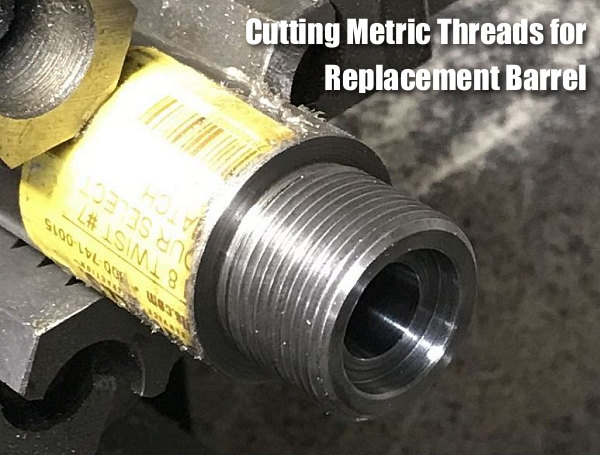
Howa Actions Require Metric Barrel Threads
It’s easy to thread a barrel for a Howa Action. You just have to cut metric threads — most lathes out there can cut them. I cut the threads below on a manual lathe using change gears. [Editor: John Whidden cuts metric tenon threads with a CNC lathe. “It’s easy,” John tells us, “No issue whatsoever.”]
Own a Ruger Precision Rifle (RPR)? Looking for the single best hardware upgrade that will improve inherent accuracy and shot-to-shot consistency? Here’s your answer. Krieger Barrels is now producing Pre-Fit barrels for the RPR in two popular chamberings: 6.5 Creedmoor and .308 Winchester. These “Drop-In Ready” barrels come finish-chambered and threaded to fit the Ruger action. The Ruger barrel attachment system allows correct headspace with a pre-chambered barrel. Krieger explains: “Thanks to Ruger’s proprietary barrel nut design, a competent gunsmith will be able to swap out your barrel using an AR15 barrel wrench and proper headspace gauges.”
Kreiger’s 6.5 Creedmoor RPR barrel is an 1:8″-twist with 26″ finished length, 0.750″ at muzzle. The .308 Win RPR barrel is a 1:10″-twist with 24″ finished length, also 0.750″ at muzzle. Both these Krieger RPR Pre-Fits feature muzzles with factory-spec thread so you can re-install the factory muzzle brake.
A number of interesting jobs in the firearms industry have become available in recent weeks. The NSSF maintains a regularly-updated listing of employment opportunities with gun-makers and shooting sports organizations. On the NSSF’s job board right now there are financial openings, account manager positions, engineering jobs, sales and marketing positions, and media/digital markeing opportunities. Here are some of the jobs we found this week posted on the NSSF Website. CLICK HERE to visit the NSSF Career Center with all current listings.
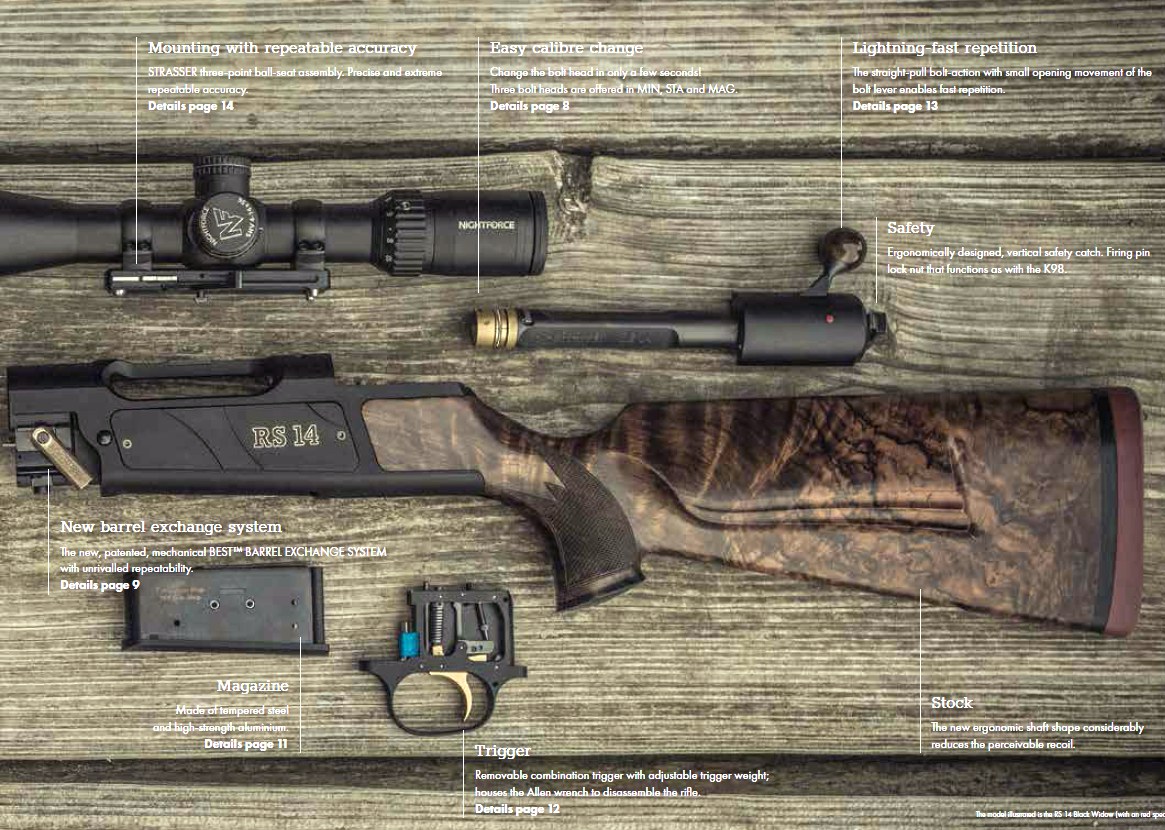
There is a new straight-pull hunting rifle coming to the USA. No, it’s not a Blaser, it’s a Strasser, made in Austria (not Germany like the Blaser). The new Strasser RS-14 is a premium hunting rifle with some very remarkable features. The trigger exchanges as a module, without tools. The entire barrel assembly can be swapped out in five minutes — and you can easily change bolt head so this rifle can shoot everything from small varmint cartridges all the way up to .30-Caliber Magnums.
The new RS14 Evolution, specially designed for the U.S. market, is a straight-pull, bolt-action rifle that features a removable trigger pack and the ability to easily adjust trigger weight without tools.
The quick-change bolt face allows users to quickly and easily switch between small, standard, and magnum bolt face. It comes with an integrated Picatinny rail on the receiver. USA buyers will be offered two different RS-14 models, one with grade E Walnut stock or the Tahr model with a grey, laminate stock. The first 100 of each model will be serial numbered to signify a special edition just for America. This rifle is a premium product — we expect the asking price to be in the $2500.00 range. For orders and inquiries, contact the U.S. importer, International Firearms Corporation (IFC).
Click the image below to see LARGE Version
You’ll find a detailed review of the Strasser RS-14 on TheTruthAboutGuns.com.
Here are highlights:
“A user can swap Strasser’s barrel and bolt face in under five minutes to accommodate new calibers, from short-action plinkers like .223 Remington to full-belted magnum loads like .300 Win Mag. You can choose your favorite calibers and different barrel and muzzle profiles.
Straight pull bolts are the quickest to operate. A traditional bolt-action rifle requires four movements: up, back, forward, down. The RS-14 requires only two: straight back and forward. That ‘extra’ speed could make all the difference in the field…
The RS-14’s bolt is a thing of beauty. Perfectly machined with a satin-smooth finish, it glides back and forth in the action’s channel. The over-sized bolt handle gives the operator a large target to grab when reloading.”
We like “outside of the box” thinking. And in the world of competitive shooting, it doesn’t get more unconventional than this. But this radical liquid-cooled benchrest rig wasn’t just a crazy experiment — it actually delivered the goods. This IBS Heavy Gun, built by Joel Pendergraft, produced a superb 10-shot, 3.044″ group that stood as an International Benchrest Shooters (IBS) 1000-Yard Heavy Gun record for seven years, not being broken until 2016*.
Using this water-cooled 300 Ackley Improved, Joel shot the record-breaking group in April 2009 at Hawks Ridge, NC. This monster features a 12-twist, 4-groove Krieger barrel inside a water-filled sleeve (like on a liquid-cooled machine gun). Joel shot BIB 187gr flat-based bullets in Norma brass, pushed by a “generous amount” of Alliant Reloder 25 and Federal 210M primers.
This 3.044″ 10-shot group was a remarkable accomplishment, breaking one of the longest-standing, 1000-yard World Records.
Pendergraft was modest after his notable achievement: “What makes this so very special is to be able to celebrate the accomplishment with all of my shooting friends[.] A good friend once said that records are shot when preparation and opportunity meet. I feel blessed to have personally had the opportunity. The preparation we can individually work on and achieve but the opportunity only comes to a few. Those of you that compete in long range competition will know what I mean.”
*On July 24, 2016, Michael Gaizauskas shot a 2.871″ ten-shot group that bettered Pendergraft’s record by 0.171″ (less than a quarter inch). Michael’s group was also all in the 10 ring, for a perfect 100 score. CLICK HERE for IBS Long-Range Records
You may not be aware, but the Civilian Marksmanship Program runs a reliable, reasonably-priced maintenance/repair facility for USGI-issue rifles. Since October 2013, the CMP Custom Shop (Anniston, AL) has provided gunsmithing services for a wide range of U.S. Military rifles, specifically those issued in early eras. As well as repairs and troubleshooting, the CMP Custom Shop can upgrade, accurize, customize, and refinish the types of rifles the CMP sells.
CMP will work on the M1 Garand, M1 Carbine, 1903 and 1903A3 Springfield, the 1917 Enfield and the Krag. Other rifles like the Remington 40X, Mossberg 44, and H&R Model 12 can also be serviced. CMP will NOT work on shotguns, pistols, revolvers, M14/M1A, AR15-style rifles or other commercially-produced modern rifles. For a list of services (with prices) visit the CMP Custom Shop webpage.
NOTE: Before you can send a rifle to the CMP Custom Shop you must be a customer on file in the CMP system. Customers must meet the same eligibility requirements as for CMP rifle purchases. Once qualified, you can purchase a rifle from the CMP and have the CMP Custom Shop make modifications to it prior to shipping.
CMP Custom Shop Can Work on USGI Rifles Purchased from Other Sources
The CMP Custom Shop can work on rifles that may have been purchased elsewhere as long as they were made by a USGI contractor. Some examples include: Springfield Armory (not Springfield Inc.), Harrington & Richardson, Winchester, International Harvester, Remington, Rock Island, Eddystone, Inland, Underwood, Rock-Ola, Quality Hardware, National Postal meter, Standard Products, IBM, Irwin-Pederson and Saginaw. NOTE: There are many NON-USGI copies of the M1 Garand, 1903 Springfield and especially the M1 Carbine that CMP will be unable to work on.
For more information, call (256) 835-8455, x1113, or send email to customshop [at] thecmp.org. Shipping and Correspondence address for the CMP Custom Shop is:




 Emil Kovan Competition History:


 Howa 1500 HACT 2-Stage Trigger





 A number of interesting jobs in the firearms industry have become available in recent weeks. The NSSF maintains a regularly-updated listing of employment opportunities with gun-makers and shooting sports organizations. On the NSSF’s job board right now there are financial openings, account manager positions, engineering jobs, sales and marketing positions, and media/digital markeing opportunities. Here are some of the jobs we found this week posted on the NSSF Website.



 For more information, call (256) 835-8455, x1113, or send email to customshop [at] thecmp.org. Shipping and Correspondence address for the CMP Custom Shop is:


