A pre-cut hole at the rear of each receiver allows easy insertion of a cleaning rod to clean the bore from the chamber. The Brownells BRN022 receiver will take all accessories/parts made for the Ruger 10/22. You can order factory bolt parts, and a premium barrel.
Now you can build the ultimate 10/22 with an affordable billet railed receiver. Precision-machined from billet 6061 aluminum, the Brownells BRN-22 receiver is fully compatible with components for the Ruger 10/22 platform. Brownells offers both standard factory 10/22 top profile (with drilled-and-tapped scope mounting holes), and a Railed Receiver (shown above) with an integral Picatinny top rail. We think most buyers will get the railed version shown above. At $89.99, it’s only $10 more than the basic version.
Some folks may ask — “Well why not just purchase a production Ruger 10/22 rifle from the factory? It will come complete with barrel, trigger, and stock…” The answer is the components. By starting with a bare bones receiver you can have better-than-factory components from the start — a better barrel, a premium trigger. Plus the Brownells BRN-22R Railed Model comes with a built-in Picatinny rail — that makes it easy to mount optics. And, if you want a specialty stock — say for rimfire tactical games — you can purchase an aftermarket stock that fits your requirements. Finally, the action has a port in the rear so you can insert a cleaning rod to clean from the breech end. This avoids accuracy-compromising cleaning rod damage to the muzzle.
The first part of the video features the all-new Brownells BRN-22R Railed Receiver:
Railed Receiver with Installed Barreled for $159.99
Brownells also sells BRN-22 receivers complete with pre-installed .22 LR barrels. The BRN-22 Barreled Receiver features a 16″ long barrel in either sporter or heavy contours, threaded at the muzzle. Price is $149.99 standard, and $159.99 with Railed Receiver. Then you can add the remaining components — your choice of trigger, stock, sights/optic, and muzzle device.
NOTE: This is NOT a complete barreled action — you will still need bolt, bolt handle, and trigger group — but all those parts can be easily acquired by direct mail-order. Like the bare BRN-22 receiver, this barreled receiver is the “gun” component for ATF purposes, so this must be shipped to your FFL. If you don’t want the rail, get the standard barreled receiver and save $10.00.
BRN-22 Barreled Receiver Features:
Receiver machined from 6061 T6 aluminum billet
Matte black hardcoat anodized receiver finish
1/2″-28 tpi muzzle threads for brakes and suppressors
Matte black oxide finish on barrels
Compatible with all components that fit a factory Ruger® 10/22®
FFL required for purchase
Barrels are available in Sporter and Heavy profile, both in 16″ length, while the Heavy barrel is also available in a short, 10″ length for pistol or SBR builds. All barrels come with ½”-28 tpi muzzle threads for the installation of a compensator, flash suppressor, or silencer.
At the request of our readers, we provide select “Deals of the Week”. Every Monday morning we offer our Best Bargain selections. Here are some of the best deals on firearms, hardware, reloading components, optics, and shooting accessories. Be aware that sale prices are subject to change, and once clearance inventory is sold, it’s gone for good. You snooze you lose.
Today, 28 May, 2018 is Memorial Day — the important day when we honor those military personnel who have died serving their nation. We urge all of our readers to respect this solemn occasion and remember those who “sacrificed all” to safeguard your freedom.
To mark this holiday, many vendors are running Memorial Day Sales. We spotlight some of these end-of-May promotions. Be aware that Memorial Day Sales are typically short-lived — quite a few of these sales conclude at 11:59 pm on Monday May 28th, or a day later — Tuesday May 29th. A few sales end Tuesday at noon. If you want these deals — act now.
1. Natchez — 10% Off Everything Memorial Day Sale
Natchez Shooters Supplies typically offers some of the best prices on reloading tools and optics. Now those deals are even better as Natchez has knocked 10% off the price of virtually every item in stock. Use Code PO180526 to get these savings. But hurry — sale ends 5/28/2018 at 11:59 pm CT.
2. Bruno’s Shooters– Major Memorial Day Sale
Bruno Shooters Supply runs a big sale each year during Memorial Day weekend. Lots of premium items are discounted: BAT Actions, Krieger Barrels, Berger Bullets, Lapua components, Nosler Bullets, Redding Dies and more. There are also discounts on primers and powders. CLICK HERE to see all the Sale Items. You’ll want to act quickly, as Bruno’s Sale ends Tuesday, 5/29/2018 at 12:00 noon Mountain Time. That’s a mid-day cut-off on the 29th!
As part of its Upgrade Summer Sale, Brownells is offering Free Ground Shipping ($49+) and Free Second-Day Shipping ($99+). Scores of popular items are on sale now through 11:59 PM on May 28, 2018: Leupold Scopes, Aero Precision Uppers and Lowers, Lake City Ammo, Federal Ammo, Remington Shotguns, Smith & Wesson pistols, MagPul magazines, and much more.
4. MidwayUSA — Save $10, $20, or $30 with Codes
Large retailer MidwayUSA offered free shipping for Memorial Day Weekend. Now MidwayUSA is running a money off promotion through 5/31/2018. While some exclusions apply, this applies to most regularly-priced, in-stock items (not sale or clearance items). Here’s how it works, use code 10MAY18 during check-out to save $10 off $100+, use code 20MAY18 to save $20 off 200+, or use code 30MAY18 to save $30 off $300 or more. Note, this special ends 5/31/2018 at 11:59 pm CT.
5. Precision Reloading — Money Off Memorial Day Savings
Precision Reloading has a pretty straight-forward promo for Memorial Day. You can get $10 off any order of $100 or more with Code 10M18, OR get $30 off any order of $300 or more with Code 30M18. That’s 10% saved right off the top. But act soon — this offer expires May 28 at 11:59 pm CST.
6. Optics Planet — 10% Off Orders $50 or More
Right now you can save 10% off scores of products at Optics Planets. Of course this includes Riflescopes, Rangefinders, and Spotting Scopes, but Optics Planets carries many other products of interest to shooters and hunters. Use Code MEMWK to save 10% off all qualifying Sale Items. NOTE: This offer expires May 28 at 11:59 pm CST.
Optics Planet Sale Tip courtesy EdLongRange.
7. Brownells — Howa Barreled Actions on Sale, Starting at $259.99
Right now, Brownells is running a big sale on Howa Barreled Actions, in a wide variety of chamberings. You may want to pick up one of these barreled actions, which start at $259.99. We like Howa actions — they are smooth, and they feature an excellent two-stage trigger. Howa also offers a unique Mini Action, which is great for a small-caliber varmint rig. Here are some of the Howa Barreled Actions currently in stock at Brownells. NOTE: This is just a partial sample — there are many other varieties:
.223 Rem, 20″ Heavy Barrel, $399.99
6.5 Grendel, Mini Heavy Barrel, $389.99
6.5 Creedmoor, 24″ Heavy Barrel, $399.99
6.5 Creedmoor, 26″ Heavy Barrel, $429.99
7mm-08, Std Cerakote, $579.99
7.62×39, Mini Light Barrel, $259.99
.308 Win, 20″ Heavy Barrel, $289.99
.308 Win, 24″ Heavy Barrel, $299.99
.30-06 Sprg, 22″ Sporter Barrel, Cerakote, $349.99
.300 Win Mag, 24″ Heavy Barrel, $279.99
8. Creedmoor Sports — Free Shipping on $49 Plus Sale Items
Creedmoor Sports is running an attractive promotion for Memorial Day. First you can get Free Ground Shipping on orders $49.00 or more. In addition many items are 10% off. For example Lapua and SK rimfire ammo is 10% off now. NOTE: This is a limited time offer. Some exclusions apply. Drop-shipped items exempt.
9. Stocky’s — LR Stocks with Aluminum Bedding Block, $179.99
Here’s a good deal on a versatile Stocky’s Long Range Stock with aluminum V-block bedding system. For just $179.99, order this for Rem/Rem Clone long actions or short actions, with either narrow or wide (varmint/tactical) barrel channel. This would be a good choice for a varmint rifle. This is also offered with handsome hydrographic or web-pattern baked-on textured finishes for $199.99.
Craters may look interesting on the moon, but you don’t want to see them on your primers. Certain mechanical issues that cause primer craters can also cause primer piercing — a serious safety problem that needs to be addressed. If you have a gun that is cratering primers (even at moderate pressure levels), there is a solution that works with many rifles — send your bolt to Greg Tannel to have the firing pin hole bushed.
Shooters who convert factory actions to run 6BRs, 6PPCs or other high-pressure cartridges should consider having the firing pin bushed. These modern cartridges like to run at high pressures. When running stout loads, you can get cratering caused by primer flow around the firing pin hole in the bolt face. The reason is a little complicated, but basically the larger the hole, the less hydraulic pressure is required to crater the primer. A limited amount of cratering is normally not a big issue, but you can reduce the problem significantly by having a smith fit a bushing in the firing pin hole. In addition to reduced cratering, bushing the firing pin often produces more consistent ignition.
This is a highly recommended procedure that our editors have had done to their own rifles. Greg Tannel (Gre-Tan Rifles) is an expert at this procedure, and he does excellent work on a wide variety of bolts. Current price for a bushing job, which includes turning the firing pin to .062″, is $80.00, or $88.00 with USPS Priority Mail return shipping.
If you have a factory rifle, a bushed firing pin is the way to go if you are shooting the high-pressure cartridges such as 6PPC, 6BR, 6-6.5×47 and 6.5×47. This is one of the most cost-effective and beneficial upgrades you can do to your factory rifle. For more info on the Firing Pin Bushing process, visit GreTanRifles.com, or email greg [at] gretanrifles.com. (After clicking the link for GreTanRifles.com, Click on “Services” > “Shop Services” > “Bolt Work”, and you’ll see a listing for “Bush Firing Pin Hole & Turn Pin”. Select “View Details”.)
Firing Pin Hole Bushing by Greg Tannel
Work Done: Bush firing pin hole and turn pin.
Functions: Fixes your cratering and piercing problems.
Price: $80.00 + $8.00 return shipping Total Price: $88.00
Actions for which Bushing is Offered: Remington, Winchester, Savage multi-piece pin, Sako, Kimber, Nesika, Stiller, BAT Machine, Kelbly, Lawton, Surgeon, Borden, Wichita, Hall, Ruger, Howa, Weatherby, Dakota, Pacific Tool, Phoenix, and Defiant bolt action rifle or pistol.
Actions for which Bushing is NOT Available: Case hardened receivers, ARs, Accuracy International (AI), Barnard, Big Horn, Cooper, Desert Tactical Arms, Kimber, Rosenthal, New Savage single piece pin, Rimfires, Falling block, Break-open, Lever, Pump rifles, 1903-A3, CZ, Mauser.
How to send your bolt in to be bushed:
You can send your bolt snail mail, priority mail, or UPS (Please do not use FEDEX as it sometimes has delivery delays). Pack your bolt carefully and ship to: Gre’-Tan Rifles, 24005 Hwy. 13, Rifle CO 81650. Please include your name, phone number, and return shipping address.
Due to the high volume of work, turn around is 5 to 8 weeks on bushing a bolt. Three or more bolts will be sent back to you UPS and we will have to calculate shipping. We can overnight them at your expense. You can pay by check, money order, or credit card. For more information visit GretanRifles.com.
This is good news for gunsmiths and small manufacturers who have been threatened by onerous regulations (and huge fees), under ITAR. With a Republican President in the White House, it looks like the Departments of Commerce and State are moving towards removing common gunsmithing activities (such as threading barrels or fitting brakes) that were potentially under the purview of ITAR. In addition, possible Federal rule changes would broadly move firearms and ammunition out from ITAR regulation. Generally speaking, it appears that the proposed rule changes will make Federal law more tolerant, so that producers of small firearms accessory parts would no longer have to register as ITAR manufacturers (with hefty annual fees).
As part of the Export Control Reform (ECR) initiative and ahead of expected publication in the Federal Register this week, the Departments of Commerce and State have posted the new proposed rules transitioning export licensing of sporting and commercial firearms and ammunition from the ITAR-controlled U.S. Munitions List (USML) to the EAR-controlled Commerce Control List. Thus, items removed from the USML would become subject to the Export Administration Regulations (EAR).
The NSSF states: “The new proposed rules represent significant change in the regulations controlling exports of our products, and all exporters need to review these important proposed rules.
NSSF is preparing comments on the rules for formal submission. We will be sending out a recap of the changes in the next few days. Please make sure all your export specialists have a chance to review and provide comments. NSSF will be drafting a comments letter for both rules based on this review.”
SUMMARY: This proposed rule describes how articles the President determines no longer warrant control under United States Munitions List (USML) Category I – Firearms, Close Assault Weapons and Combat Shotguns; Category II – Guns and Armament; and Category III – Ammunition/Ordnance would be controlled under the Commerce Control List (CCL). This proposed rule is being published simultaneously with a proposed rule by the Department of State that would revise Categories I, II, and III of the USML to describe more precisely the articles warranting continued control on that list.
SUMMARY: The Department of State (the Department) proposes to amend the International Traffic in Arms Regulations (ITAR) to revise Categories I (firearms, close assault weapons and combat shotguns), II (guns and armament) and III (ammunition and ordnance) of the U.S. Munitions List (USML) to describe more precisely the articles warranting export and temporary import control on the USML. Items removed from the USML would become subject to the Export Administration Regulations (EAR).
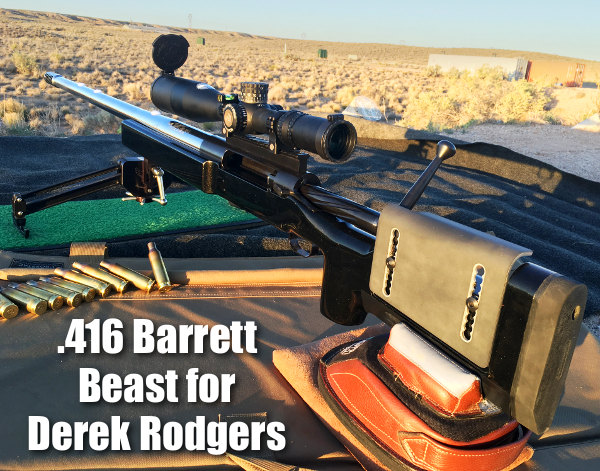
Current F-TR World Champion Derek Rodgers is also the reigning King of 2 Miles champ, so he knows something about Extreme Long Range (ELR) shooting. While Derek won his KO2M title at Raton shooting the .375 CheyTac cartridge, Derek decided that something even bigger was in order. This season, Derek will be shooting a .416 Barrett. Last week we showcased his impressive .416 Barrett ammo, with massive Cutting Edge bullets.
Now we can show the Big Rig that will deliver those .416-caliber projectiles. This monster weighs 40+ pounds and sports a 40″ Bartlein barrel — more length for more velocity. Derek’s new ELR rifle features a McMillan Beast 2 stock, BAT EX action, and Nightforce ATACR 7-35x56mm scope. Derek explained why he moved up to a bigger caliber: “I built a new rifle with the anticipation of seeing impacts easier. It was not just a larger caliber being more effective on hitting ELR targets, but rather hoping that a missed shot would have a much larger impact. Impacts beyond a mile become harder to see due to terrain and vegetation. So any added dust or splash erupting from the earth is a decisive benefit over an equally-accurate smaller caliber.” Here is Derek’s full report on his new .416 Barrett rifle.
Derek Rodgers Campaigns a .416 Barrett
Report by Derek Rodgers Cartridge Choice — I chose a standard .416 Barrett cartridge as it allows for bullets up to and slightly exceeding 550 grains. It really does bridge the gap between the .375 variants and a 50 BMG. There are several great solid ELR bullet options from manufactures like Cutting Edge that range from 475-550 grains. These offer a variety of extremely high BC options for barrels that have different twist rates. Most loads will utilize the slowest burn rate powders commercially available. Good options are Vihtavuori 20N29, RL50, H50BMG and other powders with a similar burn rate.
Shooting the .416 — Tamer than Expected
An initial observation is that the rifle is very controllable and feels much like a larger F-TR gun. The rifle weighs 40+ pounds, balanced and stays on target very well. The recoil is manageable and linear. This seems to give a straight rearward impulse that does not affect positioning. This allows for quick repositioning into battery and faster follow-up shots.
Rifle Details — BAT EX Action, Bartlein 40″ Barrel, McMillan Beast 2 Stock
Derek’s .416 Barrett ELR Rig features a BAT EX action with a Bix N’ Andy trigger. Out front is a gigantic 40” long, 1:9″-twist Bartlein barrel fitted with a Terminator T5 muzzle brake. The handsome McMillan Beast 2 stock combines a lower center of gravity design with a higher butt location. Given that high butt geometry, McMillan cleverly fitted the higher buttpad with a port allowing the cleaning rod to pass through (see photo below). On top is a Nightforce ATACR 7-35x56mm scope in NF rings on a +60 MOA rail, with Holland 34mm bubble level. The stock is supported by a Phoenix bipod and rests in an Edgewood bag designed for the McMillan Xit F-TR stock.
Note the extended Buttpad height. That helps with recoil in prone position. This McMillan Beast 2 stock includes a pass-through hole for the cleaning rod.
Gunsmithing by Blake Barrel and Rifle in Arizona
Derek’s rifle was built and chambered by Bryan Blake of Blake Barrel and Rifle in Phoenix, Arizona. The chambering was done with a Manson Precision reamer. Derek explains: “Bryan and his family have been in the machine shop business for several generations and have the expertise and equipment to handle larger barrel diameters associated with F-Class to ELR type rigs. I tried to consider all angles and potential pitfalls that might occur during the building process. However, Bryan added his own touches to make the project his own. He truly created a work of art and supplied a turn-key rifle that is meticulously built from the inside out and looks as great as the tolerances it holds.”
Do you know what the inside of a rifle chamber (and throat zone) really looks like? Do you understand the concept of headspace and why it’s important? If not, you should read the Brownells GunTech article Gauging Success – Minimum Headspace and Maximum COL. This article explains the basics of headspace and shows how to measure headspace (and length to lands) in your barrels with precision. The article also explains how to adjust your full-length sizing dies to “bump the shoulder” as needed.
Why is headspace important? The article explains: “Controlling headspace and setting proper C.O.L. also represent improved safety and reduced cost of handloading. Excessive headspace can cause case head separation and gases in excess of 60,000 PSI escaping from a rifle’s chamber. Too little headspace can result in a chamber forced bullet crimp and a bullet that becomes an obstruction more than a properly secured projectile. Excessive C.O.L. can result in a rifling-bound bullet, a condition that could result in spikes of excessive pressure.” [Editor’s NOTE: It is common for competitive benchrest shooters to seat bullets into the rifling. This can be done safely if you reduce your loads accordingly. With some bullets we often see best accuracy .010″ (or more) into the lands. However, this can generate more pressure than the same bullet seated .010″ away from initial lands contact. As with all reloading, start low and work up gradually.]
How is headspace specified? Most cartridges used within the United States are defined within ANSI/SAAMI Z299.3-4. Brownells explains: “In the case of the .243 Winchester, as an example, there are pressure specifications, cartridge drawings and, as pictured above, chamber drawings. Armed with a chamber drawing, each manufacturer producing a firearm for the .243 Winchester knows the proper standard dimension to cut chambers and set headspace. Notice there are two headspace reference dimensions for the chamber. The upper is a place in the chamber where the shoulder is .400″ in diameter; the “datum” or “basic” line. The lower is the 1.630″~1.640″ minimum – maximum dimension from the breech face (bolt face) to that point in the chamber that measures .400″.”
The actual headspace of any firearm is the distance from the breech face to the point in the chamber that is intended to prevent forward motion of a cartridge.
Here’s something you may not have seen before — a left-port, side-charging AR15 Upper. This unit was developed by John Scandale of Keystone Accuracy. While this was designed for left-handed High Power shooters, the lefty upper also works well for right-handed F-TR shooters. This design allows a prone shooter to single-load with his left hand, an efficient system for a right-handed shooter. Here is a review of the lefty upper from GS Arizona, who created the Rifleman’s Journal website. Like John Scandale, GS is a southpaw.
The Lefty AR Upper from Keystone Accuracy
by GS Arizona
We left-handed shooters are always the last to get the benefit of new firearms developments, or so it seems to us most of the time. There is no rifle more popular today than the AR15, whether for competitive shooting or plain recreational use; but even for that ubiquitous black rifle, left-handed items are few and far between. However, Keystone Accuracy run by left-handed High Power shooter John Scandale has some good stuff for us.
John is a long time High Power shooter, a member of the National Guard’s All-Guard rifle team and a Distinguished Rifleman. He knows exactly what makes a good High Power rifle — unlike many of the mail-order parts and pieces you see offered for sale by someone who only shoots his computer keyboard… John is a real shooter, I’ve known him for many years and trust his work.
The most interesting item from Keystone is the left-hand billet upper receiver for the AR15 match rifle. This thick-wall, CNC-machined piece appears to be very durable and fits all existing AR15 lower receivers.
When the AR15 was becoming popular in High Power shooting in the mid-1990s, I had a match rifle built on one. To solve the left-hand problem, I had a second port milled into the left side to allow me to load the rifle comfortably in slow-fire, single-load matches. Unfortunately, sometimes the round I flicked into the left port would fall right out of the right port! That was a bit frustrating and this receiver, along with an appropriate left-handed bolt assembly will work for the lefty just as we desire.
I’ve seen quite a few AR15 based rifles in F-TR at our local club matches over the past year. This upper would be a good choice for many right-handed shooters using the AR for F-Class as it allows loading with the left hand while the right hand remains on the pistol grip and ready to fire when the target appears. In light of the fact that the bolt release is on the left side, that makes life a lot simpler than using the right hand! So if you’re a left-handed shooter or even a right-handed F-Class shooter, give this some thought, it might be just what you’ve been waiting for and didn’t even know it!
Vista Outdoor Announces Strategic Business Transformation Plan
Big news. Vista Outdoor Inc. (NYSE: VSTO) may be selling off gun-makers Savage and Stevens, declaring it will “explore strategic options” for those brands. However, Vista Outdoor will retain its businesses that produce ammunition and reloading components: Alliant Powder, CCI, Federal Premium, and Speer. The sell-off of Savage and Stevens is not a sure thing yet, but Vista’s new CEO Chris Metz has been looking hard at the “bottom line” and he says that the gun-making brands have not been as profitable as expected. This is not just an exit from gun-making. Vista Outdoors executives have analyzed the company’s full portfolio of brands, and decision-makers have targeted other brands for sell-off. READ Vista Outdoor News Release.
The Wall Street Journal reported: “The company [Vista Outdoor, VSTO, -13.07% on 5/1/18] said Tuesday it would pare its brands to focus on business lines including ammunition and shooting accessories, water bottles and packs and outdoor cooking ware. It will explore the sale of several brands including Bell bike helmets, Giro snow goggles, Blackburn handlebar tape, Jimmy Styks paddle boards, and Savage and Stevens firearms[.]”
Notably, Vista Outdoor remains fully committed to the ammunition and components businesses. In an official news release, CEO Metz stated: “Vista Outdoor is excited about the potential of each of our core businesses, particularly ammunition, which is our largest core business. An increased focus on our heritage ammunition business will manifest itself in more innovative and breakthrough new products introduced over the next few years. We also anticipate that by prioritizing this business, we will be able to invest more capital to further enhance and expand our global leadership position.” Metz denied that the sell-of of Savage and Stevens was a response to a boycott by the REI outdoor retail chain. The CEO said that REI represents less than 1% of the company’s total sales.
CEO Metz acknowleged that revenues were down substantially for the past fiscal year (ending 3/31/18), and reduced gun sales were one reason: “Sales were $2.3 billion, down 9% from the prior year. The decline was caused by lower volume in Shooting Sports across all ammunition categories, lower pricing across the portfolio, and lower firearms sales as a result of decreased demand impacting the shooting sports industry. Additionally, Outdoor Products declines were caused by market conditions affecting shooting-related categories, including hunting and shooting accessories, optics, and tactical products.”
Vista Outdoor currently has a large portfolio of brands, including guns, gear, eyewear, ammunition, camping equipment, and much more. Top brands for guns and shooting, after Savage and Stevens, are: Alliant Powder, American Eagle, Blazer Ammunition, Bushnell, CCI, Federal Premium, RCBS, and Speer.
Montana-based PROOF Research has released a revealing new video showcasing carbon fiber firearms technology and the company’s barrel-making process. Viewers will find the 8-minute film an intriguing introduction to composite barrel-making, which employs aerospace carbon fiber wrapped around a steel barrel core. The video showcases the high-tech machines used at PROOF’s production facilities.
PROOF’s CEO Larry Murphy explains that PROOF’s barrel technology is state-of-the-art: “What PROOF Research is doing is bringing disruption into our industry. We’re doing things that have never been done here before. That’s going to help the warfighter, and it’s going to help the average hunter … it’s going to do a lot of things.” The video shows how the company employs aerospace-grade, high-temperature composite materials to build match-grade carbon fiber-wrapped barrels, and composite rifle systems.
Dr. David Curliss, General Manager of PROOF Research’s Advanced Composite Division, and former head of the U.S. Air Force High Temperature Composites Laboratory, explains how aerospace expertise helps in the development of PROOF’s firearms-related products: “We are able to provide premier materials for PROOF Research for firearms barrels applications as well as the aerospace market. We’re probably the only firearms technology company that has composite materials in orbit around the earth.”
OK, admit it — you’ve always wondered how they get those color swirls and camo patterns in McMillan stocks. (You’ll be surprised at the answer). And how does McMillan manage to inlet stocks so precisely for so many different action types?
McMillan Stocks is one of the leading fiberglass stock producers, cranking out 8,000-10,000 stocks every year for hunters, target shooters, and members of the military. McMillan employs state-of-the-art, high-tech machinery. At the same time, many processes are still done by hand — such as applying colors to the stocks.
In the videos below, Kelly McMillan hosts Bob Beck of Extreme Outer Limits TV in a tour of the McMillan stock-making facility. We think all avid “gun guys” will be fascinated by these high-quality videos.
McMillan Custom Stock Production
The first video shows the stock-building operation from start to finish — You’ll see the lay-up, color application, molding, and “stuffing”. Watch carefully at 0:16 to see colors being applied.



 Craters may look interesting on the moon, but you don’t want to see them on your primers. Certain mechanical issues that cause primer craters can also cause primer piercing — a serious safety problem that needs to be addressed. If you have a gun that is cratering primers (even at moderate pressure levels), there is a solution that works with many rifles — send your bolt to
  Firing Pin Hole Bushing by Greg Tannel


 OK, admit it — you’ve always wondered how they get those color swirls and camo patterns in McMillan stocks. (You’ll be surprised at the answer). And how does McMillan manage to inlet stocks so precisely for so many different action types?


