The Civilian Marksmanship Program (CMP) does more than run matches and sell surplus firearms. The CMP also operates a full-service Custom Shop in Anniston, Alabama that does maintenance, repair, and upgrading of USGI-issue rifles at a reasonable cost.
Since the fall of 2013, the CMP Custom Shop has offered repair, upgrade, gunsmithing and custom services for a wide range of U.S. Military rifles, specifically those issued in early eras. As well as regular repairs and troubleshooting, the CMP Custom Shop can upgrade, accurize, and refinish virtually all the rifle types sold by the CMP.
What Rifles Can the CMP Custom Shop Service?
The CMP Custom Shop will work on the M1 Garand, M1 Carbine, 1903/1903A3 Springfield, 1917 Enfield, and the Krag. The Custom Shop will also service Remington 40X, Mossberg 44, and H&R Model 12 rifles. CMP will NOT work on shotguns, pistols, revolvers, M14/M1A, AR15-style rifles or other commercially-produced modern rifles. For a list of services (with prices) visit the CMP Custom Shop webpage.
NOTE: Before you can send a rifle to the CMP Custom Shop you must be a customer on file in the CMP system. Customers must meet the same eligibility requirements as for CMP rifle purchases. Once qualified, you can purchase a rifle from the CMP and have the CMP Custom Shop make modifications to it prior to shipping.
CMP Custom Shop Can Work on USGI Rifles Purchased from Other Sources
The CMP Custom Shop can work on rifles that may have been purchased elsewhere as long as they were made by a USGI contractor. Some examples include: Springfield Armory (not Springfield Inc.), Harrington & Richardson, Winchester, International Harvester, Remington, Rock Island, Eddystone, Inland, Underwood, Rock-Ola, Quality Hardware, National Postal meter, Standard Products, IBM, Irwin-Pederson and Saginaw. NOTE: There are many NON-USGI copies of the M1 Garand, 1903 Springfield and especially the M1 Carbine that CMP will be unable to work on.
For more information, call (256) 835-8455, x1113, or send email to customshop [at] thecmp.org. Shipping and Correspondence address for the CMP Custom Shop is:
Gary Eliseo of Competition Machine is a very talented sling shooter. And Eliseo Tubeguns are used by many of the nation’s top Palma and Sling Discipline shooters. Gary has “raised the bar” with his latest Tubegun product which combines a tuned Pierce action with a modernized Eliseo chassis. Gary calls this the Universal Match Rifle System (UMRS). It can accept a variety of high-end triggers, including the Jewell and Bix’n Andy two-stage.
Gary tells us: “We’re very proud to announce our new Universal Match Rifle system, built around a special hand-tuned action made to our specifications by Pierce Engineering. The Universal Match Rifle system is crafted to the highest standards and has a full line of attachments that make it easily configured for the NRA Highpower, Long Range Prone/Palma or Precision Rifle disciplines. The Universal Match Rifle is available as a complete rifle in the chambering of your choice with your choice of a Jewell single stage or Bix’n Andy two stage trigger, it’s also available as a ‘builders kit’ where you can have your gunsmith fit the barrel and trigger of your choice. Please contact us with your questions about the UMRS, or to ask about delivery schedules and pricing”.
The Eliseo UMRS has already proven itself in competition. At the recent 2018 Berger Southwest Nationals, Allen Thomas used his UMRS to win the Overall Grand Aggregate in Sling Division. Competition was fierce, with some great shooters including many sling aces from the United Kingdom.
SWN Sling Winner Allen Thomas (left) with Capstone Precision Group’s Bill Gravatt.
In this video, Gary Eliseo explains the features of his new Universal Match Rifle System. Gary builds the UMRS and other high-quality chassis systems at his Cottonwood, Arizona production facility. Visit GotXRing.com for more information on all Competition Machine products.
There is a new book, Chambering Rifles for Accuracy, that will benefit folks who want to understand the chambering process, and potentially learn to chamber a barrel on their own. We caution, however — you really need a skilled, hands-on mentor for this this task. For someone without a lot of machining experience, chambering can be tricky, and working with lathes can be dangerous to say the least.*
With those cautions stated, this book will help any gun-owner understand how chambering is done, and what to look for when assessing chambering work by commercial gunsmiths. Chambering Rifles for Accuracy is co-authored by Gordy Gritters and Fred Zeglin. The methods detailed in this book can be used equally well by gunsmiths in a professional shop, and by skilled, well-trained hobbyists working in a home workshop. The book costs $49.95 from Amazon.
Gordy Gritters is a highly-respected gunsmith and gunsmithing instructor. Gordy has built many match-winning competition rifles so he knows his stuff. Fred is a gunsmith, gunsmithing instructor, author, and is the owner of 4-D Reamer Rentals, so he is very knowledgeable on the use and care of reamers. Fred has extensive experience building high-accuracy hunting rifles.
Fred wrote the first half of the book, which covers what is needed to prepare for and chamber high-accuracy hunting barrels. Zeglin lists all the tools needed such as reamers, micrometer reamer stops, headspace gauges, and more.
Gordy wrote the second half of the book, which goes beyond basic chambering. Gordy covers setting up a lathe for chambering barrels through the headstock, various dialing-in methods commonly used, how to deal with curvature in rifle bores, and how to deal with reamer chatter (especially prevalent in 5R-type barrels). Then Gordy covers the entire dialing-in/threading/fitting/chambering/crowning process used to build a benchrest-quality rifle. Gordy also explaines how to ream custom chamber necks, and how to throat the chamber for specific bullets or for a specific purpose.
Gordy Gritters also created an excellent DVD, “Chambering a Championship Match Barrel”. No other chambering video shows the entire chambering process step-by-step with the advanced, precision techniques used by master gunsmiths. Gordy has built several rifles that hold world records and have won National Championships. This is a professional 90-minute production from Grizzly Industrial. You can purchase this $69.95 DVD from Gordy’s website or from Grizzly Industrial.
*This Editor’s own uncle suffered a severe arm injury while working with a lathe. He was not an amateur — he had done lathe and mill work for over 40 years. But a shirt-sleeve caught in the spinning chuck. The results were horrific.
The Sureshot Armament Group (SAG) has developed a modular aluminum chassis for the vintage, straight-pull Swiss K31 rifle. This chassis transforms an old classic into a modern, fast-cycling tactical rig. The SAG Lightweight K31 Rifle Chassis is CNC-Machined from aluminum. Hard anodized, it weighs just 2 lbs. 13 ounces. It offers adjustable cheek piece and butt-pad, with a three-inch LOP adjustment range. Believe it or not, installing a vintage K31 into this SAG stock is an easy bolt-on process. No modification of the K31 action is required.
The chassis-builder SAG states: “The main idea behind the SAG Lightweight K31 Rifle Chassis was to give the shooter …ergonomics of a Tube-gun but with lines of the classic rifle. The chassis ‘wraps’ the shooter around the rifle, moving bolt operation under the shooters cheek to allow the marksman to maintain cheek weld during the whole shooting series.” The chassis design also allows a more forward optics placement for better eye relief.
SAG Lightweight K31 Rifle Chassis Features:
CNC-Machined Aluminum with hard-anodized matte finish
Easy bolt-on installation to Swiss K31
Adjustable Cheek Piece (0-30mm)
Adjustable Buttpad to set LOP (11.5” – 14.5”)
KEYMOD Interface on fore-end and buttstock
Accepts any AR-type pistol grip
Overall chassis weight: 2 lbs. 13 oz. (1280 grams)
Chassis MSRP: €950 ($1163.00 USD)
About Switzerland’s Original Karabiner Model 1931 (K31)
The Karabiner Model 1931 (K31) is a magazine-fed, straight-pull bolt action rifle. It was the standard issue rifle of the Swiss armed forces from 1933 until 1958, though examples remained in service into the 1970s. It has a 6-round removable magazine, and is chambered for the 7.5×55mm Swiss Gewehrpatrone 1911 cartridge (aka GP 11).
Wiki Photo by Bouterolle, CC BY-SA 3.0
Although the K31 is a straight-pull carbine broadly based on previous Swiss “Schmidt–Rubin” service rifles and carbines, the K31 was not designed by Colonel Rudolf Schmidt (1832–1898) as he was not alive in 1931 to do so. Mechanical engineer Eduard Rubin (1846–1920) was the designer of the 7.5×55mm Swiss ammunition for which previous Swiss service rifles and the K31 are chambered. The Karabiner Model 1931 was a new design by the Eidgenössische Waffenfabrik in Bern, Switzerland under Colonel Adolf Furrer (1873–1958). The Karabiner Model 1931 replaced both the Model 1911 rifle and carbine and was gradually replaced by the Stgw 57 from 1958 onwards.
Plan to buy or build a 224 Valkyrie rifle this year? Well now you can get the official specifications for the new 224 Valkyrie cartridge and chamber. The Sporting Arms and Ammunition Manufacturers’ Institute (SAAMI), has released its official 224 Valkyrie “blueprint” which you can now download for your records. SAAMI approved the Federal Premium 224 Valkyrie as an official new cartridge this past January. The 224 Valkyrie’s SAAMI standards documents are now published and available to the industry as a whole, as well as to the public.
SAAMI allows free access to technical data and drawings for cartridge and chamber designs, which are posted in the Specifications section of SAAMI’s website. All cartridge and chamber drawing documents are contained within the ANSI/SAAMI Standards and can be found on www.saami.org. The New SAAMI Cartridge Cartridge/Chamber Designs for 224 Valkyrie can be viewed here: http://www.saami.org/PDF/224-Valkyrie-Introduction.pdf.
About the 224 Valkyrie Cartridge
Federal Premium’s 224 Valkyrie is based on a 6.8 SPC case necked down to 22 caliber. The Valkyrie has a shorter case than the .223 Remington (and 5.56×45 NATO). This allows you to load the longest, heaviest .224-caliber bullets and still feed reliably from an AR15-type magazine. The 224 Valkyrie offers flatter trajectories than other AR15 mag-friendly cartridges, including the 22 Nosler, .223 Rem, and 6.5 Grendel. With heavy projectiles, the 224 Valkyrie boasts impressive ballistics — it can stay supersonic past 1,300 yards. Plus it has roughly half the recoil of larger cartridges offering comparable ballistics, such as the 6.5 Creedmoor (see chart below).
SAAMI’s work creates standards for the cartridge, increasing safety, interchangeability, reliability, and quality for firearm manufacturers building rifles chambered for the 224 Valkyrie. Federal Premium Ammunition President Jason Vanderbrink notes: “SAAMI’s approval of the cartridge was a crucial step in legitimizing [the 224 Valkyrie] within the industry”.
The Role of SAAMI in Creating Uniform Ammunition Standards
SAAMI was founded in 1926 at the request of the federal government and tasked with creating and publishing industry standards for safety, interchangeability, reliability and quality, as well as coordinating technical data. SAAMI’s Technical Committee, which consists of firearm and ammunition industry experts, reviewed the 224 Valkyrie submission over a period of about six months. The official cartridge name, maximum cartridge and minimum chamber dimensions, pressure limits, test equipment, and other characteristics are all considered and scrutinized during the process.
Here is a “birds-eye view” from IWA. Yes that’s a mini-blimp at lower left.
After SHOT Show in the USA, the IWA Outdoor Classics is the biggest gun/hunting/outdoor trade show in the world. The IWA event, held each spring in Nuremberg, Germany, concludes Monday, March 12 after a 4-day run in the Nürnberg Exhibition Centre. This is a big event — 1562 exhibitors from around the globe are showcasing their products. IWA attendance, which has grown steadily, is expected to top 50,000 visitors this year.
Many beautiful custom hunting rifles are on display. Note the stunning wood and the elaborate metal-work on bolt and action. Don’t ask about the price…
Here are a pair of Olympic-grade Steyr air pistols. Designed for one-handed shooting, these feature very ergonomic wood grips.
Toggle action biathlon rifles like this Anschutz captured medals at the recent Winter Olympics in South Korea. Not the handy magazine storage on the fore-arm.
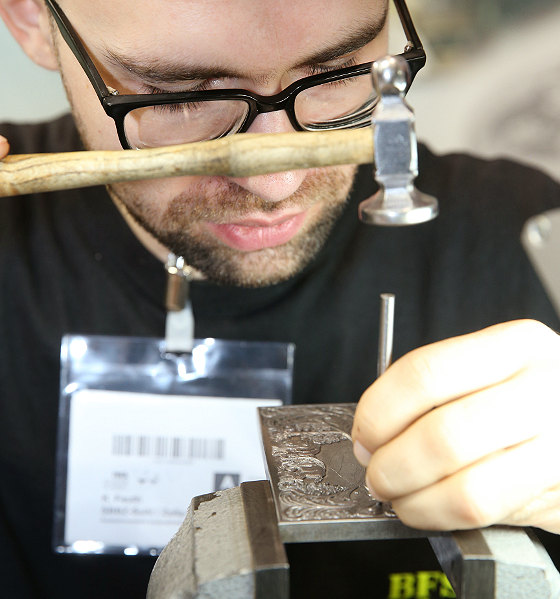
Along with displays of guns, optics, and hunting gear, the IWA show features workshop areas where skilled artisans practice their trades — you can see engraving, wood-carving, and other skills in action.
Along with match rifles and hunting rigs, there were some serious sniper rifles on display. Here a German lady gets behind a Steyr SSG M1, offered in 7.61×51 NATO and .338 Lapua Magnum.
Bling was the thing at some pistol booths. These colorful Strike One handguns are made by Arsenal Arms in Italy (more sedate colors are also offered). A Russian-Italian design collaboration, the Strike One uses a Bergmann barrel system which does not tilt (unlike the widely-used Browning system). This allows for an extremely low bore axis.
Multiple vendors had some beautifully-figured stock blanks on display. The most desirable Turkish Walnut blanks can cost thousands of dollars.
Here are some handsome Winchester Model 1866 (Yellowboy) rifles with highly-decorated receivers. This classic American design is now crafted in Italy by Uberti.
Major German rifle-makers Blaser, Mauser, and Sauer all had large, prominent displays at the IWA Show in the Nuremberg Exhibition Centre.
How and Why to Create a Dummy Round
When you have a new custom rifle built, or a new barrel fitted to an existing rifle, it makes sense to create a dummy round. This should have your preferred brass and bullet types, with the bullet positioned at optimal seating depth. A proper dummy round helps the gunsmith set the freebore correctly for your cartridge, and also ensure the proper chamber dimensions.
Respected machinist, tool-maker, and gunsmith Greg Tannel of Gre-Tan Rifles explains: “I use the dummy round as a gauge to finish cut the neck diameter and throat length and diameter so you have [optimal] clearance on the loaded neck and the ogive of the bullet just touches the rifling.” He recommends setting bullet so the full diameter is just forward of the case’s neck-shoulder junction. “From there”, Greg says, “I can build you the chamber you want… with all the proper clearances”.
Greg Tannel has created a very helpful video showing how to create a dummy round. Greg explains how to measure and assemble the dummy and how it will be used during the barrel chambering process. Greg notes — the dummy round should have NO Primer and No powder. We strongly recommend that every rifle shooter watch this video. Even if you won’t need a new barrel any time soon, you can learn important things about freebore, leade and chamber geometry.
This has been a very popular video, with 244,000 views. Here are actual YouTube comments:
That is the best explanation I’ve ever seen. Thank you sir. — P. Pablo
Nice video. You do a very good job of making this easy for new reloaders to understand. I sure wish things like this were available when I started reloading and having custom rifles built. Once again, great job, and your work speaks for itself. — Brandon K.
Beautiful job explaining chambering clearances. — D. Giorgi
Another Cool Tool — The Stub Gauge
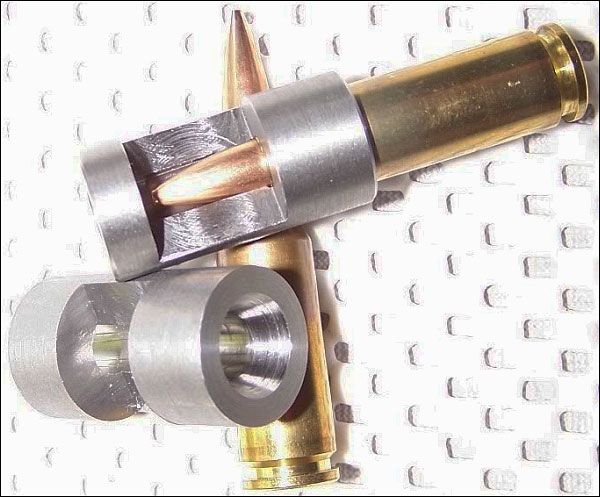
When you have your gunsmith chamber your barrel, you can also have him create a Stub Gauge, i.e. a cast-off barrel section chambered like your actual barrel. The stub gauge lets you measure the original length to lands and freebore when your barrel was new. This gives you a baseline to accurately assess how far your throat erodes with use. Of course, as the throat wears, to get true length-to-lands dimension, you need take your measurement using your actual barrel. The barrel stub gauge helps you set the initial bullet seating depth. Seating depth is then adjusted accordingly, based on observed throat erosion, or your preferred seating depth.
This barrel’s shoulder was 0.025″ off the action because Red Locktite had been used on the threads.
Gunsmith Thomas ‘Speedy’ Gonzales offered this interesting report about how NOT to headspace a barrel. Hopefully you never discover something like this…
“A good friend and customer sent this rig in for repair after FedEx damaged the rifle during inbound transport from another smith. After repairing the stock and rebedding it, I decided to re-polish the barrel to make the repair perfect. Well this just added insult to injury as the barrel did not want to come off. After a few choice words, the barrel finally broke free only to reveal something very disturbing. It seems the barrel had been ‘headspaced’ by using RED Loctite to hold it in place.” [Editor: That’s definitely NOT how barrels should be fitted.]
Speedy was not happy: “I hope the smith that did this sees the photos and realized what jeopardy he put my customer in or anyone who shot the rifle for that matter. When cleaned up, the shoulder on the barrel was over 0.0250″ (25 thousandths) away from the face of the receiver.” [Editor: That’s a lot in this business]. Check out the images below to see how much the barrel rotated further inward when cleaned up. The barrel spun in nearly another eighth-turn or more. Not good.
Velocity vs. barrel length — How much speed will I sacrifice with a shorter barrel? Hunters and competition shooters often ask that. Today we DO have solid answers to that question for many cartridge types thanks to Rifleshooter.com.
Bill, Rifleshooter.com’s Editor, explained his test procedure:
“I gathered four different types of factory Federal 224 Valkyrie ammunition, the 90gr Sierra MatchKing (SMK), 90gr Fusion soft point (SP) (referred to a Fusion MSR), 75gr Total Metal Jacket (TMJ) and 60gr Nosler Ballistic Tip Varmint (NBT). After a brief barrel break in and zero, I fired 5 rounds of each cartridge at each barrel length (except the 75 TMJ, I fired 4 rounds at each barrel length due to limited resources). I recorded the average muzzle velocity and standard deviation for each ammunition and barrel length combination and cut the barrel back 1 inch and repeated the process. I recorded barrel lengths from 28″ to 16.5″ (I try to save these barrels as finished 16″ tubes so they don’t go to waste).”
The Heavy Bullet 90gr Ammo Lost about 21 FPS per Inch
How did the test turn out? You’ll find all the results summarized in helpful tables with inch-by-inch velocity and SD numbers. For the two, 90gr ammo samples, results were similar. The 90gr SMK ammo started at 2782 fps (28″), finishing at 2541 fps (16.5″). That’s a loss of 241 fps, or 20.96 fps average per inch of length. The ammo loaded with 90gr Fusion SPs started at 2797 fps (28″) and ended at 2561 fps (16.5″), a drop of 236 fps. That’s 20.5 fps loss per inch. NOTE: Ambient temperature during the test was 45° F. You could expect the overall velocities to be a bit higher during hotter summer months.
With a the smaller bullets, the effect was even more dramatic. As you’d expect they started out faster. The ammo with 60gr Nosler Ballistic Tips (NBT), a good choice for varminters, started at 3395 fps (28″), and declined to 3065 fps (16.5), a total velocity drop of 330 fps. Average velocity loss was 28.7 fps per inch of barrel length. Rifleshooter.com also tested Federal 75gr TMJ ammo.
About the .224 Valkyrie Cartridge
The new .224 Valkyrie was introduced late last year as a Hot Rod cartridge that will work in AR15s. Designed to rival the .22 Nosler while still running well in ARs, the new .224 Valkyrie offers excellent long-range performance when loaded with modern, high-BC bullets. We expect some bolt-action PRS shooters might adopt the .224 Valkyrie. Why? Reduced recoil. With the 90gr SMK, the .224 Valkyrie offers ballistics similar to the 6.5 Creedmoor but with significantly less felt recoil. Check out this chart from Federal showing comparative recoil levels:
.224 Valkyrie vs. .22-250 Remington
The Social Regressive explains: “There are two key reasons why the 224 Valkyrie is unique and desirable. First, it is specifically designed to fit the limitations of the AR-15 platform. It does so even when loaded with gigantic bullets, like the 90-grain SMK that Federal announced. .22-250 Rem is too long and too fat to work in the AR-15 platform; it needs an AR-10 bolt and magazine.”
The new .224 Valkyrie is basically a 6.8 SPC case necked down to .22-caliber. You can use your existing AR15 lower, but you will need a dedicated .224-Valkyrie upper, or at the minimum a new barrel, modified bolt with proper bolt face, and 6.8-compliant mags.
So what does a “worn-out” barrel really look like? Tom Myers answered that question when he removed a 6.5-284 barrel and cut it down the middle to reveal throat wear. As you can see, there is a gap of about 5mm before the lands begin and you can see how the lands have thinned at the ends. (Note: even in a new barrel, there would be a section of freebore, so not all the 5mm gap represents wear.) There is actually just about 2mm of lands worn away. Tom notes: “Since I started out, I’ve chased the lands, moving out the seating depth .086″ (2.18 mm). I always seat to touch. My final touch dimension was 2.440″ with a Stoney Point .26 cal collet.”
Except for the 2mm of wear, the rifling otherwise looks decent, suggesting that setting back and rechambering this barrel could extend its useful life. Tom reports: “This was something I just thought I’d share if anyone was interested. I recently had to re-barrel my favorite prone rifle after its scores at 1,000 started to slip. I only ever shot Sierra 142gr MatchKings with VV N165 out of this barrel. It is a Hart and of course is button-rifled. I documented every round through the gun and got 2,300 over four years. Since I have the facilities, I used wire EDM (Electro Discharge Machining) to section the shot-out barrel in half. It was in amazingly good shape upon close inspection.”
Tom could have had this barrel set back, but he observed, “Lately I have had to increase powder charge to maintain 2,950 fps muzzle velocity. So to set it back would have only increased that problem. [And] I had a brand new 30″ Krieger all ready to screw on. I figured it was unlikely I’d get another full season on the old barrel, so I took it off.”


 The Civilian Marksmanship Program (CMP) does more than run matches and sell surplus firearms. The CMP also operates a full-service Custom Shop in Anniston, Alabama that does maintenance, repair, and upgrading of USGI-issue rifles at a reasonable cost.

 For more information, call (256) 835-8455, x1113, or send email to customshop [at] thecmp.org. Shipping and Correspondence address for the CMP Custom Shop is:






 Velocity vs. barrel length — How much speed will I sacrifice with a shorter barrel? Hunters and competition shooters often ask that. Today we DO have solid answers to that question for many cartridge types thanks to


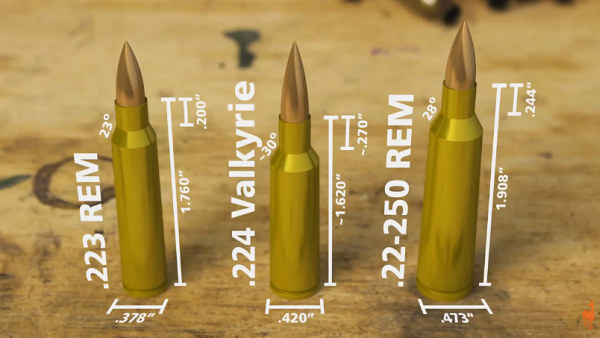 Image from Social Regressive
  So what does a “worn-out” barrel really look like? Tom Myers answered that question when he removed a 6.5-284 barrel and cut it down the middle to reveal throat wear. As you can see, there is a gap of about 5mm before the lands begin and you can see how the lands have thinned at the ends. (Note: even in a new barrel, there would be a section of freebore, so not all the 5mm gap represents wear.) There is actually just about 2mm of lands worn away. Tom notes: “Since I started out, I’ve chased the lands, moving out the seating depth .086″ (2.18 mm). I always seat to touch. My final touch dimension was 2.440″ with a Stoney Point .26 cal collet.”


