Eurooptic vortex burris nightforce sale


teslong borescope digital camera barrel monitor


As an Amazon Associate, this site earns a commission from Amazon sales.


November 8th, 2026

Sunday GunDay: NRA 2026 F-Class National Championships
2026 F-Class NRA National Championships ben avery az arizona john masek

Rain-Soaked Week at the 2026 NRA F-Class National Championships at Ben Avery

A Week Shaped by Weather Report by John Masek
I came away from the 2026 F-Class Nationals at Ben Avery in Phoenix, Arizona feeling that the weather had shaped the week as much as the competition. Held from October 25 through November 1, 2026, the championships brought together F-Open and F-TR shooters for Mid-Range and Long Range matches with nearly 300 competitors in attendance.

Difficult Calls, Safety First
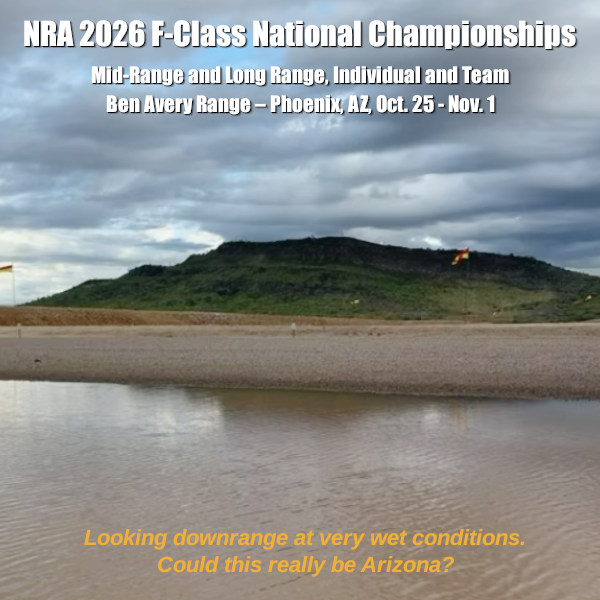
The Mid-Range matches opened in beautiful conditions, with mild but challenging winds. By the long-range portion, however, the weather had deteriorated. Match directors had to balance keeping the championship on schedule with the risks of flash flooding and lightning, while following Ben Avery’s inclement-weather safety rules. Another consideration not apparent to most of the shooters was the condition of the pits where excessive rain created flooded pools and treacherous-to-drive water-soaked sand. That made access for the staff and competitors very difficult. As the week progressed, worsening weather forced changes to the match schedule and challenged shooters to adapt and stay flexible.

f-class rifle
Here is a modern F-Open rifle, similar to the rifles used by top F-Open competitors.

From my perspective, the Match Directors made the best decisions they could with the conditions in front of them, putting shooter safety first — even when those decisions were unpopular. That is never an easy balance at a National Championship, where delays disrupt a tightly planned program and affect competitors who have traveled a long way to take part. Despite the challenges, match officials were able to ensure that all scheduled shooting for the week took place minus just one long range match. The is a very good result all things considered.

Standout Performances
Despite the difficult week, the winning scores were impressive:

▶ Mid-Range F-TR Champion: Robin Retzloff, 1793-108X
▶ Mid-Range F-Open Champion: Peter Johns, 1797-126X
 Mid-range F-TR Winning Team: The Misfits 1593-94X
 Mid-range F-Open Winning Team: Lapua Brux Borden 1598-115X

▶ Long Range F-TR Champion: Keith Trapp, 1383-62X
▶ Long Range F-Open Champion: John Girgis, 1400-87X
 Long Range F-TR Winning Team: Team Vortex 1578-71X
 Long Range F-Open Winning Team: Bayou Chingones 1594-97X

2026 F-Class NRA National Championships ben avery az arizona john r. girgis f-open long range champion
2026 F-Class Nationals Long Range F-Open Champion John R. Girgis. John won with a score of 1400-87X, with every shot scoring ten points, not dropping a single point! His 87 X-count was also very impressive.

Notably, Long Range F-Open Champion John Girgis scored 1400-87X — a perfect score. That is truly remarkable given the conditions. I don’t believe we’ve seen that before in the Long Range match and it is pretty remarkable. John also finished second in the 600-yard Mid-Range match, just two points behind the winner. His results stood out in a championship that demanded both precision and adaptability in a sea of potential winning performances.
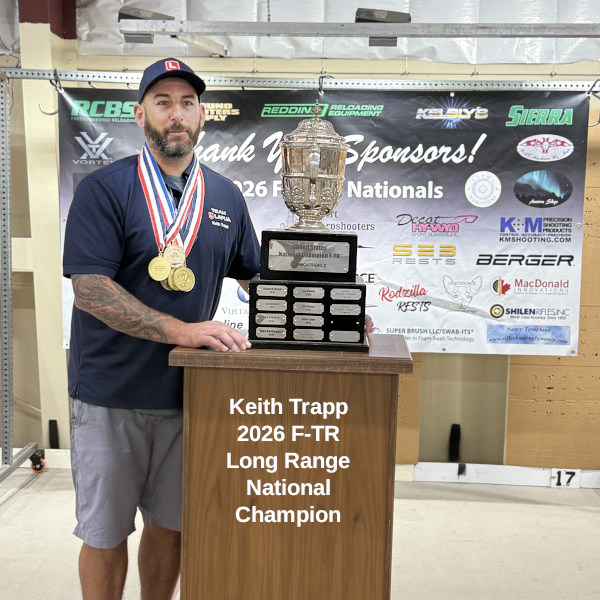
2026 F-Class NRA National Championships ben avery az arizona keith trap team vortex f-tr long range champion
2026 F-Class Nationals Long Range F-Open Champion Keith Trap. Keith, a past champion, won the F-TR division with a strong consistent performance. Keith also was the coach for Team Vortex, winner of the Long-Range F-TR team competition.

The fierce competition, unpredictable weather, and remarkable scores made this one of the most memorable national matches I’ve ever attended and leaves me already excited to attend next year.

ALL SCORES From Mid-Range and Long Range Matches

600-Yard Mid-Range National Championships

Mid-Range Nationals — F-TR Individual Grand Aggregate
Mid-Range Nationals — F-TR Team Aggregate
Mid-Range Nationals — F-Open Grand Aggregate
Mid-Range Nationals — F-Open Team Aggregate

1000-Yard Long-Range F-Class National Championships

Long Range Nationals — F-TR Individual Grand Aggregate
Long Range Nationals — F-TR Team Aggregate
Long Range Nationals — F-Open Grand Aggregate
Long Range Nationals — F-Open Team Aggregate

Challenging Wind Conditions in Past Years

Along with the clouds and moisture, there were some challenging wind conditions at times during the 2026 matches but nothing overly crazy. There were some moderate to strong winds this year, but the winds were generally consistent and not that unpredictable. Here is a video taken at Ben Avery at the 2022 NRA F-Class National Championships. In this video, shooters fight through extremely strong 18-30 mph winds at 600 yards. In these kind of extreme conditions, a major unexpected gust can send your bullet off-target.

F-TR Ben Avery F-Class downrange
F-TR rifle from previous competition at Ben Avery range. F-TR (F-Class Target Rifle) rules allow bipods and rear sandbags. The total weight limit (with bipod and scope) is 18.18 pounds (8.25 kg). In NRA F-TR competition, rifles are strictly limited to two cartridge types: .308 Winchester/7.62x51mm NATO and .223 Remington/5.56x45mm NATO.

Here’s a shot from Ben Avery when the sun is shining…

ben avery f-class nationals

Permalink - Videos, Competition, News, Shooting Skills No Comments »
November 8th, 2026

Gear Options for Holding Ballistics Data Displays on Your Rifle

mdt m-lok card PRC dope roller quick detach qd ballistic data turret holder come-ups knob

When shooting any match that requires moving back and forth between multiple target distances it is very handy to have your ballistics data, i.e. your “come-ups”, placed within easy view. That way you can instantly see your elevation for various target distances in seconds. This can really help a PRS/NRL competitor on timed stages. And having a convenient “Dope” display of elevation at various distances can also benefit varminters who are shooting critters. In our varmint hunters we targeted p-dogs from about 80 yards out to 500+.

PRC DOPE Roller QD Ballistic Data Turret

PRC dope roller quick detach qd ballistic data turret holder come-ups knob

The PRC DOPE Roller QD Ballistic Data Turret provides a handy, low profile display of windage and elevation data. You can see your “dope” without breaking position from behind the rifle. Then simply rotate the knob to display data from various distances. The ballistic data is placed by wrapping a simple 1″ x 3″ adhesive address label around the outside surface of the DOPE Roller. This handy quick-detach roller retails for $64.95 from Precision Rifle Components.

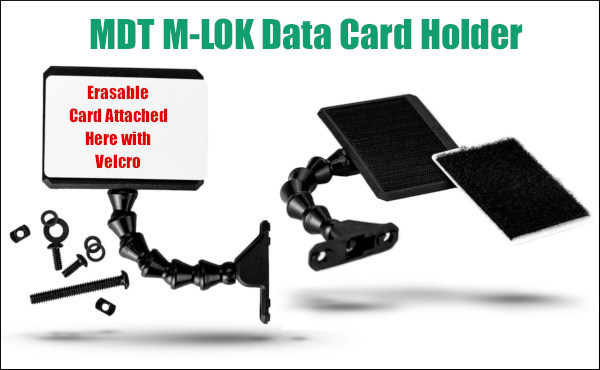
MDT M-LOK Data Card Holder

mdt m-lok card PRC dope roller quick detach qd ballistic data turret holder come-ups knob

The MDT M-LOK Data Card Holder has an adjustable neck allowing you to easily position your ballistics data for optimal viewing. Data entries are written on on a reusable card that attaches with Velcro. The Data Card Holder Kit comes with hardware to mount to any M-Lok rail. In addition the card holder fits directly to an MDT ACC chassis attachment point. This MDT kit includes: M-LOK Data Card Holder, Wet Erase Data Card, Wet Erase Marker, and installation hardware. NOTE: The Card Holder sticks out about 6.7″ when fully extended, but arm links can be removed to make the arm shorter. The unit folds flat for storage. This complete kit is $59.95 at Creedmoor Sports.

Warne Universal Data Card Holder

warne m-lok card PRC dope roller quick detach qd ballistic data turret holder come-ups knob

The Warne Universal Data Card Holder easily attaches to the scope tube, in left or right configurations, for a universal fit. Data is displayed in a convenient location to make quick and accurate target transitions, and the articulating arm allows for low profile storage while not in use. The Warne Universal Data Card Holder retails for $88.49 at Warnescopemounts.com. Three ring sizes are offered: 30mm, 34mm, 35mm. A 50-pack of Warne Data Card label refills is currently $16.99 from Warne.

ballistics data scope coverScope-Cover Mounted Ballistics Table
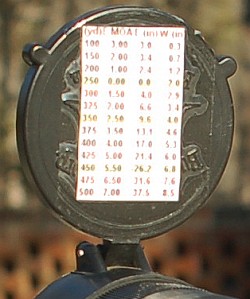
Another option is to place your ballistics card on the back of the front flip-up scope cover. This set-up is used by Forum member Greg C. (aka “Rem40X”).

With your ‘come-up’ table on the flip-up cover you can check your windage and elevation drops easily without having to move out of shooting position.

Greg tells us: “Placing my trajectory table on the front scope cover has worked well for me for a couple of years and thought I’d share. It’s in plain view and not under my armpit. And the table is far enough away that my aging eyes can read it easily. To apply, just use clear tape on the front objective cover.”

Cheap But Effective — Tape on the Stock with Ballistics Data

Bryan Litz tape ballistics come-up hold-over

At the 2021 Nightforce ELR Steel Challenge, Applied Ballistics guru Bryan Litz wrote his come-ups on blue masking tape applied to his stock. He did this based on a tip from Chase Stroud. With the tape applied behind the action, the numbers are easily visible. This “cheap trick” does work apparently — Bryan won the match with a convincing victory over 220 other shooters. READ Match Report.

Cheap But NOT So Effective — Numbers on Hand

ballistics data hand come-up PRS NRL

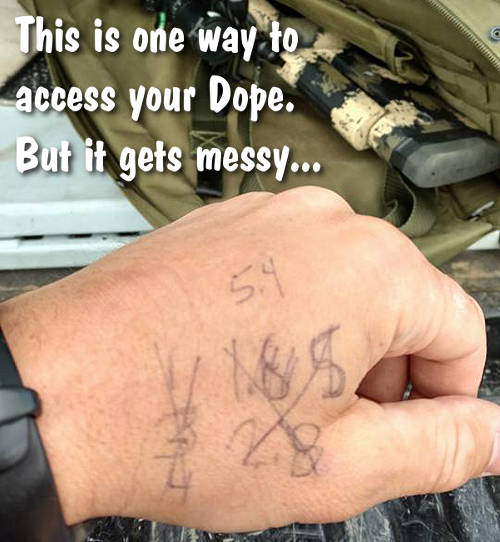
Many of us have scribbled some come-ups on the back of a hand or on our forearm using a marking pen. That can work if you only have a couple distances to deal with — say 100 and 300 yards. But if you want a more complete Come-up table, get one of the card-holders shown above. Writing numbers on the skin is generally not such a good idea….

Permalink - Videos, Gear Review, Optics, Tech Tip No Comments »
November 8th, 2026

Humidity Changes Can Alter Powder Burn Rates and Performance

Tech Tip Norma Powder gunpowder moisture temperature humidity

It’s October, the fall season, and that means rainy, wet weather is on the way in many areas of the country. With rain comes increased moisture in the air, i.e. increased humidity. And that, in turn, can affect how your powders perform by altering their burn rates.

Most shooters realize that significant changes in temperature will alter how powders perform. That’s why you want to keep your loaded ammo out of the hot sun, and keep rounds out of a hot chamber until you’re ready to fire. But there are other factors to be considered — HUMIDITY for one. This article explains why and how humidity can affect powder burn rates and performance.

We’ve all heard the old adage: “Keep your powder dry”. Well, tests by Norma have demonstrated that even normal environmental differences in humidity can affect the way powders burn, at least over the long term. In the Norma Reloading Manual, Sven-Eric Johansson, head of ballistics at Nexplo/Bofors, presents a very important discussion of water vapor absorption by powder. Johansson demonstrates that the same powder will burn at different rates depending on water content.

Powders Leave the Factory with 0.5 to 1.0% Water Content
Johansson explains that, as manufactured, most powders contain 0.5 to 1% of water by weight. (The relative humidity is “equilibrated” at 40-50% during the manufacturing process to maintain this 0.5-1% moisture content). Importantly, Johansson notes that powder exposed to moist air for a long time will absorb water, causing it to burn at a slower rate. On the other hand, long-term storage in a very dry environment reduces powder moisture content, so the powder burns at a faster rate. In addition, Johansson found that single-base powders are MORE sensitive to relative humidity than are double-base powders (which contain nitroglycerine).

Tests Show Burn Rates Vary with Water Content
In his review of the Norma Manual, Fred Barker notes: “Johansson gives twelve (eye-opening) plots of the velocities and pressures obtained on firing several popular cartridges with dehydrated, normal and hydrated Norma powders (from #200 to MRP). He also gives results on loaded .30-06 and .38 Special cartridges stored for 663 to 683 days in relative humidities of 20% and 86%. So Johansson’s advice is to keep powders tightly capped in their factory containers, and to minimize their exposure to dry or humid air.”

Confirming Johansson’s findings that storage conditions can alter burn rates, Barker observes: “I have about 10 pounds of WWII 4831 powder that has been stored in dry (about 20% RH) Colorado air for more than 60 years. It now burns about like IMR 3031.”

What does this teach us? First, all powders start out with a small, but chemically important, amount of water content. Second, a powder’s water content can change over time, depending on where and how the powder is stored. Third, the water content of your powder DOES make a difference in how it burns, particularly for single-base powders. For example, over a period of time, a powder used (and then recapped) in the hot, dry Southwest will probably behave differently than the same powder used in the humid Southeast.

Reloaders are advised to keep these things in mind. If you want to maintain your powders’ “as manufactured” burn rate, it is wise to head Johannson’s recommendation to keep your powders tightly capped when you’re not actually dispensing charges and avoid exposing your powder to very dry or very humid conditions.

Real-World Example — “Dry” H4831sc Runs Hotter

Robert Whitley agrees that the burn rate of the powder varies with the humidity it absorbs. Robert writes: “I had an 8-lb. jug of H4831SC I kept in my detached garage (it can be humid there). 43.5-44.0 gr of this was superbly accurate with the 115 Bergers out of my 6mm Super X. I got tired of bringing it in and out of the garage to my house for reloading so I brought and kept the jug in my reloading room (a dehumidified room in my house) and after a few weeks I loaded up 43.5 gr, went to a match and it shot awful. I could not figure out what was going on until I put that load back over the chronograph and figured out it was going a good bit faster than before and the load was out of the “sweet spot” (42.5 – 43.0 gr was the max I could load and keep it accurate when it was stored in less humid air). I put the jug back in the garage for a few weeks and I now am back to loading 43.5 – 44.0 gr and it shoots great again. I have seen this with other powders too.”

If you have two jugs of the same powder, one kept in a room in your house and one somewhere else where it is drier or more humid, don’t expect the two jugs of the same lot of powder to chrono the same with the same charge weights unless and until they are both stored long enough in the same place to equalize again.

Permalink - Articles, Bullets, Brass, Ammo, Reloading, Tech Tip 2 Comments »