Eurooptic vortex burris nightforce sale


teslong borescope digital camera barrel monitor


As an Amazon Associate, this site earns a commission from Amazon sales.


July 3rd, 2026

Independence Day Weekend Promotions at Ten Top Vendors

4th July Sales event promotion discount code

Many leading shooting sports vendors are running sales for the 4th of July, with some sales extending through the 5th, 6th, or 7th of July. With some vendors, you’ll find sitewide discounts plus significant additional savings on select products. In addition some sellers are now offering FREE Shipping or FREE Hazmat (with a minimum order).

Here are TEN notable 4th of July Independence Week Sales Events from leading online retailers. With 7/4/2026 marking the 250th Anniversary of the founding of our nation, many vendors are running really significant summer promotions. This is a great time to save on guns, reloading supplies, ammo and more.

Brownells — 12% Off Products with Code FREEDOM12

Brownells 12% sale  July 250 years discount code freedom12

Creedmoor Sports — 10% Off Products with Code USA250

Creedmoor Sports July 250 years discount code USA250

Precision Reloading — 10% Off $99+ Orders with Code FOURTH

Creedmoor Sports 4th July 250 years discount code USA250

Bullet Central — Big Savings on Actions, Stocks, Barrels & More

graf sons grafs.com July 4th 250 years discount code scopes actions

Peterson Cartridge — Save 25% on Cosmetic Seconds Brass

Peterson cartridge brass 4th July 250 years 25% off cosmetic second brass

Midsouth — FREE Shipping $99+ and Free Hazmat $250+

midsouth July 4th 250 years discount code free shipping ammo sale hazmat

Sportsman’s Warehouse — 10% OFF All Ammo Plus Gear Sales

sportsman's warehouse 10% off ammo July 4th 250 years discount code sale hazmat

Powder Valley — Major Red, White, Blue & Green RCBS Sale

powder valley 2026 July 4th sale RCBS discount

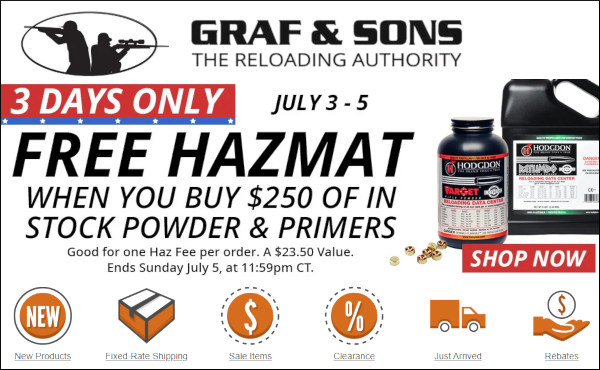
Graf & Sons — FREE Hazmat ($250+) Promotion and Specials

graf sons grafs.com  July 4th 250 years discount code hazmat shipping

MidwayUSA — FREE Shipping on $100+ Orders (Plus Discounts)

midwayusa July 4th 250 years discount code USA250

Permalink Bullets, Brass, Ammo, Hot Deals, New Product, News No Comments »
July 3rd, 2026

Can Carbon Build-Up Inside Cases Raise Load Pressure?

Carbon fouling case cartridge interior Pressure volume ultrasonic

As a cartridge case is reloaded multiple times, burnt powder residue and carbon builds up on the inside of the case. Unless the case interior is cleaned in some fashion, eventually you’ll see a slight reduction in case capacity. One of our Forum members from Australia wonders about the effects of reduced case capacity: “If the capacity of the case decreases as the crud builds up, then it effectively reduces the size of the cartridge (inside). Wouldn’t that change the pressure produced from that of an equivalent clean case?”

Interesting Test of Case Capacity Changes
Forum member Fred Bohl has actual test results that can help answer the above question. Fred proved that, over a 20-reload cycle, the case capacity of uncleaned cases did decline a small amount. However, surprisingly, this did not seem to affect the actual chronographed velocity of the load. Extreme Spread (ES) did increase, but Fred believes the higher ES was due to changes in case-neck tension, rather than due to the slight reduction in case capacity. Fred reports:

“Back when beginning to use ultrasonic case cleaning, part of the motivation was to get the inside clean based on the assumption that allowing burnt residue to build up inside cases would affect capacity, and, ultimately, performance. An experiment was done to test this hypothesis. The load used, 30.5 grains of RL15 behind 107gr SMKs in a 6mmBR, was selected for best group and lowest ES in prior load development. It turned out to be 92% of initial case capacity and neither “full” or compressed. (I would suspect that different powders, load weight, and total case capacity might produce very different results.)

We took 30 cases of identical initial capacity and tracked three lots of 10 each:

LOT 1: No Internal cleaning
LOT 2: Cleaned with media in tumbler
LOT 3: Cleaned with Ultrasound machine

Each case (in each lot) was shot and reloaded 20 times. The simplified results after 20 reloads of each lot were as follows:

Lot 1 (not cleaned) – 0.3 to 0.4 gr. loss of capacity, 5 to 8 fps greater ES.
Lot 2 (tumble cleaned) – 0.1 to 0.3 gr. loss of capacity, 4 to 6 fps greater ES.
Lot 3 (ultrasonic cleaned) – no loss of capacity, no detectable change in ES.

FINDINGS
There was no detectable correlation of velocity change to the lots. An oddity was that on very hot days Lot 1 velocities were, occasionally, slightly higher. From results of another ongoing test, I believe the above differences in ES are probably due more to variance in bullet grip tension than case capacity. The ultrasound cleaned cases (LOT 3) did maintain the lowest ES, but we are not 100% sure of the reasons why. More consistent bullet seating might be the reason.”

Carbon fouling case cartridge interior Pressure volume ultrasonic

Editor’s NOTE: Fred’s results do suggest that carbon build-up inside the uncleaned cases might cause a slight increase in pressure that shows up on hot days. Fred has posted that: “A local shooter reported doing the 20 reload, no-clean test on a .308 that gave a loss of capacity of 2.0 grains, doubled ES and significant velocity changes. However, I don’t have any details on his load weight or powder.” Obviously a lot of carbon can build up with 20 reloads. Many shooters retire their brass before then.

Ultrasonic Cleaning and Neck Lube
Some time ago, Jason Baney did a lengthy test on ultrasonic cleaning. Jason found that with his ultrasonically-cleaned cases, the inside of the necks got so “squeaky clean” that he needed to use dry lube in the necks. Jason uses the dry lube kit from Neconos.com. This applies ultra-fine Moly powder to the neck interior using small carbon steel balls.

Neconos.com moly neck lube

Permalink - Articles, Bullets, Brass, Ammo, Tech Tip No Comments »
July 3rd, 2026

What You Need to Know About Primers — Explained by an Expert

Primer Priming Tool Magnum primers foil anvil primer construction reloading powder CCI
Winchester Pistol Primers on bench. Photo courtesy UltimateReloader.com.

There is an excellent article about primers on the Shooting Times website. We strongly recommend you read Mysteries And Misconceptions Of The All-Important Primer, written by Allan Jones. Mr. Jones is a bona fide expert — he served as the manager of technical publications for CCI Ammunition and Speer Bullets and Jones authored three editions of the Speer Reloading Manual.

» READ Full Primer “Mysteries and Misconceptions” Article

This authoritative Shooting Times article explains the fine points of primer design and construction. Jones also reveals some little-known facts about primers and he corrects common misconceptions. Here are some highlights from the article:

Primer Priming Tool Magnum primers foil anvil primer construction reloading powder CCISize Matters
Useful Trivia — even though Small Rifle and Small Pistol primer pockets share the same depth specification, Large Rifle and Large Pistol primers do not. The standard pocket for a Large Pistol primer is somewhat shallower than its Large Rifle counterpart, specifically, 0.008 to 0.009 inch less.

Magnum Primers
There are two ways to make a Magnum primer — either use more of the standard chemical mix to provide a longer-burning flame or change the mix to one with more aggressive burn characteristics. Prior to 1989, CCI used the first option in Magnum Rifle primers. After that, we switched to a mix optimized for spherical propellants that produced a 24% increase in flame temperature and a 16% boost in gas volume.

Foiled Again
Most component primers have a little disk of paper between the anvil and the priming mix. It is called “foil paper” not because it’s made of foil but because it replaces the true metal foil used to seal early percussion caps. The reason this little disk exists is strictly a manufacturing convenience. Wet primer pellets are smaller than the inside diameter of the cup when inserted and must be compacted to achieve their proper diameter and height. Without the foil paper, the wet mix would stick to the compaction pins and jam up the assembly process.

Read Full Primer Story on ShootingTimes.com

VIDEOS about PRIMERS
Here are two videos that offer some good, basic information on primers:

Permalink - Videos, Bullets, Brass, Ammo, Reloading 2 Comments »