Sierra Bullets has published load data for the 6mm Creedmoor cartridge, a necked-down version of the popular 6.5 Creedmoor. Sierra has released very comprehensive 6mm Creedmoor load data, covering fifteen (15) different bullets from 55 to 110 grains. NOTE: Hornady-brand brass was used for Sierra’s 6mm Creedmoor load tests, not the newer, stronger Lapua 6.5 CM brass with small primer pockets. Hand-loaders using Lapua 6.5 Creedmoor brass necked to 6mm may have to adjust their loads.
Sierra writes: “As soon as the 6.5 Creedmoor was released in 2007, a 6mm version was being envisioned. After the 6mm Creedmoor demonstrated its worth at 1000 yards it began to catch the attention of Precision Rifle Series (PRS) competitors. The 6mm Creedmoor is a great fit for those looking for an AR platform-friendly cartridge. It delivers velocities very similar to the .243 Win and yet fits the AR10 magazine length[.] The 30-degree shoulder makes this a very efficient case and helps prolong case life as well. The 6mm Creedmoor works well with powders such as H4350, [RE-16], RE-17, and Ramshot Hunter for heavier long-range bullet weights. Slightly faster powders such as RE-15, Win 760, and Vihtavuori N540 work well with lighter weight bullets.”
Sierra Bullets Tested for 6mm Creedmoor Load Data
55gr BlitzKing (#1502)
60gr HP (#1500)
70gr HPBT (#1505)
70gr BlitzKing (#1507)
75gr HP (#1510)
In developing its 6mm Creedmoor load data, Sierra tested a very wide selection of propellants, two dozen overall. For the smaller bullets, fast-burning powders such as Benchmark, H4895, and CFE223 were tested. For the heavier 100+ grain bullets, Sierra tested a selection of medium-burn-rate powders including H4350, Reloder 16, Reloder 17, Varget, and Superformance. Sierra did a very thorough job. We know this information will be welcomed by 6mm Creedmoor shooters.
Don’t know what powder to try first? For the 107-110 grain bullets, if you want best accuracy and low ES/SD, our Forum members recommend Alliant Reloder 16 and Hodgdon H4350. If you are seeking max velocity with the 110-grainer, look at Hodgdon Superformance and Reloder 19.
Here are Sierra’s 6mm Creedmoor Load Data Charts for 90-95 grain bullets plus the 107gr MK and 110gr MK. There are five other tables for other bullet types.
BONUS: PRB 6mm Creedmoor and 6.5 Creedmoor Load Survey
The Precision Rifle Blog compiled Load Data from PRS Competitors, for both 6mm Creedmoor and 6.5 Creedmoor. This is a good place to start. PRB surveyed the match loads for “173 of the top-ranked precision rifle shooters in the country”. One cautionary note: These PRS guys may be loading fairly hot, so work up gradually, 0.3 grains at a time. CLICK HERE.
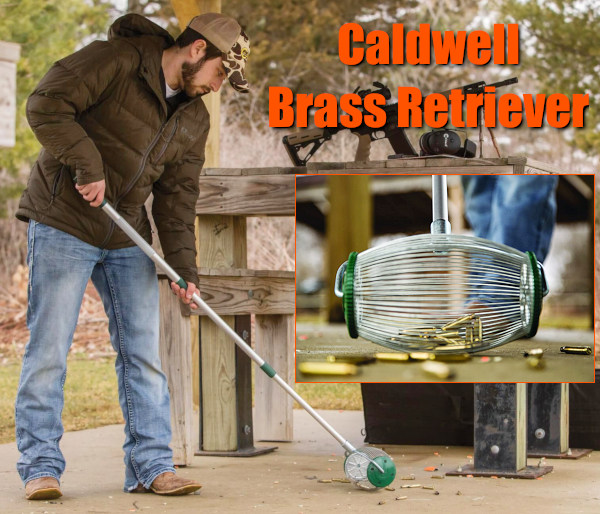
Caldwell Brass Retriever
Tired of bending over or kneeling down to retrieve your fired cartridge brass? For older shooters (including this Editor) getting down on the ground to pick up brass is tough on the lower back and knees. Here’s a product that makes brass retrieval quick, easy, and pain-free. The Caldwell Brass Retriever works quite well with a little practice, once you apply the correct pressure. While it won’t always grab every fired case, it will capture nearly all, and that can really make the job go much faster.
One owner praises this as a “very good tool” that is “a lot easier on my back.” While it can work on grass, gravel, and hard-packed earth, the unit works best on smooth, hard surfaces. Currently priced at $49.99 at MidwayUSA, it is an affordable tool.
Caldwell states: “Spend less time bending over and picking up brass at the range and more time shooting. The Caldwell® Brass Retriever picks up brass, saving your back and time. The Brass Retriever can pick up rifle and pistol brass quickly and efficiently. The retriever comes complete with a roll cage separator that allows you to dump the collected brass into a bucket quickly. It is collapsible as well, making it convenient to transport. The retriever’s handle expands from 28″ up to 57″ tall.”
Brass Retriever Owner Reviews
Here are Amazon reviews from actual purchasers. It’s clear the device is not perfect and can miss a case or two. However, the Brass Retriever does grab the vast majority of brass on the ground, sized .223 Rem or larger diameter. This will save time and reduces stress on your back and joints:
“This thing … does a terrific job of collecting the brass from a standing posture quickly and efficiently. It helps to have the cases on a smooth surface like concrete or dirt without a lot of vegetation. But we used it on open desert yesterday and it collected nearly every case with a single pass. It’s now a permanent piece of gear in the stuff we take when target or ground squirrel shooting.” — Hans H.
“This WILL save your back. The only drawback is you can’t overload it with brass. After couple dozen pieces (or less) it will start dropping brass while you’re attempting to collect others. That’s the limitation (one of them). There is a short learning curve (15 min.) in which you’ll learn how much brass is too much And how you need to orientate the wires to pick up the brass. It doesn’t do as well on gravel or high grass as it does on a smooth, firm surface. Even with its limitations, it’s a keeper. Just empty every dozen or so pieces and it works very well.” — Jeff M.
Specialized Tool for .22 LR Brass
NOTE: The Caldwell Brass Retriever is designed primarily to recover reloadable rifle and pistol brass, with case diameters as fat as .223 Rem or larger. Some people state it can be used for smaller .22 LR cartridges too, but there is a much better product for that.
The UniqueTek Rimfire Brass Wizard is optimized for picking up .22 LR rimfire cases. It has a smaller basket with wires spaced closer together. It can also pick up pistol and rifle cartridge brass but will hold fewer cases than the original Brass Wizard or the Caldwell Brass Retriever. The Brass Wizard “Rimfire” The Brass Wizard “Rimfire” comes standard with the telescoping handle and includes a”Dumper” accessory.
Even with high-quality brass from Lapua, Peterson, Norma, Alpha and RWS, occasionally you may find one or two cases per box which have a small flake or obstruction in the flash-hole. This will appear like a thin crescent on one side of the flash hole (see photo). You should inspect ALL new brass before loading to identify any pieces with a partially-obstructed flash hole. It’s a good idea to remove any flake or thin crescent left as an artifact of the flash-hole forming process. Because the flash-hole itself is normally centered and of the correct diameter, it is not necessary to ream the flash-hole to a larger diameter. All you really need to do is remove the small obstruction(s). This can be done quickly with inexpensive tools.
Use a Small Pin Vise to Remove Flash-Hole Obstructions
Folks have asked if there is a tool that can remove obstructions from a Lapua small, BR-sized flash hole without opening the hole size. The Lapua PPC/BR flash hole is spec’d at 1.5mm, which works out to 0.059055″. Most of the PPC/BR flash-hole uniforming tools on the market use a 1/16″ bit which is nominally 0.0625″, but these often run oversize — up to 0.066″.
If you want to just clear out any obstructions in the flash hole, without increasing the flash hole diameter, you can use an inexpensive “pin vise” with an appropriate drill bit. For $5.39, Amazon sells a 10-piece set of cobalt steel 1.5mm drill bits, that matches the Lapua flash hole exactly. Other vendors offer a #53 pin vise drill bit that measures .0595″ or .060″ (depending or source). An 0.0595″ bit is close enough. You can find pin vises and these small-diameter drill bits at hobby stores.
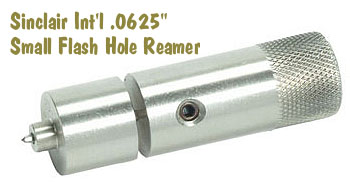
For quite some time, Sinclair Int’l has sold a similar device for small (PPC and BR-size) flash holes. Like the 07-3081 unit for large flash holes, the 073000 Reamer for small flash holes works from the outside, so it can index off the primer pocket. It reams to .0625″, and also costs $29.99. The standard dimension for Lapua 220 Russian and 6mmBR flash holes is 1.5mm or .0590″. This tool will permit standard-size decapping rods with .0625″ tips to work without binding. However, note that both Forster and Redding normally supply .057″ decapping pins with their PPC and BR dies. So, it is NOT necessary to ream your Lapua BR/PPC flashholes, unless you prefer to do so for uniformity. It IS, however, a good idea to check BR/PPC flash holes for burrs before loading the first time.
NOTE: If you purchase either the 073081 or 073000 Sinclair Flash Hole Reamer tools, we recommend you mic the cutter tip before you process a bunch of cases. Sometimes a tip comes through that is oversize. This will ream the flash holes larger than you may intend.