Production wood rifle stocks, both laminates and hardwoods, are commonly made with stock duplicating machines. Stock duplicators allow a stock-maker to copy a master design faithfully and efficiently. The video below, from Colorado rifle-maker Michael Cuypers, shows a stock duplicator (in automatic mode) cutting a piece of Turkish Walnut, for a mauser 98. This machine rotates the blank while a spinning vertical cutting head shapes and trims the blank. This duplicator manually tracks the shape/profile of the master blank. To make another stock, this process needs to be repeated, with the master in place. For more information about this duplicating machine, visit www.riflebuilders.com.
Watch Stock Duplicator in Progress
Future Technology: We are starting to see stocks made with CNC milling machines that cut stock profiles based on three-dimensional scans of master stock designs. However, the traditional mechanical duplicator process in the video is still most commonly used by most of today’s stock-makers.
Turkish Walnut — Where to Get a Beautiful Blank
The Bijou Creek video above shows a Turkish Walnut stock being roughed out. Turkish Walnut is some of the most beautifully figured wood available — but it can be pricy. If you are looking for this kind of ultra-high-grade wood, it makes sense to shop carefully. You’ll find a wide selection of Turkish Walnut blanks at the HunterBid.com website. Hundreds of selections are available at auction. Prices start as low as $150.00. The finest blanks sell for $1,000 or more. New blank selections are added to the website every other day. HunterBid.com is run by Chiron Inc., which is 100% owned by the Ergin family who are of Turkish origin. Chiron maintains warehouses in Dover, NH and Istanbul, Turkey.
Video find by Boyd Allen. We welcome reader submissions.
What do you get when you cut a 6.5 Creedmoor-chambered barrel down to just over 16 inches? A lot more velocity than you might think. Our friends at Rifleshooter.com recently did a barrel cut-down test with 6.5 Creedmoor test rifle, shortening the barrel from 27 to 16.1 inches in one-inch increments. Surprisingly, with a 142gr Sierra MK, the total velocity loss (as measured with a Magnetospeed) was just 158 FPS, an average of 14.4 FPS per inch of barrel length. With the lighter 120gr A-Max bullet, the total velocity loss was 233 FPS, or 21.8 FPS average loss per inch of barrel.
Test Procedure
Five (5) rounds of each type of cartridge were fired at each barrel length and the velocity data was recorded with a MagnetoSpeed V3 barrel-mounted chronograph. The rifle was then cleared and the barrel was cut back one inch at a time from 27″ to just over 16″. NOTE: During this winter test, the air temperature was a very chilly 23° F. One would expect higher velocities across the board had the outside temperature been higher.
The photo below shows how the barrel was cut down, inch-by-inch, using a rotary saw. The barrel was pre-scored at inch intervals. As the main purpose of the test was to measure velocity (not accuracy) the testers did not attempt to create perfect crowns.
6.5 Creedmoor vs. Other Mid-Sized 6.5mm Cartridges
The 6.5 Creedmoor is a very popular cartridge with the tactical and PRS crowd. This mid-size cartridge offers good ballistics, with less recoil than a .308 Winchester. There’s an excellent selection of 6.5mm bullets, and many powder choices for this cartridge. When compared to the very accurate 6.5×47 Lapua cartridge, the 6.5 Creedmoor offers similar performance with less expensive brass. For a tactical shooter who must sometimes leave brass on the ground, brass cost is a factor to consider. Here’s a selection of various 6.5 mm mid-sized cartridges. Left to right are: 6.5 Grendel, 6.5×47 Lapua, 6.5 Creedmoor with 120gr A-Max, 6.5 Creedmoor with 142gr Sierra MK, and .260 Remington.
When asked to compare the 6.5 Creedmoor to the 6.5×47 Lapua, Rifleshooter.com’s editor stated: “If you don’t hand load, or are new to precision rifle shooting, get a 6.5 Creedmoor. If you shoot a lot, reload, have more disposable income, and like more esoteric cartridges, get a 6.5×47 Lapua. I am a big fan of the 6.5×47 Lapua. In my personal experience, the 6.5×47 Lapua seems to be slightly more accurate than the 6.5 Creedmoor. I attribute this to the quality of Lapua brass.”
A 7mm Snake for Santiago
Our friend Dennis Santiago has a reptilian rig in his arsenal. It’s actually an Eliseo R1 single-shot tubegun chambered in .284 Winchester. The eye-catching aspect of Santiago’s .284 bolt-gun is the snakeskin dip job on the exterior. This really creates a distinctive look. Dennis tells us: “It was Gary Eliseo’s idea to try a water-transfer printing finish for this rifle. There are many patterns to choose from — this is the WTP-260 Snakeskin Illusion-Fall Copper from WaterTransferPrinting.com. For a single shot LR gun, I figured something on the bright side would be interesting and pick up less heat from the sun in the summer.”
Dennis will use his new rifle in prone matches, where a single shot works fine. He says: “Underneath the hood, it’s a Rem 700 Long Action, chambered in .284 Win. Yes it’s a single shot! I don’t need anything else for a prone gun. Nothing to get in the way of building the perfect position.”
Dennis says: “Length of pull, offset and cast initially set the same as my similar RTS .308. My gun, my body dimensions.”
A FFP 6-24x50mm Sightron Rides on Top
The optic is a Sightron 6-24x50mm, FFP MOA-2. Dennis reports: “I looked at many scopes (within my determined price range), and this is the one that had the best combination of features for for this gun’s particular application. The sight line sits about 3 inches above bore line on these guns. It’s been leveled, bore-sighted and pre-dialed for a 200-yard estimated zero for the ammo I plan to use. Those are Gen II A.R.M.S. rings. Super easy to tailor to different rail widths. Same rock-steady steel performance.”
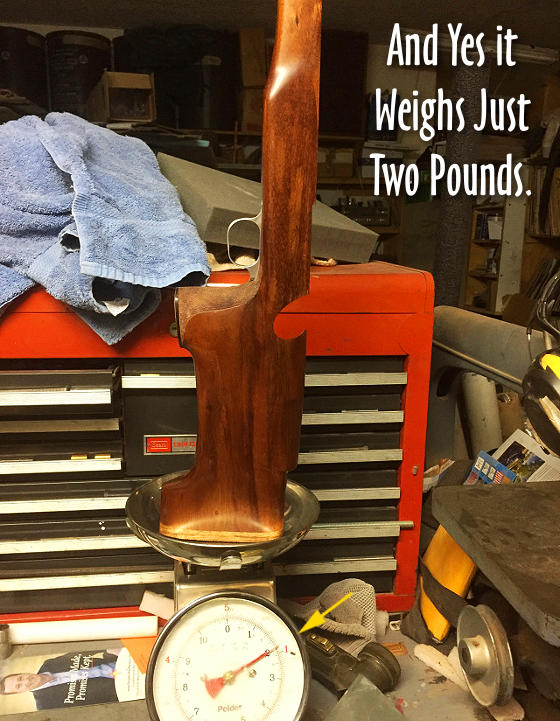
Our friend, gunsmith/stockmaker Doan Trevor recently created a lovely, one-of-a-kind silhouette stock for an Anschutz rimfire action. Built as a true custom design, this stock combines ideal standing position ergonomics with light weight — the entire stock weighs a mere two pounds. This project really showcases Doan’s remarkable skills with wood. Read the full story about this project (with more photos) at DoanTrever.com.
Doan explains his design process: “A customer came to me wanting to know if I could build a silhouette stock that was 2 pounds or less. I used the Koa wood because it is a lower specific gravity than Walnut (which makes it lighter) and stronger. I was still able to use pillar bedding and keep the weight down. The fore end could be shortened to reduce the weight even more. Since the drops on a silhouette rifle are different than a prone rifle, I kept the pistol grip from the prone rifle which is comfortable and tried to come up with a higher cheek piece and more drop to the buttplate. All of this required lots of hand carving.”
Want to upgrade your AR’s trigger? Shooting USA and Brownells have created a video tutorial that shows how to remove a factory AR trigger and replace it with an upgrade. This video illustrates the procedures to follow and the tools you’ll need. Step-by-step, the video explains how to swap the factory trigger group for a self-contained ‘box style’ drop-in trigger module or a traditional (multi-part) trigger system with enhanced performance.
Many AR-15s come from the factory with a military-type trigger that has a long, gritty, heavy pull. Replacing that trigger is one of the best ways to improve your AR’s performance. You’ll be rewarded with a smoother pull, shorter take-up, and reduced pull weight. You will also have a choice between a single-stage and a dual-stage trigger.
The box-style, self-contained drop-in systems from companies like AR Gold, CMC, Timney, and Wilson Combat are the easiest to install. John Scoutten explains: “These self-contained systems … are very simple to install. In fact, all you do is remove the factory parts, drop in the whole system, replace your pins, and you’re done.” Conventional two-piece trigger groups are offered by DPMS, Geissele, JP Enterprises, and Rock River.
The key points of the video tutorial are also explained on the Shooting USA website with text and still pictures. Before you start your trigger project, review Shooting USA’s AR Trigger Upgrade Page. You’ll find helpful close-up photos on that page.
Brux Barrels, based in Lodi, Wisconsin, has earned a reputation for producing great-shooting tubes. Brux-made barrels have won their fair share of matches, and set some notable records in the process. A few years back, Rodney Wagner shot the smallest five-shot, 600-yard group (0.336″) in the history of rifle competition, using a Brux barrel chambered for the 6mm Dasher.
Folks often ask us why Brux barrels shoot so well. “What’s the secret?” they ask. We can only answer with what Brux explains on its own website: “To make a cut-rifled barrel you have to start off with the proper ingredients: the best steel available, skill, and experience. Since there are really only two main suppliers of barrel-quality steel, the skill and experience is what really makes a barrel maker stand out.” Here is how Brux’s co-owners, Norman Brux and Ken Liebetrau, explain all the procedures involved in making a Brux cut-rifled barrel:
Brux Barrel-Making Process, Start to Finish
We start out with either 4150 chrome-moly or 416R stainless steel double stress-relieved bar stock. The bar stock starts out at 1-9/32″ in diameter and 20-24 feet long so we cut it to length.
Step two is to rough-contour the outside of the barrel blank in a lathe.
Thirdly, the blank gets mounted into a Barnes gun drill. The cutter bit has holes through which oil or coolant is injected under pressure to allow the evacuation of chips formed during the cutting process. This is called “oil-through” or “coolant-through”. Without this, you wouldn’t want to even attempt drilling a hole 30” long and under ¼” in diameter. The combination of a 3600rpm and good flushing allows us to drill a beautifully straight and centered hole .005” under “land” diameter at a rate of 1” per minute.
Clean the barrel.
Next the blank is sent back to the lathe to machine the finished contour of the outside.
Clean the barrel again.
Now, the blank is sent on to the Pratt & Whitney reamer in which an “oil through” reaming tool is used to cut away the extra .005” left in the drilling process. The reamer makes an extremely accurate bore size and after it is finished the bore will have a better surface finish and will be at the proper “land” diameter.
Clean the barrel again.
In the sixth step we hand lap each barrel to remove any slight tool marks that may have been left by the reamer and inspect every one with a bore scope. If the barrel doesn’t meet our standards for surface finish and tolerance it doesn’t get any further.
Clean the barrel again.
The barrels then go onto the rifling machine which is responsible for cutting the all so familiar grooves in the bore. A caliber/land configuration-specific rifling head is used to progressively shave away small amounts of steel to form the rifling grooves. This is accomplished by simultaneously pulling the rifling head through the reamed blank as the blank is spun at a controlled rate. After each cut, the blank is rotated 90 degrees (for a four-land configuration) and after one full rotation (360 degrees) the rifling head is slightly raised to shave off the next bit of material. This process is repeated until we reach groove diameter.
Clean the barrel again.
Lastly, the barrel is hand-lapped again (to ensure a smooth bore), and a final inspection is performed with the bore scope.
The barrel is cleaned one last time, wrapped, packed, and shipped to [the customer].
Anyone reading this detailed description of the Brux barrel-making process will doubtless come away with a new appreciation for the time, effort, and dedication required to produce a premium match-grade cut-rifled barrel. Obviously, there are no easy shortcuts and great attention to detail is required each step of the way. As shooters we’re lucky that we have barrel-makers so dedicated to their craft.
Credit James Mock for steering us to this Barrel Making 101 feature on the Brux website.
Many short-range Benchresters have thought about converting their 6 PPC to shoot a 30BR for score matches, or a Dasher for mid-range (or even 1000-yard) games. That way you have a rifle that does double duty, giving you the most bang for your buck. Though an action with a PPC bolt won’t normally work with 30BR/6BR/Dasher cases with their larger .308-class rim (0.4728″ diameter), there is a pretty easy solution that allows you to cycle these bigger cartridges with a 6PPC-style bolt (designed to fit .220 Russian rims).
“Rebating case rims … lets you shoot a 30BR in score matches using your PPC action. All you need is a new barrel. This saves buying another bolt, receiver, or rifle.” — Butch Lambert
Butch Lambert of ShadeTree Engineering provided this tip. Butch notes that many 6 PPC benchrest group shooters also enjoy shooting in score matches. But to be really competitive in the BR for score game, that means shooting a 30BR, which has a wider, .308-class rim (0.4728″ diameter). Likewise, if you want to compete in 600-yard registered BR events or in varmint matches, you probably want to run a bigger case, such as the 6BR, 6mm Dasher, or 6-6.5×47. Those cartridges also have the larger 0.4728″ rims.
To convert a PPC-boltface action to shoot the bigger cases you can spend a ton of money and buy a new bolt. That can cost hundreds of dollars. The simpler solution is to turn down the diameter of the larger cases on a lathe. Butch explains: “We’ve seen plenty of interest in rebating case rims. This lets you shoot a 30BR in score matches using your PPC action. All you need is a new barrel. This saves buying another bolt, receiver, or rifle if you have a PPC boltface. Anyone who has access to a lathe can do this job pretty easily. Yesterday I turned 150 case in about an hour.” Below is the lathe form tool Butch uses to rebate the case rims.
Forum member Rardoin’s handsome F-Open rig features the new Borden BRM-XD action.
One of the most popular items in our Shooters’ Forum is the ongoing “Pride and Joy” thread. Since 2009, Forum members have posted photos and descriptions of their most prized rifles. Here are some of the most recent “Pride and Joy” rifles showcased in our Forum. Do you have a gun you’d like to see featured there? Just Register for the Forum and you can add your favorite gun to the list.
Bill Goad’s 6PPC Hunter “Ranch Rifle”
Forum member Grimstod tells us: “This is the personal rifle of Bill Goad. He has been experimenting with it on several levels. It is shooting great and has several matches on it now. Please enjoy these photos. More can be found on the website www.PremierAccuracy.com. We like the subtle barbed wire effect on the stock.
Twin-Upper AR with Custom Wood Furniture
This very unique AR belongs to Forum member Nuto-BR. He tells us: “Here are the two uppers I built. The top one is am X-caliber in 20 Practical with 24-inch, 1:11″-twist barrel. The bottom one is a WOA in .223 Rem, with 20″, 1-12″ twist barrel. They both shoot 1/2 MOA or better. Both stocks are laminated Maple and Walnut. I reversed the order of the two woods to tell them apart.”
Two Dashers and a Rimfire for Fun
Courtesy Forum member Dan H., here are two red-stocked Dashers plus an Anschutz 54.30 (Benchrest Stock) to make it a trio. Dan says: “The Anschutz provides good practice in trigger-pulling. It’s amazing what you can learn from a rifle that is as sensitive as this one.”
Dream Hunting Rifle with Custom Camo
Here is Forum member TyDaws’s “Dream Hunting Rifle” in 6.5-280 Ackley Improved. We love the custom paint work by by Melodie Yarbrough. Smithed by West Texas Ordnance, this rifle features a Rem 700 action with fluted bolt, PT&G tapered recoil lug, and Timney 510 2-lb trigger. The barrel is a fluted 26″ 1:8″-twist Bartlein 5R #3 contour. On top is a Huskemaw Blue Diamond 4-16x42mm optic in Warne Maxima rings. That’s an Atlas bipod up front.
Three Guns for Mr. Big
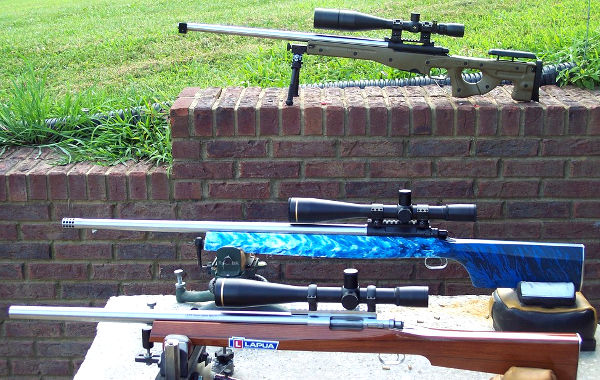
Forum Member Mr. Big offered up another trio of rifles — two bench guns and a tactical rig. Mr. Big says: “Here are the rifles I shoot most: Farley 6mm PPC, Stiller .243 Win, and Rem 6.5×47 Lapua. They will do just about anything I ask them to…” Challenge: Can you identify the makers of the three different stocks shown in this picture (and the different materials used in each)?
Dasher in Robertson Spider Web Stock
Here is Forum member Vahena’s 6mm Dasher. It has a no-turn-neck chamber in a 28″, 1:8″-twist barrel with 1.25″ straight contour. This has an original Robertson fiberglass stock with spider web graphics. This rifle was originally built as a 6.5×284 with a fluted barrel. Now it sports a bigger barrel for a smaller cartridge. The front rest is a SEB Neo with counterweight up front.
We know some guys who make their own stocks, and others who do their own chambering. But consider this, Robert Carnell of Australia built his own state-of-the-art, water-cooled, tension-barrel Rail Gun, even including the action. That’s right, Robert even made his own action. Wow, this has to be the ultimate home gunsmithing, do-it-yourself project.
Carnell is an accomplished benchrest shooter and past Australian Sporter Class Champion. In 1993 he won a Silver Medal at the World Championships. But Carnell is far more than an ace trigger-puller. Robert is a skilled and creative “home gunsmith” who has crafted his own custom action and built his own railguns from scratch. Robert also runs the Austrialian Benchrest Bulletin website.
Home-Built Rail Gun — Aussie Innovation
Below are photos of one of Rob Carnell’s most amazing builds. This liquid-cooled, tension-barrel rail gun is a great example of self-reliant Aussie engineering. The barrel runs inside a coolent-filled, large-diameter sleeve, much like an old water-cooled machine gun. This is the fourth rail gun that Rob built, and the second fitted with a tensioned barrel.
Robert explains: “My railgun design has a 1.75″ barrel under tension inside an aluminium tube filled with radiator coolant. There is nearly a gallon of coolant, and the barrel stays cool no matter how many shots I seem to fire, or how quickly they are shot. The brass nut on the front rides on a nylon bearing and can be tightened to get the best accuracy. I am a believer in the ‘tuner’ idea and this seems to work for me. The main tube is thick-walled aluminium 600mm (24″) long. There is a flange at both ends. The flange at the back fits onto the barrel before the action is screwed on. The front flange is a press-fit into the tube, then there is a brass nut that fits over the barrel and screws against a nylon washer on the front flange. The Railgun’s base is aluminium and has the standard adjustments — windage, elevation and a sighter cam. In addition, there is a 1/10 thou dial indicator for windage. This allows me to zero the indicator and shoot my group. If I need to add a bit of windage for a condition, I can quickly get back to the original position if my condition comes back.”
Home-Built Action Uses Rem Bolt
Rob’s rail gun uses his own home-made stainless action, which features Panda-spec threads and a modified Remington 700 aftermarket bolt. Not bad for a do-it-yourself project we’d say! CLICK HERE to read how Rob designed and built the action.
Tonight (12/7/2016), Shooting USA television features the Remington Bicentennial — celebrating 200 years of continuous production by one of America’s most legendary companies. The history of Remington Arms is a remarkable story. No large American enterprise — not Ford, not General Motors — can match the 200-year continuous history of Remington. The Remington enterprise is nearly as old as the United States. This story began in 1816, when a young man, Eliphalet Remington II, wanted a rifle…
According to historians, Eliphalet told his father he wanted a gun, so his father told him to build one himself (Eliphalet had been trained as a blacksmith). And so, in 1816, Eliphalet did just that, with the help of a hired gunsmith to bore and rifle his barrel. Eliphalet then took the finished flintlock to a local shooting match. “And his gun shot well,” says Remington Historian Richard Shepler. “So neighbors and friends asked, ‘Could you make me a barrel?’ Over time there was more and more demand.”
By 1828, Eliphalet moved into a factory in Illion, New York. In 1845, he jumped at the opportunity to secure the first of many government contracts. When the Civil War broke out, Remington stayed busy producing firearms. While later in the 1890s during peacetime, Remington manufactured cash registers, sewing machines, knives and even the first successful typewriter.
Whether fulfilling government contracts during wartime, or manufacturing cash registers and sewing machines during peacetime, Remington’s story continues today, arming sportsmen, hunters and armies around the world.
Shooting USA AIR TIMES BY TIME ZONE
Eastern Time: 9:00 PM, 12:30 AM (Wed); 4:00 AM (Thur)
Central Time: 8:00 PM, 11:30 PM (Wed); 3:00 AM (Thur)
Mountain Time: 7:00 PM, 10:30 PM (Wed); 2:00 AM (Thur)
Pacific Time: 6:00 PM, 9:30 PM (Wed); 1:00 AM (Thur)


 A 7mm Snake for Santiago






 Tonight (12/7/2016),


