Cerakote is an advanced, highly durable, heat-cured coating that offers excellent corrosion resistance when applied to firearms. Cerakote can be applied to both metals and plastics, and many top firearms manufacturers (and custom gun builders) now offer Cerakote finishes as an option on their shotguns, hunting rifles, and tactical arms.
While Cerakote is not difficult to use, application of Cerakote is not just a simple “spray and bake” process. Best results are achieved when firearms are carefully degreased and surface-prepped prior to application. The video below, produced by NIC Industries, the manufacturer of Cerakote, shows the application process from start to finish. If you watch the video you’ll learn the importance of careful, step-by-step product prep. Metals should be surface-blasted prior to coating, and curing times need to be adjusted to the material type (polymer vs. fiberglass vs. metal). Cerakote is offered in a wide variety of colors. Multi-color finishes, including camouflage, can be applied by a skilled operator.
The video above shows a professional technician applying Cerakote finish to rifles and pistols. All gunsmiths who plan to offer Cerokote finishes should definitely watch this video. NOTE: Cerakote Firearms Coatings are designed for professionals and should be applied by an NIC-trained application specialist or a coating professional with proper training and equipment. NIC Industries stresses that “it is critical to follow all these instructions”.
Story tip by EdLongrange. We welcome reader submissions.
Can you buy a new firearm for fifty bucks? Yes you can, when the “firearm” is a stripped lower receiver, the key component of an AR15-type rifle. With an AR lower, you can build your own “black rifle” project, which could be a gun for Service Rifle competition, or a specialized varmint-slayer, or a rig for 3-Gun matches — the choice is yours. Once you have the serialized lower (which must be transferred through an FFL dealer), you can build your own project as you see fit, with the trigger, barrel, stock, handguards, and sighting system of your choice.
Right now Sportsman’s Guide is offering a great deal on Anderson stripped lower receivers. You can purchase the lower for just $49.99 ($44.99 for Buyer’s Club Members). These are good-quality lowers, with correct mil-spec dimensions, and precision-machined to ensure drop-in installation of aftermarket components. Crafted from 7075-T6 aircraft-grade aluminum forgings, the made-in-USA Anderson lowers have a hard-anodized black finish. The take-down pin has a standard 0.250″ diameter.
The Legal Brief is a feature of TheGuncollective.com that focuses on firearms rules and regulations. In this Legal Brief video, Attorney Adam Kraut explains key State and Federal regulations governing firearms, and explains how to ensure compliance with all applicable laws.
This five-minute video explains barrel length rules for rifles and shotguns, and also explains the best (and most fool-proof) methods to measure your barrel. In addition, the video explains how to measure firearm overall length. A rifle or shotgun which is less than 26 inches overall can also be classified as a “Short-barreled” rifle/shotgun subject to the NFA. NOTE: Under federal law “If the rifle or shotgun has a collapsible stock, the overall length is measured with the stock EXTENDED”.
Highlights of LEGAL BRIEF Discussion of Barrel Length and Firearm Overall Length
The ATF procedure to measure the length of a barrel is to measure from the closed bolt or breech face to the furthest end of the barrel or permanently attached muzzle device. ATF considers a muzzle device that has been permanently attached to be part of the barrel and therefore counts towards the length.
How to Measure Barrel Length: Drop [a] dowel or rod into the barrel until it touches the bolt or breech face, which has to be closed. Mark the outside of the rod at the end of the muzzle crown (if you don’t have a permanently attached muzzle device) or at the end of the muzzle device if it is permanently attached. Remove the rod and measure from the mark to the end of the rod. That is your barrel length[.]
Remember, if the barrel length is less than 16 inches, it is possible that the firearm could be a short barrel rifle (if you are building a rifle or it is already on a rifle) and if the barrel length is less than 18 inches, it is possible the firearm could be a short barrel shotgun (again if you are building a shotgun or it is already a shotgun). Both of these firearms would be subject to the purview of the National Firearms Act and would require the firearm to be registered accordingly.
How to Measure Overall Length:The overall length of your rifle or shotgun may also classify it as a Short Barrel Rifle or Short Barrel Shotgun. The overall length of a firearm is the distance between the muzzle of the barrel and the rearmost portion of the weapon measured on a line parallel to the axis of the bore. … If the rifle has a permanently attached muzzle device, that is part of the overall length. … If the rifle or shotgun has a collapsible stock, the overall length is measured with the stock extended.
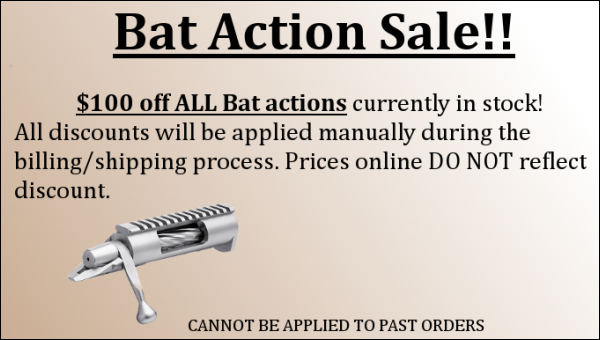
Who wouldn’t like to save a cool hundred bucks, particularly on a BAT action? BAT Machine Co. in Idaho produces some of the most beautifully-machined, and smooth-running custom actions you can buy. There’s a reason so many world Benchrest and F-Class records have been set with BAT actions — they really are THAT good. The quality of machining, smoothness of bolt operation, precision of firing pin function, and general fit and finish are top-flight.
Right now you can SAVE $100.00 on all BAT Machine actions in stock at Bruno Shooters Supply. NOTE: This is a limited-time offer that applies to current, in-stock inventory only. All listed BAT action prices are a check or money order price. Any action purchased with a credit card will incur an additional 4% service fee. Moreover, there is an additional $40.00 for shipping per action, which must be shipped to a FFL dealer since the action itself is considered the “firearm” under Federal law.
Barnard makes great actions, many of which come complete with superb two-stage triggers. For a long-range competition rifle, a Barnard action is a very good choice. And now you can save up to $150.00 on Barnard Precision actions, complete with trigger. Our friend, 4-Time National Long-Range Champion John Whidden, decided to offer a special Holiday Promotion for shooters. A wide selection of Barnard actions have been discounted 10% (ten percent). This is a great opportunity to save money.
Whidden Gunworks has many Barnard actions on sale. These include repeater actions and actions that will fit large magnums — so there’s something for every application. John Whidden tells us: “As a part of this sale, Whidden Gunworks is offering $50 off barrel installations for any in-stock action sold. We have in-stock barrels from both Bartlein and Lilja. If you hurry, there is time to have your barrel installed on your new action by Christmas!”
This sale is limited to the models shown below and the inventory on hand:
Barnard Action Q & A with John Whidden
Q: In addition to the Model P, What Other Actions Does Barnard Produce?
Whidden: Many shooters familiar with the Barnard Model P, but we now carry six (6) other Barnard actions. These include the PC action with multiple bolt/port options, the Model SM repeater (with Rem 700 footprint), and the PLM which is a perfect fit for the big .338 Lapua Magnum cartridge.
Q: What Are the Key Features of Barnard Actions?
Whidden: Barnard actions have won a reputation for accuracy, robustness, and exceptional straightness and quality in manufacture. Their design is very rigid and stiff. The three-lug bolt gives a short bolt-lift. These qualities are available in the full line of of Barnard actions. The fact that many models include the excellent Barnard trigger make them a good value among custom actions.
Q: What Barnard Actions Do You Recommend for Particular Disciplines?
Whidden: For those interested in F-Class and Long Range Benchrest shooting styles the Model PC is very attractive. The PC is the same size and footprint as the familiar Model P except that the PC offers different bolt/port configurations. Available in the PC are right bolt/left port, left bolt/right port, and dual ports. The Model S and SM actions will accept Remington pattern triggers and fit into stocks inletted for the Rem 700. This gives PRS shooters the chance to have a superb action with a three-lug configuration for their use. The PL and PLM are sized for the .338 Lapua Magnum cartridge and wildcats based on that case-head size.
This is the MOTHER LODE of GUN INFO. If you’d like to have instant access to 6300+ gun schematics and descriptions of 64,300+ firearms, then consider signing up for a Firearms Guide subscription. The annual subscription is on sale right now for just $24.95 as a Cyber Monday Special. That’s a 38% savings ($15.05) off the regular $40.00 annual fee.
You may be familiar with the Firearms Guide when it was distributed as a DVD. Now the 7th Edition is a fully interactive, subscription-based online database of firearms and ammo, which is also the most complete guide to global gun values on the web. The amount of imagery is amazing — there are tens of thousands of photos and over 6300 schematics, which help you work on a firearm or identify key components/parts. Published since 2009, the Firearms Guide permits detailed searches of antique and modern guns and side by side comparisons of search results. Guns are cross-referenced with the ammunition database.
Guns and ammo are presented with prices, specifications, features, ballistics, and up to 12 high-rez zoom-able color pictures. GUN VALUES are provided for dealers and gun collectors. You can access thousands of printable and zoom-able GUN SCHEMATICS (diagrams or exploded views) with parts lists and blueprints for professional gunsmiths.
If you are a gun collector, or just an information junkie, you’ll find the Firearms Guide to be an invaluable resource. The scope is truly worldwide, with coverage of gun makers in Western Europe, Eastern Europe, South America, South Africa, and Asia as well as North America. The online database’s search capability lets you search by gun caliber, manufacturer, and key features (e.g. “.223 Rem, Colt, folding stock”). There are 14 different search criteria — this allows you to “drill down” precisely to find the gun you want in seconds. Shown below are typical profiles of listed products:
About the Firearms Guide Database Firearms Guide has been published from 2009 to 2015 on DVDs and sold through Cabelas, Bass Pro Shop, the NRA and other vendors. In 2016 Firearms Guide was transformed into a subscription-only, online searchable guns and ammo reference and gun value guide for industry professionals and enthusiasts. Firearms Guide is a proud sponsor of the NRA.
Need a new barrel for your Rem-actioned hunting or tactical rifle? Here’s a great DIY option for riflemen. McRee’s Precision offers complete, no-gunsmithing re-barreling kits for Remington and Rem-clone actions. These feature a high-quality, pre-chambered “PRE-FIT” stainless barrel from Criterion, a Savage-style barrel nut, a recoil lug, and a special barrel-nut wrench. With this system you can easily re-barrel your favorite Remington rifle yourself in less than an hour. You don’t need to pay gunsmithing fees, or wait weeks (or months) for a busy smith to do the job. And the price is under $500.00. McRee’s Precision even offers a Half-MOA Accuracy Guarantee with its pre-fitted barrel kits. NOTE: Check MrReesPrecision.net on Thanksgiving for a Holiday Special Price (probably 10% Off).
McRee’s Precision Remington DIY Barrel Kit includes Criterion Pre-Fit Stainless Barrel, Barrel Nut, Recoil Lug, Thread Protector, and Barrel Nut Wrench: The stainless steel Barrel Nut is set up for 1 1/16 x 16 barrel threads, while the stainless steel recoil lug has a 1/8 inch removable locator pin and is set up for 1.0625 dia barrel threads.Barrel Kit Specifications.
McRee’s Precision sells Rem-action Pre-Fit barrel packages (complete with barrel nut, recoil lug, and wrench) starting at $499.52 (get a Holiday Discount on that price commencing 11/24/2016). Choose from five chamberings: .243 Win, 6.5 Creedmoor, .260 Rem, .308 Win, and .300 Win Mag. These Pre-Fit barrel kits are “100% complete and ready-to-install”. All you need to do is remove your current barrel, place the recoil lug, spin on the new tube, follow the instructions for setting head-space, then torque the barrel nut against the lug. NOTE: You may require a barrel vise and action wrench to remove the original barrel. Minor inletting changes may be needed forward of the action.
The folks at McRee’s Precision say their Pre-Fit system offers many advantages: “Remington Pre-Fitted Barrel Kits have become popular over the years. If Savage can do it, why not for our Remingtons? Our [Criterion-supplied] barrels are spec’d to the McRee standard of performance. There are several places to get the tools required to remove your factory barrel correctly. Once you have your barrel removed all you have to do is follow the normal Savage procedure to install your new barrel. We recommend that you contact your local gunsmith for the install. Feel free to call us with any questions.”
Product Tip from Ed LongRange. We welcome readers’ submissions.
Want to build your own accurized M1 Garand? Then consider signing up for the CMP’s Advanced Maintenance Class (AMC), a 3-day program for students with mechanical aptitude and a desire to work on M1 Garand rifles. Each student will assemble his own CMP Special M1 Garand Rifle with a USGI receiver. This will be a “keeper” Garand that the AMC student takes home. Total cost for the 2017 AMC is $1830.00, which includes the cost of the rifle ($1030.00) plus tuition charges. Students must provide their own accommodations in Anniston, Alabama.
Registration is open for the Civilian Marksmanship Program’s (CMP) 2017 Advanced Maintenance Clinics. Interested persons may register now through December 2, 2016. NOTE: If you are interested in this program, apply soon — all spots in last year’s classes filled up quickly.
Each 3-Day Advanced Maintenance Class will be led by highly-qualified Custom Shop staff members. On the third day, students will visit the Talladega Marksmanship Park as VIP guests of the CMP. At Talladega, each AMC student will have a chance to fire the M1 Garand they built in the class, shooting at Talladega’s high-tech electronic targets.
CMP 2017 Advanced Maintenance Class (AMC) dates are:
January 24-26; January 27-29
March 14-16; March 17-19
August 15-17 (Buddy Class); August 18-20 (Buddy Class)
October 24-26; October 27-29
This class is not intended for gunsmiths — no prior armorer experience is required. Students will assemble their own CMP Special rifle, which is included in the $1830.00 fee. Class topics will include:
– Commercial barrel installation, chambering, and headspace
— Component function, selection, and inspection
— Fitting and proper assembly of a complete CMP Special rifle
— Discussion of malfunctions and their remedies
— Accurizing techniques for the M1 Garand
How to Register
Applicants must register via the CMP Competition Tracker system website between November 21 and December 2, 2016. An electronic lottery will randomly assign the 20 available seats for each class date. CLICK HERE for more details.
Read Orchid Advisors’ Full Form 4473 Revision Report on Ammoland.com.
Dope or Guns. But Not Both…
Federal law is clear on this. Make your choice. — Dennis Santiago
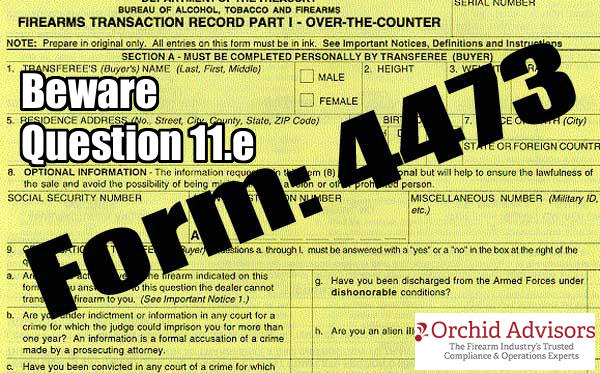
You may live in a state where private use of marijuana has been decriminalized, but you still have to worry about the Federal Government. Use of marijuana (cannabis) is still prohibited under Federal law. Admitting that you smoke dope can and will prevent you from being able to purchase firearms. We raise this point because ATF has modified Forum 4473, the Federal Firearms Transaction Record, to include a new warning. The Shooting Wire explains:
“ATF notified licensees last week that ATF Form 4473… has again been revised. There’s now a warning attached to question 11.e.
11.e is the famous question, ‘Are you an unlawful user of, or addicted to, marijuana or any depressant, stimulant, narcotic drug, or any other controlled substance?’
The warning simply says that use and possession is illegal under federal statute regardless of the state’s rules. Some on social media said, ‘ATF is telling you to mark that answer “no”. Apparently they don’t remember Scooter Libby.
Lying on ATF Form 4473, as noted right above Block 14, is a federal felony — punishable by fines and a term of imprisonment. Want an all-expense paid vacation at Club Fed? If not, don’t mess with the [Federal Government].”
There are a number of other small changes and additions in the latest revision of Form 4473. These changes are reviewed in great detail by Orchid Advisors, firearms industry compliance experts. If you sell firearms, we recommend you read Orchid Advisors’ full Form 4473 Report on Ammoland.com. Below you can read all six pages of the new ATF Form 4473.
You can print Form 4473 from the ATF’s website at https://www.atf.gov/firearms/firearms-forms. FFL dealers should note that all six pages of Form 4473 must be printed and retained as permanent transaction records.
Jim Borden of Borden Accuracy tells us that he will soon offer Titanium actions: “The Alpine and Timberline family of actions will soon be available for sale with Titanium action bodies. Stay tuned!”
Jim provided this photo of a prototype Alpine Magnum Titanium action body on the scale. Note it is just a bit over one-half pound without bolt. That’s light-weight. Jim said he will “send bolt body, action body, recoil lug, bolt stop and bolt shroud for PVD treatment next week”. Jim hopes to be shooting the finished prototype Titanium Alpine action in two weeks.
AccurateShooter.com will provide a full report on the Borden Titanium actions when they reach final production stage. The reduced weight benefits game hunters who have to carry their rifles far afield all day long. We also like the idea of a Titanium action in a small-caliber, carry-around varmint rifle. With a low-recoiling cartridge such as the 20 Vartarg or .223 Remington, it makes sense to have a light-weight rifle that’s easy to pick up and move around.


 Cerakote is an advanced, highly durable, heat-cured coating that offers excellent corrosion resistance when applied to firearms. Cerakote can be applied to both metals and plastics, and many top firearms manufacturers (and custom gun builders) now offer Cerakote finishes as an option on their shotguns, hunting rifles, and tactical arms.




 “ATF notified licensees last week that ATF Form 4473… has again been revised. There’s now a warning attached to question 11.e.


