In the video below, Forum Member Thomas Haugland (from Norway) shows how to install a Picatinny-type rail on a Sako action. Every stage of the process is illustrated — removing the barrel from the action, drilling/tapping the action, aligning/attaching the rail, and finally mounting the scope and test-firing the rifle. Note that the action is removed using a large adjustable-end wrench with brass disks to protect the finish. This is possible because this particular Sako action has a flat bottom and top. With a different action you’ll want to use a custom action wrench.
In the video, Thomas and his assistant actually fabricate the rail from scratch. That’s probably beyond the ability of most do-it-yourselfers. You can purchase precisely machined Picatinnny rails from Seekins Precision and other sources instead. Still, it is interesting to see the milling of the rail. Note that, before screwing the rail to the top of the action, Thomas applies a marine epoxy (timeline 3:18). This effectively beds the rail to the top of the action and provides a more secure installation.
You can find more interesting gunsmithing, hunting, and long-range shooting videos on Thomas Haugland’s YouTube Channel.
Black Rifle Gone Bad…
Take a close look at this AR-15 bolt. Notice something missing — namely all the lugs? A healthy AR-15 bolt has seven (7) bearing lugs (plus an extractor hump). For all seven lugs to have sheared “clean off”, something serious must have happened to this bolt assembly. The folks at Brownells published this “lost luggage” image on Facebook to spur discussion. So, you AR experts out there — what do you think caused the problem here? Was it over-pressure, metal defect, headspace problem, gas system malfunction (or some combination of issues)? Post your theories in the comment section below…
With barrels, one always wonders “Can a little more length provide a meaningful velocity gain?” To help answer that question, Rifleshooter.com performed an interesting test, cutting the barrel of a .223 Rem rifle from 26″ all the way down to 16.5″. The cuts were made in one-inch intervals with a rotary saw. At each cut length, velocity was measured with a Magnetospeed chronograph. To make the test even more interesting, four different types of .223 Rem/5.56 ammo were chron’d at each barrel length.
Test Barrel Lost 25.34 FPS Per Inch (.223 Rem Chambering)
How much velocity do you think was lost, on average, for each 1″ reduction in barrel length? The answer may surprise you. The average speed loss of the four types of .223/5.56 ammo, with a 9.5″ shortening of barrel length, was 240.75 fps total (from start to finish). That works out to an average loss of 25.34 fps per inch. (See inch-by-inch data HERE.)
5.56/.223 Barrel Cut-Down Speed Test 26″ to 16.5″
Start FPS at 26″
End FPS at 16.5″
Total Loss
Average Loss Per Inch
UMC .223 55gr
3182*
2968
214
22.5 FPS
Federal M193 55gr
3431
3187
244
25.7 FPS
Win m855 62gr
3280
2992
288
30.3 FPS
Blk Hills .223 68gr
2849
2632
217
22.8 FPS
*There may have been an error. The 25″ velocity was higher at 3221 fps.
Rifleshooter.com observed: “Cutting the barrel from 26″ to 16.5″ resulted in a velocity reduction of 214 ft/sec with the UMC 223 55-grain cartridge, 244 ft/sec with the Federal M-193 cartridge, 288 ft/sec with the Winchester M855 cartridge and 217 ft/sec with the Back Hills 223 68-grain match cartridge.”
How the Test Was Done
The testers described their procedure as follows: “Ballistic data was gathered using a Magnetospeed barrel-mounted ballistic chronograph. At each barrel length, the rifle was fired from a front rest with rear bags, with five rounds of each type of ammunition. Average velocity and standard deviation were logged for each round. Once data was gathered for each cartridge at a given barrel length, the rifle was cleared and the bolt was removed. The barrel was cut off using a cold saw. The test protocol was repeated for the next length. Temperature was 45.7° F.”
Much Different Results with 6mmBR and a Longer Barrel
The results from Rifleshooter.com’s .223/5.56 test are quite different than the results we recorded some years ago with a barrel chambered for the 6mmBR cartridge. When we cut our 6mmBR barrel down from 33″ to 28″ we only lost about 8 FPS per inch. Obviously this is a different cartridge type, but also our 6mmBR barrel end length was longer than Rifleshooter.com’s .223 Rem start length. Velocity loss may be more extreme with shorter barrel lengths.
Forum member Roy Bertalotto did a real nice off-set scope installation on a bolt gun to help a sight-challenged shooter. Roy explains: “A friend of mine shoots left-handed and has lost the sight in his left eye. I built him a scope mount so he can still shoot left-handed, but now use his right eye.” Roy’s fabrication work is impressive and we praise his efforts to help a fellow shooter stay in the game.
Roy bolted a plate to the existing scope rail on the top centerline of the Rem 700 action. This plate extends a few inches to the right. On the outboard end of the plate, Roy fitted a second scope rail, aligned with the bore. Weaver-based rings are then clamped to the outboard (right side) auxiliary rail.
Be Careful of Canting Issues with Offset Scope Installations
We’re pleased to see that Roy developed a solution for a shooter with an optical disability, but we want to stress that this is a specialized installation that can create some problems with point of impact shift if the gun is not maintained perfectly level. With the amount of horizontal offset (between the scope’s optical axis and the bore axis) built into this rig, if the rifle is canted, point of impact can shift rather dramatically. For a southpaw who is willing to adapt his/her shooting style, it may be better, in the long run, to learn to shoot right-handed if his/her right eye is the only good eye. Likewise, if a right-handed shooter can only see well through his left eye, he may benefit from learning how to hold the stock and work the trigger with his left hand. The shooter could still work the bolt with his non-trigger hand. Changing from right-hand to left-hand shooting (or vice-versa) may require a stock swap if the stock is not ambidextrous.
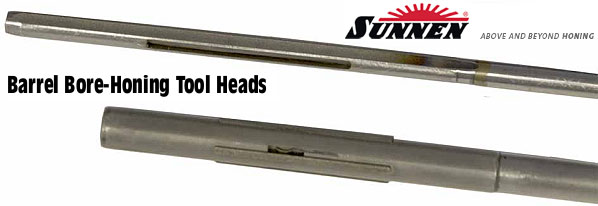
Some custom barrel makers are now honing barrels (after drilling) to improve bore diameter uniformity, smooth the interior finish, and reduce barrel lapping times. For years, large-scale manufacturers of hammer-forged barrels have employed honing. Now the process is being used by smaller, “boutique” barrel-makers. This article explains how and why barrel honing is done. Take the time to watch the video. For anyone with an interest in barrel-making, this video is an eye-opener…
Barrel Honing Process Demonstrated (Worth Watching!):
For custom barrel makers, honing is a time-saver and cost cutter. A few minutes on a honing machine can cut lapping times in half, leaving a cross-hatched surface finish in single or low double-digit Ra. Honing is the same process used to make diesel fuel injectors with bore roundness and straightness controlled to fractions of a micron (<0.000040"), with surface finish Ra ≤0.15 µm (6 µin).
A key manufacturing process used for hammer-forged barrels is now getting attention from the makers of custom button-rifled barrels. This process is precision bore-honing. Honing produces a high-quality bore surface fast, which is critical to hammer forging. (Why is honing so important with hammer forging? Surface finish is the one feature of the barrel that cannot be controlled in hammer forging. Surface imperfections in a barrel blank tend to be amplified as the blank is formed on the rifling mandrel. And if the bore is chromed afterwards, imperfections in the surface finish become even more obvious.)
Honing dramatically improves bore diameter size uniformity and accuracy, surface finish and roundness throughout the length of the barrel. It can certainly be used in place of a pre-rifling lap. The chief difference between a lapped and honed bore is the direction of the finish lines in the bore. Honing leaves fine spiraling crosshatch lines, while a lap leaves lines going longitudinally in the bore. After rifling the manufacturer can remove the crosshatch finish with a quick lap if desired. Honing is fast, accurate, and can be automated. Its surface quality and geometry can duplicate lapping, except for the longitudinal lines of the lapped finish.
Frank Green of Bartlein Barrels told us: “We worked with Sunnen and we did all the initial testing on the prototype machine for them. The machine works great! We ordered and received last year a new manufactured machine with the changes we wanted on it and we just ordered a second one a month or so ago. Should be here next month.”
Computer-Controlled Bore-Honing
Honing can be done with great precision through the use of advanced, computer-controlled honing machines. Sunnen Products Company recently introduced a new machine for .17 to .50-caliber barrels (see control panel below). The spindles on this machine can correct bore size imperfections so small only an air gauge can measure them. The consistency this allows improves bore uniformity, which, in turn, produces more accurate barrels for the precision market.
Sunnen Products Company is the world’s largest vertically-integrated manufacturer of honing systems, tooling, abrasives, coolants and gauging for precision bore-sizing and finishing. Sunnen’s customers include manufacturers of diesel and gas engines, aerospace components, hydraulic components, oil field equipment, and gun/cannon barrels. Sunnen, which just celebrated its 90th anniversary, employs more than 600 people worldwide.
In the video below, Forum member Eric Cortina shows how to install a Jewell Benchrest trigger into a Kelbly F-Class Panda action. You could follow the same simple procedure to install a Jewell in a standard Panda action. Kelbly’s sell both standard and long versions of the F-Class Panda action. Both versions feature integral recoil lugs in the front.
To see more detail in this “how-to” video, you can zoom it to full-screen size. Simply click the full-screen icon (4-cornered frame) just to the right of the YouTube logo in the lower right.
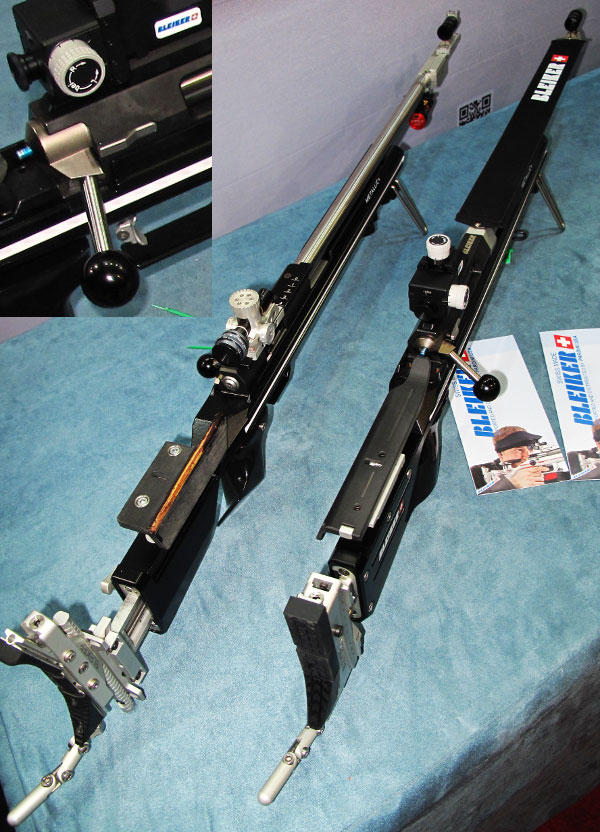
You don’t want to inquire about the price of a Bleiker competition rifle. As the expression goes, “If you have to ask, you can’t afford it”. At the Pardini USA booth at SHOT Show we saw a pair of black beauties — two “full-race” Bleikers, one a smallbore match rifle (.22 LR) and the other a 300m position rifle chambered in 6mmBR Norma. The combined price for the two rifles was a jaw-dropping $20,100.00. Yep, over $20K for the two. The 6mmBR rig was $10,200 while the smallbore rifle was $9,900.00.
Bleikers command such high prices because they win. At recent ISSF 300m and Smallbore Championships, Bleikers have been used by many of the medal winners. A gun is worth $10K if it can really put you on the podium or, better yet, deliver a world championship.
You are looking at $20,100 of Competition Rifles here. (Click Image for full-screen version.)
Take a look at this slick feature on the 300m gun. The adjustable cheek-pad automatically tilts up (for clearance) when you retract the bolt. That’s clever Swiss Engineering.
Forum member Preacher recently crafted a nice varmint rifle for fellow Forum member Dave 0. (aka “Waskawood”). But rather than buy an off-the-shelf stock, Preacher crafted this stock all by hand, starting from a laminated blank panel. He calls this stock project his “Axe Job”.
CLICK for Full-size Photo
This stock is being used on a prairie dog rifle, chambered for a 17-caliber wildcat, the 17 VHA, which is based on an H&K 4.6x30mm parent case. With about nine grains of 300 MP pistol powder, the 17 VHA drives 20-grainers at about 3850 fps. (SEE details at end of article).
The ‘Axe Job’
Report by Preacher
I like carving with the laminates because all the lines are right there in front of my eyes, so it’s easy to follow along and get it just right, until it’s pleasing to the eye. I never use a template, I just keep checking the lines as I go along. I have all the needed equipment to power build one of these, but I really enjoy the time spent on the hand work. From start to completely ready-to-install, I’ll have about six (6) weeks into one of these stock projects. A lot of that is drying time for the clear coats.
A little work with the hand axe, after a trip through the band saw…
The majority of the laminated blank panels I use for my gunstocks are purchased directly from Cousineau Wood Products or from Rutply.com. You have to buy at least four full panels at a time, all the same color, but that will yield eight (8) stocks. Seems like I have a little over $150.00 in a blank large enough to start making a full-sized, benchrest-style stock.
A little work with a chisel…
A little work with a rasp. (Before I was rich and famous and could afford really good rasps, I used a good old horse shoe rasp.)
A little more work with the chisel…
Preacher’s Advice on Carving Your Own Stock
The one main advantage of being older that dirt, and tormented with MS the past 40 years, is lots of free time to enjoy what ever I can do these days, as long as I can set down to do it, and I can make a lot of wood chips setting down.
Any one can do this if they have the time to devote to it. All it takes is time and a good eye for details. I made a lot of firewood over the years, until I got the hang of it. Most all those problems were inletting, and screw hole spacing. Get those right the first time and you’re on your way….
A little more work with the rasp…
A few coats of Auto clear has it about buttoned up…
Micro 17 VHA Wildcat Here’s the finished rifle built by Preacher for Dave, using the ‘Axe Job’ stock. Dave tells us: “Preacher chambered the rifle for the 17 VHA, a wildcat based on the H&K 4.6x30mm MP7 PDW case necked down to 17 caliber. There are numerous articles in the Varmint Hunter’s Magazine about it. This efficient little round shoots 20gr ballistic tips at 3850+ fps. That’s not too shabby for ‘nine point something’ grains of pistol powder.”
“My intentions for my 17 VHA rifle are to plop down in the middle of a PD town with my swivel bench and shoot prairie dogs. I also thought it would be a nice platform to test the accuracy of the cartridge. If I like the little round as well as I think, I plan to build a more practical rifle that I can carry. I really want to thank Preacher for his patience with me through this project, as it was my first custom build.”
Story by T. Logan Metesh forNRABlog.com
Since beginning in 1979, SHOT Show has become one of the premier firearms industry event of the year. As I was packing up amazing and historic guns from the NRA Museums for SHOT Show, I was led down a path of historical whimsy — what would SHOT Show have been like 160 years ago in 1855?
All of the today’s household names in firearms would have been in attendance: Remington, Colt, Smith & Wesson, Winchester, and others. Some of them were already well established; others were on the edge of greatness. Eliphalet Remington (right) would have been there. Already a well-known and respected businessman, he would have been representing the company he founded 39 years before in 1816.
Samuel Colt would have been in very good spirits. He had just renamed his company — Colt’s Patent Fire Arms Manufacturing Company — and had broken ground on a new factory that would open the following year in 1856. His revolver patent was also set to expire in 1856. Colt had recently fired Rollin White, a trivial matter at the time, but it would come back to haunt him.
Horace Smith and Daniel Wesson would have been there, too. At this point, the now-venerable firearms company had only been a partnership for three years. They would likely have been joined by one of their investors, Oliver Winchester, and showcasing their lever-action “Volcanic” arms.
Very shortly, Winchester would buy Volcanic, Rollin White would patent a bored-through cylinder that Colt had rejected, and Smith and Wesson would form Smith & Wesson Revolver Company utilizing White’s new patent.
As you can see, many of the technologies we consider antiquated were, at the time, revolutionary. Some of the designs we take for granted today were in their infancy in 1855.
Other lesser-known (and less successful) gunmakers hoping to capitalize on their new products would have been there as well. After all, there’s no better place to unveil new designs than at SHOT Show!
Thomas Wright Gardener Treeby (often known as T.W. Treeby) would likely have been at SHOT Show displaying his new 14-shot, .54 caliber chain rifle. Designed in 1854 and patented in 1855, these rifles were made in an attempt to create a successful repeating rifle design. The British military tested the gun with a 30-round chain, but the idea never caught on.
Rare, Antique Firearms on ForgottenWeapons.com
See the Treeby Chain Gun and other rare firearms on ForgottenWeapons.com. It is believed that only two Treeby Chain rifles were ever made. The 14 chain-linked “chambers” rotated into place via a sprocket (like on a bicycle), and each had a separate percussion cap. Watch this ForgottenWeapons.com video to see how it worked.
The NRA Gunsmithing Guide contains 336 pages of solid, comprehensive gunsmithing info drawn from articles originally published in the American Rifleman magazine.
The $24.95 book includes 116 articles by expert smiths who build, repair, accurize, and customize all types of firearms (with a strong emphasis on rifles). The three main subject areas are: improving rifle accuracy, customizing fine rifles, and restoring old rifles. Roughly one-third of the articles cover these three topics.
As you would expect from content that first ran in American Rifleman magazine, the articles in the NRA Gunsmithing Guide are richly illustrated with photographs, charts, drawings, diagrams, and data tables. Not Available in bookstores, the NRA Gunsmithing Guide is sold online through Palladium Press, the NRA’s Book Publishing Affiliate.


 Forum member Roy Bertalotto did a real nice off-set scope installation on a bolt gun to help a sight-challenged shooter. Roy explains: “A friend of mine shoots left-handed and has lost the sight in his left eye. I built him a scope mount so he can still shoot left-handed, but now use his right eye.” Roy’s fabrication work is impressive and we praise his efforts to help a fellow shooter stay in the game.






 Here’s the finished rifle built by Preacher for Dave, using the ‘Axe Job’ stock. Dave tells us: “Preacher chambered the rifle for the 17 VHA, a wildcat based on the H&K 4.6x30mm MP7 PDW case necked down to 17 caliber. There are numerous articles in the Varmint Hunter’s Magazine about it. This efficient little round shoots 20gr ballistic tips at 3850+ fps. That’s not too shabby for ‘nine point something’ grains of pistol powder.”

 All of the today’s household names in firearms would have been in attendance: Remington, Colt, Smith & Wesson, Winchester, and others. Some of them were already well established; others were on the edge of greatness. Eliphalet Remington (right) would have been there. Already a well-known and respected businessman, he would have been representing the company he founded 39 years before in 1816.


