There’s a chap in Poland named Łukasz Pietruszka, who is a bonafied “Wizard of Wood”. Lukasz handcrafts unique custom stocks, selling them through his LP Gunstocks company. Many of his most eye-catching stocks are for airguns (particularly Field Target rifles), but he also produces fine stocks for rimfire and centerfire hunting rifles. Lukasz is a master carver who includes exquisite details on many of his stocks. Some of these designs, crafted from exotic hardwoods, raise stock-crafting to an art form.
Check out the figure on this Turkish Walnut stock by Łukasz Pietruszka.
You can see a variety of Lukasz’s stocks in a video sampler. If you’re a fan of fine wood, you’ll love this video. So pull up a chair, grab your favorite beverage, and enjoy this 16-minute video interlude.
Watch Video in High Definition
NOTE: We recommend you view this video in high definition, in wide screen format. To do this, start the video, then click on the gear-shaped icon at the lower right-hand corner of the video frame (it’s located just to the right of the clock icon). If you have a fast internet connection, select 720P or 1080P from the pop-up menu. (1080P is the highest resolution.) Now select theater mode or full-screen mode using the small icons on the lower right of the frame.
Radical ‘Shockwave’ from LP Gunstocks
Here is a truly amazing bit of craftmanship. The images below show a one-of-a-kind Shockwave stock created by Łukasz for a Steyr Field Target air rifle. Over the top? Perhaps… but you have to admire the imaginative design and exquisite worksmanship.
Video find by Boyd Allen. We welcome reader submissions.
“Gain-twist” refers to a form of barrel rifling where the twist rate gets tighter over the length of the barrel. For example, a gain twist barrel might start with 1:12″ twist and finish with 1:8″ twist. There is some evidence that gain-twist rifling can deliver more velocity (compared to a conventional barrel) with certain cartridge types. There have also been claims of increased accuracy with some types of bullets, but such claims are more difficult to quantify.
Gain-twist rifling is not new. This form of rifling has been around for a long, long time. The first gain-twist barrels appeared in the late 1800s. However, in the last few years, there has been increased interest in gain-twist barrels for both short-range and long-range competition.
Video Explains Gain Twist Rifling
Radical Extreme Gain Twist Barrel Design
In this video from our friend John M. Buol Jr., gunsmith John Carlos talks about a fairly radical gain-twist barrel design for high power and service rifle shooters. Produced by Bartlein Barrels, this gain-twist barrel starts with a 1:14″ twist and finishes with a 1:6.8″ twist at the muzzle (See 1:50 time-mark). Carlos believes that this type of barrel delivers higher velocities while providing excellent accuracy for a wide range of bullet weights. In .223 caliber, the gain twist works with the 75-77 grain bullets used on the “short course” while also delivering excellent accuracy with the longer 80-90gr bullets used at 600 yards and beyond. Velocity is the important bonus for long-range use. Carlos says the gain twist barrels deliver greater muzzle velocity, allowing a 90 grain bullet to stay well above the transonic zone, even at 1000 yards. (See 4:50 time-mark.)
This 1:14″ to 1:6.8″ gain-twist barrel is the product of much experimentation by Carlos and Bartlein. Carlos states: “We’ve varied all sorts of internal dimensions, such as the land height, and the groove depth. We’ve tried 5R rifling and 4-groove rifling, and we’ve worked with various rates of twist, and I believe we have it down really well right now.”
In this video, John Carlos explains the history of gain-twist rifling, and he explains how modern Bartlein gain twist barrels have been developed in recent years for both benchrest and High Power applications. If you are interested in barrel technology and design, take the time to watch.
Most of you know Carl Bernosky as a great marksman and 10-time National High Power Champion. But you may not realize that Carl is also a superb stock-maker. A true craftsman, Carl produces outstanding laminated and fancy wood stocks for hunters and competitive shooters. Visit CarlBernosky.com to see a selection of Carl’s competition and hunting stocks.
One of Carl’s latest creations is a thumbhole F-Class stock. Designed for F-Open shooters, this stock features a flat, 3″-wide fore-end, ergonomic grip, and adjustable cheekpiece. The laminated Bernosky stock featured here was crafted for Chesebro Rifles, which offers a turn-key stock package for the Barnard ‘P’ action, one of our favorite custom actions. This particular build features a MT Guns Vee Block Bedding System, MT Guns 3-Way Adjustable Butt Plate, and B&D Precision removable cheek piece.
Click Photo to view full-size image of stock.
As you see it, complete with all hardware (including short fore-end rail for bipod) this stock runs $1275.00 ready to ship. Just attach your Barnard barreled action and you’re ready to compete. The stock (by itself) weighs 6.5 pounds. Contact Chesebro Rifles, (661) 557-2442, for more information.
We normally use a gun cradle when cleaning or adjusting our rifles. But there are situations, such as when working on a barreled action, when it’s nice to use a pad that lies flat. Many work pads are too small — they’re nothing more than oversize mouse pads. Here are three gun pads that are big enough to work well with rifles and/or barreled actions.
DryMate Gun Cleaning Pad The Drymate Gun Cleaning Pad is a full 54″ wide x 16″. That’s four and a half FEET wide — longer than most rifles, so you have plenty of surface area for working. Conveniently, this product can be washed with soap and water. It is offered in three versions: Green, Blaze Orange, and Camo. We like the Blaze orange version because the bright color makes it easier to see small parts such as screws and springs.
Boyt Harness Counter Pad
The 48″ x 12″ Boyt Harness Counter Pad was originally designed more for display purposes than for serious work sessions, but we like this product. It is useful if you want to lay your gun on a bench to make small adjustments. The Boyt Counter Pad is nice and big, a full four feet from end to end. The back side is canvas while the top-size is a quilted cotton fabric. This product has received high praise from buyers. Here are actual owner reviews:
Expensive… but worth every penny. I bought three of them because I want to have at least one always around. I use one for a shooting bench or tailgate mat and another for my primary gun cleaning workbench mat. Awesome for both purposes. This one was perfect for my array of needs. — Joe D.
This mat is great for cleaning guns and keeping your surfaces clear of oil or solvent. The mat has plenty of space for a rifle or handgun and the padding is thick enough[.] I would definitely buy again and have recommended this to my friends and family. — Safety Guy
I bring this to the rifle range with me every time, to rest my rifle on the table without worrying about scratches. It fits nicely in my soft rifle case. One side is a tough canvas material that doesn’t show scratches, and the other side is a soft fleece material that protects the finish of your gun. — MACPSU
Hoppes Gun Cleaning Pad
The Hoppes Gun Cleaning Pad is 36″ wide x 12″. That’s big enough for many barreled actions (unless you have a really long barrel). This pad has a non-slip nylon backing, and Hoppes claims that the “Soft acrylic material absorbs 8 times its weight in fluids.” This Hoppes Cleaning Pad is very affordable. It costs just $8.39 at Amazon.com with free shipping for Prime members.
Brux Barrels, based in Lodi, Wisconsin, has earned a reputation for producing great-shooting tubes. Brux-made barrels have won their fair share of matches, and set some notable records in the process. Last year, Rodney Wagner shot the smallest five-shot, 600-yard group (.0349″) in the history of rifle competition, using a Brux barrel chambered for the 6mm Dasher.
Folks often ask us why Brux barrels shoot so well. “What’s the secret?” they ask. We can only answer with what Brux explains on its own website: “To make a cut-rifled barrel you have to start off with the proper ingredients: the best steel available, skill, and experience. Since there are really only two main suppliers of barrel-quality steel, the skill and experience is what really makes a barrel maker stand out.” Here is how Brux’s co-owners, Norman Brux and Ken Liebetrau, explain all the procedures involved in making a Brux cut-rifled barrel:
Brux Barrel-Making Process, Start to Finish
We start out with either 4150 chrome-moly or 416R stainless steel double stress-relieved bar stock. The bar stock starts out at 1-9/32″ in diameter and 20-24 feet long so we cut it to length.
Step two is to rough-contour the outside of the barrel blank in a lathe.
Thirdly, the blank gets mounted into a Barnes gun drill. The cutter bit has holes through which oil or coolant is injected under pressure to allow the evacuation of chips formed during the cutting process. This is called “oil-through” or “coolant-through”. Without this, you wouldn’t want to even attempt drilling a hole 30” long and under ¼” in diameter. The combination of a 3600rpm and good flushing allows us to drill a beautifully straight and centered hole .005” under “land” diameter at a rate of 1” per minute.
Clean the barrel.
Next the blank is sent back to the lathe to machine the finished contour of the outside.
Clean the barrel again.
Now, the blank is sent on to the Pratt & Whitney reamer in which an “oil through” reaming tool is used to cut away the extra .005” left in the drilling process. The reamer makes an extremely accurate bore size and after it is finished the bore will have a better surface finish and will be at the proper “land” diameter.
Clean the barrel again.
In the sixth step we hand lap each barrel to remove any slight tool marks that may have been left by the reamer and inspect every one with a bore scope. If the barrel doesn’t meet our standards for surface finish and tolerance it doesn’t get any further.
Clean the barrel again.
The barrels then go onto the rifling machine which is responsible for cutting the all so familiar grooves in the bore. A caliber/land configuration-specific rifling head is used to progressively shave away small amounts of steel to form the rifling grooves. This is accomplished by simultaneously pulling the rifling head through the reamed blank as the blank is spun at a controlled rate. After each cut, the blank is rotated 90 degrees (for a four-land configuration) and after one full rotation (360 degrees) the rifling head is slightly raised to shave off the next bit of material. This process is repeated until we reach groove diameter.
Clean the barrel again.
Lastly, the barrel is hand-lapped again (to ensure a smooth bore), and a final inspection is performed with the bore scope.
The barrel is cleaned one last time, wrapped, packed, and shipped to [the customer].
Anyone reading this detailed description of the Brux barrel-making process will doubtless come away with a new appreciation for the time, effort, and dedication required to produce a premium match-grade cut-rifled barrel. Obviously, there are no easy shortcuts and great attention to detail is required each step of the way. As shooters we’re lucky that we have barrel-makers so dedicated to their craft.
Credit James Mock for steering us to this Barrel Making 101 feature on the Brux website.
We first featured this amazing stock last year. We felt this creation was such a stunning piece of work that it deserved a second look. If you missed this masterpiece the first time around, feast your eyes…
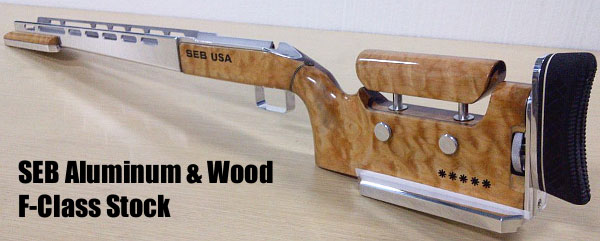
Sebastian (“Seb”) Lambang, creator of the SEB Coaxial Rests and the Coaxial Joystick Bipod, has engineered an impressive new wood and aluminum F-Class stock. The stock features a long, box-section aluminum fore-end with a wood rear section and wood-trimmed “wings” on the front bag-rider. The aluminum fore-arm has “buick vents” for weight reduction. From the end of the action rearward, the stock is mostly wood, with light and dark fancy wood laminates on opposite sides (left and right).
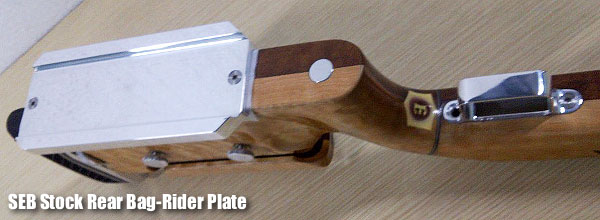
The foot of the buttstock has a very wide aluminum rear bag-rider with rails. The rear wood section appears to be two solid pieces of wood — but that is deceiving. Seb explains: “To save weight, the buttstock is hollow (using thin-walled wood)”. To strengthen the construction, Seb added carbon fiber inside the buttstock. So what you see is a wood outer shell with carbon fiber layers on the inside. The stock sports vertically-adjustable cheek-piece and buttplate. The thick, rubber buttpad should diminish felt recoil even when shooting big cartridges with heavy bullets.
This is an interesting, innovative stock design. And as with everything Seb produces, the craftsmanship, fit and finish are superb. We may get a chance to see how well this new stock shoots at the F-Class World Championships later this month in Raton, New Mexico.
Seb also crafted a handsome set of angled scope rails with beautifully-machined scope rings. Imagine being able to custom-make one-off products of this quality in your own machine shop!
2014 and 2012 U.S. National F-TR Champion James Crofts is one of America’s top F-Class shooters. A member of the 2013 World Championship-winning F-TR Team USA squad, James knows a thing or two about long-range shooting, that’s for sure. But you may be surprised to learn how James sharpens his shooting skills at relatively short distances. You see, James often practices with a .22 LR rimfire rifle at distances from 50 to 200 yards. James tells us: “Shooting my F-Class rimfire trainer saves me money and improves my shot process and wind-reading abilities.”
Remington rimfire 40X barreled action in PR&T LowBoy stock with PT&G bolt.
Rimfire Training Teaches Wind-Reading Skillsby James Crofts
Training with the rimfire is extremely useful and can be done from 25 yards out to 200 yards. I am lucky and can shoot 50 yards right off my back deck. That is far enough that any miscue on rifle handling will show up on the target. I use a two dry-fire to one actual shot routine for my practices. This gives me much more positive reinforcement without any negative reinforcement.
Wind reading is extremely important with a .22 LR rifle. I use a set of smallbore flags to aid my wind calls. The smallbore flags are a must and force you to look at the flags and mirage on each and every shot. If you think the flags at Camp Butner move a lot, try smallbore flags around tall pine trees.
Rimfire Training Is Cost-Effective
Rimfire ammunition is much less costly than centerfire ammo. Though .22 LR prices have risen in recent years (and rimfire ammo is harder to find), even now I can get a 500-round brick of .22 LR ammo for less than $75.00. That works out to fifteen cents a round. That’s a fraction of the cost of handloading .308 Win match ammo. Heck, you can pay 40 cents a piece for match-grade .308-cal centerfire bullets. Then you have to figure in brass, primers, and powder.
My CMP 40X Rimfire F-TR LowBoy Clone
My quest into the .22 LLR rimfire field started with an email from the Civilian Marksmanship Program (CMP) announcing Rem 40X stripped barreled actions for sale. I thought, “Hmmm… Could one of those little 40X barreled actions be turned into a F-Class training rifle?” My gunsmith Ray Bowman of Precision Rifle & Tool was brought in at this point.
After conferring with Ray, it was decided that he could indeed turn this into a F-Class training rifle. Ray contacted Dave Kiff of PT&G and ordered a new bolt for the Remington 40X rimfire action. Next was the stock decision. I decided to go with a PR&T Low Boy F-Class stock — this is an exact clone of the stock for my .308 Win F-TR competition rifle. Then a Jewell trigger was acquired to complete the components. Ray built this just like he would any custom rifle, other than using the stock barrel. The project turned out awesome. The rifle was a hammer from the beginning even with the stock barrel.
About James Crofts
This spring, James Crofts was chosen as the new Vice Captain for the USA F-TR National Team. James comes from a military background, having served 20 years in the U.S. Navy aboard fast attack submarines. James has also been a shooting member of the 8-man F-TR Team USA, and he is always one of the top shooters in any F-TR competition. James told us: “Now the work begins, but with Ray Gross as Captain I think we can handle it. It will be a tough act to follow. Darrell Buell and Mike Miller set the bar extremely high with back-to-back world championship gold medals.”
Alex Sitman of Master Class Stocks in Pennsylvania is widely considered one of the finest rifle-stock craftsmen in the country, if not the world. Alex’s workmanship and dedication to excellence is top-of-the-line. Alex normally custom-fits each stock to his customer precisely. Many hours are dedicated to stock prep and inletting, and his bedding jobs are flawless. Each stock is exactingly hand-crafted with great attention to detail, and then the stock is “dressed” in the customer’s choice of finishes.
Doing all that takes time — a lot of time. That’s why Master Class Stocks has a long waiting list, and it can take months before a big job is completed. But when Alex is involved, you can count on the final product being a work of stock-making art. Here’s an example. Alex recently stocked an F-Class rifle using eye-popping, exhibition-grade Bastogne walnut. The wood was sourced from Cecil Fredi of GunstockBlanks.com. Alex says: “Cecil’s wood is some of the best I’ve ever used. This blank cost over $1000.00, but it was truly spectacular.” Since the blank was less than 3″ wide, Alex (with assistance from 8-time NRA High Power Champion Carl Bernosky) laminated on the 3″-wide forearm “wings” using spare wood left after the blank was cut. See how Alex and Carl carefully matched the grain of the wood on the forearm. And note how perfectly the adjustable cheek-piece is fitted. If you want a stock like this on your next rifle, contact Alex Sitman at Master Class Stocks, (814) 742-7868.
The Bastogne Beauty — More Construction Details
Eric Kennard tells us: “This rifle was built for Mike Dana in Florida. Kelbly’s did the metal work. [The action is a Stolle Panda F-Class.] Barrel by Brux. Chambering? 6mmBR of course! Mike added a March 10 x 60 scope. Let me tell you this is beyond a work of art! The fit is absolutely perfect! There is not one flaw in the wood-work. The pillar bedding is also perfect! Did you notice the ebony inserts? Or Alex’s custom trigger guard? Alex out did-himself this time. Most of us would not dare to shoot [this gun]!”
Today, AR-platform rifles are hugely popular. Dozens of manufacturers sell AR-type rifles, in a wide variety of configurations and calibers. But before there were M16s and AR-15s, ArmaLite produced a 7.62×51 caliber rifle, the AR-10. Invented by Eugene (‘Gene’) Stoner for the Armalite company, this is the father of all of today’s AR-platform rifles.
If you’re curious about the AR-10, in this video, Jerry Miculek puts an original 1957-vintage AR-10 through its paces on the range. This extremely rare, early-production rifle was provided by Mr. Reed Knight and the Institute of Military Technology. (The gun in the video was actually produced in the Netherlands under license, see video at 4:40.) This AR-10 is the direct ancestor of the AR-15, M16, and many of the modern sporting rifles that we use today.
The AR-10 was slim and light, weighing in at around 7 pounds. Some folks might argue that the original “old-school” AR10 is actually better that some of today’s heavy, gadget-laden ARs. The AR-10’s charging “lever” was under the carry handle — that made it easier to manipulate with the gun raised in a firing position.
You’ll notice there is no “forward assist”. Inventor Gene Stoner did not believe a separate “bolt-pusher” was necessary. The forward assist was added to solve problems encountered in Viet Nam. Some critics say the forward assist “only takes a small problem and makes it a big problem.” For today’s competition ARs (that are never dragged through the mud) the forward assist probably is superfluous. It is rarely if ever needed.
Note also that the handguards are fairly slim and tapered. Today, six decades after the first AR-10 prototypes, we are now seeing these kind of slim handguards (made from aluminum or lightweight composites) used on “full race” ARs campaigned in 3-gun competition.
History of the AR-10
The AR-10 is a 7.62 mm battle rifle developed by Eugene Stoner in the late 1950s at ArmaLite, then a division of the Fairchild Aircraft Corporation. When first introduced in 1956, the AR-10 used an innovative straight-line barrel/stock design with phenolic composite and forged alloy parts resulting in a small arm significantly easier to control in automatic fire and over one pound lighter than other infantry rifles of the day. Over its production life, the original AR-10 was built in relatively small numbers, with fewer than 9,900 rifles assembled.
In 1957, the basic AR-10 design was substantially modified by ArmaLite to accommodate the .223 Remington cartridge, and given the designation AR-15. ArmaLite licensed the AR-10 and AR-15 designs to Colt Firearms. The AR-15 eventually became the M16 rifle.
AR-10 photos from Arms Izarra, a Spanish company specializing in de-militarized, collectible firearms. Interestingly, this particular AR-10 was produced in the Netherlands under license.
Muzzle brakes are controversial. Some people swear by them, while others swear at them. Still, there’s no question that a good brake can reduce felt recoil up to 45%. And likewise, the best brakes, when installed properly, seem to have no negative effect on accuracy.
Roy Bertalotto has done considerable experimentation with muzzle brakes, testing dozens of brake designs on his own rifles over the past few years. Roy’s article, Adventures with Muzzle Brakes, discusses various aspects of muzzle brake design and performance. Roy doesn’t claim that his testing is definitive, but his article is definitely worth a read. Here are some of Roy’s interesting findings:
Exit Hole Diameter
“Best accuracy and effectiveness of the brake was obtained with a hole .020″ over bullet diameter. If the exit hole is too small, such as +.005″ over bullet diameter, accuracy suffers. If the depth of the exit hole is too shallow, the metal around the hole will erode very quickly.”
Hole Placement
“The most effective braking was with a brake 1″ in diameter with a 3/4″ exit hole on each side, just in front of the muzzle. The bullet passes through a cone of 35 degrees before it exits the brake. (Like the tank example), Incredible reduction of recoil. But loud and ugly. Very easy to make since you don’t need a spin fixture or a dividing head.”
Bottom Gas Venting Helps Accuracy
“In my tests, not having holes all around the brake effects accuracy a bit. I believe it does something to the bullet by the air pushed ahead of the bullet creating unequal turbulence in the bullet path. I’ve tried a few brakes where I drilled only holes on the top, test fired, and then completed holes on the bottom and in every case, accuracy improved.” Below are spiral-ported brakes crafted by Clay Spencer.
Brakes Work Best with High-Pressure Cartridges
“The higher the pressure of the particular round, the more effective the brake. I have over 20 rifles with brakes. The 220 Swift is the king of reduction. Followed very closely by the 25-06, 6mm Remington, any Weatherby small bore. With a proper brake and a hot handload under a 40 gr bullet, the Swift will move 1/2″ to the rear and 0 muzzle rise! Big boomers with low pressure like 45-70s and shot guns benefit the least.” [Editor’s Note: Roy is judging effectiveness by the percentage of recoil reduction rather than absolute levels of recoil. Obviously if you start with a heavier-recoiling round, the absolute amount of recoil energy reduction is greater. Roy is really talking about efficiency–brakes are most efficient when used with high-pressure cartridges.]
Installation is Key to Accuracy
Roy’s findings are fascinating and suggest that further study of muzzle brakes is warranted. But we can all agree that precision installation of the brake is essential for accuracy. A poorly-installed, mis-aligned brake will degrade accuracy, that is well-known.
Harrell’s Precision has made thousands of muzzle brakes, in many styles and port arrangements. The Harrell brothers offer some good advice for gunsmiths installing brakes: “Muzzle brakes aren’t magic, they reduce recoil by redirecting exiting gas. What’s important is that they are straight and the threads are perpendicular with the base. The only way to get the base and threads perpendicular is to thread, not tap, them on a lathe.”


 Watch Video in High Definition


 Most of you know Carl Bernosky as a great marksman and 10-time National High Power Champion. But you may not realize that Carl is also a superb stock-maker. A true craftsman, Carl produces outstanding laminated and fancy wood stocks for hunters and competitive shooters. Visit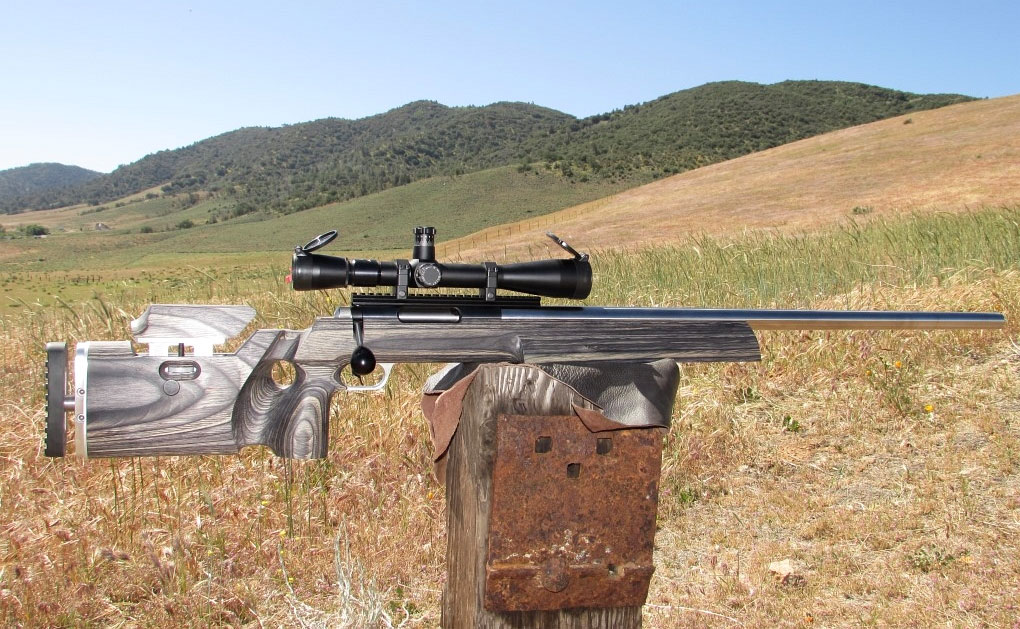


 The
The 






 Alex Sitman of


