|
|
January 11th, 2014
 In our Shooters’ Forum, you’ll find a lengthy thread about accuracy problems with a Savage LRPV, chambered in 6mmBR. The gun would repeatedly split groups at 100 yards, and at 300 yards, the “flyers” would open up the groups to 1.5 MOA or larger. Interestingly, the factory test target (at right) showed a split group — not a good sign. In our Shooters’ Forum, you’ll find a lengthy thread about accuracy problems with a Savage LRPV, chambered in 6mmBR. The gun would repeatedly split groups at 100 yards, and at 300 yards, the “flyers” would open up the groups to 1.5 MOA or larger. Interestingly, the factory test target (at right) showed a split group — not a good sign.
The gun’s owner, forum member LR_Shooter, tried a variety of tweaks: “I did this, done that… [changed] torque, tang floated, bedded action, recut chamber, and [adjusted firing pin]”. But nothing really helped. Frustrated, LR_Shooter asked his fellow Forum members for help. Much advice was proffered, including the novel idea of removing the middle action screw in the Savage 3-screw target action. Some of the advice proved helpful, but none of the suggested remedies produced a major improvement. This rifle, out of the box, tossed flyers and no amount of tweaking (or changes in shooting technique) really cured the basic problem. That is, until, the factory barrel got replaced…

New Criterion Pre-Fit Barrel Works Wonders
LR_Shooter acquired a Criterion pre-fit barrel from Jim Briggs at Northland Shooters Supply (NSS). These pre-fits are designed for easy installation with the standard Savage barrel nut. Wouldn’t you know it, with a new 30″ heavy-contour barrel on the LRPV, the gun started shooting way better. No more crazy fliers, no more split groups, no more excessive vertical. And the improvement came without any other major modifications. LR_Shooter reports: “I got a replacement barrel from Jim at NSS. It is a 30″ bull Criterion barrel. So far, without playing with torque screws and having my old setup… I’m very satisfied with the barrel I got. Now I have no problem getting [groups] under 0.25 MOA. Finally this thing can shoot!” The targets below, shot with the new Criterion barrel, speak for themselves. The left target was shot at 100 yards, while the target on the right was shot at 300 yards (very impressive).
Targets Shot with Savage LRPV Fitted with Criterion Barrel

Read Thread on Savage Accuracy Issues Fixed By Criterion Barrel
Moral of the Story — Sometimes A New Barrel Really Is the Right Solution
All of us have struggled at times with a rifle that won’t live up to expectations. This Editor personally struggled for over a year with a .260 Rem Savage with a factory tube. The gun tended to split groups and the POI walked as the barrel heated. I tried one powder/primer combination after another, working through a variety of seating depths over many months. I was persistent. Out of stubbornness, I just believed that sooner or later I’d find the magic load.
Well folks, sometimes there’s really nothing you can do about a sub-par barrel. It is what it is. To really improve a gun’s accuracy (particularly a gun with a factory tube), you may need to open your wallet and get a quality aftermarket barrel. Spending months trying one recipe after another may simply be an overwhelming waste of powder, bullets, and your precious time.
Albert Einstein supposedly said: “Insanity is defined as doing the same thing over and over again, and expecting different results.” Well that sort of describes my efforts with my .260 Rem. Once I had enough evidence that my barrel split groups no matter what load combo (and seating depth) I tried, it was time to pony up for a new barrel. When I did finally screw on a nice PacNor 3-groove Supermatch, that Savage suddenly became a true tack-driver. As re-chambered in 6mmBR with the Pac-Nor, in calm conditions, my Savage will now consistently shoot in the twos with heavy bullets, and it can sometimes dip down into the ones with Berger 80gr flat-base bullets. The moral of the story here is simple — don’t waste weeks or months chasing your tail with a barrel that just won’t deliver (after a reasonable amount of testing). Save up for a custom barrel, get it chambered properly, and stop your cycle of frustration.
Contact Information for Northland Shooters Supply:
E-mail: briggs.j-b@q.com (that is Q.com not G.com)
Phone: (763) 682-4296
Fax: (763) 682-6098
Mailing address:
P.O. Box 333
Buffalo, MN 55313
January 11th, 2014
 For 2014, Kelbly’s is introducing a new series of rifles for competition, tactical disciplines and hunting. The Arcas™ Series rifles are complete packages designed with Kelbly’s recommended specifications and top-grade components. Pick your application (Benchrest, F-Open, F-TR, Hunting, Tactical) and Kelbly’s can provide a complete build with all the bells and whistles. For 2014, Kelbly’s is introducing a new series of rifles for competition, tactical disciplines and hunting. The Arcas™ Series rifles are complete packages designed with Kelbly’s recommended specifications and top-grade components. Pick your application (Benchrest, F-Open, F-TR, Hunting, Tactical) and Kelbly’s can provide a complete build with all the bells and whistles.
Shown below are the four Arcas competition rifles currently offered. In addition to these four comp guns, the Arcas series includes two tactical-style rifles and two hunting rifles (starting at $2799.00). All these Arcas series rifles will be on display at SHOT Show next week. Let us know (via comments) which Arcas models interest you the most, so we’ll be sure to feature those in our SHOT Show reports.

Every Arcas Series rifle comes with premium components and a wide choice of stock colors. In addition you can have an Arcas rifle customized. For example, the Arcas F-Open rifle shown below can be customized with an extra long barrel ($20 per inch), fluted barrel ($199.00 extra), polished metal (all parts, $249), a GRS Laminated Stock with ergonomic grip (no charge), or a PRT Lowboy stock with high gloss finish ($799 extra).

January 6th, 2014
 Looking for a nice, half-pound trigger for your Rem-actioned varmint or tactical rifle? Well Timney has introduced a new series of triggers with pull weights adjustable from 8 ounces (half a pound) up to 40 ounces (2.5 pounds). These new 8-to-40 oz. triggers are also adjustable for sear engagement and over-travel. They will be offered in blued steel ($209.95 MSRP, $199.00 street price) or nickel-plated versions ($10 more). The new 8 oz. to 40 oz. Calvin Elite triggers are named for Timney designer Calvin Motley, who designed Timney’s AR drop-in trigger, Timney’s Rem 700 trigger with blocking safety, and other critically-acclaimed replacement triggers. Looking for a nice, half-pound trigger for your Rem-actioned varmint or tactical rifle? Well Timney has introduced a new series of triggers with pull weights adjustable from 8 ounces (half a pound) up to 40 ounces (2.5 pounds). These new 8-to-40 oz. triggers are also adjustable for sear engagement and over-travel. They will be offered in blued steel ($209.95 MSRP, $199.00 street price) or nickel-plated versions ($10 more). The new 8 oz. to 40 oz. Calvin Elite triggers are named for Timney designer Calvin Motley, who designed Timney’s AR drop-in trigger, Timney’s Rem 700 trigger with blocking safety, and other critically-acclaimed replacement triggers.
New for 2014, the Calvin Elite series will initially be offered for Remington Model 700 and Model Seven rifles, with other action types to follow. These Timney triggers are proudly made in the USA and are covered by Timney’s lifetime product warranty.
Timney’s new Calvin Elite series triggers are precision-made with top-quality components. Sears are wire-EDM-cut and triggers are CNC-machined. Parts that receive heavy wear are made from A2 tool steel (heat-treated to Rockwell 58 hardness), with Teflon-nickel coatings. The lightweight 6061-T6 aluminum housings are CNC-machined and anodized Timney Elite Gold. To learn more about the new Calvin Elite triggers, call 1-866-4TIMNEY (toll-free), or visit TimneyTriggers.com.
Calvin Elite Remington Model 700
Fully adjustable for sear engagement, over-travel, and pull weights from 8 ounces – 2.5 pounds. Trigger-Blocking Safety. MSRP $209.95 or $219.95 (nickel plated).
Calvin Elite Remington Model Seven
Fully adjustable for sear engagement, over-travel, and pull weights from 8 ounces – 2.5 pounds. Trigger-Blocking Safety. MSRP $209.95 or $219.95 (nickel plated).
December 30th, 2013
Tube-gunners take note. Gary Eliseo has just introduced a new wider, V-profile rear bag rider for his Competition Machine modular chassis systems. The new bag-rider is a wide V-shape that conforms to the shape and angle of popular rear sandbags. Gary tells us that “The new F-class rear bag rider will be available as an option in 2014. Constructed of Delrin, the new bag-rider is reversible with 0 degree and 5 degree mounting ends. The bottom of the bag-rider is sized to fit 3/4″-wide ear spacing.”


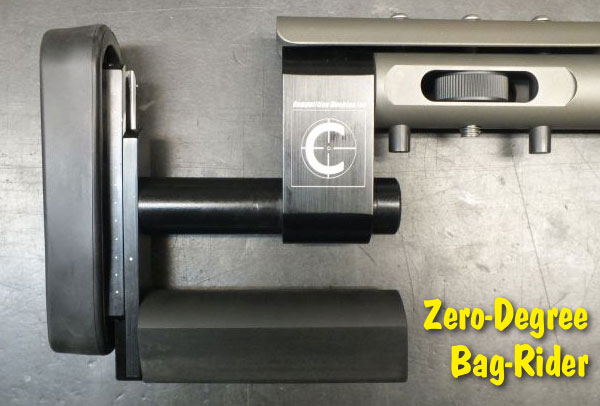
Editor’s Comment — This Kind of Bag Rider Really Works
We have tested a prototype, V-shaped bag-rider on an Eliseo 6mmBR Tubegun. The profile on our wooden prototype is very similar to Gary’s final design crafted from Delrin. We were really surprised at how much better the gun behaved with the wide, V-shaped bag rider, compared to a standard slab-sided skid. With the “V-Rider” the gun felt more “locked-in” with less side-to-side play. There also seemed to be less vertical bounce when shooting F-TR style with a bipod. But mostly the gun felt much more stable, with less tendency to roll. There was noticeably less side to side wobble, and the gun did track better.
The most important thing, is that the V-shaped bag-rider definitely made the gun easier to shoot — at least in the opinion of our three trigger-pullers. When we switched to our wide, V-shaped bag-rider, three different shooters were able to hold smaller groups with tighter horizontal. We saw fewer left/right shot impacts (away from the group center) that may have been attributable to little, last-micro-second movements of the rifle. The gun seemed to settle in the rear bag better, and after each shot, it seemed we could get back on target more quickly. The gun “locks in” to the rear bag faster and more solidly, so you spend less time fiddling with horizontal. With less wobble, the TubeGun feels less top-heavy. Understand that a V-shaped bag rider will not make your rifle more inherently accurate. However, it may help you steer the gun more consistently, and it make help the rifle track more consistently.
Product find by EdLongRange. We welcome reader submissions.
December 28th, 2013
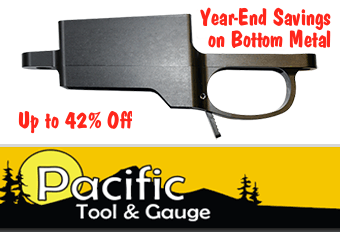 Do you need bottom metal for your Remington-footprint action (factory or custom) or a Winchester action? Then visit PacificToolandGauge.com pronto. Right now PT&G has bottom metal marked down, with savings up to 42%. Choose from a variety of styles. There are hinge-mount, flush-mount, and magwell-type versions offered, starting at just $75.00, a 42% savings over the $129.00 regular price. If you want one of these bottom metal sets, act quickly — the Special concludes at 11:59 pm on December 28, 2013. Do you need bottom metal for your Remington-footprint action (factory or custom) or a Winchester action? Then visit PacificToolandGauge.com pronto. Right now PT&G has bottom metal marked down, with savings up to 42%. Choose from a variety of styles. There are hinge-mount, flush-mount, and magwell-type versions offered, starting at just $75.00, a 42% savings over the $129.00 regular price. If you want one of these bottom metal sets, act quickly — the Special concludes at 11:59 pm on December 28, 2013.
 Sale Tip from EdLongrange. We welcome reader submissions.
December 6th, 2013
Report based on story by Ashley Brugnone, for The First Shot CMP Online Magazine
After a month of business, the CMP Custom Shop is already stacked to the ceiling with rifles needing customization and repair. With nearly 200 rifles already shipped to the Shop, the gunsmiths running the operation only anticipate more to come in the future. “Things are going great,” said John McLean, CMP Custom Shop manager. “We’re learning how to do everything we need to do in order to get things done as quickly for customers as we can, as well as do a good job.”

The Custom Shop opened its doors on October 1, 2013, offering upgrades, customization, refinishing, and other types of repair for U.S. Military-type rifles. The shop specializes in such rifles as the M1 Garand, M1 Carbine, 1903 and 1903A3 Springfield, the 1917 Enfield and the Krag. CMP will NOT be working on shotguns, pistols, revolvers, M14/M1A, AR15-style rifles or other commercially-produced modern rifles.
A M1917 U.S. Enfield was the first gun to pass through the doors of the custom shop. It was sent to be refinished by a contractor, spending nearly a month being restored. The rifle was then repaired by McLean and his crew and is just about ready to be returned to its owner. McClean explains: “The amount of time we work on pieces varies very widely. It could be five minutes worth of work to a couple days worth of work, depending on what the customer wants.”
John McLean works on a M1917 U.S. Enfield — the first of many rifles to arrive at the shop for repair.
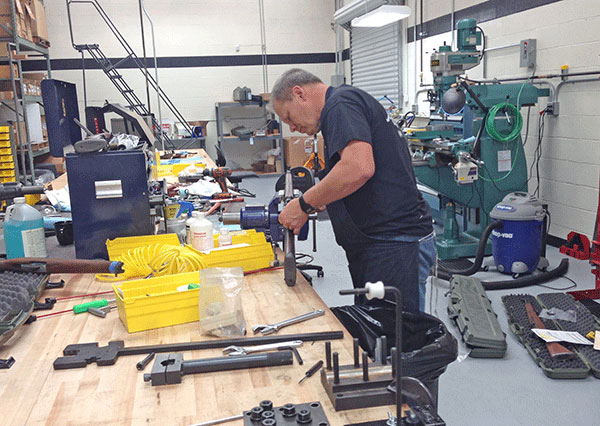
Rifles needing repair can be shipped to the CMP Shop in Anniston, Alabama from anywhere in the country. Then, once repaired, these rifles are shipped back out to the owners. Shelves of rifles to be serviced are presently stacked to the ceiling of the Custom Shop, representing about 90 days’ worth of scheduled work for the CMP gunsmiths.

CMP Custom Shop Also Offers Training Classes
The space where the rifles are repaired, though meant as a machine shop, was also designed as a classroom. Benches facing a projection screen hanging on the wall to display slides and other instructional materials seat a class of about 20 people. Recently, the shop held its first CMP Advanced Maintenance Class (AMC), which involved both hands-on training. Students raved about this class: “Fantastic course. Can’t say enough good about it. Instructors were phenomenal”; “This was by far the very best firearms class I have ever taken.” The CMP Custom Shop will hold six more classes in 2014, However, registration is already full for all sessions.

For a list of services the shop provides, visit the CMP Custom Shop web page. For detailed CMP Custom Shop information, or specific questions, please contact John or Chris at customshop@thecmp.org or call (256) 835-8455, ext. 1113.
December 2nd, 2013
Forum member Jonathan L. (aka ‘Quest-QC’) was a member of the Canadian F-TR team at the F-Class World Championships in Raton, NM this fall. His handsome .308 Winchester rifle features some interesting hardware and a stunning African Padauk-wood stock stiffened with carbon fiber layers. We were impressed by the innovative, adjustable bag-rider assembly Jonathan fitted to the rear of his stock (scroll down for photo). With an Allen wrench, the vertical height and the slope (i.e. fore/aft angle) of the V-shaped bag-rider can be changed easily. This has many advantages. First, Jonathan can set his rifle to the most comfortable height (for his prone position) without using “lifters” under the rear bag. The system also gives him some gross elevation adjustment separate from the bipod. In addition, the angle adjustment allows the bag-rider to better match the geometry of the rear bag. Last but not least, by setting up the bag-rider with some drop (higher in front, lower in back), Jonathan can fine-tune his elevation (while aiming the gun) by simply sliding the rifle fore and aft.

Jonathan says: “This year was my second year shooting at 1000 yards and I managed to find a spot on Team Canada for the FCWC at Raton. Here is the rifle that brought me there…”

The rifle features a Kelbly Panda F-Class RB-LP action, 34″ Bartlein 1:11″-twist, Heavy Palma contour barrel. Fitted to the red-toned Padauk-wood stock is a 23.2 oz., StarShooter CF-SS light weight bipod with custom bench feet. On top is a March 8-80x56mm scope in Kelbly rings. Total weight of the rifle is 18 pounds, 1 oz., complete with the 24 oz. adjustable brass bag-rider at the back. The bag-rider block was modeled in 3D, then machined afterwards to use up the remaining weight available after all the other components. CLICK for StarShooter CF-SS Bipod Video.
African Padauk Wood is Very Stiff
Jonathan chose the red-toned African Padauk Wood because it is stiff for its weight: “The reason for choosing African Padauk is that the weight of the wood is the same as Maple but 45% more rigid.” The downside of Padauk, as Forum member Gstaylorg notes, is that it is a “very oily wood, which can make it somewhat difficult to finish with something like polyurethane. [Padauk] can generate a lot of bubbles and cause cracking problems around joints and/or seams.” Jonathan did note that he has observed a few bubbles in the auto clear coat on his stock. He plans to refinish the stock in the off-season.

Gun Is Extremely Accurate with Berger 200gr Hybrids
Jonathan says this rig was very accurate, at least until his barrel gave up the ghost. He says he has put 15 successive shots in about 1/4 MOA: “I managed to make it twice (1/4 MOA for 15) by taking my time between shots. You don’t want to overheat this barrel. I needed to provide a very strong effort (mentally) to be able to achieve such precision as the rifle is way better than me.” Jonathan shoots Berger 200gr Hybrid bullets (in the lands) with Hodgdon Varget powder, and Federal 205M primers, loaded into neck-turned Lapua .308 Win brass. He has also had good luck with Vihtavuori N150 powder in the past.

In compliance with F-Class rules, the adjustable bag-rider system would not be adjusted “on the fly” during record fire. The bag-rider’s vertical rise and fore/aft slope would be optimized before shooting, then locked in place. The bottom photo offers a good view of the V-shaped profile of the metal bag-rider. We have found that this kind of V-profile, closely matching the triangular profile of the rear ears, makes a rifle more secure in the rear bag and often allows the gun to track better.


November 27th, 2013
McMillan will still be making stocks and other components. However, it is selling off its gun-building business. Strategic Armory Corps (SAC) announced it has acquired McMillan Firearms Manufacturing, LLC. McMillan produces quality hunting and tactical rifles including the highly-regarded TAC-50, TAC-416, TAC-308, TAC-300/338, and the new Alias modular rifle system. McMillan produces a full line of hunting rifles, including the Custom Collection, Mountain Extreme Series, and Long Range Hunting Series. McMillan also builds competition and target rifles.


The McMillan Firearms acquisition carries out Strategic Armory Corps’ strategy of acquiring premium firearms manufacturing companies (SAC has previously purchased ArmaLite Inc. and Surgeon Rifles). “The acquisition of McMillan Firearms is consistent with our focus on acquiring the highest quality manufacturers of premium firearms,” said Mark Johnson, Strategic Armory Corps CEO. “This transaction provides the perfect product line complement to the ArmaLite and Surgeon Rifles product lines and will allow us to more effectively serve the needs of the custom bolt action rifle enthusiast.”
Kelly McMillan stated, “Both Ryan and I will continue on as long term consultants with McMillan Firearms. We are proud of our heritage and are confident that Strategic Armory Corps will continue to build the highest quality firearms for our valued customers”.
Strategic Armory Corps is based in Phoenix, Arizona and is a fast-growing firearms and ammunition company that serves the needs of the high end firearms enthusiast. In July of 2013, the company acquired ArmaLite, Inc. one of the oldest names in the AR-style sporting rifle segment of the industry.
Story lead from EdLongrange. We welcome reader submissions.
November 16th, 2013
 Kirby Allen of Allen Precision Shooting, www.apsrifles.com, has developed a .30-caliber jumbo-sized magnum he calls the 300 Raptor. The 300 Raptor (center in photo) is based on Allen’s 338 Excalibur parent case (far right in photo), necked down to 30 cal with shoulder moved forward to increase case capacity. Allen states: “This is the largest capacity and performance .30 caliber magnum on the market that can be used in a conventional sized receiver.” Kirby Allen of Allen Precision Shooting, www.apsrifles.com, has developed a .30-caliber jumbo-sized magnum he calls the 300 Raptor. The 300 Raptor (center in photo) is based on Allen’s 338 Excalibur parent case (far right in photo), necked down to 30 cal with shoulder moved forward to increase case capacity. Allen states: “This is the largest capacity and performance .30 caliber magnum on the market that can be used in a conventional sized receiver.”
Shoot 200s at 3600 fps
Performance of Allen’s new 300 Raptor is impressive. Allen claims that “200gr Accubonds can be driven to nearly 3600 fps, 230gr Berger Hybrids to 3350 fps, and the 240gr SMK to right at 3300 fps. These loads offered case life in excess of 6-7 firings per case and many of my test cases have over 8 firings on each case so they are not an overly hot load showing the potential of this big .30 caliber.”

To showcase the new cartridge, Allen built up a prototype rifle with a McMillan A5 stock, Raptor LRSS Action with extended tenon, and a Jewell trigger. The first 300 Raptor Rifle is currently on its second barrel, a new 30″, 3-groove 1:9″-twist Lilja in a custom APS “Raptor Contour”. This distinctive dual-fluted contour runs full-diameter almost to the end of the stock, and then steps down and tapers to the muzzle, where a beefy Medium 3-port ‘Painkiller’ Allen Precision brake is fitted.

Story tip by EdLongrange. We welcome reader submissions.
November 14th, 2013
 Wouldn’t it be great if you could apply a durable, two-part, commercial-grade coating on gun parts, with the ease of “rattle can” spraying. Until recently, you had to have some pro-grade equipment to apply multi-stage coatings. Now that has changed thanks to a new “can-in-a-can” developed in Europe. DuraCoat® can now be applied, in your choice of nine colors, from a single, convenient rattle can. The secret is the new type of twin-chamber can construction. An inner chamber holds the DuraCoat hardener (catalyst), while an outer chamber contains the DuraCoat color coating liquid. Wouldn’t it be great if you could apply a durable, two-part, commercial-grade coating on gun parts, with the ease of “rattle can” spraying. Until recently, you had to have some pro-grade equipment to apply multi-stage coatings. Now that has changed thanks to a new “can-in-a-can” developed in Europe. DuraCoat® can now be applied, in your choice of nine colors, from a single, convenient rattle can. The secret is the new type of twin-chamber can construction. An inner chamber holds the DuraCoat hardener (catalyst), while an outer chamber contains the DuraCoat color coating liquid.
The “can-in-a-can” design keeps the two elements completely separate until you are ready to apply the coating. It’s really quite ingenious. Duracoat’s owner, Steve Lauer, found this innovative dual-chamber aerosol can design in Europe. We believe his company, Lauer Custom Weaponry is the first to introduce this spray can technology in the American gun coating market.

Video Shows How to Apply DuraCoat with New Twin-Chamber Aerosol Can
 DuraCoat is a two-part coating system. Once the DuraCoat is mixed with the hardener, a chemical reaction occurs. That is why the two fluids must be kept separated until it’s time to coat a project. When you’re ready, you mix the two products by pushing a plunger in the bottom of the can. This is done by attaching a red button to the bottom of the can. Push down on the can and you’ll here a “pop” that indicates the hardener can migrate into the main chamber. Shake the can for a couple minutes and you are good to go (provided the product to be coated has been prepped properly.) DuraCoat is a two-part coating system. Once the DuraCoat is mixed with the hardener, a chemical reaction occurs. That is why the two fluids must be kept separated until it’s time to coat a project. When you’re ready, you mix the two products by pushing a plunger in the bottom of the can. This is done by attaching a red button to the bottom of the can. Push down on the can and you’ll here a “pop” that indicates the hardener can migrate into the main chamber. Shake the can for a couple minutes and you are good to go (provided the product to be coated has been prepped properly.)

DuraCoat is Versatile
Duracoat can be used on carbon steel, stainless steel, aluminum, metal alloys, wood, plastic and many other surfaces. No baking or pre-heating is required. DuraCoat is not just a thin cosmetic layer like conventional paint. When properly applied, DuraCoat offers good abrasion resistance and very effective protection against corrosion. DuraCoat Aerosol is currently offered in nine (9) popular colors: Matte Black, Woodland Green, Parkerized Gray, OD Green, White, Combat Gray, Pink Lady, Magpul Flat Dark Earth, and Blackhawk Coyote Tan. View DuraCoat Color Chart.
|


