At the request of our readers, we provide select “Deals of the Week”. Every Sunday afternoon or Monday morning we offer our Best Bargain selections. Here are some of the best deals on firearms, hardware, reloading components, optics, and shooting accessories. Be aware that sale prices are subject to change, and once clearance inventory is sold, it’s gone for good. You snooze you lose.
NOTE: All listed products are for sale to persons 18 years of age or older. No products are intended for use by minors.
1. Graf & Sons — Frankford Arsenal F-1 Press, $103.99
⏺ Versatile press, good primer exit, plus built-in light
Here’s a handy, single-stage press with some cool features. The Frankford Arsenal F-1 press has an open front for easy case placement, plus a built-in LED lamp at the top. And after decapping, spent primers go straight down a tube into a handy, clear, twist-off catch cylinder (as on a Forster Co-Ax). We think this would be an excellent secondary press used for decapping or bullet seating. Priced at just $103.99 at Graf & Sons — this press is a GREAT deal, but act quick, supplies are limited. NOTE: This press does NOT have primer seating capability — you must prime cases with a separate tool. Also, the power cord for the LED light is NOT included. CLICK HERE for full Frankford Arsenal F-1 Press Review.
2. Brownells — Weekly Deals on Guns, Optics, Actions and More
⏺ Major savings on hundreds of products — actions, optics, rifles, pistols
3. Palmetto SA — Savage Axis XP Rifle with Scope, $520.00
⏺ Great deal on Savage Camo hunting rifle with bore-sighted optic
Hunting season is starting soon. If you need a hunting rifle, consider a camo-stocked Savage Axis XP rifle, complete with mounted/bore-sighted Weaver 3-9x40mm scope. This has a nice camo stock plus a user-adjustable AccuTrigger. Total price, with scope, is just $469.99 for .223 Rem, .243 Win, and 7mm-08. Or get a long-action .270 Win Axis XP for $428.99 or a .30-06 Springfield Axis XP for $479.99. If you don’t need a camo stock you can get a scoped Savage Axis XP for just $368.99 in 6.5 Creedmoor, .270 Win, and .308 Win. All these are great deals for a rugged, reliable rifle complete with scope.
4. EuroOptic — Trijicon Close-Out Scope Sale
⏺ Huge discounts on high-quality Trijicon scopes
While supplies last, save up to 57% on these Trijicon Tenmile and Credo Scopes on closeout! User reviews of these optics have been very positive. Choose the 3-9x40mm Trijicon Huron BDC Hunter for $449.99, the 6-24x50mm Tenmile FFP for $849.99 (great scope choice for PRS/NRL), or the innovative 1-8x28mm Trijicon Credo HX (good for ARs) for $999.99 (over $900 off!).
⏺ Fast, programmable, accurate dispenser at great price
The Frankford Arsenal Intellidropper (#ad) is a high-quality powder scale/dispenser. It’s accurate to +/- one-tenth of a grain, dispenses in seconds, and can be controlled by a handy mobile App that stores charge weights for different cartridges. This unit has a 7000-grain capacity with both auto and manual trickle capability. This $174.99 price is a good deal now — you save $55 (24%) off the typical $230 online price.
⏺ Save hundreds on advanced optics with built-in rangefinders
The Burris Eliminator III is a 4-16x50mm optic with a built-in Laser Rangefinder. This rangefinding scope is now on sale for $699.99 at MidwayUSA, a 49% savings off the original $1399.99 price. Plus the newer Eliminator IV model is now just $885.00, a 49% savings. We really like these units for varmint hunting — you can instantly range the critters, with the vertical hold shown by a red dot in the reticle.
7. Midsouth — Bulk Tipped Bullets Sale, 250 for $42 and up
⏺ Super deal on good bullets for varmint hunting and ARs
Varmint hunters may shoot hundreds of rounds in a day, and AR competitors will run through many magazines in multi-gun matches. If you are a high-volume .22 cal centerfire shooter, here’s a great bullet deal at Midsouth. Get 250 55gr poly-tipped bullets for $41.99 — just 17 cents per bullet. Or get 250 poly-tipped 62-grainers for $44.99 — 18 cents each. If you want a heavier .22 cal poly-tipped bullet, Midsouth has 250ct packs of 75-grainers for $49.99, 20 cents per bullet. In addition to the .22 cal bargains, there are also 110gr .308 cal poly-tip bullets on sale at $64.99 for 250.
⏺ Great price on versatile rapid access 2-gun security safe
If you want handy storage for two handguns or one pistol, watches, and other valuables, consider this SnapSafe 2-Gun Keypad Vault, now just $69.99 at Grafs.com (46% off). Along with the keypad, there is a backup rotary key lock. The spring-loaded door opens immediately with your programmable code. A protective foam liner safeguards contents, the interior shelf is removable, and the base is pre-drilled so the vault can be bolted in place. This is a great deal — the very same SnapSafe 2-gun vault costs $134.99 right now at MidwayUSA — nearly twice as much.
9. MidwayUSA — Plano Protector Pro-Max Rifle Case, $30.29
⏺ Good price on a sturdy, 52″ interior transport case for long rifles
Do you have a long-barreled hunting or varmint rifle? With a 52″ internal size, this Plano Protector Pro-Max Rifle Case handles rifles with barrels up to 30″ (or 31″ with a thin buttplate). On the inside the case has high-density, interlocking foam padding. On the outside, the case has four clamps, padlock tabs, and a handy carry handle. NOTE: This case will work well for normal trips to the range. However, you’ll want a thicker, more sturdy TSA-approved case for airline transport.
10. Palmetto SA — Walker’s Muffs + Safety Glasses, $15.99
⏺ Killer deal on hearing and eye protection combo
Need basic hearing and eye protection? Or perhaps you could use a spare set for friends you invite to the range? Check out this Walker’s Ultra Slim Muff & Glasses Combo. You get good quality 27dB NRR (Noise Reduction Rating) muffs AND a set of quality shooting glasses — all for just $15.99. That’s a great price for essential safety items. Shooters should always have both eye and ear protection whenever at the range.
As an Amazon affiliate, this site can earn revenues through sales commissions.
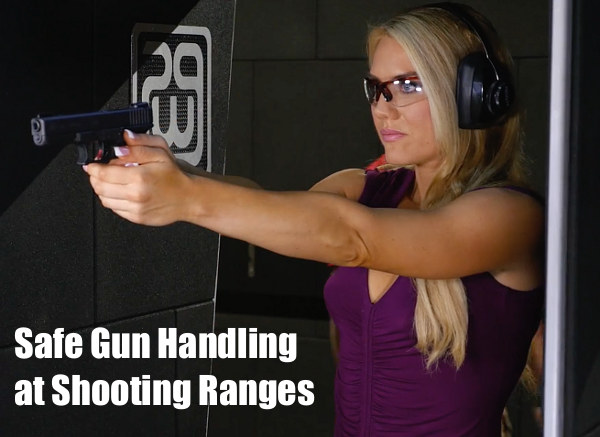
Shooting indoors is fun, and at many indoor ranges you can shoot in the evening after work. But when shooting indoors you should always be extra careful. Follow all key gun safety practices and adhere to proper range “Etiquette”. We also recommend double hearing protection — plugs under muffs.
The NSSF (NSSF) offers a useful Range Safety and Etiquette video. This 8.5-minute video explains safe practices, especially at indoor ranges. In the video, the moderator list the basic rules of gun safety, before covering key range etiquette topics such as range officer commands, how to uncase your firearm on the range when you first arrive, and what to do if a firearm is accidentally dropped. There are also safety tips specific to handling both semi-automatic handguns and revolvers.
BAD RANGE BEHAVIOR — Five Things NOT to Do at the Range
Here are the five worst behaviors we’ve seen at indoor ranges. These behaviors are both dangerous and inconsiderate. Any one of these behaviors can get you permanently banned from an indoor range.
1. Sweeping other individuals after loading a weapon behind the firing line is very bad. All your weapons should be empty until you reach your shooting station.
2. Turning the handgun sideways while trying to clear a malfunction or insert/remove a magazine. This will point the muzzle at a fellow shooter. Or, after shooting a gun, the shooter fails to clear the weapon and then places the gun somewhere near the shooting station with the muzzle in an unsafe position.
3. Reacting unpredictably when firing a high recoil handgun. We’ve seen people take a second shot by accident with the muzzle way off target.
4. Not obeying range commands — in particular continuing to shoot during called cease-fires.
5. Poorly aimed shooting that hits target frames or carriers, causing ricochets.
Seven Types of People at the Gun Range — HUMOR
This video is satire, but with lots of truth in the characterizations. Laughter guaranteed.
Double-Up on Hearing Protection When Shooting Indoors
When shooting rifles and pistols indoors we recommend quality muffs with earplugs underneath, offering double protection. When inside an enclosed range, with other shooters blasting away right next to you, you really need effective hearing protection. But you also need to hear range commands and be able to communicate with your fellow shooters. That’s why we recommend electronic muffs with plugs underneath.
This evening, Shooting USA TV will feature a major U.S. Practical Shooting Association (USPSA) competition — the USPSA Production Class Nationals. Watch the broadcast at 9:00 pm Eastern/Pacific, 8:00 PM Central on the Outdoor Channel. SEE Shooting USA info. This week’s show also features a review of the new ZEISS Conquest HD Binoculars — great for hunters.
The USPSA Production division is easily the most approachable in terms of equipment. These are virtually out of the box guns with minimal enhancements. Even so the national championship chase is highly contested and the level of competition is extremely high.
Broadcast Times: Wednesday 9:00 PM Eastern/Pacific, 8:00 PM Central on Outdoor Channel.
You can also subscribe for $1.99/month to watch broadcasts “on demand” at any time on Vimeo: vimeo.com/ondemand/shootingusa
About the USPSA — Active Sports Group Nationwide
The United States Practical Shooting Association (USPSA) is a leading competitive shooting organization dedicated to promoting safe, fair, and fun practical shooting sports. Members engage in dynamic and challenging courses of fire, where speed, accuracy, and power are equally tested. USPSA shooters of all skill levels can enjoy shooting on the clock at steel and reactive targets. Whether you’re a seasoned shooter or new to the sport, USPSA offers fun and well-run competitions.
Hit Factor Scoring Based on Time AND Accuracy
Scoring is more complicated than fixed time events or steel shooting where your time is your score. In USPSA and IPSC each stage is worth a specific number of points. After a competitor completes a stage, the total score they shoot on the targets is divided by the time it takes to finish the stage. This establishes their hit factor. The competitor with the highest hit factor wins the stage and earns the total number of points available for that specific course of fire. The remaining competitors receive a percentage of the stage points based on their hit factors.
Top photo credit: Paul Erhardt, U.S. Air Force, Public Domain, Wikimedia.org.
While Accurateshooter.com concentrates on high-accuracy rifles, we know that many of our readers enjoy handguns. We are often asked “What is your favorite handgun — Glock? HK? SIG Sauer?” The answer to that question may be surprising. This Editor’s favorite handgun, at least the one that gets shot most often, is a rimfire revolver — that’s right, a wheelgun.
This Editor’s first really accurate handgun was a .22 LR Smith & Wesson Model 617 that could easily stack ten shots in a dime at 10 yards. It remains my favorite and most-used handgun. What can we say about the Model 617? The single-action trigger pull is superb, and the accuracy surpasses most any semi-auto rimfire pistol, except for a few, very expensive target pistols. We like the 6″ version for the longer site radius, but the 4″-barrel 617 is also very accurate, and it balances better.
S&W Model 617 now has a 10-round cylinder, but early models were six-shooters.
We strongly recommend that new pistol shooters start off with a .22 LR rimfire handgun. The .22 LR cartridge is accurate but has very low recoil, less “bark” than a centerfire, and very little smoke and muzzle flash. New shooters won’t have to fight muzzle flip, and won’t develop a flinch from the sharp recoil and muzzle blast common to larger calibers. With the .22 LR, the trainee can focus on sight alignment, breathing, and trigger pull.
Smith & Wesson Model 617 Video Reviews
Here are two video reviews of the Smith & Wesson Model 617, both 4″-barrel and 6″-barrel versions. Both videos demonstrate the 617’s great accuracy. The reviewers concede that this handgun is pretty expensive, but all agree that the Model 617 will last a lifetime, and hold its value.
This Video Features the Full-size 6″-Barrel Model 617:
Recommended .22 LR Revolver Training Targets
The .22 LR cartridge makes small bullet holes in paper. These can be hard to see if you’re shooting at large, black bulls-eyes, particularly at an indoor range. Also, when shooting rimfire, you’ll go through ammo quickly. For that reason we recommend targets with bright-colored, multiple aiming points.
The 19″x25″ Sight-Seer target (left) is great for pistol practice. It features eight red bulls on a 1″-square grid. Ultra bright fluorescent red inks, printed on heavy, 60-lb vellum paper, are highly visible, even indoors. You can use a classic Six O’Clock hold with this target, putting the bottom of each circle on top of your revolver’s front sight.
The smaller, 8.5″x11″ Sinclair Fluorescent Sight-In Target (right) has four small diamonds surrounding a large center diamond overlaid on a 1-inch grid. Diamonds and grid are printed in fluorescent red/orange on white, heavy-grade paper so your shots print nice and clean. A 25-pack is $6.99 at Brownells.
Recommended .22 LR Ammo Box
When we go to the range with rimfire handguns or rifles we bring this handy ” target=”_blank”>$13.99 MTM ammo caddy. The compact carry case will hold boxed ammo, plus you can lay out your ammo in 10-round rows (with 100 rounds nose-down). This makes it easy to fill the 10-Rd cylinder on your Model 617. This ammo case is offered in both blue or red (rust) and there is room in the center for more ammo boxes. One recent purchaser notes: “Very handy box for .22 LR makes knowing your shot count easy”.
The Rimfire Challenge Shooting Association (RCSA) will host its annual World Championship next month. The 2024 RCSA World Championship will take place October 19-20, 2024 at the Cavern Cove Competitive Shooting facility in Woodville, Alabama. This RCSA World Championship event will feature multiple stages with metal targets, shot with both rimfire rifle and rimfire pistol. See Rimfire Challenge action from last year’s RCSA Championship below:
Watch Action from the 2023 Rimfire Challenge Championship at Cavern Cove Range in Alabama
The RCSA promotes rimfire competition nationwide, supports beginning competitors and clubs, and solicits support for rimfire events from industry businesses. The RCSA is now an official partner of the +ONE Movement, a mentorship program organized by the National Shooting Sports Foundation (NSSF). NSSF +ONE programs encourage mentorship related to firearm safety, firearm basics, shooting sports, and hunting. The +ONE program focuses on peer-to-peer development in shooting sports and hunting.
About the Rimfire Challenge Shooting Association
Designed to introduce new shooters to shooting sports in an exciting, family-friendly format, Rimfire Challenge matches focus on competition with .22 LR rifles and pistols. Matches are open to shooters of all shooting experience levels, with events conducted at ranges nationwide. The video below shows the Rimfire Challenge Shooting Association 2022 Championship.
This article is Copyright 2023 AccurateShooter.com. No reproduction on any other site is permitted.
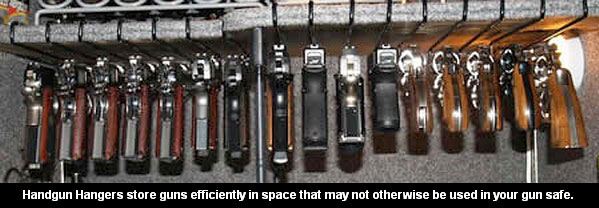
If you’re looking for a space-saving handgun storage system, consider the Easy Use Gun Hangers from USA GunClub, sold on Amazon. These vinyl-coated, wire hangers organize handguns below the shelves in your gunsafe, freeing up storage space above the shelves. To use the handgun hangers, simply slide each hanger on the shelf and then slip your pistol’s barrel over the lower rod. Handgun Hangers are intended for guns with an overall length of 10 inches or shorter. They will fit shelves that are at least 11 inches deep and 5/8-1 inch in thickness. Handgun Hangers will hold handguns .22 caliber and up, though the fit is a bit snug on .22s. A four-pack of Handgun Hangers costs $8.99 on Amazon. This product has been an Amazon Best Seller among handgun storage accessories.
WARNING — Always Make Sure Handgun is UNLOADED when using Handgun Hangers!!
USA GunClub also offers an Over-Under Hanger that holds two handguns — one above the shelf, and one below. A two-pack of Over-Under Hangers (capable of holding four handguns) costs $9.99 on Amazon. This may be a good solution for you. This Editor personally prefers the standard model, so I can use the upper surface of the shelf to hold odd-shaped items such as cameras, binoculars, and miscellaneous valuables.
You can help support marksmanship training by participating in a major rimfire fun match — Metal Madness — an action shooting contest for all skill levels. The event takes place September 14, 2024 at the Grand Rivers Shooting Range in Kentucky. MidwayUSA Foundation has partnered with the Metal Madness Shooting Sports Association (MMSSA) to organize this event. Each entry donation is matched by the Foundation to benefit the youth shooting program of your choice. To learn more about Metal Madness, visit MMSSA.net.
MMSSA is a rimfire shooting sport offering the instant gratification of ringing steel targets. No special or fancy “raceguns” are needed — most any .22 LR firearm will work.
What is Metal Madness?
Metal Madness is a speed and accuracy-based shooting sport where participants shoot rimfire rifles or pistols at steel plates. Each competitor will shoot through 10 stages, moving to a new shooting lane each time. Each lane has randomized numbered metal plates, which must be shot in numerical order.
Scoring is time-based, plus penalties for missed plates or shooting plates out of sequence. With misses costing 2 seconds each, hitting plates in the proper order is extremely important. The eight fastest times from ten lanes fired are added together for each shooter’s bracket time.
$25 Per Entry — All Rimfire Ammo is Provided
At the fundraising match on September 14, every $25 donation is good for one 10-stage session. For each $25 session, competitors will fire through 10 different shooting lanes, with each lane featuring multiple steel targets. The .22 rimfire ammunition required to participate will be provided.
There is no limit on the number of entries a competitor may have. Competitors may participate in multiple sessions, with the same gun or different guns. All .22 caliber firearms are allowed to shoot Metal Madness.
Grand Rivers Shooting Range Address: 787 Dover Road, Grand Rivers, Kentucky
If you have a question about MidwayUSA Foundation’s Metal Madness Event, contact Sarah Hall, Project/Events Manager: shall@MidwayUSAFoundation.org | 573-303-8869.
GunGoddess.com features a variety of products and shooting accessories especially chosen for lady shooters. You’ll find colorful apparel, carry purses, holsters, and even jewelry crafted from bullet castings.
GunGoddess.com was started by Athena Means, an active IDPA and USPSA pistol shooter. Athena, whose husband Mike served 20 years in the military, was inspired to create the site after searching in vain for shooting apparel and accessories in colors other than black, green, and tan. Athena wanted something with more appeal to the feminine eye: “I set out to find fabulous products that women shooters would love, and bring them all together here. Ladies who love to shoot will find all the traditional gear they need, but in neon pink and leopard print instead of traditional black!”
GunGoddess.com Has Gift Items for All Members of the Family
Though it specializes in products for women, GunGoddess.com also offers gift selections that will work for gun guys as well. If you’re looking for a gift for a guy, you’ll find unisex holsters, range bags (for pistols), compact gun safes, ear muffs, shooting glasses, indoor concealment furniture, and more. There are many unique items on the GunGoddess webstore that will make great holiday gifts.
Today’s Saturday video showcase is a wheelgun extravaganza. We offer eight videos covering some of the most famous double-action revolvers in existence. Check out reviews of Colt, Smith & Wesson, Korth, Dan Wesson, Ruger, and other models, in a variety of chamberings, both centerfire and rimfire. We think every serious gun enthusiast should have at least two revolvers in his collection — one centerfire and one rimfire. This Editor owns a stainless, 10-shot .22 LR Smith & Wesson Model 617. It has probably shot more rounds than all my other pistols combined, and it is still performing flawlessly after 25 years.
Multiple Revolver Line-up: S&W, Colt, Ruger, Taurus, Dan Wesson, Chiappa, Charter Arms, Webley and More
This 12-minute video provides a quick introduction to eleven interesting wheelguns: Smith & Wesson Model 29 (00:22), Colt Python (1:22), Ruger GP100 (2:25), Taurus Model 66 (3:40), Smith & Wesson Model 686 (4:38), Charter Arms Bulldog (5:41), Chiappa Rhino (6:32), Webley Revolver (7:27), Dan Wesson 715 (8:21), H&R Model 929 (9:59), Taurus Judge Public Defender (10:52). NOTE: This video also includes a review of the Bersa .380 which is NOT a revolver, so the video title is a little misleading. There are 12 handguns, but only 11 revolvers.
Colt Python .357 Mag 1000-Round Test
How well do modern wheelguns hold up to extended use? This video provides an answer. Honest Outlaw’s testers put 1000 rounds through a new-generation Colt Python chambered for the legendary .357 Magnum round. The Python showed outstanding accuracy, and the tester praised the trigger. Testing was done indoors and outdoors, both rapid-fire and slow-fire. After a couple hundred rounds, the Python needed a thorough cleaning of cylinder and barrel, but otherwise the revolver performed really well.
Hickok45 Shoots the New Colt Anaconda in .44 Magnum
Hickok45 is a respected YouTube video reviewer. In this detailed 19.5-minute video, Hickok45 reviews and tests a new generation Colt Anaconda revolver, chambered for the powerful .44 Magnum cartridge. This Hickok45 review is one of the most popular wheelgun videos on YouTube, having logged over 1.4 million views in three years.
Colt King Cobra Target .22 LR Revolver
This TFB Showtime episode examines the new .22 LR rimfire Colt King Cobra Target. The King Cobra Target .22 LR features a 10-shot cylinder, and the same adjustable target sights as the .357 Magnum version.
At the NRA Annual Meetings in 2022, Colt Manufacturing introduced an impressive new rimfire revolver — the King Cobra Target .22 LR. Colt states: “From competition to plinking and small game hunting, this baby Cobra does it all and packs 10-rounds of .22 LR in its cylinder”. The King Cobra Target 22 LR is available with 4.25-inch and 6-inch barrel lengths, both with 1:16″ RH rifling twist. MSRP is $999.00.
The Massive Smith & Wesson 500 Magnum X-Frame
If bigger is better, then a Smith & Wesson 500 Magnum should be in your collection. This jumbo-size wheelgun shoots a huge 50-caliber cartridge, the .500 S&W Magnum. Even with compensator slots on the end of the barrel, the recoil is massive — enough so that we would NOT recommend this big revolver to novice shooters.
In 2003 the engineers at Smith & Wesson wanted to deliver maximum power for serious handgun hunters. The power they sought required an entirely new frame, the massive “X-Frame”. That became the basis for the new Model S&W 500, the most powerful production revolver in the world.
Colt vs. Smith & Wesson
Here’s a pretty informative video, with two qualified experts, Bill Wilson and Ken Hackathorn. This covers the basic differences between Smith & Wesson and Colt revolvers. This video explores the classic “Ford vs. Chevy debate” of the revolver world. Both S&W and the Colt revolvers have their die hard loyalists. In this episode, the Gun Guys weigh the merits of Bill’s Colt Shooting Master and Ken’s S&W Registered Magnum.
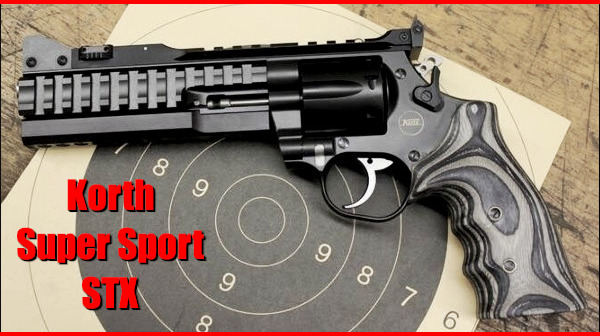
Korth Super Sport STX Revolver — $4,393.00 Wheelgun
Germany’s Korth Arms makes some of the best revolvers on the planet. Korth’s machining tolerances are second to none. The triggers are superb and the accuracy is excellent. At the 2022 IWA Outdoor Classics Expo, Korth featured a “badass” black heavy-barreled wheelgun, the Super Sport STX Revolver. This features a full-length scope rail and slab sides, for use in Bianchi Cup-type competitions.
Korth states: “In addition to the National Standard Super Sport STX, we present the weight-reduced ALX version. Both weapon types are equipped with a 4-position rear sight”. You’ll need serious bucks to buy a Korth Super Sport STX. Currently the 8-shot STX model in .357 Magnum sells for €4,077.00 Euros (about $4,393.00 U.S.). Below are a trio of blued Korth revolvers:
Smith & Wesson Model 648 in .22 WMR
We love Smith & Wesson rimfire revolvers. We have put thousands of rounds through S&W Model 617 revolvers, with 4″ and 6″ barrels. These stainless .22 LR handguns are accurate, superbly reliable, and they hold their value. In general we’ve found that Smith & Wesson rimfire revolvers may be less fussy with ammo, and more trouble-free than typical semi-auto rimfires. Bottom line, we feel that everyone should have an S&W rimfire wheelgun in their collection.
Along with its .22 LR wheelguns, S&W now offers another very impressive Rimfire Revolver option — the “revived” Model 648 in .22 WMR (Winchester Magnum Rimfire). This stainless Model 648 brings a more powerful cartridge to S&W rimfire revolver fans.
AccurateShooter.com is more about rifles than pistols. But we know that the majority of our regular readers own handguns, and many also have concealed carry (CCW) permits. And with the prospect of social unrest following the election, we expect more reader than ever will be “packing” a sidearm. Accordingly, we’ve found a great resource for CCW holders that can help you select a holster. On the Shooting Illustrated website you’ll find a detailed review of 30 different holster types. Each holster is illustrated, with pros and cons explained. These are all EDC holsters, meaning those designed for “Every Day Carry”.
Shooting Illustrated calls this article “HolsterPallooza” and it really does provide a ton of helpful information. Most other holster reviews on the web may feature a half-dozen holsters at the most. In this Holsterpallooza article you can see 30 holsters, with a wide variety of materials, designs, and applications. There are small molded IWB holsters for CCW, conventional on the belt holsters, leather shoulder holster rigs, and even ankle holsters. This is a great place to start if you are in the market for a holster.
Here’s sample of the many holster options reviewed, an innovative hybrid IWB holster constructed with leather over Kydex. That gives you the “best of both worlds” — the secure fit/retention of a molded Kydex shell, with an attractive leather exterior.
Shooting Illustrated explains: “As the interface between your gun and your body, the holster is a vital component of your carry rig. In many cases, the circumstances of your daily life will determine the method of carry you choose. This, in turn, will determine what type of holster you need, which may end up determining the handgun you carry. Therefore, choosing the method and type of holster may be as, or even more important than, choosing a firearm.”
MORE Reviews — Hickok 45 Reviews 15 CCW Holsters:
If you want to see even MORE holsters for “Every Day Carry” (EDC), check out this video from Hickok 45. This popular YouTube host looks at 15 different IWB holsters from a number of manufacturers. Hickok 45 examines many hybrid holsters that combine Kydex or plastic with leather for increased comfort. He has his favorites… and they might not be what you’d expect. NOTE: As this video has been watched over 900,000 times, you may also want to read the viewer comments. There are many helpful suggestions from CCW holders who carry daily.




 Shooting USA TV will feature a major U.S. Practical Shooting Association (USPSA) competition — the USPSA Production Class Nationals. Watch the broadcast at 9:00 pm Eastern/Pacific, 8:00 PM Central on the Outdoor Channel. SEE


 USA GunClub also offers an


 If bigger is better, then a