|
|
March 4th, 2009
Forum regular Aaron H. (aka “6BR”) has been having great success in the California varmint fields with “Orange Crush”, his super-accurate 6BR rifle. Aaron recently posted his experiences with various laser rangefinder (LRF) types, and field binoculars. While there’s plenty of information available on LRFs, including our own Laser Rangefinder Comparison, it’s harder to find good info on binoculars from the perspective of a varmint hunter. Aaron looked at a variety of premium binoculars, and ended up choosing the 15×45 Zeiss Conquest, after careful consideration.

Choosing the Right Binoculars for Long-Range Varmint Hunting
Aaron writes: “[It] was a hard undertaking to pick the right pair. I decided I wanted a high magnification pair of binos in the 10x to 15x range. I narrowed my choices down to Zeiss, Swarovski, Leica, or Nikon. I was sure I was going to buy the Swarovskis when I started comparison shopping. However, I was wrong… I ended up getting a pair of the Zeiss 15×45 Conquests.”
 
Aaron reports: “The clarity of the Zeiss binos is awesome. I am glad I took the time to look through each and every pair before I bought. I was also impressed with the Nikon Monarch ATB; for the price, they are impressive. The Swarovskis were awesome too. However, through my eyes, the Zeiss clarity was better.”
The Zeiss 15×45 Binoculars are fairly expensive. At most places they go for about $1100.00 (see chart below), but you can find some better deals. Aaron tells us: “I had to sell other firearms to be able to afford the Zeiss binos and a Swaro 8×30 LRF. If you decide to shoot varmints, at long range, you’ll find out very quickly how important it is to have quality optics. When you spend a bunch of time looking through binoculars, it can become very hard on the eyes. So the better quality binoculars you have, the more comfortable you’ll be during your varmint hunt. I learned the hard way during the beginning years of long range varminting, and I realized how important it is to have quality optics.”
Nikon Monarch ATB Offers Great Performance for the Price
Aaron was impressed with the Nikon ATBs, given their low cost. But Aaron cautions: “It’s very important to go look through the binos before you buy a pair. Had the Zeiss 15×45 Conquests not been so remarkably clear, I probably would have bought a pair of the Nikon Monarch ATBs. If you need a pair of binoculars and you can’t afford the higher end binoculars, I would highly recommend the Nikon Monarch ATBs, offered in both 10-power and 12-power. I would have to say, and I am not making this up, they were close to the clarity of the higher-end binos. I also looked through a pair of the Leupold Golden Ring binos. They are nice, however, I felt the clarity of Nikons were much better and the price was much cheaper.” [Editor: The Nikon 10x42mm and 12x42mm Monarch ATBs retail for about $290.00 and $330.00 respectively at discount vendors such as B&H Photo.]

Aaron added: “One more thing, I am stating my own opinion on what I think works best for me. Another brand of optics might work better for someone else. I don’t want to offend anybody or imply that other brands are bad, I just wanted to give my experience with what I use and have had success with.”
Tips for Holding Binoculars Steady
Nate Haler, another Forum member, offered this advice about high-magnification binoculars: “Unless you are using a tripod or other mechanical support for a binocular, 15x magnification is too much. Image tremble will be much more problematic when trying to hand-hold a binocular of such high magnification. Furthermore, the exit pupil (i.e. the little circle of light transmitted to the ocular lens) will be only 3mm in a 15×45 binocular, which means 15x magnification and a 45mm objective lens. Exit pupil enables you to see the image better or worse in low light. 7mm exit pupil is about as big as a healthy human eye in a young adult can dilate. Smaller than that, and the image is dimmer.”
Editor’s Comment: Nate makes some very good points, but we would add that you can rest your binoculars on a pack or sandbag, or use an inexpensive tripod or bracket to hold the binoculars steady. Zeiss also makes a 12-power version of the binoculars Aaron favored. This editor has used 12x binoculars in the field without difficulty, but you definitely have to learn to “hold steady”. One technological solution is built-in image stabilization. Canon has a series of image-stabilized binoculars (8x, 10x, 12x, 15x, and 18x), and they work very well. The 15×50 is shown below. Regarding the 3mm exit pupil, yes a bigger exit pupil is better in low light, but 3mm should be adequate for daytime hunting. Keep in mind that a shooter using a 25-power riflescope will be looking through an exit pupil that’s 2mm or smaller.

Geovid All-in-One Option (Rangefinding Binoculars)
The Leica Geovid binoculars are another option for hunters. These combine great glass with a built-in Laser Rangefinder. That way you only need one optic for both game spotting and rangefinding. Aaron considered the Geovid option, but it didn’t offer any money savings compared to purchasing binoculars and LRF separately. Additionally, he felt that his Swaro 8×30 rangefinder out-performed the LRF in the Geovids. “The Leica Geovids are excellent. They are just so darn expensive. I think they start around $2600 for the 8×42 and go up to $3300 for the 15×56 pair. I would still choose the Swaro 8×30 LRF over the Geovids. Why? Because the Swaro out-ranges the Geovids by 300 yards and the Swaro is $1600 cheaper. That leaves a lot of cash left over for good binoculars.”
February 25th, 2009
There are many television shows about hunting. But the Freedom Hunters series, we believe, deserves special recognition. Freedom Hunters arranges “once-in-a-lifetime” outdoor hunting adventures for American military combat veterans. Footage from these hunting trips, along with background stories on the service men and women chosen for the hunt, are packaged into weekly cable broadcasts. Click the image below to visit Freedom Hunters’ Video Archive. There, click on the “PFC Josh Reilly” link to view great clips from a Wyoming hunt.

Freedom Hunters Seeks Female Veteran for Wyoming Pronghorn Hunt
Freedom Hunters is looking to present an all-expense-paid Wyoming pronghorn hunt to a female veteran. Freedom Hunters producers are specifically looking for women who have served in Afghanistan or Iraq. The hunt will be guided by Llano Outfitters (Casper, WY, 307-235-4865), one of Wyoming’s premier elk, deer and pronghorn outfitters. The hunt will take place in late October 2009. Applications must be received by March 15, 2009.
The woman selected to participate in this hunt will receive gifts from product sponsors and will be featured on a future episode of the Freedom Hunters television show. Those interested in applying for this opportunity should apply via the Freedom Hunters’ Application Page on the web.
Freedom Hunters is a 501(c)3 charitable organization serving the American military family. It is dedicated to honoring those who protect our freedoms. For more information about Freedom Hunters Programs, visit FreedomHunters.org or e-mail info [at] freedomhunters.org. Freedom Hunters airs Fridays at 4:00pm MST on the Altitude Sports and Entertainment network.

February 24th, 2009
 On LongRangeHunting.com, you’ll find a good article about wind reading by Shawn Carlock. Shawn Carlock is a veteran law enforcement marksman and the current USPSA national precision rifle champion. Shawn offers good advice on how to estimate wind speeds and directions using a multitude of available indicators — not just your wind gauge: “Use anything at your disposal to accurately estimate the wind’s velocity. I keep and use a Kestrel for reading conditions….The Kestrel is very accurate but will only tell you what the conditions are where you are standing. I practice by looking at grass, brush, trees, dust, wind flags, mirage, rain, fog and anything else that will give me info on velocity and then estimate the speed.” On LongRangeHunting.com, you’ll find a good article about wind reading by Shawn Carlock. Shawn Carlock is a veteran law enforcement marksman and the current USPSA national precision rifle champion. Shawn offers good advice on how to estimate wind speeds and directions using a multitude of available indicators — not just your wind gauge: “Use anything at your disposal to accurately estimate the wind’s velocity. I keep and use a Kestrel for reading conditions….The Kestrel is very accurate but will only tell you what the conditions are where you are standing. I practice by looking at grass, brush, trees, dust, wind flags, mirage, rain, fog and anything else that will give me info on velocity and then estimate the speed.”

Shawn also explains how terrain features can cause vertical wind effects. A hunter positioned on a hilltop must account for bullet rise if there is a headwind blowing up the slope. Many shooters consider wind in only one plane — the horizontal. In fact wind has vertical components, both up and down. If you have ever piloted a small aircraft you know how important vertical wind vectors can be. Match shooters will also experience vertical rise when there is a strong tailwind blowing across an up-sloping berm ahead of the target emplacements. Overall, Shawn concludes: “The more time you spend studying the wind and its effect over varying terrain the more successful you will be as a long-range shooter and hunter.”
February 12th, 2009
Site contributor Chris Long (aka “TechShooter”) has crafted a report about his July, 2007 Prairie Dog Expedition in Wyoming. Ralph and Lenora Dampman of Trophy Ridge Outfitters served as guides for the trip. Trophy Ridge runs ‘Dog hunts near the town of Carlile in the NW range of the Black Hills, near Devil’s Tower National Monument. Primarily big game outfitters, Ralph and Lenora have access to thousands of acres of private ranch land. They run guided prairie dog hunts during their off-season. Chris reports “The terrain is beautiful, a welcome change from the South Dakota prairie, with lots of hills and Ponderosa pine trees. [These] ranch lands are home to some prodigious dog towns.”
Chris continues: “The goal of this trip (besides having a great time) was to get in some long range (1000+ yard) opportunities, and possibly even a shot over 1500 yards, in order to qualify for the VHA 1500 yard certification. I had worked up some really good loads for the 6.5-284 TubeGun and the .260 AI using the new 130 grain Berger VLDs, and wanted to see how they performed at these extreme ranges. I also wanted to see how the trusty 6 Dasher performed as a long range varmint cartridge.”
Chris Long was joined by two friends who came all the way from Virginia. Chris reports, “Our plan was to get in four days of intense, long-range shooting. We were not disappointed! The shooting was from 100 to over 1000 yards, and the dogs were everywhere. There were plenty of targets close in, so there was a lot a variety. It is especially challenging to move in and out in range by these extreme amounts. It gave me a lot of practice estimating range and wind conditions, then seeing if I could get the come-ups and windage right on the scope for the first shot at the new range. By the end of the trip, I was getting it pretty close, with some 1-shot hits out to about 600 yards.”

Chris’s primary long-range rifle was his 6.5-284 Tube-gun (photo above) running 130gr Berger VLDs at 3165 fps. Chris reports the 130s can be shot at 3165 fps with no excessive pressures, and “scary, one hole, 5-shot 100-yard group accuracy.” With a B.C. of about 0.6, the 130s shoot flatter and exhibit less wind drift than the 140gr class bullets at 2950 FPS.
Chris’s second gun was a more conventional bolt-action in a Franklin LowRider stock, set up with both 6mm Dasher and .260 AI barrels. Chris notes: “The Dasher has proven itself in spades as an extremely accurate cartridge for F-Class Open competition, and I was anxious to see how it performed as a varmint cartridge. The performance was excellent, with many hits out past 1000 yards. This rifle is set up as a switch-barrel rig, and is the platform for the 260 AI. I made a portable barrel vise that mounts in the trailer hitch receiver on the Suburban. That, with a rear entry action wrench, makes barrel changes a 5 minute affair. I would shoot until the barrel got a bit hot, then switch and proceed with the other caliber.”
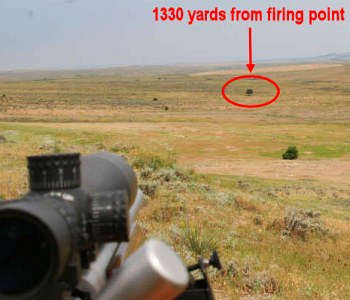
CLICK HERE to read the complete story. It contains more load data, details of hits made out to 1330 yards, and many great photos of the Wyoming scenery. For .260 AI and 6 Dasher tech tips, visit TechShooter’s Shooting Pages.

Photos and quotes copyright © 2007 Chris Long, All Rights Reserved, used by permission.
February 3rd, 2009
 The Rocky Mountain Elk Foundation’s 25th Annual Elk Camp & Hunting, Fishing and Outdoor Expo will be held March 5-8 at the Fort Worth (Texas) Convention Center. The event features many interesting demonstrations and “how-to” seminars. You can learn how to call elk, pack a horse, hunt backcountry, get more from a hunting guide, field dress big game, cook venison, train a retriever and hunt predators — all under one roof. In addition there are seminars on bow-hunting and black powder shooting. These seminars and more, each presented by noted authorities, are free with the price of admission. Daily admission is $12 per person or $25 per family, and free for kids 5 and under. The Rocky Mountain Elk Foundation’s 25th Annual Elk Camp & Hunting, Fishing and Outdoor Expo will be held March 5-8 at the Fort Worth (Texas) Convention Center. The event features many interesting demonstrations and “how-to” seminars. You can learn how to call elk, pack a horse, hunt backcountry, get more from a hunting guide, field dress big game, cook venison, train a retriever and hunt predators — all under one roof. In addition there are seminars on bow-hunting and black powder shooting. These seminars and more, each presented by noted authorities, are free with the price of admission. Daily admission is $12 per person or $25 per family, and free for kids 5 and under.

Photo courtesy Rimrock Elk Hunt Ranch, Rexburg, Idaho
The Elk Foundation’s Elk Camp & Hunting, Fishing and Outdoor Expo also features the RMEF/Leupold 2009 World Elk Calling Championships, hundreds of exhibits, displays, activities, auctions, raffles and more. It’s all a public-welcome showcase and fundraiser for one of the nation’s premier conservation organizations. Since launching in 1984, the Elk Foundation has enhanced or protected habitat on over 5.5 million acres.
January 25th, 2009
Barry O. (aka “TheBlueEyedBear”) of Montana is a long-term Forum member and “friend of the site”. Barry owns some pretty spectacular rifles, all built with premium components. His latest ‘Pride and Joy’ is a mighty impressive piece of field artillery. This is one serious “big boomer” chambered in the 338 Snipe-Tac® cartridge (based on 408 CheyTac®). The rifle was built by Dave Viers of Black Diamond Rifles (Viersco.com). Viers tell us: “The 338 Snipe-Tac® was developed in 2001 for extreme long-range hunting and target applications. The parent case is the 408 CheyTac® necked down and shoulder improved to 35 degrees. H2O capacity is a whopping 165 grains! For velocity, 140 grains of Hodgdon BMG-50 powder propels a 300gr Sierra MatchKing bullet to a average speed of 3300fps. Accuracy is half-MOA or less.”

Barry successfully took elk with this rifle this season. The .338 Snipe-Tac certainly offers more than enough “knock-down power” for any North Americcan game. Barry explains: “Success must have come from the gun — it could not have been the ‘Nut behind the trigger’. My elk load this season was a Henson 265gr aluminum-tipped bullet pushed by 140+ grains of US-869 powder. Muzzle Velocity was 3496 fps (recorded by my PVM-21). Muzzle Energy approached the ‘Mack Truck’ mark. The bullet impact at 424 yards destroyed the off shoulder of my elk.”

Gun Specifications:
Action: Lawton 8000 Action with Jewell HVRST trigger.
Barrel: 32″ Lawton chrome-moly, 1:11″ barrel with Viersco Muzzle Brake.
Stock: Manners carbon Tactical Stock with custom camo paint by Dave Viers.

For more info, contact David Viers, Viersco Mfg., 58896 – 866 Road, Allen, NE 68710, phone: 402-635-2333 or 712-266-5083 (cell).
December 30th, 2008
Forum Member and Univ. of Wyoming college student Adam Teeter (aka “Cowboyarcher”) is building sets of ultra-light shooting sticks for hunters and varminters. The shooting sticks are made from camouflaged arrow shafts and 550 para-cord. Adam can build the sticks to your specs with a variety of para-cord colors: white, black, green, olive drab, tan, and dark brown (chocolate). Custom sticks (your choice of colors) cost $27.00 per pair delivered, and he has a few sets already made for $25.00. Buying a set of sticks would be a good way to help a young man finance his college education. Adam is currently studying Rangeland Ecology and Watershed Management.

Adam tell us: “These shooting sticks are custom-built to your specs. Very light, they are great for walking varminters or for big game hunters. I use brand-new arrow shafts and 550 para-cord for the construction. The camouflage sticks are approx. 35” long and the black ones are approx. 32” long. I simply insert the arrows like one would for shooting them and add a field point. I am looking into the possibility of using blunts, or adding a fender washer under the field point for a little floatation. For now, field points will vary some from pair to pair. Since these are custom, I can do any combination of colors you choose, up to two, or cut them to different lengths.” Adam added: “I guarantee these sticks to be of the highest quality and to your satisfaction. If you’re not happy with them, I will make it right. And… I will accept trades. If you’ve got something [interesting], let me know and we’ll see if we can’t work out a trade.”
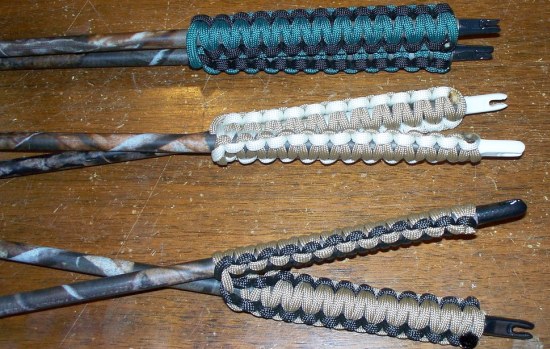
Colors shown above are: Dark Green/Black, White/Tan, Tan/Black
To order, contact Adam via email: teeteradam [at] gmail.com. Or you can postal-mail your order (with your specs and Postal Money Order) to Adam Teeter, 6011 Southview Rd., Laramie, WY 82070.
For more information and photos, VIEW THIS FORUM THREAD in our Shooters’ Forum.
December 14th, 2008
 The Varmint Hunters’ Assocation (VHA) publishes an excellent print publication, the Varmint Hunter magazine. In addition, the VHA offers a wealth of online resources. On the VHA Website, VarmintHunter.org, you’ll find lots of useful features, including Event Calendar, online store, shooting and safety tips, and select reprints from Varmint Hunter magazine. Right now you can read a free feature article by Thomas Tabor on the 20 VarTarg cartridge in a Cooper model 21 Montana Varminter. If you’re a fan of small, efficient cartridges for varminting, this article is a “must-read”. Here are links to the 20 VarTarg story, and three other excellent articles from Varmint Hunter Magazine: The Varmint Hunters’ Assocation (VHA) publishes an excellent print publication, the Varmint Hunter magazine. In addition, the VHA offers a wealth of online resources. On the VHA Website, VarmintHunter.org, you’ll find lots of useful features, including Event Calendar, online store, shooting and safety tips, and select reprints from Varmint Hunter magazine. Right now you can read a free feature article by Thomas Tabor on the 20 VarTarg cartridge in a Cooper model 21 Montana Varminter. If you’re a fan of small, efficient cartridges for varminting, this article is a “must-read”. Here are links to the 20 VarTarg story, and three other excellent articles from Varmint Hunter Magazine:

• 20 VarTarg in Cooper Montana Varminter
• Precision Ballistic Charts–A Critical Aid To Long-Range Shooting
• Trials And Tribulations Of Making The Long Shot
• Stand And Deliver: 10 Tricks… To Be A Better Coyote Hunter
Files are Adobe Acrobat (.pdf) format. Copyrighted photos courtesy Varmint Hunters Association, All Rights Reserved.
November 29th, 2008
 Increasing the numbers of women involved in the shooting sports is vital. We need more women shooters to grow our gun clubs’ membership rolls and expand the consumer base for firearms products. From a political standpoint, getting women involved in shooting strengthens the gun rights movement, and helps counter efforts to close gun ranges and shooting facilities. And remember, women are important decision-makers at the family level. Wives often decide if there will be a gun in the house and if children in the family are allowed to participate in shooting sports. Increasing the numbers of women involved in the shooting sports is vital. We need more women shooters to grow our gun clubs’ membership rolls and expand the consumer base for firearms products. From a political standpoint, getting women involved in shooting strengthens the gun rights movement, and helps counter efforts to close gun ranges and shooting facilities. And remember, women are important decision-makers at the family level. Wives often decide if there will be a gun in the house and if children in the family are allowed to participate in shooting sports.

The NRA’s Women On Target program has been very successful at getting the ladies involved in shooting sports. The Women On Target program offers new lady shooters the chance to receive handgun, rifle, and shotgun instruction by other women, in a low-stress situation. Program Coordinator Beth Hellman reports: “We have had a record-breaking number of Women On Target® Instructional Shooting Clinics so far this year — 239 — and a record-breaking number of participants — more than 7,000!”
CLICK HERE To learn more about Women On Target® Instructional Shooting Clinics for your club or organization, or call (800) 861-1166 for more information.
Women On Target Hunting Program
The popular Women-Only Hunt Program allows women to enjoy the outdoors with experienced outfitters guiding all female clients. A wide variety of hunts are offered in the second half of 2008 including duck/goose hunts, pheasant hunts, turkey hunts, whitetail deer hunts, and even a Rocky Mountain Elk hunt. This program has been operating successfully since 1999.

CLICK HERE for Hunt Dates and Outfitter List
Photos courtesy National Rifle Assn., All Rights Reserved.
November 12th, 2008
Tred Barta is a well-known hunter and angler with a television show on the VERSUS cable network. Barta has strong opinions about modern hunting methods — he thinks they have made things too easy, so the ethos of hunting has been lost. Modern hunting aids have transformed a noble pursuit into mechanically-aided harvesting. Barta wants hunters to return to simpler methods — to earn their trophies the hard way.

As a fisherman, Tred has set several world records. He has caught more tuna on rod and reel than any other man alive. Tred’s motto is to do things “the hard way, the Barta way.” He believes that the pursuit can be as meaningful as “bagging the trophy”, so he avoids using modern gear such as game cameras and feedstands. In fact, he usually hunts with a longbow and homemade cedar arrows.
In a recent interview on the Women’s Outdoor Wire, Barta observes:
“We’re lazy today, and we’ve lost the morality of hunting. Before you go out, you spray on nine chemicals to kill your scent, put on $2,000 worth of odor eliminating camo and download the photos from your nine game cameras [.] Then you get on your ATV and ride to your box blind that has windows, heat, and an internet connection because we don’t want you go get bored while you’re ‘hunting’. Then you take a customized rifle capable of taking an animal at 650 yards and whack one. The animal gets winched onto your ATV, driven to your truck, hoisted into the back, and then hauled off to the butcher. And you call yourself a hunter.”
 Hunting Should be Simple, But Not Fishing? Hunting Should be Simple, But Not Fishing?
Barta’s views on hunting appeal to those who want a return to the “simple ways”. We agree, in principle, that hunters should learn the skills of the stalk and “work for their prey.” Part of the core experience of hunting is the “walk in the woods” and the age-old challenge of out-witting a wild animal. So, there is merit in Barta’s message.
On the other hand, Barta can be criticized as employing a double standard. He advocates using “primitive” skills when hunting, but when fishing, it’s a different story. When Barta goes tuna fishing, he’s not using a dugout canoe and a home-made spear. Instead he employs a modern twin-diesel, 33-foot Rampage sport-fisherman. This is a $400,000+ yacht, equipped with full electronics, including radar, GPS, and fish-finders. Tred sure enjoys his high-tech fishing boat, yet he mocks hunters who use an ATV to haul in their game. Hmmm, that doesn’t seem right…
While we’re sympathetic to Barta’s philosophy, we don’t think going all the way back to bows and arrows is the answer for everyone. Barta acknowledges that he fails to harvest an animal 70% of the time he hunts. That may be fine for Barta, who gets paid to hunt where-ever and whenever he wants, but for the “regular Joe” who has saved his hard-earned dollars for a once-in-a-lifetime Alaskan hunt, it makes good sense to use equipment that improves the odds of success. Should a hunter carry an inaccurate rifle, or leave behind the binoculars, just to increase the difficulty factor? We don’t think so. That’s no knock on the bow-hunters or those who prefer to hunt as native Americans did. We just think that one can remain true to the “hunting ethic” even when using modern equipment.
Photos courtesy VERSUS Country and Rampage Sport Fishing Yachts
|


