.17 HMR and .22 WMR Options Enhance Ruger Precision Rimfire for Varmint Work
Many readers may not know this, but the Ruger Precision Rimfire rifle is available in two additional rimfire chamberings: .17 HMR and .22 WMR. While .22 LR ammo is considerably cheaper, .17 HMR and .22 WMR shoot flatter and deliver much more energy. This makes the Ruger rig way more suitable for varminting. In fact we think this .17 HMR transforms the Ruger Precision Rimfire into a very good “carry-around” varmint rifle. We really like the .17 HMR — it’s our favorite rimfire cartridge for small varmints out to 160 yards.
Both cartridge types, .17 HMR and .22 WMR, also offer higher velocities, less wind drift, and flatter trajectory than the .22 LR. This is a benefit when cross-training. You can shoot at more distant targets with considerably less elevation dialed in your scope. And the windage corrections will be less extreme.
Ruger says: “Faster, flatter and with high-performing bullets, .17 HMR and .22 WMR cartridges expand the capabilities of the Ruger Precision Rimfire platform. Like its .22 LR predecessor, these new magnum offerings maintain the same ergonomics, trigger and manual of arms as the larger centerfire Ruger Precision Rifle.”
Here’s an excellent video review of the .17 HMR Ruger Precision Rimfire rifle by YouTuber 22 Plinkster. The reviewer was impressed with the rifle’s accuracy with 17gr ammo.
Both Ruger Precision Rimfire rifles feature 18″ hammer-forged barrels threaded for muzzle devices, including the Ruger® Silent-SR®. The 15″ free-float handguard with Magpul M-LOK slots provides generous scope clearance and easy mounting of M-LOK-compatible rails and accessories.
Like its .22 LR version, the magnum Ruger Precision Rimfire models featured an adjustable bolt throw (that can emulate a centerfire action if desired), along with trigger that adjusts from 2.25 to 5 pounds. The .17 HMR and .22 WMR models ship with a 0 MOA Picatinny rail and one, 15-round BX-15 Magnum magazine or one, 9-round JMX-1 rotary magazine. The BX-15 Magnum is a natural pairing for the new Ruger Precision Rimfire in magnum calibers. It is also compatible with Ruger 77/17®, Ruger 77/22® and Ruger American® Rimfire rifles chambered in .17 HMR and .22 WMR.
The 17 Mach 2 (aka “17 HM2″) is making a come-back. We’re glad. This high-velocity round fits actions and magazines designed for the .22 LR, so it’s an easy barrel-swap upgrade for most rimfire bolt-guns (semi-autos are more complicated). The 17 Mach 2 cartridge doesn’t deliver the velocity of the 17 HMR, but it is still way faster than a .22 LR. Expect 2000-2100 fps with 17 Mach 2 compared to 1250 fps for “High-Velocity” .22 LR ammo. And, importantly, 17 Mach 2 ammo is much less expensive than 17 HMR. If you shop around, you can get 50 rounds of 17 Mach 2 for under $8.75. That’s 40% cheaper than the typical $14.50 price of 17 HMR — a significant savings!
17 Mach 2 Major Selling Points:
1. 60% more velocity than typical “High-Velocity” .22 LR ammo.
2. 35%-40% less cost than average 17 HMR ammo.
3. 17 Mach 2 OAL is compatible with .22 LR receivers and magazines.
17 Mach 2 Rifle Reviews
Gun-makers have taken notice of the availability of 17 Mach 2 ammo, introducing new models chambered for this versatile little rimfire round. For a high-volume, small-species varminting, the 17 Mach 2 is much more effective than the .22 LR, and much less expensive than the larger 17 HMR.
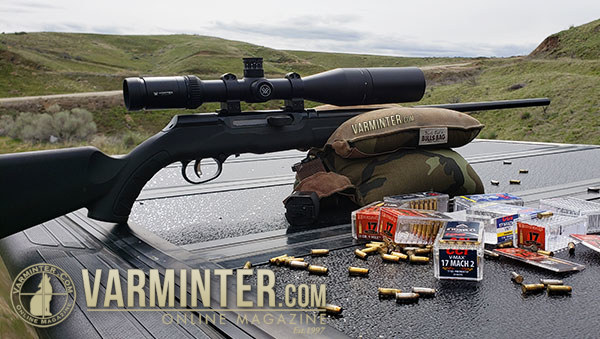
New Savage A17 in 17 Mach 2
There are a number of reviews on new-generation 17 Mach 2 rifles. Recently Varminter.com reviewed the Savage A17 in 17 HM2. Editor Eric Mayer wrote: “This new addition to the A17 line comes at a time when the 17 Mach 2 round is experiencing a resurgence, with ammo now available from CCI and Hornady, including the lead-free NTX round from Hornady. This means … you don’t have to break the bank to buy a current, functioning, semi-auto 17 Mach 2 and you don’t have to … convert your 10/22.”
Eric shot four different types of 17 Mach 2 ammo, putting 1000+ rounds through the Savage. He was impressed: “I am very excited that Savage Arms has chambered their A17 rifle in the 17 Mach 2 / 17 HM2 round. After shooting the prototype, I can confidently say that this new A17 will become my go-to 17 Mach 2 rifle. This new rifle is a great option for varminters everywhere!”
Toggle Bolt Volquartsen Summit in 17 HM2
It’s rare for us to see a new rimfire that we’d really like to own, but the new Summit from Volquartsen fits the bill. This versatile rifle features a cool, straight-pull toggle bolt, similar to those on elite Biathalon rifles. You can see how this gun shoots in this informative 22 Plinkster video:
22 Plinkster Tests Volquartsen Summit Rifle in 17 Mach 2
The 17 Mach 2 (17 HM2) is making a comeback. Now leading manufacturers are offering this efficient little rimfire cartridge in some nice rifles. Both Anschutz and Volquartsen will offer new 17 Mach 2 rifles in 2019. The Volquartsen Summit features a lightweight, carbon fiber-wrapped barrel threaded 1/2-28 for brakes or suppressors. The Summit boasts a nice 1.75-lb trigger pull. The Summit’s CNC-machined receiver features a +20 MOA Rail. NOTE: The video shows a silhouette-style laminated wood stock. However, the Summit comes standard with a composite Magpul stock that actually works better for shooting from a bench.
17 Mach 2 — Best Rimfire Bang for the Buck?
If you are looking for a capable, squirrel-busting round or a fun plinking round, you should definitely consider the 17 Mach 2, especially since CCI has committed to production of the little cartridge. CCI recently rolled out its “Gen 2″ 17 Mach 2 VNT Ammo with polymer tip (see top of article).
Considering that 17 HMR ammo is now running $14.50 a box, the 17 Mach 2 is an excellent value by comparison. It is available from many vendors for under $8.75 per 50ct box. That’s under $0.18 per round. When you consider overall “bang for the buck”, for many shooters, it makes sense to use the 17 Mach 2 rather than a 17 HMR. You save money, barrel life is a little longer, and the 17 Mach 2 is still a much more potent cartridge than the .22 LR. Check out this comparison, and note how the 17 Mach 2 has a much flatter trajectory than the .22 LR. For varmint shooting, the 17 Mach 2 is clearly the better choice.
Hornady’s 17 Mach 2 has a 2100 FPS muzzle velocity vs. 1255 FPS for “High-Velocity” .22 LR.
Gorgeous wood stock crafted by Joel Russo: “A customer from Texas commissioned me to make him a one-of-a-kind stock, so I pulled a slab out of inventory, and put it all together.”
One of the most popular items in our Shooters’ Forum is the ongoing “Pride and Joy” thread. Since 2009, Forum members have posted photos and descriptions of their most prized firearms. Here are some notable “Pride and Joy” rifles (and one wheelgun) showcased in our Forum. Do you have a gun you’d like to see featured there? Register for the Forum and you can add your favorite gun to the list.
Above is a nice field rifle built up by a father for his daughter. Forum member FrankZ explains: “This is my favorite rifle and it will become my daughter’s first centerfire. The action is from the first rifle I purchased with my own money 21 years ago (700VSS).” The rifle now sports a 24″ Brux barrel chambered in 6mm Creedmoor, with aftermarket PT&G Bolt and DBM metal.
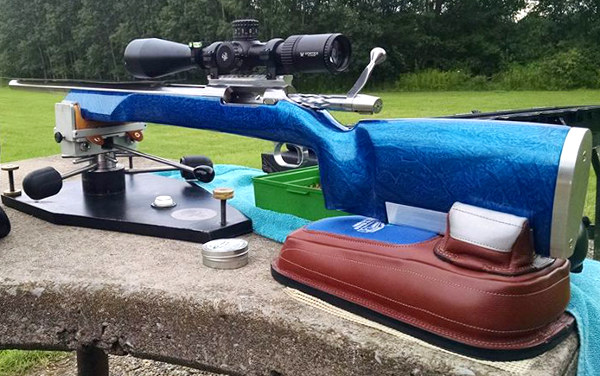
Here is a 6BR Ackley Improved built by Alex Wheeler. This blue marble-painted beauty features a BAT “B” action timed by Alex, fitted with Jewell trigger, and Borden trigger guard. The barrel is a Hawk Hill HV contour finished at 28 inches. The stock is a Deep Creek Tracker with 4″ forearm and rudder system (the toe of the stock adjusts for angle, allowing better tracking). This scope is a Vortex 15-60x52mm Golden Eagle riding in Burris Signature Zee rings.
Forum member Grimstod posted this nice 6BRX in a scenic setting: “Bill Goad at Premier Accuracy crated this fantastic 6BRX. It shoots better then I do.” The rifle features a single-feed Alpin action, with Hart 26″ 1:8″-twist barrel, chambered for the 6BRX (6mmBR wildcat) with .269 neck. Grimstod currently runs 95gr Berger VLDs in Lapua brass. On top is a Leupold 40x45mm scope on a Picatinny rail that Grimstod machined himself. The stock is an HS Precision painted by Premier Accuracy.
Here’s a gorgeous green 6mm Dasher. Forum Member Gunnermhr states: “This is my new 12-lb Dasher for the 1000 Yard Benchrest silhouette matches. My good friend at CRS Custom Rifle Stocks in Aaronsburg, PA made and painted the stock. It’s similar to a Tooley MBR with a few modifications. It still supported on a 3″ forearm and is full length. Hard to imagine it still makes weight with a wood stock and a 36 power Leopold. Crossed the scale at 11.7lbs. The rifle features a BAT “B” Action. The paint is Candy Apple Green, the forearm has a white base-coat, center section is gray base coat and the buttstock is black base coat, all covered with five coats of clear. It’s the new pride of the fleet as it shoots as good as it looks. This gun hammers with 105gr Berger Hybrids.”
Here’s a state-of-the-art Benchrest rifle, finished proudly in bright red. Forum Member JimmyMac posted: “Picked up my new 6 PPC today. This red rig features a Borden B action (Jewell trigger) fitted with a Lederer 1:14″-twist barrel with a Loker tuner. The barrel action rides in a Roy Hunter stock. On top is a Nightforce 42x44mm Competition scope in BAT rights. The rifle was smithed by Dave Bruno.
This impressive rifle features an “antique” 1917 Enfield action chambered for the .338 Win Magnum cartridge. The lovely Maple stock was hand-carved by Forum member Spitfire_ER. He tells us: “I found this piece of wood as a return at a lumber yard about 7-8 years ago. I asked the guy in the yard about it and he said it had been returned because it had too much figure for the job the customer was working on. First thing I thought was, ‘That would make a nice stock’.”
Not a Rifle But Still a Stunner…
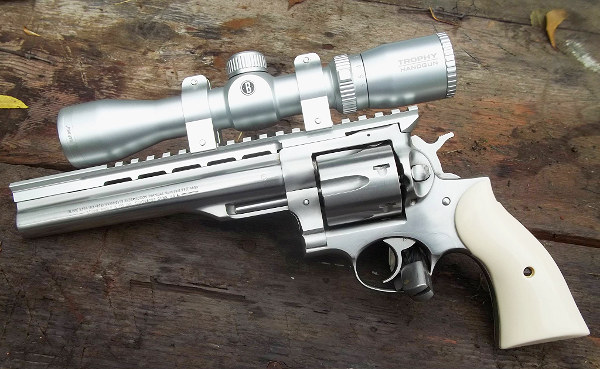
Last but not least is one of the nicest stainless Ruger revolvers we’ve ever seen. Forum member Longcarbine says: “This is not a rifle, but it’s my favorite weapon”. The Ruger is fitted with a custom Picatinny scope rail with matching silver-tone Bushnell Trophy handgun scope, plus handsome faux Ivory grips. This wheelgun is almost too pretty to hunt with…
With fall approaching soon, hunting season is right around the corner. Long-range hunters may want to add Shooter’s Bible Guide to Rifle Ballistics (2nd Edition, 2022) to their reference library. Written by Dr. Wayne van Zwoll, this 264-page resource focuses on the basic principles of ballistics. While the book concentrates on the many factors that affect bullet trajectories, the book also includes chapters on everything from rifle design to bullet construction and handloading. And there are many helpful tips for long-range hunters.
Gunsmith and long-range shooting school instructor Darrell Holland recommends the book highly. This updated Second Addition was released in July 2022, so it is still quite current. Darrell tells us: “Friend and noted author Wayne van Zwoll has authored another fine book on long range shooting. Wayne is a great shot (probably one of the best sling shooters I’ve been around) and superb hunter in his own right. We applaud his efforts to provide sound and accurate knowledge on long range hunting.”
Van Zwoll is the “real deal” — an experienced outdoorsman, with serious shooting and writing “creds”. Over his career, Van Zwoll worked for the BLM, then Washington’s Department of Game. He worked as a photographer for the U.S. Forest Service, then became one of the Elk Foundation’s first field directors. He has guided hunters in Utah and Wyoming, and has hunted on five continents. Wayne has shot competitively since his days on the Michigan State University rifle team. He qualified for the final Olympic smallbore tryouts in 1972 and later won two state prone titles. For many years he conducted shooting seminars for Safari Club International (SCI). Wayne van Zwoll has authored 14 books, and written more than 2,000 articles for numerous magazines, including Field & Stream, and Outdoor Life. In 2006 he received the Jack Slack Outdoor Writer of the Year award. Wayne now serves as Special Projects Editor for Intermedia Outdoors.
A high ballistic coefficient helped a Creedmoor bullet slice stiff wind 250 yards to this Vaal Rhebok.
Leica Sport Optics has a limited-time promotion on its excellent Rangemaster CRF laser rangefinders (LRFs). From August 15 to September 30, 2023 you can save $50.00 to $200.00 on three high-qualtiy Leica Rangemaster models:
PROMO DATES: These $50 – $200 instant savings go into effect on Tuesday, August 15, 2023 and run through September 30, 2023.
Leica Rangemaster models perform very well, and have a compact design, and handy control features. These models all feature very good glass plus 7X magnification for easy spotting of targets and hunting prey down-range. The higher-end Rangemaster .COM models boost Bluetooth® connectivity. This allows storage, transmission, and management of ballistics data via the Leica Ballistics App.
If you’re in the market for a laser rangefinder — perhaps to use while hunting this fall, you can take advantage of this Leica Rangemaster promo from August 15 through September 30, 2023. Get these limited-time offers by visiting a participating Leica Sport Optics dealer or Leica online optics vendor. We recommend EuroOptic.com, Brownells, and Sportsman’s Warehouse.
This 600+ page resource covers rifles, shotguns, handguns, muzzleloaders, airguns, optics and more. We like the print edition, but there is also a Kindle eBook version for $19.99 on Amazon. Both paperback and Kindle versions provide hundreds of photos plus new product roundups, in-depth product tests, and scores of articles and stories.
There are dozens of photo-illustrated feature articles. Among the notable stories are a guide to the new Hornady 7 PRC cartridge, a detailed history of .45-70 Gov’t rifles (from 1878 to the present day), an extensive review of single-shot falling block rifles, and a feature on custom and engraved rifles.
Gun Digest 2024 Editor-in-Chief Phil Massaro has assembled a large team of respected industry authors for the new book, including Kristin Alberts, Joe Arterburn, Craig Boddington, Joe Coogan, Rick Hacker, Jay Leyendecker, Robert Sadowski, Ron Spomer, Patrick Sweeney, Wayne van Zwoll, and many more.
Gun Digest 2024 covers hunting, personal defense, target shooting, gunsmithing, and collecting. There are Updated Ballistics Tables, and the catalog section shows off the newest offerings in rifles, handguns, shotguns, muzzleloaders and air rifles. The new 78th Edition has a vast collection of gun histories, in-depth reviews, and new product roundups. Written by top gun writers, the feature stories cover every aspect of guns and shooting — hunting, personal defense, target practice, gun making, and collecting. In addition to this, the Gun Digest 2024 book includes gun field tests, ballistic tables and more.
Reports from the Field cover the newest firearms and accessories. A Testfire section brings readers up to date on product performance. And there are over 30 feature stories, including the Guns of Western Movies/TV, Rimfire Handguns, and Hunting rifles.
Other Good Books from Gun Digest Media
Gun Digest Media produces numerous other quality books for rifle, pistol, and shotgun owners. Here are four books we recommend. These are offered in both paperback and eBook versions:
We’re in the middle of summer, so many folks will head to the hinterlands on prairie dog safaris. On a good P-Dog adventure, you may shoot hundreds of rounds over a long weekend. So you’ll need plenty of ammo. With these ammo volume requirements, you probably won’t have time to load to benchrest standards, and you may not have the budget for match-grade bullets. To save time you may throw (rather than weigh) your charges, or even load on a progressive press. This all raises the question of ammo accuracy — how good is “good enough”? A Sierra Bullets expert answers that question here — explaining how to efficiently load ammo for varmint work.
Ammunition Accuracy Requirements 101 — Varmint Ammo
This story based on article by Sierra Bullets Chief Ballistician Tommy Todd
I load and shoot ammunition for a living. In my duties here at Sierra I constantly test bullet accuracy for our production needs. Because of this, I shoot a variety of different calibers and cartridges on a daily basis and a large demand of this shooting is keeping the guns and loads tuned for optimum accuracy. I have a very narrow window of tolerances to maintain in order to provide our customers (you) with the most accurate bullets on the market.
I have learned many tricks and techniques over the years to tuning a load, prepping brass, and cleaning barrels to keep a gun shooting. I often utilize the things I have learned and take them to extreme levels when competing in a shooting event. I also often ignore most of these things (other than safety) and simplify the process if the shooting I will be doing does not warrant.
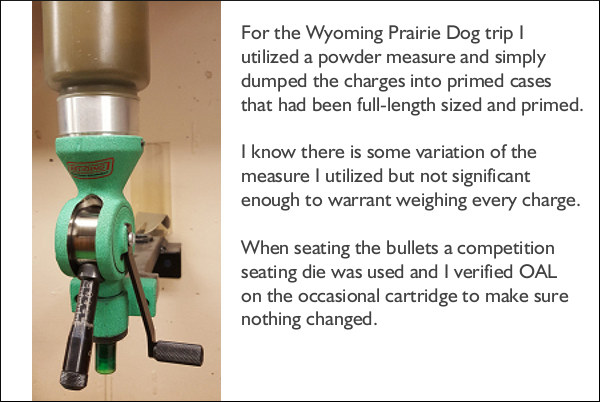
Recently I went on a prairie dog shoot in Wyoming with some good friends. The targets cooperated as did the weather with the exception of some challenging winds we experienced. We had a great time and make a lot of hits on those small rodents. When loading for the .223 Remington rifles and the TC Contender, I cut a few corners in the ammunition-loading process due to both time constraints and accuracy needed. When shooting at a prairie dog a miss is simply that, but when shooting at say the X-Ring at 1000-yard competition, a poorly-placed shot [harms your] placing in the match. Because of this, I can afford to miss an occasional shot at a varmint due to ammunition capability without worry but will not allow the same tolerances in my match ammo. For the Wyoming trip I utilized a powder measure and simply dumped the charges into primed cases that had been full-length sized and primed.
I had measured enough for length to know that while there was some variance all were under maximum length. I know there is some variation of the measure I utilized but not significant enough to warrant weighing every charge. When seating the bullets a competition seating die was used and I verified OAL on the occasional cartridge to make sure nothing changed.
This varmint ammo, with thrown charges, put TEN shots inside ONE inch at 200 yards. That’s half MOA. Good Enough? Absolutely!
The ammo produced shot under one inch at 200 yards in one of the guns I planned on taking on to Wyoming with me. [Editor: That was for TEN Shots — see above.] I knew I had loaded ammunition that was quite suitable for the task at hand which was evidenced by the number of hits I was able to make at fairly long range.
NOTE: The author, Tommy Todd, explains that, when loading ammo for F-Class matches, he uses more exacting methods. He weighs every charge and seats his bullets carefully with an arbor press. Todd adapts his methodology for his particular application. The lesson here is to load to the level of precision demanded by your discipline. READ Full Story HERE.
Lever-action rifles have been an important element of American history. These were truly the rifles that “Won the West”. Today, lever-action rifles remain popular with hunters and cowboy-action shooters. And rimfire lever guns are fun for short-range shooting at reactive targets. Easy to carry, lever guns can also be very effective on varmints. For this Saturday-at-the-Movies installment, we feature eight videos about lever-action rifles. These videos review modern lever guns as well as historic 19th-century lever-action rifles. Three of these videos features sophisticated 3D computer animation so you can look inside the rifles to see how the internal mechanisms function to feed, fire, and eject cartridges.
How a Lever-Action Rifle Functions
This video shows the inner mechanisms of a classic lever-action rifle. It shows how the lever actuates case-feeding from the under-barrel tube, then how the hammer is cocked/fired, and finally how the ejection works after the shot is fired. This video also covers lever-action rifle history, looking at the Winchester 1873 as well as popular modern lever-action firearms.
Classic American Lever-Action Rifles — Hickok45’s Insights
Hickok45 is one of the more knowledgeable YouTube gun reviewers, and he personally owns a number of lever guns. In this video, which has over 2.5 million views, Hickok45 first showcases the original Henry Rifle, and the brass-receiver model 1866 (aka “Yellowboy”). Then he reviews Winchester’s model 1873 and model 1876 (Centennial). Next comes Winchester designs by J.M. Browning — the model 1886, model 1892, model 1894, and lastly the distinctive model 1895 with vertical magazine. The Model 1895 was a favorite of President Theodore Roosevelt.
This insightful Hickok45 video has garnered 2.5 million YouTube views. If you can take the time to watch the entire 37-minute video, this is a great history lesson for 19th-century lever guns. In the video, Hickok45 also shows cartridges used in the various rifles.
Top Five Lever-Action Rifle for Hunting and Home Defense
This video combines reviews from multiple YouTube hosts, including .22 Plinkster. It is a good starting point if you are considering purchase of a modern, lever-action rifle for hunting or home defense. We recommend, prior to purchase, that you go to a gun store to inspect the rifles and work the actions. Some lever guns are significantly smoother in operation than others. You’ll also want to check the triggers, and see the options for mounting optics. This video provides a quick look at a variety of lever guns including: Henry Side Gate Lever Rifle; Winchester Model 1866 Short Rifle (replica); Browning BLR Lever Rifle; Marlin Dark Model 336; and Marlin 1895 Custom Shop 45-70.
Seven Reasons to Own a Lever-Action Rifle
We own a variety of lever-action rifles, including Marlins well as handsome replica Uberti 1866 and 1873 rifles. There is much to be said about the lever gun design. Compared to typical modern bolt-actions, lever guns are narrower and lighter. With a little tuning, the replica 19th-century lever-action rifles cycle very quickly and smoothly. And the modern lever guns are good choices for hunters, with their ability to mount scopes and fire modern high-velocity cartridges. This video reveals the reasons every serious shooter should have at least one lever-action rifle in his or her collection.
How a Winchester 1873 Works
This video has over 15 million views on YouTube. The Model 1873 was one of the most successful Winchester rifles of its day, with Winchester marketing it as “The Gun that Won the West”. The original Model 1873 was manufactured between 1873 and 1923, and it is still available today in replica versions. The 1873 was originally chambered for the .44-40 cartridge, the first significant centerfire cartridge. The 1873 was later produced in .38-40 and .32-20, all of which later became popular handgun cartridges of the day. The Model 1873 was produced in four variations: a 24-inch barrel rifle, a 20-inch barrel carbine, and a “musket”—which was aimed at military contracts and only made up less than 5% of production. The standard rifle-length version was most popular in the 19th century, although Winchester would make rifles to order in any configuration the customer wished, including longer barrels or baby carbines with barrels as short as 12 inches, octagonal-shaped barrels, color case-hardened receivers and fancy engraving.
The Henry Big Boy Lever-Action .44 Magnum
Here’s good, thorough 16-minute review of a modern Henry Big Boy side-gate lever-action rifle chambered for the potent .44 Magnum round. This rifle shows the benefits of modern manufacturing methods, and shows good fit and finish. The review puts the rifle through its paces, show how quickly a modern lever gun can be cycled. We think this would be a good choice for a home defense rifle that could share ammunition with a defensive revolver.
How It Functions — The Classic Winchester 1894
This Winchester 1894 animation video has over 16 million views on YouTube. The video host, Weapons Explained, notes: “The John Browning–designed Winchester Model 1894 is the most prevalent of the Winchester repeating rifles. The Model 1894 was first chambered for the .32-40 and .38-55 cartridges, and later, a variety of calibers such as .25-35 WCF, .30-30, and .32 Winchester Special. Winchester was the first company to manufacture a civilian rifle chambered for the new smokeless propellants, and although delays prevented the .30-30 cartridge from appearing on the shelves until 1895, it remained the first commercially-available smokeless powder round for the North American consumer market.”
Marlin 336 XLR Tactical-Style Lever-Action Rifle
And now for something a bit different… Here a Marlin 336 XLR lever-action rifle has been updated with a tactical-style forearm, rail-mounted optic, and suppressor. The reviewer noted how well the rifle functioned: “Recently I got my hands on this 336 XLR from Marlin and all of my preconceptions of tactical lever action rifles has now changed. What I found was a very modern and capable twist to an old school platform.”
More Information on Lever-Action Rifles
Want to learn more about lever-action rifles? RifleShooter magazine has published an interesting article, the 10 Greatest Lever-Action Rifles of All Time. Writing for RifleShooter, Brad Fitzpatrick examined a wide selection of lever guns produced in the past 150 years, and came up with this list of ten “all-star” lever-action rifles:
Savage Model 99
Winchester Model 1873/73
Winchester Model 1888/88
Winchester Model 1892/92
Winchester Model 1894/94
As with all “Top 10″ lists, this will be controversial. Where is the Winchester model 1866 “Yellowboy”, the favorite of Native Americans? Where is the iconic Winchester model 1895, the beloved gun Teddy Roosevelt called “Big Medicine”? But other choices are hard to fault. The classic 1860 Henry Rifle surely belongs on the list. And, believe it or not, the Winchester Model 94 is the best-selling sporting rifle of all time in the USA, according to RifleShooter.
Rimfire Varmint Adventure
Can you shoot prairie dogs with a .22 LR Rifle? The answer is yes, if you have an accurate rifle, know your drops, and keep your targets within a reasonable distance (inside 240 yards). While the .17 HMR and .17 WSM are much more potent, flat-shooting, and effective P-dog slayers, a talented marksman CAN get good results with a .22 LR rimfire rifle, as ace PRS shooter and gunsmith Jim See recently proved.
Posting on his Facebook Page on 7/9/2020, Jim wrote: “Took out the .22 LR for some LR prairie poodles, there were not many in this town, but it gave me a chance to get some impressive hits. Norma TAC-22 ammo put the smack down on a first-round hit, called head shots at 189 yards. The body-shot dog was a first-round kill at 240 yards. I had one more head shot with a second round hit at 163. The nice part about using the .22 Long Rifle ammo is the [critters] don’t spook too bad, so a follow-up shot with a correction is usually available to get a better wind hold.” Even unsuppressed, a .22 LR rimfire shot makes much less noise than a centerfire round.
NOTE: The Norma TAC-22 .22 LR ammo used by Jim See offers great bang for the buck. It is quite affordable — a 50rd box is just $4.99 at MidwayUSA. Some lots have show outstanding accuracy. These target photos (below) come from Champion Shooters Supply which may have gotten an exceptional lot. This vendor tells us: “We have found this to run very well in Ruger rifles, handguns, and target pistols. These are 5-shot groups at 50 yards with an Anschutz 1913 rifle. This is an incredible value.” Jim says the TAC-22 ammo delivers 1″ groups at 100 yards in his rifle.
Sierra Bullets has introduced a new line of loaded centerfire varmint ammunition, the Prairie Enemy series of cartridges. Sierra currently offers Prairie Enemy ammo for six cartridge types: .204 Ruger, .223 Rem, .224 Valkyrie, .22-250 Rem, .243 Win, and 6.5 Creedmoor. To celebrate this new ammo line, Sierra created a colorful Prairie Enemy P-Dog target. Click the image below to download the PDF target.
In today’s high-inflation economy, FREE is good. Here’s a list of classic, older shooting books that can be downloaded for FREE from Google Books. This list includes many classic treatises on rifle marksmanship that still have value for today’s competitive shooters. In addition, we’ve included notable, illustrated firearm histories, such as Townsend Whelen’s fascinating book, The American Rifle, and The Gun and its Development (9th Ed.), by William Wellington Greener.
In the list below, the title link will take you to the Google Books page for each book. You can read the entire book online, or (in most cases) you can download it to your computer as a PDF file and save it (or print it). You can also create your own Google Library and save the books there for access from any computer.
To download a book, first click the title from the list above. Then, on the Google book page, look for the row of buttons under the book title. Click the “Download PDF” Button. This will load the full book as a PDF into your browser. You can then save this to your computer or tablet hard drive. Choose a location to hold your new e-book, and click “save”. Alternatively, click the blue “READ for Free” button and the book will appear right on the Google site, with navigation (forward/back) arrows at the top of the page.


 .17 HMR and .22 WMR Options Enhance






 Van Zwoll is the “real deal” — an experienced outdoorsman, with serious shooting and writing “creds”. Over his career, Van Zwoll worked for the BLM, then Washington’s Department of Game. He worked as a photographer for the U.S. Forest Service, then became one of the Elk Foundation’s first field directors. He has guided hunters in Utah and Wyoming, and has hunted on five continents. Wayne has shot competitively since his days on the Michigan State University rifle team. He qualified for the final Olympic smallbore tryouts in 1972 and later won two state prone titles. For many years he conducted shooting seminars for Safari Club International (SCI). Wayne van Zwoll has authored 14 books, and written more than 2,000 articles for numerous magazines, including Field & Stream, and Outdoor Life. In 2006 he received the Jack Slack Outdoor Writer of the Year award. Wayne now serves as Special Projects Editor for Intermedia Outdoors.





 Rimfire Varmint Adventure


 In today’s high-inflation economy, FREE is good. Here’s a list of classic, older shooting books that can be downloaded for FREE from Google Books. This list includes many classic treatises on rifle marksmanship that still have value for today’s competitive shooters. In addition, we’ve included notable, illustrated firearm histories, such as Townsend Whelen’s fascinating book, The American Rifle, and The Gun and its Development (9th Ed.), by William Wellington Greener.


