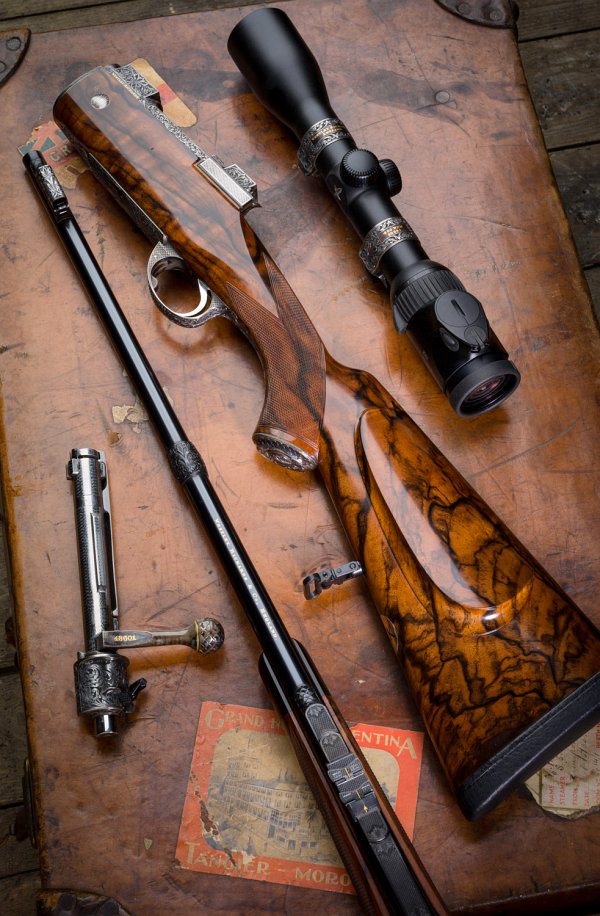
Hunting Season has already started in some states, and is right around the corner in other locations. For readers who plan to hunt game this fall, we recommend you brush up on hunter safety and learn the laws in your jurisdiction. Here are some helpful resources for hunters: Safety Tips, Hunter Education, License Requirements, and Where-to-Hunt interactive map. Top photo courtesy Horn Fork Guides, Ltd., in Colorado.
Hunter Safety Tips NRAFamily.org has a good article listing seven salient safety tips for hunters. Anyone preparing for a fall hunt should read this article before heading into the field. Here are three key bits of advice:
1. Be Positive of Your Target before Shooting
This might sound overly simplistic, but the fact remains that, every year during whitetail season, farmers everywhere are forced to spray-paint their cattle or risk having them “harvested” by hunters who don’t bother confirming the species of the large ungulate in their sights. Why does this happen? The most likely explanation is “buck fever,” meaning that the hunter wants so badly to see a nice big buck that sometimes his eyes deceive him into thinking that there’s one there. When in doubt, don’t shoot.
2. Scopes Are Not Binoculars
Never use a riflescope as a substitute for binoculars. The temptation to do so is real, but when one does this, one is by definition pointing the muzzle of the gun at unknown targets.
3. Know When to Unload
When finished hunting, unload your firearm before returning to camp. You should also unload your gun before attempting to climb a steep bank or travel across slippery ground.
Visit WhereToHunt.org
There’s a great online resource for hunters that will help you find game locations in your state and ensure you have all the proper permits and game tags. WheretoHunt.org features an interactive map of the country. For all 50 states, the NSSF has compiled information about hunting license and permits, where to hunt, hunter education classes, laws and regulations and more. For each state you’ll also find a link for required applications and license forms.
Click Map to Get State-by-State Hunting INFO
Hunting Affiliation Groups
There are many good organizations dedicated to promoting hunting and preserving our hunting habitats. These groups all offer valuable information for hunters:
Hunting season is coming soon in many parts of the nation. If you’re thinking about what bullets to use for your annual game hunt, you’ll find some VERY valuable information here. Federal has created an award-winning Bullet Breakdown Video (below) that demonstrates how various hunting bullets perform in ballistic gelatin. This and other videos are found on Federal Premium Ammunition’s YouTube Channel. The Bullet Breakdown Video features four bullet types used in Federal Ammo: Nosler Ballistic Tip; Sierra GameKing; Trophy Bonded Tip; and Barnes Triple-Shock X-Bullet.
NOTE: You may want to lower the video sound level before playback.
Federal’s high-resolution, slow-motion video-graphy helps demonstrate which loads are the best for specific uses. The ultra-slo-mo footage provides a detailed view of each bullet penetrating ballistic gelatin blocks. These blocks closely mimic animal tissue and clearly display performance characteristics.
“The Bullet Breakdown Video is a great tool for hunters trying to decide on ammunition type,” said Federal’s Jason Nash. “Properly preparing for the hunt is crucial-and not all bullets are made the same. The bullet is the one link between hunter and game and can be the difference between success and failure. This video helps show hunters how different bullet construction affects terminal performance[.]” For more info, visit www.FederalPremium.com.
There’s a new premium First Focal Plane option for PRS/NRL competitors and long-range hunters. ZEISS has just introduced the all-new LRP S3 scope series, with 4-25X and 6-36X models, in both MRAD and MOA versions. These new scopes are impressive, with superb glass and best-in-class vertical elevation. And the prices are attractive, starting at $2199.99. You could pay a lot more for a top-tier FFP scope.
The new ZEISS LRP S3 optics for precision shooting and hunting boast impressive total elevation travel, advanced optics, daytime visible illuminated reticle, ballistic stop, and external locking windage turret. The product family consists of two models: ZEISS LRP S3 425-50 and LRP S3 636-56. Both are available in either Milliradian (MRAD) or minute-of-angle (MOA) configurations.
“With the LRP S3 we have expanded our successful long-range precision scope portfolio to provide more options for highly reliable and precise optics that are ready for competition”, stated Kyle Brown, Director of Marketing and Products for ZEISS Consumer Products USA. ZEISS LRP S3 first focal plane riflescopes are purpose-built for success in the world of long-range shooting and hunting.
While the concept of “buy once, cry once” is a long-held tradition in the competition optics market, ZEISS is trying to break that mold. PRS/NRL competitors and long-range hunters favor first focal plane scopes with large magnification ratios and crystal clear optics. Most of the “alpha” scopes in this arena have price-tags of $4000 or more, but ZEISS is wading in with a more budget-friendly option — the ZEISS LRP S3 series. These new FFP 4-25X and 6-36X scopes have an ample 6x zoom ratio with MOA or MIL reticles (and corresponding click values). MSRPs are reasonable: $2499.99 for the 6-36X and $2199.99 for the 4-25X.
These new first focal plane LRP S3 optics feature multiple lens elements of highest-quality, extra-low dispersion (ED) glass, making them contenders for the brightest, clearest sight picture available. ZEISS promises “90% light transmission for a noticeably brighter image.”
I chose to review the LRP S3 6-36X models in both MOA and MIL formats. Like any top quality scope, the ZEISS offering is well packaged and properly protected for shipment. Upon opening the package, one is immediately struck with the diameter of the turrets. They are large and easy to grasp, unlike many of the competitor’s designs. A truly shooter-friendly feature for PRS shooters and hunters alike is the repositioning of the index marks for both the windage and parallax adjustments to the upper side of the scope body. This is a welcome feature, making pre-stage windage setting much easier.
The turrets are 10 MIL or 25 MOA per rotation, making it unlikely that the shooter will get lost while adjusting. If more than one rotation is needed, a nicely visible micrometer scale rests below the turret, to keep things oriented. The elevation knob features a zero stop to get you back to the starting point reliably, and the windage knob features a lock to prevent accidental adjustment. The turrets themselves have large, unmistakable markings that are easy to read, even without one’s reading glasses.
The scopes were mounted in ZEISS ultralight rings and placed on a double mount side-by-side on a tripod with one of the best pieces of glass the author owns — a Nightforce Competition 15-55x52mm. Looking across the river at the adjacent city 3 miles away told the tale. The glass in the ZEISS was nearly identical in resolution and color to Nightforce’s Japanese glass. Moreover, the ZEISS collected more light, thanks to the larger 56mm objective and 34mm main tube. Through tough conditions on a hazy afternoon, the ZEISS had slightly better clarity than the Nightforce. A day later, looking into the evening sunset as a backdrop, they were identical to the author’s eye at both 36x and 15x respectively. Even the heavy mirage present didn’t seem to differentiate between the scopes.
With excellent HD quality glass, and good magnification options (4-25X and 6-36X), what is missing? Two things got my attention. The first was the lack of a sunshade as part of the scope. ZEISS offers sunshades separately at a reasonable cost, but they really should be offered as part of the scope package in my opinion. The second is the lack of range markings on the parallax knob. Setting parallax with range markings is not ideal, but can be quite helpful in shooting situations on the clock.
Impressive So Far, with More Testing to Come
The LRP S3 636-56 is an option-rich scope at a reasonable price for both PRS/NRL and hunting applications. Will it prove to rival the $4000 “alpha” scopes at a much lower and more affordable cost? We plan to answer that question with a detailed field test in the weeks ahead. Stay tuned. – Keith Glasscock
ZEISS LRP S3 Optics Key Features
Best-in-Class Total Elevation Travel
4-25x50mm: 46.5 MRAD / 160 MOA
6-36x56mm: 32.0 MRAD / 110 MOA
Advanced Optical Design — for a highly detailed and precise image
Ballistic Stop and External Locking Windage Turret for precise shot placement
Daylight Visible Illuminated Smart Reticle – quick and precise to read, with minimum target coverage and red or green illumination settings
Relatively Compact and Tested to Be Tough in Extreme Conditions
With its 34mm aluminum main tube mono-bloc housing, shock tested up to 1,500g-force, waterproofness up to 400 mbar, the LRP S3 is not only compact but also very robust. It is engineered for extreme usage in rough terrain. “The LRP S3 meets all requirements not only for long-range competitions but also for particularly demanding hunting situations over long distances”, notes Kyle Brown of ZEISS. And these scopes are covered by ZEISS’s Limited Lifetime Warranty and 5-Year No-Fault Policy.
Availability: All ZEISS LRP S3 models — LRP S3 425-50 and 636-56 both MRAD and MOA versions — will be available at authorized ZEISS retailers beginning early October 2022 for the North American markets. For more information about the ZEISS LRP S3 scopes, visit www.zeiss.com/lrp-s3.
This is the biggest sale day of the year for hunters. MidwayUSA’s Camo Tuesday is a once-a-year event with some of the best deals you’ll find on hunting clothing, rifles, optics, trail cams, boots, backpacks, ammo, rangefinders, binoculars, GPS units, knives, and everything else a hunter could need. Along with great Camo Tuesday bargains, you can get FREE Shipping for orders over $49 with Code CAMOTUESDAY2022.
CAMO TUESDAY Hunting Sale at MidwayUSA
Camo Tuesday only happens once a year. It is more than just another hunting sale — it’s the ultimate shopping day for the fall hunting season. You can get huge savings on select hunting gear, plus free shipping. MidwayUSA offers big discounts on camouflage clothing as well as hunting boots, rifles, shotguns, crossbows, ammunition, optics, rangefinders, trails cams and more. Here are just a few of the deals:
Camo Tuesday Sweepstakes — Many Prizes
Along with the super sale discounts, MidwayUSA is running a big Camo Tuesday Sweepstakes with prizes totaling $4,749.96 in value. No purchase is necessary, but MidwayUSA requires entrants’ email and phone number. CLICK HERE for contest entry page.
Hunting season is right around the corner. That means its time to inspect all your hunting gear, including your scope set-up. If you have a new optic, you’ll want to get it mount it correctly, A proper scope installation involves more than just tensioning a set of rings — you need to consider the proper eye relief and head position, and it should be leveled correctly. This video shows a simple, quick method to mount a scope. The method assumes that the reticle (cross-hairs) are square without the turret. You’ll want to confirm that with a plumb line hanging straight down, a procedure you can do indoors.
In this NSSF video, Ryan Cleckner shows how to set up a scope on a hunting or tactical rifle. Ryan, a former U.S. Army Sniper Instructor, notes that many hunters spend a small fortune on equipment, but fail to set up their rifle to use the optics optimally. Cleckner likens this to someone who owns an expensive sports car, but never adjusts the seat or the mirrors.
Ryan notes that you want your head and neck to be able to rest naturally on the stock, without straining. You head should rest comfortably on the stock. If you have to consciously lift your head off the stock to see through the scope, then your set-up isn’t correct. Likewise, You shouldn’t have to push your head forward or pull it back to see a clear image through the scope. If you need to strain forward or pull back to get correct eye relief, then the scope’s fore/aft position in the rings needs to be altered. Watch the full video for more tips.
Tips on Mounting Your Scope and Adjusting Your Comb Height:
1. Normally, you want your scope mounted as low as possible, while allowing sufficient clearance for the front objective. (NOTE: Benchrest shooters may prefer a high mount for a variety of reasons.)
2. Once the scope height is set, you need to get your head to the correct level. This may require adding an accessory cheekpad, or raising the comb height if your rifle has an adjustable cheekpiece.
3. Start with the rifle in the position you use most often (standing, kneeling, or prone). If you shoot mostly prone, you need to get down on the ground. Close your eyes, and let you head rest naturally on the stock. Then open your eyes, and see if you are too low or too high. You may need to use a cheekpad to get your head higher on the stock.
4. If your scope has a flat on the bottom of the turret housing, this will help you level your scope. Just find a flat piece of metal that slides easily between the bottom of the scope and the rail. Slide that metal piece under the scope and then tilt it up so the flat on the bottom of the scope aligns parallel with the flats on the rail. Watch the video at 8:40 to see how this is done.
Video find by EdLongrange. We welcome reader submissions.
As a Labor Day Weekend bonus, we thought we’d celebrate the beauty of highly-figured wood with a collection of custom rifles. In our Shooters’ Forum, there is a long-running Gun Glamour thread that showcases many beautiful wood-stocked rifles. Today we feature some very handsome rifles from that Forum Thread as well as other rifles we’ve featured in the Daily Bulletin.
Two F-Open Beauties with Walnut Laminates
Cerus-stocked Special from Cigarcop
Forum member Keith W. (aka “Cigarcop”) of KW Precision LLC is a talented riflesmith whose projects display outstanding finish work and attention to detail. Keith does some of the best bedding work we’ve ever seen. Back in 2018, Keith built a stunning .284 Win F-Class rig for a shooter in Delaware. It’s a beauty, that’s for sure.
Check out the stunning Cerus F-Open stock. This features multiple laminations with highly-figured Walnut on the sides. This certainly ain’t your “off-the-shelf” laminated stock. This just shows the beauty that can be achieved with carefully-chosen lamination layers (plus 12 coats of clear).
This beautiful F-Open rig features a laminated wood stock with stunning figured walnut on the outside.
A Beauty for the Boss (of Grizzly.com)
This F-Class rifle belongs to Shiraz Balolia, Chairman/CEO of Grizzly Industrial. Shiraz finished the stock himself: “I installed the bottom wider track for my rear bag and also carved out the finger grooves in the grip. The blank was quite long so I cut off approximately two inches from the front end of each stock and also deepened the large tracking cavity under the fore-end. I went ahead and inlaid my name in Mother-of-Pearl on the Walnut stock.” The stock was then sent to Sims Guitar Finishing for clear coating with “wet look” finish. This rifle is chambered for the .300 Shiraz wildcat, an improved .300 WSM.
F-0pen Stock made of highly-figured Walnut with Curly Maple inner laminations.
Beautiful Rifles from our Forum Gun Glamour Thread
Here are a variety of handsome wood-stocked rifles from our Forum Gun Glamour thread. In that thread, member Kurz posted a dream gun owned by a friend in England. Kurz included a quote from a book created by the rifle’s owner: “There, with my father’s words ringing in my ears, I shall take that ‘step forward’ and order a perfect machine based on the Mauser ’98 action, built from metal and wood by master craftsmen who truly understand that ‘reliable’ and ‘mechanical integrity’ have as much relevance today as they did all those years ago.”
A gun can “shoot dots” and still be handsome. Here is a short-range benchrest rifle with a stunning, exhibition-grade Walnut stock. Forum member Josh B found this beauty.
Forum member JRS submitted a stunner from Europe. This beauty features a truly exquisite piece of wood with elaborately engraved receiver. It also has escutcheons and special metal work on the grip.
Lever-action Falling Block rifles can be beautiful too. This one features a color case-hardened receiver and handsome two-piece fancy wood stock. This was submitted by Forum member Kurz who notes: “Besides exhibition grade walnut, I like the variations available in spalted maple for rifle stocks.”
Here is member Oldduc’s Stevens 44 1/2, .38-55 Black Powder Cartridge Rifle, with an extra .218 Mashburn Bee barrel. Very nice blueing along with the figured wood stocks and fore-arms.
A competition rifle must be “performance first”. But that doesn’t mean they can’t be handsome too. Forum member XTR’s rifle, an F-TR rig, features Maple wood with Bubinga tips.
Here is “something completely different” — a classic lever-activated Martini Martini Cadet chambered in .20 Vartarg (rimmed). Look at the figure on that fore-end. Remarkable!
And wood can work for Benchrest rifles too, when cleverly fashioned in thin carbon-reinforced laminates. Photo from member mdman352.
“Wood is Good” — as demonstrated by all the rifles showcased above. In the photo below, master stock-builder Doan Trevor handcrafts a highly-figured wood stock.
Are you feeling lucky? Here is one of the better hunting season prize packages we’ve seen in recent years. It’s easy enough to enter to win an impressive collection of products including a lever-action rifle, Taurus Tracker revolver, multiple Vortex optics products, knives and much more. There is no purchase necessary for a chance to win.
Alien Gear Holsters, American manufacturer of holsters and firearms accessories, has pulled together some of the top brands in the industry to create an impressive hunting season giveaway for 2022. There’s a massive collection of cool products for the 2022 Hunting Season Prize Package. Shawn Hostetter, CEO of Alien Gear Holsters, states: “All together this prize package is worth several thousand dollars and would make an incredible start to hunting season, or a fantastic gift for the hunter in the family.”
Products Included in the impressive Prize Package:
- A Rossi R92 Rifle .44 Magnum 16″ barrel, 8-round capacity
– A Taurus Tracker Revolver
– Eberlestock Vapor 500 Backpack w/ Scabbard
– Vortex Diamondback HD 16 – 48 X 65 Spotting Scope
– Vortex Diamondback HD 2000 Rangefinder
– Vortex Viper HD 10 X 42 Binoculars
– Tactacam Spotter LR Spotting Scope Camera
– A 103 Skinner Knife and A 657 Pursuit Large Guthook Knife
– O-Light Javelot Turbo Light and Mounting Hardware w/ Remote Switch
– A Quake Kits Reasonably Prepared Emergency Kit
– Aid-PAK Gen-2 from Urban Medical Gear
– Alien Gear Holsters Cloak Chest Holster and Cloak Slide Holster
– Bigfoot Gun Belts OD Green Tactical Belt
– Shot IQ Precision Pistol Course from Joel Turner
It’s easy to enter by filling out Online Entry Form. Eligible participants have until September 30, 2022, to enter for a random chance to win this ultimate hunting package.
As part of NRA Women TV, hunting guide Kristy Titus hosts a series of videos that explain important strategies and shooting skills for hunters. Titus, co-host of the Team Elk TV show, is a certified instructor who has hunted around the globe. She grew up in the outdoors, running pack mules in Oregon with her father. In these videos, Kristy discusses demonstrates field positions that can be employed during a hunt. She also explains preparation for a hunt, including fitness training.
Click each link below to watch other Kristy Titus Hunting Videos.
“When it comes to bolt-action rifle fit, there is no ‘one size fits all’,” says Titus. “When picking out your rifle [consider options] after the purchase to ensure you are as comfortable as possible.”
Varminting for Fun — With Rimfires and Centerfires
One of the most fun things you can do with a rifle is to shoot varmints such as ground squirrels, prairie dogs, rockchucks, and groundhogs. There’s great satisfaction making a perfect hit on a critter that sends the beastie spinning in the air. Varminting also affords a great excuse to acquire more rifles, because it really does make sense to own and use multiple varmint rifles in various calibers.
Having multiple rifles on a varmint safari lets you preserve barrel life, and shoot lesser-recoiling calibers at the shorter distances. For example, with California ground squirrels, we like a .17 HMR inside 125 yards, then switch to a 20 Practical (20-223 Rem). For prairie dogs, you may want that 20 Practical, plus a nice .22 BR for 250-400 yards, and a .243 Ackley (or 6XC or 6mm CM) for long shots.
Seven Varmint Rifles — Rimfire and Centerfire
With 525,000 subscribers, the Backfire YouTube Channel is highly popular. The capable hosts provide honest, candid reviews. This video covers seven different varmint rigs. First off is the Air Arms TX 200 (00:25). Then the excellent .22 LR CZ 457 is featured (01:33), followed by a .223 Rem AR15-platform rifle (02:30). Next up is the .22 LR Christensen Arms Ranger 22 (03:40), which proved to be “crazy accurate”. Then the video showcases a Bergara Premier in 22-250 (04:20), an “excellent coyote gun that you could use on varmints as well”. Last up is the Ruger American Predator (05:20) in .17 HMR.
Five Varmint and Predator Rifles Reviewed
This video covers three major manufacturer centerfire varmint rifles: Remington Model 700 PCR (01:39), Winchester Model 70 Varmint Rifle (03:36), and Henry Long Ranger in .223 (08:02). The video also covers the Ruger American Rimfire Target rifle (07:04), and the interesting Stoeger RX20TAC Varmint Air Rifle (05:31). Airguns can be effective at close ranges on small varmints such as squirrels. But for an effective kill, we recommend at least a .17 Mach 2 (HM2) beyond 50 yards.
Three Varmint Rifles Reviewed — Savage .17 HMR, Ruger .22 Magnum, Howa .243 Winchester
This video covers two rimfires and a nice .243 Win centerfire. First up is a Ruger 77/22 in .22 WMR (Winchester Magnum Rimfire). This cartridge has a lot more punch than a standard .22 LR round. Next up is the very nice Savage A17 Thumbhole in .17 HMR. This semi-auto rifle offers nice ergonomics, good feed reliability, and very good accuracy at 100 yards (check out that 3-shot target at 100 yards). Last but not least, the video features the nice Howa 1500 Ranchland with Hogue stock, in this case chambered for the .243 Winchester. These Howas have a smooth-cycling action and nice HACT 2-stage trigger.
.17 WSM — The Most Powerful .17 Cal Rimfire
We think that every varmint hunter should own a nice .17 Cal rimfire rig. Out to 200 yards or so the .17 WSM or .17 HMR is very effective on small varmints. It’s nice to be able to shoot affordable ammo out of the box and not have to scrounge for hart-to-find powder and primers. This video features a superb .17 Cal varmint rig, the Primal Rights TS Custom chambered for the impressive .17 WSM cartridge.
Long Range Rockchuck Adventure with Gunwerks Crew
This Gunwerks video showcases varmint hunting in the Western USA. In this video Aaron Davidson and the Gunwerks crew try out some new rifles on some rockchucks. Most of the the rifles were suppressed but the host said the rockchucks took cover after the first shot, so this required good coordination among shooters and spotters. A 6XC varminter is featured at 2:44 and there’s some nice drone footage starting at 2:00.
.22-250 Nails Ground Squirrels and Rock Hyraxes in South Africa
Here’s an interesting video from South Africa. The video maker starts with shots on ground squirrels. His .22-250 blasts them into little pieces. They he switches to more distant targets, a furry ground-hog size animal called the Rock Hyrax, Cape Hyrax, or Dassie. Mature Rock Hyraxes weigh 4-5 kilograms and have short ears and tail. These Rock Hyraxes are found at higher elevations in habitats with rock crevices, allowing them to escape from predators (but not skilled varmint hunters).
The Henry AR-7 Survival rifle is a unique rifle. Weighing just 3.5 pounds, this little semi-auto rimfire can perform pest-control duties for a farmer or rancher, or serve as a utility rifle carried in a truck or ATV. The cleverly-designed AR-7 is affordably priced, just $289.99 at Sportsman’s Warehouse.
We think most gun-owners would enjoy adding an AR-7 to their collection. The Henry AR-7 breaks down for easy carry in a backpack or a vehicle. The barrel, receiver, and magazines all fit INSIDE the buttstock. That’s handy. And this little 3.5-pound rifle offers surprisingly good accuracy.
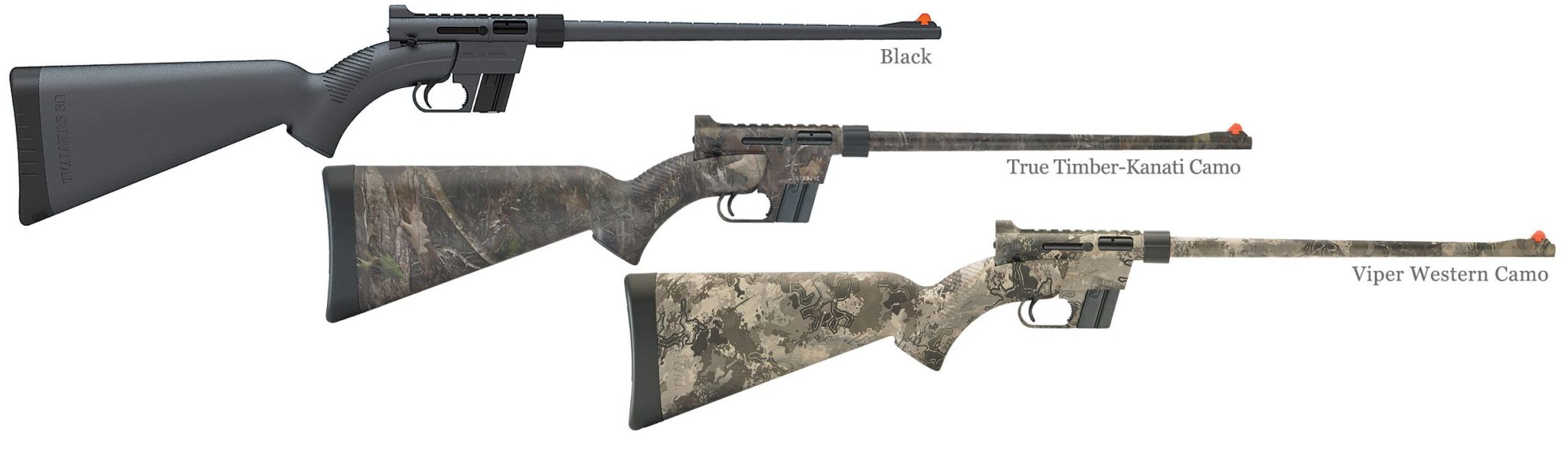
If you don’t like basic black, Henry offers two camo versions from the factory: True-Timber Kanati Camo, and Viper Western Camo. Click the photo below for full-screen (2048 pixel wide) image:
Or, if you have artistic skills (and confidence with spray cans), you can paint your AR-7 yourself, as this owner did. The talented gun-painter reports: “[This is a] great little gun that is accurate and I love how it packs away. I paint all my black guns. Already took a grouse at 16 yards.”
History of the Henry AR-7 Rifle
Starting in 1959 the AR-7 was provided to U.S. Air Force fliers as a survival rifle to use if they were stranded in a remote area. Today the AR-7 is a favorite of bush pilots, backpackers, and backcountry adventurers who, like their Air Force counterparts, need a rifle that’s easy to carry yet can take down small game. Like the original Henry U.S. Survival Rifle, this innovative, semi-automatic rimfire rig is lightweight (3.5 lbs.) and highly portable. At just 16.5″ long, with all components stowed, it easily fits into a backpack, or the cargo area of an ATV, truck, boat. or plane. The AR-7 is chambered in .22 LR so you can carry plenty of ammo without adding much weight to your gear. When disassembled, all the pieces fit inside the impact-resistant, water-resistant stock.
Assembly is as easy as attaching the receiver to the stock, inserting the barrel, and screwing on the barrel nut. In a few seconds, without any tools, the Henry U.S. Survival AR-7 is ready for action. It now comes standard with a steel barrel covered in tough ABS plastic with a protective coating for corrosion resistance. The Henry U.S. Survival AR-7 is available in three finishes; Black, True Timber Kanati Camo Pattern, and True Timber Viper Western Camo Pattern. All models are equipped with an adjustable rear sight and a blade front sight. As you can see below, the built-in storage can be used to hold magazines and ammunition as well as the rifle components.
Another AR-7 owner posted this review:
Simple Goodness: Henry AR-7 — Fun Modern Version of a Classic
Henry got this modern take of the AR-7 right. Gentle finger-tighten is all it takes to assemble. The funky orange plastic sight on the end of the barrel is kind of loud, but was also easy to target with. Brand spanking new, I was getting grapefruit-sized patterns out of each 8-round mag at 50 feet. For a compact take-down, was surprised that length-of-pull was satisfactory for a six-foot guy. It didn’t feel cramped.
For realistic backpack, bail-out, or bug-out situations this would be a smart choice. It was fussy with a single Rem Golden in the first mag… but after that no problems, and no issues at all with Federal and CCI. The safety is right-handed but large and easy to get used to. The charge handle retracts so [you must] pull it up before pulling back, but that motion seemed to become reflexive pretty quickly. The mag eject is in front of the trigger and pushes forward. All in all, [the AR-7 offers a] really nice, compact form factor. [It is] light, perfect for backpack plinking and … low-rent varmint sniping.





 Federal’s high-resolution, slow-motion video-graphy helps demonstrate which loads are the best for specific uses. The ultra-slo-mo footage provides a detailed view of each bullet penetrating ballistic gelatin blocks. These blocks closely mimic animal tissue and clearly display performance characteristics.


 In this NSSF video, Ryan Cleckner shows how to set up a scope on a hunting or tactical rifle. Ryan, a former U.S. Army Sniper Instructor, notes that many hunters spend a small fortune on equipment, but fail to set up their rifle to use the optics optimally. Cleckner likens this to someone who owns an expensive sports car, but never adjusts the seat or the mirrors.