State and regional fish and wildlife representatives from across the country recently visited SIG SAUER, Inc. headquarters and the SIG SAUER Academy in New Hampshire. These groups came to see the firearm manufacturing process. This would help them understand how guns and ammo excise taxes fund a sizable portion of modern conservation agency jobs, research, habitat projects, equipment, and technology.
Gun Industry Funds Wildlife Conservation
One of the most significant funding sources for conservation derives from firearm, ammunition, fishing and archery equipment manufacturers through the Wildlife and Sport Fish Restoration program. Nearly $1.1 billion in funding is generated annually.
Participants toured the manufacturing facility, seeing every step of the manufacturing process – they even tested the firearms at SIG SAUER Academy. This collaborative event was made possible through the Partner With A Payer Initiative, which connects state and federal agency staff to the manufacturers whose products generate excise taxes, enabling vital conservation work throughout the USA.
Major partners of this tour include the U.S. Fish and Wildlife Service (USFWS), NSSF — The Firearm Industry Trade Association, and Council to Advance Hunting and the Shooting Sports (CAHSS). The event was featured as part of the annual National R3 Symposium that focuses on the the recruitment, retention, and reactivation of target shooters and hunters. That in turn helps the represented agencies increase conservation funding via excise taxes.
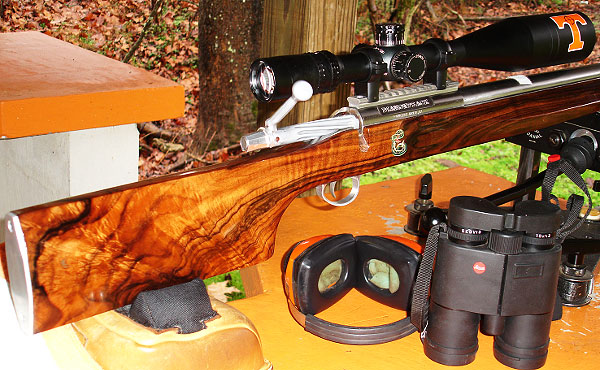
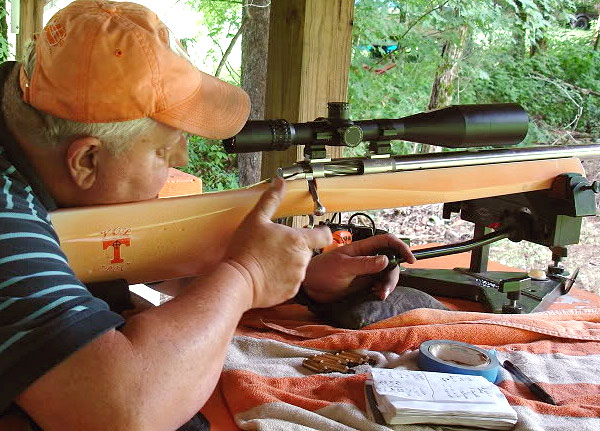
Shooting Prairie Dogs at extreme long range takes some highly specialized equipment. Forum Member VolDoc and his friends have taken long-range varminting to a whole new level. With his Savage-based, Hart-barreled 20 BR, VolDoc managed a verified 1,032-yard Prairie Dog kill, possibly the longest recorded with a .20-Caliber rifle. But that’s just part of VolDoc’s impressive precision varminting arsenal. Here we showcase three of VolDoc’s accurate rigs: his stunning English Walnut Diamondback 6BR/Dasher, his Nesika-actioned “Orange Crush” Dasher, and the 1K Prairie Dog-slaying 20 BR Savage.
Diamondback Switch-Barrel Rifle Specifications
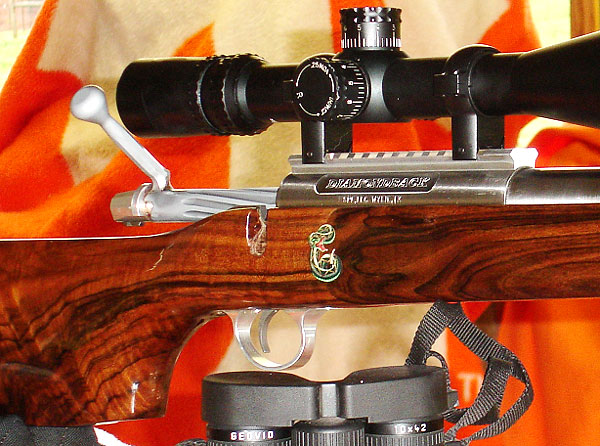
The action is a Stiller Diamondback, drop-port. The custom stock is similar to a Shehane ST-1000, but crafted from 40-year-old English Walnut. [Editor’s note: the wood on this gun is gorgeous!] There are three barrels for the gun with three different chamberings: 6BR Brux 1:8″-twist HV; 6BRX Krieger 1:8″-twist HV, and 6mm Dasher Krieger 1:8.5″ twist fluted straight contour (no taper). The scope is a Nightforce 12-42x56mm, with 2DD reticle.
Comments: This rifle is a good study in comparison of the three different chamberings. On the same rifle platform (same stock and action), each of these barrels had killed prairie dogs over 1,000 yards. So if someone asks which is best, a 6BR, or 6BRX, or 6 Dasher, VolDoc says they are all effective. The improved cartridges will deliver higher velocities, which can be an advantage. On the other hand it is simpler to load 6mmBR brass right out of the box, and it’s easy to find an accurate load for the 6mmBR (see photo).
Nesika 6mmBR/Dasher Rifle Specifications
VolDoc’s “Big Orange Crush” rifle has a stainless Nesika ‘J’ action, with 2 oz. Jewell trigger, in a painted fiberglass Shehane ST-1000 stock. Originally a 6BR, the gun is now chambered as a 6mm Dasher with a .271 no-turn neck. The barrel is a 1:12″-twist Krieger fited with Vais muzzle brake. On top is a NightForce NXS 12-42x56mm scope with double-dot reticle. The double-dot gives precise aiming and lower dot can be used as an aming point, when you need a few more MOA of elevation in the field.
Comments: Big Orange Crush shoots 87gr V-Maxs into bugholes at 3,400 fps. VolDoc’s load with the 87s is very stout, more than 32 grains of Vihtavuori N-135 with Wolf SRM primers. Cases are full-length sized, with an 0.266″ bushing for the necks.
This 3400 fps load with the 87gr V-Maxs has accounted for hundreds of Prairie Dogs killed from 97 yards to 1,050 yards. The 87gr V-Max at this speed literally picks Prairie Dogs up and throws them 10 feet vertically and laterally. VolDoc reports: “The barrel now has more than 3,000 rounds down the tube and exhibits little throat fire-cracking and no loss of accuracy. I can’t explain why, it just hasn’t deteriorated yet. This rifle is my best-ever ‘go-to’ Prairie Dog rifle.”
Savage 20 BR Rifle Specifications
The action is a Savage Dual Port, with an aftermarket Sharp Shooter Supply (SSS) 4 oz. Evolution trigger. The stock is a modified Savage factory unit that has been pillar-bedded. The factory barrel was replaced with a 28″ Hart stainless, 1:9″ twist barrel fitted with a Rayhill muzzle brake. The gun is chambered in 20 BR with a 0.235″ no-turn neck. Kevin Rayhill did the smithing. To provide enough elevation to shoot at 1,000 yards plus, Ray fitted a +20 MOA Bench Source scope base. This +20 rail is very well-crafted, and made especially for the Savage Model 12.
Comments: VolDoc reports: “When I got the Savage back from Kevin Rayhill, it still had my 6 BR factory barrel on it, as I use it to compete in Factory-class regional matches. I put on the new 20 BR Hart barrel Kevin had chambered and quickly put in a full day of load development using the 55gr Bergers (0.381 G1 BC) and the 40gr V-Maxs. Both proved very easy to tune and I soon had my loads. My 55gr Berger load with runs about 3590 fps. Varget was very accurate with the 55s (see load dev. targets below).
The mild recoil of the 20 BR, along with a very good muzzle break (Rayhill’s design) enables me to spot every hit or miss myself. Kevin also re-contoured the underside of the Savage stock so it tracks straight back on recoil, also making seeing hits easier.”
The 20 Caliber 1000-Yard Prairie Dog Quest
Making the 1032-Yard Shot with a 20 BR by Dr. John S. (aka “VolDoc”)
This article covers my recent successful quest for a 20-caliber varmint kill past 1,000 yards. This may be a first — I couldn’t find anyone else with a confirmed 20-Cal Prairie Dog kill at 1000+. I started a thread on the Varmint section of the AccurateShooter.com Forum about building a 20 BR capable of 1,000-yard Minute of Prairie Dog accuracy and many said 20 Cal bullets just could not do it. Some came to my defense and said those that doubted had never studied the ballistics of the 20BR with the new Berger 55gr bullets now available. Well, folks, I can tell you, hitting a Prairie Dog at 1000 yards isn’t easy — but it IS possible. Here’s how it was done….
Gale-Force Winds and High Temps
After arriving at our Prairie Dog Ranch in Colorado, I soon realized my quest was going to be especially difficult because we had continual 40+ mph winds and 100° heat every day. We had a special place where Birdog and I had made many 1,000-yard+ kills in years past, so I knew the ideal location but needed a small window of opportunity either early morning or late afternoon. Based on past experience, I knew I needed about 21 MOA from my 100-yard zero to get to 1,000 yards. On the first day of the Safari, I shot the 20 BR in the 45 mph brutal winds and heat of 97°. But after about 20 shots, I connected on a dog and lifted him about three feet high. Well, that’s a start.
Winds Subside — Here’s Our Chance …
On the second day of our shoot, I had listened to the early weather forecast, so I knew that there was to be a brief period of light winds early in the morning. We were out on the Colorado prairie at daylight and the conditions were perfect. The sunrise was at my back and we had about a 10 mph tailwind. I looked through my Leica Geovid Rangefinder Binos and the Prairie Dogs were out for breakfast. I quickly ranged the targets and found a group at about 1,050 yards. The technique is to find the dogs, range them, click-up according to your ballistic chart and shoot.
My first shot was very, very close. I added about four clicks up and a couple of clicks left for windage and let another go. That shot threw dirt all over, but the dog didn’t even flinch. This is another good point to remember about long-range Prairie Dog hunting. To be successful, the dogs can’t be too skittish, because if they have been shot at even a few times, they will go down and stay down. So, you should have an agreement with those in your party as to where each member is going to be shooting and respect this boundary. Drive-by shooting style is OK if that’s your thing, it’s just not mine.
Hitting the Mark — Dead Dog at 1032 Yards
On the fourth shot, I saw the dog go belly up and kick its final throws. My quest for the 20-Caliber 1,000-yard Prairie Dog had become a reality. We confirmed the distance with our lasers at 1,032 yards. Our technique for retrieving a dead dog at that range is worth mentioning. When I killed that dog, I left it in the crosshairs of my Nightforce scope. My shooting buddy kept looking through the scope (of my gun) and guided me to the deceased dog using Motorola walkie-talkies. When I got to the dog I was jubilant. I marked it with my tripod and orange jacket, and we took some pictures. (See view through scope photo below). The 55gr Bergers require a center mass hit as they will not expand, especially at that range. I centered this dog in the head — his BAD LUCK, my GOOD.
After making the 1,032-yard kill, I shot many many other Prairie Dogs with the Savage 20 BR using the 40gr V-Maxs. The dog flights were spectacular — red mist and helicopters, counter-clockwise or clockwise on demand. I killed at least five at over 500 yards. I will not use the 55 Bergers on Prairie Dogs again since the quest is over. I will use the 40gr V-Maxs and 39gr Sierra BlitzKings for next trip’s 20 BR fodder.
If you need a good hunting rifle, consider a Tikka. The latest generation Tikka T3x rifles are very popular with hunters around the globe — for good reason. These rifles offer smooth-running actions, easy sub-MOA accuracy with good ammo, crisp triggers, and reliable detachable box magazines. The Tupperware stocks aren’t super-rigid, but they are comfortable and easy to handle. The Tikka T3 and T3x models are smart choices for hunters, offering good performance for the price (starting at $629.99 for the T3x Lite, now on sale at EuroOptic.com). Tikka’s T3x series includes a wide selection of chamberings, from .204 Ruger up to the large magnums.
Testing the T3x Series on the Range — Fun in Finland
This video was produced at a range in Finland. Tikka product manager Taneli Pokkinen shoots three Tikka rifles — the first two prone, off bipod, and the third standing (as a hunter might shoot). You can see the recoil of various chamberings, plus the accuracy at 100m, which is pretty impressive. Rifles tested are: 1) Tikka T3x Varmint Hunter; 2) Tikka T3x Super Varmint (with suppressor); 3) Tikka T3x Roughtech Ember. NOTE: At 4:30 there is a 5-shot group from the Super Varmint as shot by a gunsmith. All shots are touching — very impressive!
These two short videos explain two key features of modern Tikka rifles — the smooth running bolt and the precise, crisp, and relatively light trigger. We recommend you check out both of these tech videos if you’ve never handled a Tikka rifle before. Tikkas really do have very good factory triggers, with bolt smoothness that rivals some custom actions.
Tikka Rifles — Five Recent Models Reviewed
If you are considering a Tikka for PRS/NRL, check the first segment of this video covering the Tikka T3x TAC A1. In order, here are the five (5) Tikka rifle reviewed, with video start times (if you want to skip around): 1. Tikka T3x Super Varmint (00:40, video only); 2. Tikka T3x TAC A1 (01:13); 3. Tikka T3x Super Varmint (02:34); 4. Tikka T3x Lite Roughtech Ember (05:12); 5. Tikka T3x Varmint Hunter (wood) (07:31). Note: The review sections are done by a knowledgeable Tikka product manager Taneli Pokkinen. CLICK HERE for 40+ Tikka factory videos.
Tikka T3X — Hickok45 Shows Function and Shoots at Steel Plates
Popular YouTube gun reviewer Hickok45 reviews the Tikka T3x Tactical Compact Rifle in 6.5 Creedmoor. There are good explanations of the operation of the action and magazine. In addition Hickok45 shoots the rifle offhand (05:10 and 13:44 time-marks), evaluating the ergonomics of the stock and the trigger feel. Hickok45 now has 7.98 million subscribers to his YouTube Channel.
Tikka T3x Compact Lite Roughtech Ember
The Tikka Compact Lite Roughtech Ember has a handsome brown polymer stock with subtle camo. This nicely-finished 6.8-pound rifle comes with a stainless fluted barrel fitted with factory muzzle brake. It is on sale currently starting at $939.99 at EuroOptic.com. The stock has interchangeable pistol grips for various shooting positions. The fore-grip has attachment points, allowing forearm width to be increased. In this video, at the 8:40 time-mark, the trigger is adjusted to crisp 2.5 pounds, as verified with a trigger gauge. That is excellent for a factory trigger.
Why the TIKKa T3x Is Great for Hunting
With 970,000+ subscribers, the Backfire Channel is one of the most popular gun channels on YouTube. You can trust Backfire reviewers because they pay their own money for all the products they review. This video reviews current generation Tikka rifles. Backfire had high praise for Tikka T3x rifles: “The Tikka T3x SL is an incredibly lightweight mountain rifle that should be in every hunter’s safe. We like it for its lightweight build, stainless steel barrel, superb trigger, and surprisingly accurate shooting. Overall, this is the hunting rifle we recommend more frequently than any other.”
TIKKA T3x TAC A1
Along with the hunting rifle models, Tikka also produces quality, metal chassis tactical-style rifles. The Tikka T3x TAC A1 has earned considerable praise and is PRS/NRL competition-ready right out of the box. The T3x TAC A1 is offered in multiple calibers/chamberings, barrel lengths, and chassis colors. The impressive T3x TAC A1 retails for $1999.00 – $2319.00 at EuroOptic.com.
BONUS: TIKKA T3x vs. Ruger American
This comparison video compares the Tikka T3x with the Ruger American rifle. The reviewers explain the key differences and the pros and cons of each type. The video examines the receivers, barrels, triggers, and stocks of the Tikka and the Ruger. What’s the bottom line? Well the Ruger has a price advantage, but the Tikka T3x has a better trigger, nicer action, better magazines, and probably better 5-shot accuracy.
This custom war wagon hauls varmint hunters around the Longmeadow Game Resort in Colorado.
Today is May Day, May 1st, so we are well into springtime. The woes of winter are behind us. For many shooters, Spring is a great season to head out to the varmint fields. Here are six items that can help ensure successful spring varmint adventures.
Six Great Products for Varmint Shooters
1. BarrelCool In-Action Fan
Busy Varmint shooters may expend hundreds of rounds in a day. That’s tough on barrels. One way to extend your round count is to use the ingenious BarrelCool device. This little yellow gadget fits in your action with a blower tube that goes into the chamber. A small electric fan blows cooling air through the barrel. It really works — folks who’ve purchased the $44.95 Barrel Cool and run temp strips on their barrel say the BarrelCool can significantly reduce the time it takes to cool down a hot barrel.
In the past, folks have tried various methods to cool barrels: water flushed through the bore, CO2 tanks, even battery-operated fish pumps. BarrelCool is a simpler, less costly, and much handier solution. Priced at $44.95, this small device can potentially can save you money by extending barrel life. To see how Barrelcool works, watch the video below:
2. Uncle Bud’s Bulls Bag Sandbag
On most varmint hunts we spend most of the time shooting from a portable bench with a pedestal-type rest (we like the SEB Mini). But it’s nice having a big, heavy X-Type sandbag rig also. These four-chamber designs, such as the Uncle Bud’s Bulls Bag, allow shooting from a truck hood or any flat surface. Some rifles with narrow fore-ends really benefit from the firm “hug” provided by these “butterfly” style sandbags. We like the 15″ Uncle Bud’s Bulls Bag, currently $80.00 at BullsBag.com (khaki/suede). Durable and well-made, it will provide years of service. There is also a 10″ version that is easier to carry, starting at $62.00. Forum member Stoner24mkiv likes a Bulls Bag for shooting from a vehicle. He also suggests: “[take] an adjustable bipod if you are going to do any walking. Have a fanny pack or backpack for extra ammo, water, bore-snake, etc. when you go on your walkabouts. Bring a Boonie hat for blocking the sun, sun glasses, sunscreen. High leather boots.”
3. Burris Scope with Built-In Laser Rangefinder
The Burris Eliminator is an impressive piece of electro-optical technology. With a push of a button, a built-in laser rangefinder senses the distance to your target and the Eliminator’s microprocessor instantly calculates the required hold-over based on your load’s ballistics. The calculated aiming point is then displayed in the reticle with an illuminated red dot on the vertical cross-hair. Just put the red dot on the target and make the shot. Easy as that. If you are working a large prairie dog field and constantly moving near to far and back again, this scope is really handy. We’ve used the Eliminator III out to 500 yards on small steel targets and it worked flawlessly.
Right now you can get the 5-20x50mm Burris Eliminator V model for $1183.99 on Amazon (#ad — you must add to cart to see this price). Or you can get the 4-16x50mm Burris Eliminator III model for $1167.40 on Amazon (#ad). Note: the Eliminator V has been replaced by the compact Eliminator 6, but that newer model costs $2499.99. The Eliminator III and V both offer better value for the price.
4. Hornady 17 HMR V-Max Loaded Ammo
For those distant prairie dog shots, you’ll want a centerfire round with some reach, such as a 22 BR or 22-250. However, for closer work, or for smaller varmints such as ground squirrels, the 17 HMR is hard to beat. There are many good factory rifles chambered for the 17 HMR, such as the Savage A17 (shown below). Right now Hornady 17 HMR ammo is on sale at AmmoASAP.com for $12.05 ($0.24 per round). That’s a good deal. This same ammo sells elsewhere for up to $18.00 per 50-round box. NOTE: Hornady also offers 17 HMR ammo with 20gr XTP hollow-point bullets. Both types work well.
5. Stick-On Temp Strips Monitor Barrel Heat
You never want your barrel to get too hot. Accuracy suffers when barrels over-heat, and excessive heat is not good for barrel life. So how do you monitor your barrel’s temperature? You can check if the barrel is “warm to the touch” — but that method is not particularly precise. There is a better way — using temperature-sensitive strips. McMaster.com (an industrial supply house) offers stick-on temp strips with values from 86° F to 140° F. A pack of ten (10) of these strips (item 59535K13) costs $12.66 — so figure it’ll cost you about $1.27 per barrel for strips. That’s cheap insurance for your precious barrels. For best barrel life, try to stay under 120 degrees F.
6. Low-Fouling Power for High-Volume Varmint Loads
For high-shot-count varmint safaris, you want a clean-burning powder that minimizes barrel fouling. While there are many great powders for the .223 Rem, we like Hodgdon CFE 223 for high-volume varmint loads. This powder really seems to keep barrels cleaner. Originally developed for U.S. rapid-fire military systems, CFE 223 incorporates a proprietary chemistry named “Copper Fouling Eraser”. Based on tests with extended shot strings, Hodgdon claims that, by using CFE™223 varmint hunters, match shooters, and AR shooters can maintain accuracy for longer periods, with less barrel-cleaning time.
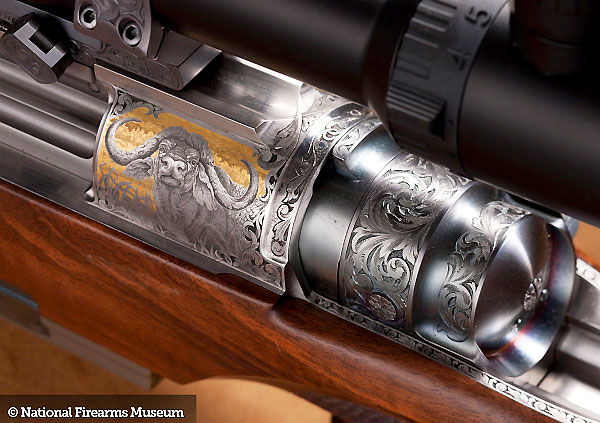
One of the most unique and exotic rifles in the NRA Museum is the Fuchs Double Barrel Bolt Action Rifle. “This is the … most substantial bolt action rifle ever made,” said NRA Museums Senior Curator Philip Schreier. This unique double barrel bolt-action rifle loads two cartridges at the same time. It is the world’s only repeating double rifle design. Incorporating titanium components to reduce weight, this .416 Remington Magnum rifle has an eight-shot capacity, feeding from a beautifully engraved massive magazine assembly mounted under the receiver. Hungarian inventor Joseph Szecsei developed this innovative design after being charged simultaneously by three elephants in 1989. These rifles are sold by Fuchs Fine Guns in Innsbruck, Austria.
An engineering tour de force, this elaborately engraved rifle is also a work of art. On the action, and bottom metal are engraved images of the “Big Five” African game species: elephant, cape buffalo, rhino, lion, and leopard. This rifle has been featured on Curator’s Corner on the Outdoor Channel, and it now resides behind glass in the Robert E. Peterson Collection at the NRA Museum.
Here gun builder Gerhard Fuchs explains the features of the exotic double-barreled bolt-action rifle:
This amazing twin-barreled bolt-gun has a unique closing mechanism that locks two separate bolt bodies into the chambers of the right and left barrels. Yes there are two firing pins, two ejectors, two extractors, and two triggers. We’re not sure how one jumbo camming system closes two bolts — Perhaps one of our gunsmith readers can explain how this system works.
This Rifle Has TWO Barrels and TWO Bolts
Just $78,000 at “Half-off Pricing”
Shown here (above and below) is another Fuchs double bolt rifle chambered in .416 Remington. This example, without the “Big Five” animal engravings, sold a few years back on Gunbroker.com for $78,000. That astronomical sum is just half the original cost, according to the seller. This amazing double safari rifle has 22″ barrels and weighs 11.5 pounds.
More Eye-Catching Examples of the Fuchs Double Barrel Rifle
Along with the rifle featured in this article, you can see other Fuchs Double Barrel Repeater rifles with the same twin-bolt action on the Fuchs Fine Guns website. Here are examples.
With spring soon changing to summer, we are in peak varmint season in many parts of the country. In an area with a high number of critters, a semi-auto varmint rifle is a good choice. You get quick follow-up shots, with reliable 20-rd and 30-rd magazines.
For this Saturday at the Movies Showcase we feature a variety of semi-auto, AR-platform rifles chambered for efficient, high-velocity varmint ammo. Cartridges include: .17 WSM, .17 Remington, .20 Practical, .204 Ruger, .22 Grendel, .223 Rem, and 6mm ARC. We conclude with a video that reviews a variety of lead-free .223 Rem ammo types.
Rock Chuck Hunting in Eastern Oregon
This video has some great backcountry footage. The host nails a number of rockchucks with his .223 Rem-chambered AR-15. The shooter says that the default AR-15 cartridge works great for varmints: “The .223 Remington becomes a rockchuck hunter’s friend with the right load: Nosler 40gr Ballistic Tip loaded over a stuffed case of H335 powder. This achieves 3800 FPS with excellent accuracy.”
.17 Remington AR-15 — Small Bullet, Ultra-High Velocity
The .17 Remington wildcat is based on the .223 Remington case necked down to .172″, with the shoulder moved back. High muzzle velocity (4000+ FPS), flat trajectory, and very low recoil are the .17 Remington’s primary attributes. It has a maximum effective range of about 440 yards on prairie dog-sized animals, but the low BCs of the small .17-cal bullets makes them quite susceptible to crosswinds at such distances.
This Varminter.com video was created in spring 2022, just in time for Rockchuck and Thermal Coyote hunts. The host noted: “This was my first experience with the .17 Remington, but I was not unaware of its history and steady popularity among varmint and predator hunters. Although finding an available and affordable .17 Remington bolt-action rifle is nearly impossible nowadays, building one in an AR-15 was simple and straight-forward.” The video has full description of all the components for the build. The .17 Rem is fast — the 25gr bullet runs 3777 FPS from an 18″ barrel (see 01:42 time-mark). READ Full Story.
.17 WSM Rimfire in Franklin Armory F17-L
What’s the ultimate rimfire varmint rifle? An AR chambered for the .17 WSM could be the answer. Eric Mayer of Varminter.com states: “The Franklin Armory F17-L in .17 Winchester Super Magnum (WSM) has a lot of firsts. It is the first semi-automatic rifle in .17 WSM now available to the general public. It is the first gas-piston system, AR-15 rimfire rifle built in partnership between Franklin Armory and Osprey Defense.”
Eric has used the .17 WSM AR shooting ground squirrels, rock squirrels, prairie dogs, and rabbits. Eric notes: “The report of the .17 WSM is nowhere near as loud as most of the centerfire [varmint] cartridges. I found that when I shot the FA-17, it did not cause the other ground squirrels… to run for cover. The lack of recoil … allowed me to see right where I hit [and] if I happened to miss, [low recoil] made for quick corrections for wind, or distance.” READ Full Report
The .17 WSM is a much larger, more powerful round than the .17 HMR. See the size difference above.
Eric Mayer created his own custom .17 WSM AR-15 varmint rifle, built with a Franklin Armory F17-V4 Upper, Aero Precision Lower, and Magpul stock. This was used in California and Arizona. READ Full Story.
.20 Practical — Fast, Accurate, Easy to Form
The .20 Practical cartridge is simply a .223 Rem necked down to .20 caliber. This is a great choice for prairie dogs — and probably our favorite wildcat for the AR-15. Just neck down your .223 Rem brass, fit a .20-Cal barrel and you’re good to go. Robert Whitley notes the the .20 Practical “is a perfect cartridge for varmint hunting and general shooting — very accurate and fast! It functions 100% out of an AR-15.”
The .20 Practical offers some notable advantages for high-volume varmint shooters. The .20 Practical delivers very high velocity with very low recoil while still providing outstanding accuracy. The .20 Practical is great option for folks who favor “fast and light” — smaller, lower-mass bullets traveling at very high velocities. This little cartridge can launch 40-grainers at over 3900 FPS, and 32-grainers even faster. This makes the .20 Practical a great choice for an AR-based varmint rifle.
.20 Practical Ultimate AR Varminter
A decade ago AccurateShooter.com created a .20 Practical AR15 Ultimate Varminter with a custom 20-caliber upper from Robert Whitley of AR-X Enterprises, LLC. That project rifle was ultra-accurate — every 5-shot group out of the gun was less than the size of a dime. That gun was auctioned off, but Robert Whitley continues to produce custom 20 Practical AR-15 uppers.
You make .20 Practical cases by simply necking down .223 Rem brass to .20 caliber. You can start with standard .223 Rem brass and even load with standard .223 Rem dies. Just swap in a smaller expander and use smaller neck bushings.
Prairie Dog Hunt with .204 Ruger AR — Watch The P-Dogs Fly
The video was created during a 2018 prairie dog safari. It has stunning footage of hits on P-Dogs at multiple distances. You can see over FIFTY hits with some amazing P-Dog aerials. Watch the first flyin’ dog at 00:20 time-mark and there’s a truly spectacular gut-busting hit at 3:13. That shows the potency of a high-speed .20-cal projectile. The shooter was using a custom-built AR-15 chambered in a .204 Ruger. That cartridge was driving 35gr Berger hollow point bullets at a stunning 4050 FPS! The rifle was fitted with a Dakota silencer suppressor and many other custom components. If you’ve never tried prairie dog hunting, watch this video start to finish and you may be hooked.
6mm ARC AR-15 Varmint Rig
This Varminter.com video examines the 6mm ARC cartridge from a varmint hunter’s perspective. Created by Hornady, the 6mm ARC was designed for target shooting and medium-sized game both in bolt guns and Modern Sporting Rifles. Hornady states: “The 6mm ARC … fits in an AR-15-pattern action, functions reliably out of standard-capacity 24- or 17-round magazines. It delivers substantially better ballistics than the .223 Rem[.]” This video examines how the 6mm ARC performs in an AR-15 for varmint and predator hunting. The host reviews available factory varmint loads. The video also examines reloading components for the 6mm ARC — brass and bullets. CLICK HERE for full article.
Cottontail Rabbit Hunting with Suppressed .204 Ruger AR-15
As a varmint hunting tool, the .204 Ruger in an AR-15 is a versatile, worthy cartridge/rifle combo for the job. This video covers a cottontail rabbit hunt. The host states that “We were contacted by a farmer who was being slammed with cottontail rabbits eating out huge portions of his alfalfa fields.” This suppressed .204 Ruger AR-15 proved seriously effective on the rabbits, driving high-velocity rounds with impressive accuracy. See more details on the Varminter.com website.
The .22 Grendel is an extremely accurate and efficient cartridge based on the 6.5 Grendel necked down to .22 caliber. The case can drive 55gr varmint bullets at high velocities — over 3500 FPS. With a faster-twist barrel you can load up to 90gr bullets at 2500 FPS. The tester achieved velocities close to a 22-250. The short, fat case fits in AR-15 magazines, but may not feed as reliably during rapid fire. The tester did experience one double-feed.
Lead-Free Ammo Offerings Tested in .223 Rem AR-15
Some states — such as California — prohibit hunting with bullets that contain lead. If you plan to hunt in an area with such restrictions, you’ll need to find a lead-free substitute. Thankfully a number of manufacturers produce ammo with solid brass projectiles or other lead-free bullet designs. This Varminter.com video reviews .223 Remington no-lead ammunition from Cor-Bon, Hornady, Nosler and Winchester. These ammo types were tested in a AR-15 varmint rifle, used in a coyote hunt featured at the end of the video. SEE Full Story on Varminter.com.
It’s nearly Easter and the 2025 outdoor season is well underway. Do you have a good first-aid kit in your vehicle to deal with possible injuries to family members of all ages? For just $20.00 you can get an excellent kit from Be Smart/TRI, the #1 maker of First Aid Kits in the USA.
TRI’s Be Smart Get Prepared First Aid Kit has 201 items inside a sturdy case with shoulder strap and carry handle. There is also a handy, detachable mini pouch with key essentials for first aid on-the-go. You can easily bring the mini-pouch along on a bike ride or hike.
This multi-purpose First Aid Kit includes:
• 50 – Bandages 3/4 x 3
• 30 – Bandages 3/8 x 1 1/2
• 6 – Bandages Closure
• 3 – Knuckle Bandages
• 1 – Tapes – .5 x 2.5yd Waterproof
• 10 – Cotton Tips – 2.75″”/10 Pack
• 4 – Finger Splints
• 1 – First Aid Guide
• 4 – Gauze Pad – 2 x 2 / 4 ply
• 4 – Gauze Pad – 4 x 4 / 4 ply
• 1 – Gauze Pad – 5 x 9
• 2 – Nitrile Gloves
• 1 – Instant Cold Pack – 5 x 6
To help ensure that outdoor adventures remain safe and trouble-free, the CTD Shooters’ Log has a helpful Essential Summer Survival Guide. This is worth reading before you venture away from civilization.
Here are some highlights of the article with links for MORE INFO:
First Aid Kits for Campers
You should never venture outside without a first aid kit close at hand. While exploring the outdoors, all types of accidents can occur—from cuts, scrapes, and burns to broken limbs and severe allergic reactions.
Basic Survival Skills
Basic survival skills are a necessity if you plan to spend any amount of time outdoors. These five tips, plus a how-to on what to pack in a lightweight, basic survival kit will help if you are ever stuck, lost, stranded or injured in the field.
How to Treat Burns
Fireworks, barbeques and campfires — in the summer we are frequently around fire, which increases our chance of getting burned. A first-degree burn is most likely home treatable, while a third degree burn requires immediate medical attention. Learn how to spot the differences between minor and severe burns.
For our readers who are stuck at home under government orders, we are reprising a video feature about hunting in Norway. For those whose horizons have been limited due to the “shelter at home” response to the Coronavirus pandemic, we offer this getaway to scenic Vesterålen in northern Norway…
This is one of the finest shooting videos we’ve ever seen. Set in the scenic Vesterålen archipelago of northern Norway, this high-quality 15-minute video is part National Geograhic travelog, part ballistics lesson, part gear review. Given the current COVID-19 lockdowns, we wish we had the opportunity to join Ulf Lindroth and Thomas Haugland on their remarkable shooting adventure. This video was originally created for Great Britain’s Fieldsports TV Channel.
This is an outstanding video, recommended for anyone interested in long-range hunting.
Long range shooters Lindroth and Haugland traveled to the Arctic Circle to field test a new .338 LM Blaser R8 (in GRS stock) fitted with a Zeiss Victory V8 4.8-35x60mm scope. (Ammo is Norma-brand .338 Lapua Magnum). The video shows how they confirm the ballistics of the Norma factory ammo in the Blaser R8 rifle system.
Ulf and Thomas initially test out the system confirming drop at multiple yardages, and then use the rifle for practical accuracy. Ulf says: “If you know your hunting will demand a long shot, and you want to push the limit but still be sure to make the first-shot kill… If you want to do an ethical hunt, if you want to push that limit, you have to do [this kind of testing].”
Ulf Lindroth (above) observed: “We shot [at 808 meters] observed the misses, clicked our way into the target, and now we have the true drop at that distance… in this air pressure, in this temperature. From there we can start working to find our TRUE trajectory. And when we have THAT… we can get serious about some target shooting.”
.338 Lapua Magnum — Big-Bore High-Performance Cartridge
From WikiPedia: The .338 Lapua Magnum (aka 8.6×70mm) is a rimless, bottlenecked, centerfire rifle cartridge. It was developed during the 1980s as a high-powered, long-range cartridge for military snipers. Due to its use in the War in Afghanistan and the Iraq War, the cartridge has become widely available. The loaded .338 LM cartridge is 8.6 mm (0.34″) in diameter and 93.5 mm (3.68″) long. Muzzle velocity is dependent on barrel length, seating depth, and powder charge, and varies 2,890 fps to 3,000 fps for commercial loads with 250gr bullets.
A recent scientific discovery in Washington State suggests that areas in North America once harbored large colonies of giant, man-sized rodents — distant cousins to today’s prairie dogs.
In late 2024, while searching for ancient dinosaur fossils, a field team of Princeton University paleontologists has uncovered a startling find — the skull of a massive prehistoric rodent, along with other skeletal remains.
The skull, nearly the size of a horse’s head, is almost identical in form to the skull of a modern-era prairie dog, though it is is more than 50 times as large. Apparently today’s Black-Tailed Prairie Dogs had some very large predecessors. Based on the size of the skull and other bones, scientists estimate that the giant prairie dogs could stand up to 7′ tall and weigh up to 350 pounds. In other words, this critter was man-sized.
The giant rodents lived much like modern prairie dogs do today — grazing on vegetation and nesting underground in burrows. The giant skull was unearthed in Washington’s Mima Mounds Natural Area Preserve. View More: Mima Mounds Aerial photo.
Mystery of Mima Mounds Finally Solved
Southwest of Seattle, near Littlerock, Washington, you’ll find the Mima Mounds, a vast field of clustered earthen mounds covering over 600 acres. Since their discovery (by whites) in the 18th century, the Mima Mounds have confounded scientific explanation — until now that is. The location of the giant prairie dog skull and bones inside one of the Mima Mounds indicates, with great certainty, that the mound field was created by a large colony of giant burrowing rodents. Scientists now believe that the Mima Mounds area is a prehistoric prairie dog field, created by the creatures scientists have nicknamed “Big Dogs”.
NW Indian Legends Spoke of Giant Prairie Dogs
The presence of the giant prairie dogs at Mima Mounds is confirmed by Northwestern Indian legends describing a giant burrowing beast that stood as tall as a man, when raised on its hind legs. Researchers, who transcribed oral histories of the Sauk-Suiattle tribe, have recorded numerous references to a large, man-sized creature that burrowed underground. In the Suiattle language the beast was called “Chok-lahtle-wachook”, which, literally translated, means “Standing Man-Mouse”. A number of ancient Indian carvings and artifacts have depicted this creature (see photo at right), but cultural historians had not understood their significance. For decades the historians presumed Chok-lahtle-wachook was a wholly fictional man-beast, not a real species. Such mythical hybrid creatures are commonly revered as important totemic spirits by many Native American cultures. However, it now appears that Chok-lahtle-wachook really existed, and did so in great numbers.
Can Science Revive the Giant Prairie Dog?
The discovery of the giant prairie dog has electrified the scientific community because it appears that bone samples may contain recoverable DNA. And that means — you guessed it — there is a small chance that Chok-lahtle-wachook could be cloned. Geneticist Amy Moorwall of the Univ. of Washington explains: “These are not 100-million-year-old dinosaur bones. This creature lived in relatively recent times, so there is much more genetic material remaining that hasn’t completely fossilized. Initial inspection of bone marrow samples suggest that there may be viable, complete DNA strands that could be recovered. If that’s true, this could be one of our first opportunities to revive an extinct species.”
Varmint Hunters Hope for Successful Cloning
Could Chok-lahtle-wachook once again stand tall upon America’s prairies through the application of modern genetic cloning technology? If so, that would be exciting news for the nation’s hunting community. Varmint hunting is hugely popular in North America, and the possibility of bagging a man-sized prairie dog would be a dream come true for avid varminters. Ryan Stanley of the Varmint Hunters’ Association (VHA) told us that his members hope that the giant prairie dog could be cloned successfully: “We would definitely support a cloning effort. Many of our members spend countless days, over many seasons, trying to earn a 1000-yard patch, signifying a confirmed varmint kill at 1000 yards. Getting that patch, for a varminter, is like a baseball player making it into Cooperstown. Needless to say, if VHA members have a chance to shoot at a 7-foot-tall, 300-pound varmint, instead of a puny little prairie dog, many more of our members will finally earn their 1000-yard patch.”
Spring Groundhog Hunting — Fun and Challenging
Springtime is the right time for groundhog hunting in the Northeast USA. Groundhog hunting is both fun and challenging. In today’s Saturday Showcase, we feature three videos showing successful groundhog hunts. Then there is a video about checking your equipment and verifying your varmint rifle zero.
We’ve even included a good video offering cooking tips for groundhog/woodchuck.* Yes groundhog meat can be quite savory — used in stews, sandwiches, or tacos. Last but not least we’ve included a section on groundhog shooting matches. These are fun matches with paper and/or steel groundhog targets.
Groundhog Hunt Report — Successful Stalk and Shoot
Here’s a great Realtree.com video showing successful groundhog hunts. This covers the process of spotting and tracking groundhogs on farmlands. Woodchucks are sensitive creatures that get easily spooked. This video shows that groundhog hunters need patience and skill, plus an accurate rifle.
Groundhog Hunting on the Family Farm with .17 HMR
In this video, the host employs his CZ 457 rifle chambered in .17 HMR to hunt groundhogs on his farm. The video provides a hunter’s POV with excellent Scope-Cam footage. This young shooter has 280 videos on his popular Blocketh Outdoors Channel including videos showing how to stalk groundhogs successfully. These critters go to ground quickly if they see or hear the hunter. NOTE: The lead photo for this Saturday Showcase comes from another Blocketh Outdoors groundhog video.
Groundhog Killshot Compilation Video
Here’s a classic “killshot” video showing multiple hits on groundhogs. If you want to see how a well-aimed varmint bullet can flip, spin, and elevate a groundhog, this video will keep you entertained. While we like explosive hits on prairie dogs, it may be better to use a solid, non-expanding bullet if you plan to harvest the groundhog (aka woodchuck) meat.
Groundhog Hunting — Importance of Confirming Your Zero
This AR15 Hunter channel video covers getting ready for spring groundhog season. This is a helpful video that shows how to confirm your zero on your varmint rifle. If you have an AR-platform Modern Sporting Rifle, this video is worth watching.
If you don’t have groundhogs in your part of the USA, don’t fret. You can still have fun hunting smaller varmints such as ground squirrels and Prairie Dogs. Here’s a good video covering P-dog hunts with a suppressed .223 Rem AR. The video covers recommended equipment including bipod, tripod, and optics.
Groundhog Matches — Fun Shooting at Paper and Steel ‘Hogs
Along with actual groundhog hunting, many shooters like to shoot paper and/or steel groundhogs in club groundhog competitions. These are fun matches that you can shoot with a variety of rifles. Our first choice would be a 22 BR for ranges out to 450 yards or a 6 BRA if targets are farther out. One popular match in the Northeast is the St. Thomas Ground hog shoot in Pennsylvania (see below).
At clubs across the country, varmint fun shoots (also known as “groundhog matches”) are becoming more popular every year. In these matches, usually shot from the bench, you engage paper targets, clay pigeons, steel “critter” silhouettes, or some combination of paper and reactive targets. Shooters like these matches because you can shoot a wide variety of rifles, you don’t have to spend a fortune to be competitive, and there is fun for the whole family. Rules are inclusive — you won’t be turned away because your rifle is two ounces overweight. A large percentage of the match fees usually go back to shooters in the form of cash prizes. And the level of camaraderie is high.
St. Thomas Groundhog Shoot, Report by Jonathan Trivette
Nestled at the base of a mountain in south-central Pennsylvania is the St. Thomas Sportsmen’s Association. On a cool Saturday morning you’ll find some of the area’s best shooters at the monthly Groundhog Match. The match attracts shooters from Virginia, Maryland, West Virginia, and of course Pennsylvania.
It may not be the longest-yardage match in the area, but it can be the one of the toughest. The range is sloped up the mountain a little so the winds can be very tricky. Often times the three wind flags at 200, 300, and 400 yards will all be blowing in different directions.
* “Groundhog” and “Woodchuck” are simply two different names for the same animal. Both terms have been used in the English language since the 1600s. In many places, the terms are used interchangeably, but “groundhog” is now increasingly more common in the USA.




 Making the 1032-Yard Shot with a 20 BR

 Hitting the Mark — Dead Dog at 1032 Yards


 This amazing twin-barreled bolt-gun has a unique closing mechanism that locks two separate bolt bodies into the chambers of the right and left barrels. Yes there are two firing pins, two ejectors, two extractors, and two triggers. We’re not sure how one jumbo camming system closes two bolts — Perhaps one of our gunsmith readers can explain how this system works.


 .20 Practical Ultimate AR Varminter





 A recent scientific discovery in Washington State suggests that areas in North America once harbored large colonies of giant, man-sized rodents — distant cousins to today’s prairie dogs.
 NW Indian Legends Spoke of Giant Prairie Dogs
 Varmint Hunters Hope for Successful Cloning
 Spring Groundhog Hunting — Fun and Challenging
 Along with actual groundhog hunting, many shooters like to shoot paper and/or steel groundhogs in club groundhog competitions. These are fun matches that you can shoot with a variety of rifles. Our first choice would be a 22 BR for ranges out to 450 yards or a 6 BRA if targets are farther out. One popular match in the Northeast is the St. Thomas Ground hog shoot in Pennsylvania (see below).


