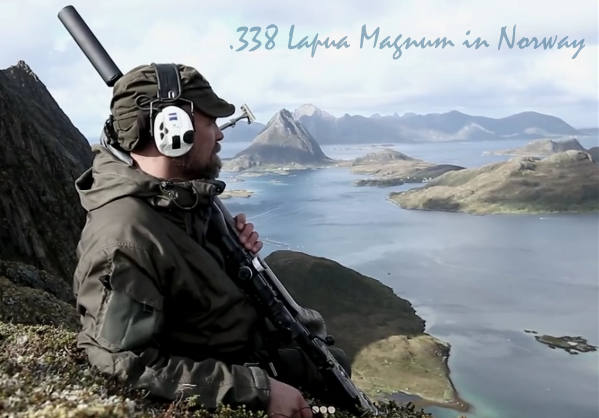
For our readers who are stuck at home under government orders, we are reprising a video feature about hunting in Norway. For those whose horizons have been limited due to the “shelter at home” response to the Coronavirus pandemic, we offer this getaway to scenic Vesterålen in northern Norway…
This is one of the finest shooting videos we’ve ever seen. Set in the scenic Vesterålen archipelago of northern Norway, this high-quality 15-minute video is part National Geograhic travelog, part ballistics lesson, part gear review. Given the current COVID-19 lockdowns, we wish we had the opportunity to join Ulf Lindroth and Thomas Haugland on their remarkable shooting adventure. This video was originally created for Great Britain’s Fieldsports TV Channel.
This is an outstanding video, recommended for anyone interested in long-range hunting.
Long range shooters Lindroth and Haugland traveled to the Arctic Circle to field test a new .338 LM Blaser R8 (in GRS stock) fitted with a Zeiss Victory V8 4.8-35x60mm scope. (Ammo is Norma-brand .338 Lapua Magnum). The video shows how they confirm the ballistics of the Norma factory ammo in the Blaser R8 rifle system.
Ulf and Thomas initially test out the system confirming drop at multiple yardages, and then use the rifle for practical accuracy. Ulf says: “If you know your hunting will demand a long shot, and you want to push the limit but still be sure to make the first-shot kill… If you want to do an ethical hunt, if you want to push that limit, you have to do [this kind of testing].”
Ulf Lindroth (above) observed: “We shot [at 808 meters] observed the misses, clicked our way into the target, and now we have the true drop at that distance… in this air pressure, in this temperature. From there we can start working to find our TRUE trajectory. And when we have THAT… we can get serious about some target shooting.”
.338 Lapua Magnum — Big-Bore High-Performance Cartridge
From WikiPedia: The .338 Lapua Magnum (aka 8.6×70mm) is a rimless, bottlenecked, centerfire rifle cartridge. It was developed during the 1980s as a high-powered, long-range cartridge for military snipers. Due to its use in the War in Afghanistan and the Iraq War, the cartridge has become widely available. The loaded .338 LM cartridge is 8.6 mm (0.34″) in diameter and 93.5 mm (3.68″) long. Muzzle velocity is dependent on barrel length, seating depth, and powder charge, and varies 2,890 fps to 3,000 fps for commercial loads with 250gr bullets.
A recent scientific discovery in Washington State suggests that areas in North America once harbored large colonies of giant, man-sized rodents — distant cousins to today’s prairie dogs.
In late 2024, while searching for ancient dinosaur fossils, a field team of Princeton University paleontologists has uncovered a startling find — the skull of a massive prehistoric rodent, along with other skeletal remains.
The skull, nearly the size of a horse’s head, is almost identical in form to the skull of a modern-era prairie dog, though it is is more than 50 times as large. Apparently today’s Black-Tailed Prairie Dogs had some very large predecessors. Based on the size of the skull and other bones, scientists estimate that the giant prairie dogs could stand up to 7′ tall and weigh up to 350 pounds. In other words, this critter was man-sized.
The giant rodents lived much like modern prairie dogs do today — grazing on vegetation and nesting underground in burrows. The giant skull was unearthed in Washington’s Mima Mounds Natural Area Preserve. View More: Mima Mounds Aerial photo.
Mystery of Mima Mounds Finally Solved
Southwest of Seattle, near Littlerock, Washington, you’ll find the Mima Mounds, a vast field of clustered earthen mounds covering over 600 acres. Since their discovery (by whites) in the 18th century, the Mima Mounds have confounded scientific explanation — until now that is. The location of the giant prairie dog skull and bones inside one of the Mima Mounds indicates, with great certainty, that the mound field was created by a large colony of giant burrowing rodents. Scientists now believe that the Mima Mounds area is a prehistoric prairie dog field, created by the creatures scientists have nicknamed “Big Dogs”.
NW Indian Legends Spoke of Giant Prairie Dogs
The presence of the giant prairie dogs at Mima Mounds is confirmed by Northwestern Indian legends describing a giant burrowing beast that stood as tall as a man, when raised on its hind legs. Researchers, who transcribed oral histories of the Sauk-Suiattle tribe, have recorded numerous references to a large, man-sized creature that burrowed underground. In the Suiattle language the beast was called “Chok-lahtle-wachook”, which, literally translated, means “Standing Man-Mouse”. A number of ancient Indian carvings and artifacts have depicted this creature (see photo at right), but cultural historians had not understood their significance. For decades the historians presumed Chok-lahtle-wachook was a wholly fictional man-beast, not a real species. Such mythical hybrid creatures are commonly revered as important totemic spirits by many Native American cultures. However, it now appears that Chok-lahtle-wachook really existed, and did so in great numbers.
Can Science Revive the Giant Prairie Dog?
The discovery of the giant prairie dog has electrified the scientific community because it appears that bone samples may contain recoverable DNA. And that means — you guessed it — there is a small chance that Chok-lahtle-wachook could be cloned. Geneticist Amy Moorwall of the Univ. of Washington explains: “These are not 100-million-year-old dinosaur bones. This creature lived in relatively recent times, so there is much more genetic material remaining that hasn’t completely fossilized. Initial inspection of bone marrow samples suggest that there may be viable, complete DNA strands that could be recovered. If that’s true, this could be one of our first opportunities to revive an extinct species.”
Varmint Hunters Hope for Successful Cloning
Could Chok-lahtle-wachook once again stand tall upon America’s prairies through the application of modern genetic cloning technology? If so, that would be exciting news for the nation’s hunting community. Varmint hunting is hugely popular in North America, and the possibility of bagging a man-sized prairie dog would be a dream come true for avid varminters. Ryan Stanley of the Varmint Hunters’ Association (VHA) told us that his members hope that the giant prairie dog could be cloned successfully: “We would definitely support a cloning effort. Many of our members spend countless days, over many seasons, trying to earn a 1000-yard patch, signifying a confirmed varmint kill at 1000 yards. Getting that patch, for a varminter, is like a baseball player making it into Cooperstown. Needless to say, if VHA members have a chance to shoot at a 7-foot-tall, 300-pound varmint, instead of a puny little prairie dog, many more of our members will finally earn their 1000-yard patch.”
Spring Groundhog Hunting — Fun and Challenging
Springtime is the right time for groundhog hunting in the Northeast USA. Groundhog hunting is both fun and challenging. In today’s Saturday Showcase, we feature three videos showing successful groundhog hunts. Then there is a video about checking your equipment and verifying your varmint rifle zero.
We’ve even included a good video offering cooking tips for groundhog/woodchuck.* Yes groundhog meat can be quite savory — used in stews, sandwiches, or tacos. Last but not least we’ve included a section on groundhog shooting matches. These are fun matches with paper and/or steel groundhog targets.
Groundhog Hunt Report — Successful Stalk and Shoot
Here’s a great Realtree.com video showing successful groundhog hunts. This covers the process of spotting and tracking groundhogs on farmlands. Woodchucks are sensitive creatures that get easily spooked. This video shows that groundhog hunters need patience and skill, plus an accurate rifle.
Groundhog Hunting on the Family Farm with .17 HMR
In this video, the host employs his CZ 457 rifle chambered in .17 HMR to hunt groundhogs on his farm. The video provides a hunter’s POV with excellent Scope-Cam footage. This young shooter has 280 videos on his popular Blocketh Outdoors Channel including videos showing how to stalk groundhogs successfully. These critters go to ground quickly if they see or hear the hunter. NOTE: The lead photo for this Saturday Showcase comes from another Blocketh Outdoors groundhog video.
Groundhog Killshot Compilation Video
Here’s a classic “killshot” video showing multiple hits on groundhogs. If you want to see how a well-aimed varmint bullet can flip, spin, and elevate a groundhog, this video will keep you entertained. While we like explosive hits on prairie dogs, it may be better to use a solid, non-expanding bullet if you plan to harvest the groundhog (aka woodchuck) meat.
Groundhog Hunting — Importance of Confirming Your Zero
This AR15 Hunter channel video covers getting ready for spring groundhog season. This is a helpful video that shows how to confirm your zero on your varmint rifle. If you have an AR-platform Modern Sporting Rifle, this video is worth watching.
If you don’t have groundhogs in your part of the USA, don’t fret. You can still have fun hunting smaller varmints such as ground squirrels and Prairie Dogs. Here’s a good video covering P-dog hunts with a suppressed .223 Rem AR. The video covers recommended equipment including bipod, tripod, and optics.
Groundhog Matches — Fun Shooting at Paper and Steel ‘Hogs
Along with actual groundhog hunting, many shooters like to shoot paper and/or steel groundhogs in club groundhog competitions. These are fun matches that you can shoot with a variety of rifles. Our first choice would be a 22 BR for ranges out to 450 yards or a 6 BRA if targets are farther out. One popular match in the Northeast is the St. Thomas Ground hog shoot in Pennsylvania (see below).
At clubs across the country, varmint fun shoots (also known as “groundhog matches”) are becoming more popular every year. In these matches, usually shot from the bench, you engage paper targets, clay pigeons, steel “critter” silhouettes, or some combination of paper and reactive targets. Shooters like these matches because you can shoot a wide variety of rifles, you don’t have to spend a fortune to be competitive, and there is fun for the whole family. Rules are inclusive — you won’t be turned away because your rifle is two ounces overweight. A large percentage of the match fees usually go back to shooters in the form of cash prizes. And the level of camaraderie is high.
St. Thomas Groundhog Shoot, Report by Jonathan Trivette
Nestled at the base of a mountain in south-central Pennsylvania is the St. Thomas Sportsmen’s Association. On a cool Saturday morning you’ll find some of the area’s best shooters at the monthly Groundhog Match. The match attracts shooters from Virginia, Maryland, West Virginia, and of course Pennsylvania.
It may not be the longest-yardage match in the area, but it can be the one of the toughest. The range is sloped up the mountain a little so the winds can be very tricky. Often times the three wind flags at 200, 300, and 400 yards will all be blowing in different directions.
* “Groundhog” and “Woodchuck” are simply two different names for the same animal. Both terms have been used in the English language since the 1600s. In many places, the terms are used interchangeably, but “groundhog” is now increasingly more common in the USA.
A while back your Editor was in New Mexico, on a prairie dog expedition. While in the field, my companions and I used two pairs of Steiner 8x30mm Military/Marine binoculars to spot the critters. Finding the Prairie Dogs (PDs) could be challenging in the high grass. Often, a PD would reveal only its head — a small target at distances approaching 400 yards. We really needed sharp optics with high contrast to spot the dogs hiding behind tufts of grass or dry brush.
The Steiner Military/Marine binoculars performed superbly. I came away very impressed with these armored 8x30mm binoculars (now called Model 2033). The glass is bright and super-sharp. And the rubber-armored body is truly rugged. These binoculars offer both right and left diopters — important for me as my right eye requires more correction than the left eye. One great feature of the Steiners is the focusing system which keeps everything you can see in focus. This really is a big deal. You don’t have to constantly fiddle with focus — everything past about 20 yards is in sharp focus all the time.
As one Steiner owner reports: “Focusing set-up is worth the price of admission. Set it and forget. Amazing. This single feature makes these worth owning.” And the sharpness is impressive. I compared the Steiners’ image with a 6.5-20×40 Leupold EFR riflescope set at 8X. Both 8×30 Steiners were brighter than the Leupold scope, and the Steiners resolved individual blades of grass and fine details better than the Leupold. Of course, comparing a binocular optic with a riflescope is like comparing apples and oranges. The advantages of binoculars (compared to a monocular scope) are well known — the brain combines the two images (left eye and right eye) to create a more vivid, 3D effect, with greater perceived contrast.
Steiner 8×30 Military/Marine Binocs are Just $211.15
At the end of our hunt, I told my host that I planned to purchase some Steiner 8×30 Military/Marine Binoculars similar to the units we used during our New Mexico varmint hunt.
When I arrived home I was amazed to see that the Steiner 2033 8×30 Military/Marine is available for just $211.15 on Amazon.com (#ad), with free shipping. That’s a great value, considering the ruggedness and optical quality of the unit.
The Steiner 210 10×50 Military/Marine (#ad) is also offered on Amazon.com. It has more magnification and better low-light performance. However, it currently runs $420.00, nearly twice the current price of 8×30 Military/Marine on Amazon! Unless you really need the 10×50’s extra low-light capability, the 8×30 M/M is the smart choice.
The folks at Sierra Bullets asked a few staff bulletsmiths a classic question about guns: “If you could own only one firearm which one would you choose?” There were many interesting answers including a “cheater” response — the drilling — which is really two guns in one. The most-often mentioned chambering was the venerable .30-06. Respondents cited its versatility, hunting prowess, and ready availability of ammo. The popular .308 Winchester, as expected, got mentions as did its cousins the .243 Win and 7mm-08. There were quite a few votes for classic lever guns, as well as 12-gauge shotguns. Two bulletsmiths cited the .22 LR, and we can certainly see the logic in that answer. The little rimfire cartridge is versatile, quiet, and inexpensive. SEE All Answers.
We ask our readers the same question — if you could only have one long gun, what type of firearm would it be? List the gun type and chambering in the comments section.
If You Could Have Just One Long-Gun — ANSWERS:
Media Relations Manager Carroll Pilant answered: “I would NEVER own only one gun. If I HAD to pick one, it would be a drilling in 12 gauge over .30-06.”
Ballistic Technician Rich Machholz answered: “The early tang safety Ruger M77s pretty much have all you could want in a bolt gun, but I do like the Winchester lever guns and the combination guns, particularly the drillings. Since I have the first two, I’m going for a Doug Turnbull 1886 or a side by side 20 gauge over .223 drilling.”
Ballistic Technician Philip Mahin answered: “More than likely it would have to be a bolt action .30-06. The reliability is legendary on a wide range of game animals and factory ammunition has still been available at my local stores even in these tough times.”
Ballistic Technician Duane Siercks answered: “If I had to boil it all down to one gun, it would probably be a .30-06. I have a Remington 700C (custom shop gun) that has worked very well for anything and everything I have ever wanted to do with it.”
Ballistic Technician Paul Box answered: “A .22 Rimfire.”
Chief Ballistician Tommy Todd answered: “Remington 700 in .308 Winchester.”
VP – Sales & Marketing Matt Reams answered: “A light weight Kimber in 25-06.”
Production Toolsetter Brad Vansell answered: “Savage weather warrior 7mm-08 is my rifle of choice.”
Production Toolsetter Dan Mahnken answered: “The .308 Winchester rifle — [based on the] wide range of bullets made and the wide range of things that one can hunt with it.”
Process Engineer David Palm answered: “Savage action 243 Winchester.”
Ballistic Technician Gary Prisendorf answered: “Probably a .22 LR. It may not be the best choice, but you could use it for about anything if you really had to.”
Production Manager Chris Hatfield answered: “Beretta A300 Outlander 12 gauge.”
Spring is coming soon, and that means it’s time to get ready for early varmint season. Here are eight great rifles from our Shooters’ Forum Favorite Varmint Rifles Thread. You’ll see a variety of action types and stock designs, both custom and factory. And we’ve featured a wide range of chamberings, from 17 Fireball up to a .243 Super Rock Chucker (aka 6mm-06). The common factor is serious accuracy. All these rigs are great shooters that have brought smiles to their owners while bringing doom to varmints.
1. Rem 700 in 20-222 — with Birthday Gift Barrel from Dad
This is proof that you don’t have to spend a fortune to have a great varmint rig. Forum member JDS Holler posted: “Here’s my baby, ‘Plain Jane’. I took a $500 birthday check that my Dad gave me, and ordered a great barrel from PacNor, chambered in 20-222. I got busted up in a fall, and had four months down time to accumulate the components to add to my old .222 Rem 700 donor action. I couldn’t be happier with the outcome. That old Bushnell has been replaced by a Vortex Viper, and this rifle just flat shoots.”
2. 6 BRA with Krieger Barrel from Alex Wheeler
Alex Wheeler of Wheeler Accuracy knows a thing or two about accurate rifles, having built many match-winning benchrest rifles. For varmint work he likes the 6 BRA (BR Ackley) wildcat cartridge: “My favorite varmint setup is this 6mm rifle with BAT SV action in a Nesika bay varmint stock with a 1:8″-twist Krieger HV contour barrel chambered for 6 BRA. I like the 6mmBR and variants (Dasher, BRX, 6BRA) with zero freebores.” He gets great results with 55-60 grain Sierras and Noslers with H322 powder: “I shot 55 Sierra Blitzking, 55 Nosler Ballistic Tip, and 60gr Sierra Varminter HP. H322 was the best powder. Jam ‘em 10 thou in the rifling — and of them — and man they were like magic.” Alex also feels the 6mm rifles are easier to tune than 22-caliber varmint rigs and the 6mm barrel throats last longer. He often puts an older 6mm match barrel on a varmint gun and it still holds quarter-MOA.
Alex recommends sticking with a 1:8″-twist even when shooting light 6mm bullets. The extra RPM makes the bullets MUCH more explosive on critters: “I’ve done one 1:13.5″-twist and I’ll never do that again. I’m not kidding, with the 8-twist it’s twice as energetic. It can lift those ground squirrels 20 feet in the air. With the 13.5-twist it’s not half that.”
About the Suppressor — The rifle is wearing a “can” in the photo. However, Alex tells us that he now avoids suppressors for most varmint work: “I didn’t like the suppressor — it put off so much heat that the mirage was terrible. With the heat mirage, after 5-10 shots you couldn’t see. I learned my lesson. I pulled that sucker off after the first time I shot it.”
3. 6mm Dasher in Convertible Laminated Stock
The 6mm Dasher has won many benchest matches, and it’s also an ultra-accurate varminting cartridge. This Dasher belong to Forum member MTLager who posted: “Here’s my baby — 6 Dasher with BAT SV action. First one built. Serial number PT1.” This impressive rig features a tack-driving, 1:8″-twist Brux Heavy Varmint contour barrel. This rig is “Smokin the 75gr V-Maxs” reports MTLager. The stock is very interesting. MTLager explains: “This is a Richard Franklin laminated blank made into a stock by J.T. Barber. It has a 3″-wide fore-end for varmint shooting. But I can change the front to 4″-width and a rear section can be removed.” The angled rear “toe” of the buttstock can be taken off, allowing a flat, straight bottom for benchrest competition.
4. Slick 17 Fireball with BAT Action and Stunning Stock
This rifle is almost too pretty to carry out into the varmint fields. Look at that wood! This handsome small-caliber varminter belongs to Forum member “20 TAC”. Chambered for the 17 Fireball wildcat (.221 Fireball necked down), this rig features a BAT Action, Jewell Trigger, and a custom exhibition-grade walnut stock sporting a true ebony fore-end cap. The checkering is exceptional. Owner 20 Tac report this rig “shoots 20 grain V-Max bullets with H4198 very well.” That’s a Nightforce scope on top.
5. 6mmBR in McMillan Stock with Krieger Barrel
This website stated 17 years ago as 6mmBR.com, so we had to include a classic 6mmBR Norma in today’s varmint rifle line-up. Forum member Powderbrake posted: “Here is my favorite varmint rifle — [a 6BR with] Stiller Predator V RBLP action, bedded in a McMillan stock.” This accurate varminter features a 1:8″-twist 6mm Krieger barrel and Jewell trigger. Up top is a Nightforce NXS 8-32x56mm scope. Below are the owner’s key gear items: Leica Laser-Rangefinding Binoculars, Smartphone with Applied Ballistics software, and Kestrel Weather Meter. Powderbrake told us he recently upgraded to a Model 5700 Kestrel with ballistics software and LiNK. (Editor: The $399.00 Kestrel 5700 has ballistics software, but if you want the full Applied Ballistics suite, order the $699.00 Kestrel 5700 Elite).
6. Efficient 20 Vartarg for Prairie Dog Adventures
The .20 Vartarg is based on the .221 Fireball case, necked down to .204 and slightly modified for extra capacity. This very efficient cartridge offers low recoil and great accuracy. It’s one of our first choices for ground squirrels and P-dogs out to 300 yards. 20 Vartarg here belongs to Forum Member DogBuster, an avid varminter based in Utah. He posted: “If I recall, I had a hot spot in this location — probably kilt 150+ prairie dogs that morning. The hay wagon helped too, offering added elevation.”
7. AR-10 Custom in .243 Winchester
Forum Member Urban Rifleman calls this .243 AR10-platform rifle the “Goblin Killer”. This Gen 2 DPMS rifle features a Craddock Precision Bartlein 1:8″-twist 5R barrel chambered in .243 Winchester with a Tubb assymmetrical muzzle brake. Up front is the unique Tubb Bipod which reduces hop. The buttstock is a Magpul PRS Gen 2. The scope is a Leupold VX-3i LRP 6.5-20x50mm FFP TMR. We’re told this rig “will easily shoot 1/2 MOA, sometimes much smaller”.
Urban Rifleman produces a variety of great gun accessories sold through TheUrbanRiflemanStore.com. That green grip is his Urban Rifleman/Tubb ergonomic grip.
8. Savage 20 BR Varmint Rifle with Hart Barrel
This rifle is owned by Forum member VolDoc. The action is a Savage Dual Port, with an aftermarket Sharp Shooter Supply (SSS) 4 oz. Evolution trigger. The stock is a modified Savage factory unit that has been pillar-bedded. The factory barrel was replaced with a 28″ Hart stainless, 1:9″ twist barrel fitted with a Rayhill muzzle brake. The gun is chambered in 20 BR with a 0.235″ no-turn neck. Kevin Rayhill did the smithing. To provide enough elevation to shoot at 1,000 yards plus, Ray fitted a +20 MOA Bench Source scope base. This +20 rail is very well-crafted, and made especially for the Savage Model 12. VolDoc reports: “The mild recoil of the 20 BR, along with a very good muzzle brake (Rayhill’s design) enables me to spot every hit or miss myself. Kevin also re-contoured the underside of the Savage stock so it tracks straight back on recoil, also making seeing hits easier. My 55gr Berger load with runs about 3590 fps. Varget was very accurate with the 55s.”
The 20 Caliber 1000-Yard Prairie Dog Quest
Making the 1032-Yard Shot with a 20 BR by Dr. John S. (aka “VolDoc”)
Here’s my account of a successful quest for a 20-caliber varmint kill past 1,000 yards. This may be a first — I couldn’t find anyone else with a confirmed 20-Cal Prairie Dog kill at 1000+. Well, folks, I can tell you, hitting a Prairie Dog at 1000 yards isn’t easy — but it IS possible. Here’s how it was done….
Gale-Force Winds and High Temps
At our Prairie Dog Ranch in Colorado, I soon realized my quest was going to be especially difficult because we had 40+ mph winds and 100° heat every day. We had a special place where Birdog and I had made many 1,000-yard+ kills in years past, so I knew the ideal location but needed a small window of opportunity either early morning or late afternoon. Based on past experience, I knew I needed about 21 MOA from my 100-yard zero to get to 1,000 yards. On the first day of the Safari, I shot the 20 BR in the 45 mph brutal winds and heat of 97°. But after about 20 shots, I connected on a dog and lifted him about three feet high. Well, that’s a start.
Winds Subside — Here’s Our Chance …
On the second day of our shoot, I had listened to the early weather forecast, so I knew that there was to be a brief period of light winds early in the morning. We were out on the Colorado prairie at daylight and the conditions were perfect. The sunrise was at my back and we had about a 10 mph tailwind. I looked through my Leica Geovid Rangefinder Binos and the Prairie Dogs were out for breakfast. I quickly ranged the targets and found a group at about 1,050 yards. The technique is to find the dogs, range them, click-up according to your ballistic chart and shoot.
My first shot was very, very close. I added about four clicks up and a couple of clicks left for windage and let another go. That shot threw dirt all over, but the dog didn’t even flinch. This is another good point to remember about long-range Prairie Dog hunting. To be successful, the dogs can’t be too skittish, because if they have been shot at even a few times, they will go down and stay down. So, you should have an agreement with those in your party as to where each member is going to be shooting and respect this boundary. Drive-by shooting style is OK if that’s your thing, it’s just not mine.
Hitting the Mark — Dead Dog at 1032 Yards
On the fourth shot, I saw the dog go belly up and kick its final throws. My quest for the 20-Caliber 1,000-yard Prairie Dog had become a reality. We confirmed the distance with our lasers at 1,032 yards. Our technique for retrieving a dead dog at that range is worth mentioning. When I killed that dog, I left it in the crosshairs of my Nightforce scope. My shooting buddy kept looking through the scope (of my gun) and guided me to the deceased dog using Motorola walkie-talkies.
When I got to the dog I was jubilant. I marked it with my tripod and orange jacket, and we took some pictures. The 55gr Bergers require a center mass hit as they will not expand, especially at that range. I centered this dog in the head — his BAD LUCK, my GOOD.
After making the 1,032-yard kill, I shot many many other Prairie Dogs with the Savage 20 BR using the 40gr V-Maxs. The dog flights were spectacular — red mist and helicopters, counter-clockwise or clockwise on demand. I killed at least five at over 500 yards. I will not use the 55 Bergers on Prairie Dogs again since the quest is over. I will use the 40gr V-Maxs and 39gr Sierra BlitzKings for next trip’s 20 BR fodder.
Parting Shot from Groundhog Country, SW Pennsylvania
This nice tripod with rifle mount (and Rem 40XB 22-250 on top) belongs to Forum Member Snert.
NSSF Praises New Federal Legislation Protecting Hunters and Anglers
NSSF, the Firearm Industry Trade Association, praises U.S. Sen. Steve Daines’ (R-Montana) introduction of new U.S. Senate bill S. 537, the Protecting Access for Hunters and Anglers Act. This federal legislation would prohibit the U.S. Fish & Wildlife Service (USFWS), Bureau of Land Management (BLM) and U.S. Forest Service (USFS) from banning the use of traditional lead ammunition and tackle absent approval by the applicable state fish and wildlife department and proof that lead ammunition and tackle is primarily causing a wildlife population decline. Similar legislation was introduced in the U.S. House of Representatives by U.S. Rep. Rob Wittman (R-Virginia) as H.R. 556.
“This legislation is tremendously important to protect the primary funding for wildlife conservation in America,” said Lawrence G. Keane, NSSF Sr. V.P. and General Counsel. “Firearm and ammunition manufacturers have paid over $29 billion, when adjusted for inflation, since 1937 and that has been the leading funding source of wildlife and habitat conservation in America. Efforts by bureaucrats to limit or eliminate the use of traditional lead ammunition and fishing tackle without scientific evidence puts those conservation funds at serious risk by increasing costs and creating barriers to participation in outdoor recreation.”
NSSF denounced the USFWS Final Rule it published in 2023 that offered sportsmen and women a “bait-and-switch” deal to open hunting and fishing opportunities on eight National Wildlife Refuges (NWRs), but banned the use of traditional lead ammunition and fishing tackle. The Final Rule offered no scientific evidence of detrimental population impacts to support banning the use of traditional ammunition, despite promises by the Biden administration to “follow the science.”
Firearm and ammunition manufacturers pay a 10 and 11 percent excise tax to the Wildlife Restoration Trust Fund, commonly called the “Pittman-Robertson excise tax”.” The firearm and ammunition industry was directly responsible for $886.5 million Pittman-Robertson taxes of the $1.3 billion apportioned to the states through the USFWS for state conservation and education programs in 2024 alone. As adjusted for inflation, the firearm and ammunition industry has paid over $29 billion into the fund since its inception in 1937.
Photo courtesy Rocky Mountain Elk Foundation (RMEF).
NRL Hunter is a popular series of competitions for all levels of hunters — both newcomers and experts. Matches that showcase hunting skills are hosted through the country with multi-distance, walk-around shooting courses similar to PRS/NRL, but limitations on weight and equipment cost make this more affordable and practical. These events provide a competitive format for new and seasoned hunters to learn about skills, gear, and local hunting terrains. To participate in matches, hunters must purchase a $100 Annual NRLH membership ($75.00 for Young Guns). For more information, visit NRLHunter.org.
In this video top NRL Hunter Pro division competitor Jon Pynch shows the gear he uses to win. He talks about gear used for spotting and ranging targets, building positions, and making shots. Jon also gives his tips on how to cope with broken down equipment and bad weather. Check out the video and try an NRL Hunter match in your state.
Here are upcoming NRL Hunter events slated for the next 8 weeks. CLICK HERE to visit the full NRL Hunter Match Calendar showing all 31 events scheduled in 2025. Registration is still available for most of these matches. You’ll need to become an NRL Hunter Member and then pay match fees which are typically $250-$275 Individual, $500-$550 Team, and $150-$185 Skills.
This is only partial listing. CLICK HERE for all 28 NRL Hunter 2025 events.
Here is the most recent NRL Hunter Podcast, released 1/29/2025. In this episode William Righter, Mike Lilly, Sarah Beard, and Nick Mowrer join Travis Ishida at the 2025 NRL Hunter PRO-AM held in Arizona last month. They review how NRL Hunter competitions run, and how to get the best results. CLICK HERE to visit the NRL Hunter Podcast page with dozens of other informative podcasts, all accessible at no cost to you.
Hunters normally prefer relatively lightweight rifles. When trekking into the backcountry in pursuit of deer and elk, every pound counts. Along with the rifle, the hunter will be carrying a pack with binoculars, food, emergency gear, and tools for harvesting the meat. With all this extra mass to carry, today’s hunters want to keep their rifle’s weight to a minimum without sacrificing accuracy and durability. That was the design objective for Savage’s new Model 110 Ultralite Elite hunter — to “achieve lighter weights for higher altitude hunts and longer treks for big game.” At $3299.00 MSRP, the model 110 Ultralite Elite is the highest-priced Savage rifle on the market. But it offers impressive features and performance for that price.
This video shows key features of Savage 110 Ultralite Elite — good graphics, worth watching!
The modern 110 Ultralite Elite boasts a Proof Research carbon fiber-wrapped stainless barrel and advanced MDT HNT26 folding carbon fiber stock. With these components the 110 Ultralite Elite offers very impressive performance with a remarkably light weight. With its carbon components, and the shorter barrel option, the Savage 110 Ultralite Hunter weighs around 5.5 pounds without scope and rings — a good 3 to 4 pounds lighter than a typical wood-stocked hunting rifle. Seven chamberings are currently offered: 6.5 Creedmoor, 6.5 PRC, 7mm PRC, 7mm BC, .308 Winchester, .300 WSM, and .300 Winchester Magnum. The internal magazine holds three rounds, and barrel lengths vary from 18″ to 22″. The shorter 18″ barrel is offered for 6.5 Creedmoor, 7mm BC, and .308 Win.
SAVAGE 110 Ultralite FEATURES:
MDT HNT26 Chassis with carbon fiber fore-end, pistol grip, and foam-filled carbon fiber buttstock
Adjustable stock LOP and comb height with four LOP spacers
Proof Research Carbon Fiber-Wrapped Stainless Steel Barrel
Barrel has 5/8×24 threaded muzzle & Omniport muzzle brake
Lightweight Stainless Steel Receiver with Cerakote finish
Savage’s product page states: “Savage is taking innovation and accuracy to new heights at faster speeds with the 110 Ultralite Elite. With its exclusive Proof Research carbon fiber wrapped stainless steel barrel and MDT HNT26 folding carbon fiber stock, the 110 Ultralite Elite can achieve lighter weights for higher altitude hunts and longer treks for big game. Savage teamed up with PROOF Research to craft a barrel specific for a purpose driven firearm. At under 5.8 pounds, the 110 Ultralite is designed to combat elevation and elements while maintaining the performance of a factory blueprinted Savage 110 action.”
22 Plinkster Video with Steel Target Testing and Scope Camera
If you are potentially interested in purchasing a Savage 110 Ultralite Elite, you should definitely watch this review by popular YouTuber 22plinkster. He explains the features of the rifle, shows off the high-tech carbon components, and then bench-tests the rifle for accuracy on steel targets from 200 out to 1000 yards. The test rifle had a 20″ barrel chambered for the 6.5 PRC. The ammunition was 130gr Federal Terminal Ascent. Starting at 4:12 time-mark you can see 22Plinkster engaging the steel targets. The video provides a shooter’s POV via a TriggerCam Scope Camera.
HuntStand Quick Review of Savage 110 Ultralite Elite
Here is the HuntStand Channel video review from last year when the 110 Ultralite Elite was first released. The HuntStand’s Josh Dahlke was impressed with the rifle’s build quality and light weight. This has a five-minute dialog with a Savage representative. The video has some useful close-ups and it shows how the folding stock works. However, there is no field testing on targets.
TFB-TV Showtime Video Review of Savage 110 Ultralite Elite
This video was produced by The Firearm Blog (TFB-TV) last spring. TFB-TV states: “Savage Arms is typically associated with high quality but economically priced hunting rifles but at IWA 2024, they are unveiling a high end collaborative ultra-lightweight rifle with participation from Proof Research and MDT. The rifle will use an MDT chassis with carbon fiber elements and a folding stock, a Proof Research carbon fiber-wrapped barrel, and Savage’s excellent trigger. It’s hard to believe that Savage is getting on board with high end players like MDT and Proof, but it’s a welcome surprise, to be sure.”
Backfire Multi-Rifle Review Highlighting Savage 110 Ultralite Elite
In this video, the Backfire Channel host reviews a number of rifles. Starting at the 12:20 time-mark he spotlights the Savage 110 Ultralite Elite, calling it his “Dream Rifle”. He highlights the noteworthy features of the Ultralite Elite, and then shows how it can be mounted on a tripod using the integral ARCA rail.
Want to get more info on the Savage 110 Ultralite Elite? Here are three more web resources:
Here is an interesting item for hunters who want to keep their rifle as light as possible. MDT has introduced a new Titanium muzzle brake that weighs just 1.7 ounces. This ultralight MDT Hunt Brake can reduce recoil, so it’s a definite help for heavier calibers. And by reducing recoil up to 66% the follow-up shot speed is greatly improved. The new MDT Hunt brake has upward venting ports to reduce muzzle rise also (see video below at 1:05 time-mark).
On the negative side, the muzzle brake will increase noise heard by the hunter and can kick up dust if the shooter is firing from the ground. That can give away a hunter’s position, potentially spooking his prey.
Still, many hunters may want a modern brake, and this new $249.95 MDT Hunt Brake has some impressive design features. The baffles are designed to mitigate recoil and keep the shooter on target, and the self-timing lock makes installation easy. The MDT Hunt Brake is the third in MDT’s muzzle brake series which includes the steel Elite Brake ($129.95) and the innovative MDT Comp brake ($249.95), which has tunable upward gas vents and directs the blast away from the shooter.
Key Features of the MDT Titanium HUNT BRAKE:
Titanium Construction — Hunt Brake Weighs just 1.7 ounces
4 Baffle design to mitigate recoil and muzzle climb
The design also reduces backwards muzzle blast
Designed to match Sendero profile barrels
Self-timing nut for easy installation
Size specification options:
6.5/7mm/308 – 1/2-28
6.5/7mm/308 – 5/8-24
.338 – 5/8-24
MSRP $249.95




 A recent scientific discovery in Washington State suggests that areas in North America once harbored large colonies of giant, man-sized rodents — distant cousins to today’s prairie dogs.
 NW Indian Legends Spoke of Giant Prairie Dogs
 Varmint Hunters Hope for Successful Cloning
 Spring Groundhog Hunting — Fun and Challenging
 Along with actual groundhog hunting, many shooters like to shoot paper and/or steel groundhogs in club groundhog competitions. These are fun matches that you can shoot with a variety of rifles. Our first choice would be a 22 BR for ranges out to 450 yards or a 6 BRA if targets are farther out. One popular match in the Northeast is the St. Thomas Ground hog shoot in Pennsylvania (see below).


 A while back your Editor was in New Mexico, on a prairie dog expedition. While in the field, my companions and I used two pairs of




 Making the 1032-Yard Shot with a 20 BR
 Hitting the Mark — Dead Dog at 1032 Yards

 “This legislation is tremendously important to protect the primary funding for wildlife conservation in America,” said Lawrence G. Keane, NSSF Sr. V.P. and General Counsel. “Firearm and ammunition manufacturers have paid over $29 billion, when adjusted for inflation, since 1937 and that has been the leading funding source of wildlife and habitat conservation in America. Efforts by bureaucrats to limit or eliminate the use of traditional lead ammunition and fishing tackle without scientific evidence puts those conservation funds at serious risk by increasing costs and creating barriers to participation in outdoor recreation.”


