|
|
November 6th, 2012
Lars Dalseide, editor of the NRAblog, found a cool new product for pistol shooters and 3-Gun competitors. The new NRA Handgunner Backpack provides a convenient transport solution for your pistols, magazines, and assorted range gear. This product offers all the carrying capacity of a large range bag, in a design that, when worn on your back, leaves your hands free to haul long-gun cases, target frames, spotting scopes, or other bulky hardware. Measuring 17″ wide, 22″ high and 9″ deep, the pack has plenty of room for your gear.

 Quad-Pistol Gear Hauler Quad-Pistol Gear Hauler
The cleverly-designed Handgunner Backpack carries up to four pistols. Undo the zipper, slide out the compartment, place your pistols in one of the four foam gun cradles. Store your magazines in a zip-up side pocket with six (6) individual mag sleeves. There are also specially designed compartments for ammo boxes, muffs, protective eyewear, target stapler, and more. You’ll find handy embroidered patches showing the right spot for each gear item.
Lars tells us this pack is comfortable and sturdy. The shoulder staps and the rear back panel feature moisture-wicking padding. To keep the rain out, the pack comes with a waterproof cover. And the pack won’t collapse when you set it on a bench — it is designed to stand up on its own.
We’re impressed with the design and features of this pack. A lot of smart thinking went into its design. As you might expect though, because the Handgunner Backpack has so many features, it’s not cheap. This specialized backpack sells for $119.95 at the the NRA Online Store. We don’t think that’s too much, considering what this pack can do. This could be a sweet Xmas gift for the pistolero or 3-Gun shooter in the family. If you are running a shooting match, the Handgunner Backpack would make a great prize — way more useful than a walnut plaque.
November 5th, 2012
ArmaLite has just introduced its latest bolt-action rifle, the new AR-30A1. Armalite’s AR-30A1 is available in .300 Win Magnum (24″ barrel) and .338 Lapua Magnum (26″ barrel). Both the .300 WM and .338 LM are offered in two versions: Standard and Target. The Target versions feature an adjustable stock, plus an extended Picatinny rail running forward of the action.

On the surface, the AR-30A1 bears a family resemblance to its predecessor, the AR-30. But, the AR-30A1 actually shares few components from the AR-30: grip, buttpad, trigger, and a few small parts. All other components are new and/or improved. Armalite claims that the new AR30-A1 has better ergonomics, versatility, reliability, and ease of use.

Features of all versions of the new AR-30A1:
- Muzzle brake threads are suppressor industry standard (5/8 x 24 for the 300 WM and 3/4 x 24 for the 338 LM). Many suppressors can be attached without an adaptor.
- The bolt-mounted safety mechanism locks the firing pin to the rear. This design is stronger and more secure than a sear- or trigger-blocking safety.
- Cheek-piece supports contain integral cleaning rod guides to prevent bore damage.
- Multiple sling installation locations allow simultaneous use of a sling and a bipod. Rear sling swivel can be moved to either left or right side.
- The entire buttstock assembly can be quickly and easily removed with only one allen wrench. Standard and target buttstocks are interchangeable on any receiver.
- Steel single-stack magazines. Ambidextrous magazine release.
Features specific to the AR-30A1 Target version:
- Target rifles feature 18″-long, +20-MOA Picatinny rail over the receiver and barrel, plus rails on both sides of the forearm.
- The buttstock can be adjusted without tools for lengths of pull from 13.6″ to 15.6″. Buttpad adjusts for height and cheek-piece offers 1″ of vertical adjustment.
Specifications — .300 WM Standard
Caliber: .300 Winchester Magnum
Barrel: 24″ Chrome Moly
Rifling Twist: 1:10
Muzzle Device: Muzzle Brake
Trigger: Single Stage
Stock: Standard
Fixed — nonadjustable
Overall Length: 46.0″
Length of Pull: 13.5″
Weight: 12.8 LBS
Accuracy: 1/4 to 3/4 MOA at 300 Yards
Included: One 5-Round Mag, Detachable Sight Rail, Hard Case, Sling, Manual
Price: $3,264.00 |
Specifications — .338 LM Target
Caliber: .338 Lapua Magnum
Barrel: 26″ Chrome Moly
Rifling Twist: 1:10
Muzzle Device: Muzzle Brake
Trigger: Single Stage
Stock: Adjustable Cheek Piece (height) & Buttstock (length)
Overall Length: 48.1″ – 50.1″
Length of Pull: 13.6″ – 15.6″
Weight: 15.3 LBS
Accuracy: 1/4 to 3/4 MOA at 300 Yards
Included: One 5-Round Mag, Detachable Sight and Accessory Rails, Hard Case, Sling, Manual
Price: $3,599.00 |
November 5th, 2012
Here’s a cool product for some fun plinking with the kids. Matterhorn Innovations produces the unique ReVersa Target, a heavy paperboard target with large bullseyes on the front, plus pre-cut tabs for clay pigeons on the reverse side. You can start with the black & white side for precision work, and then flip the target over and blast away at a dozen clay birds held in individual tabbed pockets. ReVersa targets cost $4.99 each at Brownells.com. That price does NOT include the wire target-holders shown in the photos — those sell separately for $19.99.

We expect most ReVersa target buyers will use these 2′ x 3′ cardboard sheets inside 200 yards. However we think the ReVersa targets would also be useful for long-range shooters who want to try reactive targets for a change. We often shoot at clay pigeons at long range, but we either have to set them on the berm, or tape them one by one to a cardboard backer. With the ReVersa target, you can easily position a dozen clays up off the ground where they are more visible. Buyers have been happy with these jumbo-sized, double-sided targets — user feedback on Brownells.com has been all positive.
November 4th, 2012
Wow. If James Bond shot F-TR, we think this is what he might use. You’re looking at the radical new Steve Jennings stock for F-TR competition. This skeletonized stock is crafted to fit the Barnard action. As you can see, there is no conventional fore-arm. Instead a carbon fiber tube extends forward of the action. At the front end of the tube, a fixture hold the beefy, forward-angled, girder-style bipod legs. These legs adjust to two heights, for prone or bench shooting. Large Delrin cylinders at the bottom of the legs provide stability and help resist bipod hop. Cost of the Jennings stock, including bipod legs and bag-rider assembly, is $700.00 at Chesebro Rifles.
 

The rear bag-rider, which adjusts for height, is also carried by a carbon-fiber tube that runs from the bottom of the pistol grip back to the buttplate. The bag-rider is attached via an eccentric fixture. This way, as you spin it in and out, the vertical position changes. This allows you to get the elevation centered -up on the target, but this system is not designed for fast changes “on the fly”. Small changes in elevation are made by squeezing the bag.

 Mark Chesebro also offers a complete rifle built around the new Jennings stock. Built with a Barnard Action, Trueflite (NZ) barrel, and Barnard trigger, a complete Jennings F-TR rifle costs $2500.00. For more information on the Steve Jennings F-TR stock, or complete rifles built with this stock, visit ChesebroRifles.com or call (805) 280-5311. We hope to get our hands on one of these rigs for testing very soon! Mark Chesebro also offers a complete rifle built around the new Jennings stock. Built with a Barnard Action, Trueflite (NZ) barrel, and Barnard trigger, a complete Jennings F-TR rifle costs $2500.00. For more information on the Steve Jennings F-TR stock, or complete rifles built with this stock, visit ChesebroRifles.com or call (805) 280-5311. We hope to get our hands on one of these rigs for testing very soon!
EDITOR’s COMMENT: Now it would be great if Seb Lambang’s joystick bipod head could somehow be adapted to this rig, with the joystick running under the carbon fiber “fore-end”, but still using the forward-angled Jennings girder-style legs and oversize “Coke-Can” bipod feet. That could definitely be a James Bond-worthy F-TR rig.
Product Tip by EdLongrange. We welcome reader submissions.
November 2nd, 2012
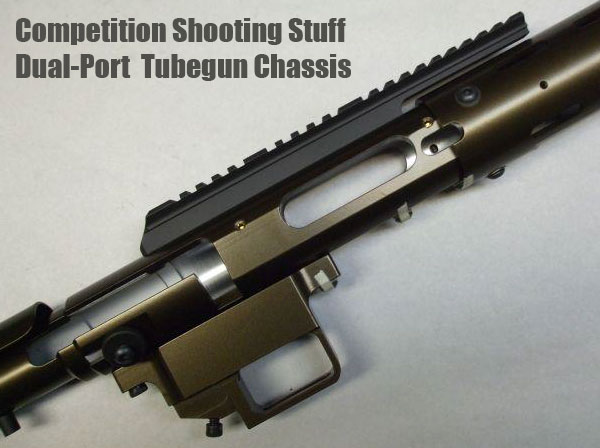
Gary Eliseo’s Tubegun chassis kits, long favored by High Power and prone sling-shooters, are now being used in increasing numbers by F-Class shooters, particularly F-TR competitors shooting from bipod. Here’s good news for the F-TR crew. Gary Eliseo has announced that his B1 and R1 Competition Shooting Stuff (CSS) Chassis kits will now be available with DUAL PORTS, by special order. This allows a right-handed F-TR shooter to load with left hand, with the fired case ejecting on the right. For more information visit www.GotXRing.com or call Gary at (714) 630-5734.
October 26th, 2012
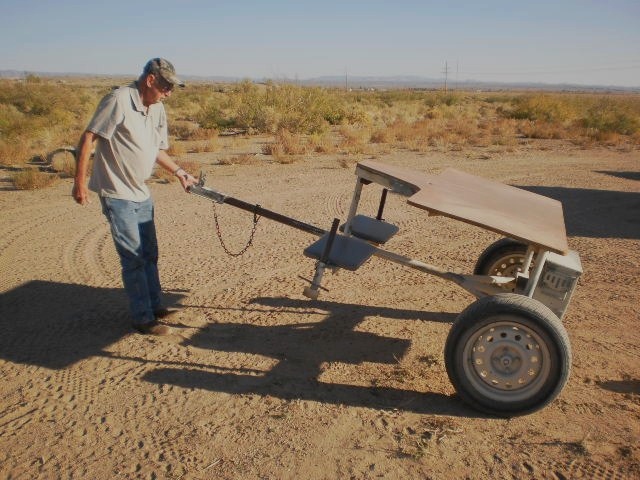
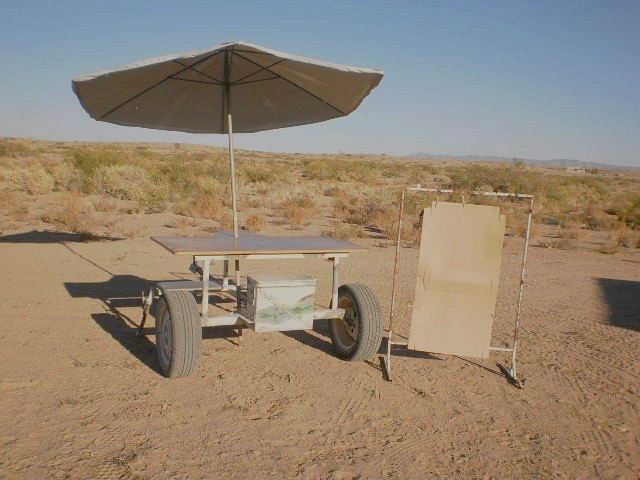
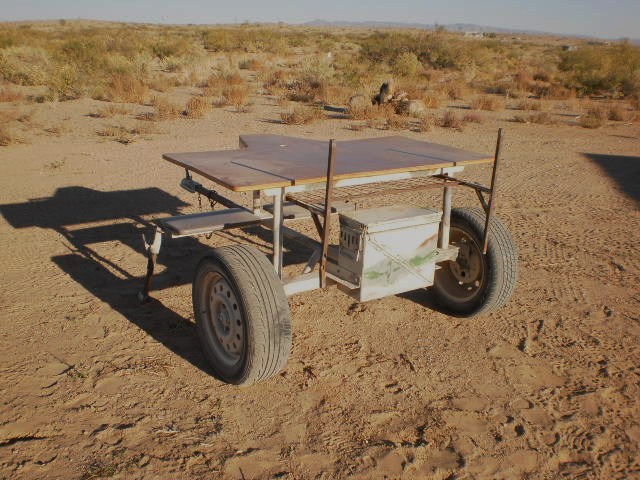
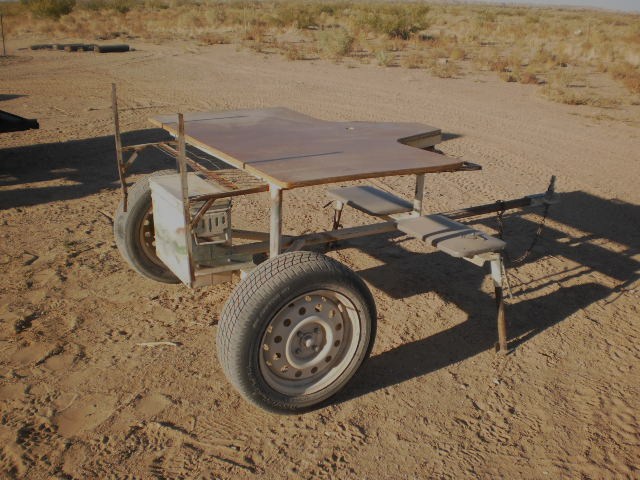
 After we ran a story on the New Mexico War Wagon, readers wanted more details about this well-designed mobile shooting bench belonging to Forum member John H. (aka “Skratch”). After we ran a story on the New Mexico War Wagon, readers wanted more details about this well-designed mobile shooting bench belonging to Forum member John H. (aka “Skratch”).
John told us: “My brother-in-law and I built this mobile bench a few years ago. The axle, wheels and tire are a tag axle from a small Chevy car, obtained from a salvage yard for about $35-$40 a decade ago. The tubular frame is drill stem, while the bench-top and seats are 3/4′” plywood. Under the plywood we fitted rails so we can slide our target stand under the benchtop for secure travel. The total cost for everything (including storage box) was about $250-$300.”
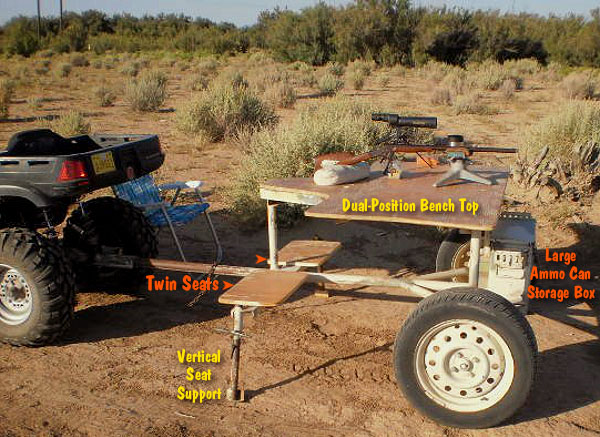
We set the bench and seat heights so that, with adults, the rifle sets straight level to the shoulder. For the smaller ‘younguns’ we just use a sofa pillow to raise them up. (Yes, adjustable seat heights would be great.) The ammo box holds our rifle rest, sand bags, spotting scope, and miscellaneous gear. Options are a couple of lawn chairs, and a cooler of brew (for after the shooting is done).
Click on image frames to see full-size photos
Some readers wanted to know how John’s War Wagon is positioned in the field and if it is ever detached from John’s ATV. John answers: “We do unhook the 4-wheeler for target-checking unless we have an extra along which is usually the case. That way we can level the table front to rear. We have an umbrella from a patio table to provide shade on extra warm days.”
Potential Modifications and Upgrades to the War Wagon
When our buddy Mark LaFevers (AccurateShooter.com’s chief fabricator), saw the war wagon, he was impressed. Mark, a professional welder by trade, is now thinking about building a similar rig — with some enhancements. Mark told us: “The thing I like best about the design is the simplicity. It has enough features to get the job done without any frills, bells and whistles. There is always the danger as one adds items that seem like they would be desirable, that the unit becomes too complex and loses its fun aspect. Still, I would try adding a few things.
 I like how the builder has added stabilizers at the seat locations. For areas with steep or uneven terrain , I would consider adding a trailer tongue jack to be able to level front to rear, or disconnect from the ATV to go check targets. I would also consider not hard-fastening the bench-top to the frame, but rather mounting it with screw-jacks to be able to level it independently from the frame, both crosswise and lengthwise. Being able to level the benchtop may not be necessary in flat prairie country, but it would be helpful on hilly or uneven terrain. I like how the builder has added stabilizers at the seat locations. For areas with steep or uneven terrain , I would consider adding a trailer tongue jack to be able to level front to rear, or disconnect from the ATV to go check targets. I would also consider not hard-fastening the bench-top to the frame, but rather mounting it with screw-jacks to be able to level it independently from the frame, both crosswise and lengthwise. Being able to level the benchtop may not be necessary in flat prairie country, but it would be helpful on hilly or uneven terrain.
I would also make the seat height-adjustable. That would accommodate different shooter body sizes and shapes. Height could be adjusted with a threaded seat column, which you can buy cheaply online. You could even mount a slider to allow front-to-rear seat movement. This would allow you to move back for longer rifles and forward for smaller rifles or Encore-style pistols.
Of course, there are other possible “creature comfort” options. If you really wanted to “pimp your ride”, you could include an umbrella stand, gimbaled beer holder, the mandatory water-misters, and a mobile sound system….
October 25th, 2012
 Here’s good news for folks looking for another domestic source of cartridge brass. Federal Premium, the folks who make Federal Gold Medal match ammo, is now offering new, virgin, unprimed cartridge brass for a variety of rifle and pistol cartridge types. The new Federal Premium brass will be sold by Sinclair International, Grafs.com and other popular retailers. Sinclair has Federal brass in stock now for the most popular rifle cartridges, including .223 Rem, .243 Win, .270 Win, .308 Win, .30-06 Springfield, .300 WSM and seven more cartridge types (13 rifle brass types total — see chart below). Here’s good news for folks looking for another domestic source of cartridge brass. Federal Premium, the folks who make Federal Gold Medal match ammo, is now offering new, virgin, unprimed cartridge brass for a variety of rifle and pistol cartridge types. The new Federal Premium brass will be sold by Sinclair International, Grafs.com and other popular retailers. Sinclair has Federal brass in stock now for the most popular rifle cartridges, including .223 Rem, .243 Win, .270 Win, .308 Win, .30-06 Springfield, .300 WSM and seven more cartridge types (13 rifle brass types total — see chart below).
Federal’s new brass for reloaders starts at $25.99 for fifty (50) cases of .308 Win Brass. The equivalent of $51.98 per hundred cases, that’s pretty affordable. However, note that some types of Federal brass are much more expensive. For example, Federal’s .300 WSM brass costs $43.99 for fifty (50) cases at Sinclair. Click Here for Federal Premium Brass at Sinclair.

Sinclair Int’l notes: “Federal ammunition has long been prized for its reliability, consistency, and quality. But the only way to get Federal brass for reloads was to save your spent shells or scrounge them off the range – until now. Pristine, unfired, properly head-stamped Federal brass for popular rifle cartridges is now available from the manufacturer, and we’re pleased to offer it.”
Product Tip from EdLongrange. We welcome submissions from readers.
October 24th, 2012
In our Shooters’ Forum thread about Portable Shooting Benches, Forum member John H. of New Mexico (aka “Skratch”) showed off a nicely-crafted mobile shooting bench that he can haul with his ATV. This trailer-mounted, movable bench is built on a central tubular spine that also serves as the tongue for the trailer, which attaches to a standard hitch. The bench offers two (2) shooting positions so it works for both left-handed and right-handed shooters.

Up front, for storage, a surplus .50-Cal ammo can is secured to the trailer frame. The V-shaped middle section of the wood benchtop looks to be reinforced with a metal stiffener frame on the underside. The front section of the bench is supported by twin tubular uprights attached to the box-section axle housing. The two wooden bench-style seats (on left and right) ride on a cross-tube. At the ends of that cross-tube are adjustable legs for additional support.
Great Rig for New Mexico Varmint Hunting
There are plenty of great varmint hunting areas in Skratch’s home state of New Mexico — you’ll find some huge prairie dog fields there. But to get the best results on a varmint-hunting field session, you need a solid shooting station that can be easily hauled to new locations as needed. It looks like John (aka “Scratch”) has come up with an outstanding “War Wagon” for his New Mexico varmint safaris.
October 23rd, 2012
As we reported a few weeks ago, Bryan Litz has written a new book, Accuracy and Precision for Long Range Shooting. We know many readers have pre-ordered Bryan’s latest book. Here’s the good news. Bryan reports that most pre-orders for the new book shipped yesterday, and the rest will go out today.

We asked Bryan to explain the differences between his original Applied Ballistics for Long Range Shooting resource book and the new Accuracy and Precision book. Here is Bryan’s explanation…
The first book, Applied Ballistics for Long-Range Shooting, covers the elements of long range shooting and explains how all the various mechanisms of external ballistics affect trajectories. It’s also the book that contains detailed drawings, BC and stability data for hundreds of bullets.
 The new book, Accuracy and Precision for Long Range Shooting explains the impact of external ballistic effects in terms of “hit percentage”. For example, if you choose to ignore Coriolis Effect in your ballistic solution, how much will your hit percentage be reduced on a 10″ target at 1000 yards? How about a 5″ target at 500 yards? How much would your hit percentage be improved on a 15″ target at 1200 yards if you reduce wind uncertainty from +/-3 mph to +/-2 mph? The new book, Accuracy and Precision for Long Range Shooting explains the impact of external ballistic effects in terms of “hit percentage”. For example, if you choose to ignore Coriolis Effect in your ballistic solution, how much will your hit percentage be reduced on a 10″ target at 1000 yards? How about a 5″ target at 500 yards? How much would your hit percentage be improved on a 15″ target at 1200 yards if you reduce wind uncertainty from +/-3 mph to +/-2 mph?
There are also numerous performance comparisons between different classes of cartridges. For example: how much higher is hit percentage for a .338 Lapua Magnum than a .308 Winchester for common environments and targets?
The new book identifies accuracy and precision effects and defines their effects separately. Did you ever wonder why it’s so easy to shoot a 10 inch GROUP at 1000 yards, but how difficult it is to HIT A 10″ TARGET at 1000 yards on the first shot? Shooting a 10 inch group is precision, but centering the group is a challenge of accuracy.
It’s quite common for long range shooters to focus 90% of their effort on the precision aspect, and only 10% on accuracy. To actually hit targets, you need a balance of accuracy and precision, with accuracy becoming increasingly more important as range is extended. — Bryan Litz
October 19th, 2012
 Sebastian (Seb) Lambang of SEB Coaxial, a brilliant designer and fabricator, has created an ingenious joystick bipod. The first coaxial bipod we’ve ever seen, Seb’s new bipod is a superb example of creative design and smart engineering. This unit gives F-TR and other bipod shooters precise, one-handed control of both windage and elevation. Seb’s innovative joystick bipod is yet one more example of the innovative, advanced engineering we’ve come to expect from his company. We think this guy could be building Formula 1 cars if he set his mind to it. We are fortunate that Seb loves shooting, so he applies his talent to designing and building great new products for the shooting sports. Sebastian (Seb) Lambang of SEB Coaxial, a brilliant designer and fabricator, has created an ingenious joystick bipod. The first coaxial bipod we’ve ever seen, Seb’s new bipod is a superb example of creative design and smart engineering. This unit gives F-TR and other bipod shooters precise, one-handed control of both windage and elevation. Seb’s innovative joystick bipod is yet one more example of the innovative, advanced engineering we’ve come to expect from his company. We think this guy could be building Formula 1 cars if he set his mind to it. We are fortunate that Seb loves shooting, so he applies his talent to designing and building great new products for the shooting sports.
Seb tells us: “I just finished a prototype joystick bipod, i.e. a bipod with joystick (coaxial) elevation and windage control. This patent-pending bipod is my newest project/invention. As far as I know, there is no one that makes this type of bipod… so it’s probably the only one in the world.” We already know some shooters who want to order Seb’s joystick bipod, but Seb cautions: “It’s not for sale yet. It’s still in prototype step. There is always a rough draft before the masterpiece.”

Seb will test and refine the design in the next couple of months before production starts. But Seb is quite satisfied with the design so far: “The rigidity, ease and comfort of use, and compactness, are already OK in my opinion.” Folks in Europe will be able to see the design very soon. The first real-world test of Seb’s new joystick bipod will be at the European F-Class Championship, slated for November 2-3 in the UK. Seb notes: “I won’t be shooting F-TR in the match, but I will ask some fellow F-TR shooters at the Bisley range to test it, and provide feedback.” Seb invites Daily Bulletin readers to look at the photos and provide comments or suggestions on design enhancements.
Technical Description
 At the lowest setting with the adjustable legs, the SEB bipod is approximately 6″ tall. At the highest setting, the unit is about 9″ tall. To smooth upward movement of the rifle, Seb designed the coaxial head with “built-in uplift”. The joystick itself is about 10″ long, with a collet-type head. When folded, the new SEB Bipod is relatively compact, about 9″ long x 5″ wide x 2″ thick. Most parts are made from aircraft grade 7000 series aluminum. The current weight of the prototype is 26 ounces (740 grams). Seb is working on reducing weight for the production models. At the lowest setting with the adjustable legs, the SEB bipod is approximately 6″ tall. At the highest setting, the unit is about 9″ tall. To smooth upward movement of the rifle, Seb designed the coaxial head with “built-in uplift”. The joystick itself is about 10″ long, with a collet-type head. When folded, the new SEB Bipod is relatively compact, about 9″ long x 5″ wide x 2″ thick. Most parts are made from aircraft grade 7000 series aluminum. The current weight of the prototype is 26 ounces (740 grams). Seb is working on reducing weight for the production models.
Joystick Function and Adjustment Range
As with SEB Coaxial front rests, the joystick function is user-selectable. The joystick handle can operate either ‘up for up’ or ‘up for down’, simply by reversing the unit and the joystick. The bipod’s effective windage and elevation range* is approximately 38 MOA horizontal (windage) and 16 MOA vertical (elevation). Seb explains: “That’s not as much as my other rests, but for F-Class use it should be adequate. The finer the adjustment, the better on the target and the smoother the joystick operation. It’s like using a scope with 1/8 MOA adjustment rather than 1/4 MOA.”
*True vertical travel is about 32 MOA but in the field the rifle stock will limit how far you can lift the joysticK. Note also that the adjustment range varies with your set-up geometry. The shorter the distance between the rear bag and the bipod, the greater the travel in MOA. This means that if you extend the distance between rear bag and bipod, you will lose some MOA travel.
|