If you’re looking for the newest, hot tubegun set-up, check out BAT Machine’s new 3-Lug tubegun action. This new action, created with design input from Gary Eliseo of Competition Shooting Stuff (CSS), is designed to work perfectly in Eliseo’s modular tubegun chassis systems. The new BAT “tubegun special” action features a smooth, short-throw 3-lug bolt along with an integral, large-diameter recoil lug precision-machined as part of the action. The new BAT tubegun action will mate perfectly with an all-new tubegun chassis kit Gary Eliseo has “designed around the action”.
Gary Eliseo is excited about the BAT 3-Lug and he will be offering a new chassis for this “tubegun special” action. The new BAT 3-Lug action is shorter than Remington-style actions and Barnard actions, so it will NOT fit in existing Eliseo tubeguns. Accordingly, to use the new BAT 3-Lug action you will need a new chassis kit. Gary may, at some point in the future, offer a retrofit kit, but for now, you’ll need Gary’s new chassis if you want to run the BAT 3-Lug. Gary hopes to deliver BAT 3-Lug-capable chassis kits in about six (6) months time. That sounds like a long time, but remember that it will take you about six months to get your BAT 3-Lug action once you place an order with BAT Machine. The action is currently SINGLE SHOT only, and fits short-action-length cartridges (e.g. 6BR, .243, .308 Win). Price for the new action is roughly $1200.00. Both right-hand and left-hand versions will be offered in both stainless and chrome-moly. Extra-cost options will include fluted bolts and dual ports (as shown in photos). The new chassis kit will initially be available for standard RB/RP or LB/LP configurations.
Gary believes the new BAT 3-Lug action, when fitted to his new chassis, will be ideal for Palma, Long-Range Prone, and F-TR Shooters. Gary says: “This new action is stiff and smooth, with a fast 60° bolt lift. It offers many of the best features of a Barnard action, in a more compact, American-made design, available in stainless steel as well as chrome-moly.” (Barnards are chrome-moly only.) BAT Machine is currently accepting orders for the 3-Lug Tubegun action and you can order the new Eliseo Chassis designed around this action from CompetitionShootingStuff.com.
Meopta USA now offers additional versions of its award-winning MeoPix® iScoping Adapter to fit Swarovski, Leica and Zeiss spotting scopes and binoculars, as well as most popular mid-level optics brands. With this iScoping Adapter, you can use your iPhone to record still images or video of the view through your spotting scope. This is great for capturing views of your target, or to record mirage conditions and flag positions for later study.
Available in several eyecup diameters, the MeoPix® iScoping adapter correctly positions an iPhone® 4/4S to a spotting scope or binocular eyepiece. Proprietary technology provides a secure fit to the iPhone and precise alignment to the spotting scope or binocular eyepiece. Priced at $59.99, the iScoping Adapter is sold by Cabelas.com and major optics dealers. “The overwhelming responses and feedback about the MeoPix iScoping Adapter convinced us to make versions to fit most popular brands of optics” said Meopta USA GM Reinhard Seipp.
Gear Review by Boyd Allen
Just about everyone knows that Wilson and Redding make neck-sizing bushings. But few shooters seem to be aware that RCBS produces bushings. In fact, RCBS does make quality neck-sizing bushings, including very nice Tungsten Disulfide-coated bushings.
As a companion product for their Gold Medal bushing-style dies, RCBS produces its own line of sizing bushings, that have a couple of notable features. First, along with plain steel bushings, RCBS offers bushings with a distinctive, dark gray Tungsten Disulfide (WS2) anti-friction coating. Redding offers bushings in bare “white” steel or with a gold-colored Titanium-Nitride anti-friction coating. Wilson bushings are plain steel with a shiny silver finish. Though the Redding and Wilson plain steel bushings may look like stainless, remember that these un-coated bushings need to be kept oiled or they WILL rust. In normal use, you shouldn’t have to worry about rust on the Tungsten Disulfide-coated RCBS bushings.
Comparing coated bushings, Redding’s gold TiN-coated bushings look pretty, but the WS2 anti-friction coating on RCBS bushings seems to work as well. Tungsten Disulfide (WS2) has an extremely low coefficient of friction — 0.03 compared to 0.6 for Titanium Nitride. Accordingly, the RCBS WS2-coated bushings can work with minimal neck lubrication. When I actually sized necks with the RCBS WS2-coated bushings, the “smoothness” of the neck-sizing operation seemed on a par with other quality, coated bushings.
Another notable difference with the RCBS bushings (compared to other brands) is that RCBS stamps the bushing size onto the outside of the bushing, rather than on the top. RCBS puts the bushing diameter on a reduced-diameter band that runs around the circumference of each RCBS bushing. I think that this is a good idea because it eliminates the possibility that raised edges from the stamping itself might interfere with proper bushing alignment*. (Remember that the top of the bushing — where size marks are stamped by other bushing-makers — contacts the retaining cap in the die during sizing.) Putting the size marks on the outside also makes it easy to distinguish RCBS bushings from other bushing brands.
The other feature that I like is the shape of the entry chamfer on the bottom of the RCBS bushing. This chamfer is large and angular, rather than curved. This is only a guess, but I think that it may do a better job of letting the bushing align itself with the case as it is inserted into the die, and do a better job on brass from chambers that allow more neck expansion. (The picture shows the smaller chamfer at the top of the bushing.)
That about wraps it up, with the exception of one small point. While MidwayUSA has a wide selection of RCBS bushings, other retailers need to do a better job of stocking these bushings. I got mine from RCBS, but you may have trouble finding them in many online catalogs, or on dealers’ shelves. Hopefully this small review will help to increase awareness of RCBS bushings, and more retailers will carry them.
*As you probably know, stamping displaces metal, some of which is raised above the level of the surface that was stamped. Although it can be argued that shooters have gotten some pretty spectacular results in spite of any cocking of neck bushings caused by their being stamped on top, I am sure that a lot of us would prefer to have things as straight as they can be, and moving the stamping to a recessed band that runs around the outside of the bushing helps accomplish this.
Hornady just unveiled its “new and improved” online Ballistics Calculator. It’s free, fast, and easy to use. New enhancements include selectable G1 or G7 BCs, drop and windage in MOA and MILS, metric value option, and the ability to enter shooting angle, wind angle, and more. To access all these features (such as G7 BCs), you’ll need to select the “advanced” display from Hornady’s Ballistic Calculator Entry Page. That will open up more entry fields. Default values are entered in the temperature and pressure fields, but you can override these with your actual field data. You can select a zero range from 0 to 2000 yards, with intervals from 25 to 400 yards. Once you’ve entered all the values, simply click “Calculate” and the program provides your drop numbers in a handy chart.
Printable ‘Cheat Sheet’ for your Rifle
One very cool feature of Hornady’s online calculator is the “Cheat Sheet” — a handy, printable come-up table. Once you’ve entered your variables and run the calculator, the results appear in a handy table that you can print-out and affix to your rifle stock. Here’s a sample Cheat Sheet prepared for Berger’s 105gr VLD and a 6mm Dasher*.
Although it can employ G7 BCs now, the Hornady Ballistic Calculator, unlike the JBM online solver, does NOT include a built-in database of G7 values, based on field-testing by Bryan Litz. For that reason, the JBM Ballistics Calculator is still our first choice for an online ballistics solver. We really do like Hornady’s handy “Cheat Sheet” option though. You can, of course, get a Litz-derived G7 value from JBM and then plug that number into the Hornady Calculator to produce a printable drop table.
*NOTE: Note: Even if you have a Dasher and use the Berger 105gr VLDs, you should run your own solution with your specific sight height, elevation, temp, pressure, humidity, and zero distance.
Bryan Litz, chief Ballistician for Berger Bullets (and a trained rocket scientist) has authored an impressive new book: Accuracy and Precision for Long Range Shooting. Bryan’s new book is a companion to his successful treatise, Applied Ballistics for Long-Range Shooting. Now in its Second Edition, Litz’s Applied Ballistics book has become the “go-to” Ballistics book for precision shooters worldwide.
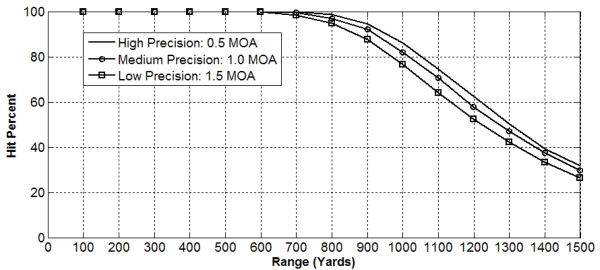
While Bryan’s first book covers the science of ballistics and trajectory calculation, his new book examines practical issues involved in long-range accuracy. Bryan explains: “In a nutshell, this book focuses on the uncertainties of practical shooting which affect hit percentage on various size targets. In other words, classic ballistics teaches you how to calculate windage and elevation corrections. This book will help you understand what your chances are of hitting a target under certain conditions, and how to improve those chances through training and design.
Practical Examples
Does a low ES/SD really make a difference at long range? Absolutely. In Chapter 6, you can see that reducing muzzle velocity variation from 20 fps Standard Deviation (SD) to 10 fps SD improves hit percentage on a 5″ circle at 500 yards from 83% to 93%.
Ever wonder how much spin drift, Coriolis affect, or using G1 vs. G7 BC’s affect your chances of hitting a target? In Chapter 10 for example, you’ll learn that ignoring spin drift in ballistic calculations reduces hit percentage on a 10″ target from 21% to 15% at 900 yards for a specified environment and cartridge.
The new book is divided into three main sections. Part 1 focuses on Precision, which explores how hit percentage is related group size. Litz explains the variable that affect group size: muzzle velocity variation, range estimation error, wind estimation error, and inherent rifle precision
Part 2 focuses on Accuracy, which is how well the group is centered around the aim-point. Topics include: leveling your sights, trajectory modeling and secondary effects, calibrating ballistic solutions, and live fire verification.
Part 3 focuses on Weapon Employment Zone (WEZ) analysis. WEZ evaluates firearm effectiveness in terms of hit percentage. The author applies WEZ in the contexts of score shooting, varmint and big game hunting, and tactical shooting. WEZ is also used to compare hit percentage for the 300 Win Mag vs. .338 Lapua Mag.
Book is 300-page, Hard-Cover Format
Accuracy and Precision for Long Range Shooting is a 6″x9″ hardcover book with 300 pages, and retails for $34.95. The book is currently at the printers, and should begin shipping by October 15, 2012. In the mean time, you can pre-order and save $5 off the regular $34.95 retail price.
Berger Bullets has announced a new series of “Classic Hunter” Hybrid bullets designed to fit and feed in magazines and perform well in barrels with SAAMI standard chambers. Berger’s Eric Stecker explains: “For the first time in Berger’s history we’ve purposefully designed Hybrid-shaped hunting bullets that comply with the restrictive dimensional standards set by SAAMI. We did this so that hunters can shoot ammo loaded with Berger Hunting bullets in their factory rifles while feeding through a magazine.”
Berger came up with a new hunting bullet design because SAAMI standard dimensions significantly limit the length of the nose (negatively affecting external ballistics performance) in two ways. First, the length from the end of the neck to the tip of the bullet of SAAMI standard ammo is typically so short that to make an ogive that will allow bearing surface to be forward of the neck it must be blunt and therefore have a low BC. The other way SAAMI limits nose length is by specifying longer throat lengths than are optimal. Stecker notes: “When you have a long throat, the nose can’t be too long or the jump to the rifling is considerable. This is typically bad for precision and accuracy. So what you end up with is stubby nose bullets with low BC and poor external ballistics performance.”
To overcome SAAMI-imposed design contraints, Berger’s Bryan Litz designed Hybrid hunting bullets with noses short enough to conform to SAAMI dimensional standards. These bullets should be popular among those who hunt with factory rifles and feed their ammo through a magazine. The bullets use a dual-curve ogive design. As you move forward along the bearing surface, the ogive curve starts as a tangent tangent curve (which is forgiving of seating depth). As you continue forward on the nose the tangent curve transitions into a secant curve. Secant ogives are known to be more efficient in the wind (VLD bullets are pure secant ogives).
When you combine these two shapes you get the best of both worlds (less sensitivity to seating depth differences and improved external ballistics performance). Since these new Berger Classic Hunter bullets must have a nose length that is short enough to comply with SAAMI standards we get the most external ballistics performance possible by making the nose with Bryan’s Hybrid design.
Eric Stecker is enthusiastic about the new Hybrid Hunting Bullets: “We know that this bullet design works [well] because we tested it not only in media but also on game. I took these bullets with me to New Zealand to test them on several animals of various sizes and at various ranges. I know from firsthand experience that hunters who try this bullet in the field will be happy that they did.”
Product Tip by EdLongrange. Product Photos by Robert Whitley, 6mmAR.com.
Black Powder Cartridge Rifles (BPCR) typically fire cartridges with large capacity — 70 grains or more of the ‘holy black’. For a variety of reasons, BPCR shooters may want to use a black powder substitute when training, hunting, or when competing in matches that allow substitutes. The problem with most smokeless propellants is that they are designed to operate at much higher pressure levels and they don’t fill the case well when loaded to black powder pressure levels. (There are some exceptions).
Allian Black MZ Wins Field & Stream Award
Alliant Powder has developed a new black powder substitute that works well in black powder cartridge rifles and in muzzle-loaders. Alliant’s new Black MZ is an innovative, non-corrosive black powder substitute that resists moisture and reduces cleaning time.
Alliant claims that Black MZ “burns cleaner for less residue and easier cleaning” and that Black MZ can deliver “better velocities at lower pressures.” In fact, Black MZ performs so well that it was recently awarded Field & Stream’s “Best of the Best” award in its product category.
Field & Stream reports: “[Black MZ] performed so well… that the test team was able to fire muzzleloaders repeatedly without any cleaning. And when a patch was run through the barrel, there was far less fouling than is normally seen. The loose grains also can be packed tightly, producing great energy results while maintaining low barrel pressure.” Alliant states that: “Moisture resistant and virtually non-corrosive, Black MZ replicates black powder performance without the ignition headaches and cleaning hassles common to traditional black powder use.”
Alliant Brand Director Rick Stoeckel declares: “We are excited to win the Best of the Best from Field & Stream. We strive to provide the best products for our consumers, and this recognition reaffirms the effectiveness of Black MZ” [for both muzzle-loaders and Black Powder Cartridge Rifles].
Are you bored with your “whimpy” .50 BMG? Looking for something with a little more punch? Well J.D. Jones and his team at SSK Industries have created a truly big boomer — the .950 JDJ. As its name implies, rifles chambered for the cartridge have a bore diameter of 0.950″ (24.13 mm). This would normally make such rifles “destructive devices” under the 1934 National Firearms Act (NFA). However, SSK obtained a “Sporting Use” exemption allowing the rifles to be sold without special restrictions as destructive devices. CLICK HERE to watch .950 JDJ being fired.
.950 JDJ Specifications
Rifle Cost: $8000.00
Ammunition Cost: $40.00 per round
Projectile Weight: 3,600 grains (more than half a pound)
Rifle Weight: Between 80 and 120 pounds
Muzzle Energy: 38,685 ft/lbs (52,450 Joules)
Momentum: 154.1 Newton-seconds
As crafted by SSK Industries, .950 JDJ rifles use McMillan stocks and very large-diameter Krieger barrels fitted with a massive 18.2-lb muzzle brakes. The ammo produced by SSK features solid 3,600 grain bullets and CNC-machined cartridge brass. It is also possible (through a lot of work), to use a 20mm cannon casing shortened and necked-down.The primer pocket is swaged out to accept a .50 cal machine gun primer. That 3,600 grain bullet is just massive — it weighs more than half a pound. The cartridge propels its 3,600 grain bullet at approximately 2,200 fps. This yields a muzzle energy of 38,685 ft-lbs and a momentum of 154.1 Newton-seconds. The energy on target (knock-down power) is comparable to WWI-era tank rounds.
A few days ago we featured Tim Sellar’s new Double-stack Sure Feed Ammo Caddy. No sooner had we revealed Tim’s double-stacker, than we got a call from Tim saying that he was developing a new flex-arm support for his gravity-fed ammo caddies. The advantage of the flex arm is that it allows the vertical position of the caddy to be adjusted for different guns (or different shooter positions). In addition, the arm raises the caddy up off the bench, clearing space for the operation of a joystick on a coaxial front rest.
Tim explains: “At the IBS 1000-yard nationals in West Virginia this year I had a lot of requests for a flex-arm type caddy. Here’s the first prototype — the paint just dried this morning. It works great especially for the joy-stick type rest. This opens up space for the arm movement. The example in the photo has a bracket attaching the flex-arm to the rest. I can fabricate any mount specified. I also plan to offer a magnetic base for the caddy flex-arm for use with ferrous metal front rests.”
Tim hasn’t announced a price for the flex-arm option yet: “The price is still being worked out. I will announce it after some anodizing and aluminum estimates come in. Production should start early January next year”. For more information on Sure Feed Ammo Caddies contact Tim in Texas:
Sure Feed Ammo Caddies (Tim Sellars)
4704 Redondo Street
North Richland Hills, TX 76180
Phone: (682) 240-7690 (cell)
eMail: sel248 [at] aol.com
FNH has released a “TBM” upgrade kit for owners of FNH SPR rifles with the standard .308-size, 4-round DBM magazine assembly. This kits lets current SPR owners utilize the TBM (tactical box magazine) assembly with 5- and 10-round magazines. This easy-to-install kit provides SPR owners with an ambidextrous mag release, along with the ability to use larger-capacity box magazines.
This $449.00 Kit comes with new trigger guard/bottom metal, both 5-round and 10-round TBM magazines, new action screws and instructions. For SPRs with box mags, this is a drop-in, no-gunsmithing upgrade that does not require gun modification or fitting to the rifle. (TSRs or PBRs with DBM equipment might require fitting by a gunsmith). Retrofit on SPRs can be accomplished in minutes with common tools (torque wrench required). Kits are available now through the FNH USA E-Store, Brownells, and Midway USA (item number 62655-01, MSRP $449).


 Gear Review by Boyd Allen



 When you combine these two shapes you get the best of both worlds (less sensitivity to seating depth differences and improved external ballistics performance). Since these new Berger Classic Hunter bullets must have a nose length that is short enough to comply with SAAMI standards we get the most external ballistics performance possible by making the nose with Bryan’s Hybrid design.


 Black Powder Cartridge Rifles (BPCR) typically fire cartridges with large capacity — 70 grains or more of the ‘holy black’. For a variety of reasons, BPCR shooters may want to use a black powder substitute when training, hunting, or when competing in matches that allow substitutes. The problem with most smokeless propellants is that they are designed to operate at much higher pressure levels and they don’t fill the case well when loaded to black powder pressure levels. (There are some exceptions).
 Field & Stream reports: “[Black MZ] performed so well… that the test team was able to fire muzzleloaders repeatedly without any cleaning. And when a patch was run through the barrel, there was far less fouling than is normally seen. The loose grains also can be packed tightly, producing great energy results while maintaining low barrel pressure.” Alliant states that: “Moisture resistant and virtually non-corrosive, Black MZ replicates black powder performance without the ignition headaches and cleaning hassles common to traditional black powder use.”
 Are you bored with your “whimpy” .50 BMG? Looking for something with a little more punch? Well J.D. Jones and his team at


