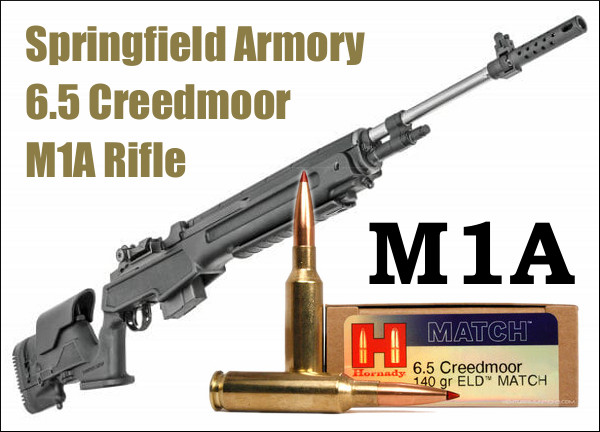
The 6.5 Creedmoor craze goes one step further. Soon you can buy a Springfield M1A chambered for this mid-sized cartridge popularized by PRS shooters. Both bolt-action and AR-platform rifles chambered for the 6.5 Creedmoor have been available for quite some time, but this is a new direction for the M1A, which has traditionally been chambered for the 7.62×51 NATO/.308 Winchester round. As chambered for the 6.5 Creedmoor, Springfield’s M1A should be easier on shooters’ shoulders. The 6.5 Creedmoor M1A has 28% less recoil than the .308 Winchester version.*
The new 6.5 Creedmoor M1A features a 22″ medium-contour, 1:8″-twist stainless barrel with factory muzzle brake. The rifle comes with iron sights: .062 post front sight and .0520 aperture rear sight adjustable for ½ MOA windage and 1 MOA elevation. Springfield ships the rifle with a 2-stage trigger tuned to 4.5 – 5 pounds. A Springfield Armory Optics mount is available to fit a magnified optic, but, to be honest, we haven’t been very impressed with that mount.
Two stock options are offered: a basic black polymer stock (not recommended — it’s weak and flexy) or a deluxe “precision” stock with adjustable cheekpiece and adjustable LOP. The deluxe precision stock, shown above, is much more rigid, and can be configured with front underside Picatinny rail (see video). Rifle Specs HERE.
With the basic polymer stock, the 6.5 Creedmoor weighs 11.4 pounds (unloaded) and has a $1985.00 MSRP. With the adjustable precision stock, the gun is a bit heavier and retails for $2045.00 in either matte black or Flat Dark Earth (FDE).
“Having a 6.5 Creedmoor caliber in the M1A lineup gives long-range shooters more choices with the precision and accuracy they require,” says Springfield Armory CEO Dennis Reese. “They can choose the round they prefer…”, i.e. .308 Win or the 6.5 Creedmoor. Excellent factory ammo is available for both chamberings.
Photo of 2009 M1A Match at Camp Perry. Shooter is Nick Till, 2007 Service Rifle Champion.
If you are looking for a robust semi-auto rifle that has an interesting legacy (the M1A was derived from the U.S. Military’s M14), this new M1A may suit your tastes. Every year at Camp Perry, Springfield Armory sponsors a very popular M1A match which attracts marksmen from around the country. We can’t say for sure that the 6.5 Creedmoor M1As will be allowed in M1A matches, but we would expect they will, though perhaps competing in a separate division.
The max weight of any Zanotti safe section is 175 pounds. This allows the safe to be installed more easily in upstairs rooms. It also makes the safe much easier to move to a new dwelling.
Gun Safe Arrives in Section — Bolt Together on Site
We bolt together bridges and pre-fab houses, so why not gunsafes? It fact there is a modular safe that ships in pieces and bolts together on site. Modular design allows a big, full-size safe to be transported much more easily than a conventional safe (that might weigh 1200 pounds or more). The Zanotti modular safe arrives in sections, none weighing more than 175 pounds. It is assembled in place, then can be dis-assembled when you need to move. The Zanotti is also well-suited for a gun-owner who lives in an apartment up many flights of stairs.
One Person Can Move All Sections with a Hand Dolly | Assemble in 30 Minutes with No Special Tools
Zanotti Safes from 350 to 825 Pounds Assembled Zanotti Armor safes are ideal for gun owners who need to move frequently or who live in a location where it is difficult to position a conventional safe. Zanotti safes arrive in three or four discrete shipping boxes. The safe is assembled by the owner, on site, in six steps. The heaviest component is the door, weighing 110 pounds in the 16-gun ZAI safe, and 175 pounds in the largest 52-gun ZAIII model. Five safe models are offered, ranging from 350 to 825 pounds assembled weight, without interior. Zanotti safes are popular with military personnel and others whose jobs force them to re-locate often. The safe can be assembled in under 30 minutes with no tools other than a hammer, and all you need is a hand dolly to move any component.
Guns Magazine reports: “The panels are interlocked by 3/8 inch, nickel-plated steel “L” shaped pins that slip into steel tubing sections welded to the interior surfaces of the panels. The slip fit is held to a tolerance of .003 inch, and the safes are completely assembled and hand-fitted at the factory to insure the panels will align properly. The body is made from 1/8 inch and 3/16 inch steel; the door from 3/16 inch steel; the locking bolts are 3/4 inch steel.” This is heavier gauge steel than you’ll find on most conventional gun safes.
Zanotti offers many deluxe interiors including a system of roll-out sliding drawers in the bottom of the safe. We think the sliding drawers are ideal for storing handguns and expensive items such as cameras and binoculars that you want to keep out of plain view. Mark Zanotti, the innovative creator of these modular safes, can also customize any interior to suit the customer’s particular needs.
To learn more about gunsafe features and fire-proofing, read our Gunsafe Buyers’ Guide.
Editor’s Note: For most applications, a conventional safe is probably still the best choice for most gun owners. Bolted down in place, a conventional safe with welded walls will provide the best security and a conventional safe can provide increased fire protection. Zanotti safes do not employ a separate layer of sheet-rock or ceramic fire lining. The Zanotti is a special product for gun-owners with special needs. The units are well-made and Zanotti offers many nice custom interior features that you won’t find even on much more expensive conventional safes.
We believe in the benefits of rimfire cross-training. With a rimfire rifle that has the same ergonomics and “feel” as your centerfire rig, you can practice more often and more affordably. You can get good rimfire ammo now for under $5.00/box (ten cents per round). Compare that to centerfire factory ammo at $1.40/round or handloads for about $0.70 (bullet, primer, powder, and brass depreciation). We know some successful PRS shooters who shoot five rimfire rounds in practice for every centerfire round.
For a tactical cross-trainer, you want a rimfire rig that feels like your centerfire rifle. McMillan now offers a stock that fits the bill. McMillan’s new A5-22 stock shares the same look and feel as McMillan’s popular A5 centerfire stock. The A5-22 is able to accommodate 10/22 type actions including KIDD 10-22 models with rear tang attachments. McMillan says: “The A5-22 is dimensionally the same as our standard A5 with some minor changes in the tang and floor plate areas. It is available in a fixed comb configuration or with an adjustable saddle-type cheek piece.”
While the new McMillan A5-22 stock was designed expressly for the Ruger 10/22 barreled action it can be inletted to fit other rimfire actions: KIDD 10-22, Volquartsen VCL (Sporter and Magnum), and Volquartsen WSM. With a basic inlet, the A5-22 costs $390.00. Uninletted (flat-top) version costs $338.00. Available options include cheekpiece, pad, studs, and rail.
Rimfire Cross-Training Resources
Quality Affordable Ammo for Rimfire Cross-Training
Looking for good, affordable .22 LR ammo for your rimfire training rifle? We suggest Norma’s Tac-22. This has shown very good accuracy in both bolt-action and self-loading rimfire rigs. The target photos above come from Champion Shooters Supply, which reports: “We have found this to run very well in Ruger rifles, handguns, and target pistols. These are 5-shot groups at 50 yards with an Anschutz 1913 rifle. This is an incredible value.”
Tac-22 ammo is available from many vendors. MidwayUSA currently offers it for $4.49 per 50rd box or $34.99 for 500 rounds. That’s just seven cents per round with the 500-count box — a great deal.
Rimfire Practice Targets
SPECIAL BONUS–Rimfire Tactical Precision Targets
These FREE targets by DesertFrog are offered in Adobe Acrobat format for easy printing. CLICK HERE to download all six targets as a .ZIP archive.
The Concept Behind the Rimfire Tactical Match
Many guys who shoot long-range tactical matches practice with .22 LR rifles of similar configuration. Rimfire ammo is way more affordable than centerfire, you do not need a big range facility, and shooting rimfire saves wear and tear on your centerfire rifle. Further, for learning how to read the wind, there really is no better training tool than a .22 LR, even as close as 50 yards. In California, various clubs have been running rimfire tactical matches for more than a decade now. Hit/miss reactive targets are typically placed from 50 to 150 yards. Some matches combine steel plates with bullseye paper targets so accuracy is important. An accurized 10/22 can be competitive in these matches.
Rimfire Tactical Series
A new .22 LR rimfire shooting discipline has been developed, copying the PRS series. The ELEY Practical Rimfire Challenge series matches are positional shooting events in field conditions out to 300 yards. You can use either a bolt-action or semi-auto .22 LR rimfire rifle. Much like PRS (Precision Rifle Series), competitors will shoot from a variety of positions: prone, strong/weak shoulders, standing, sitting, and kneeling. There will be shots from barricades, and movement from position to position during stages.
The free December Shooting Industry eZine includes a preview of the 2018 SHOT Show (pp. 44-46), detailing the week’s events and offerings at the industry’s mega trade show kicking off next month in Las Vegas. This December issue of Shooting Industry magazine also features Part I of the New Product Showcase (pages 52-71). This fully-illustrated 20-page Showcase features scores of new product offerings including handguns, long guns, ammunition, reloading tools, optics, accessories and more. If you want a preview of products to be released in las Vegas, check it out….
The December issue also features the Shooting Industry Buyer’s Guide, an industry-wide directory of product sources. This 80-page directory lists manufacturers and distributors for all types of outdoor products, including guns, ammunition, optics, reloading tools, shooting accessories, archery equipment, knives, hunting gear and more.
Shooting Industry Buyer’s Guide Lists Thousands of Companies
There is also a searchable, interactive version of the Shooting Industry Buyer’s Guide. This convenient, easy-to-use web database lists 2500+ companies, complete with address, phone number(s), email, and website link. All the major precision shooting suppliers, such as Berger Bullets, Lapua, Hodgdon, Forster, Hornady, McMillan, Nightforce, Redding, Sierra etc. are listed. Access the Buyer’s Guide at http://sibuyersguide.com.
Click Below for Online Buyers’ Guide (2500+ Companies) »
Hunters, here’s a great FREE mobile APP for Apple and Android devices. The new ZEISS Hunting App offers many practical functions: full-featured ballistics calculator, field notes with photo archive, compass function, GPS tagging for documentation of hunting experiences, and a detailed weather forecast service. The Hunting App is offered as a FREE download, in both English and German versions.
We are impressed at how this new App integrates multiple useful features — ballistics solver, compass, GPS tagging, hunt history. The “Field Notes” function can record a wide variety of info — you can save photos, record your shots and hits, log animal sightings during the hunt, and even plot game locations on a map. Zeiss explains: “This allows users to optimally record events, the game population in the hunting territory, and their own hunting experiences.” Shots can be tagged via GPS through the shooter’s and the target’s position, and then displayed on a map. The Field Notes hunt diary shows all entries in chronological order.
KEY FEATURES: Ballistics Solver, GPS Tagging, Weather Forecast, Field Notes with Photos
Full-Featured Ballistics Solver
The integrated ballistic calculator allows hunters to easily customize the settings to suit their favorite cartridges. You can enter your own data, or choose bullet/cartridge info from a database containing over 7000 ammunition types from a variety of manufacturers. The ballistics solver can be programmed for for current weather conditions (temp/humidity), and the angle (inclination) of the shot.
Weather Functions
The weather tool offers a Five-Day Forecast, and you can choose multiple locations. In addition to the current location, users can also display the weather for their hunting areas of choice. The weather forecast includes temperature, precipitation, wind direction, wind speed, humidity, and air pressure. (Note: For precise ballistics solutions, you must input the ACTUAL conditions at your shooting location).
Hunt Log and Photos
The Field Notes function can do many things. You can log all your shots and hits, and you can plot game sightings during the hunt. Events can be augmented with photos and GPS data. With the Field Notes mapping function, you can even locate game populations in the hunting territory. A compass and automatic night mode round off the list of smart features.
Product Tip from EdLongrange. We welcome reader submissions.
Own a Ruger Precision Rifle (RPR)? Looking for the single best hardware upgrade that will improve inherent accuracy and shot-to-shot consistency? Here’s your answer. Krieger Barrels is now producing Pre-Fit barrels for the RPR in two popular chamberings: 6.5 Creedmoor and .308 Winchester. These “Drop-In Ready” barrels come finish-chambered and threaded to fit the Ruger action. The Ruger barrel attachment system allows correct headspace with a pre-chambered barrel. Krieger explains: “Thanks to Ruger’s proprietary barrel nut design, a competent gunsmith will be able to swap out your barrel using an AR15 barrel wrench and proper headspace gauges.”
Kreiger’s 6.5 Creedmoor RPR barrel is an 1:8″-twist with 26″ finished length, 0.750″ at muzzle. The .308 Win RPR barrel is a 1:10″-twist with 24″ finished length, also 0.750″ at muzzle. Both these Krieger RPR Pre-Fits feature muzzles with factory-spec thread so you can re-install the factory muzzle brake.
Seems like new cartridges are being introduced every few months, particularly for the AR15 platform. This past January, Nosler gave us the .22 Nosler, a potent cartridge with better ballistics than the “plain vanilla” .223 Remington. American Rifleman reported: “Nosler is claiming its new [.22 Nosler] cartridge … can get 300 FPS and 25% more energy out of the AR platform” compared to the .223 Rem.
New .224 Valkyrie from Federal
Now Federal has introduced a .22-Caliber Hot Rod cartridge — the .224 Valkyrie. Designed to rival the .22 Nosler while still running well in ARs, the new .224 Valkyrie offers excellent long-range performance when loaded with modern, high-BC bullets.
Federal claims its .224 Valkyrie ammo loaded with the Sierra 90 MatchKing stays supersonic all the way out to 1300 yards. Watch the video above for details. Design-wise, the .224 Valkyrie has a medium-length neck, 30° shoulder. Unofficially, we are told this new cartridge is “based on on the .30 Remington/6.8 SPC case, necked down to .22 caliber”. (Source: TheFireArmBlog). It’s similar in appearance to a 6.5 Grendel necked to .22-Caliber, but the body is longer. Case capacity has been measured at 34.5 grs H2O, about 1.3 grains less than the .22 Nosler.
Federal currently offers four types of .224 Valkyrie Ammunition: 75gr TMJ “American Eagle”, 60gr Nosler Ballistic Tip “Varmint”, 90gr SP “Fusion MSR”, and 90gr HP SMK “Premium”.
COMMENTARY — Do We Need Another .22-Caliber Cartridge?
Is the .224 Valkyrie really needed? Bolt-gunners can just shoot a 22-250 (or a 22 Dasher if you want a more efficient cartridge). But for guys who want a hot-performing .22-Caliber round that feeds and functions 100% in AR-Platform rifles, this .22 Valkyrie may make sense. Just as the .22 Nosler has found favor with some shooters, there may be a market for the .224 Valkyrie — both among varmint hunters and PRS Gas Gun Series competitors.
Conceivably some bolt-action PRS shooters might adopt the .224 Valkyrie. Why? Reduced recoil. With the 90gr SMK, the .224 Valkyrie offers ballistics similar to the 6.5 Creedmoor but with significantly less felt recoil. Check out this a chart from Federal showing comparative recoil levels (highlights added).
Even with the heavy-for-caliber 90gr SMK, the .224 Valkyrie delivers significantly less felt recoil than a 6.5 Creedmoor shooting 130gr or 140gr bullets. You get a similar trajectory and good wind-bucking ability, with less push. The reduced recoil CAN make a difference, particularly during rapid-fire strings. Since PRS is shot “on the clock”, less recoil could provide a competitive advantage.
Cheaper to Shoot? Maybe, But Consider Barrel Life…
Cost considerations might also drive some PRS shooters to the .224 Valkyrie. Quality .22-Cal bullets definitely cost less than match-grade 6.5 mm projectiles. Therefore, high-volume shooters may find the .224 Valkyrie more affordable to shoot. On the other hand, barrel life for the .224 Valkyrie will likely be shorter than with the 6.5 Creedmoor, so you may end up paying more in the long run. What you save on the cost of bullets you may have to invest in new barrels.
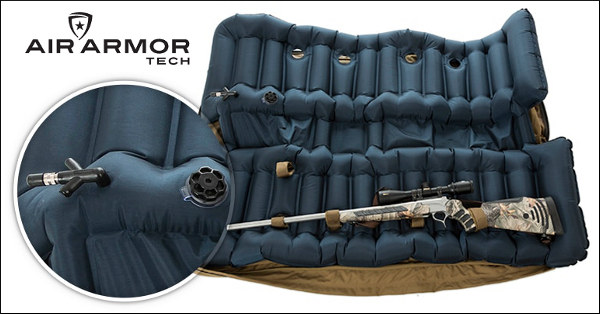
The Air Armor Tech Long Gun Case (LGC) holds multiple firearms up to 52″ OAL. When deflated, the 8-lb LGC stows in a 18″ x 9″ diameter roll. The LGC easily holds two long rifles with optics. The LGC comes complete with internal tie-downs for rifle and pistol, plus external shoulder straps for field carry.
Here’s something new and clever — a gun case with inflatable air chambers to protect the rifle. This definitely could have benefits for hunters and tactical shooters. This new Air Armor Tech military-grade gun case was recently tested by American Rifleman magazine. This gun case was developed by Blaine “Rock” Tompkins, a retired fighter pilot.
American Rifleman’s tester liked the product: “Typical foam-filled soft cases are inexpensive but don’t offer all that much padding. While hard cases provide more protection, they are bulky and take up a lot of storage space. Air Armor Tech’s inflatable gun cases … provide plenty of padding while being lightweight and easy to store. The three-pipe inflation system allows both of the 3-inch-thick (when fully inflated) air bladders to be quickly inflated.” Air Armor Tech offers two sizes, the Long Gun Case (LGC) that holds guns up to 52″ OAL, and the Mid-Length Gun Case (MLGC) that holds firearms up to 42″ OAL.
Air Armor Tech’s cases aren’t cheap — the LGC is $549 while the smaller MLGC is $499 — but when you consider your investment in rifle and optics, maybe this makes sense, particularly for hunters. Inside the bag are twin air bladders (see photo above) that cushion your guns. When deflated, the Air Armor Tech case can be rolled into a something the size of a sleeping bag.
Here are three videos that show the Air Armor Tech case works — and how it even floats. This air-cushioned bag definitely offers added protection for expensive firearms and optics.
Air Armor Tech Gun Case Features
Air Armor Tech Case on River Trip
Air Armor Tech Extended Field Test Report
“Air Armor Tech sent me a military grade inflatable rifle case to review. I’ve been using it for a couple of months on hunting trips, trips to the range and just about anything else I take a rifle or shotgun to. After using it for months, I can state without hesitation that the Air Armor Tech rifle and shotgun case is the toughest, lightest, handiest and best-made rifle case I have ever owned. It also protects my long guns better than anything I have ever tried. Besides, it even floats.” — Gun Guy, 09/25/17
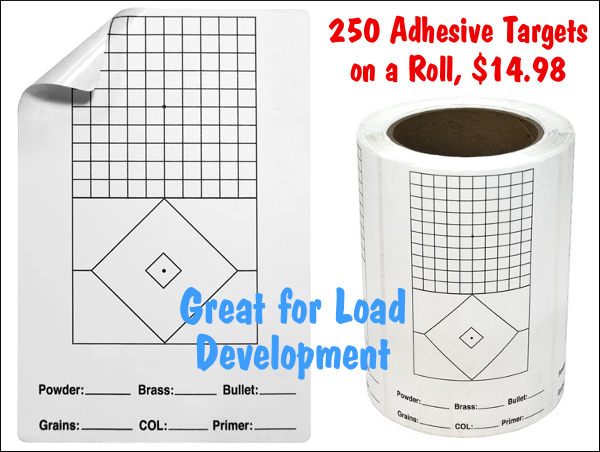
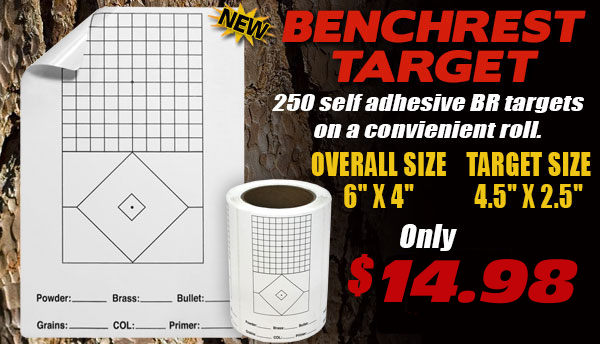
Here’s a smart new product from Midsouth Shooters Supply: 250 self-adhesive Benchrest Targets on a convenient roll. Not just for benchrest competitors, these stick-on targets work great for anyone doing load development. Each target offers a precision 1/4″ grid at the top with diamond aiming box below. This is similar to official targets used in Benechrest matches, with the addition of the upper grid lines which allow you to instantly estimate group size. These targets also include an area to list your load components. Midsouth sells the 250-target roll for $14.98.
This target was designed for benchrest shooting, developing new loads or cataloging existing ones. This easy-to-use target has a 1/4″ grid pattern at the top which helps measure groups. The vertical aiming square at the bottom helps align the cross hairs of your scope for consistent shot placement. At the very bottom of the target there is room to record your reloading information. Each Target sticker measures 6″ x 4″ with a 4.5″ x 2.5″ printed area.
The high-tech orange LabRadar represents the state-of-the-art in personal chronographs. It is extremely accurate, versatile, and you don’t need to go down-range to set it up. Some shooters have even used one during a benchrest shooting match (see below). LabRadars are used by many top shooting champions and the LabRadar chronograph has earned very positive reviews from respected testers such as Ray Gross, USA F-TR Team Captain.
Lab-Radar Discounted for First-Time Ever — Save $60.00
Since its introduction a couple years ago, the LabRadar has been in high demand. And the manufacturer has enforced a “no-discount” policy. Now, for the first-time ever, you can get a LabRadar unit for a reduced price: $499.95. This reduced price, $60 off normal retail, is available now through December 3, 2017. Many vendors are offering the LabRadar at this discounted price including Bruno Shooters Supply, MidwayUSA, and TCK LLC. Other vendors Applied Ballistics and Midsouth don’t show the discount yet, but you can call and ask.
New High-Quality Portable Base for LabRadar Chronograph
If you currently own a LabRadar, or plan to buy one soon, there’s a smart new accessory you should consider buying. Matt Owens, one of our Forum members, has created a new, compact base for the LabRadar that works better than the flat, orange baseplate offered by the manufacturer.
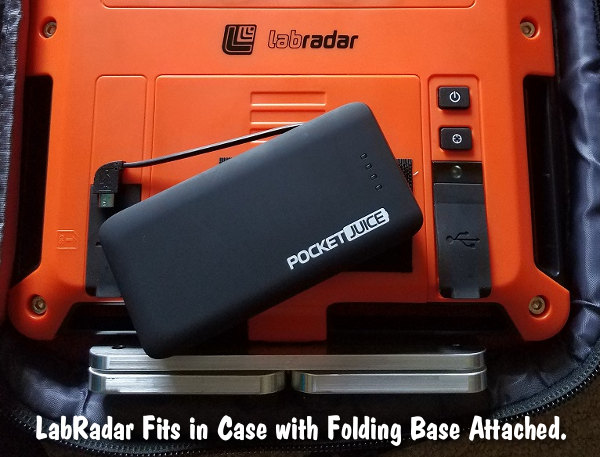
Matt, aka “Arkcomatt”, explains: “These are machined from aluminum and put together with stainless steel screws. The rubber feet are held on with screws also. No more coming off. The legs have nylon washers between them and the base for smooth operation. The screws are torqued and thread locker applied. One of the best things is, with the standard attachment, it will fit in the case with the unit. No more having to take apart! Just fold the legs. It takes up less room on the bench and allows you to get it closer to the rifle. It is very stable and holds up very well in high winds.” ORDER BASE HERE.
This folding base unit costs $75.00 + $7.50 for shipping (USPS). In addition, Arkcomatt now offers a swivel (ball) mount and stainless spike feet (for ground use). The swivel unit costs $10 and spikes are $20 per set. The 1.4″-long spikes screw in the sames holes as the rubber feet.
Forum Member Praise Arkcomatt’s LabRadar Folding Base:
You can read user reviews of the Matt’s LabRadar base in this Forum Thread.
Bullet-maker Bart Sauter has one of these bases now and he endorses it: “These bases are great for the LabRadar. Stable and compact — completely grab and go!”
Forum member Peterson1 agrees: “This is more stable than the Labradar base for my use–off a concrete BR bench, yet takes up less space. Also easier/quicker to set unit up and aimed at target. Never take the unit off for transport in LabRadar case. Only negative — you can’t trade in the factory LabRadar base toward purchase of this base. So buy smart the first time!”
Forum Member SkiUtah02 uses the base with optional spiked feet: “Met up with Matt at the Sierra Cup and bought my base with … spikes for the feet to put into the ground. Just had a chance to test it today and it worked great. I removed the rubber feet, and screwed in the four spiked feet, added a threaded-rod-coupling nut onto the bolt so that I could mount an old photography lighting stand swivel head to the base! Worked perfectly. Thanks Matt!”




 Zanotti Safes from 350 to 825 Pounds Assembled




 The free