The new Leupold Thermal Optics (LTO) Tracker is a hand-held, heat-detection device designed as a multi-purpose hunting tool for game observation and game recovery. A high-performance thermal spotter, the LTO Tracker can detect heat sources out to 600 yards. The advanced thermal imaging engine fires up in less than three seconds and offers fast 30hz frame rates.
The hand-held unit features a 20-degree field of view and 6x digital zoom. Five different thermal filters provide multiple viewing options. The LTO’s CR123 lithium battery provides more than 10 hours of continuous use. A user-controlled reticle allow the user to quickly pinpoint a game animal or other thermal source. MSRP for the LTO Tracker is $874.99.
Use LTO Thermal to Track Animals and Guide your Hunt
From checking your ingress path to your stand, to helping track wounded animals, the LTO Thermal can perform many tasks. Hunters can use the LTO Tracker to spot their quarry’s heat trail and efficiently recover the downed animal. Using the LTO Thermal, hunters can also plan their walk to their stand or blind with minimal risk of scaring off game. Where legal, varmint or feral hog hunters can use the LTO Tracker to identify their quarry, leading to more successful hunts.
“We see thermal as a vital tool in any hunter’s kit, just like binoculars or laser rangefinders,” said Tim Lesser, vice president of product development for Leupold & Stevens, Inc. “For observation and recovering downed game, the LTO Tracker will help hunters find success in the field.”
The Ruger Precision Rifle (RPR) has been a big hit. Since its introduction in 2015, this modular rifle has become the top-selling, tactical-style bolt gun in the USA. And now RPR owners have a new trigger option for their rifles. Timney Triggers has just released an affordable drop-in, two-stage RPR trigger. We expect many RPR owners will choose to upgrade their rifles with this new trigger, priced at $219.95 MSRP for either curved or straight trigger shoe. The trigger comes pre-set with a 1.5-lb total pull with one pound in the second stage. Timney is now taking orders for the RPR trigger via TimneyTriggers.com.
These triggers are crafted with advanced production methods. For example, the sear is wire EDM-cut and then Teflon-nickel coated.
Here is Timney’s Product Description for the New RPR Trigger:
The new Timney RPR trigger is a self-contained, 100% drop-in trigger ready to install in your Ruger Precision Rifle for an exceptionally smooth, crisp, two-stage trigger pull. No gunsmithing, fitting, or adjusting required.
The pull weight is factory-calibrated for a half-pound first stage and a one-pound second stage. The first stage is user-adjustable from 1/2 pound to one pound and the second stage is user-adjustable from 1/2 pound to two pounds. The trigger is offered in straight and curved trigger shoe models.
The trigger housing is constructed of military-grade, 6061 T6 alloy that is CNC-machined using state-of-the-art robotics and is anodized for superior durability. The trigger is also CNC-machined, heat-treated and coated. The sear is wire EDM cut, heat-treated to 58-60 Rockwell and Teflon-nickel coated for lubricity and dependable, long-lasting service life.
Timney RPR Trigger Review on Shwat.com
The folks at the Shwat.com blog got their hands on an early-model Timney RPR trigger. In a detailed review, Shwat.com’s testers showed how to install and adjust the new trigger, and then put it through its paces. Timney’s new RPR trigger earned high praise: “The Ruger Precsion Rifle … factory trigger is excellent and well-suited to most uses. But if you are accustomed to the feel of a more traditional trigger, this Timney is your ticket. Excellent, reliable, consistent and repeatable — it has the same precision feel and operation you expect from Timney. Installation is simple and easy with no special tools needed.”
Nosler has introduced a new line of RDF™ (Reduced Drag Factor) bullets that feature very high BCs, hybrid-type ogives, and tight, factory-closed meplats. Based on initial specs, Nosler’s new RDF bullets should be very competitive match projectiles for their respective bullet weights. Nosler claims its new RDF bullets have “the highest BCs and smallest, most consistent meplats of any hollow-point match bullet line on the market.” RDF projectiles will be initially offered in four calibers: .224, 6mm (.243), 6.5 mm (.264), and .308.
NEW Nosler RDF Bullets:
· 22 Cal 70 grain — G1 Ballistic Coefficient 0.416 | G7 Ballistic Coefficient 0.211
· 6mm 105 grain — G1 Ballistic Coefficient 0.571 | G7 Ballistic Coefficient 0.280
· 6.5mm 140 grain — BC field verification in process
· 30 Cal 175 grain — G1 Ballistic Coefficient 0.536 | G7 Ballistic Coefficient 0.270
High-BC RDF Bullets Feature Compound (Hybrid-type) Ogive Profiles
Nosler designed RDF bullets to have very high BCs for flatter trajectories and reduced wind drift. Nosler achieved high BCs by adopting a modern hybrid-type compound ogive, which bridges traditional tangent and secant bullet shapes. Another benefit of the compound (hybrid-type) ogive, is that this shape is normally less sensitive to bullet seating depth than a pure VLD-style, secant ogive shape. That allows hand-loaders to seat off the lands and still get excellent accuracy, which can be maintained even as the throat moves out over time. RDF bullets also feature a long boat-tail for aerodynamic efficiency.
Factory-Closed Meplats — No More Trimming and Pointing Tips
Compared to conventional match bullets, Nosler’s RDF bullets look quite different because the tips have been tightly closed up at the factory. Nosler claims a a 40% average reduction in meplat size vs. conventional hollow-point bullets. With Nosler doing the work on the tips, hand-loaders no longer need to point and trim tips, a laborious task done to improve BC and, more importantly, to make BCs more consistent for every bullet in the box. Consistent BC translates to reduced vertical spread at long range.
John Nosler Talks about RDF Bullets:
“Long-range competitive shooting [is] one of the fastest-growing shooting activities in the world, and quality bullets are the cornerstone of the sport” said John Nosler, Executive V.P. for the company. “Our engineers were challenged with delivering a bullet that would drastically reduce aerodynamic drag and increase ballistic consistency, providing shooters with an indisputable advantage. What we achieved is a leap in match bullet technology….”
We first saw Lyman’s new automated target system at SHOT Show in January and we liked it. This new Target System from Lyman has a motor-driven roll of targets that can be “refreshed” with a radio remote-control. Here’s how it works — a 50-foot-long target roll is mounted in the top on the target stand. When you’re ready for a new target, push a button and a fresh target rolls into place. The radio remote-control activates a battery-powered electric motor that conveniently rolls a new target into place after the current target is shot out. The remote-control works at distances up to 200 yards. NOTE: This target system is rated for rimfire and air rifle use only — no centerfire.
There are currently four (4) target roll options: Five Bullseye Target, 11-Bull Smallbore Target, Silhouette Target, and Varmint Target. MSRP is $229.95; street price is around $200.00 on Amazon.
Lyman states: “The new Lyman Auto-Advance Target System offers shooters the ability to change targets at up to 200 yards with the press of a button! No more walking downrange to replace targets, or waiting for cease-fires! The Auto-Advance Target System is battery-operated, so there is no need for wires and power outlets, plus it disassembles easily for transportation back and forth to the range. The Auto-Advance Target System has steel protection plates that are rated for use with all rimfire calibers. The Auto-Advance Target System comes with a roll of standard bullseye targets. Additional 50-foot target rolls are available with bullseye, animal and silhouette designs.”
Lapua, maker of premium brass, bullets, and loaded ammo, has released a new, state-of-the-art Ballistics program that runs on smartphones and mobile devices. The all-new Lapua Ballistics Mobile App is the first mobile ballistics app utilizing the 6DOF calculation model. 6DOF refers to “Six Degrees of Freedom”, referring to the multiple variables the software calculates. As explained below, a 6DOF solver can account for 3 components of movement PLUS 3 components of rotation. Of course, as with other ballistics software, the Lapua Mobile App looks at Bullet BC, velocity, and cross-wind effects. This software can also account for subtle, extreme long range factors such as the Coriolis Effect.
Notably, the new Lapua Ballistics App includes a library of up-to-date bullet profiles based on extensive field tests with Doppler Radar. Having an ultra-sophisticated 6DOF solver combined with Doppler Radar data makes the Lapua Mobile App one of the most accurate ballistics Apps on the market. Lapua Ballistics offers the latest, Doppler-proven Lapua cartridge and bullet data for you to combine with your firearm and local weather information. The App also includes the option to define custom bullets.
The Lapua Ballistics App is available for Android and iOS smart phones and mobile devices free of charge. For more info, visit www.lapua.com/lapuaballisticsapp.
6DOF, the most accurate calculation method. Lapua cartridge / bullet information. Distance, wind speed and angle. outputs numerical, reticle, table and graph views, metric and imperial values. Set Point Blank-range to different sight-in distances and impact windows. Define custom bullets ( BC G1 or G7 and Siacci method), Pre-set max 4 powder temperature.Sight-in-POI, Coriolis calculation
There is a new tactical action from Canada with some very interesting features. The innovative U300 Bolt Action from Ultimatum Precision features a Rem 700 footprint and three-lug bolt with 60° bolt lift (like a Barnard). The floating bolt head is quickly removable, so you can swap to a different rim size in a few minutes. Another interesting feature is a special “Battery Safety”. The firing pin can only protrude from the bolt face if the lugs are locked and in battery. This ensures that if the bolt head is not properly installed, the rifle does not fire.
The black Cerakoted U300 action is strong and tough — the 4340 steel is hard-nitrided for surface durability. The action-maker says the hard nitride and Cerakote coatings improve wear resistance, corrosion resistance, chemical resistance, and hardness. The U300 action fits AICS-compatible detachable box magazines.
Designed for Savage-type Barrel Nuts
The Ultimatum U300 system was design to accept a barrel nut so “pre-fit” barrels (configured for the U300 bolt) can be easily installed (or swapped) by the owner with no gunsmithing required. The U300 uses standard 1-1/16″ x 16 Remington 700 tenon threads, so it can fit pre-chambered barrels with Remington-style threading. NOTE: Barrels headspaced properly by a smith can also be mounted conventionally without a nut. The user can choose the system he prefers.
Ultimatum U300 Action features:
· Removable Floating 3-Lug Bolt Head
· 5/16″ Integrated Recoil Lug
· Battery Safety
· 20 MOA Picatinny rail, secured with six #8-40 bolts and two pins
· 4340 Steel with Hard Nitride Finish and Cerakote.
· Compatible with AICS-style magazines
Ultimatum Precision has started shipping the first U300 short actions. Suggested MSRP starts at $998.00 U.S. Dollars. The action-maker plans to release both a long action model and a .338-specific model later this year. Ultimatum Precision is located in Abbotsford, BC, Canada, with a subsidiary in Washington state, USA. For more info, visit www.UltimatumPrecision.com.
Here is a very interesting rifle, a true metal/wood hybrid that combines an aluminum front section with figured walnut in the rear half. As you can see, this unique rifle also features a barrel block that allows the Savage action to float. You may be wondering “how is the metal section connected to the wood?” The gun’s owner/builder epoxied a stainless steel tube in the wood and that tube is secured in the aluminum fore-end with set screws.
Forum member Justin V. reports: “Sometime last fall my buddy wanted to build barrel-blocked Bavage. He is a machinist by trade so he was able to build all of the custom components himself. I know he put a ton of time into this thing over the winter, taking his time to get it done right. If you shoot in Cadillac or Midland, Michigan you will probably see him around. He tried to shoot a match this past weekend but was rained out. Hopefully it will stop raining in Michigan so he can see what it can do at 600 yards. Here are the results….” Learn more about this gun in this FORUM Thread.
The Savage A17 in 17 HMR was American Hunter’s 2016 Rifle of the Year. We weren’t surprised. This little rimfire was the first auto-loader engineered from scratch to handle the pressure of the 17 HMR safely and reliably. The A17 also proved to be very accurate and tons of fun to shoot.
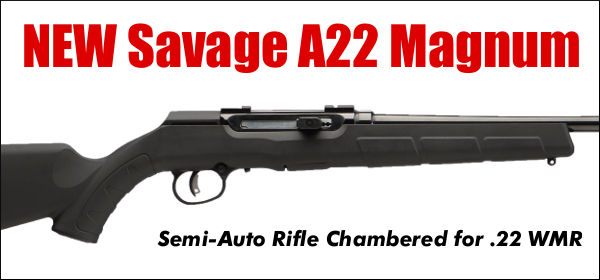
If you like the A17’s award-winning delayed-blowback technology, but prefer to shoot a .22 WMR (Winchester Magnum Rimfire) cartridge, you’re in luck. Savage just announced the A22 Magnum, a new rifle that uses an A17-type action (with innovative interrupter lug), to shoot the .22 WMR cartridge.
The A22 Magnum is chambered for .22 WMR and features the same delayed-blowback auto-loading action as the original A17. The A22 Magnum feature a strong steel receiver, chromed bolt, 10-round rotary magazine, and adjustable Savage AccuTrigger. The A22 employs a thread-in headspace system like Savage’s centerfire rifles. This makes it easier to swap in a match-grade barrel down the line. The A22 also comes with two-piece bases for scope mounts
Part No.
Description
Barrel
Weight
MSRP
47400
A22 Magnum semi-automatic, .22 WMR
21″ Barrel
5.5 lbs.
$473.00
Advantages of .22 WMR over 17 HMR
We like both rimfire cartridges, but we understand why some shooters may prefer the older .22 WMR over the newer, speedier 17 HMR. Here are some of the advantages of the .22 Winchester Magnum Rimfire (WMR):
1. .22 Caliber bores are easier to clean than .17 caliber bores. Good .22-Cal cleaning rods are less flexy than .17-cal rods and a greater range of jags and brushes are offered for the larger caliber.
2. The .22 WMR makes a bigger hole — this makes your groups easier to see at longer range, and the bigger hole can give you a scoring edge in rimfire competitions.
3. The .22 WMR offers a wider choice of ammo manufacturers and bullet types. If a hunter desires a heavier, non-fragmenting bullet, the .22 WMR may be a better choice.
Weatherby has a new modular rifle for PRS comps and other tactical disciplines. Called the Vanguard® Modular Chassis (VMC), this rifle features a Modular Driven Technologies (MDT) aluminum stock, Luth AR MBA-1 buttstock, and 22″ heavy barrel. The Weatherby Vanguard action is fitted with an adjustable 2-stage trigger. Priced at $1519.00 MSRP, this rifle can be campaigned in the PRS “Production Class”, which limits complete rifles to $2000.00 without optics. The rifle is offered in three chamberings: .223 Rem, 6.5 Creedmoor, and .308 Winchester.
Weatherby says its Vanguard Modular Chassis tactical rifle is very accurate. To back that claim, Weatherby offers a SUB-MOA accuracy guarantee — Weatherby guarantees the rifle will shoot .99” or smaller 3-shot groups at 100 yards when used with Weatherby® factory or premium ammunition.
Near Half-MOA Accuracy with Factory Ammo
It turns out Weatherby’s accuracy claims are conservative. This tactical rifle is closer to a half-MOA rig than a 1-MOA gun. American Rifleman recently tested a .308 Win version of this rifle and recorded really stellar accuracy — close to half-MOA. What’s more, this rifle is not fussy — with a 1:10″-twist barrel it proved very accurate with six different types of factory ammo.
In fact, the rifle delivered near-half-inch 5-shot groups with two types of Hornady factory ammo, and the worst group (of six ammo types) was 0.76″, still very impressive for factory fodder. With good hand-loads this gun could go well under half-MOA (for five shots).
Vanguard Modular Chassis FIVE-SHOT Test Groups with Factory Ammo:
0.53 inches | Hornady 168gr Match BTHP (2718 fps)
0.55 inches | Hornady 155gr Steel Match (2612 fps)
0.57 inches | Black Hills 168gr BTHP (2608 fps)
0.66 inches | Federal Premium 168gr MatchKing BTHP (2659 fps)
0.70 inches | Hornady 155gr American Gunner (2697 fps)
0.76 inches | Black Hills 175gr BTHP (2603 fps)
NOTE: Group sizes are for 5-shot groups shot from bench at 100 yards with Caldwell pedestal rest and rear sandbag. Pentax Lightseeker 6-24x50mm scope. Velocities in FPS from PACT Chronograph.
The accuracy testing was done by gunwriter Mike Detty, who notes: “My single best group was fired with Hornady’s Match 168-gr. BTHP ammunition. Five shots measured just slightly more than a half-inch. Hornady’s 155-gr. Steel Match ammo wasn’t far behind with a group of .55″. Also accounting for the small groups is the VMC’s wonderful trigger. It is a two-stage affair and the first stage has about 3/8” take up with about a pound of pressure until it reaches the second stage where another 1 ¾ lbs. was required to break the shot.”
PRS Production Class Cost Limits
Production Division combined rifle and scope MSRP as listed on the company’s website shall not exceed $3,000 USD, the rifle shall not exceed $2,000 USD and the optic not exceed $2,000 USD. [Editor: For example, you could have a $2,000 rifle with a $1000.00 scope or vice-versa. The total system cannot exceed $3000. Rifle alone cannot exceed $2000.00 retail sale price.]
Production Division rifles are not permitted to be altered or improved in any way from the original factory configuration.
Many folks think the ultra-smooth Bix’N Andy triggers are the best match triggers you can buy. But until now Bix’N Andy trigger units, with their light pull-weights, have been intended primarily for benchrest and F-Class disciplines, where light pull weights are favored by many competitors. Well, Bix’N Andy has just released a new TacSport trigger that can be adjusted to a pull-weight of up to five (5) pounds (combined first and second stages). But remarkably, the same new TacSport trigger can still go down to about one ounce — that way you can adjust the pull weight through a very wide range to suit the application. Length of trigger shoe travel can also be set from zero to 7mm.
This trigger can operate as a single stage or as a two-stage. Each stage can be adjusted independently. Set the trigger at a few ounces for load testing from the bench, then crank it up to 2.5 pounds for a tactical match. Run it as a single stage for the bench or a two-stage for field work. With this flexibility and wide pull-weight adjustment range, the new Bix’N Andy TacSport trigger is well-suited for tactical shooters, hunters, and LEO marksman. The TacSport trigger also comes with a right-side top safety.
The new Bix’N Andy TacSport trigger is now available from BulletCentral.com for $495.00. Yes, that’s pricey, but this trigger offers features and “feel” you can’t find anywhere else.
Product Tip from EdLongrange. We welcome reader submissions.



 1. .22 Caliber bores are easier to clean than .17 caliber bores. Good .22-Cal cleaning rods are less flexy than .17-cal rods and a greater range of jags and brushes are offered for the larger caliber.


