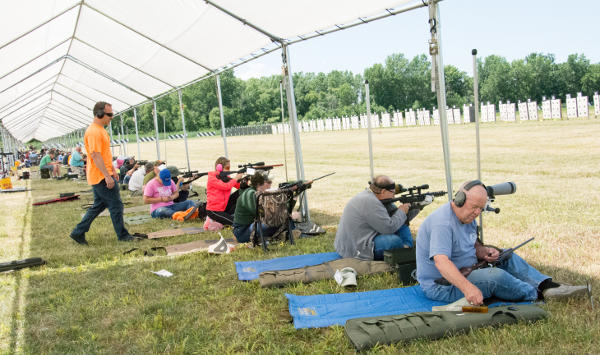
Today, July 22, 2018, the CMP hosts the popular Rimfire Sporter Match at Camp Perry. A great event for shooters of all ages and skill levels, the Rimfire Sporter Match will attract hundreds of shooters. This year a special smart-phone App will be used to speed up scoring.
Hundreds of shooters will compete in the Rimfire Sporter Match today at Camp Perry.
Rimfire Sporter Course of Fire
Competitors will complete slow fire prone, rapid fire prone, slow fire sitting or kneeling, rapid fire sitting or kneeling, slow fire standing, and rapid fire standing shot sequences. To learn more about the National Rimfire Sporter Match, CLICK HERE.
Rimfire Sporter Classes
Three different classifications of rifles can be used in Rimfire Sporter competition: “O Class” for open-sighted rifles, “T Class” for telescope-sighted rifles, and the recently-added “Tactical Rimfire” class. Awards are offered to High Juniors, High Seniors, High Women as well as Overall winners are named for each class.
Do you want to see more match photos? CLICK HERE to view the CMP Zenfolio Archive with 500+ photos from 2016 National Rimfire Sporter Match.
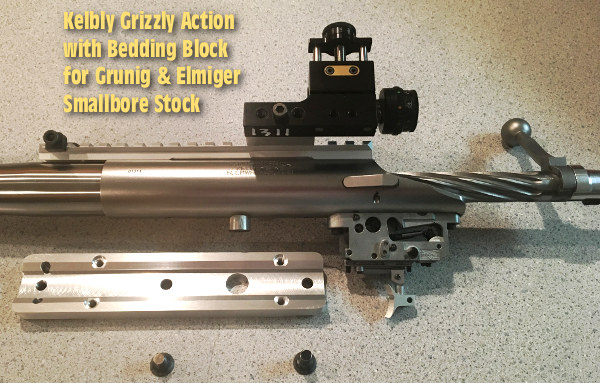
Our friend Kevin Nevius, best known for his smallbore skills, went head to head against the nation’s top long-range aces this past week, and emerged on top. Besting the likes of past multi-time Long Range Champions David Tubb and John Whidden, Kevin Nevius shot superbly at Camp Atterbury to win his first NRA National Long Range Championship. Kevin finished with 1245-64X, one point ahead of Phillip Crowe, 1244-74X. Bob Gill, shooting a .223 Rem with iron sights, was third on X-Count, with 1244-68X. Kevin built his own rifles for the match, using Kelbly centerfire actions in a Grunig & Elmiger smallbore stock. Here is Kevin’s first-hand report of his 2018 LR Championship victory.
2018 NRA Long Range Championship — Rising to the Challenge
by Kevin Nevius This was my first opportunity to shoot the NRA Long Range Nationals since its relocation to Camp Atterbury, and it was great to see everyone and get back to the matches. It is always so humbling walking onto the range and seeing all of the people I read about and admire so much. I can’t think of another sport where people so accomplished will share so much and be so helpful.
Regarding the weather, we had generally great conditions with very mild winds in the mornings, building gradually as the days progressed. By the afternoon hours, there were certainly challenges as the air started moving. Obstructions to the wind on either side of this range vary, so you needed to pay attention for sure — it may be calm at the targets or firing line, only to show something to worry about on the mid-range flags. Mirage is my primary indicator shooting smallbore, but mirage over 5/8ths of a mile is a little less telling (and a lot more confusing, at least for me!). I think most competitors, including me, use some combination of mirage and flags to make corrections. At the start of the string, I try to gauge a predominant condition, and more importantly which indicator is the most reliable to look at to determine that condition.
Smallbore shooting is where I learned to build a good position, and so much of that carries forward to Long Range High Power. It was a huge shock though, the first time I looked at a 44” aiming black through aperture sights at 1000 yards! Smallbore aiming blacks are twice as big, at one tenth the distance — the fact that we can hit something at 1000 yards with that sight picture still amazes me!
Kevin’s Arsenal — 6.5×47 Lapua and .308 Win Barreled Actions in Smallbore Stock
I have always build my own rifles, and always struggled to get the individual rifles you need for the LR aggregate (Any and Palma) and smallbore to feel, balance and fit identically. This year for the first time, I machined bedding blocks that allowed me to put almost identical centefire barreled actions into my smallbore prone stock – effectively making the position and fit of all the rifles for all disciplines identical (it is, after all the same stock used for everything).
I used two modified Kelbly Grizzly actions (one barreled in 6.5×47 for the any rifle matches, and one barreled in 308 for Palma) fitted to two identical aluminum bedding blocks. The bedding block footprint matches my smallbore barreled action – a Grunig & Elmiger Racer WC. The stock is a Grunig & Elmiger Hybrid, which is a composite aluminum skeleton and carbon fiber skin.
Championship-Winning 6.5×47 Lapua and .308 Win Loads
I was using a 6.5×47 Lapua in the “Any Rifle” matches. The barrel is a 1:8″-twist Benchmark medium Palma contour finished at 35 inches, throated +0.060″. My 6.5×47 load was Lapua brass, CCI 450 primers, VV N160 powder, and 140 grain Berger Hybrid bullets. For the Palma match, a .308 Win barreled action was fitted in the same Grunig & Elmiger smallbore stock. The .308 barrel was another Benchmark 35″ medium Palma, using the current Fullbore chamber throated +0.120″. I was using Lapua .308 Palma small primer brass, Federal 205M primers, VV N140, and 155 grain Lapua Scenar L bullets.
Shooting Between Champions — Tubb on the Left, Whidden on the Right
On the final day (the Palma Individual), we were squadded based on seed position, so David Tubb was on my left, and John Whidden on my right. I am not sure if a more intimidating position on the firing line exists, but it was so clear to me especially on that last day how blessed I was to be there. In every match, there is an element of luck — regarding weather, squadding assignment, target service, firing point condition, even equipment malfunction. A host of things can go wrong…
I lost my very first shot at 900 mostly due to elevation (I was coming a little unhinged with the realization I might be in the lead – just being completely honest!), and settled down to clean the remainder of the string. The wind had built by then, and would run both right and left with the small boils in between. At 1000 I lost two, and was pretty happy with that. It was getting pretty dicey, and I resigned myself to the fact that it was becoming one of those days where 10s were enough (and Xs were pure luxury!). John shot well at 1000, but he always does — I don’t think there is a better long range shooter in the country and it’s been that way for a bunch of years. I can’t say enough about him – he is a dear friend and everything a champion should be. (Editor: Whidden finished fourth overall, at 1243-78X, with high X-count for the event.)
To put it all together takes so many things — preparation, tuning, load development, position practice. And yes, it takes some divine intervention for sure. I will never forget this experience, and am so grateful to have been successful this year.
John Whidden of Whidden Gunworks congratulated Kevin: “I was really proud of my friend Kevin Nevius and his fine shooting over the match. Kevin is respected both for his shooting and his character. The match went well and a number of improvements were made over last year. The targets were better, the number boards better, and the match ran very efficiently. Kudos to those who made these positive changes happen.”
Tough Time for Tubb on Last Day
Kevin noted that it was intimidating to be squadded between David Tubb and John Whidden, two multi-time Champions. Unfortunately Tubb, who had shot brilliantly (800-50X) throughout the Long Range event, had issues with his .308 Palma rifle on the final day. Kevin noted: “Yes David had some problems with his .308. When we arrived at the range on the last day, for the Palma Individual, David was in the lead with 800-50X, having shot ‘clean’ (not dropping a point). Bob Gill was second with 798-43X, and I was in third place with 798-42X. As we started the 800-yard string, there was some commotion going on to my left, and all I know is that as we finished and started moving to 900 yards, David was not happy. I believe he had lost 4 points at 800. We went to the pits, and he said his rifle was not shooting well, and he was pretty unhappy to say the least. He tried to adjust the seating depth of his ammunition before heading back out to the 900-yard line, in the hopes the gun would shoot better”. But it ended up a very tough day for David, as his chances for another LR Championship vanished.
Editor: With a 800-50X total, David Tubb was the Winner of the Canadian Cup Trophy, earned before the last day.
Bob Gill Proves the .223 Remington (and Iron Sights) Can Be Competitive
There were many interesting stories at this year’s Long Range Championship. The .223 Rem Eliseo Tubegun belonging to Californian Bob Gill proved to be “the little rifle that could”. Gill shot his .223 Rem Palma rifle for the entire Long Range Championship cycle. And yes Bob shot irons the whole way, even during the Remington and Wimbledon “Any Sight” matches where scopes are allowed. Kevin observed: “Bob Gill was amazing, and that rifle must be pretty awesome too. I don’t think I have ever seen someone shoot a .223 Rem at 1000 yards that well — ever. I believe Bob was shooting 80 grain bullets. As I pulled for Gill on the third day, I can testify that his bullets were still plenty supersonic!”
Editor: Gill finished 3rd overall, just one point down from Kevin, and six Xs behind runner-up Phillip Crowe. Gill also won the Sierra Trophy.
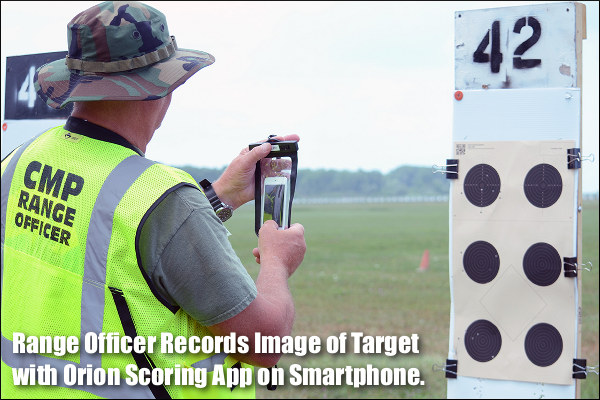
Elite smallbore competition returned to the summer National Matches in high-tech style this year. New Orion scoring software was used to enhance and speed up the scoring process. Range officers simply snapped photos of targets after each relay using the Orion App on smartphones. The software then identified the bullet holes and logged the shot location in the scoring rings. This handy new software was used for 3P and prone smallbore competition. It will also be used tomorrow, July 22nd, at the hugely popular Rimfire Sporter Match.
Story based on Camp Perry Report by Ashley Brugnone, CMP Writer
A staple during the National Matches season for over half a century, high-level Smallbore Matches returned to Camp Perry this summer (after the NRA moved the Smallbore Championships to Camp Wa-Ke’-De in Indiana in 2016).
“We had a lot of competitors who wanted smallbore to return to Camp Perry” said Match Director Brad Donoho. “This year, we tried to give everybody the opportunities they were used to at Camp Perry and try to stay true to history while also being innovative at the same time.”
The CMP’s new National Matches Smallbore series kicked off July 17 on Camp Perry’s Rodriguez Range with the Three-Position Day 1 event. Competitors in the event fired 40 shots onto paper targets at three positions: prone, kneeling and standing.
For the Camp Perry smallbore matches, new image-based software was used for scoring. Orion Scoring System developed scoring software that can read shots from photos captured with smartphones. The Orion Smartphone App links directly to the Orion Scoring system, which then identifies shots on the target and scores accordingly based on shot placement in scoring rings.
Range Officers snap photos of targets with Orion Scoring App.
Once all firing was completed for each stage at the National Matches events, range officers on the line walk downrange with a mobile device loaded with the Orion Scoring System App. The new scoring system drastically slashed competition time while also easing the scoring element for both competitors and match workers.
CMP verifiers reviewed the targets on computers before posting the results online, all in a matter of minutes. The physical paper targets were also retained — just in case a challenge was brought forward by a competitor.
“The hope is, at its best, we should be able to have scores posted online before firing begins for the next stage, which would be pretty revolutionary for paper targets at Camp Perry,” said Donoho.
The electronic Orion Scoring System will also be used to score the National Rimfire Sporter rifle competition, set to take place at Camp Perry on Sunday, July 22. “This is the first step to allow Orion users to use this at their home range”, noted Donoho. An extensive amount of testing was conducted on the Orion electronic scoring system in the months leading up to the National Matches. It performed admirably this past week at Perry
3P Finals and Prone Elimination Match on Electronic Targets
Another exciting element added to the prone match is a prone elimination event, fired on CMP’s electronic targets on the Petrarca Range — another first for a National Match smallbore event. “We wanted to do something new – something creative,” said Donoho. “Hank Gray, from the USAMU suggested an elimination event where we start with a full range of shooters and start elimination shooters after the first stage of fire to get them down to the Top 10.” The Three-Position finals was also fired on the CMP’s Petrarca Range electronic targets at Petrarca Range during the Matches.
Video Demonstrates Kongsberg Electronic Target System Installed at Camp Perry:
These electronic targets have sensors on the target frame that plot each shot’s point of impact in the bullseye. Shot location and score value are calculated instantly with results visible on a monitor placed next to the shooter. This is faster than the Orion system, but it is also much more expensive. The advantage of the Orion system is that it can work with conventional paper targets on standard target frames. Orion scoring does not give instant results, however, unlike the Kongsberg system.
Bigger is Better?
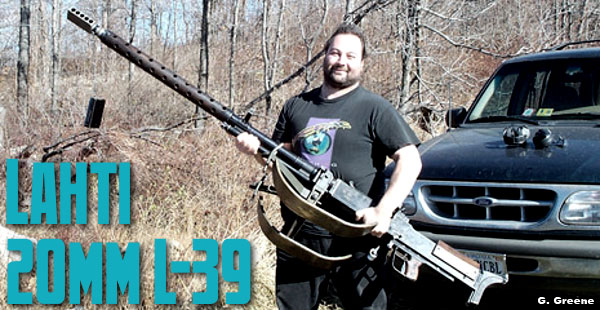
Yes, size matters — at least when it comes to gun safes. Is your current safe bursting at the seams with your ever-growing firearms collection? Perhaps you need a little more vertical clearance for your Lahti L-39 or favorite Punt Gun? Well Superior Safe Co. has a solution for you — a humongous safe that stands 10-feet tall and weighs more than a pick-up truck. For reference, the young man in the picture, Greg from Pyramyd Air, is an honest 6’3″ tall.
Sized Right — For a 7-Footer
Now if you’re not an NBA center, the lock placement on this safe is not very practical. The lock’s keypad is a good foot above Greg’s head, making access somewhat difficult for the “vertically challenged” customer. We’re not sure what Superior Safe hand in mind here — unless this mega-safe was really created for the likes of Shaquille O’Neal or Joel Embiid.
Still, Americans love big stuff — big cars, big houses, and, of course, big guns. At least if you purchase one of these monsters, you’ll have the peace of mind that a smash-and-grab thief can’t roll it away on a hand dolly. Superior Safe, which displayed this yellow giant at the NRA Annual Meeting & Exhibits a while back, explains that this is a “custom model” not on the normal price list — face it, if you need to ask about the price, you can’t afford it. Joking aside, if you really need this kind of capacity for a firearms collection (with a punt gun or Lahti), you’d be wise to consider a custom walk-in vault, built into a room in your house. (Safe photo courtesy Pyramyd Air.)
What is a Punt Gun? A punt gun is an extremely large shotgun used in the 19th and early 20th centuries for shooting large numbers of waterfowl for commercial harvesting operations and private sport. Punt guns could have bore diameters exceeding 2 inches (51 mm) and fire over a pound of shot at a time. A single shot could kill over 50 waterfowl resting on the water’s surface. Punt guns were too big to hold so they were often mounted directly on the punts (boats) used for hunting, hence their name. Generally the gun was fixed to the punt, requiring the hunter to manuever the entire boat to aim the gun. Firing the gun often propelled the punt backwards from recoil. Sometimes fleets of punt gun-boats were used together. In the United States, this practice depleted stocks of wild waterfowl and by the 1860s most states had banned the practice. In the United Kingdom, a 1995 survey showed fewer than 50 active punt guns still in use. UK law limits punt guns to a bore diameter of 1.75 inches (1 1/8 pounder). Learn more at Wikipedia.com.
Lahti L-39 photo, courtesy Gordon Greene, originally appeared in The Gun Zone.
Love your LabRadar chronograph? Or wish you owned one? Well now the LabRadar is even better. The makers of the advanced, Doppler-radar LabRadar system have introduced a versatile new LabRadar Mobile App that works with iOS (Apple) and Android systems.
The Mobile App lets you control the LabRadar remotely with your smartphone or laptop. This makes it easier when you position the LabRadar beyond arms reach (such as when using a suppressor). The App also makes it much easier and faster to change settings, display shot data, and download test results.
LabRadar Android Mobile App:
Initial feedback on the LabRadar Mobile App has been very positive, though it took some guys a couple tries to get everything working right. Android users — be sure to turn on your “Location Services”. You’ll find a full discussion of the LabRadar App, with set-up tips, on our Shooters’ Forum. Read HERE.
LabRadar iOS (Apple) App, iPad Version:
Here’s a recent review from a LabRadar owner using an Android phone: “[This App] makes the LabRadar exponentially more useful without additional cost. Firmware update to 1.20 was uneventful and quick. No issues running this on a Samsung Galaxy S9+. Shot series can be reviewed on the phone while disconnected from the radar. While connected you can change the radar settings from within the App. Great features and flawless execution.”
LabRadar Mobile App Functionality
With the new Mobile App, you can control your Labradar from your smartphone or tablet with its Bluetooth connection. Manage, store or delete the information in your series as you wish. View your data and summaries displayed in list or table formats. Even view a graph of speed vs. distance.
– Control your LabRadar from your smartphone or tablet
— Display Single Shot Stats: Velocity, Energy, Power Factor
— Display Shot Series Stats: Average, ES, SD, Hi/Lo Shot
— View Velocity by Distance as Graph and List
— Arm, disarm, and change your settings
How to Install and Use LabRadar Mobile App
First get the LabRadar App for your mobile device. Download the Android App from Google Play. Get the iOS (Apple) Version from the Apple App Store. You may also need to update your LabRadar Firmware.
Firmware Update to Enable Bluetooth
LabRadar owners may need to upgrade their chrono’s Firmware to allow the unit to communicate with the Mobile App. The latest firmware will enable the Bluetooth connectivity on your LabRadar device. Download the new Firmware v1.2.2 by following the link below.
1. Go to http://www.mylabradar.com/download/
2. Select: Labradar Firmware v1.2.2 (English) Mobile App Ready.
3. Copy the FWA and FWB files to a SD card (or use the USB cable method).
4. Insert the SD card in your Labradar and turn it on.
5. On your Android Device, make sure your location services is enabled.
6. IMPORTANT — Do NOT PAIR your Bluetooth device to the Labradar! When using the mobile App simply connect to your Labradar from within the App.
Congratulations to SFC Brandon Green, the 2018 NRA National High Power Champion. Brandon won yet another High Power title in convincing fashion, with a 2394-147X overall score. Two other soldiers finished second and third, separated by X-Count. Second-place SFC Shane Barnhart scored 2386-137X, while SGT Benjamin Cleland was third with 2386-128X. In fourth place, and top civilian, was Ronald Zerr with 2383-126X. (CLICK HERE for High Power Results.)
Now it’s time for High Power Long Range. For the next few days, the nation’s top long-range “hard-holders” will be competing at Camp Atterbury, Indiana. The NRA High Power Long Range Championships run July 13-17, with the Long Range Palma match on Tuesday the 17th. Many notable shooters will be there, including John Whidden, who is aiming for a “three-peat” after winning the LR Championship for the past two years running (and five times in total: 2007, 2008, 2010, 2016, 2017).
Long Range competitors at 2017 NRA National High Power Rifle Championships.
Long Range and Mid-Range National Matches at Camp Atterbury, Indiana, 2018:
Friday, July 13 – Monday, July 16: NRA Long Range (awards ceremony on concluding day)
Tuesday, July 17: NRA Long Range Palma, Palma Team Awards Ceremony
Wednesday, July 18 – Saturday, July 21: NRA Mid Range Individual
Sunday, July 22: NRA Mid Range Teams, Mid Range Awards Ceremony
Monday, July 23: Range Clean Up/Clear Out
Whidden’s Perfect 2017 Palma Match
Whidden secured the 2017 LR Title by shooting “clean” (not dropping a point) in the tough Palma competition. In the NRA Palma match, rifles must be .223 Rem or .308 Winchester, with metallic sights (no scopes). The match is conducted at three yardages, 15 shots at each distance of 800/900/1000 yards, with unlimited sighters at 800 and two sighters at 900 and 1000.
John liked the Camp Atterbury facility and he credited his equipment for his 2017 victory: “With the change to the new Camp Atterbury venue, many shooters were a little unsure how things were going to shake out. But it all turned out really well. All of my equipment shot fantastic all week long — that certainly made shooting a big score easier.”
Whidden Palma Rifle
Action: Barnard “P” (three lugs, 60° bolt lift)
Barrel: Bartlein 32″, Light Palma contour, cryo-treated by 300 Below.
Stock: Anschutz Precise aluminum smallbore stock, set up for centerfire barreled action.
Trigger: Barnard Two-Stage adjustable
The Second Amendment Foundation (SAF) has filed a lawsuit against the California Department of Justice and Attorney General Xavier Becerra, seeking an injunction against the agency for failing and refusing to establish a properly functioning Internet-based firearms registration system.
Joining SAF in this legal action are the Calguns Foundation, Firearms Policy Coalition, Firearms Policy Foundation and three private citizens. The lawsuit was filed in Shasta County Superior Court.
“We’re suing because California DOJ’s Firearms Application Reporting System (CFARS) broke down during the deadline week for people to register their firearms in accordance with new state laws,” said SAF founder and Executive Vice President Alan M. Gottlieb. “For a whole week the system was largely inaccessible. People who wanted to comply with the law simply couldn’t and now they face becoming criminals because they couldn’t do what the law requires.”
The lawsuit notes that during the week of June 25-30, which was the statutory registration deadline, the CFARS system was inaccessible and inoperable on a variety of web browsers across the state. Many users who were able to initially log in and begin the process could not finish because the system crashed, obliterating all of their work. The CFARS system was substantially underfunded and understaffed from its inception, Gottlieb noted.
“It’s like a bad version of ‘Catch-22’,” Gottlieb observed. “The government required registration by the deadline, but the online registration failed and people couldn’t register. They’re required to obey the law, but the system broke down, making it impossible to obey the law. Now these people face the possibility of being prosecuted. We simply cannot abide that kind of incompetence.”
“Attorney General Xavier Becerra seems to care about everything but the constitution, the rule of law, and law-abiding California gun owners,” said FPC President Brandon Combs. “If Becerra spent as much time doing his job as he does talking about his pet crusades against the federal government, hundreds of thousands of Californians would not be in legal jeopardy right now.”
“Predictably the state of California wants to take guns away from the law abiding. In this instance they couldn’t even build a working system to respect gun owners’ rights,” explained CGF Chairman Gene Hoffman. SAF and its partners want the court to prevent DOJ from enforcing the law to allow individual plaintiffs and other citizens in the same situation to register their legally-possessed firearms through a “reliable and functional registration system.”
The Second Amendment Foundation (www.saf.org) is the nation’s oldest and largest tax-exempt education, research, publishing and legal action group focusing on the Constitutional right and heritage to privately own and possess firearms. Founded in 1974, The Foundation has grown to more than 650,000 members and supporters and conducts many programs designed to better inform the public about the consequences of gun control.
The 2018 National Matches at Camp Perry Ohio kicked off with the NRA Pistol Championship, July 8-13.
The National Matches moved to Camp Perry, Ohio, in 1907 and continue to take place every summer on the shores of Lake Erie, though the NRA High Power Rifle Championships have moved to Camp Atterbury, Indiana. Drawing well over 6,000 annual participants, the National Matches have become a huge, national shooting sports festival. There’s nothing quite like it. Competitors range from beginners to many of the world’s best marksmen. Conducted throughout the month of July through the first week of August, the Camp Perry National months offer a spectacle of shooting with a wide variety of rimfire and centerfire disciplines, with both modern and vintage arms. If you’ve never been to Camp Perry, it is a “bucket list” experience for any serious shooter.
The National Matches at Camp Perry
The National Matches include Small Arms Firing Schools and a series of CMP National Trophy Rifle and Pistol Matches and CMP Games Events as well as NRA Championships that are held in connection with the National Matches. The National Matches at Camp Perry begin with the NRA National Pistol Championships. For 2018, the CMP has added CMP Smallbore and Long Range Matches to the month-long schedule. The CMP fulfills its responsibility to conduct the National Matches through a working partnership with the Ohio National Guard.
The First Shot Ceremony officially opens the National Matches. This year Maj. Gen. Clark W. LeMasters Jr. addressed assembled competitors, match officials, VIPs, volunteers, and spectators. After Gen. LeMaster’s concluded his speech, he had the honor of firing the ceremonial “first shot” of the National Matches, officially signaling the opening of the National Matches. (Read First Shot Ceremony News Report.)
The John C. Garand match is a Camp Perry classic. Note the signature Garand clip in the air.
The National Trophy Junior Team Match attracts squads of young shooters from around the country.
The Springfield M1A Match is popular every year. Here an amputee shooter competes in 2017.
The 2018 Vintage Sniper Rifle Match will be held August 3, 2018 on the Viale Range. This two-man team competition using scoped rifles of WWI and WWII Vintage has become of of the most popular rifle matches held at Perry. Over 250 teams have competed in recent years. Many competitors use the M1903 Springfield, but you’ll also see scoped M1 Garands, K31s, Mausers, and even a Lee-Enfield or two. (Semi-Auto shooters are scored separately).
Serious smallbore rifle competition returns to Camp Perry this year. Smallbore competitions have been slotted into the Camp Perry National Match schedule July 16-22, 2018, though the NRA National Smallbore Championships will still be held at Camp Wa-Ke-De in Indiana. The CMP will host a new series of smallbore events in July at Camp Perry, the Mecca of competitive shooting in the USA. This way elite smallbore competitors, with their premium match rifles, can enjoy the famed Camp Perry ranges. Of course, the CMP also will continue to offer the hugely popular Rimfire Sporter Match, which attracts hundreds of competitors each year.
The smallbore matches will be fired on Rodriguez Range at Camp Perry under a covered firing line. Shooters Technology will provide a scoring App that allows instant scoring for quick results. Finals will be conducted on the CMP’s Electronic Targets installed on the Camp Perry Petrarca Range.
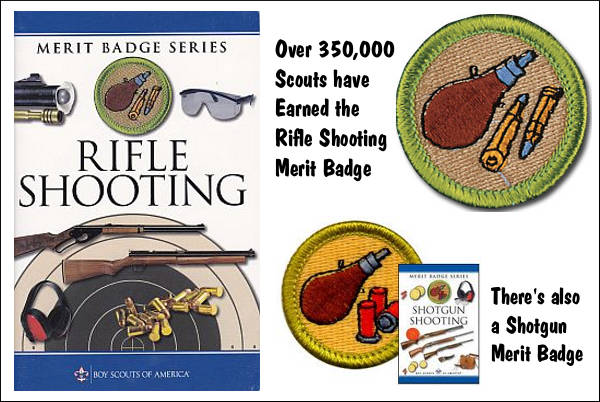
Comment: If we want the shooting sports to survive (and thrive), we need to bring young shooters into this sport. Many of our readers, as well as this Editor, got started in shooting through the Boy Scouts. I shot rimfire rifles at scout camps and earned my Marksmanship Merit Badge. AccurateShooter.com strongly supports the Scouts, and we commend the NSSF for providing grants to regional BSA Councils. This article explains how regional BSA Councils can apply for funding.
The National Shooting Sports Foundation (NSSF) has kicked off its annual grant program for the Boy Scouts of America Councils. Through this partnership, BSA Councils can receive a portion of $100,000 in NSSF grant funds to develop or expand their troop activities in target shooting and marksmanship. Target shooting programs continue to rank among Scouting’s most popular activities, teaching firearms and range safety, teamwork building and fundraising skills.
2018 marks NSSF’s eighth year supporting the BSA Council Grant Program, underscoring the time-honored practices of firearms safety, marksmanship training and shooting sports participation with the Boy Scouts. Additionally, the BSA’s recent decision to allow young females to join its ranks, though controversial, does provide an entirely new audience for BSA marksmanship training.
“Safety and marksmanship training through the Boy Scouts is a time-honored introduction to the shooting sports. We’re looking forward to increased participation from Scouts pursuing [merit] badges in these activities and then taking those new skills afield for a lifetime of enjoyment”, said Zach Snow, NSSF Range Services Director.
How Scouting Groups Can Apply for Grants
BSA Councils should review the grant guidelines and application procedures on the NSSF Website. Councils awarded NSSF funds must use those grants to purchase shooting sports equipment/supplies from NSSF Member Retailers. Qualifying purchases include: ammunition, eye and ear protection, firearms, targets, and shooting vests.
The mainstream media has an agenda, demonizing firearms and arguing that young people should never see, much less touch, a firearm. Given that agenda, don’t expect CBS, NBC, or CNN to ever say ANYthing about the 4-H Shooting Sports Program. Telling the truth about the 4-H shooting program (and other youth marksmanship programs) would under-cut the anti-gun agenda. Why? Because right now over 500,000 young men and women are participating safely and successfully in 4-H Shooting Sports programs nationwide.
Thatn’s right, currently more than half a million youths and 20,000 certified volunteer instructors are involved in 4-H shooting sports programs in 47 states across the USA. 4-H Shooting Sports is now the largest youth shooting program in the nation. Since it was founded many decades ago, 4-H Shooting Sports has served millions of young Americans. The organization declares: “The mission of the 4-H Shooting Sports Program is to assist youth in acquiring knowledge, developing life skills, and forming attitudes so they may become self-directing, productive, and contributing members of society.”
The focus of all 4-H programs is the development of youth as individuals and as responsible and productive citizens. The National 4-H Shooting Sports Program stands out as an example. Youths learn archery, marksmanship, the safe and responsible use of firearms, the principles and ethics of hunting, and much more. The activities of the program and the support of dedicated adult leaders help young people develop self-worth, as they learn important life skills and conservation ethics. (Read Brochure)
Through the 4-H Shooting Sports Program, participants learn safe marksmanship and archery skills from an early age. State-level 4-H clubs offer programs for individual training as well as team competitive shooting. There is also a 4-H Shooting Sports National Championships Event each summer which hosts Shotgun, Air Rifle, Air Pistol, Smallbore Rifle, Smallbore Pistol, Compound Archery, Recurve Archery, Muzzle-loading Rifle and Hunting Skills events.
The 2018 4-H Shooting Sports National Championships took place June 24-29 in Grand Island, Nebraska. It was a hugely successful event with hundreds of young competitors from around the nation.




 This was my first opportunity to shoot the NRA Long Range Nationals since its relocation to Camp Atterbury, and it was great to see everyone and get back to the matches. It is always so humbling walking onto the range and seeing all of the people I read about and admire so much. I can’t think of another sport where people so accomplished will share so much and be so helpful.






 A punt gun is an extremely large shotgun used in the 19th and early 20th centuries for shooting large numbers of waterfowl for commercial harvesting operations and private sport. Punt guns could have bore diameters exceeding 2 inches (51 mm) and fire over a pound of shot at a time. A single shot could kill over 50 waterfowl resting on the water’s surface. Punt guns were too big to hold so they were often mounted directly on the punts (boats) used for hunting, hence their name. Generally the gun was fixed to the punt, requiring the hunter to manuever the entire boat to aim the gun. Firing the gun often propelled the punt backwards from recoil. Sometimes fleets of punt gun-boats were used together. In the United States, this practice depleted stocks of wild waterfowl and by the 1860s most states had banned the practice. In the United Kingdom, a 1995 survey showed fewer than 50 active punt guns still in use. UK law limits punt guns to a bore diameter of 1.75 inches (1 1/8 pounder). Learn more at


 Congratulations to SFC Brandon Green, the 2018 NRA National High Power Champion. Brandon won yet another High Power title in convincing fashion, with a 2394-147X overall score. Two other soldiers finished second and third, separated by X-Count. Second-place SFC Shane Barnhart scored 2386-137X, while SGT Benjamin Cleland was third with 2386-128X. In fourth place, and top civilian, was Ronald Zerr with 2383-126X. (


 The
The 


