Did you know that American women are the fastest-growing segment of gun owners? Whether it’s for self-protection, hunting, or target shooting, women are showing more interest than ever in owning firearms. Moreover, women are taking steps to train and educate themselves, and to get involved in hunting, recreational shooting, and firearms competition. This is now a significant trend — women are becoming an important and vital part of the shooting community. Nearly one-quarter (23%) of American women now own at least one firearm.
The numbers of women participating in the shooting sports has grown dramatically in recent years. in fact, in the decade from 2001 to 2010, the number of female target shooters has risen 43.5%:
Flags placed in Arlington National Cemetery by members of the 3rd Infantry Regiment, the “Old Guard”.
Today, Memorial Day, Americans will honor the sacrifices of military men and women who paid the ultimate price in their service to our nation. More than 1.2 million American men and women have died in military service during wartime.
“The fallen warriors we honor on Memorial Day cherished liberty and freedom enough to lay down their lives to preserve our way of life,” said past Secretary of Veterans Affairs Eric K. Shinseki. “We owe them eternal gratitude and we must pass those sentiments on to future generations.”
What Is Memorial Day?
Memorial Day is a federal holiday in the United States for remembering the men and women who died while serving in the country’s armed forces. The holiday, which is celebrated every year on the last Monday of May, was formerly known as Decoration Day and originated after the American Civil War to commemorate the Union and Confederate soldiers who died in the war. By the 20th century, Memorial Day had been extended to honor all Americans who have died while in the military service.
On Memorial Day, the United States flag is traditionally raised to the top of the staff, then solemnly lowered to half-staff position until noon, when it is raised again to full-staff for the rest of the day. The half-staff position is to remember the more than 1.2 million men and women who have given their lives for this country.
Flags and flower leis adorn each grave in the National Memorial Cemetery of the Pacific in observance of Memorial Day, 1991. (U.S. Navy photo by OS2 John Bouvia, released).
Many people visit cemeteries and memorials, particularly to honor those who have died in military service. Many volunteers place an American flag on each grave in national cemeteries.
TALLADEGA, Alabama — The 3rd Annual D-Day Anniversary Matches will be held June 2-4, 2017, at the CMP’s Talladega Marksmanship Park in Alabama. The event commemorates the 73rd Anniversary of the Allied landing at Normandy in 1944. In 2015, the new $20-million-dollar Talledega Park celebrated its Grand Opening with its first D-Day Match. That was a great success, and the 2017 D-Day Match promises to be even better. This has become a hugely popular event — last year there were over 250 competitors. For many, this match was their first opportunity to shoot on electronic targets. That speeds up the relays and nobody complained about not having to do pit duty.
It’s not too late to join the fun — there are still slots available for the event. You can register online. For more information, email shall [at] thecmp.org or phone 256-474-4408 ext. 414
Watch Prone Stage from the Inaugural Talladega D-Day Match in 2015
Electronic Targets + No Pit Duty = More Fun
Competitors will be firing all matches on electronic targets. The John C. Garand Range has a huge firing line with monitors at all shooting stations. These connect to three banks of electronic targets positioned at 200, 300, and 600 yards. Spectators can view the results in real time on large monitors.
INVITATION: The Civilian Marksmanship Program would like to invite you to join us for a very special match weekend event at the CMP Talladega Marksmanship Park. The CMP’s John C. Garand D-Day Anniversary Match is a big event with many different competitions for rifle and pistol shooters. Along with the signature M1 Garand event, a Vintage Sniper Match, EIC Service Rifle Match, .22 Rimfire Pistol Match, EIC Service Pistol Match, and .22 Rimfire Pistol matches will be conducted.
State of the Art Shooting Facility in Alabama
The 500-acre CMP Talladega Marksmanship Park is one of the most advanced outdoor shooting facilities in the Western Hemisphere. The facility includes a 600-yard rifle range, a 100-yard multi-purpose range, and a 50-yard pistol range, equipped with Kongsberg electronic targets and scoring monitors that allow shooters on the firing line to review shots in a matter of seconds. Since the 54 targets at each line register hits and calculate the scores, no pit duty is required at Talladega.
State-of-the-art Kongsberg target systems are used at the CMP’s Talladega Marksmanship Park.
Talladega Marksmanship Park also contains 15 action pistol bays, a trap field with a 5-stand overlay, and a 15-station sporting clay field. The crown jewel of the Park is the 13,000-square-foot CMP Park Club House, featuring indoor and outdoor viewing areas, a CMP Pro Shop operated by Creedmoor Armory, classrooms, and lounge areas. To learn more about the CMP’s Talladega Marksmanship Park visit: Talladega Marksmanship Park Webpage.
The CMP Eastern Games were a huge success, thanks in no small part to the mobile electronic target system. The event, which drew 360+ competitors, took place April 28 – May 2 at Camp Butner in North Carolina*. The Kongsberg electronic targets allowed the CMP to run relays more efficiently, and the targets eliminate the need for competitors to do pit duty. GSM Matches, which typically run four relays each day, saw days with a total of nine and 10 relays during its scheduled times, while the Vintage Sniper and other matches finished in record time.
“The electronic targets are phenomenal,” said brothers Richard and Jonathan Mast, who attended the Eastern Games along with other family members. Jonathan added, “It was the best shooting experience I’ve ever seen as far as immediately finding out where you’re shooting – best I’ve ever had.”
Throughout the event at Camp Butner, competitors had the opportunity to fire on CMP’s mobile electronic highpower target range. The Kongsberg targets contain internal microphones that locate shot position. The scores are instantly calculated by computer and then wirelessly transmitted to portable, tablet monitors on each firing point.
The new targets were well received. Competitors observed that the targets simplify the process for the shooter and provide immediate feedback and scoring. Shooter Caleb Mast noted: “This makes it easier for people who don’t have equipment, like a scope, to get in. All you pay is the registration fee, and I just brought what I’m wearing and was still able to score well enough to get my feedback on the monitor.”
*The Eastern Games ran April 28 through May 2, 2017. The Creedmoor Cup Marches were held May 3-7, 2017, following the Eastern Games. SEE Match Schedule.
We are sad to announce that Richard (Dick) Grosbier, who served as IBS Vice President and webmaster, has passed away. He died unexpectedly at his home last Friday, May 12, while recovering from neck fusion surgery. He was 72. A memorial service was held on May 16th. We offer condolences to Carol, his wife of 38 years, and to his family members.
Dick Grosbier was one of the stalwarts of the International Benchrest Shooters (IBS) who gave countless hours to our sport. Jeff Stover, IBS President, notes: “Dick was serving as the 1st VP of IBS and was the Match Chairman. Dick worked tirelessly on behalf of our sport. Dick was very well known in benchrest, especially in the Score discipline. He has been the IBS webmaster from Day One. He was a central figure in the IBS and Benchrest as a whole.” Jeff adds that Dick’s passing leaves “a pronounced void in the world of Benchrest. He was a good man. We shall miss him.”
Many benchrest competitors have expressed their sadness at Dick’s passing:
“He was one of the most helpful and concerned people I have met in benchrest, an enthusiastic and helpful shooter with as big a heart as anyone I have ever met. I thoroughly enjoyed my numerous phone conversations with him over the years. He will be sadly missed by all his Maine friends.”– Greg P.
“Dick did a lot for the sport. It’s going to be hard to replace a man like him.” — Dick Wright
“We are truly diminished. He will be missed. My condolences to family and friends.” — James Mock
“I had met Dick several times as I traveled around in my shooting career. Dick gave freely of his talents and time to support the sport he dearly loved. Dick made a difference in the World. It’s a better place for him having been here.” — Al Nyhus
Honoring Dick Grosbier at the White Horse Range in West Virginia
The day after he died, Dick’s friends and fellow shooters honored him. On May 13th, at the 1000-yard match held at the White Horse Range in West Virginia, Stanley Taylor, David Matthew and the other competitors all took one shot at a special target placed at 1000 yards, which they all signed. The group then said a prayer and held a moment of silence for Dick. It was a thoughtful and fitting tribute to a fellow shooter. The match directors are planning a Memorial match for Grosbier later this year.
R.I.P. Richard Roland Grosbier
Dick Grosbier was a man of many talents and interests. Here is a quote from his Obituary in the Frederick (MD) News-Post:
After high school Dick joined the Air Force, from 1965-1967 serving as an Aircraft Electronics Navigational Equipment repairman. This training enabled him to begin his life’s work in the electronics field, first with Heathkit Electronics in Rockville, and later with Industrial Photo of Silver Spring.
Dick enjoyed many varied activities. He met [his wife] Carol at a sports car club, and they participated in many car rallies. He was very interested in computers[.] He was Vice-President of the International Benchrest Shooters and enjoyed benchrest target shooting at many rifle ranges up and down the east coast. He was also very involved in model railroading[.] Dick loved to travel and with his wife made several coast-to-coast trips across the U.S., visiting almost all the lower 48 states, and Hawaii.
How’d you like to score a check for $25,000? That’s the winner’s pay-out for the 2017 World Shooting Championship (WSC), which runs September 14-16 at the Peacemaker National Training Center in Glengary, WV. This event offers over $250,000 in cash awards and product prizes, making the WSC the richest combined shooting event in the USA (if not the world). This unique 3-day multi-gun match tests competitors’ skills across twelve challenging stages involving nearly every major shooting discipline for rifles, shotguns, and pistols.
This major match attracts both sponsored Pros and “regular Joes”. For 2017, shooters will be split into two groups: a Professional Division for sponsored shooters, and the Amateur Division for non-sponsored competitors. All firearms, optics, and ammo will be provided by match sponsors for both divisions. “This year the NRA is going back to basics and returning the match to the original format of two divisions for professionals and amateurs, putting everyone on an even playing field”, said Cole McCulloch, NRA Competitive Shooting Director.
WSC Highlight Video with Competitor Interviews:
What the Competitors Have to Say:
“We’ve been waiting all our lives for a match like this, so we can come over (from the UK) [and] shoot guns that we can’t even own in the UK, because of the laws. What the NRA has done is really great — this is a ground-breaking type of match.” John C., Amateur Competitor (UK)
“The main reason I signed up is just the ease of it… I don’t have to have thousands of dollars worth of guns. It’s a good way to try out all the different events.” — M.J., Amateur Competitor
“What makes this event very unique, especially to a professional shooter, is all the equipment is supplied. You have to leave your ego at home and just try to adapt as best you can to the equipment that you have supplied.” — Jerry Miculek
Video Shows 2014 World Shooting Champion SFC Daniel Horner in 3-Gun Stage
Cash Awards, Huge Prize Table, and New Random Drawings
The NRA World Shooting Championship will offer $250,000 in cash and prizes. Along with the $25,000 winner’s pay-out, there will be fat cash prizes for second and third place overall, High Lady, and High Amateur Junior. Then there are the prize tables — a real treasure trove. The designated Amateur prize table by itself will offer products and certificates topping $100,000 in value.
NEW Random Drawings — The WSC has added a new type of prize for 2017. Ten (10) Random Draw Prize Winners of $400 will be chosen during the WSC Awards Banquet. These random drawings give every competitor a chance to win cash, no matter what their event ranking.
Match entry fees are $395 for Professionals, $325 for Amateurs and Juniors. All firearms and ammunition are provided, and entry fees include one awards banquet ticket. For more information, visit WSC.NRA.org, call 703-267-1479, or email NRAhighpower@nrahq.org.
How to Win the World Shooting Championship
As first published in the NRA Blog, here are competition tips from 2015 NRA World Shooting Champion Bruce Piatt, and Dianna Muller, the top female competitor at the 2015 WSC:
“The format at the NRA World Shooting Championship is unique in that you don’t know what you have to shoot until you show up, so training for the event is a little difficult. My advice is to pack some good eye and ear protection, bring an open mind, be prepared to listen to the stage descriptions, figure out the best way you can take the guns they provide, and post the best score you can. When the match supplies all the guns and ammo, all you have to do is deal with ‘the performance’. This is the most level playing field in the shooting sports — anyone from around the world can come and play.” — Bruce Piatt
“The [WSC] is such a different breed — it’s really a difficult match for which to prepare! You are tackling disciplines outside your expertise and using guns you aren’t familiar with, and that can really rattle your nerves if you don’t prepare for that mental challenge. But you can use this match design to your advantage. Remove all expectations, because, who is great at ALL the disciplines (besides Jerry Miculek)?! Give yourself some room to be ‘not so great’, focus on the fundamentals and try to enjoy the match. It is kind of liberating throwing everything to the wind and seeing how you stack up against all kinds of shooters!” — Dianna Muller
The great shooting coat controversy has been quelled — at least for the next few months. The CMP will not be banning any brands of commonly-used jackets for now. On Monday, May 15th, the CMP announced that it would halt “strict enforcement” of shooting jacket rules for the remainder of 2017, until new, clear standards can be adopted. Here is the CMP’s statement:
Moratorium on Strict Enforcement of Shooting Jacket Rules
The Civilian Marksmanship Program has declared a moratorium on strict enforcement of rules on design and construction of shooting jackets for 2017 until specific procedures and measurement tools are developed to determine the maximum amount of support coats may provide to competitors.
“The CMP 2018 Rules will contain further clarifications concerning jacket design and construction specifics going forward,” said Mark Johnson, CMP’s Chief Operating Officer. “The CMP strives to institute rules that promote true marksmanship skill and those that resist the equipment race (gamesmanship) facets of our sport.”
“The CMP’s matches are being developed to enhance competitor learning and increasing their own personal marksmanship skill set, not who can buy the best gadget for means of additional support or easier access to higher point totals,” Johnson said.
In 2017, the primary emphasis of the shooting jacket rule, 6.6.1 in the CMP Highpower Rifle and Pistol Competition Rules, 21st Edition – 2017, still applies. The rule states, in part, “Shooting jackets made of flexible material may be worn in CMP Rifle events. Shooting jackets may have shoulder, sling and elbow pads providing those pads are not constructed so as to provide rigid artificial support. Jacket constructions that use back braces (…) or other non-flexible materials are prohibited.”
For 2018, it is the CMP’s intent to provide a clear and concise definition of “flexibility” as it relates to support materials used in shooting jackets and a simple measurement process capable of passing or failing jackets across the entire spectrum of highpower rifle jackets in the marketplace.”
Jacket Rules Not Abandoned Completely
We commend readers to look at the second-to-last paragraph in the CMP statement above. The CMP says Rule 6.6.1 still applies, requiring shooting jackets to be made of “flexible materials” without “rigid, artificial support”. Keep that in mind. While the CMP is halting “strict enforcement” of jacket rules, you still can’t show up with a bionic exo-skeleton.
We like airguns — they’re fun, quiet, and cheap to shoot (compressed air is cheaper than gunpowder and primers). Now’s a great time to purchase a new air rifle, or get airgunning tools and accessories. Now through 3:00 am on May 17th, Pyramyd Air, the USA’s leading airgun retailer, is offering 20% off airguns, optics, and accessories from over 50 name brands. You’ll find a huge selection of airguns on sale — from $50 BB Guns to $3500 Olympic-grade air rifles. Along with the 20% off discount, Pyramyd Air is offering FREE Shipping with orders over $150.00. But act soon — these offers expire at 3:00 am EST on May 17, 2017. To get 20% off, use Promo Code 17-BDAY.
Leading brands now 20% off include: Air Venturi, Benjamin, Beretta, Browning, Colt, Crossman, CZ, Gamo, Remington, Ruger, SIG, Smith & Wesson, Swissarms, Umarex, Walther and more. Here’s one of the Walther air rifles on sale, the handsome German-crafted MaximaThor model. Designed for varmint hunting, this air rifle features a Lothar Walther barrel threaded for a silencer, plus an 8-round rotary magazine. In 22-caliber it delivers 44 ft-lbs of energy at 1260 fps.
There’s a new home on the web for Extreme Long Range (ELR) shooters. Bryan Litz and Applied Ballistics recently launched ELR Central, a new website dedicated to ultra-long-range shooting*. This new site will offer a wide variety of information. Bryan Litz explains: “The most visible element of ELR Central will be a website which will serve to publish and promote all ELR shooting events going on across the country. Although owned and operated by Applied Ballistics, ELR Central will rely heavily on input from the community in order to best serve the sport as a whole.” Along with the ELR Central website, Applied Ballistics has launched a new ELR Central Facebook page.
Content Available on ELR Central
The ELR Central website will eventually offer a comprehensive library of information and activity reports. Bryan and his team plans to build out the website to include all the following:
1. Map of ELR ranges across the USA.
2. List of ELR events with links to the Match Directors’ pages.
3. Technical information and articles for the ELR community.
4. Match results/reports, including equipment lists where available.
5. Analysis of what equipment and shooters are doing well in ELR.
6. Links to other ELR shooting resources such as forums and websites.
On 5/13/17, the Applied Ballistics ELR Team had a successful practice at 3161 Yards (1.8 miles). Bryan Litz reports: “The main goal … was to test how the Berger and Cutting Edge bullets traveled through transonic and subsonic speeds. We all made several hits on target and several within 1 MOA of center.”
Standardized ELR Targets
Another goal of ELR Central is to develop standardized ELR targetry. Bryan explains: “In competitive rifle shooting, standardization of targetry is important. Applied Ballistics, through ELR Central, will provide steel targets to organizations wishing to run ELR matches and/or record-setting events. No one would be required to use these standard targets, we’re simply providing resources to help promote promote some consistency.” The initial standard target, produced by MGM Targets, will be a steel square, 3 feet (36″) per side.
ELR Central is Not A Rule-Making Entity
Bryan was quick to explain that ELR Central is not a governing body, but rather it was created to help advance the sport (and science) of shooting at very long distances, one mile and beyond: “The concept of ELR Central is a result of the ongoing discussions about standardizing ELR matches, records, targets, and more. Although ELR Central will not be enforcing these details, there is a measure of organization which we feel is appropriate, would benefit the sport, and that we are willing to provide. ELR Central is NOT a governing or sanctioning body. We do not have nor seek the authority to dictate how matches are run. For anyone who asks, we can advise on best practices, and what’s generally working, but we’re not here to tell anyone what to do nor how to do it.”
More Information on ELR Competition, per ELR Researcher:
(1) By consensus of the parties involved in the ELR meetings held at SHOT this year, and notwithstanding the names and descriptions of certain “ELR” web sub-forums, “ELR” has been defined as “beyond 1500 yards”.
(2) ELR Central-recognized “ELR” events require that more than one-half of targets must be beyond 1500 yards. Where all criteria are not met an event may be promoted as having “ELR components”.
(3) “ELR Central has published a set of guidelines and standards by which official world records can be established.” CLICK HERE for guidelines/standards.
Story tip from EdLongrange. We welcome reader submissions.
Say Hallelujah. These are pallets of Hodgdon H4350, something that’s been very hard to find recently. Check with Bruno’s, Graf’s, Midsouth and Powder Valley very soon.
Hodgdon H4350 has been the Holy Grail of reloading powders — highly desired but near impossible to find. For many popular cartridges such as 6XC, 6.5×47, 6.5 Creedmoor, and .260 Remington, H4350 has been the powder to beat — the “gold standard” for accuracy, low ES/SD, and temp stability. Unfortunately, H4350 has been in very short supply for the last couple of years. Major vendors such as Grafs.com, Midsouth and Powder Valley have been back-ordered for a long, long time.
But now that may change. Hodgdon has received a very large supply of H4350, and has started shipping pallets of the popular powder this week. The photo above was taken May 9, 2017. Hodgdon announced: “We have a lot of powder going out the door most days, but we have some special powder going out again this week. This should be on your local reloading shops’ shelves in the next couple weeks. Reloaders, rejoice!” If you’re in need of H4350, we recommend you contact your favorite shooting shop or online distributors soon. And guys — buy what you need, but don’t horde. Leave some for other shooters.


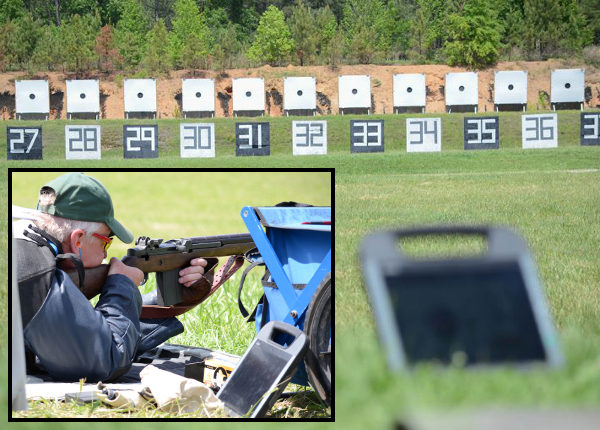


 We are sad to announce that Richard (Dick) Grosbier, who served as IBS Vice President and webmaster, has passed away. He died unexpectedly at his home last Friday, May 12, while recovering from neck fusion surgery. He was 72. A memorial service was held on May 16th. We offer condolences to Carol, his wife of 38 years, and to his family members.






 Standardized ELR Targets


