|
|
October 10th, 2014
Do you think your borescope is a state-of-the-art bore inspection device? Well think again. There is now something way more advanced than any optical borescope. A new laser-equipped scanning device can map the entire interior surface of a barrel bore. With this new technology you can now examine every land and every groove, millimeter by millimeter, from the chamber to the tip of the muzzle. The most minute flaw in a barrel can now be revealed.
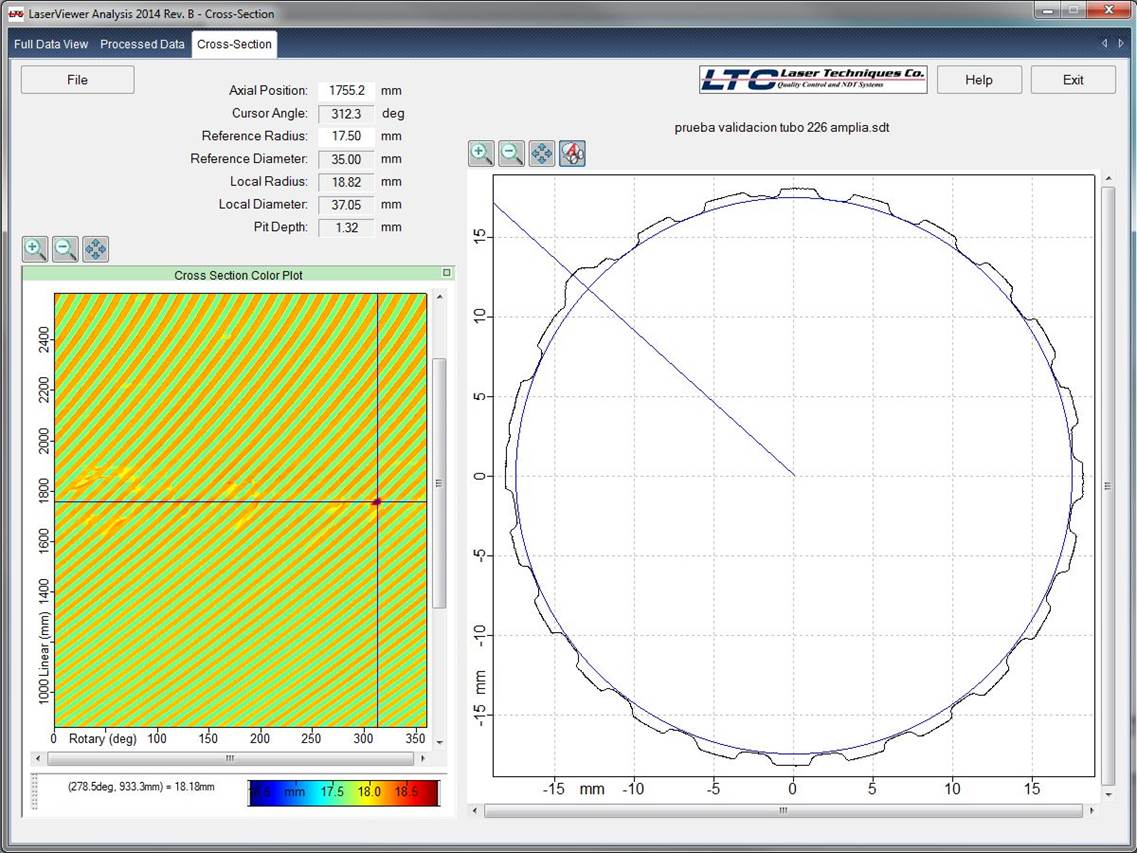
 The new device is called the BEMIS-SC™ (for Barrel Inspection Machine Small Caliber). Operated by Chesapeake Testing and Laser Techniques Company (LTC), BEMIS-SC performs non-destructive laser-based mapping of gun bores. The BEMIS-SC currently works with .22 caliber to .50 caliber (5.56 – 12.7 mm) barrels. The BEMIS captures thousands of highly accurate data points over the full length of a barrel. The inspection can be completed in mere minutes, with scan results displayed in graphical, tabular, and 3D visual formats. Here is a barrel cross-section, as scanned by the BEMIS-SC: The new device is called the BEMIS-SC™ (for Barrel Inspection Machine Small Caliber). Operated by Chesapeake Testing and Laser Techniques Company (LTC), BEMIS-SC performs non-destructive laser-based mapping of gun bores. The BEMIS-SC currently works with .22 caliber to .50 caliber (5.56 – 12.7 mm) barrels. The BEMIS captures thousands of highly accurate data points over the full length of a barrel. The inspection can be completed in mere minutes, with scan results displayed in graphical, tabular, and 3D visual formats. Here is a barrel cross-section, as scanned by the BEMIS-SC:
Click for Full-Screen Version

Until the 1980s, gun tube inspection had to be conducted by hand using a manual “star” gauge, a process that would take hours and provide minimal data. Electronic gauges were eventually developed along with the video bore scope, but these systems were still limited to very few, low-resolution data points. That has all changed with the BEMIS™, a huge leap forward in technology that is capable of rapidly capturing thousands of precise data points.
BEMIS-SC (Small Caliber) Barrel Inspection Machines

Chesapeake Testing commenced BEMIS-SC barrel inspection services in September 2014. Testing is performed in Chesapeake’s commercial barrel inspection laboratory, located in Belcamp, MD, minutes from the U.S. Army Aberdeen Proving Ground. While testing is currently limited to .22 to .50 caliber barrels, Chesapeake Testing will accommodate both smaller and larger calibers in the future.
“We have always focused on building our company around very unique technologies. BEMIS™ has changed the industry in regards to the inspection of weapon systems. We are excited to be an exclusive partner with LTC in this industry and look forward to contributing to the future of this technology,” says Jim Foulk, founder and president of Chesapeake Testing.
October 9th, 2014
Would you like to see an image you photographed on the cover of Shooting Sports USA? If you’ve snapped a great shooting-related photo, you could be honored with the cover shot for the SSUSA December issue. 2014 marks Shooting Sports USA’s second year for the December cover shot contest. Both professionals and amateur photographers may participate as long as reproduction rights are given to NRA. Shown below are the ‘Top Shots’ from 2013, i.e. last year’s finalist photos.

 Contest Entry Rules and Guidelines Contest Entry Rules and Guidelines
Contest entrants should submit one or two high resolution (300 dpi or greater) photos of youth shooting sports, famous shooting athletes, or shooters in action. Provide a caption for each image. Note: if your image shows shooters on the firing line, the shooters should be wearing ear and protection. Images should be vertically oriented to fit the cover format and color photos are preferred. The magazine’s editors will consider all submissions and pick one for the December cover of Shooting Sports USA magazine. E-mail submissions to: shootingsportsusa [at] nrahq.org.
October 7th, 2014
MIL or MOA — which angular measuring system is better for target ranging (and hold-offs)? In a recent article on his PrecisionRifleBlog.com website, Cal Zant tackles that question. Analyzing the pros and cons of each, Zant concludes that both systems work well, provided you have compatible click values on your scope. Zant does note that a 1/4 MOA division is “slightly more precise” than 1/10th mil, but that’s really not a big deal: “Technically, 1/4 MOA clicks provide a little finer adjustments than 1/10 MIL. This difference is very slight… it only equates to 0.1″ difference in adjustments at 100 yards or 1″ at 1,000 yards[.]” Zant adds that, in practical terms, both 1/4-MOA clicks and 1/10th-MIL clicks work well in the field: “Most shooters agree that 1/4 MOA or 1/10 MIL are both right around that sweet spot.”

READ MIL vs. MOA Cal Zant Article.
Zant does note that a whopping 94% of shooters in the Precision Rifle Series (PRS) used a mil-based reticle. However, Zant says: “This does NOT mean MIL is better. It just means MIL-based scopes are more popular.” Zant agrees with Bryan Litz’s take on the subject: “You can’t really go wrong with either (MIL or MOA). They’re both equally effective, it comes down to how well you know the system. If you’re comfortable with MOA, I wouldn’t recommend switching to MIL. I have a few MIL scopes but primarily because they’re on rifles used for military evaluation projects, and that community is now mostly converted to MILS, so when in Rome….”
We recommend you read Zant’s complete article which is very thorough and is illustrated with helpful graphics. Here are the key points Zant makes in his MIL vs. MOA analysis:
MIL vs. MOA — Key Points
There are a handful of minor differences/trade-offs between MIL & MOA, but there are no inherent advantage to either system. Most people blow the small differences WAY out of proportion….Here are the biggest differences and things to keep in mind:
- Whatever you decide, go with matching turret/reticle (i.e. MIL/MIL or MOA/MOA)
- 1/4 MOA adjustments are slightly more precise than 1/10 MIL.
- MIL values are slightly easier to communicate.
- If you think in yards/inches the math for range estimation is easier with MOA. If you think in meters/cm the math is easier with MIL.
- When your shooting partners are using one system, there can be some advantage to having the same system.
- Around 90% of the PRS competitors use MIL.
- There are more product options (with ranging reticles) in MIL.
Range Card Print-Outs
Zant makes an interesting practical point regarding range card print-outs. He suggests the MIL System may be easier to read: “You can see in the range card examples below, 1/4 MOA adjustments take up more room and are a little harder to read than 1/10 MIL adjustments.”

October 3rd, 2014
 Swarovski has a new STR 80 spotting scope with an illuminated reticle. That’s right, this new STR 80 spotter has a ranging reticle like a riflescope, with adjustable brightness levels. This 80mm spotting scope can be used for estimating range to targets, using MIL-based or MOA-based stadia lines on the cross-hairs. This allows you to range targets optically, as you could with a ranging reticle in a riflescope. Swarovski has a new STR 80 spotting scope with an illuminated reticle. That’s right, this new STR 80 spotter has a ranging reticle like a riflescope, with adjustable brightness levels. This 80mm spotting scope can be used for estimating range to targets, using MIL-based or MOA-based stadia lines on the cross-hairs. This allows you to range targets optically, as you could with a ranging reticle in a riflescope.
Revolutionary Reticle “ON”, Reticle “OFF” Technology
The STR 80’s illuminated ranging reticle makes the new STR 80 a fairly unique product among high-end, imported spotting scopes. Thanks to a new technology, Swarovski is the first manufacturer to successfully project a reticle directly in a spotting scope. The reticle (MOA or MRAD) can be activated or deactivated as required. Notably, because the reticle appears via electro-illumination, it can be “turned off” for un-obstructed viewing. So you can have a totally clear field of view when desired, OR a ranging reticle when that functionality is desired. Having the ability to turn OFF the reticle is great — that’s a very intelligent feature.

When viewing targets, the STR 80’s sharp HD (high-definition) lenses will resolve bullet holes at long range. Current Swaro 20-60X and 25-50X (wide) eyepieces can be used with the new STR 80 spotter. Optional accessories include Picatinny mounting rail, digiscoping attachment, and a winged eye cup.
How to Range with STR 80 Reticles
The new STR 80 scope offers a choice of either MOA or MRAD reticles with 15 brightness levels, 10 day levels, and 5 night levels. For convenient ranging, set the magnification level so that the MOA reticle displays ¼ MOA divisions, while the MRAD Reticle displays 0.1 MIL divisions. (NOTE: the reticle will change in size relative to the target at different magnifcation levels. Therefore ranging is normally done at one standard magnification level).

Dustin Woods, Sales Director for Swarovski Optik NA said: “Long range shooters asked for a premium spotting scope with integrated reticle and we have listened. With our new STR spotting scope we now have MOA and Mil-Radian reticle models. Because the reticle is illuminated, the user can have the reticle turned on when they are judging hits and misses but also turn it completely off for an unobstructed view during observation. This product is a real game changer in the precision shooting segment.”
October 2nd, 2014
When does a scope cost as much as a new Harley-Davidson? When it is a top-of-the-line 72mm Hensoldt (by Zeiss). The remarkable Hensoldt ZF 6-24x72mm SAM scope integrates ultra-bright apochromatic fluorite glass with a calculator module that provides ballistic info and weather data to the shooter. This 6-24x72mm SAM Hensoldt may be the most advanced riflescope on the planet. With a street price of $11,982.00, it is certainly one of the most expensive. Take a 360° tour with this cool video from Hensoldt Zeiss.
Please enable Javascript and Flash to view this VideoPress video.
Hensoldt ZF 6-24x72mm SAM
SAM stands for “Sniper Auxiliary Module”. An integrated ballistics calculator can be programmed for up to four different types of ammo. Sensors in the integrated ring mount measure weather parameters. These values, as well as scope data, are then directly projected into the visual field of the eyepiece. This provides selectable displays of elevation clicks, windage clicks, angle of fire, cant angle, temperature, and air pressure.


September 30th, 2014

Being in such high demand, current-model Nightforce scopes rarely go on sale. But right now, Nightforce is running a 2014 Fall Hunting Promotion with dramatic price reductions. You can save hundreds of dollars on popular SHV and NXS scopes with low to medium magnification levels. For example, the SHV 4-14x56mm, with MOAR reticle and center illumination is marked down from $1,128.00 to $1,016.99. And the savings are even bigger with First Focal Plane NXS models. The NXS 3.5-15x50mm F1 with ZeroStop, 1/4 MOA clicks and NP-RF1 reticle has been marked down from $2,543.00 to $2,160.00 — a $383.00 savings. CLICK HERE to see all discounts.


Promo Tip from EdLongrange. We welcome reader submissions.
September 16th, 2014
Here’s a nice combo offer if you’re thinking about buying a laser rangefinder for the fall hunting season. Right now, if you purchase a Leica CRF 1000-R or 1600-B Laser Rangefinder you can receive a Surefire G2x-Pro flashlight worth $85.00. The rugged, dual-power G2x-Pro should last a lifetime.
This is a limited-time offer works. When you purchase a new Leica CRF Rangemaster 1000-R or 1600-B Compact Laser Rangefinder from any authorized North America Leica Dealer you can receive a Surefire G2X-Pro flashlight and lanyard ($85 value). Send in your mail-in Rebate Form, plus your CRF proof of purchase, to Leica between Sept. 15 and Dec. 31, 2014, to receive your Surefire G2X-Pro flashlight.

Leica’s CRF 1000-R Rangemaster is an easy-to-use laser rangefinder than can fit in your pocket. The wide field of view makes target identification fast and easy. The CRF 1000-R features built-in angle correction. This provides automatic point-of-aim correction for uphill or downhill shots. That’s a very valuable feature for hunters.
Leica’s CRF 1600-B Compact Laser Rangefinder boasts an integrated precision ABC (Advanced Ballistic Compensation) system. This instantly measures distance, incline, temperature, and air pressure and then calculates hold-over based on selected bullet BC. The 1600-B’s LED display has ambient-light-controlled brightness — a nice feature when you’re in the field. For more info, visit LeicaSportOptics.com
September 6th, 2014
 The National Shooting Sports Foundation (NSSF) has created a video with helpful tips on mounting scopes, and adjusting the position of scopes to suit the shooter. This video, hosted by Ryan Cleckner, a former U.S. Army Sniper instructor, is aimed primarily at “hard-holders” who shoot prone. The video should prove useful for tactical shooters, varmint hunters, and F-Class shooters. Ryan does explain that, if you plan to use your rifle in standing, sitting, and prone positions, you need to set the scope in a “happy medium” position that provides sufficient eye relief in all shooting positions. The National Shooting Sports Foundation (NSSF) has created a video with helpful tips on mounting scopes, and adjusting the position of scopes to suit the shooter. This video, hosted by Ryan Cleckner, a former U.S. Army Sniper instructor, is aimed primarily at “hard-holders” who shoot prone. The video should prove useful for tactical shooters, varmint hunters, and F-Class shooters. Ryan does explain that, if you plan to use your rifle in standing, sitting, and prone positions, you need to set the scope in a “happy medium” position that provides sufficient eye relief in all shooting positions.
Ryan has an interesting method for leveling a rail-mounted, flat-bottomed scope (i.e. one with a flat surface under the turret housing). He simply inserts a small metal bar between rail and scope, and aligns the straight edges along the bottom of the scope turret housing with the flats on the rail (see photo). Watch how he does this on the video — it’s pretty clever. One other highlight of the video is the segment where Ryan shows how to adjust the ocular on his Leupold scope to provide the best (sharpest) image of the reticle. Ocular/reticle adjustment is covered in minutes 11:00-13:00 of the video.

The video has some faults. Some of the advice, such as “always mount the scope as low as possible” is counter-productive for benchrest shooters who want to keep their heads OFF the stock. In addition, Ryan does not explain that, with a variable power scope, proper eye relief may change considerably with the level of magnification. If you have an 8-32X scope, for example, you can set everything up perfectly for 8X magnification, only to find that you need a LOT more eye relief at 32X. We recommend positioning the scope so it provides sufficient eye relief at the highest magnification you regularly use.
September 5th, 2014
Need a hunting scope or a good pair of compact binoculars? With Steiner’s Big Game Fall Optics Promotion, you can get 10% off retail price through the end of September on Steiner GS3 Riflescopes and Predator Binoculars. The savings are automatic — there are no rebate forms, no waiting — just instant savings. And the GS3 scopes are very nice. We’ve tried them in the field. They are sharp and clear, with nice controls. The 5X magnification range is definitely a plus for hunters.
Hunters Will Enjoy This Video. It’s Definitely Worth Watching for the Outdoor Photography.
The new Steiner GS3 scopes utilize exclusive CAT (color adjusted transmission) lens coatings to amplify contrast in the peak human vision sensitivity range. The optimized contrast helps separate game from leafy or shadow-dappled backgrounds. The GS3’s 5x zoom range gives hunters great flexibility. Zoom to low magnification for a wider field of view, then zoom in at five times higher power when you spot your prey. The GS3 series scopes provide excellent low light performance, and mount on most rifles with standard-height rings.

Steiner Predator Binoculars also utilize the game-revealing CAT lens coating to help hunters detect game in heavy cover and leafy environments. They feature a roof prism design in a tough Makrolon® housing. The high definition lenses deliver very good low light performance. At approximately 10 ounces in weight, the 8×22 and 10×26 compact models are small enough to fit in a pocket. The larger 8×42 and 10×42 models (below) offer greater low-light performance. We wish these binocs had captive lens covers, however. We try to keep ocular and objective lenses always covered except when glassing.

August 29th, 2014
 How would you like to get an exclusive Leupold-logo jacket? From September 1 to October 15, 2014, Leupold will send a limited-edition Carhartt jacket to everyone who buys an American-made VX-3, VX-3L or VX-6 riflescope. OFFER Details. How would you like to get an exclusive Leupold-logo jacket? From September 1 to October 15, 2014, Leupold will send a limited-edition Carhartt jacket to everyone who buys an American-made VX-3, VX-3L or VX-6 riflescope. OFFER Details.
This distinctive, made-in-USA jacket will only be produced during this promotion and will not be available for sale anywhere. “Leupold is a uniquely American company,” said Bruce Pettet, CEO and president of Leupold & Stevens, Inc. “We’re proud of that fact and want to celebrate the American employees who design, machine and assemble our riflescopes right here in Beaverton, Oregon.”
CLICK HERE to Learn More about this Special Offer.

The Leupold Warranty — As Good As It Gets
Those of us who own Leupold scopes (this Editor has four), know that the company stands behind its products 100%. The Leupold Full Lifetime Warranty is justifiably famous. For the life of the product Leupold will either repair your Leupold product or replace it free. No escape clauses, no BS. And warranty coverage is not limited to the original owner. I’ve had Leupold fix “previously owned” Leupold riflescopes no questions asked. That’s a great reason to trust in Leupold.
|