Having heard many good things about Vortex spotting scopes from our readers and Forum members, on Day 1 of SHOT Show we headed over to the Vortex Optics booth. On display was the entire line-up of Vortex Viper and Razor spotting scopes (both HD and non-HD), with objective diameters ranging from 50mm to 85mm. We know that the 85mm Razor HD has been very popular with our readers, as it offers excellent “bang for the buck”. This spotter runs $1599.00 complete with 20-60 power eyepiece. That’s about half the cost of the big name Euro-brand spotting scopes with comparable objectives. Making the Razor HD even more attractive this year is the availability of a new 18X/23X long-eye-relief eyepiece for Vortex’s flagship spotting scope.
For 2013, Vortex has added much-requested 65mm and 50mm models to its Razor HD line of spotting scopes. This is good news for guys who prefer a lighter, more compact spotting scope, or who don’t need the extra light-gathering power of a big 85mm objective. The 65mm and 50mm Vortex Razor HD models should be available by mid-spring 2013, and they will be priced quite a bit lower than their 85mm big brother shown above.
Watch Video to See Vortex Spotting Scopes and NEW 2.5-10X FFP Tactical Scope
Watch Factory Video on Vortex Razor 85mm HD Spotting Scope
After reviewing Vortex’s spotting scopes, we checked out an all-new, compact first focal plane scope from Vortex that we predict will be very popular with three-gun and tactical shooters. The New Vortex Viper PSD 2.5-10x32mm tactical scope features an FFP design. This enables rapid ranging with the provided reticles at all magnification levels. This scope with be offered with mil-based clicks and EBR-1 milrad reticle, or with MOA-based clicks and a EBR-1 reticle with MOA-based subtensions. We were also pleased to learn that Vortex will add a 6-24x50mm model to its Viper HS riflescope line.
At SHOT Show, Leupold displayed its latest VX-6 scope, a 3-18x50mm. The new 3-18x50mm scope comes in both illuminated and non-illuminated versions. Leupold also confirmed that a 4-24 power VX-6 will be introduced in mid-year 2013. The new 4-24X will have side-parallax, with Varmint Hunters’ and Fine Duplex reticle options. Also new for 2013, Leupold is adding an illuminated version of its 2-12x42mm VX-6.
The new 3-18x50mm VX-6 scope from Leupold comes with all the features you could want. It offers side parallax adjustment, pop-up resettable dials, “diamond-coat” scratch-resistant lenses, a European-style true diopter eyepiece, and illumination control via gold push-button in the center of the left-side turret. There are 11 different illumination settings, so you can adjust the brightness to the conditions. Additionally, when you purchase a 3-18x50mm VX-6 you get one free tuned BDC dial from the Leupold Custom Shop. Reticle choices for 3-18x50mm include: Duplex, Boone & Crockett, Fire-Dot Illuminated Duplex, and illuminated Boone & Crockett.
Carl Zeiss Sports Optics has rolled out its new Conquest HD5 riflescope line. These new HD5 scopes feature five-times (5X) magnification range, 1/4-MOA clicks, lockable turret options, and improved (optional) RAPID-Z® ballistic reticles. Made in Germany, these compact, 1-inch-tube scopes are available in three models: 2-10x42mm, 3-15x42mm, and 5-25x50mm.
Compared to previous Zeiss Conquests, the new HD5 scopes feature more ergonomic turrets, improved magnification rings with finer adjustment, and a lower profile. These scopes all have an adjustable -3 to +2 diopter eyepiece. (We’d like to see all premium scopes offer diopters). All HD5 scopes are covered by the US Lifetime Warranty and 5-Year No-Fault Policy.
Improved, more ergonomic turret design (lockable option).
Enhanced RAPID-Z or Z-Plex ballistic reticles.
Improved rubberized, fine-adjusting power ring.
Conquest HD5 2-10x42mm:
Features: Compact with extremely wide field-of-view in 2-power. The Conquest HD5 2-10×42 is parallax free to 500 yards and is available with either a Z-Plex (#20) reticle (MSRP $889.00) or RAPID-Z 600 (MSRP $972.00) or standard hunting turrets.
Conquest HD5 3-15x42mm:
Features: Trim, low-profile hunting scope with side parallax adjustment. The 3-15×42 weighs just 18.8 ounces, and is 13.8 inches long. Z-Plex reticle is available in either hunting turret or lockable target turret. MSRPs are: $999.00 with Z-Plex hunting turret, $1083.00 with RAPID-Z 600/800, $1,110.0 with Z-Plex and Lockable Target Turret.
Conquest HD5 5-25x50mm:
Features: One of the most compact 5-25X side-parallax scopes on the market. The 5-25×50 is 14 inches long and weighs just 26.6 ounces. Zeiss claims roughly 62 MOA of vertical adjustment and roughly 38 MOA of horizontal travel. Offered with Z-Plex reticle and lockable target turret, RAPID-Z® 800 with hunting turret, Rapid-Z® 1000 with lockable target turret or with a RAPID-Z® Varmint reticle and hunting turret. MSRP is $1111.00 with target turrets, or $1194.00 with RAPID-Z variants.
Mike Jensen, President of Carl Zeiss Sports Optics says the new HD5 scopes offer very high quality at affordable prices: “We are listening to what hunters want and delivering the very best to them at incredibly competitive price points. This new series of 1-inch hunting riflescope will be what all others are measured against.”
Story Tip from EdLongrange. We welcome reader submissions.
Nightforce Optics has created quite a stir in the tactical shooting community with the announcement of its new 5-25x56mm First Focal Plane scope, which it calls the “B.E.A.S.T.”. The news is in the numbers — this new scope offers a whopping 120 MOA of elevation travel, and you get a full 60 MOA travel with each rotation of the turret. That’s right — 60 MOA with one turn. With many modern cartridges you can get to 1200 yards (and maybe farther*) with a single revolution — that eliminates all sorts of user-error issues when dialing back-and-forth between yardages.
This is a first-focal-plane design, so the reticle stays constant relative to the target, allowing ranging at any magnification. The scope is offered with four (4) click-value choices: 1/4 MOA, 1/2 MOA, 0.1 Mil, and 0.2 Mil. Whether you chose MOA clicks or Mil-based clicks, you can get an appropriate reticle because Nightforce offers both the MOAR ranging reticle and the Mil-R ranging reticle. The three other reticle options are: MD2.0, TReMoR, and H59.
The new B.E.A.S.T. 5-25x56mm Nightforce has a mounting length of 5.92″ and weighs just 39 ounces. If you need illumination for low-light work, you’ll like the new B.E.A.S.T. scope. It offers external-control digital illumination with Unique i4F™ four-function brightness control. Other features are listed below.
Nice Scope with a Beastly Price
Nightforce says that “B.E.A.S.T.” stands for “Best Example of Advance Scope Technology” — some marketing guy’s bright idea we suppose. Perhaps “B.E.A.S.T.” better signifies “BEAST of a price”. This scope, with either MIL-R or MOAR reticles, costs an astounding $3,298.00! You can build a pretty darn good custom rifle, all premium components, for less than that!
*We used JBM Ballistics to plot the trajectory of a .308-caliber 168gr Berger Match Target BT launched with a 2800 fps muzzle velocity (sea level with 59° temp). Starting with a 100-yard zero, JBM calculates 52.5 MOA drop at 1200 yards and 62.6 MOA drop at 1300 yards.
Nightforce Optics has just announced an all-new, side-focus 15-55x52mm Competition™ Scope. It looks very impressive. The ED (low-dispersion) glass in the new 15-55X provides high contrast, low chromatic aberration, and 92% light transmission. And this scope is a LOT lighter than the current 12-42x56mm — that will help guys make weight. We’re pleased to see the new scope offers a fast-focus, European-style eyepiece. Two reticles will be offered initially: the CTR-1 and DDR (shown below). The big question is “how much will it cost?”. A Nightforce dealer told us that Minimum Advertised Price (MAP) will be $2231.00. We’ll run a full report on this scope when we get our hands on it at SHOT Show.
The big news is that, with a weight of just 27.8 ounces, the new 15-55X Nightforce Competition Scope is 24% lighter than the NF 12-42×56 Benchrest model, and 20% lighter than the NF 12-42×56 NXS. Like the NXS series, the new Competition scope offers side parallax adjustment; and, it will focus from 25 yards to infinity, making it suitable for rimfire and airgun shooting as well as centerfire competition. The turrets provide positive and repeatable .125 MOA (eighth-minute-of-angle) clicks. Each rotation provides 5 MOA of adjustment. And we’re pleased to see that the Competition Scope offers a full 60 MOA of travel — for both windage and elevation. That’s impressive. CLICK HERE for more information.
Nightforce Benchrest Model vs. NXS by Jason Baney, AccurateShooter.com Asst. Editor
Anyone who has considered purchasing a Nightforce scope inevitably asks: “Which one best suits my application — NXS or Benchrest model?” Shooters also ask: “Why is there such a price difference between the NXS and Benchrest (BR) models?” This article compares the features of the two models (NXS and BR), and provides some guidelines for choosing the right Nightforce scope for your needs.
The NXS line is priced a bit higher, costing about 40% more than the comparable Benchrest model. NXS scopes are also a bit more robust, and feature a side parallax adjustment (side-focus), whereas the BR scopes have an adjustable front objective for correcting parallax. Another main difference is click value, as the BR scopes have 1/8 MOA clicks while the NXS scopes currently feature 1/4 MOA clicks. The “zero-stop” feature is something to consider as well, as it is only available on the NXS models and allows the shooter to quickly spin the elevation turret back down to a close range zero, usually 100 yards, without counting clicks.
Click Value: 1/4 MOA vs. 1/8 MOA
The tighter 1/8 MOA click value is generally more desirable for long range shooting as eighth-minute clicks allow the shooter to adjust Point of Impact more precisely than quarter-minute clicks. The 1/4 MOA clicks are worth about 2.6″ at 1000 yards, while a 1/8 MOA click will move your POI only 1.3″ at 1000. It is easy to see why the 1/8 MOA click value may be preferable when trying to dial in on a 3-5 inch X-Ring or 10-Ring. This is one reason why so many F-Classers favor eighth-minute clicks. The F-Class X-ring is just 5″ in diameter.
If you wanted 1/8 MOA clicks, it used to be that you had to choose the Nightforce BR model. That has changed. Nightforce now offers 8-32X and 12-42X NXS models with 1/8 MOA clicks. The 1/8 MOA-click NXS lineup is ideal for those who prefer side-parallax control AND more precise click values. Another consideration regarding click value is the availability of milrad clicks. “Mil” clicks are desirable when the scope has a mildot or MLR reticle, or similar reticle based on a milradian scale. Mil clicks are only available on NXS scopes at this time.
Ruggedness — NXS has the Edge Durability is not usually an issue with target shooters as the scope will mainly be used in benign environment on a fixed-distance range. So, as long as a scope tracks and performs reliably, most target shooters won’t fret about durability. For those that may use their rifles in a tactical or field situation, or when hunting, the added robustness of the NXS scope may prove quite important. Now the BR scopes are no slouch as far as durability compared to similar scopes, but, in my experience, they cannot take quite the abuse that the NXS scopes can.
Side-Focus Parallax vs. Front Adjustable Objective
As far as the side parallax adjust vs. adjustable objective, this usually boils down to personal preference. The side-focus parallax adjustment NXS model fits one additional focus lens in the scope body — a lens not required in the front-adjusting Benchrest model. According to Nightforce, this one extra lens in the NXS can reduce potential light transmission by 1.0 to 1.5 percent in the NXS compared to the BR model. However, most human eyes will not notice the difference, and overall resolution should be virtually the same. The side-focus NXS models will be much more convenient from a prone position than will the BR scopes as it is not necessary to reach out of position to correct parallax. The BR scopes tend to be more convenient in fixed distance environments like benchrest or F-class, where there tends to be multiple shots at a similar distance, or there is plenty of time to adjust parallax. Compared to the NXS models, the BR scopes use more movement to produce the same amount of parallax adjustment — so you can say the BR offers “finer” adjustment. By contrast, the NXS side-focus delivers a coarser yet quicker adjustment requiring less movement to “dial-in” minimal parallax.
Zero-Stop Feature on NXS Only Another point of consideration is the availability of a “zero-stop.” This is particularly useful in the same situations that the NXS scopes make the most sense. Namely, tactical or field situations where there may be stress combined with longer shots where dialing the turrets is required. The zero stop allows the shooter to set a stop point, usually a 100-yard zero. Then no matter where the turret is positioned in its span of travel, the zero can be quickly re-established by spinning the turret down until it stops at the pre-set zero.
At present, the Zero-stop is available on all Nightforce variable NXS models except the 12-42×56. So you CAN get the zero-stop on the 8-32 NXS, but not the 12-42 NXS.
CONCLUSION
With the new 1/8 MOA NXS models now available, the decision on which Nightforce scope to buy, will come down to focus/parallax adjustment, field hardiness, and price. Though it may still be a hard decision in certain situations, hopefully this discussion has made the decision a bit easier. All in all, Nightforce scopes are a great value and they offer enough choices to satisfy nearly all shooting situations. Nightforce Scopes can be purchased through EuroOptic.com and other Nightforce dealers.
Carl Zeiss Sports Optics has some very attractive promotions in place right now — with rebates from $50 to $500.00. With Zeiss Field Days mail-in rebates you can save money on premium rifle scopes, spotting scopes, laser rangefinders, and rangefinding binoculars. But time’s running out. The 2012 Carl Zeiss Field Days Promotion runs out on December 31, 2012. CLICK HERE for Field Days Rebate Coupon.
Save $500.00 on Zeiss Diascope Spotting Scopes
Zeiss produces a very high-quality spotting scope. We did a three-way test with a Pentax PF-100ED, 2010-model (one piece) Swarovski 80mm, and 2012 Zeiss 85mm Diascope. Compared to the big Pentax, the Zeiss could resolve very fine lines better and the Zeiss had less chromatic aberration. The Diascope was very, very close to the Swaro in resolution, but it had a slight edge in low light given its larger front objective. Most of our testers gave a slight edge to the Swaro for contrast. The dual-rate focus system on the Zeiss does take a while to master, but it allows faster focusing than either the Pentax (which uses two separate knobs for course and fine focus), or the Swaro (which has one large full-diameter focusing ring). If you’re choosing between the Swaro and the Zeiss, the $500.00 rebate can easily settle the argument. Street price for the Zeiss Angled 85mm Diascope (before rebate) is $2999.99 including Vario 20-60x Eyepiece. Do note, however, that anyone considering a high-end spotting scope should also look at the Kowa 88mm TSN-88X Prominar HD series ($2310.00 street price for TSN-883 Angled, BODY ONLY).
How to Get Your Discounts
All purchases must be made from a Carl Zeiss Authorized Dealer in the United States and rebate request forms must be completed and postmarked within 30 days of purchase. Payment will be made by a ZEISS Prepaid Reward Card by American Express. For promotion details, visit the Field Days Promo Page. For faster payment and real-time tracking, register on-line at Zeiss.4myrebate.com. After submitting your rebate forms, check the status of your rebate with the Zeiss Online Rebate Tracker.
$500 rebate on the 65mm and 85mm VICTORY DiaScope (plus free tripod).
$300 rebate on the award-winning VICTORY RF rangefinding binoculars.
$50 rebate on the award-winning VICTORY 8×26 PRF laser rangefinding monocular.
$100 rebate on the NEW Conquest HD 42mm binoculars.
$100 rebate on the NEW Conquest 30mm Duralyt Riflescopes.
$100 rebate on all riflescopes that have any Rapid-Z reticle.
In our Shooters Forum, one newcomer wanted some advice on selecting a reticle for F-Class optics. He wondered about the advantage of Forward Focal Plane (FFP) vs. conventional scopes and also wondered if one type of reticle was better for “holding off” than others.
In responding to this question, Forum regular Monte Milanuk provided an excellent summary of aiming methods used in F-Class. For anyone shooting score targets, Monte’s post is worth reading:
Aiming Methods for F-Class Shooting — by Monte Milanuk
F-Class is a known-distance event, with targets of known dimensions that have markings (rings) of known sizes. Any ‘holding off’ can be done using the target face itself. Most ‘benefits’ of forward focal plain (FFP) optics are null and void here — they work great on two-way ranges where ‘minute of man’ is the defining criteria — but how many FFP scopes do you know of in the 30-40X magnification range? Very, very few, because what people who buy high-magnification scopes want is something that allows them to hold finer on the target, and see more detail of the target, not something where the reticle covers the same amount of real estate and appears ‘coarser’ in view against the target, while getting almost too fine to see at lower powers.
Whether a person clicks or holds off is largely personal preference. Some people might decline to adjust their scope as long as they can hold off somewhere on the target. Some of that may stem from the unfortunate effect of scopes being mechanical objects which sometimes don’t work entirely as advertised (i.e. one or two clicks being more or less than anticipated). Me personally, if I get outside 1-1.5 MOA from center, I usually correct accordingly. I also shoot on a range where wind corrections are often in revolutions, not clicks or minutes, between shots.
Some shooters do a modified form of ‘chase the spotter’ — i.e. Take a swag at the wind, dial it on, aim center and shoot. Spotter comes up mid-ring 10 at 4 o’clock… so for the next shot aim mid-ring 10 at 10 o’clock and shoot. This should come up a center X (in theory). Adjust process as necessary to take into account for varying wind speeds and direction.
Others use a plot sheet that is a scaled representation of the target face, complete with a grid overlaid on it that matches the increments of their optics — usually in MOA. Take your Swag at the wind, dial it on, hold center and shoot. Shot comes up a 10 o’clock ‘8’… plot the shot on the sheet, look at the grid and take your corrections from that and dial the scope accordingly. This process should put you in the center (or pretty close), assuming that you didn’t completely ignore the wind in the mean time. Once in the center, hold off and shoot and plot, and if you see a ‘group’ forming (say low right in the 10 ring) either continue to hold high and left or apply the needed corrections to bring your group into the x-ring.
Just holding is generally faster, and allows the shooter to shoot fast and (hopefully) stay ahead of the wind. Plotting is more methodical and may save your bacon if the wind completely changes on you… plotting provides a good reference for dialing back the other way while staying in the middle of the target. — YMMV, Monte
Let’s say you’ve purchased a new scope, and the spec-sheet indicates it is calibrated for quarter-MOA clicks. One MOA is 1.047″ inches at 100 yards, so you figure that’s how far your point of impact (POI) will move with four clicks. Well, unfortunately, you may be wrong. You can’t necessarily rely on what the manufacturer says. Production tolerances being what they are, you should test your scope to determine how much movement it actually delivers with each click of the turret. It may move a quarter-MOA, or maybe a quarter-inch, or maybe something else entirely. (Likewise scopes advertised as having 1/8-MOA clicks may deliver more or less than 1 actual MOA for 8 clicks.)
Reader Lindy explains how to check your clicks: “First, make sure the rifle is not loaded. Take a 40″ or longer carpenter’s ruler, and put a very visible mark (such as the center of an orange Shoot’N’C dot), at 37.7 inches. (On mine, I placed two dots side by side every 5 inches, so I could quickly count the dots.) Mount the ruler vertically (zero at top) exactly 100 yards away, carefully measured.
Place the rifle in a good hold on sandbags or other rest. With your hundred-yard zero on the rifle, using max magnification, carefully aim your center crosshairs at the top of the ruler (zero end-point). Have an assistant crank on 36 (indicated) MOA (i.e. 144 clicks), being careful not to move the rifle. (You really do need a helper, it’s very difficult to keep the rifle motionless if you crank the knobs yourself.) With each click, the reticle will move a bit down toward the bottom of the ruler. Note where the center crosshairs rest when your helper is done clicking. If the scope is accurately calibrated, it should be right at that 37.7 inch mark. If not, record where 144 clicks puts you on the ruler, to figure out what your actual click value is. (Repeat this several times as necessary, to get a “rock-solid”, repeatable value.) You now know, for that scope, how much each click actually moves the reticle at 100 yards–and, of course, that will scale proportionally at longer distances. This optical method is better than shooting, because you don’t have the uncertainly associated with determining a group center.
Using this method, I discovered that my Leupold 6.5-20X50 M1 has click values that are calibrated in what I called ‘Shooter’s MOA’, rather than true MOA. That is to say, 4 clicks moved POI 1.000″, rather than 1.047″ (true MOA). That’s about a 5% error.
I’ve tested bunches of scopes, and lots have click values which are significantly off what the manufacturer has advertised. You can’t rely on printed specifications–each scope is different. Until you check your particular scope, you can’t be sure how much it really moves with each click.
I’ve found the true click value varies not only by manufacturer, but by model and individual unit. My Leupold 3.5-10 M3LR was dead on. So was my U.S.O. SN-3 with an H25 reticle, but other SN-3s have been off, and so is my Leupold 6.5-20X50M1. So, check ‘em all, is my policy.”
From the Expert: “…Very good and important article, especially from a ballistics point of view. If a ballistics program predicts 30 MOA of drop at 1000 yards for example, and you dial 30 MOA on your scope and hit high or low, it’s easy to begin questioning BCs, MVs, and everything else under the sun. In my experience, more than 50% of the time error in trajectory prediction at long range is actually scope adjustment error. For serious long range shooting, the test described in this article is a MUST!” — Bryan Litz, Applied Ballistics for Long-Range Shooting.
Webyshops.com just let us know about a very special deal — FFP Mildot Spotting Scopes priced way below the original U.S. Army contract price. This is an excellent deal for guys looking for a spotter with mildot ranging ability. Webyshops’ buyer tells us: “We picked up a limited number of Leupold spotting scopes (it was originally a military order and they decided not to take all or did not get the budget approved for all). It has a First Focal Plane Duplex Mil Dot Reticle. Normal retail price is $2800.00. We have them available on a first come, first serve basis for $999.” CLICK HERE for more info.
The rugged, waterproof Leupold Mark 4 Tactical spotting scope is currently in service with several branches of the U.S. military. The LEUPOLD Mark-4 12-40×60 Tactical Spotting Scope, Duplex Mil-Dot Reticle (67180) utilizes a front focal Duplex Mil-Dot Reticle. With the reticle located in the front focal plane, the reticle magnifies with the image, so you can calculate range at any power setting.


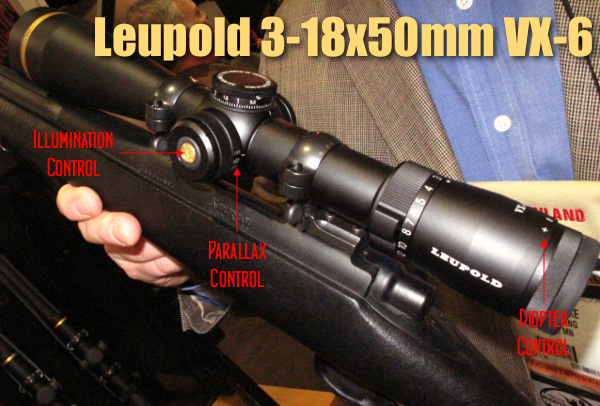
 At SHOT Show, Leupold displayed its latest VX-6 scope, a 3-18x50mm. The new 3-18x50mm scope comes in both illuminated and non-illuminated versions. Leupold also confirmed that a 4-24 power VX-6 will be introduced in mid-year 2013. The new 4-24X will have side-parallax, with Varmint Hunters’ and Fine Duplex reticle options. Also new for 2013, Leupold is adding an illuminated version of its 2-12x42mm VX-6.


 Durability is not usually an issue with target shooters as the scope will mainly be used in benign environment on a fixed-distance range. So, as long as a scope tracks and performs reliably, most target shooters won’t fret about durability. For those that may use their rifles in a tactical or field situation, or when hunting, the added robustness of the NXS scope may prove quite important. Now the BR scopes are no slouch as far as durability compared to similar scopes, but, in my experience, they cannot take quite the abuse that the NXS scopes can.
 Another point of consideration is the availability of a “zero-stop.” This is particularly useful in the same situations that the NXS scopes make the most sense. Namely, tactical or field situations where there may be stress combined with longer shots where dialing the turrets is required. The zero stop allows the shooter to set a stop point, usually a 100-yard zero. Then no matter where the turret is positioned in its span of travel, the zero can be quickly re-established by spinning the turret down until it stops at the pre-set zero.


 F-Class is a known-distance event, with targets of known dimensions that have markings (rings) of known sizes. Any ‘holding off’ can be done using the target face itself. Most ‘benefits’ of forward focal plain (FFP) optics are null and void here — they work great on two-way ranges where ‘minute of man’ is the defining criteria — but how many FFP scopes do you know of in the 30-40X magnification range? Very, very few, because what people who buy high-magnification scopes want is something that allows them to hold finer on the target, and see more detail of the target, not something where the reticle covers the same amount of real estate and appears ‘coarser’ in view against the target, while getting almost too fine to see at lower powers.
 Others use a
 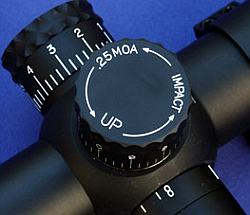 Reader Lindy explains how to check your clicks: “First, make sure the rifle is not loaded. Take a 40″ or longer carpenter’s ruler, and put a very visible mark (such as the center of an orange Shoot’N’C dot), at 37.7 inches. (On mine, I placed two dots side by side every 5 inches, so I could quickly count the dots.) Mount the ruler vertically (zero at top) exactly 100 yards away, carefully measured.


