In our articles collection, you’ll find a story of interest to varminters and game hunters. Choosing And Using Modern Reticles, by author John Barsness, reviews the many “hold-over” reticle options currently available for hunting scopes. The latest “hunting hold-over” reticles, such as Leupold’s Varmint Hunter Reticle, offer both vertical marks (for hold-over) and horizontal bars or dots (for wind compensation). The idea is to allow the shooter to move quickly from one target distance to another, without having to dial elevation changes with his scope turrets. Likewise, the horizontal wind-hold markings give the shooter reference points for winds of specific velocities. That makes the process of “holding-off” for wind much more predictable.
In the Barsness article, which originally appeared in Varmint Hunter Magazine, the author traces the history of ranging/hold-over reticles starting with the Mildot reticle. Barsness explains how to use the mildot reticle, noting how it is best used with a First Focal Plane scope design.
First Focal Plane vs. Second Focal Plane Designs
If nothing else, you’ll want to read this article just to improve your understanding of First Focal Plane (FFP) vs. Second Focal Plane (SFP) optics operation. If you want to use the markings on a reticle to range at various magnification levels, then you want the FFP design, preferred by the military. If, on the other hand, you prefer the viewed appearance of your reticle to stay constant at all power levels, then you’ll probably prefer the SFP design.
Barsness explains how the modern “Christmas Tree” design reticles, such as the Zeiss Rapid Z, evolved, and he explains how to use these reticles to adjust your point of aim for different target distances. These hold-over reticles can be very handy, but you must remember that the yardages which correspond to the stepped vertical markings are determined by the ballistics of your cartridge. Thus, if you change your cartridge, or even change your load significantly, your hold-over yardage values will change. You will then need to field-test to find the actual value of the reticle’s hold-over points.
Even if you are not a hunter, you can benefit from reading the Barsness article. For anyone shopping for a varmint scope, the article is a “must-read”. And Barness clears up some common misconceptions about FFP vs. SFP optics. Barsness also offers good, common-sense advice. We agree with Barsness when he says that some reticle designs have become too complicated. Barsness writes:
These days there are reticles with everything from a few extra dots along the vertical cross hair to reticles that cover the bottom third of the scope’s field of view, providing an aiming point for every blade of grass in North Dakota. Here we run into the basic fact that simpler reticles are easier to use, if not quite so versatile.
Personally, I particularly like simple reticles in shorter-range varmint rifles, whether rimfires or small centerfires such as the 22 Hornet. These aren’t likely to be used at extended ranges, or in any significant amount of wind. Hence, something like the Burris Ballistic Plex reticle provides about all the information we can realistically use — the reason there are Burris Ballistic Plex scopes on most of my rimfire or small centerfire varmint rifles.
When it comes to long-range optics, some folks can’t have too much magnification (as Tim Allen used to say: “More Power!”). At 500 yards and beyond, when the air’s misty or the mirage is thick, you can’t always use extreme magnification. But, when the conditions are excellent, it’s nice to have 50X magnification (or more) on tap. You can always “crank it back down”. Higher magnification (when conditions are good), can help you see your bullet holes at long range, and that makes it easier to judge your hold-offs and keep your group centered. In addition, there’s no doubt that high magnification lets you aim more precisely, no matter what the distance. Even at 100 and 200 yards, short-range benchresters are using 40X, 50X, and even 60X power scopes. This allows you to position your cross-hairs with extreme precision — something you need when you’re trying to put multiple shots through the same hole.
Raising the Optics Bar
How much power is usable? A few years back, folks said you can’t use more than 45X or so at long range. Well, as modern optics have evolved, now guys are buying scopes with even more magni-fication — way more. There are practical limits of course — with a 56 to 60mm front objective, the exit pupil of a 60X or higher-power scope will be very tiny, making head orientation ultra-critical. Any many scopes get darker as you bump up the magnification.
Despite the exit pupil and brightness issues, shooters are demanding “more power” these days and the scope manufacturers are providing new products with ever-greater magnification levels. Right now, the most powerful conventional riflescope you can buy is the March X-Series 8-80x56mm scope. Featuring a 34mm main tube and 56mm objective lens, this offers a true 10-times zoom ratio and up to 80X magnification. This scope has minimal distortion thanks to high-quality ED lenses designed in-house by Deon Optical, which also machines the main tube from one solid piece of billet aluminum.
To demonstrate the capabilities of high-magnification March scopes, Aussie Stuart Elliot has created a cool through-the-lens video with the March 8-80x56mm scope set at 80-power (See 0:30 timeline). Along with being one of Australia’s top benchrest shooters, Stuart runs BRT Shooters Supply, dealer for March Scopes in Australia. In the video below you can see the March 8-80X focused on a target at 1000 yards (910m). For best resolution, watch this video in fullscreen, 720p mode.
Look through the Lens of 80-power March Scope at Target 1000 Yards Away
Through-the-Lens Views at 40X and 80X at 1100 Yards
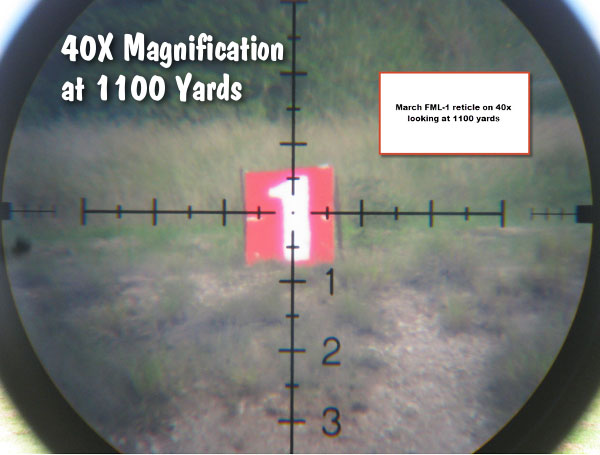
To reveal the difference between 40X and 80X magnification, here are two through-the-lens still images taken with March scopes sighting to 1100 yards. The top photo is at 80X magnification, looking through the March 8-80x56mm. The lower photo is at 40X magnification viewed through a 5-50x56mm March X-Series scope. You can see there is a big difference in perceived target size! Click on the “Larger Image” button to see full-screen version at 80X.
Here is another view through a March high-magnification scope, this time at 1000 yards. We’re not exactly sure of the power setting, but we think this is at least 40X. Note the good contrast, and the absence of color fringing or chromatic distortion. When you’re shooting at 1000 yards and beyond, having high-quality glass like this can provide a competitive advantage.
Video Find by Boyd Allen. We welcome reader submissions.
When you’re practicing or developing loads at long range, it can be a challenge to see your bullet holes on the target, even with a premium spotting scope. Yes, when viewing conditions are perfect, a top spotting scope such as the 88mm Kowa Prominar can resolve 6mm bullet holes at 600 yards and beyond. However, when there is dust or mist in the air, or when the mirage gets thick and heavy, even the best spotting scope may be unable to resolve bullet holes clearly at just 300 yards.
That’s why, if you do much long-range shooting, you should consider getting a wireless target-cam system. This combines a video camera placed near the target with a monitor on your shooting bench. The image from the camera is sent wirelessly to a receiver hooked up to your monitor. With a good camera and quality electronics, a target-cam system can provide sharp images out to 1000 yards.
Until recently, good “turnkey” target-cam systems have been expensive — $1400.00 and up. Guys who couldn’t afford this investment have tried cobbling together systems from various parts. Sometimes the “home-built” systems work, but sometimes they are disappointing.
Turnkey Target-Cam Systems Starting at $725.00
Now Target-Sight.com offers complete Target-Cam systems starting at $725.00 (for 600-yard system). This includes everything you need: 27X Sony Video Camera, transmitter, receiver, color monitor, three Li-Ion batteries, AC adapters/battery chargers, and even the tripod. Or $800.00 buys Target-Sight’s complete 1000-yard system. It includes the same package of components, but with extended range.
Dan Norgrove, the man behind Target-Sight.com, has been able to source quality electronic components at very good prices. Accordingly, you may be able to buy a complete, field-tested Target-Sight system, for not much more than the cost of buying the hardware yourself. And if you put together a bunch of miscellaneous parts, you can’t be confident that they will all work together optimally. The Target-Sight systems work, have good battery life, and everything arrives in one box — delivered with free shipping.
We know that folks considering target-cam systems are justifiably cautious before they shell out hundreds of bucks. You want to be assured that the system is easy to set-up, functions right, and that the image on the monitor is sharp and clear. To satisfy those concerns, Dan Norgrove has created a video showing his Target-Sight system in use in the field. This video shows the actual image on the Monitor from a target-cam placed 300 yards away. (Please note this video is slow in sections because the field test is an uninterrupted “single take”. That way you can be confident there were no tricks done during the editing. What you see is what you get.)
Houle Bloop Tube (Sight Extension) Gear Reviewby Robert Whitley
As a competitive shooter and a builder of custom AR-15 accuracy competition uppers, one of the frequent requests I have from shooters is for a recommendation for a good bloop tube. What people want is a bloop tube that is light and strong, one that has no detrimental effect on accuracy, one that works well with many of the existing front sights, and can be removed and re-attached quickly and easily with no loss of zero. For years finding a bloop tube that fulfills all these requirements has been a somewhat elusive exercise. I am pleased to report that I have found the Houle Bloop Tube to meet all my requirements. In my opinion, this is the best bloop tube on the market, by far. You can order a Houle tube from Norm’s Website, TopGunRI.com or e-mail Norm at topgunngh [at] verizon.net.
Bloop Tubes Designed by a National Champion
Norm Houle is a High Power and long-range shooter who has used these tubes to win National High Power Rifle Championships multiple times in past years. This past summer at Camp Perry, Norm’s bloop tubes were used by top “podium level” shooters in various events, including David Tubb, who won the National Long Range Championship using one of Norm’s tubes. Rodrigo Rosa also used Houle tubes this year to place second in the National High Power Rifle Championship and third in the Long Range National Championship.
I have a couple of Norm Houle’s bloop tubes that I have used with a couple of rifle projects. Here are some of my thoughts on installation and use of the Houle Bloop Tubes:
Accuracy with the tubes in place is excellent!
The tube assemblies are two piece clamp-on tube assemblies, and the bloop tubes can be removed and re-attached with no loss of zero (and I mean no loss of zero). This is a big one! Over the years I have had quite a few clamp on tubes, but few of them repeated like these.
The tubes are very light but also very strong and low profile. Some of the clamp-on bloop tubes I have had over the years were huge, heavy and provided a large side profile (crosswind sail factor for offhand, etc.).
Norm offers 2″, 4″, and 6″ bloop tube lengths. The tubes are made to work with a .750″ dia. muzzle turn down and both of the ones I have work perfectly with a minimum turndown of 1.625″ long which provides enough “front-back” distance to permit the locating ring and bloop tube to be properly mounted on the barrel at the same time and work as they should. The tubes are also set up to use front sights set up to mount on a .750″ diameter mounting.
Each tube assembly has a clamp-on locating ring plus a clamp-on bloop tube that positively indexes off a tapered pin that protrudes from the locating ring. The locating ring is light but very strong and absolutely stays put when you clamp it on the barrel end (clamps on with one screw using a common 7/64″ Allen wrench). The bloop tube part of the assembly has two clamp-on screws (use a common 7/64″ Allen to put on, mount and take off).
Using Different-Length Tubes for Different Applications You can buy one tube with two or more locating rings and set multiple rifles up so you can move your bloop tube (with front sight attached) from rifle to rifle. You can also use two different bloop tubes to mate up with one locating ring on the same rifle. Norm uses a 2″ tube (with a front sight attached) for offhand and rapid sitting at 200 yards (short tube minimizes crosswind sail factor). For 300-yard rapid prone and 600-yard slow prone, Norm takes off the 2″ tube and mounts a 6″ tube on the rifle (with a front sight attached to it). Norm switches back and forth as needed from match to match (a 4″ tube is also offered). Norm noted that Rodrigo Rosa also used the same Houle bloop tube set-up with two different tubes this year at Perry to take second overall.
The price of a Houle bloop tube assembly with locating ring is $125.00. That’s more than some other brands, but a good value considering the design, features, and high-quality construction of Norm’s bloop tubes. Just as with all sights and optics… you get what you pay for.
Jerry Schmidt, an avid shooter and hunter from Montana, has created a tool designed to help install single-dovetail or double-dovetail rings on hunting rifles. Jerry’s invention, the Scope-Tru Alignment Bar (patent pending), is unique. Unlike most other alignment systems, this is a single, long precision machined rod with a pointed forward end. You work on one ring at a time, first setting the front ring in the dovetail and then setting the rear ring. The process is shown by Jerry in the video below.
Jerry explains: “The Scope-Tru Alignment Bar is a tool designed to install both standard ring/mount systems, and dual dovetail ring/mount systems. The tool provides significant leverage to turn the dovetail rings into their bases. By observing the pointer on the end of the bar, it is easy to align the ring with the center of the barrel, thereby assuring that the ring is installed at 90 degrees to the axis of the bore. Because the bar is a one-piece tool, it is possible to get the rings into nearly perfect alignment with each other, and near perfect alignment with the bore axis.”
The photos above show how the tool is used to install and align a set of standard hunting rings (with rear windage adjustment). You start with the front ring, rotating it 90 degrees in the dovetail, and then align with the center of the barrel. Next, slide the tool rearwards and loosely set the rear ring in place. With both rings adjusted correctly, the alignment tool will be perfectly centered and both rings with be subsequently squared at 90° to the bore axis. Schmidt says he can install conventional rings with this tool, tighten them to spec on a rifle scope, and there will be virtually no marks on the scope tube. (Of course this would require that the rings are extremely well made with no burrs or highspots on the trailing and leading edges.)
The Scope-Tru Alignment Bar is CNC-machined from TGP bar stock, and will be offered in both 1 inch, and 30mm diameters. The durable bar is designed for regular, long-term use by the professional gunsmith, the home gunsmith or “gun crank”, and retail or wholesale sporting goods store staff. The 1″-diameter, all-steel Scope-Tru is can be purchased for $135.00 plus shipping and handling. The version for 30mm rings AND a new combo 1″/30mm Scope-Tru tool are both in final development, and could be available in the near future. To place an order for a 1″-diameter Scope-Tru, CLICK this LINK.
For more info, visit Parabola-LLC.com, phone (406) 586-1687, or email info [at] parabola-llc.com. CLICK HERE for a shorter video that shows the entire mounting process in a compressed time format.
Even if you don’t shoot competitively, you can benefit from having a mirage shield on your barrel. The shield helps prevent barrel heat from “cooking” the air in front of your scope, which can distort the view you see through the optic. Barrel heat creates a mirage effect that can blur the target image and actually shift your apparent aiming point up and down. Competitors know that a mirage shield helps them shoot smaller groups and better scores. Mirage shields can likewise benefit Varmint shooters on those hot summer groundhog and prairie dog expeditions.
Make a Mirage Shield from Discarded X-Ray Film
Forum member Fabian from Germany, whose Sako 6BR was featured as a Gun of the Week, has devised a clever and inexpensive mirage band option. Fabian is a radiologist by trade. He notes that many X-ray machines require a daily test film for calibration. These are normally just discarded in the trash, so you can get them for free.
Fabian explains: “I’m a radiologist, so I handle medical x-ray films every day. Modern X-ray machines use laser-based printers and they need to print a test-film every day. One x-ray film is about 43×35 cm (16.9″ x 13.7″). Made from polyester, the films are very stable and only 0.007″ inches thick. They are light-weight, semi-transparent, and very stable. Using normal scissors, you can easily cut four mirage shields from a single sheet of film. Then glue on some velcro to attach to your barrel. Try it, you will not be disappointed.”
More Do-It-Yourself Ideas
Other forum members have made mirage shields out of common, inexpensive materials such as old venetian blinds, thin plastic edging strips, and even cardboard reinforced with strapping tape. There’s no “magic material”. However many shooters have found that wider shields (extending well past the barrel sides) work better than narrow shields, particularly in hot weather.
Mirage Shields with Printed Designs
If you prefer to purchase a mirage shield, Shotmaster 10X offers a wide variety of shields starting at just $5.00 for a plain white 18″ shield. Patterned shields (including camo designs) are priced by length: $8.50 (18″), $9.50 (20″), $11.00 (24″). All Shotmaster shields come with two (2) velcro patches with self-stick adhesive.
Camera Land has announced a remarkable Combo Optics Sale on Minox Optics products. If you purchase a qualifying Minox rifle scope from Camera Land, you can get a Minox Binocular or Minox Monocular for just one penny more. Yes, that’s correct, add your choice of four Minox BF Binocular models or the MD 8×42 CWP Monocular for just $.01. That’s an awesome deal — consider that the Minox BF 10×42 binocular (by itself) sells for $150.00-$199.00 elsewhere. Note: Purchasers are limited to a single $0.01 Binocular or Monocular per new riflescope ordered.
New ZA 3 and ZA 5 Minox Scopes Are Good Buys
These are current production, quality scopes. The new Minox line of riflescopes is impressive, with German Schott glass, strong monotube construction, and a no-fault, lifetime warranty. Just last week we reviewed the new Minox ZA 5 6-30x56mm scope and concluded it offers an impressive set of features for the price. Retailing for $799.00 to $829.99 (depending on reticle) the 6-30X ZA 5 is an outstanding value for a high-magnification, side-focus, 30mm-tube scope with premium glass. The 6-30X ZA 5 is more than two hundred bucks cheaper than a Leupold VXIII 8-25x50mm LRT, yet the Minox offers more magnification, plus a true diopter eyepiece not found on the Leupold. The Minox scopes from Camera Land even come with a Scopecoat cover at no extra cost.
Camera Land reports very positive buyer feedback on the new Minox ZA-3 and ZA-5 riflescopes: “We’ve sold a ton of these. Buyers tell us they are impressed with the glass and the overall quality. These scopes hold zero, the controls are positive, the warranty is great. The Minox rifle scopes are an excellent value right now.”
How to Purchase Minox Scope with Companion Optic
NOTE: Not all binocular/monocular options for this promo are displayed on the Camera Land web site. To secure the companion binocular/monocular you want with your Minox rifle scope: 1) Call 212-753-5128 and speak with Doug or Neil, or 2) Purchase the scope you want, select the one binocular shown to be offered, and in the note area of the order type in “Minox Promotion” and list the binocular/monocular you prefer. To keep it simple, we recommend you just call Doug at 212-753-5128 and ask about the Minox “Penny Promo”. Please mention AccurateShooter.com. Doug can take your order or he can send you a Paypal invoice listing the Minox rifle scope the Binocular/Minocular of your choice.
Open Box Bargains on Minox Rifle Scopes
In addition to the 1 cent combo sale, Camera Land has some great “open box” bargains on Minox rifle scopes. Open Box #66030 ZA-5 4-20×50 Plex (#66030) have been discounted from $699.00 to only $449.99. Likewise Open Box ZA-5 3-15×42 Plex (#66020) have been discounted from $499.00 to $319.99. NOTE: All open box items may not be listed on the Camera Land website. Call 212-753-5128 and speak with Doug or Neil about these special discounted items.
Promo Tip by EdLongrange. We welcome reader submissions.
Now through September 2, 2012, you can save big bucks on “factory blemished” Leupold VX-3, VX-L, VX-7, and Rifleman series scopes at MidwayUSA. Prices are slashed by as much as $260.00, and MidwayUSA is offering free shipping as well. These scopes may have minor cosmetic blemishes (small scratches, dents or ring marks) which do not impair function or reliability. All these “blem” scopes still carry Leupold’s full lifetime transferrable warranty.
The scopes on sale are mostly mid-power hunting scopes (2.5-10X, 3-9X, 3.5-10X, 4-12X etc.) with 1/4-MOA clicks. Savings can be substantial. For example, the 3.5-10x50mm VX-3L Rifle Scope was marked down to $519.99 from the regular $699.00 price — a $180.00 savings. If you want to take advantage of this special “factory blemished” Leupold scope sale, act soon — these are selling out quickly. The sale expires September 2, 2012.
Sale tip from EdLongrange. We welcome reader submissions.
We know that many readers, particularly target shooters and long-range varmint hunters, are looking for a fairly high-magnification optic that is also affordable. A common question in our Shooters Forum is: “I can’t afford a Nightforce. Is there a quality scope with more than 25X magnification that costs under $900.00.” Fitting that bill are two scopes that have been on the market for a while — the Bushnell Elite 6500 4.5-30x50mm, and Sightron SIII 8-32x56mm. Now there’s a new optic from MINOX to add to the list of quality, high-magnification scopes that can be purchased for well under $1000.00.
Great Glass in 6-30x56mm MINOX
There is a new 6-30 power scope from Minox that offers impressive features at an affordable under-$900.00 price point. The Minox ZA 5 6-30x56mm SF riflescope offers a wide 500% zoom range, 30mm main tube, and outstanding Schott glass from Germany. These scopes are engineered in Germany and assembled in the USA. The Minox 6-30×56 offers a handy side-focus parallax control. What’s more, the Minox has a European-style diopter eyepiece, with a -2 to +1.5 range. That’s great for shooters who would otherwise require corrective lenses. Leupold and Bushnell don’t provide a diopter eyepiece — that’s something you normally find on high-end European scopes (such as Schmidt & Bender).
The Minox 6-30x56mm riflescope is offered with three reticle choices: MinoPlex (Medium Plex), BDC (bullet drop compensating), and XR-BDC which has finer lines in the central zone, with both vertical and horizontal stadia (hash-marks). We favor the XR-BDC for target use.
Minox offers a strong “no-fault” lifetime warranty on its scopes. The MINOX Lifetime Total Coverage Warranty “provides protection against manufacturing defects, functional failures, or any accidental damages to the covered product, including breakage, water damage, or any accident”. Put simply, “MINOX will repair or replace any damaged MINOX Riflescope with no questions asked.”
Features of Minox ZA 5/30 6-30×56 SF Riflescopes:
Side Focus Parallax Adjustment
Ample 4″ plus Eye Relief
Premium lenses by SCHOTT AG of Germany
Zero resettable 1/4 MOA Windage and elevation knobs
Fast-focus European-style diopter eyepiece (-2 to +1.5)
Minox M* multi-coated lenses for improved contrast, detail, and brightness
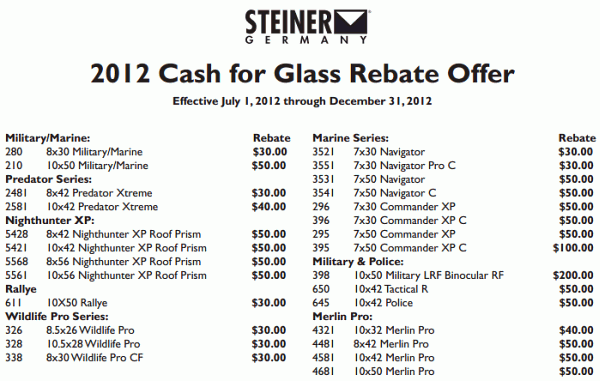
Through the end of this year (2012), Steiner is offering substantial rebates on a wide variety of Steiner binoculars. This year’s rebates range from $30 to $200, for the 27 Steiner binoculars listed below. To get your rebate, complete the Steiner Cash for Glass Rebate Coupon and send it, along with your original sales receipt and original UPC barcode, to: Steiner Cash for Glass Rebate, MPS Dept. No. 446-STNCASH 2012, P.O. Box 3250, Cinnaminson, NJ 08077.
Note: No photocopies or mechanical reproductions of UPC barcode or sales receipt will be accepted. Mail must be signed and postmarked by January 31, 2013, and received by February 15, 2013, to be eligible for the rebate. Offer valid in USA only, and limited to one claim (rebate) per household.
Promo tip by EdLongrange. We welcome reader submissions.


 In our articles collection, you’ll find a story of interest to varminters and game hunters. Choosing And Using Modern Reticles, by author John Barsness, reviews the many “hold-over” reticle options currently available for hunting scopes. The latest “hunting hold-over” reticles, such as Leupold’s Varmint Hunter Reticle, offer both vertical marks (for hold-over) and horizontal bars or dots (for wind compensation). The idea is to allow the shooter to move quickly from one target distance to another, without having to dial elevation changes with his scope turrets. Likewise, the horizontal wind-hold markings give the shooter reference points for winds of specific velocities. That makes the process of “holding-off” for wind much more predictable.

 When it comes to long-range optics, some folks can’t have too much magnification (as Tim Allen used to say: “More Power!”). At 500 yards and beyond, when the air’s misty or the mirage is thick, you can’t always use extreme magnification. But, when the conditions are excellent, it’s nice to have 50X magnification (or more) on tap. You can always “crank it back down”. Higher magnification (when conditions are good), can help you see your bullet holes at long range, and that makes it easier to judge your hold-offs and keep your group centered. In addition, there’s no doubt that high magnification lets you aim more precisely, no matter what the distance. Even at 100 and 200 yards, short-range benchresters are using 40X, 50X, and even 60X power scopes. This allows you to position your cross-hairs with extreme precision — something you need when you’re trying to put multiple shots through the same hole.
 Raising the Optics Bar



 Bloop Tubes Designed by a National Champion

 You can buy one tube with two or more locating rings and set multiple rifles up so you can move your bloop tube (with front sight attached) from rifle to rifle. You can also use two different bloop tubes to mate up with one locating ring on the same rifle. Norm uses a 2″ tube (with a front sight attached) for offhand and rapid sitting at 200 yards (short tube minimizes crosswind sail factor). For 300-yard rapid prone and 600-yard slow prone, Norm takes off the 2″ tube and mounts a 6″ tube on the rifle (with a front sight attached to it). Norm switches back and forth as needed from match to match (a 4″ tube is also offered). Norm noted that Rodrigo Rosa also used the same Houle bloop tube set-up with two different tubes this year at Perry to take second overall.


 Now through September 2, 2012, you can save big bucks on “factory blemished” Leupold VX-3, VX-L, VX-7, and Rifleman series scopes at
  Great Glass in 6-30x56mm MINOX
 Minox offers a strong “no-fault” lifetime warranty on its scopes. The MINOX Lifetime Total Coverage Warranty “provides protection against manufacturing defects, functional failures, or any accidental damages to the covered product, including breakage, water damage, or any accident”. Put simply, “MINOX will repair or replace any damaged MINOX Riflescope with no questions asked.”
 Through the end of this year (2012), Steiner is offering substantial rebates on a wide variety of Steiner binoculars. This year’s rebates range from $30 to $200, for the 27 Steiner binoculars listed below. To get your rebate, complete the Steiner