Shown is a new .338 Lapua Magnum rifle from Israel’s IWI. Impressively beefy rig.
For folks in the gun industry, the third Monday in January is the best day of the year. Held in conjunction with SHOT Show, Media Day at the Range lets us try out dozens of new rifles and pistols, as well as meet top gun designers and friends in the shooting sports. We saw some very interesting new products this year. Here are some of the most interesting “take-aways” from Media Day at the Range 2017 on January 16th.
Most Innovative — “The FIX” Rifle from Q
The star of Media Day, at least in the rifle category, was “The FIX”, a new modular rifle from the Q Team. This innovative rig features a totally unique bolt system with a 45° lift and a bolt housing that runs on rails (literally). This thing cycles fast and smoothly.
The trigger, set at 2.5 pounds, was one of the best we’ve ever tried on a centerfire factory rifle. One has to admire the engineering on “The FIX”. This new rifle has definitely “raised the bar” for tactical-style rifles. It’s different, it works, and it offers real advantages for both hunters and tactical style shooters.
Savage 10 with Ergonomic GRS Stock
Perhaps the most ergonomic rifle we shot all day was the new Savage GRS-10 in a stiff, composite GRS stock. European-crafted GRS stocks feature a very comfortable hand-grip, plus fully adjustable cheek-piece and adjustable length of pull. As shown this rifle is very affordable for PRS production-class competition.
To be frank, this Editor liked this rifle more than the Ruger Precision Rifle. A lot more. The GRS stock fit better, the Savage bolt cycled much more smoothly, the trigger was better, and the magazine seated more easily. If you don’t have to be “tacticool” with a metal stock, you should definitely consider this Savage. The new Savage GRS-10 will be offered in 6mm Creedmoor, 6.5 Creedmoor, and .308 Win chamberings. Here’s a video review by Guns America.
Blacktical Bolt-Action Rifles — The PRS Influence
We saw many new (or upgraded) PRS-style bolt action rifles in modular aluminum frames. There were offerings from Savage, Bergara, Tikka, and more. We’ll provide a more thorough run-down on these new guns next week. We really liked the new Tikka T3x TAC A1, while tactical shooters Ed and Steve (aka the 6.5 Guys) were impressed with the new Bergara: “Bergara has in-sourced chassis and triggers to produce very high quality offerings at a very competitive price. Handling, shooting and cycling the bolt on the $1150 MSRP Hunting and Match Rifle would lead one to believe the price tag was a mistake (maybe the first digit should have been a 2). We felt the same when we got behind the $1,699 Bergara Match Precision Rifle.”
Tikka T3x TAC A1
Bergara Match Precision
Pistols — The Sounds of Silence
The most interesting handgun on display was SilencerCo’s Maxim 9, which features an integral suppressor. It looks bulky but it felt relatively normal in the hand. The silencer did tame muzzle lift as well as reduce sound levels dramatically. This is an impressive piece of engineering.
There were many other pistols equipped with more conventional screw-on silencers. Here is a special edition Smith & Wesson M&P model.
Optics — High-End Models from Schmidt and Bender
There were many new optics on display at Media Day, none more impressive than the new 5-45x56mm PMII from Schidmt & Bender. Led by our good friend Kyle Brown, Schmidt & Bender USA had a strong presence at Range Day, with many optics models fitted to high-end tactical rifles. Jason Baney (shown below with Kyle), used one of these rifle/scope combos to make 5 of 5 hits on steel at 960 yards.
Jason Baney checks out the new 5-45x56mm PM II with help from Kyle Brown (left).
Meeting Old Friends
One of the great things about Media Day is the chance to re-connect with old friends. At the Winchester booth, it was great to see Kim Rhode, a six-time Olympic medalist (including three golds). She is the first Summer Olympian to win an individual medal at six consecutive summer games. Kim, a Californian, is leading efforts to challenge draconian new California laws that will severely restrict how ammo is distributed and sold in California. Kim said that, under the new ammo laws, she will not be able to obtain the special “International Loads” she shoots in competition. We wish Kim well in her efforts. We believe that California’s new laws restricting the purchase of ammunition are unconstitutional and, hopefully, will be challenged successfully in court.
Along with Kim we met with our friends Steve (L) and Ed (R), aka the 6.5 Guys, along with past Top Shot Champion Dustin Ellermann (in middle below).
World Record AR Speed-Shooting by Jerry Miculek
At the Smith & Wesson shooting bay, we watched the legendary Jerry Miculek set a world speed record for 10 rifle rounds total on three targets. Before a cheering gallery of fans, Jerry drilled multiple sub-two second runs using his S&W M&P 15T semi-auto rifle. The fastest split was a 1.59 (but we’re waiting for final confirmation on that). We’re told that’s definitely a new world record. Jerry may not be getting any younger, but he’s still blazing fast. Jerry calls this 10-shot drill “STL” or Share the Love.
Ammunition — Polymer Jacketed Pistol Bullets
One of the more notable, recent developments in pistol ammo has been synthetic jacketed bullets. With a total polymer shell over a lead core, these are safer when shooting steel targets because they do not fragment like conventional, jacketed bullets. With no exposed lead or copper, there’s minimal contact between these materials and the barrel, so there’s less copper and lead fouling. Moreover, according to Federal’s test engineers, the red Syntech coating produced 12% less friction in the barrel. Here is the American Eagle 9mm Luger 115gr Total Syntec Jacketed ammo provided by Beretta at Media Day.
At the request of our readers, we provide select “Deals of the Week”. Every Monday morning we offer our Best Bargain selections. Here are some of the best deals on firearms, hardware, reloading components, and shooting accessories. Be aware that sale prices are subject to change, and once clearance inventory is sold, it’s gone for good. You snooze you lose.
1. Amazon — Lyman BoreCam $197.19
Here’s the best deal we’ve found on a very useful product. The Lyman BoreCam is an electro-optical borescope with a digital display. You can record “stills” on a SD card. This is one of the hottest products on the market right now — and users really like the BoreCam (although some wish the digital view-screen was larger). Amazon.com now has the Lyman BoreCam for $197.19. Grab it while you can at that price (with FREE shipping for Prime members). Other online vendors are charging a LOT more (e.g. MidwayUSA price is $259.99).
2. Natchez — RCBS ChargeMaster Dispenser, $259.99
Here’s a KILLER DEAL on the RCBS ChargeMaster combo scale/powder dispenser. This unit sells elsewhere for up to $389.00. You may want to act quickly as sale pricing changes frequently and many other vendors have recently raised their prices. Grafs.com sells this for $382.99 now while the current Amazon.com price is $349.99. You can save a lot through Natchez right now — ninety bucks compared to Amazon. Act quick before they sell out.
3. CDNN Sports — Ruger American Ranch Rifle (Tan), $349.99
Here’s a nice little varmint rifle from Ruger with good features and performance at a great price: $349.99. You could pay that much just for a barrel. This .223 Rem rifle features a 16.5″ hammer-forged barrel barrel threaded 1/2″-28 at the muzzle for brake or suppressor. The action, which features a 70° three-lug bolt, and Picatinny-style scope rail, sits in an aluminum bedding block. The crisp trigger adjusts down to 3 pounds. With a weight (before optics) of 6.1 pounds, this is a handy carry-around varminter. We like this rifle. For $349.99 it’s a steal.
Benchrest Matches have been won (and many records set) with 36X Weaver T-Series optics. Our friend Boyd Allen observed “You can pay three or four times as much for a scope but not necessarily be more competitive — a 36X front objective Weaver is enough to win with…” The Classic T-Series Weaver has proven to be one of the most reliable high-magnification scopes ever made. The “old-fashioned” adjustable objective works well and the Weaver Micro-Trac turret system delivers precise and repeatable elevation and windage control. Now just $369.99 at Natchez, this is a great deal.
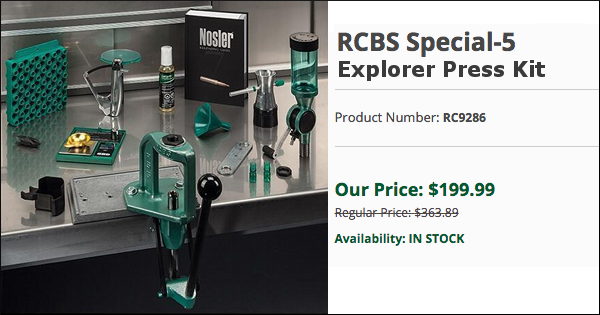
5. Natchez — Special 5 Reloading Press Kit, $199.99
Looking for a great holiday gift for a family member getting started in metallic cartridge reloading? This RCBS Kit has everything a new reloader needs: single-stage press, powder measure, scale, powder trickler, priming tool, cartridge tray, “rocket” chamfer tool, case lube and more. This is an excellent entry-level reloading kit, on sale for just $199.99 at Natchez Shooters Supplies. We like the relatively compact Special 5 press for most reloading duties. Eventually you may want to add an additional, large heavy press, but this will get the job done. For the combined package, with all the tools one needs to hand-load quality ammo — this is a stunningly good deal at $199.99.
6. Monmouth Reloading — 500 Lake City 5.56 Cases, $35.00
500 pieces of Lake City brass for just thirty-five bucks? Yep, that’s a great deal for anyone who needs .223/5.56 brass for varmint safaris and tactical comps. Monmouth Reloading is selling genuine, once-fired Lake City 5.56x45mm brass, thick-walled and sourced direct from the U.S. Military. Monmouth reports: “Our current stock of Lake City 5.56 looks to be all newer year Lake City head stamp but may contain a small percentage of other NATO headstamps. Lake City is a popular, reliable brass, normally capable of many reloads.” Monmouth includes 1% overage to account for any damaged brass. NOTE: Brass has crimped primers, so the pockets will need to be reamed or swaged prior to reloading.
Got patches? Here’s a great deal on 100% cotton flannel patches. There are many sizes available, starting at $9.99 for 800 one-inch “17 Cal” patches. For 6mm rifles, we actually like the 1.25″ round “22/223″ sized patches priced at $11.99 for 800. Choose either round patches or square patches in most sizes. We generally like round patches for use with spire-tip jags, but some shooters prefer to wrap their patches around a jag or brush and square patches work better for wrapping. The large, 2″-square .30 Cal patches cost $17.99 for 800. These prices include FREE Shipping for Prime Members.
8. Home Depot — 72″ Wood Workbench for $75.36
This patented Home Depot workbench assembles in a few minutes. Simply unfold the legs, pop in the shelf, and you are ready to start your project. Made from Premium 2×4 Hemlock fastened with glue and screws, this workbench is a great value. The bench (72″ wide x 35″ high x 22″ deep) can easily be stored when not in use. NOTE: The wood is unfinished (can be painted or stained).
We like binoculars with built-in Laser Rangefinding capability. With rangefinding binoculars, you can carry one less piece of gear, and a binocular optic is much more effective in the field than the monocular on a typical dedicated laser rangefinder (LRF). The stereo view gives better definition and depth perception, and the larger, binocular lenses give better low-light performance than the smaller-diameter monocular optic found in a conventional LRF.
Leica and Swarovski make excellent rangefinding binoculars, with great glass and impressive laser performance. But these European LRF Binoculars are very expensive — the latest Leica 10×42 Geovid is $2600.00 and the Swarovski 10×42 EL hits the three grand ($3000.00) mark. Frankly, that’s just too expensive for the vast majority of consumers.
New Vortex Rangefinding Binoculars at $1199.00 Street Price
Enter Vortex into the HD rangefinding binoculars marketplace with a quality, life-time “unconditional” guaranteed product at less than HALF the price of the Leica Geovid. MSRP of the Vortex’s new Fury HD Laser Rangefinder Binoculars is $1599.00, but “street price” will be hundreds less. Vortex says “expect to pay about $1199.00 at dealers for the Fury HD”. A lot more guys can afford $1200.00 than $2600.00, that’s for sure.
The Vortex Fury has some very cool features. It offers angle compensation as well as line-of-site modes. Scan mode gives readings as you pan or track a moving animal. You can set the distance output to yards or meters. All the controls are on the right side so you can operate the Fury HD easily with one hand. Check out the Fury’s features in the promo video below:
The Fury HD has good glass — fully multicoated HD lenses with good lowlight performance. The armored housing seems pretty tough. We like the fact that Vortex has provided a left eye diopter adjustment so users can fine-tune image focus for their vision.
Vortex says the Fury HD will range “reflective targets to 1600 yards with an ultra-fast readout”. That may be a bit generous. In the real world, we expect the hand-held Fury HD to range deer-sized objects out to 800 yards or so, and larger objects (such as vehicles) out to 1200. This is based on our testing of other similar rangefinding binoculars.
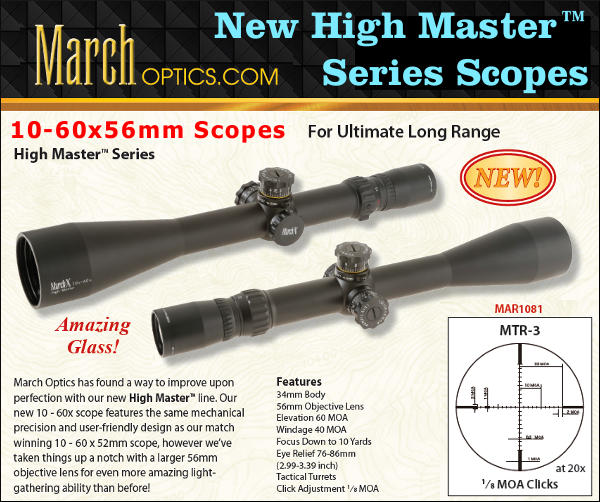
At SHOT Show in Las Vegas, March Optics will unveil its new “High Master” series scopes. These top-of-the line optics are designed for Benchrest and Long-Range Competition. We’ve always been impressed with the clarity and sharpness of March optics, and now they are even better. The High Master line of scopes boast class-leading, state-of-the-art ED glass that delivers outstanding sharpness with near-zero chromatic aberration.
The March engineers tell us: “We’ve found a way to improve upon perfection with our new High Master™ line. Meticulously designed and individually hand-assembled by the expert engineers at March, these scopes feature our new Super-ED, high-refractive glass for unparalleled quality and exceptional clarity. This high-tech glass greatly reduces chromatic aberration for a previously unheard-of level of sharpness and brilliance.”
New March High Master Scopes
March 10-60x56mm Zoom Scopes for Ultimate Long Range
(Five Versions: MAR1078 3⁄32 MOA DOT Reticle, MAR1079 1⁄8 MOA DOT Reticle, MAR1080 MTR-1 Reticle, MAR1081 MTR-3 Reticle, MAR1082 MTR-4 Reticle)
NOTE: The new 10-60x56mm scope features the same mechanical precision and user-friendly design as March’s match-winning 10-60x52mm zoom scope, but with a larger 56mm objective lens and enhanced glass.
March 40–60x52mm EP Zoom Scopes for Benchrest Competition
(Three Versions: MAR1083 CH Reticle, MAR1084 3⁄32 MOA DOT Reticle, MAR1085 1⁄8 MOA DOT Reticle)
NOTE: For shooters seeking “one-hole” accuracy in the Benchrest game, this is the scope. The new High Master 40-60x52mm EP Zoom scope gives serious Benchrest shooters an ultra-sharp, high-magnification variable scope with zero POI shift when changing magnification.
March 48 x 52mm Fixed Power Scopes for Benchrest Competition
(Three versions: MAR1075 Cross-Hair Reticle, MAR1076 3⁄32 MOA DOT Reticle, MAR1075 1⁄8 MOA DOT Reticle)
NOTE: These new March 48-power scopes look to set new quality standards among high-magnification, fixed power scopes for benchrest competition. Fixed-power scopes are lighter and simpler than variable scopes of equal magnification. In weight-limited Benchrest classes this fixed 48X will be a top choice.
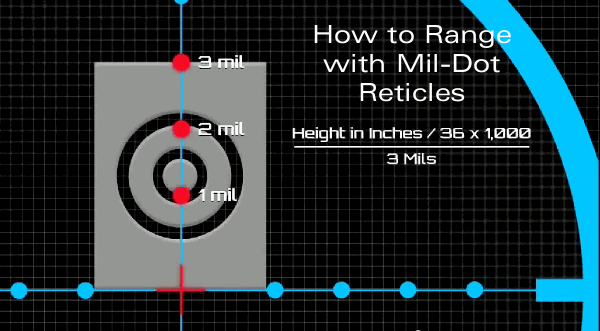
MIL-system scopes are popular with tactical shooters. One advantage of MIL scopes is that the mil-dot divisions in the reticle can be used to estimate range to a target. If you know the actual size of a target, you can calculate the distance to the target relatively easily with a mil-based ranging reticle. Watch this helpful NRA video to see how this is done:
Leupold has released three new VX-3i scopes for precision shooters. The new VX-3i LRP (“Long Range Precision”) series of scopes offer impressive features at affordable price points. There are three new LRP models: 4.5-14x50mm, 6.5-20x50mm, and 8.5-25x50mm. The “3i” in the model names indicates a three-times zoom ratio.
Both front focal plane (FFP) and rear focal plane VX-3i LRP models will be offered. All VX-3i LRP scopes come with a removable throw lever on the zoom ring. The big, knurled turrets are easy to manipulate and feature an elevation zero stop. You can choose either quarter-MOA or 1/10th MIL clicks, and the reticles are matched to the click values — MOA/MOA or mil/mil.
Several popular reticle options are available, including MOA-based Impact-29 MOA, Impact-32 MOA and T-MOA®; or the mil-based TMR® and the new Leupold CCH (Combat Competition Hunter) reticle. The Leupold CCH is a grid-based reticle providing holdovers and wind holds in mils. That should prove popular with tactical marksmen and PRS competitors.
For target work at 400+ yards we like the 8.5-25x50mm LRP:
Competing with Vortex and Bushnell for the Tactical Market
We see these VX-3i scopes as direct competition for the Vortex and Bushnell scopes now favored by many tactical and PRS shooters. Leupold’s goal was to build a scope with the features customers want at affordable prices. Tim Lesser, Leupold’s VP of product development, explains: “The VX-3i LRP [optics line] is a high-end, long-range riflescope that’s within most people’s budget, be it for PRS, long-range target shooting or even hunting.”
At the request of our readers, we provide select “Deals of the Week”. Every Monday morning we offer our Bargain selections. Here are some of the best deals on firearms, hardware, reloading components, and shooting accessories. Be aware that sale prices are subject to change, and once clearance inventory is sold, it’s gone for good. You snooze you lose.
The LabRadar is the most advanced chronograph on the market. When it was first released, you had to wait months to get one of these Doppler Radar units. Now they are in-stock and ready to ship at Bruno Shooters Supply for $559.95. Once you learn how to position and adjust the LabRadar, you should find the machine reliable and versatile. We do recommend getting a separate battery pack. If you are considering purchasing a LabRadar Chronograph, we strongly suggest you read the very thorough and informative LabRadar Review by Ray Gross, Captain of the USA F-TR team.
2. CDNN — ANSI Z87.1-Approved Safety Eyewear, $1.35 Each
You won’t find a better deal on name-brand ANSI Z87.1-approved safety glasses. Choose from Pyramex, Radians, or Winchester brands on sale now at CDNN Sports. We have used Pyramex safety eyewear for years. These are lightweight, comfortable and fairly rugged. The Radians Maverick features a stylish silver frame, while the Winchester eyewear features wrap-around amber lenses.
3. Eurooptic.com — Leupold VX-6 Scope Super-Sale
Eurooptic.com has received hundreds of brand-new Leupold VX-6 riflescopes, and will sell them at very deep discounts. Leupold’s VX-6 line spans 15 models, all with 6:1 zoom magnification ranges. From the 1-6x24mm CDS optic to the impressive 7-42x56mm Side Focus Target model, you can find a VX-6 for virtually any rifle application. And now you can save hundreds by purchasing overstock VX-6s on sale.
Benchrest Matches have been won (and many records set) with 36X Weaver T-Series optics. Our friend Boyd Allen observed “You can pay three or four times as much for a scope but not necessarily be more competitive — a 36X front objective Weaver is enough to win with…” The Classic T-Series Weaver has proven to be one of the most reliable high-magnification scopes ever made. The “old-fashioned” adjustable objective works well and the Weaver Micro-Trac turret system delivers precise and repeatable elevation and windage control. Now just $369.99 at Natchez, this is a great deal.
5. Able Ammo — 247 Rounds .223 Rem, HP Bullets
Here you go — instant varmint safari. This Hornady-made .223 Rem ammo features quality hollowpoint bullets, rather than the not-so-accurate FMJ bullets with most bulk .223 ammo. This stuff is much more accurate (with lower ES/SD) than other low-priced ammo. Users report sub-MOA accuracy with this stuff. If you’re planning a varmint safari this spring but don’t have the time (or gear) to reload, pick up a couple boxes of this stuff and you’re good to go. There are 247 rounds in each polymer ammo “can”. This ammo usually comes loaded with Hornady’s XTP (eXtreme Terminal Performance) bullets which work great on varmints.
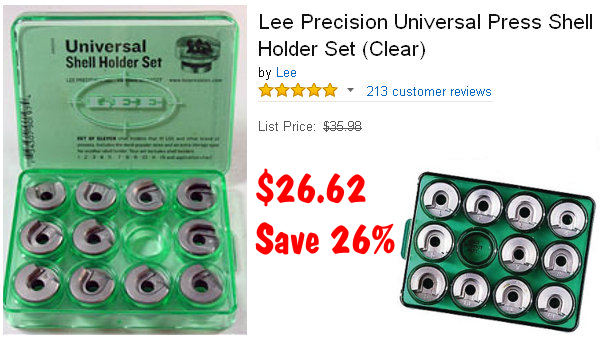
6. Amazon.com — Lee Universal Shell Holder Set, $26.62
Every hand-loader needs one of these Lee Universal Shell Holder Sets. The kit contains 11 shell-holders for most popular rifle and pistol cartridge types. This editor bought one of these kits 25 years ago, and I still use it every week. It’s nice having one, compact container that has every shell-holder I need for both pistol and rifle cartridges. Even if you prefer more expensive Redding shell-holders, this 11-piece kit serves as a valuable back-up. Right now the Shell Holder Set is on sale at Amazon.com for $26.62, with free shipping for Amazon Prime members.
This is quality, CCI made-in-USA ammo with reloadable, brass casings. We have used this CCI-made Blazer 9mm ammo in Sig, HK, and Glock pistols and it performed very well. This stuff won’t last long at this price (less than $0.20 per round). If you need 9mm practice ammo, order soon — this very same 1000-round case of Blazer 9mm ammo costs $60.00 more at MidwayUSA. Blazer Brass is loaded in boxer-primed, reloadable brass cases for added value.
At the request of our readers, we provide select “Deals of the Week”. Every Monday morning we offer our Bargain selections. Here are some of the best deals on firearms, hardware, reloading components, and shooting accessories. Be aware that sale prices are subject to change, and once clearance inventory is sold, it’s gone for good. You snooze you lose.
1.Sportsman’s Outdoor Superstore — Hunting Rifles on Sale
Looking for a quality hunting rifle at a very affordable price? Right now the Sportsman’s Outdoor Superstore has a wide selection of bolt-action hunting rigs at very attractive prices. Choose among Browning, Howa, Kimber, Ruger, Savage, and Thompson Center models. Rifle prices start under $250.00 (with applicable mfg. rebates). Many of the rifles come complete with scope. Here are some of the best deals:
Here’s the best deal we’ve found on an excellent product in high demand. The Lyman BoreCam is an electro-optical borescope with a digital display. You can record “stills” on a SD card. This is one of the hottest products on the market right now — and users really like the BoreCam (although some wish the digital view-screen was larger). Amazon.com now has the Lyman BoreCam for $197.19. Grab it while you can at that price. Other online vendors are charging a LOT more (e.g. MidwayUSA price is $259.99).
3. Bruno’s — 10% Off Gift Certificates (Use for Any Merchandise)
Now through December 25th (Christmas Day), you can purchase a Bruno Shooters Supply Gift Certficate at a ten percent discount. For example a $50.00 certificate costs $45.00 and a $100.00 certficate is just $90.00. NOTE: These certificates can be used to purchase ANY merchandise Bruno’s sells, including items on sale. In effect, this means the entire store is ten percent off, AND you get a discount on top of current sale prices. For example, powders are 10% off at Bruno’s through the end of the year. So you could purchase $111.00 worth of powder with a $100.00 gift certificate that only cost you $90.00 out of pocket — effectively saving you 20%. If you do the math, you’ll see this is a great opportunity if you combine the Gift Certificate with Sale offers. (Thanks to EdLongrange for the Tip.)
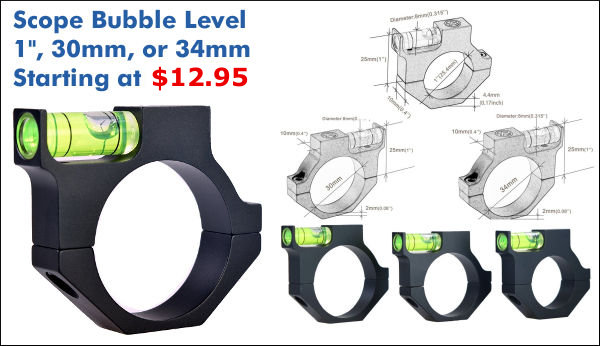
If you shoot long range, you need a scope level. This Discovery scope level is fully CNC-machined to close tolerances for a good fit. It is available with three inner diameters to fit scopes with 1″, 30mm, or 34mm main tubes. The 1″ version is just $12.95 while the 30mm model is $13.95 and the large 34mm version is $15.95. You could easily pay $35.00 or more for a 30mm scope level. Purchasers have praised this product: 89% of verified buyers rated this 4 or 5 stars.
5. Natchez — RCBS ChargeMaster Dispenser, $279.99
Here’s a very good deal on the popular RCBS ChargeMaster combo scale/powder dispenser. This unit sells elsewhere for up to $389.00. You may want to act quickly as sale pricing changes frequently and many other vendors have recently raised their prices. Grafs.com sells this for $369.99 now while the current Amazon.com price is $296.99. You can save a lot through Natchez right now. NOTE: There is an RCBS Rebate Program in effect now — if you spend at least $300.00 on “RCBS tools and accessories” you can get $75.00 back.
6. MidwayUSA — Pro Series Shooting Mat, $29.99
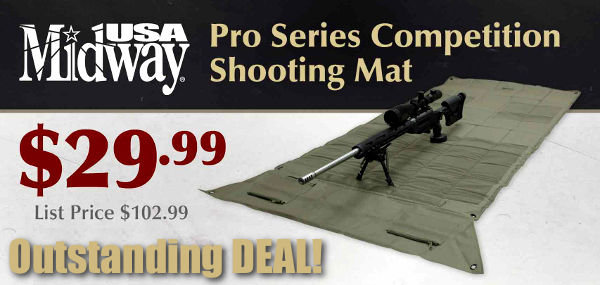
Here’s a heck of a deal on a very good shooting mat. MidwayUSA has slashed the price on its Pro Series Shooting Mat (in Olive Drab). You can get this 73.5″ x 35.5″ padded mat for just $29.99. This Mat has some very nice features, such as a Bipod Pre-load Web, 0.35″ thick padding, and multiple pockets. It’s easy to transport, rolling up to about nine inches in diameter and fitted with a nice carry strap. Midway normally sells this Pro Series Mat for about $70.00, so the $29.99 price is a total steal. If you need a good basic shooting mat check out this deal.
This is a very good spotting scope for the price. Yes it gives up some low-light performance to a spotter with an 80mm objective, but otherwise it is a good performer, and we can’t think of much that will touch this Vortex Diamondback spotting scope for anywhere near the $399.99 sale price. Choose from angled or straight version for the same $399.99 price, which includes the 20-60X zoom eyepiece.
8. Cabelas.com — Catch-All Gear Bag $9.99
This versatile bag holds lots of gear, and you can’t beat the price — just $9.99. At 16″x10″x6″ it’s big enough to hold rifle ammo, muffs, a Kestrel, and other accessories. It can also serve as a general utiling bag for car camping trips. Six exterior pockets, including zippered mesh pockets on top and side, provide multiple storage options. This Catch-All Gear Bag is available in Forest Green/Black and Dark Green/Camo. This a real bargain — the original price was $24.99.
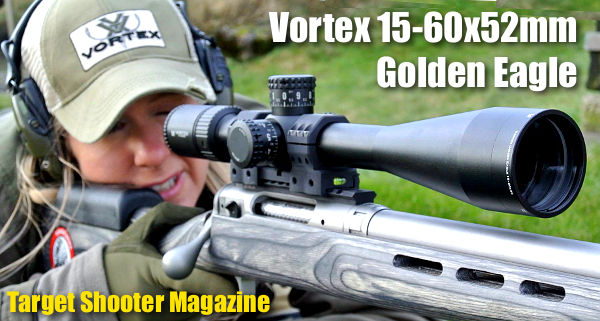
Our British friend Vince Bottomley has had a chance to test the new Vortex 15-60x52mm Golden Eagle scope, priced at $1499.00 in the USA. How does this affordable, high-magnification target scope compete with other comp scopes that cost hundreds (or even thousands) more? Very well indeed according to Vince. He says the Golden Eagle can definitely run with other “big name” high-magnification zoom optics designed for F-Class, Benchrest, and Long Range competition. Vince has written a detailed 15-60x52mm Golden Eagle review for Target Shooter Magazine. Shooters looking for a high-magnification zoom optic should definitely read Vince’s review.
Vince notes that the Vortex Golden Eagle offers impressive performance for the price: “The stunning March 10-60 is the current choice of the serious F-TR shooter – this hand-built scope weighing just 25 oz. from the Deon Optical Corporation of Japan is as near to perfection as any long-range competition shooter could wish. There are several other scopes which have also stood up to scrutiny against the March — the 7-42 Leupold and the Nightforce 15-55 Competition for example. So, why are we getting so excited about the Vortex? One reason – the price!
Sensibly, Vortex manages to offer a product which ticks all the boxes but comes in at around two-thirds of [Leupold 7-42, Nightforce 15-55]. Fantastic value for a top-quality Japanese/American scope, especially considering the dollar/pound exchange rate following Brexit.”
Useful Reticle Design and Innovative Windage Knob
Vince liked the scope’s ECR-1 Reticle which provides true MOA-value hold-off/hold-over stadia (hash marks) at 40X. The Golden Eagle also offers an optional new type of windage knob that provides an increasing value count on both sides of the windage Zero. Vince says this was a smart feature: “The ‘both ways’ windage knob was great. At the end of the shoot, it was easy to know which way to turn it back to zero.”
Should You Buy One?
Here’s how reviewer Vince Bottomley answered that question:
“Well, a high-magnification zoom scope seems to be an F-Class essential, judging from the number of 10-60 March and 15-55 Nightforce scopes in evidence at any GB F-Class League match. If these three scopes were all in the same price-bracket, then the decision in choosing the Vortex 15-60 Golden Eagle would be more difficult but, when the Vortex is only two-thirds the cost of the other two. However, weight-wise, there’s a small penalty – at a tad under 29 oz., the Eagle is 3 oz. heavier than the March but, if you choose your rings carefully, you could pull some of that back.
Finally, Vortex offers probably the best ‘no quibble’ guarantee on the planet and, if you had any wavering doubts about buying a Golden Eagle, that should clinch it.”
UK readers interested in purchasing the Golden Eagle should Contact Osprey Rifles on OspreyRifles.com or e-mail Stuart on stuart@ospreyrifles.com
At the request of our readers, we provide select “Deals of the Week”. Every Monday morning we offer our Bargain selections. Here are some of the best deals on firearms, hardware, reloading components, and shooting accessories. Be aware that sale prices are subject to change, and once clearance inventory is sold, it’s gone for good. You snooze you lose.
1. CDNN Sports — Ruger American Ranch Rifle (Tan), $349.99
Here’s a nice little varmint rifle from Ruger with good features and performance at a killer price: $349.99. You could pay that much just for a barrel. This .223 Rem rifle features a 16.5″ hammer-forged barrel barrel threaded 1/2″-28 at the muzzle for brake or suppressor. The action, which features a 70° three-lug bolt, and Picatinny-style scope rail, sits in an aluminum bedding block. The crisp trigger adjusts down to 3 pounds. With a weight (before optics) of 6.1 pounds, this is a handy carry-around varminter. We like this rifle. For $349.99 it’s a steal.
2. Precision Reloading — NEW High-BC Sierra 6mm 110gr SMKs
Here’s the new King of the 6mm Hill. Sierra’s new 110gr 6mm MatchKing, optimized for a 1:7″-twist barrel, promises class-leading ballistics. The listed G1 Ballistic Coefficient (BC) is an impressive 0.617. That’s 12.8% higher than the 0.547 G1 BC Sierra claims for its older 107gr MatchKing. That’s a very significant improvement. We attribute the reduced drag of the new 110-grainer to an improved hybrid-ogive bullet shape along with smaller meplats and (we believe) pointed tips.
Manufacturer-listed G1 Ballistic Coefficients of 6mm Match Bullets
If you want to try out Sierra’s impressive new 6mm (0.243) MatchKings, visit Precision Reloading, which got some of the very first production run from Sierra. You may want to pick up powder and primers too. Now through the end of the year, Precision Reloading is offering a low $15 HazMat fee on any powder and primer order.
3. Midsouth — Lock ‘N Load Complete Reloading Kit, $259.99
The Hornady Lock-N-Load Classic Reloading Kit comes with everything you need to turn out high-quality handloads. The $259.99 Kit includes: Hornady Lock-N-Load Classic single-stage press, Hornady Powder Measure, Digital Scale, Two-Volume Hornady Reloading Manual, Three Lock-N-Load Die Bushings, Reloading Block, Chamfer/Debur Tool, Hand Priming Tool, and One Shot™ Case Lube. We’ve used this press and it is excellent. The L-N-L bushings allow fast die changes.
Need a reliable, high-magnification scope for your benchrest rifle, but on a tight budget? Then look no further. Here’s a great deal. Weaver’s latest T-Series XR scopes are now just $739.95 at Brunos Shooters Supply. These Weaver scopes are renown for their repeatability and precise clicks. This new model features 1/8 MOA clicks and side-focus parallax adjustment. The XR series are offered with Fine Cross Hair or Target Dot reticles. Even with a 48mm front objective, these XR scopes weigh just 24 ounces. Save big bucks — these Weaver XRs sell elsewhere for $899.00.
If you have brass or small parts to clean an ultrasonic cleaning machine really comes in handy. This Lyman machine was a good deal at $69.99 before. Now it is an awesome deal at $49.99 from Cabela’s. Plus, for a limited time, you can also get FREE Shipping. At check-out, use Code 6JOLLY for free shipping on orders of $49.00 or more.
6. Natchez — Hornady 22-Cal Varmint Bullets, $9.99 Per 100
Headed out for a varmint safari next spring? Need inexpensive bullets to load up this winter for your .223 Rem or 22-250? Then check out this deal on Hornady 55-grainers from Natchez. Get 100 Soft Point .224-Caliber FB bullets for just $9.99. At that price, it doesn’t hurt so much when you shoot 1000+ rounds over a weekend. With good expansion, these bullets work great on prairie dogs and other small critters. Note: These sale bullets ship in a bag, not the box as shown.
This is quality, CCI made-in-USA ammo with reloadable, brass casings. We have used this CCI-made Blazer 9mm ammo in Sig, HK, and Glock pistols and it performed very well. This stuff won’t last long at this price (less than $0.20 per round). If you need 9mm practice ammo, order soon — this very same 1000-round case of Blazer 9mm ammo costs $60.00 more at MidwayUSA. Blazer Brass is loaded in boxer-primed, reloadable brass cases for added value.
8. Cabelas.com — Catch-All Gear Bag $9.99
This versatile bag holds lots of gear, and you can’t beat the price — just $9.99. At 16″x10″x6″ it’s big enough to hold rifle ammo, muffs, a Kestrel, and other accessories. It can also serve as a general utiling bag for car camping trips. Six exterior pockets, including zippered mesh pockets on top and side, provide multiple storage options. This Catch-All Gear Bag is available in Forest Green/Black and Dark Green/Camo. This a real bargain — the original price was $24.99.
9. RCBS — Buy Green, Get Green Rebate
RCBS is running a very attractive Rebate Program currently. If you spend $300.00 on qualifying products you get a $75.00 rebate. Spend $50 and get a $10.00 Rebate. This program is limited to one (1) rebate redemption per calendar year, with a maximum of $75.00. CLICK HERE for more information. NOTE: To qualify, you must supply completed RCBS rebate coupon, original UPC barcodes from package, and original cash register receipt and/or dated, itemized sales invoice.