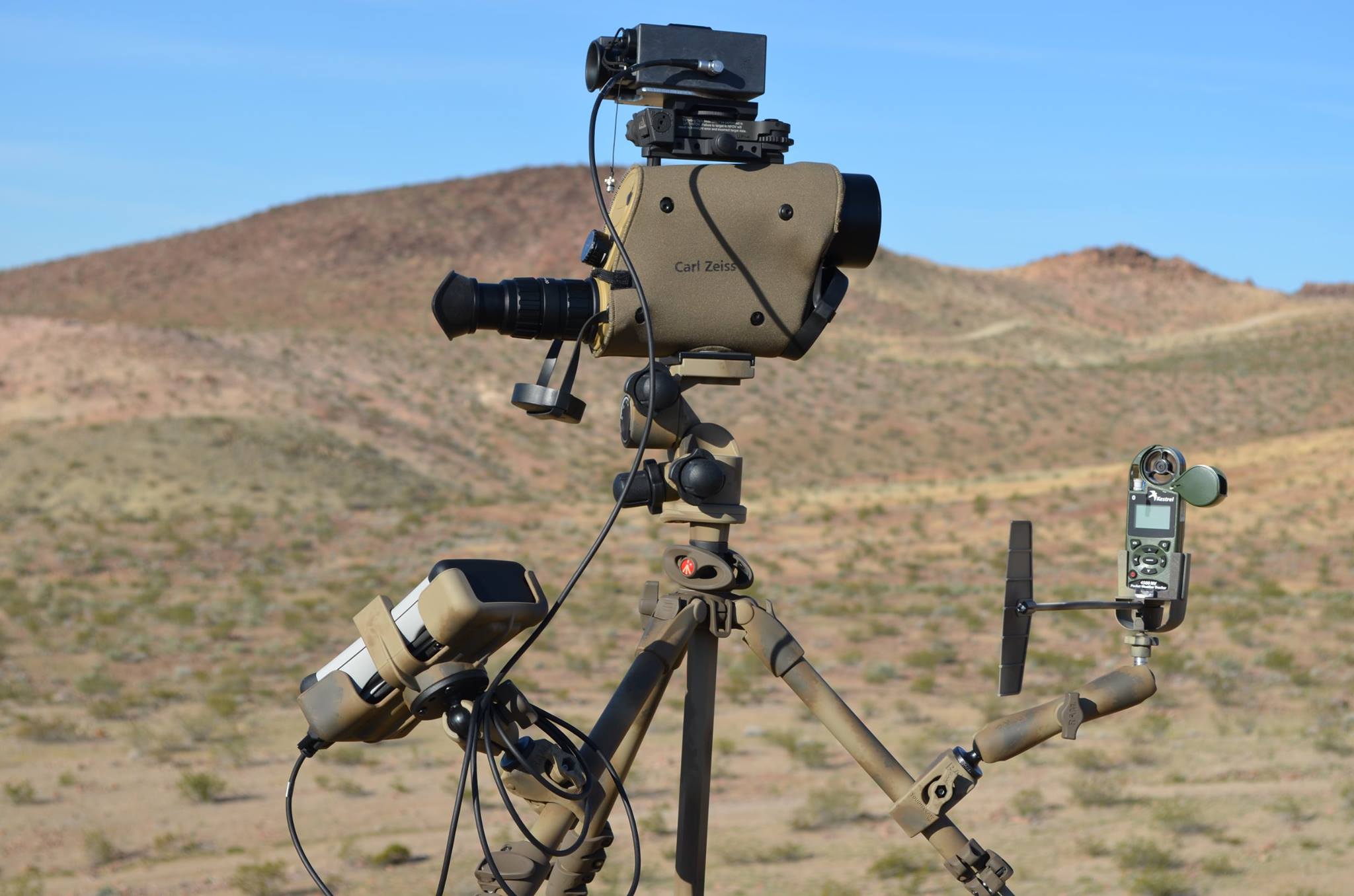
Here’s an impressive hardware package for long-range shooting. This set-up combines a folded-path spotting scope with a Laser Rangefinder (LRF) and a Kestrel Wind Meter. The LRF is mounted directly to the Hensoldt-Zeiss spotting scope ($4330.00 retail) so the two units stay aligned at all times. That makes it easy to spot and range your target quickly. LRF and weather data is piped into a PDA which automatically generates a firing solution (providing windage and elevation adjustments). That’s slick.
Ashbury Precison Ordnance sent us these photos, noting: “The ingenuity of APO customers never ceases to impress us! This rig has a co-located LRF adjustable for azimuth and elevation, a Kestrel weather station (Bluetooth?) and Trimble NOMAD RPDA. Firing solutions are updated as data is transmitted to the PDA from the LRF and weather station. That Hensoldt Spotter 60 is a nice piece of glass for shooting at extremely long distances.” The spotting scope is mounted on a Manfrotto 410 3-axis geared head.
In the above video, a spokesman for Horus Vision explains how and why scopes can experience zero shift. First, just cleaning the gun can cause a small shift in point of impact. Second, when you re-tighten rings and ring bases, this can cause a change in zero. Horus recommends that you use a torque wrench to confirm that you maintain the same torque settings each time. The same goes for action screw tension — tensioning your action screws can shift the point of impact.
Other factors that can cause a change in zero:
Temperature
Dramatic ranges of temperature will change your zero, because the air density affects the velocity of the bullet. With increased temperature, there may be a higher velocity (depending on your powder).
Gun Handling and Body Position
You rifle’s point of impact will be affected by the way you hold the gun. A “hard hold” with firm grip and heavy cheek weld can give you a different POI than if you lightly address the gun. Even when shooting a benchrest gun, the amount of shoulder you put into the rifle can affect where it prints on paper.
Type of Rifle Support — Bench vs. Field
Whenever you change the type of rifle support you use, the point of impact can shift slightly. Moving from a bipod to a pedestal rest can cause a change. Similar, if you switch from a mechanical rest to sandbags, the gun can perform differently. That’s why, before a hunt, you should zero the gun with a set-up similar to what you would actually use in the field — such as a rucksack or shooting sticks.
Transportation of Firearms
Even if you don’t mishandle your weapon, it is possible that a shift of zero could occur during transport. We’ve seen zero settings change when a tight plastic gun case put a side load on the turrets. And in the field, if the turret knobs are not covered, they can rub against clothing, gear, storage bags, scabbard, etc. If the knobs turn, it will definitely move your reticle slightly and cause your point of impact to be off.
Minox has introduced two new high-quality spotting scopes, the MD 60 Z and MD 80 Z. Both employ a “folded light path” design that makes these optics much more compact than conventional spotting scopes. With 20-60X magnification and a retail (MAP) price of $1398.00*, we think the MD 80 Z could become popular with long-range shooters who prefer a straight-through optic. With 12-40X power, the ultra-compact MD 60 Z ($1298.00 MAP), would be a good choice for hunting applications. We hope to get an MD 80 Z to test soon. These should be hitting dealers’ shelves by late April.
We like the folded light path design for two main reasons. First, this puts the heavy objective lens much closer to the tripod mount, reducing the amount of overhang (or cantilever). In practice, this makes the scope much more solid on the mount. With other long, heavy spotting scopes, even with a sturdy bipod, just a slight touch causes the scope to jiggle or shake. We’ve found with some of the big 80-88mm (objective) spotting scopes, it is almost impossible to focus the scope without causing it to jiggle a bit, which takes a while to settle. With a shorter spotting scope with the balance point much closer to the mount, the “jiggle factor” is much reduced.
The compact design also makes these Minox spotting scopes much easier to transport and tote around. The MD 60 Z and 80 Z will easily fit in a medium range bag or utility box. If you regularly use a spotting scope you’ll appreciate the compact size and portability of the MD Series units.
Built-in Eyepieces, with 20-60X on MD 80 Z
Minox’s MD Series spotters have permanently-attached wide-angle, zoom eyepieces. This keeps dust and moisture out of the scope bodies, but it does limit your options. You can’t swap eyepieces to change the zoom range or go to a fixed-power. But we think the 20-60X magnification range is ample on the MD 80 Z, while the 12-40X range on the MD 60 Z is plenty for hunting use. We think that, for most outdoor uses, a fixed eyepiece has benefits. And we bet that 9 out of 10 spotting scope owners just stick with the eyepiece that came with their scope (and never swap in a different ocular). So, ask yourself, “Do I really need to change eyepieces?”
The Minox MD eyepieces have ample 30mm eye relief. Notably, Minox gave these spotting scopes a huge range of diopter adjustment, from -5 to +50. This means that just about any person can use the optics with no need for glasses or corrective lenses.
Straight Eyepiece Only
No angled eyepiece option is offered on either the MD 80 Z or MD 60 Z. If you’re spotting for a fellow shooter from a seated position, a straight eyepiece makes sense. On the other hand, for prone shooting, when you’re spotting your own shots, most folks prefer a spotting scope with an angled eyepiece. When shopping for a spotting scope, determine how you will most commonly use the optic. This Editor owns both a straight spotting scope and an angled spotting scope. I use the straight spotter most of the time, except when I am shooting prone. If you really need an angled spotting scope, Minox does offer an ultra-short, 16-30X MD 50W spotter. This is one of the most compact angled spotters on the market, and it weighs just 24.3 ounces!
* The MD 80 Z’s Minimum Advertised (MAP) price is $1398.00 while MSRP is $1498.00. MAP price for the MD 60 Z is $1298.00 with a $1398.00 MSRP.
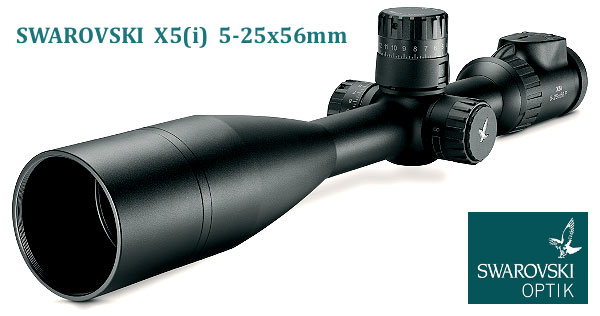
If you are looking for a premium riflescope with 25-26X max magnification, there are two impressive new options, and both come from Europe. Swarovski just announced its new X5 5-25x56mm scope while Leica has unveiled the new ER 6.5-26x56mm LRS. Intended for long-range shooting, both these scopes offer razor-sharp glass and some advanced features. The Swaro offers 20 MOA per revolution, plus a unique “Sub-zero” capability. The Leica has some interesting reticles and an attractive price.
Scope Brand/Model
Max Power
Elevation
Clicks
Tube
Lume
Est. Price
Swaro X5 5-25x56mm
25X
82 MOA
1/4 or 1/8 MOA
30mm
Optional
$3300/$3500(i)
Leica ER 6.5-26×56 LRS
26X
120 cm*
1/6 MOA*
30mm
No
$2089**
* This is at 100m for the Euro version with 0.5cm click values (1/6 MOA). Leica has not published MOA elevation. 120 cm at 100m works out to about 41 MOA at 100 yards.
** Based on €1990.00 (Euros) stated price. The actual price, as sold in the USA, could be higher.
Swarovski X5 5-25x56mm
Swarovski recently unveiled its new X5 series of second focal plane scopes for long-range shooting. There will be two models, a 3-18x50mm and a 5-25x56mm. Both are available in standard and illuminated versions, the latter designated as X5(i). Long-range reticles with be available with either 1 MOA or 2 MOA stadia hash-marks. The 5-25X model offers either 1/4-MOA or 1/8-MOA clicks.
Swaroski says: “The X5 series has been developed specifically with the long range shooter/hunter in mind. The newly-designed turrets allow for 20 MOA per revolution, have a viewing window to show the user what revolution he or she is on. At the heart of the X5(i) is a Spring Retention and Lever System that exerts the same pressure on both turrets from the inversion system regardless of positioning. This assures maximum accuracy and repeatability.”
Check Out Features of Swarovski X5 Riflescopes
The 5-25x56mm X5 has a lot of elevation travel — 82 MOA. And this is a rugged scope — the elevation, windage, and parallax turrets, as well as the inversion system are built with stainless steel components. This enhances component longevity and durability.
X5 Offers Dual Zeros (for Long Range and Short Range
The Swarovski X5 scopes boast a new “Subzero” Function. This innovative feature allows the shooter to instantly come down 10 MOA (40 clicks) from a pre-set zero. That’s a nice option for training, letting you quickly switch from near to far. The new X5(i) Rifle Scope will be available in two different models, X5(i) 3.5-18×50 and X5(i) 5-25×56, in Fall 2015. For more information, visit Swarovskioptik.com.
Leica ER 6.5-25x56mm LRS
With 26X magnification on tap, the ER 6.5-26x56mm LRS riflescope is suitable for long-range hunting as well as many target disciplines. The new Leica ER 6.5-26×56 LRS offers ultra-sharp glass with low color fringe (chromatic aberration). This is a big advantage when viewing high-contrast subjects such as black-on-white targets. Eye relief is ample, and the scope offers a -4 to +3 Diopter compensation. Three reticle options are offered including two Ballistic reticles with elevation lines and horizontal (windage) hash marks.
With a rugged, aluminum “mono-body” main tube, the Leica is waterproof and fog-proof. Like all of Leica’s ER riflescopes, the ER 6.5-26x50mm LRS features a high-tech glass coating process technology. The scope is bright, with 91% light transmission. The HD glass elements are precision-ground with a state-of-the-art laser-guided production process.
Leica Pricing is Attractive
The new Leica ER 6.5-25x56mm is priced competitively. At the IWA show in Germany this month, Leica said the scope should retail for about 1990.00 Euros, which works out to $2089.00 U.S. Dollars at current exchange rates. Even if the “as imported” price goes up for the U.S. Market, that makes the scope much less expensive than Swarovski’s X5 5-25x56mm scope, and less than some comparable US-made optics.
Buy a scope, get a mat for free. Sounds good to us. Leupold is now offering a free Tactical Tailor® Shooting Mat with the purchase of a Mark® 4, 6, or 8 riflescope. The shooting mat comes branded with the Leupold Logo, and has a retail value of approximately $95.00. Get INFO.
This offer runs through April 15, 2015. All documentation must be submitted by April 30, 2015. Visit the Leupold Promo Page for more information on this offer.
Below is the top half of a Walmart ad intended to sell hunting rifles and accessories. We’re pleased that Walmart still stocks guns, ammo, and gear on its shelves. But look carefully at the fellow in the tree-stand. He’s got some nice camo clothing, but a few items are missing that might help this hunter in his quest to take home a buck. Apparently Walmart’s ad-makers aren’t too experienced with shooting.
Editor’s comment: The new lens technology described here is a big deal. The “flexible” polymer lens is nothing short of revolutionary — there’s never been anything like it on a riflescope (though our own human eyes have flexible lenses). In the world of optics, this is as noteworthy a development as the touch-screen was for personal computing. Flexible, “adaptive” lenses can potentially be employed for a wide variety of products, from cameras to spotting scopes. Think about the benefits of “instantaneous zoom” for security cameras.
Sandia’s RAZAR Scope Features Flexible Lenses That Can Change Focal Length Instantly
Sandia National Laboratories has developed a truly game-changing piece of optical technology at the direct request of the Department of Defense: the RAZAR (Rapid Adaptive Zoom for Assault Rifles). Fundamentally different than every other riflescope ever made, the RAZAR represents a revolution in lens design and function. Until now, all riflescopes used a set of rigid, hard lenses (usually glass). The new RAZAR utilizes an advanced set of flexible polymer lenses that allow the user to toggle between high and low magnification with the press of a button. The RAZAR can literally zoom in and out in the blink of an eye (250 milliseconds).
The RAZAR works in conjunction with a tactical-style optic, such the Leupold HAMR (top photo). This tandem (two-part) sighting system combines the conventional scope’s eyepiece and illuminated reticle with the RAZAR’s ultra-fast zooming capability. Unlike traditional eyepiece (ocular) magnifiers, the RAZAR sits in front of the primary optic.
See RAZAR Demonstrated in Sandia Labs Video
Game-Changing Technology
The RAZAR’s instant, push-button zoom capability gives soldiers the ability to change field of view and magnification without re-positioning their grip on the rifle, unlike traditional variable-power riflescopes. This capability can be invaluable to a soldier in combat.
Michael Squire, a former SFC with Special Operations Research Support Element, said the ability to zoom between near and far targets within seconds, without taking his hand off the weapon, is “game-changing.” Squire added: “The difference that can make, especially with somebody shooting back, could mean life or death…”
The secret to the RAZAR’s high performance lies within the development of the advanced technologies within the scope. A hermetically sealed, flexible polymer lens core encapsulates a proprietary polymer liquid, and this core then works in tandem with glass lenses to form the basis of the optical design.
Rapid changes in magnification are accomplished via a piezoelectric motor that changes the curvature of the lenses, achieving the correct positioning within 250 milliseconds within an accuracy level of 100 nanometers. When zooming, these electronically-controlled actuators act much like the tiny muscles that allow the human eye to change focus from near to far. Human eyes have flexible lenses controlled with muscles*. The RAZAR has flexible lenses controlled by tiny electric motors.
It’s important to highlight the reliability that Sandia was able to build into the RAZAR. The system requires very little mechanical power to operate, and can undergo up to 10,000 zoom actuations on a single set of two standard AA batteries. The ultrasonic motor draws no power unless it’s being used to bend the soft lenses, which makes the RAZAR very reliable. If the batteries do go flat, the RAZAR remains fully usable — the system simply stays at the last magnification level until the batteries are replaced.
Sandia’s RAZAR design provides a large, clear viewing aperture, without sacrificing any of the optical quality found in traditional riflescopes. The RAZAR is also shock-proof, vibration-proof and capable of operating in a very wide temperature range.
The Future of “Instant Zoom” Adaptive Lenses
Sandia Labs is developing other specialty lenses in the near-infrared, short wave-infrared and mid-wave infrared spectrum, primarily for DOD use. However, Sandia has suggested that its flexible polymer-lens technology could be adapted for other imaging applications where rapid zoom is needed, such as binoculars, spotting scopes, and even security cameras. For more information, visit the Sandia Labs website.
*Changing the curvature of the human eye lens is carried out by the ciliary muscles surrounding the lens. They narrow the diameter of the ciliary body, relax the fibers of the suspensory ligament, and allow the lens to relax into a more convex shape. A more convex lens focuses divergent light rays onto the retina allowing for closer objects to be brought into focus.
About the Author
Kip Staton is a freelance gun writer based in North Texas, and loves to blog about news within the firearms industry and his perceptions on marksmanship. Kip is a content marketer, copywriter and digital strategist for an award-winning Dallas marketing agency. To read more by Kip, visit KipStaton.com.
Schmidt & Bender revealed some impressive optics at SHOT Show. Perhaps the “star” of the S&B line-up was the 3-27x56mm PMII. This optic boasts the first-ever 9 times zoom range. Originally custom-designed to U.S. SOCOM specs, this impressive optic won a contract for use in SOCOM sniper platforms. S&B’s representative said this scope, when employed with steep-angled bases, may be used to engage targets at distances exceeding 2 kilometers.
Unrivaled Brightness — T96 Polar Offers 96% Total Light Transmission
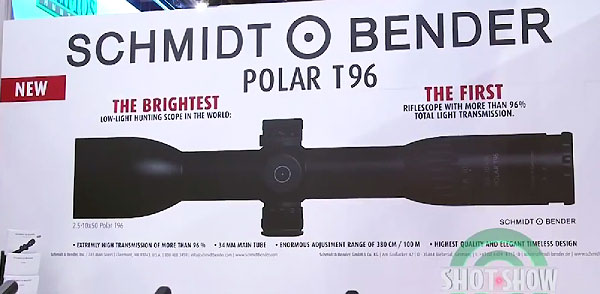
Schmidt & Bender also unveiled its all-new 2.5-10x50mm Polar T96 scope, which S&B claims is “the brightest low-light hunting scope in the world” Designed for hunting, the new Polar boasts extremely high 96% light transmission levels, the most ever in a 10-power scope. In addition, transmission of “night-relevant wavelengths” has been improved dramatically, offering 5% more light in the evening than other hunting scopes. This means the scope will be brighter at dusk than other optics, effectively extending a hunter’s usable time in the field, allowing the hunter to use “the last light of the day.” S&B is considering expanding the T96 scope line to include 3-12X or 4-16X models.
Schmidt & Bender had scores of scopes on display, worth well over $100,000 in retail value.
At SHOT Show 2015, SIG Sauer showcased a host of new optics products. SIG’s new Electro-Optics division will market a complete line of riflescopes, battle sights, red dot/reflex sights, rangefinders, binoculars, and spotting scopes. For ALL the new Electro-Optics products, SIG will be offering a lifetime transferable warranty. That’s impressive. SIG’s new electro-optical offerings, which are named after radio alphabet words (such as “Bravo” and “Tango”), are revealed in this video:
The “Whiskey” riflescope series is marketed as a rugged, affordable optical solution for hunters. Designed for law enforcement and tactical shooters, the “Tango” series of riflescopes feature 6X zoom ratios and meet MILSPEC requirements. Shown below is the 3-18x44mm Tango.
The “Bravo” series of prismatic battle sights (illustration below) are pretty remarkable. An innovative new lens design provides an exceptionally wide field of view. SIG claims that Bravo battle sights offer a 50 percent greater field-of-view than similar battle sights.
The “Romeo” series of red dot sights are designed for tactical carbines. The miniature “Romeo1″ Reflex Sight is designed to be slide-mounted on a pistol, and SIG will offer several pistols with the Romeo1 pre-installed. For big game hunting or extreme long-range shooting, SIG developed the “Kilo” rangefinder series, the “Victor” spotting scope line and the “Zulu” binocular series. The “Kilo” rangefinder (bottom photo) can reach out to 1600 yards and features an auto-dimming display. It is about the same size as a Leica CRF, but it is easier to hold. There are molded, rubberized finger grooves on the top and the whole unit has a nice feel in the hand.
To learn more about other SIG Sauer products for 2015, visit the Shooter’s Log, presented by Cheaper than Dirt. For 2015, along with new handguns and rifles, SIG Sauer has rolled out a branded line of suppressors. SIG’s new cans should be popular with both tactical shooters and hunters (where suppressor use is allowed).
Our friends Ed and Steve, aka the 6.5 Guys, were prolific last week in Las Vegas, visiting dozens of vendors at SHOT Show. Here are Ed and Steve’s video reports for Ashbury Precision Ordnance (APO), Vortex Optics, and Thunderbeast Arms. (If you’re thinking about buying a suppressor definitely check out the new Ultra series from Thunderbeast, featured in the third video below). You can see more SHOT Show videos by Ed and Steve at 6.5Guys.com.
Ashbury Precision Ordnance
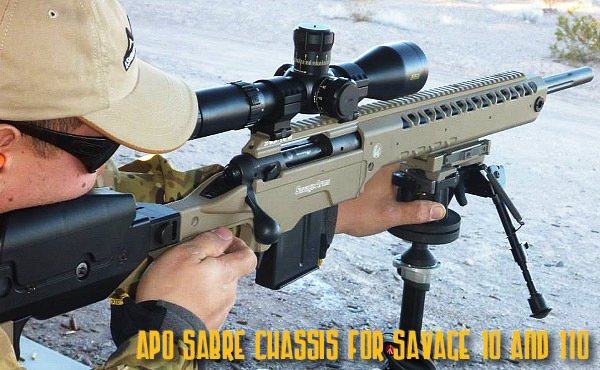
Here Precision Rifle Series (PRS) Competitor Melissa Gilliland talks about the modular chassis systems offered by Ashbury Precision Ordnance (APO). With adjustable buttplate, cheekpiece, and grip, these systems can be adapted for a variety of shooting disciplines. APO even offers a modular chassis for Savage barreled actions. Melissa shoots a tricked-out 6.5 Creedmoor rig with a Titanium APO action.
New Precision Rifle from APO
SABRE Chassis System for Savage Actions
Vortex Optics
Vortex continues to grab a larger share of the tactical and long-range hunting markets. This video features the Vortex Razor HD Gen II 4.5-27x56mm and 3-18x50mm scopes. These Gen II Razors feature apochromatic objective lenses, rugged 34mm single-piece aluminum main tubes, and versatile 6X zoom range. Both MOA-based and Milrad-based reticles are offered. Vortex scopes have large, user-friendly controls, and a good feature set for the price.
Thunder Beast Arms
Thunder Beast Arms’s suppressors, built by shooters for shooters, are tough yet light. Thunder Beast developed a strong following for its titanium cans that offered excellent performance with light weight. In this video, Thunder Beast unveils its new “Ultra” series of suppressors. Compared to Thunder Beast’s previous CB-series suppressors (of like size), these Ultras are 4 to 5 ounces lighter, yet provide 4 to 5 decibels of additional noise reduction. That represents a major gain in suppressor performance.